The next chapter: May 2015 update

Holy shemoley! It’s June already and I’m three weeks into my five week leave. Time she’s a-flying 😦

May 2015 progress

May was all about catching up on my revisions. I’d fallen behind and had really wanted to get them done before my leave started. As it was, I worked through until May 24th on my revisions. The remaining words I wrote on Initiate of Stone were (marked in red) were on my query and synopsis.

I rewrote the latter no less than three times, but I think the third one is the best of the three, so I’m going with that version.

It should be no surprise, then, that the lion’s share of my word count was on IoS: 24,511 words (!) Now, keep in mind that revision word counts are halved (unless I drafted completely new chapters).

Overall, this revision of IoS came in at a whopping 129,402 words. That’s only 520 words fewer than the previous revision, despite the fact that I eliminated a POV character. As I expected, her role and sections were easily assumed by other characters, but I had to write more to make things work seamlessly.

Ah, well.

I wrote more of Marushka, as well, but I haven’t finished the draft yet. I’d wanted to have that done before my leave, too. What can you do, though? 3,173 words isn’t anything to sneeze at.

I revised a short story and submitted it to an anthology (for a scant 10 words), but I won’t hear anything about that until the end of July. I missed an anthology deadline for which I had the perfect story. I could have kicked myself. I mistook the date and thought I had until the end of the month when I only had until the 15th.

That kind of thing happened a lot in May.

And blogging filled out the rest of my word count for the month with 9,706 words.

That’s a total of 37,400 words. Egads! Again, the lion’s share of that was on revision, which are a different beast, but it’s my best month since NaNoWriMo 2013 🙂

May 2015 Summary

This month, I’ve been pouring more time and effort into researching agents and planning my querying strategy. I think June will be a low word count month as a result.

I’ve also organized a couple of workshops for visiting writers. On May 31st, Jane Ann McLachlan delivered a great workshop on Crafting the Contemporary Genre Novel. On June 18, Madeleine Callway will be delivering a workshop on How to Get Published. I’ll have more on Madeleine with an interview in just a few 🙂

And there are a pile of other things happening.

More on that in my Sundog snippet.

The Next Chapter

Wordsmith Studio homecoming blog hop number three

WSS Homecoming 2015It’s been three years since I joined a bunch of fellow platform builders in what became Wordsmith Studio.

Today: blog hop, part the third.

1) What are you currently working on?

The final (for now) revisions of Initiate of Stone, drafting Marushka, my 2014 NaNoWriMo novel, and revising one long short story that may actually be a novel in disguise 🙂 Plus, I blog.

2) For past work, what was your greatest joy or greatest challenge?

Finishing my first draft of IoS and getting my two short stories, “The Broken Places” and “Downtime” published would all have to tie for greatest joys.

My greatest challenge to date has been the first chapter of IoS. Oh, and trying to keep things balanced. Actually, the balance thing wins out in the toughest challenge category. I suck at balance.

3) For current work, what challenge are you working through now?

As mentioned above, my first chapter. For some reason, this particular opening is kicking my buttocks. I’ve tried starting the story earlier, later, a prologue (very bad), and rewriting the first chapter from scratch about four times. I’ve tried Surry Idol at the Surrey International Writer’s Conference, Ray Rhamey’s Flogging the Quill, beta readers, and advice from writing mentors.

4) For work you are just planning or starting, what challenges or growth are you expecting or hoping to encounter?

Every novel I draft, revise, or edit improves my craft. The next work I’ll be starting from scratch will be this year’s NaNoWriMo. It’s a new adult science fiction thriller. Oh yeah. That won’t be hard to sell at all 😛

5) What have successes or challenges in your work (recently) taught you?

I write a lot more than I thought I did. Others see value in my work. Tracking your writing progress is a great motivation. I generally rise to any challenge I set myself.

6) What obstacles or challenges have you not been able to overcome, or still frustrate you?

The aforementioned beginnings, though I think a breakthrough is due. Overdue, frankly.

7) How would you describe a great writing day (or week)?

A great writing day is any day that I write. Period. If I achieve my goals, that’s a lovely cherry on top of the sundae. In a way, every word is a victory 🙂

8) What specific tools or strategies help you succeed? 

Jamie Raintree’s writing spreadsheet is a fabulous tool and motivation. K.M. Weiland’s Helping Writers Become Authors blog and her books are some of the best craft advice out there. Awesome. Similarly, Roz Morris’s Nail Your Novel series and blog are teh best. And she’s so generous with her time and advice. Finally, attending conferences and conventions have been a big help. I learn metric tonnes at each one 🙂 The networking isn’t half bad either.

And there you have it.

See you on Tuesday for my Tipsday writing curation.

Powered by Linky Tools

Click here to enter your link and view this Linky Tools list…

Muse-inks

Wordsmith Studio third anniversary blog hop

Alrightie, then!

Three years ago, Wordsmith Studio got its start.

WSS Homecoming 2015

Here’s my interview:

1. Are you a WSSer (a member of Wordsmith)? If so, sound off about how long you’ve been a member, your favourite way to participate, or anything you’ve missed if you’ve been away. We’re not your mother/father… there will be no guilt about how long since your last call.

I was with WSS from the start. I’m a founding member. I’ve only contributed one post to the collective, however. Life is busy. No excuses. Just facts. I have enough trying to keep up with the day job, my blog, and, what’s most important, my writing. Oh, and there’s that pesky family thing, too 😀

2. What medium do you work in? For our writing folks, are you currently working on fiction, poetry or non-fiction, or a combination? Anyone YA or mystery or thriller or…?

I started off getting published as a poet, and won a few short story contests. Now, I’m writing fantasy novels—yes, that was plural—and science fiction short stories. I continue to blog about aspects of the writing life that are important to me.

3. What’s the name of your current project (ok multitaskers, give us your main one)?

Initiate of Stone is my epic fantasy. I’m currently in my last revision (for now—I know there will be much more coming) prior to diving into the query process later this spring. I know, I’ve been saying that forever, haven’t I?

4. What is your favourite detail, sentence or other bit you’ve written lately?

Gah! I have to pick just one? OK. Here’s the opening of a recent short story:

“I wander endless halls, time compressed by shimmering walls, thought slowed by the dance of acrylic and oil over canvas, memory smothered by ephemera. There are only three floors and a block of conjoined buildings, but the halls twist and turn back upon themselves. I can walk for hours staring at the art and collectibles, which change regularly, and then stare at the plastic card in my hand, wondering which of the rooms I’ve passed is mine.”

5. Any obstacles or I-hate-this-chapter moments?

ALL. THE. TIME. I constantly doubt myself. I just keep writing anyway. It’s what we do.

6. What’s the biggest thing you’ve learned lately from your writing?

Last year I experimented with working on multiple projects. I tried different approaches, but have realized that realistically, I can only work on two projects at a time (aside from blogging and writing short stories) and that they have to be at different stages of development. I can draft one novel and revise another, but I can’t draft two novels at the same time. It requires too much of the same kind of creative energy.

7. In what ways do you hope to grow in the next 6 months/year?

I want to become the bionic writer. I want to be faster, stronger . . . 😀 You get the idea.

8. In what ways do writing friends and communities help you do that?

I learn from everything I do and from everyone I meet. You might say I’m addicted.

Powered by Linky Tools

Click here to enter your link and view this Linky Tools list…

Since I didn’t blog this past weekend, I thought I’d get this posted for you.

And Tipsday will be coming up tomorrow. This will be interesting. I haven’t prepared my weekly posts in advance. This might hurt a bit . . .

Clean Reader, censorship, and political correctness

The big news of the week has been Clean Reader, which, despite the rumours, is still an app. Essentially, it’s an ereader that disguises what the creators of the app see as profanity.

There have been two camps among writers. One would rather their work not be read at all rather than have it read in an altered form, particularly when the alterations were made without the author’s consent. If the reader doesn’t like what the author writes, they have the right not to purchase or read it.

The other writerly camp concede that once the work is out in the world readers can and often do what they wish with it and as long as the author’s work is still being read and they are still being compensated for it, they’re okay with it (despite how repugnant they might find the practice of altering the work without consulting the author).

Here are some of the posts that have made it across my social media streams this week. (They’ll all appear again in my Tipsday post, BTW.)

As I mentioned on Facebook, on which I shared most of these, I’ll let you read through and decide what you think about Clean Reader for yourselves.

I will, however, share with you, why Clean Reader disturbs me.

It is censorship. No bones about it.

But censorship happens all the time in all of the arts, you say. This is true.

Profanity in television and movies is *bleeped* or dubbed when these shows are televised on network television during hours when impressionable young people might be watching.

There is a rating system for movies and while cinema employees may not strictly enforce it, they do have the right to turn away patrons if they are deemed too young to watch the movie.

Trigger warnings are plastered on music in various formats and there are usually “clean” versions of songs released for radio play.

Books are routinely banned because they are considered profane.

It was just a matter of time before categories for books (adult fiction, YA, children’s, etc.) became insufficient for some readers, or their parents.

I assume that Clean Reader is using the same conventions that allow the bleeping or dubbing of profanity in movies and music to justify the alteration of the ebooks they provide their readers.

It’s a choice and it’s a validated approach as much as I might disagree with it.

You might get the idea that I’m one of those writers in the first camp (above). You’d be right. If people don’t like what I write, they don’t have to read it. Not that every other word I write is a swear word, but I do write about sex, and body parts are also words that the creators of Clean Reader are not comfortable with.

It also smacks of political correctness (to me). It’s like some thought experiment. If we change the words, we protect those who might be harmed by them. If we change the words, we’ll prevent our children from becoming violent or otherwise behaving in a way we find unacceptable.

Big Brother, anyone? Maybe that’s overstating the issue, but I’ve always thought that common courtesy and thoughtfulness were more effective than political correctness.

Why does this concern me? Political correctness is another form of censorship. It all comes from the same, admittedly well-meaning, place, but truthfully, it doesn’t help anyone.

Those of you who have young children will know what happens when they learn their first swear word. Even if it’s something merely socially unacceptable like poopy-head or fart-face (kids often return from daycare or kindergarten with words like these) is it ever effective to forbid them from saying it?

If you’ve tried that strategy, you may have had a wee tyke running through your house shouting poopy-head at the top of her or his lungs. They do that.

More often, parents will have (sometimes repeated) discussions with their children to let them know that their words may make other people feel uncomfortable or hurt and that these words are not ones we should say without thinking about them and about the consequences of saying hurtful words to others.

Parents teach their children respect and courtesy. They teach their children to think before they speak. They teach their children about context and about human failings (you might hear Mommy or Daddy say a bad word when we’re really upset, but sometimes even we forget we shouldn’t say these things).

These early lessons can be the groundwork for more important issues that need to be discussed as children grow older. From bullying to bigotry, sexism to sexuality, words that some people find offensive are essential to these discussions.

We need to use our words, all of them, to provide our children with the tools that will help them mature into courteous and respectful people. We need to use sexually explicit terms to discuss the facts of life as well as alternative sexualities and the respect we all should have for them.

We can’t pretend vulgarity doesn’t exist. We can’t ignore bullying, discrimination, misogyny, or homophobia, and hope they’ll go away just because we don’t use “those words” anymore.

We need to teach people to be wise about their use of words.

I think that’s why Clean Reader disturbs me so much. It’s a dumbing down of language. Censorship of this kind is for people who think reading profanity will corrupt them. Censorship is for people who can’t or don’t want to trust their own judgement.

We can’t engage in meaningful discussion without words, and yes, that includes the bad ones.

It’s only my opinion, but I think my life would be diminished by the disappearance of profanity. If I’d never discovered the Shakespearean Insult Generator (and this is only one of many such sites) or Rogers Profanisaurus (they have an app now too), I would have laughed a lot less and my vocabulary would be significantly limited. Mind you, my sense of humour is distinctly scatological 🙂

I wouldn’t want to read, or write, in a world without profanity.

There are some books I’ve read and enjoyed very much that would not be affected at all by the censoring of profanity, but I couldn’t imagine enjoying Diana Gabaldon’s books (for example) half as much without it, nor would I appreciate someone editing out all the profanity in them.

If someone feels, however, that they want this service and that they can’t read books without it, I support their right to choose Clean Reader. I also pity them for feeling that Clean Reader was the only choice they could make.

Nerdmaste, my writerly peeps.

Muse-inks

My literary mothers and what they taught me

This post was inspired by a challenge that another friend participated in. That challenge was to write, in a short post, the influence of a single literary mother.

While I found the concept compelling, I also found it restrictive. I have many literary mothers. The gears have been working on this one for a few weeks now and this is the result.


Siobhhan Riddell

I was in grade three and I had just started to write. My first piece was a little essay about my new puppy.

Siobhan was in grade five. She was an artist and she illustrated a dragon slayer fairy tale.

The grade five class’s projects were presented to the grade three class. Siobhan’s drawings found their place in my imagination.Always Sail West

I submitted my first short story to CBC’s “Pencil Box” that year.

The next year, I wrote the Christmas play for my grade four class.

What was I reading at the time?

I was reading comics: Star Wars (for Princess Leia), Dazzler (Marvel), Huntress (DC). I was trying to find compelling female heroes. The writers and artists were men, however.

I also started reading C.S. Lewis, Lloyd Alexander, and I, again, was seeking women authors with whose stories I could connect. I tried Zilpha Keatley Snyder (The Headless Cupid, The Witches of Worm), Phyllis Reynolds Naylor (The Witch Saga), Joan Lowry Nixon (The Kidnapping of Christina Lattimore), and Lois Duncan (Summer of Fear, Stranger with My Face, and, of course, I Know What You Did Last Summer). While Naylor came close to becoming a literary mother, her work didn’t stay with me.

At the time, across the street from my house, were a convenience store (comics) and a branch of the public library. They were an almost daily stop in my routine.

Critical criteria of a literary mother: Her influence has to stay with me. I have to have continued to read or re-read her books, or remember the impact she had on my life in a concrete way.

Madeleine L’Engle and Susan Cooper

It was Madeleine L’Engle’s (then) Time Trilogy that I first connected with. Something inside me said, “This is what I want to write.” She’s technically science fantasy, but it was the first science anything that I’d read to that point.

Susan Cooper came into my life a little later, but again, through the public library. I read her The Dark is Rising series and loved her take on Arthurian legend. This spoke to the fantasy side of my writing persona.

I bought both series when I had enough money to do so. I still have both.

What else was I reading? Elfquest by Wendy and Richard Pini. A friend was, and still is, very much a fan. The same friend introduced me to Robin McKinley (The Hero and the Crown, The Blue Sword). Both of these were strong influences, though not quite in the literary matriarchy.

There were a lot of other novels I was reading, most thanks to the above-mentioned friend, whose dad had a fabulous classic SFF collection and often encouraged her to offer her patronage to The World’s Biggest Bookstore in Toronto when she visited him 😀

Her dad even set us up with our first D&D books, after which, we spent entirely too much money on the game, but spent years in geeky bliss roleplaying.

R.A. MacAvoy, Susanna Kearsley, Ursula K. Le Guin, and O.R. Melling

When I went to university (Guelph, the first time), I met, through my roommate, her sister, Sue Reynolds, who wrote Strandia. This book was influential on me because it was one of the first ones that didn’t involve a romance in the happily ever after of its protagonist. There were romantic aspects to the plot, but the protagonist chose wholeness for herself rather than her beloved’s proposal in the end.

Also through my roommate, I was introduced to Welwyn Wilton Katz. I read just about everything Katz wrote for a few years and she was well on the way to becoming a literary mother, but I didn’t stick with her, or rather, her books didn’t stick with me as much.

I was drafting the story that would evolve into Initiate of Stone during those years. I started keeping a journal, and aside from my course reading, I was heavily influenced by Guy Gavriel Kay. Mary Brown was also a discovery during this period. I loved her ugly duckling retellings.

I left Guelph after two unremarkable years and got a job at the Coles store in Yorkdale mall. Part of me was in heaven and buying up books like mad with my staff discount. The other part of me was unhappy because, in all other respects, the job was an epic fail on my part.

One of my discoveries during this time was R.A. MacAvoy. I started with her Damiano series, progressed with her Black Dragon series, and fell in love with her quirky Lens of the World series. I read several of her standalone novels as well. She was the first author who reflected my ancestry in her characters (Sara the Fenwoman), and the first who wasn’t afraid to introduce cultural diversity in her characters.

I keep going back to Lens of the World periodically, because that series was also written in first person, present, point of view (POV). It was a challenging POV to use, and it’s still a learning tool for me. I haven’t felt brave enough to tackle anything so ambitious myself.

I also discovered O.R. Melling about this time, but I’ll come back to her in a little bit.

After a couple of years of living in and around Toronto, two other potential careers, a couple of failed relationships, and the realization that I needed to finish my degree if I was going to be able to progress as a writer, I returned to Sudbury to finish my BA at Laurentian University.

Susanna KearsleyIt was during this time that my SFF/D&D buddy, after helping me to connect with Mr. Science and both of us marrying our partners, moved away with her husband. She emailed me and said that Susanna Kearsley, author of Marianna, and recent winner of the Catherine Cookson Award, was giving a workshop for the local writer’s group.

Of course, I hopped down for a visit with my friend and took in the workshop. I read Marianna, Splendour Falls, and The Shadowy Horses.

A couple of years ago, I reconnected with her at the Surrey International Writers’ Conference (SiWC). Her influence on me has been to introduce me to a different genre. When I first met her, it was grouped under gothic, but Susanna’s stories are more paranormal in nature and while romance does feature, it’s not the main focus of her novels.

I took a creative writing course with Dr. John Riddell (Shiobhan’s father) and started to get my stories published.

I also took a course in science fiction and was introduced to Ursula K. Le Guin. The Dispossessed blew me away not only because it was SF written by a woman, but also because of its story structure. I’ve since read the Earthsea series, The Left Hand of Darkness, collections of her short fiction, other shorter novels (Rocannon’s World), some of her YA novels (The Beginning Place), and one of her books on writing craft (The Wave in the Mind).

I keep on picking up her work and reading it. The diversity of her work and the longevity of her career have been what inspire me most about Le Guin.

Finally, toward the end on my degree, I was working on my undergraduate thesis on the YA and MG novels of Welwyn Wilton Katz, Michael Bedard, and O.R. Melling.

I had discovered Melling when I was working at Coles, and kept picking up her books. Mostly, they dealt with magical time travel and Celtic legend. In the series that she had just started (at that time), Celtic legend blended with Native Canadian.

It was the first time I’d seen someone so effortlessly intertwining mythologies in this way. It made me think thoughts. It still does.

Sheri S. Tepper and Diana Gabaldon

I started reading Sheri S. Tepper during my Laurentian years as well. I now have most of her books, even some of the mysteries written under her pen names.

What fascinates me about Tepper’s work is the complexity of her plots and the strength of her protagonists. I never cease to be surprised or amazed at some point in her novels.

Her SF would be characterized as “soft” because of the sociological focus, but I still look to her body of work as an exemplar of what can be done within the genre.

She also writes from feminist and social justice perspectives. Tepper just rocks.Diana Gabaldon

Diana Gabaldon came a little later yet. I started reading her Outlander series after Voyager was published. I’m a little over the moon that her books have finally made it to the small screen.

I’ve now read all of her Outlander books and several of the off-series, but related, Lord John Grey books.

One thing I picked up from her was playing with POV. In a novel with several POV characters, I’ve used the same technique that she does, and I use first person, past, for my protagonist and close third person for everyone else.

It was Gabaldon’s genre mashing goodness that hooked me and the quality of her storytelling that has kept me. I was able to attend some of her sessions at SiWC and she is a lovely person as well as a great writer.


I’ve read and met many other women authors, several of them Canadian, and while I’ve enjoyed reading and learned from each of them, no one else has quite made it into the literary matriarchy yet.

I read a lot of male authors as well, but that’s not what I’m writing about here, now, is it 😉

The women I’ve listed in the section headings are the ones I consider to be my literary mothers. These are the women through whom I trace my development as a reader and as an author.

Who are your literary mothers?
Muse-inks

Reprioritizing

This week, I had an epiphany. The tension has been building for some time and, really, it should have happened years ago, but I had to come to this place in my life to be able to wrap my head around it fully.

Now that I’ve come to a decision, though, I feel stupid for not having realized this sooner.

I’m a writer (duh).

What, you say? I thought you figured that one out already. Yes. I had. But it’s one thing to know something and another to become it, to take action to make your dreams reality.

Let me ‘splain.

C’mon, people, by now you should realize that everything’s a story with me 😉

Back when I was still a wounded creative (oh, poor me), even though I’d been published as a poet, and completed my MA in English Literature and Creative Writing, I couldn’t establish a regular writing practice. I knew that I wanted to be a writer, but I couldn’t find my way there.

I’d been working contract jobs interspersed with employment insurance claims and then I started working for my current employer. At last, I had a job that could pay the bills. The hand-to-mouth existence ceased.

I finally started to sort out my damage, got into therapy, went on antidepressants. I did a few other things to help myself health-wise, and then, thanks to a writing workshop arranged by the Sudbury Writers’ Guild, I found my way to the page.

I drafted my first novel, went to more workshops and conferences, read my way though one writing craft book after another, and joined professional associations.

At work, I was successful in an assessment process, and, after a relatively short period of time, another.

I started this blog and began to work on creating a “platform.”

By this time, I was in my late 30’s and I was under the impression that I could do everything. I could be awesome in my day job, my personal life, and in my creative life.

The truth? You can only run on all cylinders all the time for so long before you need a tune up.

I thought that taking the occasional self-funded leave would be enough, but each time I returned to work, exhaustion crept up on me more and more quickly.

I hit forty and travelling for training started to become less enjoyable. I applied for process after process, getting screened out of most of them, and eventually landed an acting consultant position that drove me a little crazy. I got my training certification.

Then the certification program ceased and I wondered what I had spent all that time and effort on.

Our internal college is undergoing a transformation of its own, by the way, and may be losing more than just the training certification program.

Creatively, I started working on other novels and started to get my short fiction published again.

And now, I’m in another acting consultant position.

I’ve just spent a week in Toronto, training. Introvert me was so drained, I had nothing left for the page.

That was when it hit me.

I’m spending my energy on the wrong thing.

Last year, I wrote about how my creative life was feeding me in a far more meaningful way than my work life. Dan Blank, from whom I learned a lot about platform, made particular note of that statement. He saw it was the light that would eventually become a revelation. As usual, I was a little slow on the uptake.

I’d just returned to my substantive position as an advisor with the training unit and my employer was in the midst of a business transformation process. On the heels of that, they engaged in a massive hiring process that required a lot of training for the newly hired employees.

Retirements at the executive level caused another kind of upheaval and only eight months after getting our manager back from an extended leave, we lost her to a management shuffle. Nearly everyone was moving around; nearly everyone was acting in one capacity or another. There was no stability.

We’re still in chaos. I think that’s supposed to be the new normal, but I don’t deal well with that much upheaval.

I had just decided that I would be happy not getting another acting consultant position, because there were geographical restrictions and I was not willing to move. My friends in the pool were being offered indeterminate positions and I was happy for them.

Then this position came up.

I think the same thing has happened at work that happened back when I was finishing my BA.

At that time, I was moving into a good place creatively. I was starting to get published. I thought I needed the validation of an MA, though.

So, I put myself through hell and though I got the damned degree, it’s still one of my biggest regrets.

Now, I think I need the continuing validation of promotions. I don’t. I so don’t.

What I need is to settle in as advisor for the rest of my career, however long that may be. No more special projects that either get abandoned or taken over by other departments. No more assessment processes that have nothing to do with the jobs they result in. No more acting positions in which I fail to the degree that the lessons learned are no longer within my grasp.

More than that, I don’t want to travel anymore. It simply drains me too much. I’m even considering a parallel move into quality monitoring, which would not involve training or travel, though I would be willing to help out with training in my office, if my new manager would be agreeable.

I’m planning on another self-funded leave this year, but after I’ve paid that off, I’m considering part-time work as well. My work/life/creative balance has been off for so long I can’t see how screwed up things have gotten.

This is not to say that I’m going to coast, or dog it, for the rest of my career. I don’t think that would be possible. It’s just not in me to purposefully do a poor, or inadequate, job. I’m a perfectionist, after all.

I just don’t want a day job that depletes me to the point that I can’t do what it is that I’ve been put on this spinning orb to do.

I still have to work for a few years yet to make sure our remaining debts are paid off, but once we’re in a good place, financially, I intend to make an early retirement of it and get on with the business of the rest of my life.

I’m a writer and the day job is a means to that end. I have to keep my priorities straight. I can’t afford to be putting good energy after bad.

I just have to make it through the remainder of my current acting assignment with my sanity intact first.

Wish me luck?

Muse-inks

This is what we do: On gatekeepers, rejection, and resilience

Once again, a writer friend has inspired this week’s post. So indebted. Many thanks.

Gatekeepers

I’m using gatekeeper in the Campbellian/Hero’s Journey sense, here: the Threshold Guardian archetype. At the point where the hero/ine stands at the threshold, ready to cross and gain the object of her or his quest, someone or something pops up and prevents the hero/ine from passing.

These gatekeepers must be defeated or circumvented, removed or converted to allies.

Mel’s note: To find out more, please read Joseph Campbell’s The Hero with a Thousand Faces, Christopher Vogler’s The Writer’s Journey, Maureen Murdock’s The Heroine’s Journey, or all of them.

Every writer I know has at least one.

It might be a teacher who tried to shape either the young writer or her work in an inappropriate way. It might be the friend or friends who ridiculed the young writer out of jealousy. It might be the mentor who is not equipped to truly help the writer and rather than admitting his gap in knowledge or ability discourages the writer from pursuing his calling.

More insidious is the above mentioned variety of mentor who continues to encourage the writer, praises the writer’s work, but sympathetically explains that the writer’s work will never find a market. They do this as a kindness, to spare the hapless writer the agony of further rejection.

It could be an editor who likes nothing the writer submits for review. It could even be someone who sets herself up as an expert but only misguides the writer to justify the fee the writer has been charged.

This is not an exhaustive list. Explore your past and you will discover your gatekeepers.

If you’ve had to face them before you were truly prepared, you may have failed to pass the challenge and reach the threshold.

Don’t despair. You haven’t lost your chance. The door remains. The gatekeeper leaves. Another may take her place, but on the next attempt, armed with your experience, you have a better chance of succeeding.

I was turned away repeatedly as a young writer and because of my introverted nature, it took me a long time to understand the ultimate lesson of the gatekeeper.

Mel’s note: If you want to find out more about my struggles, you can read my posts under the category, My history as a so-called writer. If you go back to the earliest post, Three Blind Mice, and read forward, it will all make much more sense 😉

What is the ultimate lesson of the gatekeeper? I’m so glad you asked.

The gatekeeper only has the power we give to them. If you do as I did and internalize the lessons of the gatekeepers in your life, you become your own worst enemy, your own biggest, baddest gatekeeper.

Don’t let that happen.

Even if you retreat from the gatekeeper at the time of your confrontation, keep your eyes on your goal and the reasons it is important for you to achieve it. Yes, you’re allowed to hurt, to grieve, to lick your wounds if you need to, but don’t lose sight of your dream.

Find a true friend, you know, the kind of person who would tell you if you have spinach stuck between your teeth, or if the outfit you chose to wear was absolutely hideous? Find your person (and yes, that’s a Grey’s Anatomy reference). Tell them about your struggle and the reasons it hurts so much to have backed down.

Then, tell your person about your dream and the reasons why it’s so important to you.

Even if they just listen, you will feel so much better afterward, but you will have reminded yourself, in telling your true friend, exactly why you write in the first place and exactly why you can’t give up.

Then you pick up the pieces and try again. Because that’s what we do.

Rejection sucks

There’s no way around it. Rejection sucks.

Rejection, particularly when it arrives as a form letter, is just a specific example of a non-human form of gatekeeper. Yes, there’s a human on the other end of that letter, but you don’t know them, and they don’t know you (most of the time).

That rejection has kept you from being published or winning a contest.

And it hurts.

Another writer friend, Nina Munteanu, has just completed a two-part post on the subject of rejection. In part one, she discusses how to accept rejection, and in part two, she discusses how we can learn from rejection.

In fact, a lot of writers have posted about it. Just Google it. You’ll see. A number of them counsel the writer to develop thick skin.

I’d like to call shenanigans on that.

No offence.

Resilience, not rhino-hide

Suck it up, buttercup, they say. Really?

If it was that simple, we’d all just grow ourselves a fine second skin of rhino-hide and the slings and arrows of outrageous fortune would mean nothing. Less.

Telling someone, anyone, to toughen up after suffering a loss (no matter how insignificant it might seem to others) is telling that person to shut down their feelings. That’s not a good thing. As writers, we kind of need those. Hell, as human beings we need our emotions.

We have to learn to acknowledge our feelings, to accept them, and process them. We can’t deny them. That way lies madness. Literally. It’s called depression. I know what I’m talking about here.

We have to figure out why it hurts, what’s at the root of the problem. Once we understand that, we can work, through reason and by respecting our emotional well-being, to heal the wound.

Rejection, as many writers have pointed out, isn’t personal. It’s a matter of subjectivity and timing.

Usually a rejection means not right for the publisher, for the project, for the theme of the anthology or issue, for the other stories that have already been accepted. And it means not right now. It doesn’t mean never.

Timing and subjectivity.

It’s not personal.

Why does it hurt then?

Because of how we react to it. Because of the insecurities and doubts we harbour about our ability, our craft.

The good news is this: we can control the way we react to rejection. Not right away, but with time and practice, by understanding and honouring our emotional response to rejection, it gets easier to process.

More good news: if the reason we get rejected is because our craft and skills are not at the level they need to be, we can control that too. We keep practicing, we keep learning, we keep moving forward.

That’s the real danger of rejection: that you let it stop you.

You have to continually connect with who you are as a writer and the reasons you write. You have to, at the core, be completely okay with not getting published. It’s kind of Zen. Let go of your desire.

Write because you’re a writer. Commit to being the best writer you can be. And yes, the work is hard, but you can do it if you’re a writer. You can’t not do it.

So the key is to develop, not rhino-hide, but resilience, the ability to bounce back. It’s something you can learn to do.

This might help. Or not.

This is going to sound like cheese. Like some really old, smelly cheese, like Limburger, or Roquefort.

Writing is like falling in love.

See, the biggest risk of falling in love is that you open yourself up and you become vulnerable. You risk getting hurt. But that’s the only way to love is with your whole heart plastered on your sleeve. It’s the only way love becomes anything lasting or good or true.

Writing’s like that.

Writing is that.

So just like you know that any relationship requires work, and sacrifice, and time, know that the thing you love to do requires the same.

You’ll get your heart broken, sure, but breaks heal.

The other great thing is that every great protagonist is wounded. Pour your learned experience into your writing. It will be amazing.

“The world breaks everyone, and afterward, some are strong at the broken places.” ~~Hemingway.

Weirdmaste (the weirdo in me recognizes the weirdo in you), writing geeks.

Now go hug your words. Get romantic with your words. Create beautiful bouncing baby words.

Because this is what we do.

Muse-inks

Bits and pieces

A.K.A. catching up on a bunch of stuff.

First of all, happy Valentine’s Day, to all of you lovely people out there!

Work

They say you’re not learning unless you’re failing. I must be learning BIG TIME at work these days.

That’s all I’m going to day about that.

Spirit

On February 1st, St. Brigid’s Day, or Imbolc, I attended Wooing the Soul, a day-long workshop and storytelling session intended to help women connect with their inner goddess. I enjoyed the storytelling, which was based on The Wooing of Etain. We danced, we sang, we invoked the spirit of Brigid, saint and goddess, and we shared food and experience.

I reconnected with a few friends whose circles I’ve moved away from in the past years.

While it was a good day, I found it was a bit long. I kept finding myself thinking, I could be writing, which is, incidentally, how I connect with my inner goddess. It’s a problem I have. Instead of talking about something, or listening to others talk about it, I’d rather be doing it 😛

I won’t write more about the day because others have done a better job than I could, namely, my friend Kim Fahner on her Republic of Poetry blog, and the facilitator herself, Ann Kathleen McLaughlin, on her blog, SophiAwakens.

Training of a different sort

On February 3rd, I delivered a workshop on getting published for the Northern Initiative for Social Action (NISA) as part of their Arts Intensive art education week.

I haven’t delivered a creative workshop in some time and I was looking forward to it. I’d love the opportunity to do more of these in the future. *hint, hint, universe*

I was far more nervous than I usually am before a training gig, which is to say I was a bit of a wreck, but the class was an intimate group.

The workshop was only two hours, and I had trouble keeping things on track, because the training I deliver for work is rarely less than a day. It wasn’t too bad, however, as the class was largely not at the querying stage yet, so the fact that I wasn’t able to discuss that aspect of getting published at length wasn’t a huge issue.

I also shared my notes and PowerPoint after the class, so everyone received all the bits I wasn’t able to discuss at length in the class.

I’m quite happy with how things turned out.

There are always lessons learned attached to any learning event, though, and I’ve got those tucked away for next time 🙂

The writing life

In writing news, I received my second rejection of a short story this year. I try to take the view that I am one more rejection closer to ‘yes,’ but honestly, things that been going so poorly in general of late that it’s been a little difficult to maintain a positive outlook.

Still, I continue to forge ahead with writing, revising, and submitting. It’s what we writers do.

Pupdate

Nuala had another glucose curve back in January and the result is that we increased her insulin by four units a day and tried reducing her prednisone.

The former is working well (we think) but we had to resume her previous dosage of pred as her ears were beginning to close up again.

Otherwise, our pup-child is doing well and we’ll return to the vet in March for another glucose curve and general checkup.

A clarification on the dream thing

I just wanted to be clear that I have ‘normal’ dreams, too.

The other night, for example, I dreamed that my sister-in-law invited herself over to our house for a sleepover, which was to take place, at her request, in the storage area of our unfinished basement, which barely has room for us to stand or move around in, let alone three adults and camping gear—oh, didn’t I mention, the sleepover was actually a camp-out, in the middle of one of the coldest winters we’ve had recently, in an uninsulated basement with a drafty window . . .

I’ve also had work-related dreams in which the office has moved into a shopping mall and I’m there, after hours, with Phil, moving my own office furniture. I’m wearing a power suit, have short, dark hair, and I’m skinny in that way only women who spend several hours a day working out are skinny. But I’m still me. No one else is there.

Or, I’ve dreamed that my boss gets a promotion, and she invites me along for the ride, literally, as she’s boarding a Lear jet and I’ve been summoned to the runway on the assumption that, of course, I’ll want to drop everything and go.

Inside the jet, she lounges like Cleopatra, a platoon of virile, young military men seeing to her every desire. I wish her well and get the heck out of Dodge, happy to have escaped the ‘trap.’ Oh yes. Hellish trap, that would be . . .

I’ve had stress dreams, falling dreams, chase dreams, abandonment dreams, and nightmares I’m not going to repeat, because, while they are all perfectly clear in my memory, I don’t want to feed those particular beasts.

It’s just those rare few per year that are well developed stories in their own rights that have little, if anything, to do with my waking life.

Just so you know. I’m mostly normal. Mostly (she says in a voice like Newt’s in Aliens).

So that’s it for this week. My mom’s coming over for supper in a bit, and then I’m going to throw my hat in the ring of another writing contest.

Break a pencil in all of your creative endeavours this week!

Muse-inks

The next chapter: January 2015 update

Technically, I could have written this post last Saturday, but I was still writing into the evening and I count everything up until go to sleep on the last day of the month. As is often the case, better late than never, right?

January 2015 progress

As you can see, I’ve continued to work on Marushka, the project I started for NaNoWriMo 2014. I had indicated in last month’s next chapter post that I wanted to work away at finishing my first draft of Marushka (total goal 75k words) and figured I’d manage this at about 5k words a month.

Well colour me blown away, I wrote almost 10k new words in January alone (!)

I continued to blog, but have stuck to my weekly curation posts and posting on Saturdays. I like this amount of output and time dedicated to the blog. It’s reasonable.

I also restarted my final pass on Initiate of Stone. It’s interesting. Back in December (I think), I shared a post in Tipsday by another writer who uses Jamie Raintree’s Excel worksheet. He had some excellent suggestions for tracking revisions.

One of them was that two words of revision = one word on the worksheet. I’ve implemented this, but in a way, it feels like cheating. In any given chapter I revise, I might, at most, change 500 words.

For example, I one chapter I revised, I cut out a page and a half to two pages of a battle scene that was a little long in the tooth, plus a few words here and there, tightening things up, etc. The chapter was over 3,800 words, however, and so when I entered my 1,950 words in the IoS column for that day’s revisions, it felt to me like I hadn’t done the work to earn that entry.

I’m still struggling with the idea, but revisions and editing are their own beasts. There has to be some way I can recognize the effort without artificially inflating my word count. I think the two-for-one word scheme is the closest I can come to doing that for now. We’ll see how that works out as the year progresses.

I also revised one short story for submission to an anthology call.

Totals for January:

  • IoS: 7,789 words
  • Marushka: 9,462 words 😀
  • Short stories: 34 words
  • Blog: 8,432 words
  • Grand total: 25,717 words (17,928 without IoS revisions)

Even without considering my revisions, it’s one of my best months outside November since I started tracking my word count. I’m amazed.

Progress summary as of Feb 7

This is something new that Jamie added to the 2015 worksheet that was not in last year’s: a place to put goals and track overall progress. I think it’s cool.

With IoS, I halved the total current word count of the last draft and entered that number as my goal in the drafting progress table (as per the two-for-one word scheme). This table pulls data from the monthly sheets, so I kind of had to do that in order for the table to make any sense.

I did the same thing for Apprentice of Wind and Figments. I do intend to proceed to those revisions after I’ve settled IoS. Because Marushka and Gerod and the Lions are still in the drafting process, I subtracted the word count as of the end of 2014 from my goal word count and entered that in the table.

I intend to write a few new short stories this year in addition to revising my existing ones for submission, so I figured 5k would be a good number of new words to aim for. NaNo is and always will be 50k.

Seeing how many words went into my blog last year, I thought 100k would be a good, round number to aim for there.

There is also a separate table for tracking revisions, specifically, this in pages. This table does not pull data from the monthly sheets. So I’ve entered the number of pages revised and the total number of pages manually. I’ll only be tracking IoS, AoW, and Figments in this way.

Because the table pulls data from the monthly sheets, the following progress reflects everything I’ve done up until today, not including this blog post.

  • IoS: 10,145 words/72 pages, or 16% of goal
  • Marushka: 10,522 of 40,192 or 26% of goal
  • Short stories: 46 words, or 1% of goal 😛
  • Blog: 9,078 words, or 9% of goal

That’s pretty awesome.

In other writerly news

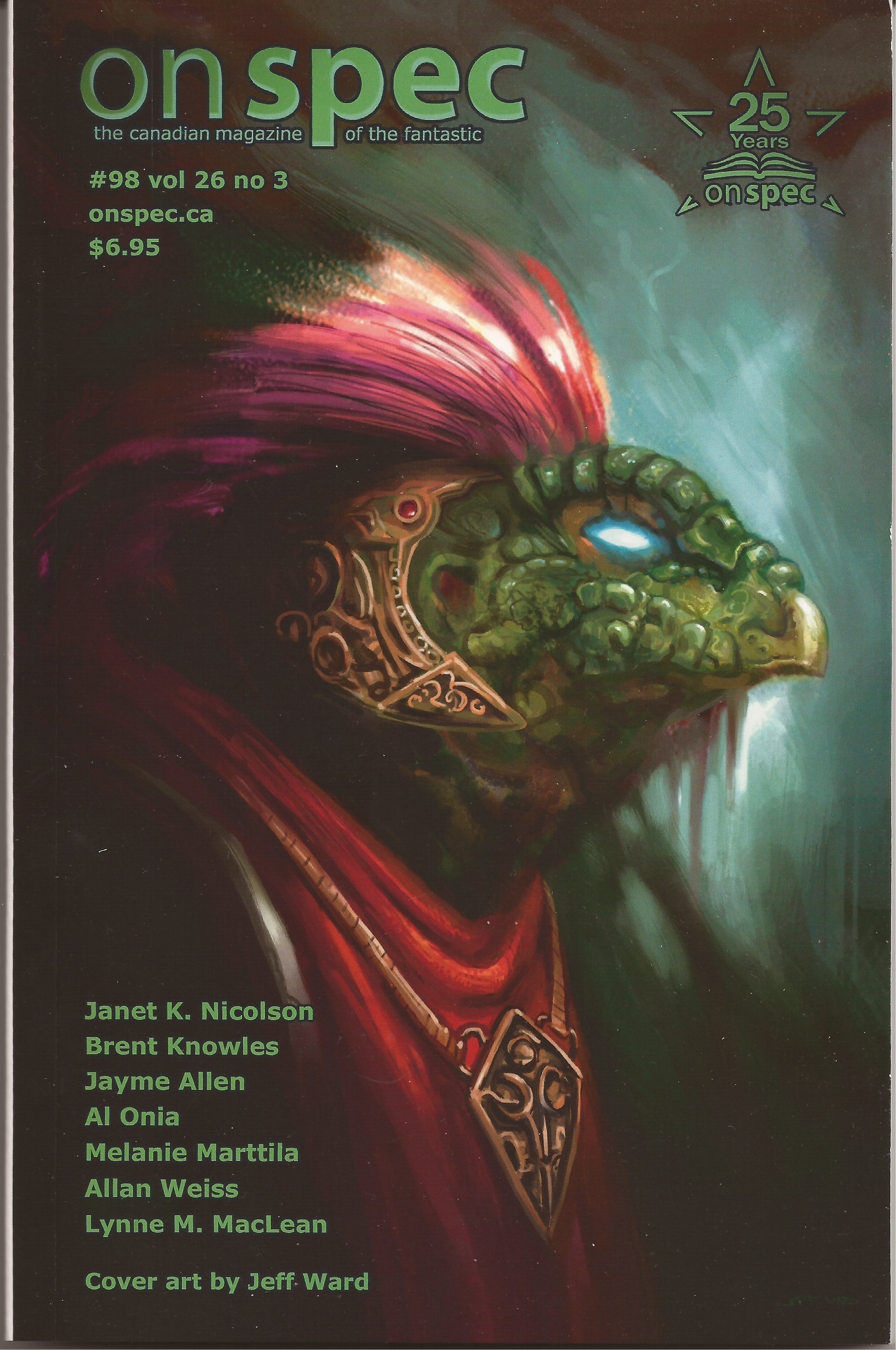
January saw the publication of “Downtime,” the short story On Spec purchased back in 2013. And, yes, I’m going to put that sexy Skeksis in your way again. As they say in one of my associations, I’m chuffed.

On Spec Fall 2014

Days afterward, I received a rejection of another short story, which, despite my best efforts, took the wind out of my sails. I know I should cultivate rhino-skin, but I’ve tried and I don’t think the goal possible. For me. At this time.

I missed one deadline for a special speculative issue of another magazine. It kind of blew right past me.

I did get my story submitted to Tesseracts 19, and I’ll be waiting on tenterhooks to see if this time will be the charm. I’ve been submitting to the anthology since 14, and I keep trying.

It’s what you have to do as a writer, keep writing, and keep trying.

And otherwise

Work has been a bit of a grind and it does not show signs of slowing up. For February, anyway.

I signed up for a five-session yoga class, and finished the last one this past Thursday. I enjoy yoga, but not the expense, or the time it takes from my already hectic life. So this is the only treat I’ve given my poor old body for now. I may well join up for the summer, if they offer the discounted membership again.

But life is good, overall. I’m making greater progress toward my goals that I thought I would, especially with the work hell.

Today, after I post this lovely thing, I’m progressing to IoS revisions, more Marushka, and perhaps working on one of those brand new short stories I told you about. Plus, the new season of Bitten (based on Kelley Armstrong’s series of novels) starts tonight, and I may fit in an episode or two of Log Horizon.

Tomorrow, another meeting of my writing/critique circle will take place, and I’ll be writing some more.

I’ll say it again. Life is good.

And so the chapter closes. See you next month!

The Next Chapter

Something awesome and dreaming up new story ideas . . . literally

Earlier in the week, a friend of mine posted to Facebook that he’d received his copy of the Fall 2014 issue of On Spec—with my short story, “Downtime,” in it!

On Spec Fall 2014

Woohoo! See—that’s my actual name on the cover!

Further, my friend (also an SF writer, incidentally) said he liked it 😀

Heck, my mom was enthusiastic about it. You would expect that, but my mom would tell me if she didn’t like it.

I brought one of my precious copies with me to work, and my coworkers said they’d have to buy copies and get me to sign.

I have yet to convince Phil to read it. He will or he won’t and I’m cool with that. I’m just curious to see what Mr. Science makes of my science fiction-y self. To be honest, he hasn’t read anything I’ve written, and he’s only heard my poetry because he was kind of obligated to be at the book launch.

Of course, I read my “love” poems, the ones he’d inspired, and that embarrassed him. Maybe that’s why he’s so gun shy of my fiction . . . Trust me, dear, my fiction is not based in real life to any recognizable extent.

In any case, to any of you who live in Canada and are interested in seeing my story, you should be able to find it at your local Chapters, or your local indie shop.

For those of you outside of Canada, please visit On Spec’s web site to find out how you might be able to get your wee mitts on some of the best SF&F in Canada.

If you like speculative fiction, you might consider a subscription.

Gettin’ dreamy with it

For those of you who haven’t been following me for very long, one of my main answers to the question, where do you get your ideas? is, from my dreams, of course.

Although it doesn’t happen very often now that I’m an adult with a full time job and stress (tends to mess up my sleep), I dream in story. There are ususally one or two really good ones a year, but I’ll dream partly formed stories an additional four to six times a year.

I’m not going to tell you the content of my dream, per se, except that it’s a new adult science fiction romance (didn’t see that coming, did you—I didn’t see it coming) and the working title would be The Reality Bomb.

I’ll probably slot it in for 2015’s NaNoWriMo and let things ruminate for most of the year.

That’s what happened with Marushka. Though her story is a YA urban fantasy/fairy tale retelling, I dreamed her up January 1, 2014. TRB was a dream of January 4, 2015.

There was another dream, which I’ll call Bright and Far Away that was a space opera story with military elements, but that one didn’t grab me as firmly as either Marushka or TRB.

So dreams coming true. It’s a theme.

Tomorrow, I’ll be wooing my soul (more on that in a future post) and Tuesday, I’ll be delivering a workshop. This is a good time for creative Mellie.

How have your creative lives been going?