The peregrine and all that followed

A.K.A inspiration, happiness, desire, Buddhist philosophy, and semiotic journeys

The peregrine

This morning, as I walked my dog, we neared a series of well-manicured cedars … and something flew out of them.  It looked about pigeon-sized, but it didn’t fly like a pigeon.  I like watching birds, okay?  I know what pigeon-flight looks like.  I know what it sounds like too, the rhythmic pumping of the wings that seems to push a little sigh with each down-thrust.

Pigeons don’t “kree” either.

This happened fast and I noticed most of it peripherally, but my interest was piqued, and the motion drew my eye to a nearby rooftop where a peregrine falcon was just landing. I saw the markings on its tail feathers and wing tips, and when it turned, I saw the pale breast, its feathery “pants.”

I mock you with my feathery pants.

It was beautiful, perfect even.

The words were out before I even knew I’d spoken: thank you.  The world shifted around me slightly.  My day was made.  Gratitude can do that to you.

I let Nuala sniff about for a bit.  She hadn’t noticed the peregrine, so I was able to watch.  It bobbed its head, assessing the threat.  I figured we must have disturbed its breakfast, that it downed something tasty and was having at in between the cedars.

So we moved on and let the peregrine get back to business.

I know we have peregrines in Sudbury.  In the past, they’ve nested at the University and of some of the buildings down town, but it’s not often I get to see one, and rare that I see one so intimately.

It got me thinking of several things.  In no particular order, they are:

There’s a poem in this

In my Thursday poetry posts, I often write a few words about the inspiration for the poem.  When I see something like the peregrine, and it touches me, usually there’s a poem in the moment.

If the moment is fleeting, I have to get it down, and quick, but if it has some staying power, the moment has to rattle around in my head for a few days, maybe a few weeks, gathering images and words like a mental tumbleweed until it gets so weighed down it can’t move anymore.  Then it’s time to write.

That’s what’s happening now.  Wee little tumbleweed, rolling around in my skull … 🙂

Happiness

The thing that made the world shift around me, that made me utter thanks, it feels like a “ping.”  It makes me take notice.

Moments of happiness and gratitude are all around you.  You experience them all the time, every day.  Pay attention.  It really does make the rest of the madness of life easier to put into perspective.

I don’t want to sound all hokey, but there’s sacred in those pings.

Desire

Which got me thinking about want.  A writer-friend posted to Facebook last week that she’d enjoy writing so much more if she wasn’t so invested in the whole publication thing.

I didn’t want to preach, so I didn’t comment, but what I wanted to write was: then stop worrying about publishing.  Write.  Act with purpose.  Continue submitting, by all means, but don’t hang your hopes on publication.  Persistence and practice pay off.  If you’re not enjoying it anymore, then you shouldn’t be doing it.  Take a break.  Give yourself a chance to remember why you love writing, why you really don’t want to do anything else.  Find your passion again and just write.  When passion fuels your efforts, you will write amazing things.  Shop those amazing things around and someone will accept them.  But stop wanting.  Just be a writer.  Write.

Another writer-friend posted this on Facebook today:

Take the “I want” out of anything, and you’ll find the happy.  It doesn’t come easily all the time, but if you can manage it even occasionally, you’ll be a happier person.  It’s this whole wibbley-wobbley, timey-wimey thing … No, that’s Doctor Who.  Sorry, obsession of mine 🙂

Really, it’s Buddhist philosophy

I read the Bhagavad-Gita not long ago, and that’s the central message of the text: stop wanting.  Stop desiring.  Be in the moment.  Act with conviction.

See the beauty, the power, and the terror (or the Krishna, if you’re a Buddhist) in everything.  It’s all connected.

Which brings me back to the peregrine.  Isn’t it a lovely little circle?

Oh, and something else

Peregrination.  Isn’t’ that a lovely word?  It means to take a journey, a pilgrimage.  Isn’t that what all of us writers do?

It’s all a wonderful semiotic mess 🙂

More insight into the mind of Mel.  Terrified yet?  Where has your mind been going lately?  Has it been going there without you?  How do your mental peregrinations influence your creativity, your art?  Do tell.

“What if” Fairy Tale Madness Blogfest, Part 2

Now, it isn’t really a fairy tale, so I don’t even know if it will be accepted on that basis alone, but Washington Irving‘s “The Legend of Sleepy Hollow” is a wonderful American short story, and one of my favourites.  It has the feel of a fairy tale to me, so to heck with it.  Caution, meet wind 🙂

Team Plot Twist

What if Katrina turned out to be totally vapid, and Ichabod couldn’t stand her family?  What if the only way he could extricate himself from this sticky mess was to fake his own death?  What if his perfect partner in crime was also his rival?

Please enjoy.

The heartless to the headless

An apparently headless Brom bent to extend his hand from horseback.

After clearing away broken bits of pumpkin and discarding his now-broken spectacles, Ichabod accepted the proffered assistance.

“You’re certain you won’t change your mind?” Brom asked.

“No, no,” said Ichabod, considering the book he’d clung to during the attack. “Katrina’s yours.  I only had to experience her family tonight to know I couldn’t countenance their relation.  It confirmed my suspicions.  Though her beauty affects me, a fickle-hearted girl like that could never make me happy.”

“You’re speaking of my bride-to-be!” Brom shrugged his head up through his cloak, his hair so awry it revealed a bald patch.  Ichabod stifled a laugh. “Watch it Ichy, or I might have to use this.”

“Put the sword away, Brom.  You’ve won.  I’ll be out of town before dawn.  You’ve nothing to fear.  You and Katrina shall be deliriously happy I should think.  I wish you nothing but the best, and several strapping, young boys such as yourself.”

Brom’s considerable brow furrowed for a moment as if trying to decide whether Ichabod was waxing sincere or sarcastic, then with a shake of his head he gave over, pulled his cloak back up over his head, and said, “You’re a strange man, and a fool to think you’d be suited to a place like Sleepy Hollow.  We’ll be as well-rid of you as you are of us.”

“Just so,” said Ichabod. “Thank you, Brom.”

“Fare well.”

“Be sure you’re well-seen tonight.”

As an answer, Brom pulled another pie-pumpkin from his saddlebag and threw at Ichabod’s feet.  Ichabod didn’t move.  The man knew his business right enough.

As he turned to fetch his donkey, Ichabod threw the book, unfinished, but not worth the effort, into the road to complete the picture.

“Rest in peace, Ichabod.”

300 words

What do you think?

“What if” Fairy Tale Madness Blogfest Part 1

Sorry to have missed a day on my blogging schedule, and a poetry day at that, but if was for a good reason.  A colleague, after 42 years of dedicated service, and service excellence, is retiring.  Her last day at work was today, but the BEA Hive took her out for dinner last night.  It was several hours of wonderful chat, memory-sharing, food and drink.  Ah, yes … there was much drinking 🙂

But so much for the excuses, and on to tonight’s post: I’m throwing my hat in the ring, the fairy ring at  that!

“What if” Fairy Tale Maddness Blogfest

So this post will tell you a bit about the blogfest, and you can join in up until 11:59 pm tonight, so get crackin’!

Part 2 will be my submission.

Onto the details.  The following is verbatim from Cassie Mae’s post (linked above).

WHAT IF?
Fairytale Madness BlogFest!
AUGUST 13th – 17th          
Have you noticed that by changing one detail; one event, one character trait, one thought…you can completely alter the rest of the story?For this bloghop we are exploring “What If?”
Not only do we want it to be fun, but it will hopefully be a fun writing exercise and make for some great reading during the hop!

To enter:
Think of your favorite “well known” fairytale and ask “What If…!”
Then, pick one of these four categories: (be sure to mention which category you’re joining, during your blog post!)

·       Best Plot Twist
·       Best Love Story
·       Best Tragedy
·       Best Comic Relief
 
Finally, write a scene(s) illustrating a new detail of the fabled fairy tale that changes our perspective.
To recap,
Is it a plot twist? (Cinderella gets knocked up by the Carriage Driver…)
An unknown romance that comes to light? (Snow White dumps the Prince for Grumpy…)
A tragic loss occurs? (The Three Little Pigs are too late to save their house…)

The wolf blows down the straw house in a 1904 ...

The wolf blows down the straw house in a 1904 adaptation of the fairy tale Three Little Pigs This is one one of the less intelligent pigs.. (Photo credit: Wikipedia)

A little comic relief? (Hansel and Gretel win a trip on Euro Rail, sponsored in part by M&M’s…)
Whatever the change…It’s limited only by your imagination – but please keep it PG-13 😉
Other Rules:
·       Post your story during the week of August 13 to 17.
·       Flash Fiction – 300 WORD MAX. (You don’t have to tell the whole story in three hundred words. Pick what works to illustrate your point.)

Got the flavour?  If you want to submit, the link is also on Cassie Mae’s post.

Good luck to all!  It’s been a fun challenge 🙂

Two lovely thinks, er, things, that fell in my lap today :)

Some say that knowledge is something sat in your lap.
Some say that knowledge is something that you never have. ~~Kate Bush, “Sat in your Lap

First

Partook of a Webinar this afternoon offered by Training Magazine Network and delivered by the inimitable Jane Bozarth on social and informal learning.  I follow her bog, the Bozarthzone, and have attended a few #lrnchat sessions on Twitter.

Jane promoted the power of social networking tools in the workplace, of curation, and the need to let learners have more control over their learning.

I’m all for this.  Unfortunately, my employer isn’t quite on the same page.  Facebook is blocked, because ours is a production environment and pressures are mounting.  Though Twitter is not blocked, our connection is so slow, in part due to the massive security measures we have in place, that it’s hardly worth the effort.

Though we have 2 internal Wikis with the capability to blog and curate, these tools are not promoted for use by our front line staff.  Again, operational requirements make it untenable.  The tools are mostly used to push information and email is still heavily relied upon as a means of communication.

We have SharePoint sites too, but again, for frontline staff, it’s used as any other Web page or site, as a means to push information, and not to engage staff in their own learning.  All of this on our sprawling Intranet, which, while it’s had a facelift, is still an unwieldy beast.

Only when staff reach the advisory or managerial level do they have the flexibility to dip their toes in those waters, and then to do so means some serious workload juggling.  Fortunately, aside from being the Learning Mutt, with a certain share of tenacity and feistiness, another of my workplace alter-egos is Shakti.  Multiple arms do tend to make the juggling easier 🙂  I could always evolve into a land-squid.

Still, informal and social learning is a wonderful dream I foster for my workplace and Jane gave me a few tools to add to my arsenal, courtesy of Diigo: http://www.diigo.com/user/jbo27712/upskilling

Second

The second gift of my day waited for me when I got home.  It arrived in the form of an email from a friend with a link: http://www.cpsrenewal.ca/2012/02/think-write-repeat.html

Think, Write, Repeat is a wonderful post.  I think I’m going to have to follow cpsrenewal 🙂  In his post, Nick Charney states that good writing and critical thinking are not only skills that can distinguish one in the workplace, but that they also support one another.

He offers a reminder: It’s a knowledge economy, stupid.  Indeed.

Charney promotes blogging as a kind of living portfolio, and one that will serve the knowledge worker well.  It’s better than a static resume that can hardly demonstrate any skill other than communication and editing.

Strong communities of practice and personal learning networks are also critical.

Once again, Writerly Goodness proves to be teh awesome (misspelling intentional) as a platform for both of my professions: writing and learning and development.

How has technology and the world of social media had an impact on your professional development?

Three great books on self-editing

(A.K.A. more writing-book porn!)

Since I started serious writing practice and got down to the business of trying to turn my idea into a publishable work, self-editing has been an obsession of mine.  I started out with a good grounding (2 degrees in English), but soon learned that there is always room for improvement.  Always and forever.

When the publishing boom of the 80s and early 90s changed directions, agents and editors state one principle requirement: write a damn good book, and write it well.

Here are, in no particular order, three books that have helped me immensely.  Just ask my Author Salon critique group, I am the queen of nitery-pickery (I’m not sure why I choose to write it like that, but I suspect it might have to do with the character of Rockery Hud-Peck from The Fintstonesthat’s just how my brain rolls).

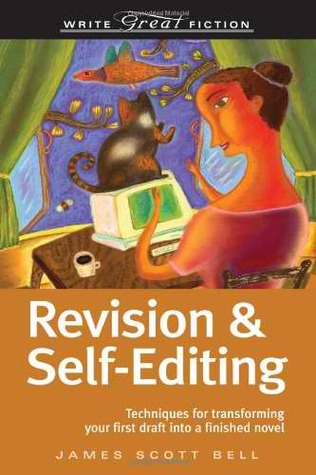
1. Revision & Self-Editing: Techniques for transforming your first draft into a finished novel by James Scott Bell (The Write Great Fictions Series, Writer’s Digest Books, Cincinnati, OH, 2008).

Bell divides his book between self-editing and revision, which he states are two separate processes.  They are 🙂

In his introduction, he references Browne and King’s Self-editing for Fiction Writers: How to edit yourself into print, another of my selections (see below), as well as a slew of writing gurus ranging from Brenda Ueland to Natalie Goldberg and Ray Bradbury.

Bell begins each section by presenting his philosophy of the task, then proceeds through self-editing with various chapters on each aspect of the work (character, plot, POV, etc.), asking probing questions along the way to get the writer deeper into their novel, and offering exercises to assist with the understanding of the element at hand as well as its relevance in self-editing.

When he gets to revision, it’s more about process than elements and analysis, but Bell is equally insightful in his discussion.

Bell is a skilled author and editor.  He writes from his experience in self-editing.  This perspective is what sets my first pick apart from the others.

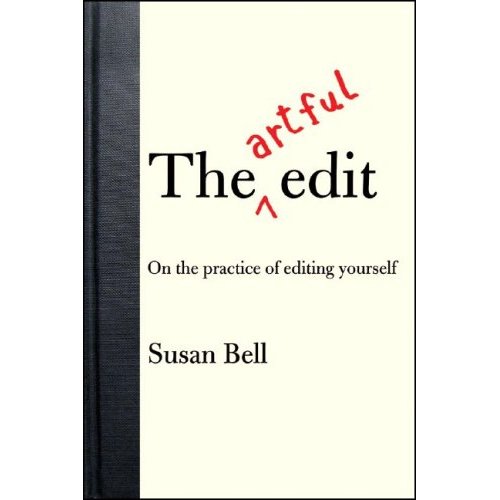
2. The artful edit: On the practice of editing yourself by Susan Bell (Norton, New York, 2007).

Susan Bell is a veteran editor and author, but her authority and perspective derive from the former role.

She breaks the self-editing task into Macro and Micro phases, again, providing examples, checklists, and exercises to deepen understanding. Then Bell offers what she calls her Master Class, provided in the form of experts in different creative fields (photographer, film, etc.) and what each can teach writers about how to make their story come alive.

Finally, she provides an overview of the evolution of editing, fascinating in itself.

Bell applies investigative zeal to her book, and it offers unique insight into the world or authors and editors, their relationships, where one begins and the other ends, and what the writer can do to become both.

3. Self-editing for Fiction Writers: How to edit yourself into print by Renni Browne and Dave King (Second Edition, William Morrow, New York, 2004).

First published in 1994 by HarperCollins, Self-editing for Fiction Writers is seen by many as one of the definitive works on the subject.

As with the James Scott Bell’s book, Browne and King’s breaks the task of self editing into its elements (characterization, dialogue, voice, etc.) devoting a chapter to each with examples and exercises.

One thing that I appreciate is the first chapter: Show and Tell (emphasis mine).  The point is made, and I fully agree, that while the writer should endeavour to show, that there are some places in your novel where telling is not only appropriate, but necessary.  It is the skilled writer who knows the difference and knows what technique should go where.

I also enjoyed the collaborative tone of the book.  When the authority is identified by “we” and not “I,” something rhetorical and clever happens: readers begin to feel that they are a part of the illustrious editorial team that wrote this book.

It’s an inclusive way of writing that empowers reading-writers to believe in their ability to self-edit.  The doors of the country club have opened, my friends, and we have all been invited in for drinks 🙂

The Wordsmith Studio Goodreads group is currently reading this book and it’s been a wonderful opportunity for me to get reacquainted with some old friends.

I recommend all three books highly (not to show favouritism or anything).

Do you have any books on self-editing that you would recommend?  Share their titles and maybe a few choice words of review in the comments so everyone can benefit from your experience 🙂

Writerly Goodness is calling it a night.

What does everyone else in Tellurin believe?

5 religions

Last week, I wrote about the two main religions of the Tellurin (humans): The Faithful, and the Holy Mother Church (HMC).  But what does everyone else in Tellurin believe?

You didn’t think I was going to stop at two, did you?

Well, I’m not.  But I’m not going to go into great gaudy detail about them either.  In the process, you’ll learn a little more about the various inhabitants of Tellurin.

Other Tellurin religions/belief systems

While the Parimi, Haldane, Espanic, Island Kingdoms, Saxon, Sami, and Skaldic all believe to a greater or lesser extend in Auraya and espouse The Faithful religion (some distinctively coloured by their own pagan belief systems), and the Caldone alone believe in the HMC, there are still other Tellurin cultures that believe in neither.

The Nubiin espouse a faith based in the divinity of their ruler, or Osire, and resulting cult of death.  The Osire (a man or woman) is tied to the land, responsible for the weather and tides that provide for a fruitful growing season in a relatively arid region.  Prosperity in the form of abundant crops and livestock result in a long rule, the opposite can result in a short one.

When an Osire ascends, work begins on his or her funerary monument.  The relative greatness of that monument and the treasures enclosed with the deceased is tied to the length of their rule.  Sound familiar?  It should.  The Nubiin are based losely on the Egyptian culture.

In the wake of the Cataclysm, and the advent of the devastating storms of Vedranya, the Nubiin faith was shaken.  If the Osire held no power over the storms, how could they be considered divine?  For nearly a hundred suns, the Nubiin struggled, even adopting a bastardized form of The Faithful religion for a while, but eventually, they returned to their traditions, rationalizing Vedranya as the cost of their prosperity otherwise.

The Hussar of the plains believe that the gods exist, but that they have no interest in what happens in Tellurin.  They believe in the power of a good horse, the strength in their limbs, and the pleasures of a life honourably lived.  They have an ethical code rather than a religion per se.

The Shooksa-Nai of the north-western region of Tellurin still live in a tribal fashion and have an animistic belief system, that is they believe in the spirits of things.  Their shaman are their spiritual leaders, healers, and advisors.  The Shanzu of the Deep Forest are similar.

A word about those pagan belief systems I mentioned off the top.  They relate to the first gods, the akhis.  Most revolve around the lord of the land (Zaidesakhi) and the lady of the waters (Augesahki).  Sacred groves were often consecrated to them.

Non-Tellurin religions

The okante (think orcs) territories are just south of the Shooksa-Nai and they too are a tribal, animistic people, and were largely peaceful until Yllel co-opted them into soul-slavery.  Now they live in fear of the mad god and do his bidding in the hope of saving their people from his wrath.

The krean (think trolls) are a seafaring people and revere the oceans and weather as their deities.  This has its roots in the akhis as well, Augesakhi and Freyesakhi.  Like the okante, they have been enslaved by Yllel and live in a similar fear of him.

The grunden (ogres), who live in the mountains, and blinsies (goblins), who live in the Deep Forest and love to harras the Shanzu, have no religion, but are also enslaved to Yllel.

The anogeni, as I’ve written in the past, were once the hands of Zaidesakhi, the fingers of Augesakhi.  The hidden people are special.  Though they’ve lost both “parents” they live in the belief that they will return to their children.  They have no true religion, because they know the true nature of the gods.  They do not require a structured religious practice as such.

They not only believe in the spirits of things, they actually study them and know them as friends.  There are twelve plants whose spirits have proven especially powerful: the ashkiwine.  It is through their relationships with the spirits that the anogeni practice their form of magic.

Because of their relationship to the akhis, they also know the spirit of the world, which they call the anoashki, the great mystery.  He is their grandfather, and they serve his purpose, one of the primary goals of which is to resurrect the fallen akhis.

Though the anogeni we meet in Initiate of Stone live in the earth, there are other groups of the anogeni that make their homes in the great trees, and in the oceans.  These last are an aquatic form of the anogeni, but they don’t have fish-tails 🙂

Another interesting thing about the anogeni is that they hold the memories of their ancestors, are born with them in fact.  As a result, they have a complex system of prophecies based on these memories and the patterns they have seen in them.  These prophecies and the anoashki guide them.

The dwergen, similarly, have no structured religion.  Dwergesakhi still lives in the heart of the earth, still speaks to them, and they know him well.  A self-evident god requires no faith.  Dwergesakhi is their creator, though, and as such they offer him respect and will do his bidding unquestioningly, as any good children might.

The eleph, being from Elphindar, are a little different.  Elphindar has no gods, but the eleph still revere the kaides esse, or the powers that be.  They believe in a kind of clock-maker, something beyond their understanding that created the universe, but then left the experiment to tick itself out in the fullness of time.  Like the Hussar, they have an ethical code by which they live.

When the eleph first arrived to Tellurin, Auremon came to them to try to make amends.  They were startled that the kaides esse of this new world took corporeal form and that they intervened in the affairs of mortals.  Since he confessed his role in their eviction from Elphindar and his inability to restore them, the eleph had no use for Auremon, and rebuffed him.

Not long afterward, the eleph encountered Yllel, when the mad god attempted to enslave them.  Yllel could not trick them, however, and this encounter only served to entrench the eleph enmity of the Tellurin gods and the people who worshiped them.

Finally, the favrard espoused an intricate system of ritual and discipline that did not focus on one god, but on all of them, past and present, known and unknown.  When Yllel enslaved them, he made them abandon their spirituality.  Some attempt to cling to their past, but Yllel punishes them for it.  The favrard are Yllel’s special pets, and one of the few peoples that he can possess.  The tortures he can inflict from within are fearsome indeed.

With this, we’re almost at the end of my world-building epic.  Next week, I’ll talk about some of the other distinctive features of Tellurin, some of the cities, keeps, towns, and villages that figure in Initiate of Stone, as well as a few odds and sods.

I hope you’ve enjoyed hearing about Tellurin and the characters in my novel.

I’m Writerly Goodness, circling three times and settling down for a nice sleep.  Until next week!

How does chaos become complexity?

Yesterday, I came across this wonderful post by Harold Jarche: Complex is the new normal.

In it, he posits that complexity is the new “normal” state of business and that those who exist in chaotic, or disordered business environments need to shift into complexity to be truly innovative.

For definitions of complex, complicated, and chaotic systems, please refer to another of his posts: It’s not complicated, you see?

The bottom line is that we function in a constant state of change these days, and depending on the specific pattern your business adopts, or falls into, you may have to take a different approach to personal and professional development.

Change and change management

My employer has just hit its stride in the business transformation game and right now, it’s utter chaos.  Add to that budget cuts that are resulting in further staff reductions.  Still business has to be done, training has to be delivered and we all have to find some way to deal.  The environment is hostile, reactionary, protectionist, and uncommunicative.

It’s difficult to remain positive in such an environment.  I must admit, I’m not doing well in this department.

We’re facing one of the biggest and most prolonged processing backlogs ever and employees are getting letters.  No one is safe, I’ve learned.  Even those who were assured that their jobs were not in jeopardy are learning otherwise.

What concerns me is that once the main thrust of the transformation process is completed, and the dust begins to settle, the chain reaction continues.  Several positions are staffed at a ratio of processing staff, including mine.  If insufficient numbers have been culled by attrition (those in a position to are seriously considering retirement) or promotion, further reorganization will be necessary.

Fortunately, I’ll have some time to wait for that nether shoe to fall.

My boss and team are a clever bunch, and they’ve decided to wade into the fray by offering Change Management training to affected staff.  Because I think it’s an important and valuable service offering, I’ve thrown my hat into that ring and will be part of the implementation team.  In other words, I’ll be training again 🙂  My wee trainer’s heart rejoices.

But change management is only part of the puzzle.  In order to pull out of this chaotic nose-dive we’re in, we have to strive for a more ordered, but still deadly flat spin, a more complex state from which we might have a chance of recovering.  If we’re clever.

Failing that, we could always eject.

But how do we achieve a complex state?

In an associated post, In an increasingly complex world, Harold Jarche shares Robert Warwicks’s seven essential criteria to consider in an increasingly complex world:

  • Go out of your way to make new connections.
  • Adopt an open, enquiring mind-set, refusing to be constrained by current horizons.
  • Embrace uncertainty and be positive about change – adopt an entrepreneurial attitude.
  • Draw on as many different perspectives as possible; diversity is non-optional.
  • Ensure leadership and decision-making are distributed throughout all levels and functions.
  • Establish a compelling vision which is shared by all partners in the whole system.
  • Promote the importance of values – invest as much energy into relationships and behaviours as into delivering tasks.

Jarche states that these criteria are a good place to start when trying to align one’s business environment to high-functioning complex from less efficient chaos, something he says he doesn’t see in most businesses these days.

I’m trying.  Sweet googly-moogly, I’m trying.  No “but” face here.  I’m seriously givin’ ‘er.

Will let you know how this all pans out.

Is your workplace in a state of flux?  Is there any strategy in place to help staff adapt and grow?  How are you dealing with change personally?  Let me know.  Seriously … commiserate!

Building your writing resume: three points to consider

This topic has come up in a peripheral way on Wordsmith Studio: As an unpublished, or even as a not-recently-published author, what can you do to bolster your writing resume?  I say peripheral, because the actual question asked was whether it was worthwhile to enter contests because many of the entry fees are expensive/potentially prohibitive.  I believe the question was posed in the context of accruing publishing credits, however, and that’s when I started to think about this topic in earnest.

So for better or worse, here are my thoughts on the subject in the context of my personal experience.

1. Contests

Contests can be fun.  They can inspire you, particularly if they have a theme you can latch onto, and the deadline always helps to motivate.  The issue for me is that many contests in literary magazines, whether for poetry or prose, carry with them entry fees, and some of these can be as much as $40 (!) for a single entry.  If that entry is a single poem (not epic, they usually have line limits), or a 2000 word or fewer short story, you really have to weigh the benefits of paying someone to consider your work, which already carries with it a labour cost in author-hours spent writing/revising.

Food for thought: Value your work.  How much do you think it cost to write?  Even at minimum wage per hour (and I’d advise a higher value than that) it’s probably more than the entry fee.  How much are you willing to pay to have your work published?  In the beginning, we may all have to pay for this consideration, but it’s important to remember that unless you have a really good day-job, you’re going to reach the point of diminishing returns sooner than later.

Yes, you can write off the entry fees on your taxes if you claim your writing as self-employment, and yes, you often get a year’s subscription to the magazine or journal, which you can declare as income on your taxes as well, but you have to consider the relative cost for benefit.

For example: If you’re paying a $25 entry fee to receive and annual subscription worth $15 or $20, this may not be in your best interest.  Sure, you may stand to win $500 if you place first in the contest, but if the magazine or journal holding the contest is well-known, you’re going to be up against some stiff competition.  Take the possible purse out of the equation and work through your numbers again.  If you don’t win, or even place, will this still be a good investment for you?

Contests are sometimes a way for a magazine or journal to generate some fresh material, gain new subscribers, or refill the enterprise’s dwindling coffers.  If you like the journal and want to support them, consider a paid subscription and simply submit to them according to their submission specifications (see below) to see if you can get published by other means.

Further, most magazines and journals that hold contests receive so many entries that their judges cannot possibly comment, even in general terms, on the quality/suitability of your work.  Entering a contest may be a good experience, but if you’re aiming to get critical feedback, it’s not your best bet.

Note: The concerns for poetry are a little different than for prose, at least here in Canada.  A poet can rarely make even a meagre income from their work unless they self-publish, and even then, the costs of producing the anthology often outweigh the profits derived from sales.  A best-seller in terms of poetry might be 500 – 1000 copies and the poet often has to go on the road (or start up a YouTube or podcast channel to promote their work) to give public readings and drum up interest in their work.  In my experience, poets write for the love of poetry.  They’re not aiming to make money from the endeavour.  The fact of publication is often worth the cost, whatever it happens to be, and most poets are gainfully employed in other, though sometimes related professions, to offset the costs associated with their calling.

My advice: Look for contests that have low or no entry fees.  They do exist.

2. Calls for submission

Which brings us to our next consideration: calls for submissions.  Most magazines and journals do have their criteria for submission posted on their Web sites.  Occasionally, periodicals, or even publishers wishing to put out an anthology will have a themed call.

Like the contests listed above, themed calls can be fun and often for the same reasons (theme, deadline, etc.).  One consideration that you should keep in mind is the potential for resubmission.  If the theme is too specific or narrow, the story or poem produced thereby may not be suitable for submission elsewhere, unless another publisher is interested in Animal Bollywood, or Japanese Steampunk.

Note: Follow the submission guidelines carefully.  Many publications weed out submissions that are not perfectly aligned with their criteria, particularly the more popular or well-known ones that are flooded with the work of hopeful authors.

Some magazines close their submissions once they’ve received what they deem to be “enough.”  Usually, this has to do with their publication schedule.

For example: A quarterly (four times per year or every three months) that publishes three to four short stories per issue might close their submissions after receiving eighteen to twenty stories (a year’s worth plus a few back-ups) that they deem suitable for publication.

This can happen in any genre (poetry or fiction) or any genre within fiction or poetry (SF, fantasy, romance, mystery, etc.).  This only reinforces the importance of looking up the submission guidelines for whatever magazine or journal you choose to submit to.  If you rely on annual print publications to plan your submission strategy, this is especially important.  The periodical’s or publisher’s situation could have changed since the guide was produced.

Remuneration: These terms can also be found on most magazine’s or journal’s Web sites.  Often, for fiction, it will be a sliding scale of cents per word depending on the length of the story.  It may be a flat fee per poem.  Some journals, particularly poetry or literary journals, will only offer contributor copies, or a year’s subscription.  Once again, as with the contest entry fees, weigh the benefits of publication.

A note regarding online publications: Online publications may not offer contributor copies either (because there is no print version), and if relatively new, may not be able to pay much, if anything.  If they are established enough to have advertising income they may provide remuneration.  Once more, read carefully.

In most cases, it will be rare that a piece of creative writing submitted in response to a call will receive detailed commentary. Once again, it’s a matter of numbers.  If you had to read a hundred short stories, would you be able to give each one individual attention?  We’d all like to say that we would, but I think the reality is that after ten or so, we’d all admit to a certain amount of exhaustion.  And to be fair, why give commentary to a handful, when everyone deserves the same consideration?  This is why most publications will not go this particular extra mile.

If you do receive a few comments or pointers: excellent!  It means that your submission was good enough to merit some extra time and attention.  If the commentary is specific, take heed and use it to your best advantage.  If it’s simply complementary, keep it, and try not to use it as an excuse not to edit and revise before submitting the piece to another venue.

3. Resources

One of the most popular series of guides is the Writer’s Digest series: Writer’s Market, Novel & Short Story Writer’s Market, etc.  I might recommend a subscription to the Writers Market.com service, which will have resources/listings updated in real time and on a regular basis.

For Canadians there is The Canadian Writer’s Market, but I’ve found that WD has been getting better and better at keeping their Canadian listings up-to-date.  This may be a good resource for those dedicated to publishing in Canada.  It comes out less frequently than WD, and so checking out the individual Web sites of publishers and publications becomes very important.

While the Interwebz can provide a plethora of resources, I’ll recommend Duotrope as an excellent starting point.  The service is currently looking for donations to remain in operation as a free resource.  If you’ve used the service and found value in it, seriously consider donating.

That’s all the Alchemy Ink Writerly Goodness has for this week!

Until next time!

Speaking of speaking to the spirits

English: Religious symbols from the top nine o...

English: Religious symbols from the top nine organised faiths of the world according to Major world religions From left to right: 1st Row: Christian Cross, Jewish Star of David, Hindu Aumkar 2nd Row: Islamic Star and crescent, Buddhist Wheel of Dharma, Shinto Torii 3rd Row: Sikh Khanda, Bahá’í star, Jain Ahimsa Symbol (Photo credit: Wikipedia)

A.K.A. Religion and spirituality in Tellurin, part 1

After last week’s lovely vacation from worldbuilding … it’s ba-ack 🙂  If you recall, last instalment, I talked about the specifics of how the magick works.  Part of that dealt with the nature of Ferathainn’s talent: her ability to communicate with the spirits of things.  We’re going to take that metaphor in a different direction this week.

So I’ve already covered the gods, and given a basic rundown of the history of Tellurin.  What’s left to say about the religions?  A fair amount 🙂

The two main religions in Tellurin, The Faithful and The Holy Mother Church are based on Auraya.

Once upon a time, on the eastern coast of Tellurin, the Parimi, Espanic, and the Haldane peoples lived in harmony with the Caldone.  Though all from tribal origins, all but the Caldone had settled into stable, agrarian territories that grew into allied provinces.

The Haldane were great artists and philosophers.  Their main tenet was to live every day to its fullest, to be joyful in the moment, and to follow their bliss.  This led them to strive for excellence in whatever profession they pursued.

The Parimi were of a similar disposition, but they were epicures verging on hedonism (eat, drink, and make love today, for tomorrow, you may die).

The Espanic expressed their philosophy in a different way.  They were great engineers, navigators, and scientists.

All Tellurin knew of the gods, but there was no codified religion yet.

In those days, Auraya, Auremon, and Tryella were active in the affairs of the Tellurin.  Auremon and Tryella weren’t interested in thanks or recognition, however.  Their efforts were altruistic.  Auraya loved the adoration and her partner and daughter were more than happy to let her take credit for their good deeds.

One of the Haldane began to collect tales of divine providence and intervention, and wrote them down.  He signed each story, The Faithful Scribe.  This collection became the Kas’Khoudum, or book of light.

The Parimi took these writings, and developed the set of practices that became The Faithful religion.  Mostly, they gathered at the full and new moons to share tales of wonder, to sing songs about them and to recite poetry based on the tales.  They shared food and drink.  In short, it was a big party that made everyone in attendance happy.  The Haldane and Espanic took to this form of gathering like bees to pollen.

Word of The Faithful gatherings spread beyond the borders of it home provinces and others began to adopt those practices.

The Cadone, however, were still largely a tribal culture.  Though they had cities, these were military strongholds and training centres.  They raided and attacked their neighbours, taking the conquered people as slaves.  When they observed The Faithful gatherings among their slaves, they thought it was pure debauchery and the Kas’Khoudum, a work of heresy.

Their Auraya was a warrior queen, champion of the bold and fearless.  They had established The Holy Mother Church in her name as an administrative branch of their great armies.  They determined that The Faithful had to be stamped out.

Though they drove the Parimi, Haldane, and Espanic peoples from their homelands and pursued them across the continent, Auraya intervened and chose one of The Faithful, Alain de Corvus, to be her Kas’Hadden, or hammer of light.

He saved the refugee peoples, turned back the Caldone, and the Parimi, Haldane, and Espanic settled peacefully on the western coast of Tellurin.

Over time, the religion of The Faithful became ritualized and the practice less joyful.

Yllel, trying to influence The Faithful for his own nefarious purpose created his own book, the Rada’Khoudum, or book of darkness (misleadingly translated as the book against darkness).  This was a book of ceremony and ritual, including a number of spells that when used, would actually bind and drain Auraya’s power, eventually weakening her.

After the Cataclysm, Yllel directed his soul-slaves to place the Rada’Khoudum into the hands of the surviving Faithful.  The Rada’Khoudum became the basis of modern Faithful practice and the Kas’Khoudum became a pleasant book of incredible tales, eventually laying forgotten and gathering dust on a shelf in the Great Library at Aurayene.

It might be helpful to think of The Faithful in the time of Initiate of Stone as analogous to the High Anglican Church in its early days, when multiple sects of Christianity were emerging and religious persecution was rife.

Think of the Holy Mother Church as Christianity in the time of the crusades, except that their collective target is any religion that is not HMC, magi, and any people not Tellurin.  They’ve been waiting and planning for years to execute their holy war.

Next week: The other religions of Tellurin.  You didn’t think I’d stop with two, did you?

Have a great long weekend!

Writerly Goodness, signing off.

Four things I learned about project management

1. My biggest take-away

Back in February, I spent five days in Toronto, taking Project Management training.  While this was ostensibly for my day-job, my biggest take-away is that anything can be a project: my novel, a poem, a short story, training, training design, home renovation, a conference or vacation, even going out to celebrate a birthday, all of it.  And anything that can be considered a project can be made more successful by solid project management practices.

Our instructor for the week was Paul  S. Adler of Paul S. Adler and Associates, a certified Project Management Professional through the Project Management Institute (PMI).   In a practical demonstration of participant-centered training in action, Mr. Adler guided the class through content-relevant activities, integrated lecture and video segments, and tied the whole together with practical application sessions that culminated in a presentation of our team projects on Friday morning.

2. The PMBOK and the PMBOX

PMBOK stands for the Project Management Body of Knowledge.  The PMBOK Guide is the Bible of project management and is produced by PMI.

One of the mini-projects that the class had to produce was a commercial for a product.  My group chose the PMBOX, containing everything you would need to manage your next project.  While our tagline was “With the PMBOX, your projects will manage themselves,” there is no magic solution to project management.  The toolkit is in the project manager’s head and reference library, and it will take years of practice to implement, understand, and perfect those skills.

3. The Spectre of Groupthink

While I think Mr. Adler’s video library could stand some updating, each was relevant and elucidating.  In a serendipitous bit of media tie-in, Roger Boisjoly, the central figure of the video on “Groupthink” passed away on January 6, 2012.  His passing was publicized on February 8, 2012 in newspapers across the US.  I found the video challenging and the difficulty of Roger’s position tragic.  Moreover, his story following the Challenger disaster he tried to avert was compelling. 

Groupthink is a phenomenon in which coverconfidence, looming deadlines, and pressure to conform can conspire to silence conscientious dissenters.  In Boisjoly’s case, he warned of the potential failure of the O ring that ultimately resulted in the Challenger disaster.

Groupthink in my workplace (not my team specifically – we’re pretty awesome) is a hazard, and extremely difficult to overcome.  I’m now dreading the possibility of having to confront the beast.  Thankfully, I don’t think it’s imminent, and the projects I might work on would not involve life-or-death decision, but still … it’s both haunting, and daunting.

4. Let’s Talk Again

On Wednesday evening, the day after we discussed Groupthink, I watched the CTV broadcast of Michael Landsberg’s interviews with Darryl Strawberry, Stéphane Richer, and Clara Hughes about depression.  It was significant for me in the context of the course, because Mr. Adler had spent some time discussing stress management that day.  As someone prone to depression, I do what I can to combat negative stress every day.  Walking my dog, or walking home from work, making a physical as well as mental “switch” between work and home lives, and seeking the happy are all important parts of my life and my “process.”

Kim Covert, of the Postmedia News service calls depression in the workplace the “trillion dollar elephant in the room.”   It’s an issue that has a huge impact on both our professional and personal lives and people have been silent with respect to depression for too long.

Bottom line: find your bliss; follow your joy; do whatever you can to find the happy in your life.

In the end

There was too much course to cram into a little blog post like this.  We covered at least ten important topics every day.  That’s a lot of learning!  Project Management isn’t something that can be done, or done perfectly, out of the gate.  As Mr. Adler told us, we just need to start with one thing, practice it, and build on that practice gradually.  Also, he encouraged us to use project management at home.

I’d highly recommend the course, or one like it, to everyone.

As Drew Dudley says so succinctly and so beautifully, leadership in everyday life can change the world.

Have you attended a course recently that has had an impact on you?  What was the course?  What was its impact?  Do share!