Tipsday: Writerly Goodness found on the interwebz, April 2-8, 2017

There’s so much writerly goodness out there, I wish I had more time to devote to curating these informal writerly learnings for you.

Aliette de Bodard guest posts on Terribleminds: in defense of uncanny punctuation. I love semicolons, too!

K.M. Weiland adds number 58 to her most common writing mistakes series: too much description. Helping Writers Become Authors

Later in the week, Kate shows you how to write stories your readers will remember.

Then, Kate pops over to Jerry Jenkins’ blog: two ways to find out if a scene deserves a place in your story.

Kathleen Jones guest posts on Jane Friedman’s blog: six ways to prepare for writing as a second career.

Angela Ackerman shows you how to use timelines to organize story details. Writers Helping Writers

Lisa Preston offers seven strategies for revising your novel. Writer’s Digest

Penny Sansevieri helps us decode Amazon keywords. Writers in the Storm

Fae Rowan shares five tips to get your characters—and you—through adversity. Writers in the Storm

Janice Hardy introduces us to a fun way to learn story structure. Writers in the Storm

Chris Winkle shares five signs your story is ableist. Mythcreants

Oren Ashkenazi looks at six objectively good stories and finds ways to make them better. Fabulous analysis. Mythcreants

Laurel K. Denton guest posts on Writer Unboxed: changing horses mid-stream (or how not to panic over a mid-book structure revision).

James Scott Bell asks, is your fiction big enough? Writer Unboxed

Donald Maass wants you to captivate readers with your opening lines: casting the spell. Writer Unboxed

Bryn Greenwood: write a book, save the world. Writer Unboxed

Kathryn Magendie explores this writing life. Writer Unboxed

Emily Wenstrom helps you grow your online platform in real life. DIY MFA

Shameless self-promotion time again: it’s me! Defining speculative fiction. DIY MFA

Gabriela Pereira interviews Susan Perabo for DIY MFA radio.

Bess Cozby offers five tips for revising your trunk novel. DIY MFA

Kristen Lamb: the single best way to become a mega-author. Later in the week, she follows up with how you can make all ads, marketing, and newsletters work better.

Jeff Lyons visits Jami Gold’s blog again: creating a strong moral premise for our story.

Michael Everest responds to a provocative post and explains the difference between giving up and giving in. Fantasy Faction

David Barnett responds to the same “failed novelist” post. The Guardian

Alex Brown unpacks Marvel’s “diversity doesn’t sell” argument and explains what diversity really means. Tor.com

The Hugo and Campbell awards finalists announced! Locus

This grammar vigilante stalks the Bristol night putting apostrophes in their right places. Ladies and gentlemen, the BBC gives you, the Apostrophiser!

I hope you learned something tasty 🙂

Be well until Thursday when you can come back for some thoughty inspiration!

tipsday2016

WorldCon 2016: Two suns in the sky

Disclaimer: I am not perfect and neither are my notes. If you notice anything that requires clarification or correction, please email me at melanie (dot) marttila (at) gmail (dot) com and I will fix things post-hasty.

TwoSuns

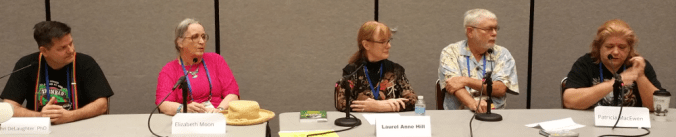
Panellists: Eva Elasigue, Courtney Schafer, [Mel’s note: Joe Haldeman was unable to attend.]

Joined in progress …

CS: Kepler discovers exoplanets by observing the subtle signs of a planet passing in front of its star. It’s focused on a small area and it’s only covered 3% of that space in detail so far. The number of exoplanets discovered is large, but only a fraction of circum-binary systems have planets that might be habitable. The planets discovered in those systems are massive, though. It’s exciting that so many planets have been discovered.

EE: One of Larry Niven’s conjectures is that a planet in a binary system would have an off-center core.

CS: It’s possible that a planet in a binary system could have a figure eight orbit. It could also be more easily ejected from the system. Since circum-binary systems are fairly common, there might be a large number of rogue planets out there. To discover the composition of a planet, you need to use spectroscopy.

Q: Is there publicly accessible software for fact-checking the plausibility of an invented system?

A: There are solar system simulators.

CS: You can also check with your local amateur astronomy club.

Q: Is Alpha Centauri A, Rigil Kentaurus, a binary star?

CS: That’s the current understanding. One thing to keep in mind is the force that would be exerted on planets in these systems. If we look at the moons of Jupiter, they need to have their own magnetospheres to maintain an atmosphere. Otherwise, Jupiter strips it away.

EE: You should check out Galaxy Zoo. It’s a citizen science initiative.

[At this point, the ideas starting coming fast and furious. To be honest, I’m not sure who said what.]

The most favorable binary systems for planets are those in which both stars are around 80% of the sun’s size. They’re also fairly close to each other. The minimum stable radius for a planet in a binary system is 2-4 times larger than [… sorry didn’t catch this. I think it’s Jupiter. Wikipedia indicates this would be correct. If the planet is a gas giant, it may not support life, but its moons might. Smaller stars would accommodate smaller planets, but the planets may not be habitable, depending on their orbits and the relative light and heat they receive from their suns.]

They probably didn’t form in their current orbit. There’s an instability in binary systems which could result in the planet spiralling into one of the stars, or being flung out of the system. Planets in binary systems would move around unless they could find a stable orbit.

There are also mismatched binary systems. A blue giant with a red dwarf, for example, or a sun-type star with a black hole.

And that was time.

For more information: If you Google the term circum-binary systems, you will find a lot. Navigate to dependable sources, like NASA, or Space.com (unlike yours truly). Or head for fun but dependable sites like Phil Plait’s Bad Astronomy column, currently hosted by Blastr.

Next week: we’re terraforming terra 🙂

Until next I blog, be well, be kind, and stay strong.

Thoughty Thursday: Things that made me go hmmmm on the interwebz, March 26-April 1, 2017

All sorts of stuff to get your mental corn popping this week.

Tad Friend exposes Silicon Valley’s quest for eternal life. The New Yorker

Gillian Anderson and Jennifer Nadel talk perimenopause and menopause. Lenny

Alex Myles: how being an empath can lead to adrenal fatigue, insomnia, and exhaustion. Elephant Journal

Lori Day: aging while female is not your worst nightmare. Feminist Current

Gisela Wolf says that people who hit the snooze button are more intelligent, more creative, and happier. The Independent

Veritasium: The science of thinking. You won’t learn anything unless you’re uncomfortable.


ASAP Science: This does not equal that. Correlation vs. causation.


Your animal life is over. Your machine life has just begun.” Mark O’Connell for The Guardian.

Ryan F. Mandelbaum reports on a new theory that connects dark matter, black holes, and gravitational waves. Gizmodo

Joanna Moorhead rediscovers her wild child cousin, surrealist painter Leonora Carrington. The Guardian

The Economist: can we know what animals are thinking? Medium

Jordan Pearson presents some of the evidence that proves cats are actually nice. Motherboard

Overtone singing never ceases to amaze me. Anna-Maria Hefele


For your listening pleasure: Minds Without Fear – Imogen Heap


And that was your thoughty for the week.

On the weekend, I’ll be covering more WorldCon 2016.

Be well until then, my friends.

thoughtythursday2016

Tipsday: Writerly Goodness found on the interwebz, March 26-April 1, 2017

Holy cow, lookit all the informal writerly learnings 🙂

K.M. Weiland covers seven stages of being a writer. Helping Writers Become Authors

Later in the week, Kate helps you notch up your scene conflict.

Fred Johnson guest posts on Jane Friedman’s blog: how to get violence right in your fiction.

Grace Wynter joins Writer Unboxed as a contributor: Look! Up in the sky! It’s a … writer?

Catherine McKenzie: are you tired of writing? Writer Unboxed

Tracy Hahn-Burkett helps you have patience over the long, long haul. Writer Unboxed

Jo Eberhardt unpacks the relationship between envy, perfectionism, and the work of writing. Writer Unboxed

Susan Spann: how to avoid pay to play publishing contracts. Writer Unboxed

Jenna Moreci: Show vs. Tell, part 2. When to tell.


Kimberly Brock has the blank page blues. Writers in the Storm

Kathryn Craft says we can do it all—but should we? Writers in the Storm

Ruth Harris shares some stress busters and burnout beaters. Anne R. Allen’s blog

Leanne Sowul: how one skeptic became a meditation convert. DIY MFA

Gabriela Pereira interviews Jessica Strawser for DIY MFA radio.

G. Myrthil explains why kid lit matters. DIY MFA

Linda Bernadette Burgess shares five ways to manage multiple creative passions. DIY MFA

Emily Temple says that if any literature is going to change the world, it’s going to be young adult. Literary Hub

Fantasy Faction explores sieges and siegecraft. Part one: attackers.

Jeff Lyons returns to Jami Gold’s blog: what is high concept and how can I create it?

Lilith Saint Crow stops by Terribleminds: when a short story won’t stay short for long.

Nina Munteanu: the power of myth in storytelling.

Bonnie Randall wonders, do sensitivity readers hurt or help our novels? Fiction University

Nathan Bransford says that the key to a great query letter is summarizing through specificity.

Barbara Kyle shares ten query letter tips.

Pamela Hodges explains how to edit your novel like a New York publisher. The Write Practice

John Koenig makes another entry in the Dictionary of Obscure Sorrows: morii.


S.B. Divya reveals the seed of her novel Runtime. Tor.com

Malka Older’s not predicting the future, she’s just observing the present. Tor.com

Sunny Moraine: resistance through speculative fiction. Tor.com

Leah Schnelbach revisits Nausicaä of the Valley of the Winds, twenty years on. Tor.com

Am I pathetic because I still love Buffy? I guess I’m not alone: Katharine Trendacosta shares pics from the Entertainment Weekly Buffy reunion photo shoot. i09

Three translators respond to Arrival. Susannah Greenblatt for Words without Borders.

Adam Frank explains how great science fiction shows like The Expanse prepare us for the future. NPR

Evan Narcisse shows us the Valerian trailer. i09

Hope you enjoyed the writerly goodness.

See you Thursday for some thoughty 🙂

Be well until then.

tipsday2016

The next chapter: March 2017 update

It’s April already.

Though I’m grateful for spring and the returning light, there still seems to be too much to do and too little time to do it in.

Still, things are progressing.

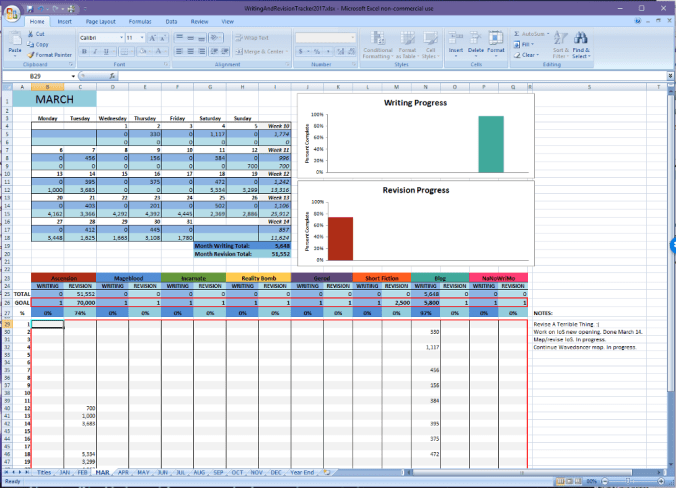
It took me a while after finishing Wavedancer to get my head around returning to Initiate of Stone. As you can see from the screenshot, the first eleven days of March were spent working through my opening chapter, long hand. I tried a few things and finally settled on one of them.

MarchProgress

Is it any better? I think so, but I’m hardly objective. Unfortunately, it’s added four pages to the ms. I’ve been trying to cut back in other areas but, so far, I haven’t been able to shrink the overall word count. There’s still work to be done.

You will also see that I only made 74% of my revision goal for the month. This is what happens.

I nearly met my writing goal for the blog at 97%.

But I didn’t revise any of my short fiction. Again. My head’s just not there. I know I should forge ahead, regardless.

To be specific:

51,552 words revised of 70,000 on IoS

5,648 words of 5,800 written on this blog

One distraction has been getting my travel arrangements made for the Writing Excuses Cruise. Most of them are in place. There are just three days between the cruise and WorldCon that I have to settle. I’m going to spend them in Finland. My hotel is booked.

A friend has lent me her Lonely Planet guide to Scandinavia. I’ve decided I’m going to spend one day visiting Marttila. Yes. There’s a city in Finland that’s shares my last name. That’s why I want to go.

I’m also trying to assemble my taxes (which melts my brain).

I continue to assemble the monthly newsletter for the Sudbury Writers’ Guild and I’m now on a couple of sub-committees for the Canadian Authors Association.

I like to keep myself busy?

Health-wise, I’ve had my first appointment with a specialist who will be able to help me, but I may have to wait for up to a year for the procedure to be performed. The hospital has cut operating time (grrr).

I’m walking more, despite a stubborn case of plantar fasciitis. I have new orthotics, but my feet are slow to adjust. I’m back to doing yoga in the mornings. I’m no longer on the iron supplement. For now. It doesn’t seem to have made a difference to my energy levels, one way or the other. Will keep y’all informed as to how things are going.

Work is chaotic. There was a site refit and so lots of disruption over the last month or so. Repeated packing and unpacking for painters, the installation of new workstations, and, finally, moving to a new workstation on another floor of the building. Everything should be in reasonable shape come Monday.

We voted on our latest contract offer, but we won’t know the results of all the votes until April 15th or so. I’m hopeful, but even if we ratify, it probably won’t be until September that we see anything in terms of our retroactive wage increases.

My back pay for my last acting position hasn’t been resolved yet, either. They say maybe June? They’ve missed every deadline so far, so I’m thinking August.

And people wonder why I’m not such an enthusiastic worker these days. Seriously?

The snow is melting, though, and we’re experiencing more days above zero (Celsius). The sun is out more. It’s brighter. I feel myself emerging from hibernation.

I’ll have another column out for DIY MFA next week, and a couple of lovely things to tell you about in next month’s update.

That’s it for me for now.

Until next I blog, be kind, be well, and stay strong. Remember: love is the greatest of magics.

The Next Chapter

Thoughty Thursday: Things that made me go hmmmm on the interwebz, March 19-25, 2017

I hope something in this mess gets your mental corn popping 🙂

Pete Mohrbacher has been painting surrealist angels since 2004. I would plaster the house with his work if I could. Angelarium.

Lori Dorn shares a documentary about M.C. Escher. Laughing Squid

Joel Levy shares some vintage photographs of the Toronto Islands. Toronto Guardian

Teodora Zareva: Disney is fulfilling on of Nicola Tesla’s dreams. Big Think

Matt Simon covers the revelation of the crazy-tough water bear’s secret. Wired

Phil Plait reacquaints himself with an old friend that has a new mystery. Is it a planet, or a star? Blastr

Then, a three billion solar mass black hole rockets out of a galaxy at eight billion kilometres and hour. Blastr

Umir Abrar: the big bang isn’t the beginning of our universe—it’s the ending of something else. Physics-Astronomy

Gobblynne provides a great reminder and lovely interpretation of the two wolves mindfulness parable. Vimeo

Tom Jacobs thinks America needs a crash course in critical thinking. I think everyone, everywhere, could use a primer. Pacific Standard

Ever twist yourself into philosophical knots wondering about the nature of reality? That’s okay, Professor Donald H. Hoffman says it probably doesn’t matter because living in a constructed fantasy world is the thing that allows us to survive. Robby Berman for Big Think.

Tori Rodriguez reveals that negative emotions are key to your wellbeing. Scientific American

Lee Suckling lists twelve signs that you may be an extroverted introvert. Stuff

Vicki Hall reports on Clara Hughes’ continuing struggle with mental illness. The National Post

Brian Resnick: if you’re not a morning person, science says you never will be. Vox

Mayim Bialik: girl vs. woman and why language matters.


Jim Moodie covers how Shannon Agowissa and Lisa Osawamick are helping to keep Sudbury’s indigenous girls and women safe. The Sudbury Star

Jimmy Thomson reports on the development of new maps that will depict the pre-colonial “Turtle Island” Canada. I’m eager to see these. CBC

Gregory D. Smithers examines the enduring legacy of the Pocahontas myth. The Atlantic

A Medieval abbey trapped by tides and time. Great Big Story


I love dance. So you think you can dance is the only reality television I watch. So this hip hop routine by Kyle Hanagami for Ed Sheeran’s “The Shape of You” kind of blew me away.


And that was your thoughty for the week.

See you on the weekend for my next chapter update.

Be well until then.

thoughtythursday2016

Tipsday: Writerly Goodness found on the interwebz, March 19-25, 2017

Another bumper crop of informal writerly learnings for you!

K.M. Weiland shares nine tips that will help you create opening and closing lines that readers will love to quote. Helping Writers Become Authors

Later in the week, Kate helps you determine when it’s a good idea to use a made-up setting.

Shanna Swendson guest posts on Fiction University: is your plot complex, or chaotic?

Vaughn Roycroft is embracing perseverance. Writer Unboxed

Maya Rock helps you prepare for the emotional roller coaster of revision. Writer Unboxed

Dave King takes a look at Stephen King, a master of suspense and suspension of disbelief. Writer Unboxed

Heather Webb tackles writing through the soggy, infuriating, anxiety-inducing middle. Writer Unboxed

Dan Blank encourages us to use the magic wand of generosity. Writer Unboxed

Jeff Lyons guest posts on Jami Gold’s blog: how to make every story idea the best it can be.

Constance Renfrow lists five story openings to avoid. DIY MFA

Gabriela Pereira interviews Dan Blank on DIY MFA radio.

Kolina Cicero shares five tips for reading like a writer. DIY MFA

Jenna Moreci: show vs. tell.


Chuck Wendig has some considerations for you, if you want to be a professional writer. Terribleminds

Kameron Hurley guest posts on Writer’s Digest: how to build fantastic worlds.

Amber Mitchell offers six tips for fantasy worldbuilding. Writer’s Digest

Jennie Nash visits the Writers Helping Writers coaching corner: how to rescue a book in danger of dying.

Jody Hedlund suggests three ways to add depth to your novel.

Kristen Lamb helps you evaluate whether or not you have a story (or just 85,000 words). Later in the week she  wonders, do some people lack the talent to be authors?

Jenny Hansen shares some helpful hacks to build a strong brand. Writers in the Storm

As a follow up to Jenny’s post, Jami Gold offers some tips for keeping our sanity while building a brand.

Alice Sudlow offers a lesson on phrasal verbs. The Write Practice

Merriam-Webster explores the history of thon, the proposed and forgotten gender-neutral pronoun.

Grace O’Connell interviews Robert J. Sawyer for Open Book.

Wyl Menmuir shares data from the app that helped him write his Booker long-listed debut. The Guardian

Natalie Zutter shares the full length trailer for Hulu’s adaptation of Margaret Atwood’s The Handmaid’s Tale. Tor.com

Hope this gave you something you needed to keep creating.

Be well until Thursday!

tipsday2016

WorldCon 2016: Political worldbuilding in science fiction

Disclaimer: I am not perfect and neither are my notes. If you notice anything that requires clarification or correction, please email me at melanie (dot) marttila (at) gmail (dot) com and I will fix things post-hasty.

PoliticalWB

Panellists: Bennett Coles, Christopher Kastensmidt (moderator), Ken Liu, Ada Palmer, Mari Kotani

Joined in progress …

KL: I’d recommend Malka Older’s Infomocracy.

AP: Historically, monarchy is attempted repeatedly. Even after the French Revolution there have been two monarchies. There have also been failed attempts at democracy. There was a Polish city that became a haven for heretics. All of this successive change creates layers of symbology.

KL: Narratives of the past inform the future. The ideal of the Roman Republic is the basis of modern democracy but the reality of ancient Rome was nothing like the ideal.

MK: Godzilla is a political movie at heart. It grew out of the horror of Hiroshima. Now we have Fukushima.

CK: What about the process of political worldbuilding? What makes it effective?

BC: The vast majority of any worldbuilding will never appear on the page but you have to work it all out. Wars are started for reasons. Those reasons could be economic, religious, political, or ideological. Battlestar Galactica is such a political story. Heinlein wrote Starship Troopers from this question: what if our heroes are fighting on the wrong side?

KL: You have to explore and categorize the problems of your milieu. How does political technology, like lobby groups, solve some of those problems? What other problems do they bring to bear? Look to history. Coups d’états are not used in the west (why not?), but other countries elsewhere in the world have them all the time.

AP: Work out more political detail then you need. Compare the world two centuries ago to the world that exists now. The structure of a family has changed over time. The family used to be not just the extended family, but also the servants. Then the nuclear family became the dominant domestic arrangement. Extend that into the future. Sometimes not mentioning something is telling. If there is news from every country but America—what happened?

BC: You have to be consistent. You have to know your world well enough to accommodate creative change. Starship Troopers has fascist trappings.

MK: Shin Godzilla. Shin means this Godzilla is true or new. It’s a katagana character, not a hiragana character. Disaster in diaspora stimulates nationalism.

KL: In “Folding Beijing,” the city itself is a metaphor. There are three dimensions, one for each class. The largest class is the useless class. By journeying through the three dimensions, the protagonist gains a deeper understanding of the way things are. He finds hope without change.

AP: The Gundam series was a way to discuss WWII. Gundam Seed was the same for 9/11.

And that was time.

Next weekend, it’ll be April and time for another next chapter update.

Until next I blog, y’all be well, be kind, and stay strong.

Thoughty Thursday: Things that made me go hmmmm on the interwebz, March 12-18, 2017

Just a little thoughty for you this week.

Grace Bains likes doing things alone and thinks people should stop worrying about it. ScoopWhoop

Ozymandias statue found in the mud. The Guardian

Phil Plait reports about astronomers who found a black hole “eating” a white dwarf. Blastr

Robert Lang, the origami master and physicist. Great Big Story


Is the future of AI chatbots that speak in their own language? Cade Metz for Wired.

Clive Thompson: how being bored out of your gourd makes you creative. Wired

Holly Riordan: Anxiety makes you look like an asshole. Thought Catalog

Jenna Birch reports on the German research that has found the cause of obsessive-compulsive disorder (OCD). Teen Vogue

Laurie Stras shares radical motets from a 16th century nunnery. The Guardian

March 17th is also St. Gertrude’s Day. She’s the patron saint of cats. Mel Campbell for Junkee.

How the Norse described their history. Oxford University Press


I hope that got your mental corn popping.

See you on the weekend for more WorldCon 2016 reportage.

Until then, stay well.

Hugs.

thoughtythursday2016

Tipsday: Writerly Goodness found on the interwebz, March 12-18, 2017

This week is filled with informal writerly learnings 🙂

K.M. Weiland shares five rules that will help you write a sequel. Helping Writers Become Authors

Becca Puglisi adds another entry to the character motivation thesaurus: pursuing justice for oneself or others. Writers Helping Writers

Jami Gold returns to the Writers Helping Writers coaches corner: what does it mean to raise the stakes?

Jami follows up on her own blog with three steps that raise your story’s stakes. And later in the week, she posts about balancing rules and voice.

Lisa Cron offers some ways pantsers can use the Story Genius method. Writers in the Storm

David Corbett: emotion vs. feeling. Writer Unboxed

Annie Neugebauer suggests changing up your reading patterns to gain more. Writer Unboxed

Dan Blank shares some great social media tips for writers on The Creative Penn.

Sara Letourneau continues her developing themes in your stories with part 9: the midpoint. DIY MFA

Stacy Woodson looks at mysteries, thrillers, and suspense: does the label matter? DIY MFA

Gabriela Pereira interviews Ben Blatt for DIY MFA radio.

Rachael Stephens shares her new favourite plotting method: Dan Harmon’s Plot Embryo.


Dimitra Fimi: inventing a whole language. The Times Literary Supplement

Chris Winkle lists five worldbuilding mistakes to avoid. Mythcreants

Jenna Ireland: racism in a fantasy landscape.

Kobo interviews Margaret Atwood on woman-crushes, feminism, and advice for her younger self. Medium

In the wake of his passing, Richard Wagamese: what it means to be Ojibway. Anishnabek News

Michael Moorcock: what is the new weird and why is weird fiction so relevant to our times? The New Statesman

What “White Rabbit” really meant (with an awesome, vocal-only track). Dangerous Minds

Wil Jones thinks this literary map of the world is simply brilliant. The Indy 100

Cracked lists 21 movie lines nobody actually says. Several commenters have refuted this, but they say these things because they’re said in movies …

Elodie shares one-sentence summations of every literary genre. Sparklife

Angela Watercutter presents the “Jane Test,” a new way to tell if your scripts are sexist. Wired

Patricia Cornwell unmasks “Jack the Ripper.” Tom Bryant for The Mirror.

Beth Elderkin shares the new Wonder Woman trailer: how the girl became the legend. i09

Katharine Trendacosta shows us the latest American Gods trailer. i09

And, phew. We’re done.

Come back on Thursday for some thoughty.

And, in the meantime, be well.

tipsday2016