WorldCon 2016: Alienbuilding

Disclaimer: I am not perfect and neither are my notes. If you notice anything that requires clarification or correction, please email me at melanie (dot) marttila (at) gmail (dot) com and I will fix things post-hasty.

Alienbuilding

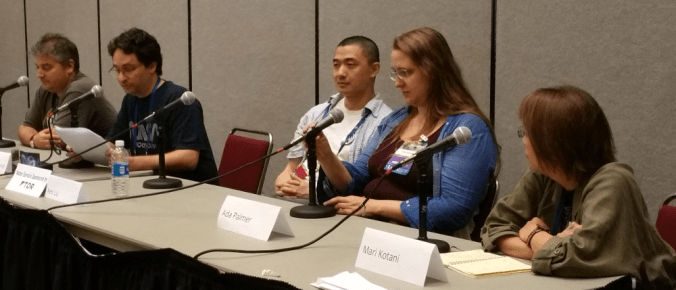
Panellists: Caroline M. Yoachim (moderator), G. David Nordley, Ctein, Larry Niven, Sheila Finch

Joined in progress …

GDN: To build aliens, you have to start with the system, planets, and so on down.

C: When it comes to the aliens themselves, a top-down approach means psychology first.

LN: I’ve created aliens with handles on the skull. Humans have bilateral symmetry on the outside. Inside, not so much. An alien can have two dominant arms for fine manipulation, or one extra-muscular arm for heavy lifting. Why not a dwarf elephant with two trunks and fingers on the trunk-tips?

SF: It happens all at once for me. I have an image of the alien. I take a step back and consider what environment might have produced it. Then, I develop the psychology and language. The metaphors used are linked to physiology.

C: I’m happy to steal if it works. I have a species I based on puppets.

CMY: Do you have to balance strangeness with relatability?

GDN: I’m not bothered by aliens that have commonalities with humans. Our basic drives are all the same.

C: There are special, species-related characteristics. Will aliens have religion? Will they be acquisitive? Are they into body augmentation?

SF: Corvids are acquisitive.

LN: I ask myself, what’s the weirdest thing about an alien? Then I extrapolate back.

SF: Sentience and self-awareness have been proven to exist in animals.

C: One notable characteristic of humans is that we build. If there’s an advanced species out there that doesn’t build, what do they do?

LN: What’s the process of adapting humans to their environments?

CMY: What pitfalls do you see? What are your pet peeves?

GDN: Characters that don’t have survival value.

LN: There was a story based on a hospital station—everyone got sick. [Mel’s note: not every disease will attack every species by the same vector. Zoonosis is not common on Earth. And then, there’s immunity.]

SF: Plant aliens that aren’t done well. Sequoias, for example, would have a chemical intelligence.

C: When the physical worldbuilding isn’t related to the story. If it’s all about the display of worldbuilding prowess, it’s essentially scenery.

CMY: When all the aliens are the same, are they truly “alien” aliens?

GDN: Silicone and oxygen might be able to produce something similar to DNA and RNA. Truly alien aliens are difficult to figure out physiologically and biologically.

SF: With truly alien aliens, their physiology becomes the story. It’s all about explaining how they function.

And that was time.

I’ll have one more WorldCon 2016 session to share with you this month, and it’s more worldbuilding (are you sensing a theme?). Next weekend: Political worldbuilding in science fiction.

Be well, be kind, and stay strong until next I blog.

Thoughty Thursday: Things that made me go hmmmm on the interwebz, March 5-11, 2017

Time to get that mental corn popping!

Some lovely pieces for #InternationalWomensDay

Today I rise. Films for Action

Jina Moore shares 16 stories that will expand your mind on IWD. Buzzfeed

Australian school boys share the stories of their female friends: why feminism is important to me.


Courtney Shea: why sports psychologist Dr. Peter Jensen works like he’s a smoker. The Globe and Mail

A Danish psychologist says “positive thinking” has turned happiness into a duty and a burden. Olivia Goldhill for Quartz.

Jen Schwartz says the secret to happiness is to simplify. Outside

The Usual Routine: why empaths act strange around inauthentic people.

Artists have structurally different brains. Melissa Hogenboom for the BBC.

Susan Storm profiles the INTJ personality. Psychology Junkie

Olivia Goldhill: Blaise Pascal understood that people are best convinced by their own data. Quartz

Rutger Bregman makes the case for universal basic income. The Guardian

The Medievalist think these ten Medieval women are worth knowing about.

Explore Canada’s great women on Canada’s History.

Paul Dalby writes about Maria Lindsay Cobham, Canada’s pirate queen. Canada’s History

Nanaboozhoo and the Wiindigo: An Ojibwe History from Colonization to the Present. Bezhigobinesikwe Elaine Fleming for Tribal College: Journal of American Indian Higher Education.

A rabbit hole in a farmer’s field leads to “mystery caves.BBC

Farah Halime profiles the millennial who might be the new Einstein. Ozy

Katherine Hobson: what going to Mars will do to our minds. Five Thirty Eight

Mark Malloy reports on scientists who have discovered how to upload knowledge into your mind. The Telegraph

Ryan F. Mandelbaum reports on the observation of time crystals. Gizmodo

Dana Dovey: scientists identify the first sign of Alzheimer’s Disease. MSN

Patton Oswalt explains why pop culture gets grieving wrong. Ari Shapiro for NPR.

The second sight among Scots Irish. McCain’s Corner

George Dvorsky shares the first footage of one of the most reclusive whales in the world. Gizmodo

It’s been a long day, and you’ve earned this video of Sir Patrick Stewart greeting his new foster dog. William Hughes for the A.V. Club.

Hope you got your fill of thoughty.

Until next I blog, be well.

thoughtythursday2016

Tipsday: Writerly Goodness found on the interwebz, March 5-11, 2017

The writerly goodness just keeps on coming 🙂

K.M. Weiland offers the next in her most common writing mistakes series: dead end relationships. Helping Writers Become Authors

John J. Kelley: the care and feeding of relationships. Writer Unboxed

Bryn Greenwood explains hot bunking for writers. Writer Unboxed

Kathryn Craft explores the power of unexpected elements. Writer Unboxed

Emily Cavanaugh helps you take yourself seriously as a writer—before anyone else does. Writers in the Storm

Orly Konig-Lopez explores living with writerly self-doubt. Writers in the Storm

James Scott Bell is in the Writers Helping Writers coaching corner: conflict and suspense belong in every kind of novel.

Dan Blank guest posts on Writers Helping Writers: the daily practice of growing your audience.

Jamie Raintree examines authenticity and the discomfort of vulnerability.

Robin Lovett extols the merits of happily ever after. DIYMFA

Gabriela Pereira interviews Clare Mackintosh for DIYMFA radio.

Jami Gold: right brain vs. left brain vs. creativity.

What’s the purpose of story structure for readers? Jami Gold

E.R. Ramzipoor guest posts on Janice Hardy’s Fiction Univerity: token or broken? Writing LGBT.

How to outline your novel, part 2. Jenna Moreci


Susan Spann lists ten questions you should ask before you accept a publishing deal. Writers in the Storm

Nevertheless, she persisted: a Tor.com flash fiction project. Awesome stories by awesome writers.

Margaret Atwood: what The Handmaid’s Tale means in the age of Trump. The New York Times

Molly McArdle takes a look at the rise of Roxane Gay. Brooklyn Magazine

Mary Walsh is coming out with her first novel! CBC Books

Kathleen O’Grady reports on the discovery of a true language universal. Ars Technica

David Schultz: some fairy tales may be 6,000 years old. Science Magazine

Robert MacFarlane considers Susan Cooper’s The Dark is Rising the eeriest novel he knows. 1843 Magazine

Twenty questions with Ursula K. Le Guin: The Times Literary Supplement

Simon Tolkien writes about his grandfather and how WWI inspired The Lord of the Rings. BBC

Here’s a literary cold case for you: Jane Austen may have died of arsenic poisoning. Christopher D. Shea and Jennifer Schuessler share the evidence, and the theory, so far. The New York Times

And that was your informal writerly learnings of the week.

See you Thursday!

Be well until then.

tipsday2016

WorldCon 2016: The art of worldbuilding

Disclaimer: I am not perfect and neither are my notes. If you notice anything that requires clarification or correction, please email me at melanie (dot) marttila (at) gmail (dot) com and I will fix things post-hasty.

Panellists: Peter Tieryas, Carrie Patel, Luke Peterson (moderator), Amanda Downum, Greg Bear

Worldbuilding

Joined in progress …

GB: Edgar Rice Burroughs was the first worldbuilder. He delved into culture and economics. Read Olaf Stapledon’s Star Maker.

LP: Where do you start?

AD: Use the character as the starting point. Develop the city, country, and world around them. Move outward to weather and so forth.

CP: Ask, what does the society value most and what does it fear the most?

PT: If you see a movie with a good story but bad effects, it’s ok. A movie with good effects but a bad story is just bad.

GB: I work from the top down. Sometimes a complete vision of the world will take years to form.

LP: How much do you need to know?

GB: I’m an English major.

CP: You don’t need to tell your readers everything. What’s important to the story you’re telling?

AD: Have a friend ask random questions and build your world or research based on that.

PT: sometimes the best research is done by people who have no expertise.

AD: Find someone who doesn’t read your genre. That’s the acid test.

LP: How do you set your limits? When do you stop?

AD: It’s hard to tell. When you’re drafting, it’s okay to leave some things undefined for later. Get the bones of the story down first.

CP: You might have to dive back in, mid-draft, if you write yourself into a situation only worldbuilding can get you out of.

PT: Hitler exempted artists, and later scientists, from war. It was dark material I had to research for my book. I didn’t want to continue, but I needed to get a grip on the story.

CP: Does the research or detail of the world tell the reader something about the character or the plot? If not, it shouldn’t be in there.

And that was time.

Next week, we move from worldbuilding to alienbuilding 🙂

Be well until then, my writerly friends, and work to make your dreams come true.

Thoughty Thursday: Things that made me go hmmmm on the interwebz, Feb 26-March 4, 2017

This week’s mental corn popping fuel is all—or almost all—about the ladies 🙂

Nicole Mortillaro: Oldest traces of life on Earth discovered in Quebec, dating back roughly 3.8 million years. CBC

Elon Musk to build three more gigafactories to change the way the world uses energy. Lorraine Chow for EcoWatch.

Ellen Dolgren: why don’t women talk about perimenopause? CBC

ASAP Thought: being a woman.


Chimamanda Adichie’s 15 suggestions on how to raise a feminist daughter. Audie Cornish for NPR.

Madison Pauly provides a brief history of men taking credit for women’s accomplishments: “I made that bitch famous.” Mother Jones

The Daily Health Post gets down and stretchy with your piriformis.

This week’s kawaii: baby sloth talk. Bright Side

We’ll see you on the weekend for more WorldCon 2016 reportage.

Be well until then!

thoughtythursday2016

Tipsday: Writerly Goodness found on the interwebz, Feb 26-March 4, 2017

Ah, another lovely batch of informal writerly learnings for you 🙂

K.M. Weiland: the lazy writer’s six-question guide to writing an original book. Helping Writers Become Authors

Kathryn Craft shares seven ways to get rich from writing (it’s not quite what you think). Writers in the Storm

What a sensitivity reader is and how to hire one. Natalia Sylvester guest posts on Writer Unboxed.

Julia Munroe Martin tells us how to get by with a little help from our (writer) friends. Writer Unboxed

Sarah McCoy: a hard change will do you good. Writer Unboxed

Donald Maass says, impossible odds for everyone! WriterUnboxed

Jo Eberhardt: how to (not) overcome fear. Writer Unboxed

Laura Drake: the angels are in the details. Writers in the Storm

Chris Winkle lists twelve traits that help create loveable heroes. Mythcreants

Oren Ashkenazi examines five great characters from horrible shows. Mythcreants

Chuck Wendig never fails to crack me up (while sharing awesome advice). A very good list of vital writing advice—do not ignore! Terribleminds

Jenna Moreci: how to outline your novel, part 1.


Angela Ackerman shares the news about the new worldbuilder tool on One Stop for Writers. Looks amazing. Writers Helping Writers

This feels weird, but also awesome. I’m curating myself! Why I write speculative fiction. DIYMFA

Bess Cozby embarks on an experiment in minimalism. DIYMFA

Gabriela Pereira interviews Dale Wiley for DIYMFA radio.

Michelle Chalkey shares five benefits of aromatherapy for writers. DIYMFA

Ruth Harris examines stress and burnout, how they’re different, and why it’s important to know the difference. Anne R. Allen’s blog

Dr. Jena Barchas-Lichtenstein asks us to, um, stop demonizing filler words. Quartz

Check out this year’s Latitude 46 line up. The North Bay Nugget

Stephanie Convery reports on Ali Cobby Eckermann, the unemployed, indigenous poet who just won the $215,000 Windham-Campbell Award. The Guardian

George Saunders: what writers really do when they write. The Guardian

Zen Pencils: Stephen King’s desk.

Hillel Italie: Ursula K. Le Guin among authors inducted into the American Academy of Arts and Letters. SFGate

George Gene Gustines interviews Ta-Nehisi Coates about creating black superheroes. The New York Times

Don Pittis: machine intelligence lessons from science fiction. CBC

Swapna Krishna pits science against The Expanse: is it possible to colonize our solar system? Tor.com

Genevra Littlejohn critiques Iron Fist. The Learned Fangirl

If you liked the movie Arrival, Phil Plait wants a (single) word with you. Blastr

In the latest Guardians of the Galaxy, Vol. 2 trailer, Peter gets to meet his dad. Katharine Trendacosta for i09.

And that’s it until next week!

But you can always come back on Thursday for a little thoughty 😉

tipsday2016

The next chapter: February 2017 update

And here we are at the beginning of a new month.

It’s been a month of big decisions and rearranging goals and priorities.

First, the good news.

After discussing the issue at length with Phil and Mom and some of my writer friends, I’ve made the decision to go to WorldCon 75 in Helsinki, Finland … and I’ve registered for the Writing Excuses cruise that immediately precedes it!

You can’t see me right now, but I’m so excited and nervous (it will be my first time to Europe) I’m vibrating on a higher level. I might be worn out before August even gets here.

Though travel arrangements are still in flux, and we haven’t even gotten to leave requests at work (which is always a concern), I’ve made the leap. I’m confident the net will appear.

I’ve also joined the DIYMFA team as a semi-regular genre columnist. My genre? Fantasy and science fiction, of course 🙂 This is another squee-worthy achievement and I hope I can live up to the DIYMFA brand.

Finally, I’m on the program committee of the Canadian Authors Association.

Add that to my newsletter-er gig with the Sudbury Writers’ Guild, and ye olde day job, and my schedule is getting pretty full.

Writing-wise, I’ve finished drafting Wavedancer and am now moving on to the mapping.

This is a bit of a change for me. In the past, I’ve left the mapping for my first revision pass, but I want to keep the novel fresh in my mind as I map this time. What’s happened in the past is that the first revision pass has ended up being primarily about the mapping because I’m reading to refamiliarlize myself with the story. Not much actual revision happens.

By mapping it out before I let the draft rest, I hope to be able to dive into more substantial structural issues with the first true revision. We’ll see how this tweak to my process works out. So far, I’m liking it, because I’m making notes for the revision and cutting extraneous stuff as I go. It’s so much easier when the story is still fresh in my mind.

I had hoped to make a mentoring connection to work on Reality Bomb, but this has not come to pass. There are some significant issues with the story and the science that mean research and rethinking. So I’m going to let that project simmer for a while longer while I conduct the requisite research and return to it later in the year with more objectivity.

I missed the first anthology call I’d identified for the year. I’d have had to write a new story for it and while an idea did eventually pop into my head, it was too late to execute. I’ve now identified several contests, magazines, and anthology calls that I’d like to try for, and I’ll see if I can’t organize myself to meet some of them at least.

Here’s how the numbers worked out:

Drafting Wavedancer – goal 14,000 words – actual 13,191 words

Blogging – goal 5,600 words – actual 4360 words

While I had planned to write a piece of short fiction, it didn’t work out because reasons.

Total writing goal for February: 19,600 words

Actual words written: 17,551

februaryprogress

Wavedancer worked out pretty much as I expected it would. The total draft is just over 100K words. I was able to wrap it up earlier than I thought, though, thanks to a number of days in January and February in which I wrote more than my daily goal of 500 words.

I don’t mind not having blogged so much. While I want to continue to curate and create useful content, I don’t want it to become a chore or to take over my creative time.

For the foreseeable, I’m going to be researching for RB, mapping Wavedancer, and working, yet again, on a brand new opening chapter for Initiate of Stone in preparation for another revision pass on that novel.

This time, I’m writing the first chapter out by hand and except for the major events, I’m going to abandon all past versions. We’ll see if this works. I’ve been too bound to what I’ve written and it doesn’t work. My unsuccessful queries and various first page/first 50 page critiques have all led me to this conclusion.

Actually, the conclusion was always there. I was just ignoring it. Delusional Mellie is delusional.

So there may not be a lot of actual words counted for the first part of March because it’s too labour and time intensive to capture hand-written work.

I’m also going to revise a piece of short fiction for a contest. It’s another problematic piece that may require a return to the drawing board.

Long story short, all this experimentation and process tweakage has meant a substantial reorganization of my writing goals for the year. I’ve shuffled and we’ll see how things go.

In other aspects of this writer’s life, the sun is finally coming out. Literally. It’s been a dull and gloomy winter up here in northern Ontario and, as a result, a lot of us are experiencing more-than-usual levels of seasonal affective disorder (SAD). I’m feeling better than I have in a long time and I thank Sol.

I’ve also been experiencing persistent health issues due to being a woman of a certain age. I think that, too, is working itself out. Finally. I still have a referral to a specialist this month and I’m going to keep it. I still want to explore my options in the hope of maintaining my recovered health.

Phil’s doing well, and is still planning to tackle further renovations this year. Exactly when these might happen is up for discussion, but, as he often reminds me, he’s not getting any younger.

It looks like problems with the pay system at work are not going to be resolved in time for me to consider a self-funded leave in the spring. So I’ll defer it, and puppy plans, until the fall (again).

But I have a lot of good stuff to look forward to in the meantime: Story Masters in May with Donald Maass, James Scott Bell, and Christopher Vogler, a possible workshop with Gail Anderson-Dargatz or CanWrite! in June, and Writing Excuses and WorldCon in August.

And, of course, lots of writing in between.

Next week, I’ll be resuming WorldCon 2016 reportage. This should continue on the weekends until sometime in April and then I’ll have a bit of a break until my next workshop, conference, or convention. I might fill it up with some series discoveries or movie madness posts.

Until next I blog, be kind, be strong, and be well.

The Next Chapter

Thoughty Thursday: Things that made me go hmmmm on the interwebz, Feb 19-25, 2017

It’s time to pop that mental corn, people.

In the war between Baby Boomers and Millennials, we’ve forgotten the hard-working, hard-playing Generation X. Um, no. We haven’t. Interesting article nonetheless. David Barnett for The Independent.

Jon Brooks: Girl? Boy? Both? Neither? A new generation overthrows gender. KQED Science

How slavery changed the DNA of African Americans. Michael White for the Pacific Standard.

Sarah Dziedzic discusses African-Canadian history with Cheryl Foggo. Canadian Living

Tristan Hopper recounts how smallpox decimated BC. The National Post

Bruce Kasanoff: intuition is the highest form of intelligence. Forbes

Anna Lovind: what if you’re on the wrong train?

I love language, and so, when I saw this article on Queens, the linguistic hub of the world, I had to share. Thanks, Lori. You always post teh awesome. Gus Lubin for The Business Insider.

This makes me sad, though. Kat Eschner: four things that happen when a language dies. The Smithsonian Magazine

Elizabeth Kolbert writes about why facts don’t change our minds. The New Yorker

Phil Plait: SpaceX nails the landing after an historic launch. Blastr

Umir Abrar is slightly embarrassed. A giant, dark galaxy is orbiting ours, but astronomers just noticed it. Physics Astronomy

Seven Earth-sized planets found orbiting around a nearby (relatively speaking) star. Phil Plait for Blastr.

NASA presents a celebration of clouds.

Brian Cox explains how the Large Hadron Collider disproves the existence of ghosts. BBC

Healthy Holistic Living shows you how to make a bee waterer to help support pollinating insects 🙂

Lauren Cassani Davis: horses can read human facial expressions (more than dogs or chimpanzees). The Atlantic

Moby just released four hours of free music composed for yoga and meditation. Educate Inspire Change

Imogen Heap – Run-time.


I hope you’ve got some good ideas to fuel you through the week.

See you Saturday for my February 2017 update 🙂

Be well until then!

thoughtythursday2016

Tipsday: Writerly Goodness found on the interwebz, Feb 19-25, 2017

And here we are for another week of informal writerly learnings.

K.M. Weiland shares eight ways to master your story’s pace. Helping Writers Become Authors

Vaughn Roycroft: the significance of small gestures. Writer Unboxed

Jeanne Kisacky shares her experience with post-project depression and recovery. Writer Unboxed

Chuck Wendig says you must write unafraid, without fear of failure. Terribleminds

Jami Gold asks, are there story elements you avoid writing?

Jeanne Cavelos guest posts on Writer Unboxed: the importance of the adversarial ally.

Stephanie O’Brien: how to write a fight scene readers will love. The Write Practice

Kristen Lamb says description is writer’s crack, but you have to find the write balance.

Jamie Raintree: there are no shortcuts. Writers in the Storm

Emily Wenstrom shares five ways to show readers you’re their perfect match. DIYMFA

Dan Blank encourages you to embrace your boundaries. Writer Unboxed

Heather Webb considers what fiction trends say about us. Writer Unboxed

Betsy Dornbusch guest posts on Terribleminds: the new relevance of the fantasy novel.

Veronica Sicoe wonders what happens when “professional writing career” isn’t your end-all goal?

Sara Letourneau joins the Writers Helping Writers resident writing coaches: using text-to-speech software as an editing tool.

Gabriela Pereira interviews Brian Meehl on DIYMFA radio: the only way forward is back.

Chris Winkle offers six tips on how to challenge bigotry in your work. Mythcreants

Oren Ashkenazi explores five underused settings in speculative fiction. Mythcreants

Pixar and the Khan Academy team up to produce The Art of Storytelling. And … it’s FREE!

Colleen Gillard wonders why the British tell better children’s stories. The Atlantic

Jason Daly reports that ancient Egyptian stories will be published in English for the first time. The Smithsonian Magazine

Michael Livingston shares the tales of his favourite five medieval women warriors (including Lagertha!). Tor.com

Space says that Mary and the Witch’s Flower captures the spirit of Studio Ghibli.

Brain full? Good. Now get writing!

See you Thursday!

tipsday2016

WorldCon 2016: The dark side of fairy tales

Disclaimer: I am not perfect and neither are my notes. If you notice anything that requires clarification or correction, please email me at melanie (dot) marttila (at) gmail (dot) com and I will fix things post-hasty.

darkside

Panellists: Ellen Datlow, Brooke Johnson, Erin Wilcox (moderator), Sandee Rodriguez, Dana Cameron

Joined in progress …

DC: Fairy tales are the intersection between the known and the unknown in a way that other stories aren’t.

BJ: Tone is the defining quality. It’s a sense of magic realism or normalized magic. I’m currently reading the Turnip Princess. It’s meant to be read. Oral storytelling. Fairy tales are mythic, grand and meaningful, larger-than-life, and yet the things that happen are everyday occurrences to the characters of the story.

SR: Folk tales have the element of reality. Fairy tales have no sense of history.

DC: Domesticity is addressed in fairy tales.

EW: There’s a marked different between fairy tales intended for children and those intended for adults.

ED: Modern retellings add sex. The originals were dark enough, though. Look at Hansel and Gretel—they were going to be eaten but ended up stuffing the witch in the oven.

BJ: Fairy tales were cautionary.

EW: In his book, The Uses of Enchantment, Bruno Bettelheim says that the reader divines whatever they want from the fairy tale. What is it that scares you most? Is it that your parents didn’t want you?

DC: Fairy tales were didactic, warnings. What happens when you go out into the world alone? There are only a handful of clever, successful kids who survive. There’s a tale about the young servant of a king, He discovers how the king became so wise—he ate a white serpent. The kid tried it and goes out into the world. He’s kind and curious and eventually becomes a wise king himself. I took the basic tale and moved it into space.

SR: Reading dark fairy tales to young kids beneficial. The story is internalized. They imagine what they would do in that situation. How would they escape? It develops creativity and problem solving skills.

EW: Do fairy tales need to be sanitized? Should they be?

BJ: Disney sanitized everything. Snow White is about persecution and stalking.

ED: Tanith Lee sexualized fairy tales. You can retell fairy tales over in different ways. Hans Christian Andersen had a thing about sacrifice and death. Look at his versions of The Little Mermaid and The Little Match Girl.

EW: Fairy tales from all over the world overlap.

DC: I read Japanese fairy tales when I was eight. There was a boy who drew cats. His drawings came to life at night to save him from a rat demon.

EW: In India they don’t really have fairies, but the national epics are being adapted.

BJ: Tiger’s Curse has Indian influences. It didn’t appeal to Disney. I’m drawn to the dark tales. I write tragic stories.

ED: Read Bullfinch’s Mythology, The Illiad, The Odyssey. Myth isn’t magical enough.

DC: Fairy tales often have bittersweet endings because you can’t go back.

And that was time.

Next week, it’s time for my next chapter update 🙂

Be well and stay strong until then, my friends.