Thoughty Thursday: Things that made me go hmmmm on the interwebz, April 23-29, 2017

Lots for the visual learner this week 🙂

I’ll just leave this here … Andrea Wallace shares her struggle with the failed Phoenix pay system. Medium

SciShow marches for science.


Deborah Tannen examines the (sometimes unintentional) subtext of digital conversations. The Atlantic

Why can’t you use your phone on a plane? SciShow


Rachel Ginder: introverts don’t hate people, they hate shallow socializing. Introvert, Dear

Veritasium looks at the sun sneeze gene (don’t know what that is? I didn’t either!)


Sandrine Ceurstremont reports that female dragonflies will fake sudden death to avoid unwanted male advances. This made me lolz. Way to go, ladies 😉 New Scientist

Dogs are doggos: an internet language built around love for the puppers. Jessica Boddy for NPR.

And speaking of dogs … kind of … this seal just wants a belly rub 🙂


Shel – Enter Sandman. Eerie and beautiful.


Now that your mental corn is popping (I hope) I shall leave you to your own devices until the weekend.

Be well until next I blog.

thoughtythursday2016

Tipsday: Writerly Goodness found on the interwebz, April 23-29, 2017

It’s another week chock full of informal writerly learnings 🙂

K.M. Weiland shares three ways to make your fiction more visual. Helping Writers Become Authors

Later in the week, Kate returns with how to write (and not write) expository dialog(ue).

Colleen Oakley guest posts on Writer Unboxed: how to make your readers believe the unbelievable (or, the importance of facts in fiction).

Barbara O’Neal explores the complex power of mapping the world of your novel (with neuroscience!). Writer Unboxed

Heather Webb explains why changing up your writing process from book to book works. Writer Unboxed

Allie Larkin says fighting writing stage fright is about more than picturing your readers in their underwear. Writer Unboxed

Kathryn Craft: to sleep, perchance to dream. Writers in the Storm

Jamie Raintree asks, are you writing out of fear, or love? Writers in the Storm

Sara Letourneau: seven steps to honouring your reality. DIY MFA

Gabriela Pereira recommends some must-read books for your writing library. DIY MFA

Kolina Cicero reviews Scratch for DIY MFA.

Angela Ackerman shares some of her fantastic finds for writers. Writers Helping Writers

Julie Glover guest posts on Jami Gold’s blog: four common copy editing issues to watch for.

Bonnie Randall guest posts on Fiction University: what writing rules do you always get wrong?

Elizabeth Sims guest posts on Jane Friedman’s blog: four methods for developing any idea into a great story.

Jenna Moreci helps you choose your next story.


Margaret Atwood shares seven tips for writers. Writer’s Digest

Roz Morris pleads with reviewers: can we open up a dialogue about self-published books? Nail Your Novel

Chris Winkle helps you depict internal conflicts. Mythcreants

Oren Ashkenazi examines five stories that are afraid of their own premises. Mythcreants

Aaron Miles returns with part two of sieges and siegecraft: defenders. Fantasy Faction

Kate Elliott: the status quo does not need world building. Tor.com

Eight words that changed the way we think. Kelley Grovier for the BBC.

Marie Mutsuki muses on the nature of fairytales and storytelling from east to west. [yes, it’s from last year, but it’s awesome] Literary Hub

Alexandra Alter reviews William Gibson’s Agency. The New York Times

Jeff Vandermeer and Cory Doctorow discuss the future of science fiction and the world. Electric Lit

Twelve women authors share how Margaret Atwood made them feminists. Elle

Another oldie but goodie from 2015. Emily Asher-Perrin thinks Real Genius is the geek solidarity film that nerd culture deserves. Tor.com

Germaine Lussier takes a look at the trailer for Kingsman: the Golden Circle. i09

And this is how we improve our craft 🙂

Hope something here gave you what you need to get to the next level.

Be well until thoughty Thursday comes along to pop your mental corn!

tipsday2016

Changing things up and the reasons why

A few years ago, I decided to change things on the blog. I started curating Tipsday and Thoughty Thursday, and then, on weekends, I mostly blogged my session notes from various conferences and conventions I’d attended.

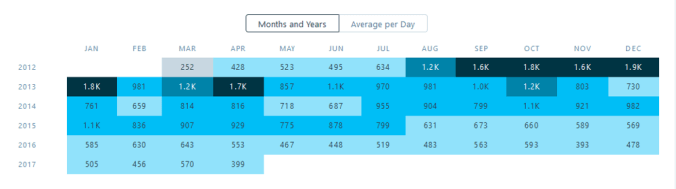
It was easy for me, with respect to generating content, and I sincerely thought I was offering something of value to my readers. My WordPress stats do not bare this out, however. Round about 2014 (when I started the curation and session notes), my views drop and are consistently below a thousand per month.

views

Views dropped again after Nuala died in 2015. My pupdates were clearly some of my more popular posts, as well.

Even looking at it by day, I only seem to have a peak in views (40+/day, which I know is nothing when it comes down to it) about once a month. When those peaks occur varies. It could be after a Tipsday post (most often), or a Thoughty Thursday post. Sometimes, it’s on a weekend, but it could be session notes, or a monthly update. There’s really no pattern that I can pull out.

But clearly, this means I’m not doing my job.

I have therefore decided that it’s time to shake things up again. Not too much. ‘Cause I’m cautious that way.

I’ve had the most views, likes, and comments on my curation posts, so I’m going to keep blogging those. I’ve created better graphics for them (thank you, Canva) and I still believe they have value.

It’s the weekends I’m going to rethink.

I’m also going to continue my monthly updates. I like sharing my progress on various projects and it keeps me accountable.

I’m no longer going to blog session notes, though. Instead, I’ll do a summary/highlights post of any writerly events I attend. There are enough of those that it will keep me producing quality content. In the past couple of years, I’ve actually glossed over some of these events, or only given them a passing mention in my monthly updates, because I really haven’t had the time to write a post devoted to every event I attended.

I’m going to revisit some of the topics from the blog posts that, even five years on, continue to receive the most traffic.

I’m also going to post a referral to my DIY MFA columns when they come out.

Finally, I’ll fill in the gaps with Movie Madness, Series Discoveries, and the odd book review. There may also be the occasional Muse Inks post on this writer’s life, which won’t focus on the writing, but the other stuff that fills up my life around writing.

When Phil and I get our next fur baby (this fall is the new goal … we hope) Sundog posts may even return 🙂

Because writerly goodness is a solo effort, though, I’m still going to have to take the occasional blogging vacay for some of the bigger events I attend. It’s the way things have to go while I’m still working a day job.

If I want to set the time aside to write and to attend my various writerly professional development opportunities, I really don’t have the time to generate a lot of content to pre-schedule and fill in the gaps. I find myself at the limit as it is, but that may be because of the various commitments I’ve made to some of the professional writing organizations of which I’m a member.

I’m considering a re-envisioning of those commitments, too. There’s only so much of me to go around. Do I want to be writing, or do I want to be contributing to the success of writing organizations? It’s going to be a tough decision, ‘cause I’m like Eek! the cat. I always think it never hurts to help. Until it does.

The next few weeks in writerly goodness:

Next weekend, it will be my monthly Next Chapter update. The weekend following, I’ll be away at Story Masters and won’t be posting, but I’ll tell you all about it the weekend after. I’ll have a few more events to discuss in upcoming weeks, but I’ll get into that in my Next Chapter post.

So stay tuned as I work my way through this transition.

And let me know what you think, please. Will this shift be a pleasing one for you? Perhaps only time (and stats) will tell, but if you have any thoughts to share, I’d love to hear them. And if you have requests to make, I’m all (virtual) ears. I know I can’t please everyone, but I’m willing to incorporate some of your suggestions into my ongoing plan.

Thanks for your time and attention.

You’re the bestest!

Muse-inks

Thoughty Thursday: Things that made me go hmmmm on the interwebz, April 16-22, 2017

I hope something in this grab bag gets your mental corn popping! On with the thoughty!

Heather MacDougall explores the pagan roots of Easter. The Guardian

Zdravko Cvijetic lists thirteen things you need to give up if you want to be successful. Medium

George Monbiot: neolibralism encourages loneliness and that’s wrenching society apart. [Mel’s note: this introvert says being alone is not necessarily lonely. Keep the distinction in mind as you read.] The Guardian

For balance: Michael Harris promotes the benefits of solitude. The Walrus

Alice Klein reports that creative people see and process the world differently. New Scientist

Tracy Moore says, we have to talk about women who regret having children. Jezebel

Kat Chow: the “model minority” myth is again used to drive a wedge between Asians and blacks. NPR

Itai Palti thinks that the next industrial revolution will be driven by human creativity, not machines. We can always hope. Quartz

D.T. Max reviews how humans have shaped our evolution. National Geographic

Why are you so tired? ASAP Science


Following up on last week’s postmodernist post, have a look at an animated introduction to Roland Barthes’ Mythologies. Learn how to deconstruct popular culture. Open Culture

Carol Off interviews biologist David George Haskell about the songs of the trees. CBC

April 22 was Earth Day, so here are some topical posts:

See you on the weekend. Be well until then.

thoughtythursday2016

Tipsday: Writerly Goodness found on the interwebz, April 16-22, 2017

And here we are with another week full of informal writerly learnings 🙂

K.M. Weiland: what does it mean to move the plot? Helping Writers Become Authors

Later in the week, Kate shows up with three ways to test your story’s emotional stakes, the latest in her lessons from the Marvel Cinematic Universe series. This post focuses on Doctor Strange.

Parul Macdonald shares six myths and truths about what editors at publishing houses are looking for. Writer Unboxed

Dave King tells you how to wrap it up. Writer Unboxed

Colleen M. Story explains how to use writer’s intuition to strike creative gold. Writers in the Storm

Jenny Hansen profiles social media personalities for Writers in the Storm.

Laura Drake helps you write a great last line. Writers in the Storm

Jami Gold looks at fixing big problems with small changes.

When is the right time to start building your platform? Kristen Lamb

Gabriela Pereira borrows a pop quiz from Kristen Lamb: are you an aspiring writer? DIY MFA

Stacy B. Woodson: when is a story a romantic suspense? DIY MFA

Gabriela Pereira interviews K.J. Howe about writing strong female characters. DIY MFA

Sara Letourneau shares five reasons to attend the Iceland Writers Retreat. DIY MFA

Kris Spisak guest posts on Jane Friedman’s blog: five commonly confused words starting with A.

Angela Ackerman says, to become a successful writer, you have to develop your intuition. Writers Helping Writers

Adam Haslett examines the perpetual solitude of the writer. Literary Hub

Oren Ashkenazi: five perspective mistakes to avoid. Mythcreants

Chuck Wendig shares the wisdom he’s gained over 5 years and 20 books. Terribleminds

Why isn’t Irish mythology more popular? Tale Foundry


Kaitlyn Johnson: mastering the dreaded synopsis. Writer’s Digest

Steve Fahnestalk: where do I send the SF/F book I just wrote? Amazing Stories

Charles Chu lists the six strategies Isaac Asimov used to write almost 500 books in his lifetime. Quartz

Nisi Shawl continues her crash course in black science fiction series by revisiting Samuel R. Delaney’s The Jewels of Aptor. Tor.com

Martin Rezny: how (and why) to write realistic magic and aliens. A-MA-zing! Electric Lit

Laura Miller reviews Jeff Vandermeer’s Borne. The New Yorker

Jane Eyre – Thug Notes Summary and Analysis (funny, but fabu)


Terri Kapsalis offers a brief history of hysteria, witches, and the wandering uterus. Literary Hub

Emily Temple: The Handmaid’s Tale adapts more than the novel. Literary Hub

The Outlander season 3 trailer (I can’t wait!):


Emily Asher-Perrin reviews the series 10 Doctor Who premiere. Tor.com

AutoCrit shares some writing memes.

I hope you picked up some tasty bits that will help you improve you craft, open your mind, or that entertained you in that special, writerly way 😉

Be well until next I blog!

And virtual hugs all around 🙂

tipsday2016

WorldCon 2016: The state of feminist fantasy

Disclaimer: I am not perfect and neither are my notes. If you notice anything that requires clarification or correction, please email me at melanie (dot) marttila (at) gmail (dot) com and I will fix things post-hasty.

FemFant

Panellists: Julia Rios, Ann Leckie, Dr. Janice M. Bogstad, Tessa Gratton

Joined in progress …

AL: In science fiction, feminist authors and novels are being recognized. Why isn’t this happening in fantasy?

JMB: In a culture where everyone is equal, can there be feminism? We’d have to step back and compare.

TG: The feminist conversation is very dynamic right now. Feminism is a tool for dismantling the patriarchy and the conversation is complicated by sexism, ageism, ableism, racism, etc. We can’t talk about feminism in isolation. There’s a lot of intersectionality. I think Kate Elliot and N.K. Jemisin are feminist fantasy authors.

AL: When someone looks at the genre from the outside, feminist fantasy isn’t identified as a sub-genre.

TG: Science fiction is more overtly political.

JR: When people talk about science fiction, everything gets lumped together. Aren’t the classical texts fantasy? Aren’t fairy tales fantasy? What happens when women authors retell myth and folklore? I’d put forth Catherynne M. Valente and Angela Carter as feminist fantasy authors.

JMB: People outside the genre depend on the frame. In academic circles, they call it the literature of the fantastic. Robin Hobb’s novels have feminist themes. Game of Thrones can be read as feminist. Does it have prominent female characters? Yes. Is it feminist fantasy, though? Perhaps that’s another discussion. How do we define fantasy separate from science fiction? Patricia Briggs and Kij Johnson write feminist stories. We’ve had realistic fiction for a very short period of time, relatively speaking. We’ve had fantasy forever. What else is Beowulf?

JR: Who influenced you as a writer?

TG: I have two big influences: Kate Elliot, because she interrogates the issues I want to explore, and Katharine Kerr.

AL: Andre Norton was a big influence on me. There’s a question as to whether she was feminist. C.J. Cherryh doesn’t consider herself a feminist. I didn’t identify as feminist initially.

JR: If an author identifies as feminist, are their novels feminist?

JMB: People describe a feminist author in relation to their work. Are there feminist themes, gestures, sentiments expressed in the work? We need to define our terms first. Is there a canon of feminist fantasy?

TG: I’m uncomfortable imposing a definition of feminism that doesn’t address intersectionality. You can’t talk about sexism in isolation.

JMB: The same people who wrote science fiction also wrote fantasy. Russ was a lesbian. Intersectionality was part of the discussion. We just didn’t call it that.

TG: Explorations of young adult feminist fantasy aren’t interested in anything before Twilight. It’s the opposite problem.

AL: In science fiction, all of the classic feminist authors are from the 70’s. But current novels are being used to say that this is a new conversation in isolation from history. We need perspective regardless.

And that was time.

This was the last of my session notes from WorldCon 2016.

Next weekend: I’m going to talk about changing things up on the blog a bit and reasons 🙂

Until then, as ever, be kind, be well, and stay strong. Tell your stories. We need them.

Thoughty Thursday: Things that made me go hmmmm on the interwebz, April 9-15, 2017

Pop that mental corn! It’s good for you!

Petula Dvorak: Mary Magdelene has been reviled as a prostitute. That’s not how she was portrayed in the Bible. The Washington Post

Angela Gemmill reports on the latest developments on a new combined art gallery and library for Sudbury. CBC

Drew Hayden Taylor considers smudging to be spiritual, but not religious. The Globe and Mail

Caitlin Thompson reports on the Heiltsuk village that is three times older than the pyramids and what it means for indigenous oral history. Coast Mountain News

Michaeleen Doucleff explains how scientists cracked a 50 year old mystery about measles. NPR

Andrew North: how Mongolia is getting palliative care right. Quartz

Belinda Luscombe: Sheryl Sandberg’s new book, Option B, is a guide for finding life after the death of a loved one. Time

Robyn Reisch explains why intelligent people choose to be less social. Intelligence.com

Dan Dowling says, here’s why you can’t stay focused. Entrepreneur

Olga Khazan examines recent studies that may prove difficult childhoods can improve cognition. The Atlantic

Alice G. Walton lists seven habits that may actually improve brain function. Forbes

Yes, you can measure white privilege. Michael Harriot for The Root.

Stephen Hui: five reasons why we should stop calling white people “Caucasian.” The Georgia Straight

Hannah Devlin discovers why AI programs exhibit racial and gender biases. The Guardian

Natalie Wolchover covers the retiree who discovered an elusive mathematical proof. Wired

Rob Waugh: Hubble just spotted something massive coming out of Uranus. Yes, you may giggle. Metro

Phil Plait shares a video from the ESA’s Gaia project: how the sky may look in 5 million years. Blastr

Physicists say they’ve created a fluid with negative mass. Holy crap is right. Fiona MacDonald for Science  Alert.

It’s okay to be smart looks at the relationship between dogs and humans.


And minute earth cover the feline side of the tale. Tail?


See you on the weekend!

Be well, my lovelies 🙂

thoughtythursday2016

Tipsday: Writerly Goodness found on the interwebz, April 9-15, 2017

And it’s been another lovely week for the writerly goodness 🙂

K.M. Weiland shows us how storytelling benefits everyone. Helping Writers Become Authors

Later in the week, Kate points out three ways to choose the right protagonist.

Roz Morris appreciates The Story of Your Life, on which Arrival was based. Nail Your Novel

Then Roz strolls over to Writers Helping Writers: planning the perfect love triangle.

David Corbett: is your character’s face the window to her soul? [Love the URL title: a face to launch a thousand words, or less. Hopefully less.] Writer Unboxed

Sarah Callender zooms in on third person narration. Writer Unboxed

Liz Michalski says, let your subconscious be your guide. Writer Unboxed

Susan Spann advises you how to request a reversion of publishing rights. Writers in the Storm

Jenna Moreci debunks writer’s block:


Bess Cozby shares the tale of how embracing minimalism made her a better (and happier) writer. DIY MFA

Gabriela Pereira interviews Kathleen Audet: finding your authentic image. They even talk semiotics (!) DIY MFA

Kristen Lamb schools us in deep POV: what it is and why readers love it. Later in the week Kristen takes us deeper into deep POV: how to immerse the reader in story.

Janice Hardy: six ways Netflix can make you a better writer. Fiction University

Later in the week Janice posts about how the wrong tone can change your whole novel.

Jami Gold tells you how to analyze your writing habits so you can improve on the bad ones.

Christine Frazier compares the hero with the secret good guy (and explains why every story needs a secret good guy). The Better Novel Project

Alex Segura explores the moments that keep you going as a writer. Terribleminds

Chris Winkle considers the big problem with uncertain endings. Mythcreants

Everyone (well, Chuck Wendig, Jim C. Hines, and Mary Robinette Kowal, anyway) has been writing about this debacle. I’ll just leave K. Tempest Bradford’s take on it here: OdysseyCon and why serial harassers are safe in out community.

Oh, and this: Bianna Wu offers her perspective on sexism and second chances. Jim C. Hines

Lessons from the Screenplay – Creating the ultimate antagonist in The Dark Knight.


The new World Fantasy Award design is revealed.

Helen Pluckrose explains postmodernism and its impact: how French “intellectuals” ruined the west. I have to say I hate postmodernism myself, and it’s probably because I never truly “got” it. Bleargh … AREO Magazine

Kristian Wilson: old books smell like chocolate and coffee according to science. Hey, who am I to argue with science? Bustle

Anna Pitoniak shares the writing lessons she learned as an editor for Random House. Literary Hub

Psyche Z. Ready offers a transgender reading of an ancient folktale. Tiny Donkey

James Whitbrook takes a look at the first Thor: Ragnarok trailer. i09

Brian Raftery shares The Last Jedi official trailer. Wired

Sense8 will be back May 5th!


And Orphan Black’s final season begins in June! Andy Swift for TV Line.

That was your informal writerly learnings for the week.

Come on back on Thursday for some thoughty.

In the meantime, be well.

tipsday2016

WorldCon 2016: Terraforming Terra

Disclaimer: I am not perfect and neither are my notes. If you notice anything that requires clarification or correction, please email me at melanie (dot) marttila (at) gmail (dot) com and I will fix things post-hasty.

Terraforming

Panellists: John DeLaughter, Elizabeth Moon, Laurel Anne Hill (moderator), Gregory Benford, Patricia MacEwen

Joined in progress …

LAH: Haw can we reduce carbon dioxide, or eliminate excess carbon dioxide?

JD: Increase conservation.

LAH: It’s difficult to motivate large numbers of people to conserve, though.

PM: Hit people in the wallet.

EM: Stop killing plants to put in asphalt. Plants eliminate carbon dioxide.

JD: Green roofs.

EM: Green roofs are a good idea, but existing structures can’t support the extra weight or handle the water. Support the creation of parks, green space, city gardens as part of urban planning.

GB: The US is the only country in which tree populations have risen. It’s also the only industrialized country that’s reduced carbon dioxide emissions.

JD: Going for a clean energy solution means more nuclear power.

LAH: What about ocean iron fertilization?

JD: Life growth is based on the amount of the rarest nutrient in the ocean. That’s iron. So far, things haven’t worked out as well as they’ve hoped.

PM: California has lost an entire youth class of sea lions for three years running. It’s happening all over. Stop over-fishing. Lower polution.

LAH: There’s a great book, Stung, about the unprecedented increase in the numbers of jellyfish. They could be a vehicle for carbon capture and storage.

GB: Thirteen years ago there was a study done on farming waste and disposing of it underwater. There’s a place, 3.2 kilometres down just off Monterey Bay. CO2 is trapped in particles. Crabs eat them and it gets bound in their shells.

JD: In Louisiana, they burn their excess silage. They have ash fall. They call it “Cajun snow.”

GB: There is no will to do the necessary research.

JD: It’s going to take a long time for global warming to become serious enough for people to care.

LAH: Are efforts to reflect sunlight back into space effective?

GB: DARPA has a project. They want to pump sulphuric oxide into the atmosphere over the arctic. It will screen out enough of the sun to slow the melting of the polar ice cap. There is no will to proceed.

PM: There are 50 to 100 mile wide gaps in the ice in the arctic. We’re heading for a crisis.

JD: NASA is involving student observers in their S Cool project.

GB: They could also look into reflective paving materials and roofing mats.

PM: 95% of our living reefs are disintegrating.

And that was time.

Next weekend, I’ll be sharing the notes from my final WorldCon 2016 panel: The state of feminist fantasy.

Until then, be well, be kind, and stay strong, my friends 🙂

Thoughty Thursday: Things that made me go hmmmm on the interwebz, April 2-8, 2017

It’s a mixed bag of thoughty inspiration and entertainment this week to get your mental corn popping 🙂

Everyone is born creative, but schools educate us out of it. Tham Khai Meng for The Guardian.

Self-described woodland hellbitch Rachael Stephen wants to become more informed (since the world is on fire).


Dhruv Khullar: how social isolation is killing us. The New York Times

Alex Pasternack examines the vast, secretive face database that could instantly ID you in a crowd. Fast Company

Andrew Rosenblum: the factories of the future could float in space. Popular Mechanics

Mike Wall reports on the new campaign that hopes to produce a picture of a black hole. Space

Canker sores are … ew. But the Sci Show has some tips to fend them off and make them go away more quickly.


Veritasium looks at the Bayesian Theorem and its applications (including spam).


Joobin Bekhrad looks at Zoroastrianism, the obscure religion that shaped the west. BBC

Ephrat Livni reports that the Japanese practice of “forest bathing” has been scientifically proven to improve health. Quartz

Kabul’s Wushu warriors.


Signe Dean: squid and octopus evolution is officially weirder than we imagined. Science Alert

Pentatonix covers Bohemian Rhapsody.


I hope something got the ideas pinging off the inside of your skull (mental popcorn).

Be well until the weekend. Virtual hugs.

thoughtythursday2016