WorldCon 2016: The steampunk explosion

Disclaimer: I am not perfect and neither are my notes. If you notice anything that requires clarification or correction, please email me at melanie (dot) marttila (at) gmail (dot) com and I will fix things post-hasty.

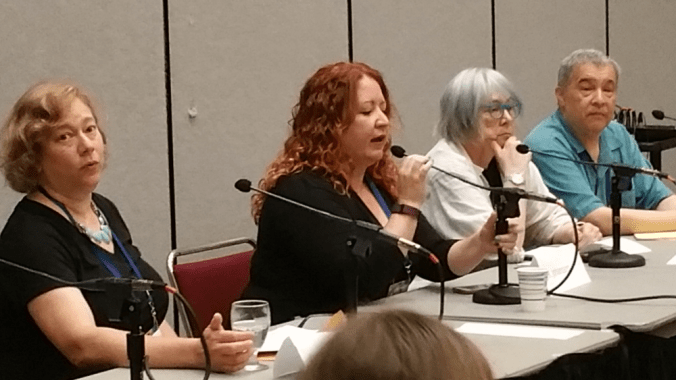
Panellists: Carrie Vaughn, Jeffrey Cook, Laurel Anne Hill (moderator), Gail Carriger, Nina Niskanen

steampunk

Joined in progress …

GC: The term steampunk emerged in the 70’s as an evolution of cyberpunk. The first iteration was dark. Then, steampunk became an aesthetic and finally, humour worked its way in. Whimsy was a reaction to darker iterations. It romanticizes the Victorian era and deals with the class system and double standards of the era. The historical time period was actually very chaotic.

NN: The interaction with class is attractive to both writers and readers. Science fiction doesn’t typically feature a lower class.

CV: The current wave of steampunk is deconstructive.

GC: It’s subversive, commenting on colonialism and class.

LAH: It’s a reinvention of the Victorian age. There was a great excitement then with the industrial revolution and technological advances. People want to recapture the excitement and inspiration of that time.

NN: In Vernor Vinge’s Rainbow’s End [about a man recovering from Alzheimer’s disease who has to renegotiate a world that’s advanced technologically while he was ill], computers have no serviceable parts.

CV: There was an anxiety about science. Frankenstein expresses that fear that we will not be able to control what we unleash.

GC: That was the dichotomy—can technology solve all our problems, or will it cause them?

JC: Rockets were being developed at the time, but the inventor also supported women in STEM [science, technology, engineering, and math].

LAH: The anxiety about science was a reaction against putting all of humanity into a box.

CV: There was a hope and drive to fix things socially as well. Technology wasn’t the answer to everything. Now there’s an environmental aspect in steampunk and that’s a reaction against our disposable society.

NN: Steampunk has avoided painting Victorian London in a “dirty” light. Historical accounts relate that at times there were seas of horse shit in the streets.

CV: Steampunk outside of Victorian Europe are appearing as a reaction against colonialism.

JC: You can have clockwork in 5th century Japan. You can do a lot within the genre. It’s not just the comedy of manners and history heavy stories. There’s more of a spectrum to be explored.

And that was time.

Next week, we’ll delve into some nifty narrative tricks (with shoe puppetry!).

Sending out a huge hug to all my American friends. Stay strong, speak out, and always, keep telling your stories. Sweet Jesus, we need them.

WorldCon 2016: Humans and robots

Disclaimer: I am not perfect and neither are my notes. If you notice anything that requires clarification or correction, please email me at melanie (dot) marttila (at) gmail (dot) com and I will fix things post-hasty.

Panellists: Kevin Roche, G. David Nordley, Brenda Cooper (moderator), Walt Boyes, Jerry Pournelle

humansandrobots

Joined in progress …

KR: They have built and programmed competent bartending robots.

GDN: There’s an S-curve with any technological development. If you picture the letter S and start from the bottom of the letter, robotics is at the first upsweeping curve.

WB: Google is the largest robotics company in the world. Boston Robotics sells services in robotic hours.

JP: With regard to artificial intelligence (AI), every time we started something that looked like AI, people said nope, that ain’t it. Unemployment is higher than the statistics report. In the near future, over half of jobs will be replaced by robots or other automation. The unemployable won’t be visible. They won’t be looking. We’ve not lost jobs to overseas corporations, or not as many as we think. We’ve lost jobs to automation. The “useless” class is on the rise. Look at it this way, an employer saves an employee’s annual salary and spends maybe 10% of it to maintain a robot doing the same work. They’d need one human to service 20 robots.

BC: How do you assign value to human work?

WB: In 1900, the second industrial revolution saw farm workers move to the cities and the factories. The real issue is a philosophical one. We’ve been assigning value to people by the work that they do. A corporate lawyer has, subjectively, greater value than a garbage man. What happens when automation and artificial intelligence replaces both?

KR: When workers are underpaid, the social contract bears the cost. Increasing the minimum wage and increased automation are exposing the dirty little secret. People need to be valued differently. Teachers and artists, in particular, can’t be replaced.

GDN: The top level docs of our society assign value to every citizen. The big question is how do we realize that? The recession has meant fewer tax dollars dedicated to the arts and infrastructure. We have to have the social conversation.

JP: Will advances in artificial intelligence implement Asimov’s three laws? Drones don’t use the three laws. IBM created an AI that beat a human at go [the game]. They took two machines, programmed them with the rules of the game, and let them play each other. After ten million games, they could functionally beat anyone. If you ask a robot to stop humans from killing each other, what’s to stop the robot from coming up with the solution to kill all humans? We have to proceed carefully.

KR: Watson won Jeopardy. Its job is to parse huge amounts of information and look for patterns. It’s humans who decided to test the system by putting it on the show.

GDN: Right now, computers are still, by and large, working on bookkeeping tasks. As we get to the point where we have to consider the three laws, we have to be cautious.

WB: We have to expand out definition of robotics. We have the internet of things with programmable thermostats and refrigerators we can access through our phones. Though still imperfect, we have self-driving cars. We need to figure out how to program morality.

GDN: Human beings don’t consistently make the same moral choices. Fuzzy logic and data sets would be required. Positronic brains would have to deal with potentialities.

KR: We don’t have an algorithmic equivalent for empathy.

And that was time.

Next week, we’re going to explore the steampunk explosion 🙂

Until then, be well, be kind, and be awesome!

WorldCon 2016: Class and equality in fantasy and science fiction

Disclaimer: I am not perfect and neither are my notes. If you notice anything that requires clarification or correction, please email me at melanie (dot) marttila (at) gmail (dot) com and I will fix things post-hasty.

Panellists: Jennie Goloboy, Jennie J.R. Johansson (moderator), Eleanor Arnason, William Hayashi

Note: Terra LeMay was scheduled to participate in this panel, but could not make it. Agent Jennie Goloboy graciously agreed to participate.

classandequality

Joined in progress.

EA: Barbara Jenson said that economy and society cannot be separated.

WH: It’s useful to use familiar tropes to reach your readers, but be wary of stereotypes.

JG: The cultural pressure to categorize people opposes the personal feeling that it’s wrong.

JRJ: You have to question it, though. It’s a useful tension to explore.

WH: Look at how other authors have addressed the issue. Young adult novels turned movies like The Hunger Games and Divergent. Frank Herbert’s Dune. Asimov’s Foundation.

EA: Melissa Scott writes about marginalized characters. Science fiction under-represents the working and middle classes.

JRJ: Marie Lu’s The Young Elites explores issues of class.

JG: What do class and equality look like in the future?  If we extrapolate from current trends, there will be more automation, shorter attention spans, but more independence.

WH: Robert Heinlein pitted the working class against the upper class. It’s a common trope, but it’s realistic. The 1% versus everyone else. Where does hope come from? In Snowpiercer, society at its worst is contained in a train. They’re the last survivors. It’s a microcosm.

JG: Young adult science fiction has focused on the dystopia. What about utopias? Utopias contain the seeds of dystopia and vice versa. But it’s not so simple.

WH: Madeleine L’Engle’s A Wrinkle in Time is hopeful.

JG: There are the working, middle, and upper classes. Are there any others to explore?

WH: Why not transcend class? It’s a spectrum.

JRJ: It’s easier to look at issues in another society, a fictional society, rather than to look at our own.

JG: A reader might say, “I identify with Katniss, so I must be a good person.”

WH: Why do we focus so much on dytopias?

And that was time.

Next week: It will be my December next chapter update and my 2016 year in review post.

Happy New Year (calendrically speaking), everyone!

WorldCon 2016: Beyond—fantasy creation for the bold

Disclaimer: I am not perfect and neither are my notes. If you notice anything that requires clarification or correction, please email me at melanie (dot) marttila (at) gmail (dot) com and I will fix things post-hasty.

Panellists: Kate Elliot and Ken Liu

kateelliottkenliu

My apologies for the picture, Kate. this was actually the better of the two I took 😦

Joined in progress …

KE: People who live in the tropics tend to have darker skin. Those in northern countries are pale. It’s a specific adaptation to their environment.

KL: My book is not an Asian epic fantasy. It’s a reinterpretation of the Han Dynasty. I defined what it means to be Chinese in my world and purposefully varied the appearance of my characters. What does it mean to be a Han Chinese? Ultimately culture is how they define themselves, not by appearance. That’s [definition by appearance] a western-centric notion.

KE: The Mali from my spiritwalker series has eight or nine ethnic groups. They identify by where they live. Ethnicity is fluid. As writers, we have to think about our choices.

KL: The shape of the eye is not a defining feature.

KE: In any culture, you’re going to have sub-cultures develop. A static culture is a dead culture. Every empire is made up of many ethnicities interacting with the dynamics of assimilation, resistance, centre/periphery. These are character and plot dynamics.

KL: Cultural change is good for building a plot. All cultures are not equal. People adapt differently to their circumstances. Build a richer world. Show the dominant culture being challenged by another.

KE: Writers bring their ideas of what cultural changes matter. The Silk Road wasn’t an actual road. It was a chain of stops on a trade route.

KL: Transformative ideas are themselves transformed in the process of their transmission from culture to culture. Christianity in South America is different than the European tradition. Buddhism is different in India, Tibet, China, Japan, and Korea. Religion interacts with political power.

KE: The way they infiltrate through social strata is also different. Ptolemaic Egypt was actually more influenced by Macedonia and Greece. The native Egyptians were marginalized and had their own traditions. One of the best ways to research a historical time period is through art history.

KL: “We have not changed” is a common cultural narrative. Why do they need to insist on that cultural story?

KE: The centre of an empire will have one narrative and peripheral societies will have other narratives unique to them. Look at the Aztecs. The conquerors write history. Find stories on the peripheries.

KL: When writing an epic fantasy based on an historical culture, respect the intellect of the people of the past. The Ancient Romans were as cynical as we are.

KE: People don’t believe the same things in the same ways.

KL: The western bias is that cultures that lacked science must have been stupid.

KE: The history of technology is fascinating. Look at the geographical impact. Where do they live? Whether the society was coastal or land-locked makes a difference in what might otherwise be common myths and legends, like flood stories.

KL: Consider you narrative space and language as a part of worldbuilding. There are two layers of understanding, the linguistic, and the folk/colloquial. Power and self-image are parts of contextual identity.

KE: Language sticks around like an artefact. European place names that were derived from the Celtic tribes remained even though the culture was marginalized.

And that was time.

Next week: We’ll delve into class and equality in fantasy and science fiction for my final WorldCon report of the year. I’ll continue them in January, after my next chapter update for December and my year-end wrap up. And of course, Tipsday and Thoughty Thursday will continue 🙂

Hope you’re enjoying time with your family and friends, whatever holiday you celebrate.

Be well!

WorldCon 2016: Oceans, the wettest frontier

Disclaimer: I am not perfect and neither are my notes. If you notice anything that requires clarification or correction, please email me at melanie (dot) marttila (at) gmail (dot) com and I will fix things post-hasty.

Panellists: Christopher Weuve (moderator), Patricia MacEwen, James Cambias, Alyx Dellamonica, Laurel Anne Hill

oceans

Yeah, I know this was supposed to be up yesterday, but yesterday, I finished off my Christmas shopping and then went to a friend’s party (at which I got hammed—don’t worry, it’s a rare occurrence; I think I just had to get some post-shopping/renovation celebration in 😉 ) so I didn’t get much writing done at all.

Life happens.

CW: There’s more space-based science fiction out there than water-based science fiction.

JC: But there are more people who will know if you get it wrong under water than in space.

CW: What, or who, was your inspiration? Frederick Pohl was one of mine.

PM: Nnedi Okorafor’s Lagoon.

AD: Alan Dean Foster. Peter Watts’ Starfish.

LAH: Starfish impressed me with this sentiment: the underwater world is so compelling that even if it scares you, you can’t wait to go back.

JC: There was a boom in the late 60’s and early 70’s. I didn’t enjoy most of it. The contemporary non-fiction on the topic was fascinating, though.

PM: Jacques Cousteau’s grandson has a new book out.

LAH: I met Jacques Cousteau. He was my idol. Few women dove in those days.

CW: James, what was it that left you wanting in the fiction?

JC: The inherent contradiction that the solution to overpopulation was to exploit the continental shelf.

PM: They weren’t talking about the future health of the oceans, or the extinctions that were already happening.

AD: I’m working on a series in which the crisis is the deoxygenation of the oceans.

PM: Canfield makes dire predictions about the future of the oceans.

LAH: Stung!, by Lisa-Ann Gershwin is about the jellyfish overpopulation and what it’s doing to the oceans.

AD: I’ve never had a distaste for ocean-based science fiction. I grew up in the prairies and then moved to Vancouver. I was captivated. The ocean is the connective tissue of planetary economy.

PM: I had no trouble buying into the ocean-based science fiction I’ve seen, but there are things missing. Other sensory systems are a fascinating area. If there’s life on Europa and it has magnetic sensing organs, they’d feel god [Jupiter] passing by every 36 hours. There wouldn’t be a single atheist among them.

CW: 20,000 Leagues Under the Sea was a seminal influence.

LAH: It was impressive. There was a 1945 movie made from the novel.

PM: Verne based it on a real French submarine. It was even called the Nautilus. In the 1800’s they had one they called the turtle. It was intended to scuttle ships, but couldn’t drill through the steel hulls.

CW: there’s no physical evidence that the turtle ever existed, though.

JC: The drive design in The Hunt for Red October, the caterpillar, was more plausible.

AD: I’m as interested in sailing, in the romance of rigging and sail, as I am in the underwater aspect.

JC: The translations of Verne’s work left out the technical aspects of submarines, how they worked.

LAH: His Majesty’s Dragon from the Temeraire series has some good naval battles.

AD: Ursula K. Le Guin’s Earthsea series.

PM: One of the things people tend to gloss over is that when you’re living on board a ship, you’re living in cramped quarters.

AD: It’s a great opportunity for character development and conflict.

JC: The Last Ship is a current attempt at ocean-based science fiction.

PM: Stephen Baxter’s Flood and Brin’s Uplift.

[Very sorry. Not sure who said the following. The ideas were coming fast and furious, but they were interesting ideas, so I had to get some of them down.]

  • Alternate means of communication underwater. Hand signals make sense, but chromatophors would be better.
  • Sub-harmonic or sonic communication.
  • Phosphorescence.
  • Infrared.
  • Plastic garbage is killing off the plankton, which is the basis of the oceanic food chain. They’re developing bacteria that eat plastic. They’re also looking at harvesters that collect plastic and convert it to diesel fuel.

And that was time.

Next Saturday is Christmas Eve, but I’ll still attempt to get my post out on time. Here’s the title for a teaser: Beyond, fantasy creation for the bold.

Be well until next week!

WorldCon 2016: Science fiction as epic

Disclaimer: I am not perfect and neither are my notes. If you notice anything that requires clarification or correction, please email me at melanie (dot) marttila (at) gmail (dot) com and I will fix things post-hasty.

Panellists: Frederick Turner, Walter Jon Williams, Cynthia Ward, John Kessel (moderator), Elizabeth Moon

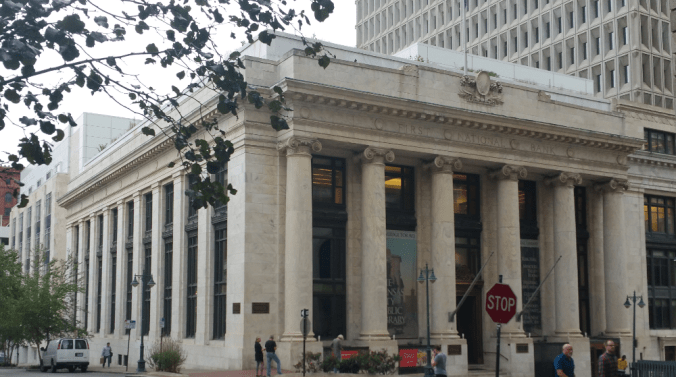
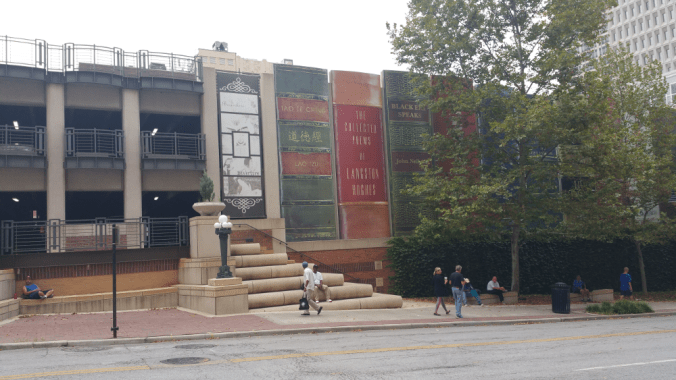
kcpubliclibrary

The Kansas City Public Library

Quick note: What’s with the non-panel pictures? In the first day, I wasn’t sure if it would be acceptable to take pictures without first asking permission. So I’m sharing pictures from Kansas City, which hosted WorldCon this year, because I took walking tours of the city Friday, Saturday, and Sunday mornings. Panel pictures will arrive with the Friday sessions.

Joined in progress.

FT: The classic epics were the science fiction of the past. They shared common themes and fundamental elements. They were from the oral tradition (storyteller). They featured a creation myth (cosmology), a hero, a quest, kinship and kinship troubles, the interplay of nature, culture, and the supernatural, descent into and emergence from the underworld, and/or the founding of a city.

EM: The SF epic can be set in a different world. One of the features in that case would be the technological difference between our world and the other one.

JK: Does scope equal epic? Northrop Frye espoused the high mimetic (imitative) as central to the epic form. Is there no everyman in the epic?

EM: The genius has epic intellect. The protagonist must be exceptional in some way.

CW: Walter Mitty is not epic.

FT: Many heroes start out as foundlings or shepherds.

WJW: Dune is a science fiction epic. Zelazny’s Lord of Light is an SF epic.

JK: Star Wars is an SF epic, a space opera. Edith Hamilton and Joseph Campbell have both analyzed it in their work.

CW: Foundation is an epic.

FT: Epic goes to the edge of the world, or humanity, or the universe. The world has to change as a result of the story.

WJW: So Epic science fiction is about man’s place in the universe.

FT: There’s an emotional, almost musical resonance.

EM: Modern readers need humour. That’s the secret spice in the stew.

JK: Economics doesn’t seem to be a factor.

CW: Not everyone appreciates an empire. Post-colonial narratives.

FT: Mad Max is dystopian and epic.

Aud: Wilson Tucker coined the term space opera in the early 40’s. It was meant to connote second rate science fiction that focused on adventure. It’s from horse opera, which was a pejorative term for a western.

Other epics were proposed by the panel and the audience: C.J. Cherryh, Leviathan Wakes, Hyperion, Babylon 5, Sagan, Clarke, David Brin, Gene Wolf. The theme of faith and religious belief was also proposed as another feature of the epic.

And that was time.

Next week: Mythology as the basis of science fiction.

Be well until then 🙂

WorldCon 2016: Is cyberpunk still a thing?

Disclaimer: I am not perfect and neither are my notes. If you notice anything that requires clarification or correction, please email me at melanie (dot) marttila (at) gmail (dot) com and I will fix things post-hasty.

Panellists: Cory Doctorow (moderator), Matt Jacobson, Patrick Nielsen Hayden, James Patrick Kelly, Pat Cadigan

thecoolestparkinggarageevar

Joined in progress . . .

PNH: Cyberpunk is a course correction.

MJ: I think of cyberpunk in terms of the Max Headroom tagline: fifteen minutes into the future.

CD: The first generation/layer was written by people who were not computer professionals. The second focused on current technology and near future extrapolation. The third layer is an aesthetic.

PC: The first generation of cyberpunk writers was the first to grow up with mass media (television, radio, etc.). The Vietnam War was the first to be televised. They wrote about the influence of media and extrapolated what the influence of mass media might be in the future.

CD: In the 1980’s, money had a huge influence on the political process.

PNH: An aesthetic is a number of people who have similar intuitions about the world. It’s deliberately referencial.

JPK: Bruce Stirling tried to “end” cyberpunk, but the readers weren’t listening.

MJ: A thing would be whatever catches people’s attention.

PC: Cordwainer Smith and Alfred Bester were influences on cyberpunk.

PNH: Science fiction is one big conversation.

MJ: Cyberpunk has been taken over by tech noir. Shows like Mr. Robot and Person of Interest.

JPK: Cyberpunk emerged pre-Apple. For most users, a computer is indistinguishable from magic.

CD: The whole point of Mr. Robot is to strongly distinguish technology from magic.

MJ: Pokemon Go demonstrates just how easy it is to know where anyone is, anywhere in the world.

CD: Actually, your device uses the statistics from the game to triangulate your location and reports the information to Nintendo. That’s a lot more scary.

PC: In the early days of the internet, there were the BBS’s, the bulletin board services. Genie—the conversation never ends. Now mass media is to ambient, we’ve stopped seeing it. Information (and misinformation) is ubiquitous.

PNH: Science fiction has been doing the virtual presence thing since 1929 with the fanzines.

MJ: Cyberpunk intersects with maker culture. High tech is repurposed.

CD: The liminal moment was a queer programmer, Jennings. Cyberpunk concerns itself with the frontier of self and interrelatedness.

And that was time.

Next week: science fiction as epic.

And, of course, in the meantime, I’ll be curating Tipsday and Thoughty Thursday for you.

Be well. Stay safe. Love unconditionally.

That is all.