What the heck is a MOOC?

If you’ve been reading my posts, you’ll know that I used to play Massively Multiplayer Online Role Playing Games (MMORPGs, or just MMO’s).  But what in the heck is a MOOC?

I was first introduced to the term last October, immediately following the course I’d taken on course design.  One of my fellow learners was a guest blogger on a corporate blog the following week.  The topic was MOOCs.

MOOC stands for Massively Open Online Course, and they are the latest trend in education.  I’ve already written about participant centered training, and, on the surface, the MOOC would be the ultimate in PCT.

Here’s another fun view of what a MOOC is: http://www.youtube.com/watch?v=eW3gMGqcZQc

By and large, MOOCs are free, and consist primarily of presentations on weekly topics, usually delivered via Webinar, and supplemented by social media (FaceBook, Twitter, etc.), but participants are expected to make the course their own and take charge of their own learning: researching, Googling, diving into the deep end.  Reporting these efforts could be done via discussion groups and blogs.

The learning material is aggregated by the learning community and made available on a Web page or other central point of online distribution.  The link to Wikipedia (above) will provide more information regarding MOOCs and some examples, including Change.MOOC.ca, the MOOC that my colleague was participating in this past year.

I’ve been following her since on her learning blog: Connecting the Dots.

By the time I found out about MOOCs and Change.MOOC.ca, several weeks and learning topics had already elapsed.  I have a personal preference for beginning at the beginning and work demands are such that I would feel extremely uncomfortable putting myself into the MOOC arena now.

I can always look forward to participating in one next year.

Some other thoughts on MOOCs:

Does the idea of a MOOC interest you?

Back-pedalling and moving forward

For the last several weeks I’ve been regaling y’all with character sketches, the creation story, and the divine history of Tellurin leading up to the beginning of my novel.  I just wanted to take a few moments to remind everyone of the overarching reason I’m doing this: world building.

As I mentioned long ago at the outset of this long, grand adventure, I’m a pantser.  That means I write by the seat of my pants.  I start with a character in a situation and writer to see how he or she will get her- or himself out of it.

I’ve recently finished Stephen King’s On Writing and was pleased to read about his process, that it too, starts with situation.  I have to have characters first, but it was gratifying to know what kind of company I’m in 🙂

The world evolves out of that process.  It’s not like I finish my first draft and say to myself, “now I must build my world.”  The world emerges from what I write.  I often take notes and research as I go.  I’ve also had wacky ideas and dreams all my life (and a stack of journals to go with them).  Sometimes, as I write, I think, hey, this idea would work perfectly for that aspect of the world.

Once I’ve finished that first draft, I refer to my journals, lists of links from internet research, the non-fiction I’ve read that relates to my setting, and aggregate documents from all of these bits and pieces.  Plotting and structure do inform my writing, they just don’t define it.

Now that I’ve reminded everyone why we’re all here, I’ll get on with the meat of this week’s post:

A geo-political history of Tellurin, part 1

When the Tellurin were first created/evolved, they were very much like innocent children.  The land and the sea and the air spoke to them.  The elemental creatures were their friends, and they could even understand the animals to a limited degree.

It depended on what animals and elements the akhis used to create people as to what the outcome was.  Experiments with boars led to the okante, jackals became the bakath, lizards produced blinsies, basilisks became krean, gorillas became grunden, and chimpanzees became Tellurin (humans).  Monkeys were also the basis for the dwergen, dwergini, the favrard, selkies and merpeople, but they were each combined with other animals.  The dwergen resulted from added badger, dwergini from added mole, the favrard from added cougar, selkies from added seal and merpeople from added dolphin.  The anogeni of Zaidesahki were created from a small nocturnal tree shrew.  Some of the people had elemental affinities too: dwergen to earth and fire, dwergini to earth and air, the favrard to air and fire, the selkies to water and earth, the merpeople to water and air, and the anogeni to earth and water.

On land, civilization began to form around the river valleys and deltas, as it often does.  For the Tellurin, organization was tribal to begin with.  There were tribes all over the main continent, in every region, adapted to every climate.  The greatest concentration of the population was on the south-eastern part of the continent where the weather was temperate and the conditions for growing food were optimal.  Large amounts of natural resources were also readily available in the area.  There the great Nubiin and Haldani civilizations developed.

They grew parallel, but with opposite philosophies.  The Nubiin were by and large a cult of death.  There were many great sourcerors among their people and inevitably their king, or osire was one.  Sourcerous battle often decided a dynasty, a new king taking by force what he wanted from the old.  Poison was a secondary art and assassins became numerous as well.

The poisonous creatures were milked for the venom and then that was in turn placed in the victim’s food or drink.  Disease was also “harvested” in the form of sputum or pus and secretly administered to the victim.

Though the osire often did have the ability to influence the weather, they soon discovered it was far less bothersome to develop a technology to serve the people’s needs rather than to sourcerously supply the solution.  Irrigation and plumbing were their first developments.  Seaworthy ships were their next, and architecture appeared to be their finest endeavour.

They began trade and to a lesser extent conquest with the help of their ships.  They quickly lost interest in defeating other people and chose instead to elevate themselves and ensure their superiority through lasting intellectual accomplishments and grandiose monuments.

They built great observatories with which to study the stars.  The temples of kings turned into their tombs as one dynasty succeeded the next.  Their sourcerors were great sophisticates and had developed elaborate rituals and ceremonies even before the Agrothe came into being.  Elaborate but effective.  They used order as a way to exert pressure on source, to make it more powerful.  Through their investigations, they had discovered a Way Between the Worlds but were unable to open it in order to pass through.  It was their theory that when they died, their soul and source passed through the Way and onto another life.

Funerary monuments were begun in the year the osire came into ascension (like a star) and continued as long as he (and sometimes his family) were able to hang onto the throne.  At the osire’s death, ceremonies would ensue for days seeing the soul into the next life.  The whole life of the Nubiin people began to focus on death in one form or another.

The Haldani, on the other hand, were adherents to the cult of life.  Anything that enhanced their experience, food, drink, sex, play, sports, became a way of celebrating life.  They were a society of epicureans and hedonists, and quickly fell in to decadence.  Their leaders were corpulent and corrupt.

The warlike Caldoni tribes that wandered the area saw the decadence and over the course of sunspans developed a plan to conquer the Haldani.  Though each tribe had its leader, all the leaders recognised Alexander as their Tigernos, or chieftain.  It was his ambition that carried the Caldoni into the very heart of the Haldani lands and gave them conquest. Eventually, the Caldoni did the same to the Espanic, but though they tried to conquer the other nations of the region, they were never wholly successful.

The Caldoni kept all the best of the Haldani culture, their art and technology, but brought order to the rest.  Except for the common troops that they were forced to kill, the Caldoni kept their Tellurin destruction to the nobles of their foe.  In the end, many lower and middle class Haldani survived and were allowed to flourish and even keep their own ways if they so chose, under close scrutiny though.

To the north of these two great cultures were the Espanic (until they were conquered), Parimi and Saxon territories.  These retained much of their tribal nature and were considered “primitive” by their neighbours to the south.

Still further to the north were the Hussari, the great horse clans.

The coastal islands to the east were home to the Brythoni, Eiran, Alban, and Cymric people.  These were called the Island Kingdoms. Though closely related, they all had distinct languages and cultures, very rich for the small geographic area they covered.  Sourcery was as varied among these people.

Moving inland, the marshy areas of the northern coast were home to the Sami.  The Sami were fierce warriors and sourcerors owing to the harsh conditions in which they lived.

Next to them were the Skalding who lived among the treacherous fjords that topped the Northern Spine of the mountains.  The Skalding were pirates and highwaymen, taking what they wanted from other people.

The mountains themselves were only sparsely populated by itinerant tribes that overseasoned in the foothills and caves, moving back into the mountains when the weather warmed in Shoudranya.

To the west of the mountains, the population remained sparse.

In the north were the tribes of the Shooksa-Nai and in the Deep Forest of the south were the Saanzu, but both of these groups remain insular and are still not integrated into Tellurin society.

When the religion of Auraya spread through out the land, each country adopted the practice in its own way.  Two of the most reverent cultures were the Caldoni and the Parimi.  Fervour was so great among them that they sought to unify the rest of Tellurin under their own vision of the goddess.

Thus began the religious wars.  There was much burning and heresy and bloodshed and in the end, the Parimi fled the superior forces of the Caldoni who threatened to wipe them out. The Haldani and Espanic remnants, seeking to overthrow their conquerors, sided with the Parimi against them, and were forced to flee along with their allies.

The Caldoni pursued them over the mountains and to the very coast of the continent before they were finally stopped. Auraya was fond of the Parimi and at this time supported them, adopting their religion, the Faithful, as her preferred religion. She raised one of them, Alain de Corvus, as the first Kas’Hadden.

It was the Kas’Hadden who turned the tide of battle against the Caldoni. They were stubborn, however, and when they chose to remain in the area, harassing the Parimi, Haldani, and Espanic, Auraya descended, turned them back to the east, and told them never to return, on pain of death.  To this day, the Caldoni believe that this apparition was not the goddess, but some trick of the Parimi.

Since that time, though they have been friendly to all outward appearances, the Caldoni have been plotting to eradicate the Parimi and the Faithful, which has become the predominant religion of Tellurin in the time of IoS.

I hope to redraw the crappy map I’ve made of Tellurin in the near future to give you a better idea of how I see the world.

Why did I call this category Alchemy Ink?

I thought it was about time I answered this question.

I was reminded that I hadn’t addressed the issue yet when I read Martina Boone’s guest post on DIYMFA yesterday.  Martina writes:

Writing fiction is alchemy. We can have all the ingredients for a great story and still miss that wow factor that makes it all come together, makes our work transform from words on a page to a living, breathing entity with the possibility to burrow into someone else’s consciousness.

I’ve always thought of writing as a kind of alchemy, a kind of magic.  This might be

My only souvenir of Siobhan’s art is this book cover.

because I write epic fantasy.  Or it might be because when I started reading for pleasure, I started with C.S. Lewis, Lloyd Alexander, and Madeline L’Engle.  It could even be my inspiration for writing: the wonderful artwork of Siobhan Riddell.  When I was in grade three, she and her grade five classmates wrote and illustrated their own storybooks.  Siobhan’s was of a knight fighting a dragon.  Classic fairy tale.

And I was hooked.

I wanted to write something, even then, that made people feel the way Siobhan’s storybook made me feel.  That was the kind of magic I wanted.

Much later, I tried out a few of writers’ groups.  One was composed of friends from university: Kim Fahner, Steven Lendt, and Dan McCormick.  I actually proposed the name “Alchemy Ink” to them.  No one seemed particularly keen.

The next was a group of women brought together around the fabulous Si Tranksen.  That group published Battle Chant in 1999 and included Paulette Dahl, Violet Brenner, Louise Lane, Carole Trepanier, and, though she departed before the book project came together, Sonny B.

After that, another group of women writers, including the fae folkstress Dolores Dagenais, Gypsy, and fellow Sudbury Writers’ Guild members, Irene Golas, Margaret Lavoie, and Sue Scherzinger met irregularly to engage in creative stuff.  We didn’t only share our writing, but did cool things like playing with clay.

When the chemistry is right, a writers’ group can be magical.  I’m going to use some of my dreadful learning lingo here, but synergies can develop between the writers, and the creative energy so generated tends to fuel the creative self in wild ways.  Some of my best writing/most productive periods were inspired while I was in writing groups.

This is why I’ve called this category Alchemy Ink.  It’s a kind of substitute for the old writing groups.  Magical things can happen when you share …

But getting back to the writing of fiction, transforming what is in my head and heart onto writing on the page is pure alchemy.  I struggle to create gold, but what I might have is a means to immortality, the other goal of alchemy.  My words, if they’re good enough, will have a life outside of mine.  With luck and diligence, they may outlast me 🙂

Martina goes on to write that she is not a pantser (like me).  For her, the magic happens between the characters, in the backstory, in the execution.  She uses plotting and structure to “make room” for the more magical aspects of her art.

The last word belongs to Martina:

Chances are, that’s the part of storytelling we fell in love with in the first place.

Why did you fall in love with the alchemy of storytelling?  Where does the magic happen for you?

A course in course design :)

During my undergraduate years, I enrolled in a class that allowed me to teach the composition portion of the first year English survey course.  Periodic tutorials provided instruction in pedagogy and marking standardization session ensured that all of us in the program were marking essays neither too harshly, nor too kindly.  I also tutored in the writing centre and received attended an information session on the specific learning needs of native students.  I did this for two years.

When I started my graduate degree, I, like many grad students, taught the first year composition course.  Essentially, there was an orientation lecture, we were given our texts, and the rest of it was up to us. I used what I’d learned during my undergraduate degree, but really, I shot from the hip.

When I learned that an optional course called “The Theory of University Teaching” was offered, I signed up right away.  A lot of what I learned at that point was muddled with all the other courses I was enrolled in, the teaching, and my ongoing creative writing project.  I taught that course for two years as well.

Most of what I learned about course design from those days was focused on university teaching.  Most of what stuck with me was adult learning theory, creating syllabi, and the importance of learning outcomes.

While I’ve put together some creative writing workshops and helped a friend, who was a high school teacher, work on her redesign of her Writers’ Craft course, I didn’t start writing courses myself until last year.

I generally run on instinct.  I think about what I’d need to know if I was the learner, and go from there.  Systems training is easier.  There’s a logical progression to the course provided by the structure of the program: Basic navigation > menus > screens > fields > inputs.  It can be boring, but I do my best not to turn into a computer in the process.

My team receiving our awards 🙂

The SMART Board course for which I receved a Service Excellence award was essentially systems training, as were the SharePoint videos I produced.

I also helped to cobble together a course on elearning design, not having a clear idea of what I was doing.

The last course design project I worked on was not writing from scratch, but rewriting a course that was originally designed as a self-instructional module.  The new venue was in-class, using with participant centered methodologies.  It may seem like a step backward in a world where virtual training is king, but it was what our participants wanted.

The response to this course tweak has been positive, though further revision has been recommended.

My writerly goodness tends to emerge in the process of course writing.  I like metaphors; creating stories and frameworks for the training to play out within.  I like to play.  I try to be clever, but it was never one of my strengths.  In the end, I’ve learned by doing and will continue to do so.

And I’ve learned by learning.  Last fall, I attended two courses, the first on participant centered training (see last week’s post, linked below) and the second on participant centered course design.  The courses were only a month apart, and there was some concern that I wouldn’t have time to assimilate the knowledge from the first before being thrown into the second.  I found the opposite to be true: the second course reinforced the learning from the first and expanded it in new directions.

Some of the things I’ve learned:

  • Allow the participants to take control of their learning;
  • Include sample questions;
  • Always include the purpose of an exercise or activity;
  • Include proper learning points for a debrief;
  • Link! (current topic to last topic; current topic to next topic; learning to application on the job; to value added pieces, etc.)
  • Assess seven ways from Sunday 🙂 and
  • Provide lots of opportunities for skills transfer and application.

I’m still missing a few bits and pieces, but I’m sure they’ll all fall into place as time goes on.  I’m addicted to learning, you see.  I can’t stop.  I learn however I can, whenever I can: reading, Webinars, informal learning …

Most recently, my employer has made available a suite of elearning courses from a third party provider.  I have my licence until the end of the year and have already completed the Change Management and mapped out enough elearning to keep my busy if I ever have a moment to spare 🙂

As I develop my platform, slowly and steadily, more opportunities will reveal themselves.  I still have a number of in-class courses I’d like to take at work, and I’m just beginning to figure out what books I want to read on the subject.

It’s going to be a great adventure.

Any gems to share about your own adventures in course design?

The cosmology and divine history of Tellurin, part 2

Last time on Work in progress: Yllel got his narsty on and killed his father!

With the death of Auremon, Yllel fled.  Almost at once, Auremon’s school, and indeed the entire island of Aurensart crumbled. Many of the initiates, apprentices, and magi died in the collapse.  What was left of Auremon’s school was a single spire of rock that rose from the water to the full height of the island.

Kaaria, an air elemental from Elphindar, and her sister Naia, rescued what was left of Auremon’s spirit and bound him into the spire that was all that remained of Auremsart. Without his god-share of power, though, Auremon was effectively trapped within the stone. He could communicate with no one but Kaaria and Naia.

Yllel returned to his preying on sourcerors and now magi as well.  He held the magi in particular contempt for his father’s sake.

Auraya, saddened enough at her mate’s sacrifice of his power, was now left bitter and bereft by his death.  She withdrew in earnest from the world, allowing Tryella to serve Tellurin in her stead.

The Kas’Khoudum, or book of light, that was started when Auraya, Auremon, and Tryella mingled freely with the people of Tellurin, was revised and added to.  Many of the feats described in its pages were Tryella’s but the goddess was more than happy to let her grieving mother take the credit for her good deeds.

In response, and out of a twisted need to outdo his mother, Yllel began to inspire the creation of his own holy book, the Rada’Khoudum, or book of darkness.  In its pages he put hideous secrets in the guise of rituals and ceremonies that seemed as if they honoured Auraya.  In truth, the spells he wove into those rituals would drain his mother of her power and bind her will to do terrible things.

When finished, Yllel was careful to see the precious book into the hands of the greatest spiritual leaders of the time.  The Kas’Khoudum, which Yllel encouraged to be seen as a pleasant book of fables, was supplanted by his liturgical masterpiece.  Unfortunately, neither Auraya nor Tryella were very interested in reading and neither of them discovered what deviousness Yllel had been up to.

Tryella investigated Auremon’s murder intensively, but none of the magi who survived the collapse of Auremon’s school could remember anything useful.  The only thing either Tryella or her mother knew for certain was that Auremon’s murderer had been one of his students.

Yllel had visited each of them briefly to offer his condolences, but did not join Tryella in her search.  Auraya retreated to the moon, but Tryella, something piqued by her brother’s behaviour, began to suspect Yllel of his treachery.

She had no proof, but it would only be a matter of time before she found it.

While Tryella didn’t find exactly what she sought, she soon learned how her brother spent his leisure time: hunting and killing the very magi their father helped to train.  She confronted him and Yllel told her that he was merely exacting revenge.  One of these was surely the creature who had killed a god.  Why should he not hunt and kill, even torture them?

Tryella went straight to Azuresahki, the blue realm of her mother.  Auraya listened with uncertainty to what Tryella told her and together they continued to observe Yllel from near and afar.

There was nothing in his choice of victim to indicate that he suspected any of these poor users of magick of Auremon’s murder.  Rather it seemed that he chose them for how much power they had.  Some managed to escape him through clever tricks they called binding, but though their power and soul might have been safe within an amulet or object, that often wasn’t enough to prevent Yllel from killing them for spite and trapping them within the object they had bound themselves to.

He didn’t attempt to break or destroy the artefact, but ensured that the object would remain lost to Tellurin forever, thus relegating the magi within to isolation, and eventual insanity.

This wanton killing and cruelty was enough to inspire Auraya to action.  Tryella still hadn’t shared her suspicions about Auremon’s murder yet, fearing her mother’s response, but held the secret as a trump card until a critical moment, or until she had proof.

Auraya first tried something like an intervention in the hope that Yllel was not lost to her entirely.  Her efforts were rebuffed. She tried again with the same results but was reluctant to give up hope.  Auraya couldn’t bear, after losing Auremon and the akhis before him, to lose another member of her family.

Eventually though, even she realized that tough love was more likely to get results.  Unfortunately, administering a godly spanking was more difficult than she could have imagined.  Tryella at her side, Auraya tried yet again to deliver her son a smack down that would put him in his place.

For his part, Yllel soon grew tired of his mother’s attempts to discipline him.  At first they might have been amusing, but now they were simply tedious.  Soon he no longer cared to hide his true feelings and motivations from them.  Soon he would have enough source that it wouldn’t matter.

Auraya had eventually to concede that Yllel was evil.  He killed for the joy of it as much as any other purpose.  He tortured her with her inability to discover Auremon’s murderer.  His attacks on Tryella were growing positively barbaric.

She had to face the fact that Yllel wanted to kill his sister, and that was something she could not allow.  Reluctant as she was to lose a child, even an evil one, Auraya began to up the stakes, pulling out all the tricks she had learned in her exceedingly long life.  Still every confrontation ended in defeat.  Yllel gloated, but though he seemed eager for the kill, he held back from it, as though he were testing them.  Or perhaps himself.

Something else would have to be done.

She got the idea from Auremon’s ill-advised release of power into the world.  In the process she knew he had torn open a Way Between the Worlds.  Auraya sought that place out and investigated it as a possible means to be rid of Yllel without having to kill her own child.

That Way would not be suitable, however.  There were still a great many people living in the world on the other side.  As Tryella continued her investigations and Yllel continued to test his newfound strength against her, Auraya sought out all the Ways Between the Worlds that existed in Tellurin.  One after another, they proved unsuitable. Until she found the one on the plains.

In the middle of the lush, grassy plains of eastern Tellurin. Auraya found a Way that seemed to lead nowhere at all.  There was literally nothing on the other side, no light, no sound, no air, and certainly no innocent people or creatures for Yllel to torture.  Now that Auraya had found her cage, she would have to figure out how to get the Way open wide enough to admit her son without sucking half of Tellurin in with it, and she would have to figure out how to close the Way afterward and make it impassable to Yllel.

She hadn’t thought so deeply about anything in a very long time.  Rarely had she had to think about how to accomplish something she desired at all.  Usually her desires simply manifested themselves.  This was something different.  Auraya was trying to change the very nature of something, a place, a void, into the ideal prison for her son.

Think of the void as a black hole … sort of.

Despite its apparent suitability, the void was its own place with its own purpose.  It did not want to be changed.  It had its own power and its own desire to use it.  In the end though, Auraya had more power and more desire, and a son she desperately did not want to kill.

When the void was subjugated and prepared, Auraya and Tryella found Yllel, engaged him in battle and lured him to the Way that led to the void.  The battle lasted sunspans in Tellurin time.

Great earthquakes shook the land.  The entire western coast of the world sheered off.  The mountains grew.  Volcanoes long dormant erupted into life.  The plains upon which the three gods fought became a desert.  The jungle became infested with random power, investing its creatures with strange abilities.  Vedranya changed from a season where few wished to travel to one in which shelter was an inescapable necessity.

This was the Tellurin Cataclysm.

In a few short suns, much of Tellurin civilization fell.  Many creatures died before they learned how to survive the newly changed Vedranya.

Finally, on the verge of exhaustion, Tryella and Auraya brought Yllel to the opening of the Way, but now Auraya had to focus her attention in opening the Way without tearing it so that it could be sealed again once Yllel was within.  That meant that the task of forcing Yllel into the void fell to Tryella alone.

She was unequal to it.  Yllel taunted her, as much as confessed to the murder of Auremon while his mother was otherwise occupied.  He was too confident by half and Tryella managed to make him stumble until he was caught in the well of the Way.

He realized his fight against the pull of the void was not going to be successful and relented, but not before reaching inside his sister and tearing her source and immortality from her, in one swift motion, killing her instantly.

Auraya wailed in despair.  First she lost the ahkis, then Auremon, now both children at once.  As she sealed the way to the void, Auraya heard Yllel say one final thing. “Don’t you want to know what I did to—”

And then he was shut away … Auraya thought forever.

Auraya was so depleted from her long battle and so wounded from her losses that she retreated again at once to the moon for solace.  Taking stock, she realized that she was now slowly dying, fading away.  She had poured out so much of her power during the battle with Yllel that the world had gotten hold of it and was slowly siphoning it away.  She could not stem the flow or find a way to reverse the process.  It would take centuries yet, perhaps even millennia for her to die completely, but it was a certainty now.

Kaaria and Naia, as they had with Auremon before, now resurected Tryella in the same manner.  The only vessel that could hold the former goddess was that of a giant sea eagle, or yrne.

From within his prison, Yllel discovered that while he could not escape, his thoughts could, and a god’s thoughts are powerful. He found someone willing to help him escape, a sourceror named Kane.  Over the next two centuries, Yllel plotted, used his favrard soul-slaves to trick some of the other people of Tellurin, the okante, krean, blinsies, grunden, and bakath into binding their collective souls to him as the favrard had done.

Tryella and Auremon, meanwhile found themselves in a predicament. Due to the nature of their respective deaths and resurrections by Kaaria and Naia, they were invisible to all but each other and their saviours. They couldn’t even tell Auraya they were still alive.

The only talent that Tryella retained was that of prescience. That talent alerted her to Yllel’s scheming and she tried to find some way of stopping him. Even with Kaaria’s help, however, her efforts proved futile, until her visions revealed to her the face of a young girl. She could be the means of defeating Yllel. Together, Tryella and Kaaria set out in search of her.

Auraya, meanwhile, while still hidden on Azuresakhi, nonetheless felt the effects of Yllel’s machinations in the world.  She determined to raise a champion of her own, a man who would become the Kas’Hadden, or hammer of light, and her avatar on Tellurin. He would protect the world and end Yllel’s predations once and for all.

Like his sister, Yllel began to be haunted by dreams of a girl. She had power, a mere splinter of a god’s but more than most Tellurin could ever hope for. He knew that she could prove a complication to his plans.  She could kill Kane before the sourceror could free Yllel from the void.

She was such a tasty prize, though, that Yllel determined to enslave her to his will instead.  Only if that plan failed would he concede and kill her.

He also became aware of what his mother was trying to do to end his hopes of escape.  Even as he commanded Kane to set sail for Tellurin and begin the war that would eventually result in his freedom, Yllel began to manipulate his mother’s followers, the Faithful.  He’d make sure that the Kas’Hadden would never be made.

And this is the point at which the novel opens.

Next week: We’ll start on the earthly history of Tellurin.

Challenges become opportunities: The Author Salon Experience

Back in December, I joined Author Salon on the advice of one of the people I consider to be my writing mentors, Barbara Kyle.

Initially, I had no clue what I was getting myself into.

My first mistake was not reading anything before I signed up, so when I was presented with a profile to fill out, I dove right in.  Little did I know that there was an art to this …  I did read the AS step-by-step guide, belatedly, but I still had no clue what I was doing.

I set up my profile to the best of my ability, sounded off in the Shout Out Forum, and then posted a call for peers in the In Production I Forum group that seemed to suit me best: Fantasy, Urban Fantasy, Horror, and Speculative Fiction.

The initial group that formed was small, but dedicated.  We started off by critiquing each other’s profiles.

Now, this may not seem particularly important work, but part of the AS process is that professional editors and agents peruse the site from time to time.  Ultimately, the author’s profile will be a marketing tool to those same agents and editors, so it is a critical piece of the AS puzzle.

It’s as important as perfecting your “pitch” or logline, as important as writing a knock-their-socks-off query letter, in short, the AS profile is as important as it gets.

I’ve been at a bit of a disadvantage because I’ve not yet attended a conference where I’ve had the opportunity to “pitch” my concept to agents.  I haven’t started shopping my novel yet, and so I really don’t have any experience crafting a query or synopsis.  I really don’t have an idea about what a hook line should be and how it differs from a conflict statement.  But I’m learning …  and I have to learn fast.

I thought I knew at least one thing going in: even if you have a series planned, the novel must function as a stand-alone, but it seems that everyone else in my critique group is using the fact that they have a series planned as a selling point.  So now I’m fairly convinced that I know nothing, and am approaching the whole process tabula rasa.

One question posed to me was, “why mention your day-job?”  The point was that the information should only be included in the event that it lends to the topic you write about, like a retired police officer writing mysteries/police procedurals.  I’d like to address that here.

As a learning and development professional, I write courses.  Certainly, it’s a completely different beast than a novel, but writing is writing and any practice reinforces skill.  It develops my rhetorical skills to direct my writing to a particular audience with a particular purpose in mind.

Also, as a corporate trainer, I have presentation skills.  It’s a good marketing point and while it may not be on the top of every agent’s list of skills an author must have, it may be an asset that tips the scales in my favour.

I’m more likely to be comfortable in an interview situation, doing public readings, and participating in workshops or conferences on a panel.  I’m tech-friendly, if not tech-savvy, as the result of my work.  I could easily put out YouTube videos or podcasts regarding craft, or reading of my work (in fact, it’s something on my list of things to do for my platform).  I could even parlay my skills into delivering Webinars or tutorials.

Finally, it was my learning and development day-job that got me back into learning-as-lifestyle.  Mutant learning, social learning, independent research, call it what you want, it’s what I need to ramp up my profile and my writing as presented on AS and attract the attention of agents and editors.  I started developing my online platform as a writer thanks to my work in L&D.

What I learned about Initiate of Stone in the first go-round:

  • It was too long;
  • It was too complex:
  • I’m too wordy; and
  • I’m not very good at seeing the redundancies in my own work.

Then, in January, all of my critique partners left In Production I and were promoted to Editor Suite.  Most of them had attended an Algonkian Conference which acted as their respective invitations to AS.  They all received personal notification to move along.  I thought I was left behind.

So I started over with a new call for peers and waited.  Eventually the administrators realized that there was some kind of miscommunication and offered a clarification.  I was promoted to Editor Suite after all!  My relief was immense.

My new critique group in Editor Suite included all of my old friends, plus a couple new ones.

The first order of business was to start over with the profile critiques, and when that was done, we moved onto critique our first acts.  AS calls them the first 50 pages, but I prefer to call it the first act because it’s actually the first 50 -100 pp, depending on where your first major plot point falls.

What I’ve learned from the critique of the first act:

  • My first major plot point takes too long to arrive;
  • The story line for my protagonist needs to be seriously amped up;
  • I still suck at the profile stuff (that’s part of what I’m working on next);
  • I may be wordy, but given my chosen genre, epic fantasy, it works, overall.

Along the way, there was this thing called the Showcase.  AS reps would be showing a foreshortened version of our profile to industry experts and seeing if they could get any interest.  The call went out about the time that the former version of this blog was hacked and there was a little confusion while I reordered my electronic life.  The server on which my blog was hosted at the time was also my email server …

Got that mess sorted, but even though the Showcase went on until May, IoS did not get a single nod.  Almost everyone else in my critique group, however, got at least one, and many received multiple expressions of interest.  I’m very happy for my peers, but really disappointed in/for myself.  This just speaks, once again, to the importance of the AS profile in the overall process.

What I’ve done or am doing as a result of all this:

  1. Cut my novel in half.  The former mid-way point is now the climax and I still have to cut about 40k words.  I don’t know how this will turn out, but I’m willing to work at it until it’s fabulous 🙂 ;
  2. Rewriting Ferathainn’s story/plot line;
  3. Revamping my profile;
  4. I’ve applied for, was accepted to, and have registered for Algonkian’s New York Comes to Niagara conference in October.  If nothing else, I’ll learn how to get my profile together there.

So we’ll see where this all takes me.  The AS journey has been fraught and fun and incredibly hard work so far.

That’s it for this week bubbies!  Gotta get working on my WIP!

For my science fiction writer friends, I want to post links to Robert Sawyer’s two-part January interview with William Gibson:

Also check out Robert’s TedXManitoba lecture:

Are you part of an online critique group?  What have you learned from the process?  How is it changing your creative life?

Participant Centered Training and Personal Knowledge Management

Bob Pike is responsible for introducing the concept of participant centered training (PCT).  He’s been in the training industry since 1969 (the year I was born, incidentally), but focused on PCT since 1979.  Needless to say, PCT is not a new idea.

Traditionally, corporate training has been conducted by a “talking head,” a subject matter expert, who imparts her or his wisdom to waiting students.  The assumption of this kind of training is that the students are sponge-like, highly motivated, and that they will somehow find a way to absorb what the trainer is saying, or to mimic the trainer’s behaviours, and be able to magically transform that information into the performance their employer desires.  But how does the average learner, who may or may not be sponge-like, accomplish this feat?  That’s the problem.

PCT turns that paradigm on its head.  The trainer is merely present to elicit the desired knowledge from the learners, to encourage the appropriate behaviours, and to facilitate the process of discovery that will lead the learners to exhibit the desired performance in the workplace.  It’s no longer about having all the answers, but about being able to help the learners, now active participants in their own learning, find the answers for themselves.

Not the “sage on the stage.” Instead, be the “guide on the side.”

Primarily, PCT is a classroom methodology, and that is how it’s often taught, but once learned, the principles can be applied to any kind of training.  If you can design the right kinds of activities and ask the right kinds of questions, it’s still possible to implement PCT online in synchronous courses, or even online, asynchronously.

It’s the facilitation (or the framework) that’s the key.

I took an introductory course to PCT delivery in 2009 and in September of 2011, took the next course on my way to training certification within my organization.  There’s a lot more to PCT than what I’ve mentioned here, but that’s the key learning behind PCT.  How the trainer, or designer, accomplishes it has been the subject of books, academic papers, and the foundation of many a training business.

It could also be the innovative trainer’s ticket …

So check it out.

Some resources for you:

I’m a novice at this whole training gig and I know I have much farther to go.

Case in point: Harold Jarche.  The man has seriously been blowing my mind in the last weeks with his posts on his blog: Life in perpetual beta.  I cannot articulate the awesome right now.

Just go read his blog.  Follow it.  Become a PKM disciple 🙂  What’s PKM, you ask?  That would be personal knowledge management.

PKM takes PCT and turns that paradigm on its head 🙂  The learner is ultimately and intimately in control of their own learning and in many ways takes facilitation out of the equation altogether.  As a newbie trainer it freaks me out a bit, but PKM is the way I prefer to learn, through networks and connections, and as an addicted learner, I’m a fan.

Acronyms abound!  So what do you think?  PCT or PKM?  A liitle from column A and a little from column B?  Does it depend on the learning situation?  Can PCT be a stepping stone on the way to PKM?  Tell me what you think.

The cosmology and divine history of Tellurin, part 1

Last time on Work in progress: The supporting cast was introduced.

Once I had all my characters, I needed to think about the world they inhabited.  I went back to the beginning.  The very beginning of everything …

In the beginning, there was the One.  It was everything and everything was in it. The One simply was, and was in perfect harmony, until something within it recognized its independence, and in that moment, the One ceased to be and everything else came into existence (including time, hence the moment, the first).

Modern science would call this the big bang.

The-thing-that-recognized-its-independence wandered the universe, searching for something like itself.  Really, it was searching for the harmony of the One again, but it had destroyed the One, a crime of which it was ignorant, thus authoring its own loneliness and misery.

Having explored about three quarters of everything that existed, it was about to give up, when it finally found something else that felt like “home.”  It had discovered the disc of debris of a planet accreting itself into existence.

The two kindred spirits found names for each other: The-thing-that-recognized-its-independence became Auraya, and the planet, Tellurin.

Tellurin is the name of the world and its spirit, but it is also the name for the main continent of the world.  Originally, it was nothing but a large landmass, one of five on the planet.  Life was limited to plants, protozoa, bacteria, and insects.  The world was one rich in power, but it was latent and undirected.  When Auraya first chose the planet for her home, she explored it thoroughly.

Eventually, the mere exposure of the world to a sentient and powerful being like the goddess encouraged the development of innate intelligences.  The world responded to Auraya’s loneliness and became her first family.

One of the continents took on sentience and personality as brothers: Zaidesahki, Tahesahki, and Nuresahki.  The four remaining continents did not fully emerge into sentience, although the achieved consciousness.  They are called the watchers, because they did not speak or interact with anyone.  They simply bore witness to all that happened.  Similarly, the planet’s single blue, moon became conscious, though never sentient.  She was nonetheless given a name: Azuresahki and became a haven for Auraya.

The air and the water were their sisters: Freyesahki and Augesahki.  The deep fiery core of the earth was another brother, but more distant and less social than the others.  He was also more volatile and less kind that the others.  His name was Dwergesahki.

When Auraya left them to explore the rest of the universe, they felt abandoned.  The first life forms above the level of insect were the elementals.  Each of the sentient elements made its own creature, rich in source and of high intelligence: sylphs (air), undine (water), nomi (earth), and efts (fire).  Then came the animals, birds, and fish.

These arose due to the combined efforts of Zaidesahki with Freyesahki and Augesahki.

Tahesahki and Nuresahki became jealous and wanted to create something better.  Beastly races like blinsies, okante, krean, grunden, bakath, and the like arose from those efforts.

Without jealousy, but merely wishing to make companions for the creations of his brothers, Zaidesahki brought forth humans (Tellurin), and favrard.  Dwergesahki, less interested in all this wasteful creating than the others, asked for Zaidesahki’s assistance in creating the dwergen and dwergini.  Along the same lines as the subterranean folk, and for purely selfish reasons (much like Auraya), Zaidesahki and Augesahki joined forces again and created the anogeni, the hidden people, as special and secret companions for themselves.

Eventually, Tahesahki and Nuresahki became increasingly jealous of their brother, who seemed so contented with what he’d done.  Tahesahki lured the favrard away from Zaidesahki to his deserts.  Surprisingly, Zaidesahki let them go and made Tahesahki welcome as the favrard were much more suited to Tahesahki’s deserts than Zaidesahki’s lush forests and mountains.

The bitter brothers ignored and mistreated their own creations, creating miserable children.  In the end, they rose up against Zaidesahki, shattering him into seven pieces and killing him.  In the process, they sundered the great landmass that had once been their collective “body,” giving themselves wounds as mortal as their brother’s.

Augesahki, devastated by the death of her brother and lover, collected the seven shattered

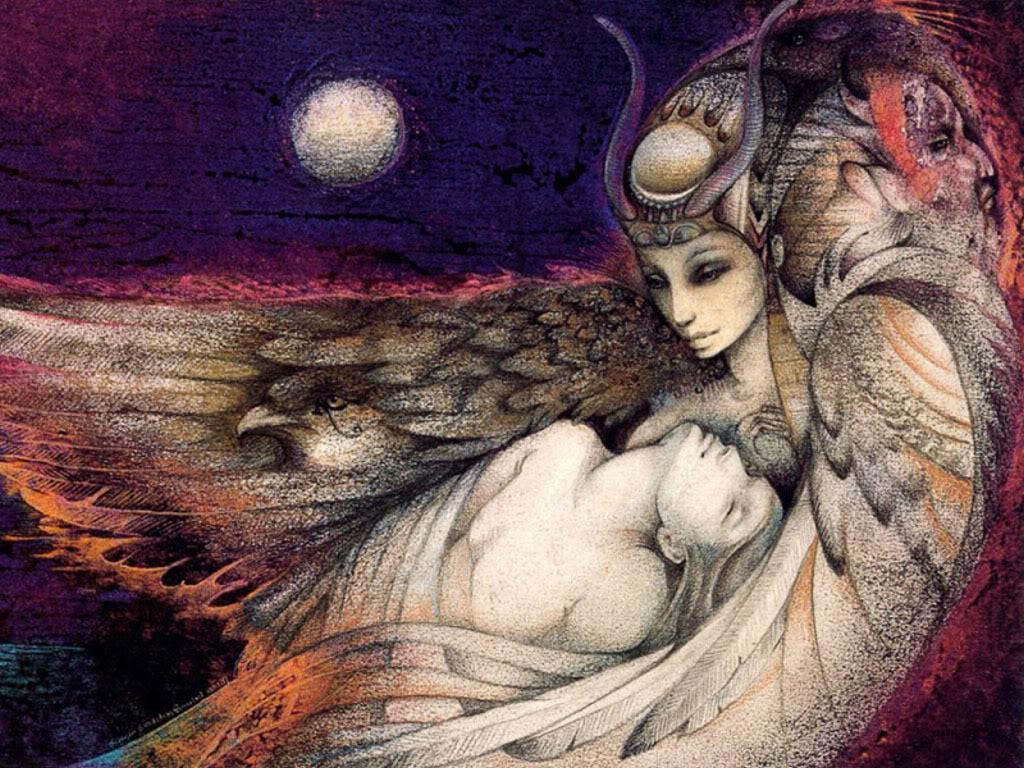
Susan Boulet’s Isis and Osiris

pieces of Zaidesahki’s soul and encased them in the body of a Tellurin who willingly sacrificed himself for the purpose.  She sealed Zaidesahki in a stone sarcophagus at the bottom of a lake in the middle of the continent.  She withdrew to the sea and became silent. (Based in part on the myth of Isis and Osiris, and in part on Arthurian Legend.)

Freyesahki and Dwergesahki remained what they always were, flighty and stoic respectively, and nothing more was heard of any of the akhis.

Auraya returned to Tellurin to show off Auremon.  Having failed to find anyone else like herself in the entire universe, she clove herself in two, creating Auremon her other half and spouse/consort. (Derived from a tale of how the Celtic goddess Aine fell in love with her reflection in a magic mirror that showed her the masculine part of her, or animus, and subsequently brought him to life.)

She was greeted with the desolation of her first “children” and the chaos of a million different life forms all clamouring for help and guidance.  The watchers, as ever, were silent.

Auraya vowed never to leave her beloved Tellurin again.

Auraya and Auremon began immediately to help the denizens of Tellurin, Auraya from her new home in the blue moon and Auremon by walking among the people in their guise.  Soon it became a titanic task for even the two celestial beings.

They determined to create two of their own children, helpers in their task.  Tryella was much like her father, adventurous, playful, and interested in getting her hands dirty.  She too, like Auremon, walked among the people of Tellurin and helped them in the disguise of one of their own.

Yllel was more introverted.  He resented the time and attention that the denizens of Tellurin exacted from his family.  Attention he thought more befittingly belonged to him.  He only helped the people of Tellurin when forced to and while neither Auraya nor Auremon chastised him for his lack, the praise they lavished on Tryella for her efforts made Yllel feel all the more jealous.

He began to sabotage their efforts in subtle ways, but bored of that quickly.  His attention was then captured by the sourcerors.  These people had recognised in themselves the ability to access and manipulate the innate power in all things.  They called it the source and themselves sourcerors.  Yllel realized that these sourcerors had much to teach him.  After all, what was he but source?  How did the gods manipulate the world around them but through the use of source?

When they began to kill one another and steal each others’ source, Yllel learned the art.  When they developed binding as a way to protect themselves from one another, Yllel paid careful attention.  Soon the god willingly masqueraded as a Tellurin to kill sourcerors and take their source.  Then a truly devious idea occurred to him.  Soul and source could be bound to other objects and even people.  What would happen if he tricked someone, or several someones into binding their source to him while they still lived …  And so Yllel created the first and greatest of his soul contracts, that with the favrard.

The favrard still lived on Tahesahki in isolation from the main continent.  They were in the midst of a battle against the other denizens of Tahesahki: the krean.  The lower race, as even the krean fancied themselves, were numerous in the extreme.  Though short-lived, the krean possessed the ability to regenerate, or heal themselves (essentially trolls, but sea-faring as well as desert-dwelling). Sheer numbers were taking their toll on the valiant favrard and they faced extermination.  In their darkest hour, Yllel came to them, putting on his most beatific form and manner.  He easily tricked the favrard into signing over their source and souls to him while they still lived, to be his slaves in perpetuity.

Binding the living to him taught Yllel much.  He did not get to claim the favrard souls and source wholesale until they died, at his hands or at each other’s, but he could use their source to feed himself even while they lived, and their connection allowed him to possess them from time to time at his whim.  It was as though a piece of him resided in each of them.  He could eavesdrop on any of them, or all of them, at will.

He experimented freely, and sometimes fatally with the first.  He learned just how far he could push them, exactly what he could make them do.  He wasn’t satisfied though.  They were still frail and mortal.  To make them immortal, Yllel would have to sacrifice too much of himself in the process.  His intent was to gather source, not expend it.  So he used his connection with the favrard to alter them.  He made them tougher, stronger, and imbued each of them with the incredible healing ability of their enemies, the krean, so that they could heal from all but the most drastic of injuries.  They would never grow old or ill, but they could be killed.

Yllel continued to make his study of the sourcerors.  One in particular was different.  His name was Halthyon, and he wasn’t a Tellurin, dwergen, dwergini, or any other people that walked on or under the earth.  Halthyon refused to give up his secrets, however.

It wasn’t long before Auremon, also seeing the sourcerors and what they did, but not understanding it in the same way that Yllel did, sought to bring even more source into the world for the people to benefit from.  He believed that if there was more power, more people could learn to use it.  Or more people would be born with the innate ability to access and manipulate the power, and he hoped that it would give them the ability to protect themselves from the worst of the sourcerors who only lived to kill each other and subjugate those of lesser talent.  So he determined to forfeit his godhood and release his power into the world.

Noble sentiments, but things don’t always go as planned.

When he released his power into the world, Auremon inadvertently tore open a doorway he hadn’t even known existed.  Speckled throughout Tellurin, and every world for that matter, are Ways Between the Worlds.  Yllel’s mystery sourceror, Halthyon came through one of these from the world of Elphindar.

Now Auremon tore that Way wide open, pulling a good half of the population of eleph, and many of the other animals, elementals, and other denizens of the world in a cataclysmic maelstrom.  Many of those so pulled died in transit, but those who survived found themselves stranded in a strange place and inexplicably unable to cross back through the Way to Elphindar.

They established their own settlements and learned of Auremon’s terrible mistake when in the aftermath of the Rending, he came to them and tried to make amends.  Their collective fear and anger and shame caused the eleph to reject Auramon’s overtures as well as those of the Tellurin, dwergen, or anyone else who came to trade or make alliances.  They became solitary, wounded people, and for a long time, there was no hope in them.

The cataclysm was a blessing in disguise, however, though one they would not understand for many sunspans to come.  Elphindar was already a dying world.  Auremon’s mistake ushered it on its way more swiftly, but the ultimate decline of Elephinar was inevitable.

Auremon’s mistake did not yield the results he had hoped for either.  No more people than before were able to sense and manipulate power.  He wanted to discover the reason why, but without his own, he was little more than a Tellurin himself.

He researched for a while, found like-minded sourcerors who thought the cannibalistic ways of their fellows and their experiments a form of heresy.  Together these sourcerors, guided by Auremon, devised a new way of viewing the manipulation of power.

By changing the names of all things sourcerous, they hoped to divorce ensuing generations of magi (as they now called themselves) from much of what was evil in their practice.  Source became magick and those who manipulated it were called magi.  A structured apprenticeship bound in ceremony and ritual and true research grounded the craft and made it “safe.”

A young mage was initiated by one of his elders when his talent was detected.  After thirteen sunspans of continuous study, the mage would be made apprentice and his abilities “unlocked.”  In truth the ability was never locked to begin with, but the young mage would be so occupied with his training that he wouldn’t have time to realize that small lie.

Auremon set up a school on a small but mountainous island off the coast of the main continent and magi from all over Tellurin would report for training.  Yllel, in the meantime, had been working hard to fortify his store of source and became contemptuous of his father’s attempts to “dumb down” the art of sourcery.

There were still sourcerors in the world and more recognized their abilities all the time, but Auremon turned a blind eye to them, hoping, quite naively that if he just ignored them, they would go away.

Yllel disguised himself as a Tellurin again and approached his father’s school as an initiate.  He soon became a favoured student, completing all of his tasks competently and without complaint, but Yllel soon began to ask questions about sourcery and the sourcerous arts.

He was trying to expose the dullards his father was producing to the true art of which Agrothe magery was a pale imitation.  Eventually, Auremon invited Yllel to a private meeting.  As he was trying to enlighten what he thought was a simple student, Yllel took advantage of their seclusion and murdered his father.  There was no source left to take, and this left Yllel frustrated and empty.

To be continued …

Do you dress for success?

If you’ve been reading Writerly Goodness for any length of time, then you’ll know that I’m fascinated by process, my own and others’.  I love to find out how other creative people do what they do, their sets of rules and their arcane rituals.  On Facebook, I often share the tips and tricks I find on my blogly ramblings, and secretly, I take a certain perverse pleasure in how many of those rules I break, and how many guidelines I defy.

Writerly Goodness aspires to the transgressive, but only rarely does she manage the faithful leap such actions require.

In May of 2011, I attended the Canadian Authors Association’s CanWrite! Conference.  Workshop host Barbara Kyle offered many writing tips, but the one that stays in my mind is this: dress for success.

Why?  I suppose it’s because I don’t, but more on that in a bit.

Barbara stated that when she got up in the morning, she was always careful to dress appropriately, as if for work: business casual.  She said that this practice honoured her work and her as its creator.  Dressing for work meant that she was serious about her writing, that she wasn’t taking anything for granted, and that she wasn’t going to waste anyone’s time, not hers, not her readers’, and certainly not her agent’s, editor’s, or publisher’s.

I agree that one should dress appropriately for one’s work, but to me, that depends entirely on what your work and life is like.  Let me ‘splain …

Writing is Barbara’s second career, after a successful first career as an actress.  She stopped acting to become an author and made the decision to write full time.  The temptation for someone in that position would be to become part of the pyjama patrol, roll out of bed, and stumble to the computer.  Barbara worked hard at her first career and knew the value of discipline, however; she knew that the slovenly writer’s life was not for her.

I don’t have that luxury.  I have to work and I have to dress appropriately for work.  When I get home of an evening, it’s actually part of my ritual to dress down for my writing.  Phil and I call this transforming into ‘comfort woman’ 🙂

I need to shed one professional self to become another, and my professional writer wants to be comfortable.

Right now, I’m in my shortie penguin pj’s, and damn, do I feel good!  You might have the urge to equate me to Michael Douglas’s character in Wonder Boys who wore the same bedraggled housecoat to write in every day … and discovered he was hideously blocked!  That would be a mistake.

I have a reason to dress as I do when I write.  That in no way means that I am any less diligent or devoted to my craft.  It simply means that my definition of appropriate dress is different.  So I’m comfortable saying that I still dress for success.

Process is different for every writer.  That’s why I find it so fascinating.

What about you?  How do you dress for success?  What does that mean for you?

More adventures in SharePoint

Last week, I took a bit of a departure from my learning journey to tell you the bitter and the sweet of a recent event in my day-job professional life.

Now we’ll get back to what was possibly the best year of my training life.

Even as I was finishing up with the elearning course, the drive was on to develop our department’s SharePoint site.  It grew from a single team site, to a site collection.  This was for our team.  A second site collection was created as a training centre for staff, and because of my tinkering, I became head designer.

So I had to set up both site collections, and develop a training product to introduce, or reintroduce my colleagues to SharePoint.  There was another survey involved as well, and many service requests to IT.  In my business, no one outside of IT can be a site owner.  The best we can do is designer.

So I spent the better part of a month, dividing my time between writing the participants’ guide and workbook, developing the scripts for the accompanying videos, and the PowerPoint slides on one hand, and developing the two site collections on the other.

I created custom lists, manipulated content types to insert templates into document library menus, put together a professional development site for my team where I promoted the learning blogs I followed, the Webinars I participated in, the books I read, and so forth.

It was about this time that I wrote my exam for the courseware writer position.

I spent two days recording and re-recording the videos.  They were still too long, but the deadline arrived, and I didn’t have the time to devote any more to the project.

In the wake of the training and the survey, several more amendments to the SharePoint site were suggested.  At the time, my colleague Laura was working on another project, putting together a Web page for our department on the company Intranet.  The Web page on our corporate site was to point to the staff training centre SharePoint site collection.  Unfortunately, there were few things we could legitimately control on the Web page, so the SharePoint sites were in jeopardy of languishing …

Until my manager decided that our SharePoint could be our de facto Intranet site.

Then began a new drive to totally redesign the training centre SharePoint.  Away went most of the Quick Launch links to the lists and libraries, away went the “out of the box” home page with its announcements and links, replaced by content editor Web parts.  I used my limited skills in image manipulation to create banners, and wiki libraries to provide a Web page-like interface for staff to access our training products and documentation.

At that time, I had three weeks to finish that bit of miracle before I had a couple of days leave, and then a week of training to attend out of town.  This was also when I submitted my application for the consultant position. If it doesn’t rain, it pours!

A marathon final day of tweaking brought that phase of the project to a close.

Were there more adventures in SharePoint yet to come? You bet 🙂  But not for a while.

This was one of the most demanding projects I’ve worked on, but I enjoyed it immensely.  I love being master of my own domain and that’s exactly what this was.

Have your interests fed into a project like this?  One that grew until you hardly thought you could complete it?  What happened?  Did you pull a rabbit out of your hat?  I bet you did!

Tell me about it … Seriously 🙂