Sundog snippets: What my mommy brought me from New Orleans

Just a quick note about my cool new mask.

My mom went with a bunch of her friends for a two-week road trip to New Orleans. She bought me a Mardi Gras mask in the French Quarter. The black bits are the ribbon ties. I think they make the mask look pleasantly evil.

I have dutifully hung it on my wall with the rest of my masks.

My new mask, making friends

My new mask, making friends

The green one on the right, I made in high school in art class. He’s a gargoyle. The brown one on the left was a gift from my friend, Margaret, from one of her trips. I can’t remember it’s origin at the moment, and I can’t take it down to check because it’s on there pretty securely.  I don’t want a random passing transport to knock anything down.

The little blue one, below right, was another gift from Margaret when she went to Jamaica. One of the wooden masks was from her, too, but it’s been so long ago now, I can’t remember which (I think it’s the singer) or where it came from 😦

Some of my other masks look on from the adjacent wall

Some of my other masks look on from the adjacent wall

Anyway.

Now you have another piece of the Mellie puzzle.

I like masks. It’s kind of a Hero with a Thousand Faces/Jungian archetypes thing. Also, shamanism.

What do you collect? Any particular reason? Is it thematic, or part of your gestalt? Is it part of who you are as a creative person?

Do share.

Sundog snippet

Six questions with Renny deGroot

I recently made Renny’s acquaintance (formally) at a meeting of the Sudbury Writers’ Guild.

She let us know that she had recently published her first historical novel, Family Business.  Another Sudbury Writer? W00t! Of course, I had to ask for an interview 🙂

______________________________________________________________________

Renny deGroot

Renny deGroot

Renny deGroot is a first generation Canadian of Dutch parents. She is a published poet and song lyricist, with Family Business being her debut novel. She studied English Literature at Trent University. Her strong Dutch roots continue to influence her while the love of her Canadian homeland with its beauty and freedom, flavours all that she does.

Renny lives in rural Ontario with her Great Pyrenees, Chocolate Lab and very old tabby cat.”

My parents were somewhat ‘citizens of the world’. My mother lived in England for a period after the war, before moving to Indonesia where she met my father (who was there with the Dutch military). They immigrated to Nova Scotia (where I was born) before settling in Ontario. This spirit of adventure influenced their three children (of whom I am the youngest). I’ve lived in Ireland, hung out in the south of France for a bit and  go ‘back’ to the Netherlands regularly to spend time with family and soak up my heritage, before always coming back with a sigh of relief, to the best and most beautiful place in the world – Canada.

_______________________________________________________________________

WG: Welcome to Writerly Goodness, Renny!

RdG: Thank you! I’m really pleased and honoured that you’ve invited me to participate.

WG: How did you come to the writing life? Give us the origin story of Renny deGroot, author 🙂

RdG: I’ve always felt artistic pulls. While my sister was sent to Brownies and my brother to Navy cadets, I was sent to art classes. Unfortunately my drawing skill set didn’t live up to my desire, so I turned to writing as an outlet. As a teenager I wrote the usual angst-ridden poetry, some of which found their way into community newsletters and school yearbooks (my mother was a faithful ‘sender-outer’ of my pieces J ). Lots of encouragement at home and from great English teachers drove me to take creative writing classes and work on my degree in English Literature.

WG: What inspired Family Business?

RdG: Well, simply put – family stories. One evening a couple of years ago I was visiting my family in the Netherlands. My uncle Jan (the youngest of my father’s six siblings) and his wife, Marja, were telling me of a certain situation with my great grandmother, and when he finished I said: ‘wow – there’s a book in that.’ My uncle looked sceptical, but they are such a great support and when I really started writing the story they did everything they could to help me with background, details and encouragement. Of course, it isn’t at all intended to accurately represent the family thing – it just was the starting point – as you say – the inspiration.

The end result is a story about a young man who struggles to learn the meaning of freedom amidst family conflict during the depression years and World War II German occupation in the Netherlands. The notion of freedom on a macro level (for a nation, race, community) and a micro level (our own individual right to choose and determine our path) is timeless and a topic that I’m passionate about. When I’m not writing, I manage an Irish tenor (http://jimmycartonband.com). Being so immersed in the Irish culture and music has been a huge contributing influence on my interest in the topic of freedom.

I’ve read that every writer could come up with ten stories based on family stuff, and I believe it. I don’t know if I just happen to have a quirky family, but I know that there’s inspiration for a few more still sitting there waiting to be harvested.

WG: And what about your new work in progress?

RdG: The working title is After Paris and it opens in spring of 1916 in Paris. World War I changed the world forever and, like Family Business, it isn’t a war story, but I’m interested in how people manage the massive changes that come into their lives both during and after these huge events. The role of women changed with WWI, for some more than others. I’m also very interested in personal development – emotional vs. intellectual. These are some of the things I want to look at, but of course rolled up into a great story.

WG: I love when writers talk about their process 🙂 Would you care to share a part of yours?

RdG: I can get pretty distracted so I need to set targets for myself – generally a page count per session and I tell myself I won’t finish for the day until I’ve done three pages or five pages, or whatever is realistic based on where I am. The beginning is the hardest so if I can get two pages done, I’m satisfied. I generally go through several pots of tea before the day is done.

After that, I love writing outside. I have a large screened-in deck and a pond with a waterfall. I’m surrounded by trees – so I am most productive when I sit out there with the sound of the wind in the trees and the music of the waterfall in the background. I’m afraid I’m less productive in winter, but do enjoy being by the fire, either reading for background, or doing a bit of writing.

When I’m in the groove, I don’t worry about grammar or phrasing too much. I want to get the story down and then I go back to start the revisions and editing. With Family Business I edited the finished story several times before hiring a professional editor and then we worked together for three full rounds. It was a great learning experience and of course I’ll incorporate those lessons into the writing of After Paris.

WG: You have a lovely Web page. Are you active on social media? What role has “platform” played in getting your work published?

RdG: I’m afraid I’m not great with the technology side of things and am learning as I go along. I guess I have to admit that I’ve only just set up a Facebook page – on the tenth anniversary of Facebook, I accept it’s here to stay, so I’ve climbed aboard, albeit somewhat reluctantly. I am more comfortable with the website for sure. That gives me the opportunity to give reign to my creativity and I see it as a spot , not just to provide information for fans, but to really interact in a virtual ‘book club’ environment. My book is for sale via my website, so it’s handy for that as well of course. Publishing and book buying/selling is a whole different world than it was, even five years ago. Amazon.com and other on-line retailers have opened up the world to make it accessible to writers like myself, who probably wouldn’t get the attention of large traditional publishing houses, and have done a great service to the reading world – as people can choose for themselves what grabs them versus having their tastes steered by the large publishers.

WG: What’s coming up for Renny deGroot and Family Business?

RdG: I am really excited about the next few months. It’s such a long process to get a book published that I feel like I’ve stepped away from Family Business for a while as I’ve become more involved with the outlining, research (including a trip to Paris last summer!) and writing of After Paris. It means putting Paris on hold for a bit, but I’m happy to be ‘back with the Meijer family.’ I have the official Book Launch in Toronto on March 1st at a wonderful downtown spot called The Hothouse Café. It’ll be an afternoon of wine, food, music and of course a reading and book signing. After that I’ll be doing a launch tour which I’m still firming up, but will certainly include Sudbury in early April, and various other spots in Ontario (looking at Port Perry, Bowmanville, and Mississauga, with more spots in Toronto, Brampton and Brantford to start with.) Then, in the summer I’ll be looking at the Maritimes – definitely Nova Scotia and New Brunswick and probably Newfoundland.

I’ll be updating my website regularly on the ‘Events’ tab, as well as Facebook – so I hope that your readers will join me, and even suggest other places that might like to host a book signing. I’m open to ideas. One idea that I really like is participating in small ‘house-readings’. I’ve been to a couple of house concerts (I first saw/heard the Good Lovelies at a house concert) and I think it’s a perfect setting for a book reading/signing/discussion. I’m really excited about these events as I get to travel, meet people and share some opportunities for storytelling.

WG: Thanks for a wonderful interview, Renny. Break a pencil in your future writing endeavours!

______________________________________________________________________

Family Business

Family Business

About Family Business:

Set in the Netherlands against the backdrop of the Great Depression and through World War II, Family Business follows the story of Agatha Meijer and her sons, André and Johan, as they build their textile business, a business Agatha is determined her sons will carry on, regardless of their own desires. Family tension comes to a head when the boys each take a stand, sending all their lives spinning in directions none of them would have ever anticipated, and making each of them question the true meaning of loyalty, love, and freedom.

For sale at:

http://rennydegroot.com (Canadian customers who would like a print copy)

http://www.amazon.com/Family-Business-Renny-deGroot/dp/1494233231/ (U.S. customers who would like a print copy)

https://www.smashwords.com/books/view/401486 (eBook)

Various other Amazon affiliates also have the print copy available for international customers (.co, .UK, .fr, etc.).

Also – Amazon.com will sell to customers in Canada, but as it comes from the U.S., shipping is much more expensive – so better to buy through the rennydegroot.com website.

The next chapter: January 2014 update

The Next ChapterFor those of you who may not remember, I decided to try out some new programs and templates for my writing this year.

So far, Scrivener and OneNote haven’t seen a lot of action.

I think that if I start a brand new project from scratch, I’ll give Scrivener a proper try. Having attempted to import several different writing projects, I wasn’t very impressed with the result. I’d still have to do a lot of work just to organize the piece of writing (break down the sections and chapters, format it the way I want, etc.).

Since I’m writing around a day job, those are precious hours I could be spending writing rather than figuring out how to import and configure my existing work.

Right now, Evernote is seeing more action than OneNote, so far as researching and organizing my short story submissions, etc.. The Webclipper tool is too convenient not to use.

The third tool that I investigated was an Excel spreadsheet that Jamie Raintree shared with her readers in December.

With a minimum of tweaking, this tool has proved TEH AWESOME for me.

I became aware of the joys of word count when I participated in NaNoWriMo last year. The simple thrill of meeting a daily goal quickly became addictive.

I’ve also been following Dean Wesley Smith’s Writing in Public reporting. That man can pump out the words!

My results are not so impressive when compared to his, as you’ll see in a bit, but just having a record of the accomplishment feeds back into my motivation. It’s a positive energy cycle 🙂

Another thing I decided to try this year was working on several projects, more or less simultaneously. In the past, I’ve been focusing on one WIP and writing short stories and my blog on the side.

This year, I’m working on the second book of my epic fantasy series, the YA Urban I drafted for NaNo, and the MG fantasy I worked on this time last year while waiting for my content edit. Plus stories and blog. Plus revisions on Initiate of Stone when all my beta readers report back.

Eep!

When it came time to implement my strategy, I just couldn’t see taking the few hours of writing time I have each night and dividing them amongst my projects. I’m good at rapidly changing focus between projects (what most people call multitasking), but not that good.

So I decided to try an experiment.

I focused on one project each week, plus the blog on weekends.

I’m not certain yet whether my experiment has been successful or not. So I’m going to continue in this vein until the experiment proves itself a worthy strategy, or it ceases to work for me. In the latter case, I’ll modify and try again.

Here’s what I’ve discovered so far

I write the most new words in a month for my blog. For January, I wrote 7114 words of Writerly Goodness. Flerkin’ shnit!

Apprentice of Wind clocks in next with 2781 new words written.

Then Gerod and the Lions with 821, my short stories with 609, and finally Figments with 207.

That’s 10,923 for the month. Holy kung pow chicken, Batman!

Keep in mind that these are new words I’m counting. AoW and Figments are already drafted, and I’m mostly realigning and writing in the holes on both of those. GatL had two chapters written, and after revamping them, I’ve gotten into fresh writing with that project. Even with the short stories, the work has been largely revision.

I’m working with the magazine’s editor to bring “Downtime” up to snuff for On Spec, and reworking one of my stories from last year for a submission deadline in February with Bastion.

January's results

January’s results

I’m not setting any hard and fast writing goals each day. I might be setting myself up for failure that way. I’m just seeing what I actually do without putting any pressure on myself.

Still, it’s interesting to see what I’ve been able to accomplish in a month of “normal” writing.

How have your writing projects been going?

Caturday Quickies: Good news and tech crisis averted

What should I find in my inbox today but a lovely message from Sopphey Vance that Enhance No. 14 is out 🙂

Aside from my lovely photograph (my first chosen for publication) you should check out all the lovely poetry. You can read the issue online, or, better still, support the Onimpression Network by purchasing a print copy of your very own.

My sweet little dear

My sweet little dear

Shortly after I checked my email this morning, my Samsung Galaxy Note II died.

Oh noes!

I didn’t realize how dependant I’d become on the dear thing until I couldn’t raise a signal from her.

Fortunately, the person at the Rogers store knew exactly what to do. He removed the battery, waited three seconds, then reinserted it.

Hard boot saves the day.

I should have thought of that 😛

Book review of The Breeders by Katie Lynn French

I’d picked up The Breeders a couple of years ago when author Katie French and I were both involved in Author Salon.

She was one of the first people to leave the group and strike out on her own.

What Amazon says:

The Breeders

The Breeders

“When the Breeders come for ya, there ain’t no escape. They strap ya to a bed and all ya hear is the thud of your heart and the cries of your friends as they wheel ya down to hell. Then the doctors come. You squeeze your eyes shut and pray you can forget. But ya never do.”

Sixteen-year-old Riley Meemick is one of the world’s last free girls. When Riley was born, her mother escaped the Breeders, the group of doctors using cruel experiments to bolster the dwindling human race. Her parents do everything possible to keep her from their clutches—moving from one desolate farm after another to escape the Breeders’ long reach. The Breeders control everything- the local war lords, the remaining factories, the fuel. They have unchecked power in this lawless society. And they’re hunting Riley.

When the local Sheriff abducts the adult members of her family and hands her mother over to the Breeders, Riley and her eight-year-old brother, Ethan, hiding in a shelter, are left to starve. Then Clay arrives, the handsome gunslinger who seems determined to help to make up for past sins. The problem is Clay thinks Riley is a bender—a genderless mutation, neither male nor female. As Riley’s affection for Clay grows she wonders can she trust Clay with her secret and risk her freedom?

The three embark on a journey across the scarred remains of New Mexico—escaping the Riders who use human sacrifice to appease their Good Mother, various men scrambling for luck, and a deranged lone survivor of a plague. When Riley is forced into the Breeder’s hospital, she learns the horrible fate of her mother—a fate she’ll share unless she can find a way out.

My thoughts:

The novel opens in medias res, and the reader experiences first hand the dangerous world into which Riley has been born.

Her family’s farm is under attack and Riley must hide away in a storm cellar to avoid capture. The men responsible for the attack are armed and outnumber the farm’s defenders. If they get their hands on any of the women who could give birth to a healthy child, they’ll be sold to the Breeders.

Riley doesn’t really know who the Breeders are or what they’re capable of, but she believes the stories of her mother and auntie, and lives in constant fear for her safety and liberty.

A series of unfortunate events leads to the death of her step-father, Arn, who protected the family from the ravages of desperate men.

French keeps the pacing fast and the action fresh, rarely letting up on the throttle. The sense of danger established in the opening scene never lets up, even after the denouement, preparing the reader for the sequel.

The romantic subplot is deftly handled and the author offers some refreshing twists that pit Riley’s conflicting needs against one another.

The only dissatisfying bit was one character’s changing allegiance. While French is careful to plant the seeds of dissention in the good doctor’s speech and actions, the indications that he disagrees with his rich and powerful employer aren’t enough to make his sudden departure and support of Riley convincing.

His weasel-like behaviour only makes me think that he will betray Riley, and I found myself disappointed that Riley didn’t give any indication she sees it coming.

The Breeders is an excellent first novel and I’ve already purchased French’s second book, The Believers.

This YA dystopian paints a picture of scientific advancement gone wrong and its unexpected consequences. In a future in which boy babies far outnumber the girls, a working uterus becomes a treasure beyond value and a commodity worth killing for.

The “haves” are those that control the breeding program. Everyone else is a “have not” living in a wild-west world of testosterone-fuelled posturing and perpetual gang wars where women and children become both the ultimate victims and the ultimate heroes.

My rating:

4 out of 5 stars.

Coming up on Writerly Goodness:

An update on my television addiction and whether the series I’ve started to watch have offered any gems of Writerly Goodness; an update on the Sudbury Writers’ Guild critique sessions and other SWG changes; more book reviews and author interviews; a discussion of what I learned from the facilitating virtual classes course I’m taking; a monthly next chapter update on the writing biz, and any other things apropos of nothing as they occur 😉

What I learned observing the Business Expertise Advisor Curriculum

In between my wintery road trips and getting stuck in an elevator last week, I was actually in Toronto for work.

Last summer, while I was still an acting consultant, the opportunity to observe and/or facilitate this course arose. The initial plan was that two sessions would be held, one in January and one in February.

I would observe the course in January with an eye to facilitating it in February. Unfortunately, the second session never materialized. It may not be until next year that I’m able to try my facilitation chops out on this course.

It’s a long time to wait in the wacky world of facilitation.

Here’s what I learned:

1. The course is a very demanding one for facilitators.

Class1One of the facilitators, who had actually delivered the course once in the past, said she didn’t want to facilitate the course again. It’s a fairly cerebral course, and a lot of material is packed in to four and a half days.

The course is intended to be an introduction to the basic duties of an advisor and as such, it covers working on a virtual team, change management, interpersonal relationships, providing advice and guidance, teaching adult learners, and workload/time management. Things are pretty tight and there’s not a lot of room to wiggle. It’s difficult to keep on track.

Because the course starts Monday morning, the facilitators and participants must travel in overtime (something management frowns on), and the facilitators can’t get into the room until the first morning of training. I prefer to prepare as much as possible in advance and to keep activities queued up and flowing well. Having an hour or an hour and a half for set up would be demanding. It also means that I’d have to come in earlier and stay later each day to stay on top of activities and exercises.

2. The course is something that every new BEA should attendClass2

And, the sooner the better.

Many of the attendees of this course had been BEAs for years and had had the course on their performance and learning agreements for years as well.

As a result, we had a lot of great discussion about our quality control processes, technology, communications, and training. I don’t know that a class of entirely new BEAs would have been half so dynamic.

We also had a varied group of participants from different business lines. One of the big questions I had when I started out as a BEA was what other BEAs elsewhere in our organization did and how those duties compared to my own.

Even though I knew there was a BEA course, it was being redesigned when I started as a BEA and was only piloted to select groups of participants in the next couple of years.

In the positions I’d held previously, there was training, weeks of it. Plus post-training monitoring. I learned the role of advisor by doing it, which is fine because it works with my learning gestalt, but I’m sure for others it was a bit of a culture shock.

After the BEA level, most of the training is piecemeal and you have to actively pursue those courses if you want to take them. Task or competency-based training is not mandatory once you’re out of production.

3. The BEAs in attendance thought the course had value for them

Class3This was a concern, because, after one of my colleagues attended a pilot of the course years ago, she did not have many positive things to say about it.

The BEA Curriculum is a course where you derive benefit proportional to the time and effort you invest.

It’s also one in which the participant should have clearly defined goals and expectations of the training. When the modules of the course that hold the most value for them come up, participants are more likely to play a more active role in their learning.

I presented a short exercise about performance management. I prefaced it with Cathy Moore’s flowchart: Is training really the answer?

Once the advisor has determined that neither training nor monitoring is the answer, what do they do? They perform a needs analysis to identify learning gaps and see if they can devise a plan, working with management, to bring the employee’s behaviour into line with the employer’s expectations.

I asked them to come up with some scenarios from their own experience, and once we had a few, divided them up by business line to review a tool in the training package and see if it would help them in those performance management situations.

Several of the participants told me they thought both the flowchart and the checklist were great resources.

So while the BEA Curriculum was not an unmitigated success (I forgot one of the groups in a breakout room and they didn’t return until after everyone else had left—bad Mellie!) I think it was a good course and one that I’ll enjoy facilitating in the future. If I can remember all the tips and trick I learned this time around!

Do you have any facilitation stories to share? New courses learned or delivered? Lessons learned in the delivery?

Do share.

Caturday Quickies: Hardy northern girl 2, winter highways 0

I left Toronto around noon and travel north through to about Pointe au Baril was good.

Then the snow started. The winds were high and blowing everything around. White out conditions pertained again.

keepinscore

I was thinking of putting a white square: Mel in white Optima in blizzard.

I was listening to the radio, attentive for not only weather and road reports, but reports of accidents as well.

It was not sounding good. A section of highway 17 west of Sudbury had been closed due to an accident. Highway 11 north of North Bay was also closed.

An accident involving a transport truck was reported around Key River.

Traffic, crawling at between 60 and 80 kilometres per hour since Britt, slowed to a stop.

We resumed a short time later with stop and go for a while, one direction of traffic being let through, and then the other.

When I reached Key River, I saw the transport in a ditch and three other vehicles were mounted on tow trucks for removal. Ambulance and police vehicles were also there and flares were being put out on the highway leading up to the accident.

Then I heard that there was another accident at highway 69 and 64, just before traffic slowed down again. Then the CBC announced that highway 69 was closed from Sudbury to the French River (highway 64 junction).

I’m not sure how long we were stopped. I turned the car off and then on again at intervals to keep the windows cleared of snow and ice, listening to the radio and watching people do the douche, trying to creep up the traffic in the oncoming lane or on the shoulder and try to find room to merge with the traffic up ahead.

I watched the guy in the car ahead of me get out to take an indiscrete piss (not something I really wanted in my image bank) and then get back in his car and turn around. Maybe ten minutes later we started to move again.

Neener.

Just north of the highway 64 junction, I saw the accident site. Four vehicles, two with destroyed front ends, were all being hauled away by tow trucks.

We were on our slow and steady way again, but the radio was still reporting that highway 69 was closed. As I was travelling on that highway, it clearly wasn’t …

Later, just south of Estaire, I saw that southbound traffic was indeed stopped, but northbound traffic was not.

I made it home. In one piece. With no damage to the rental and my sanity intact.

Caturday Quickies

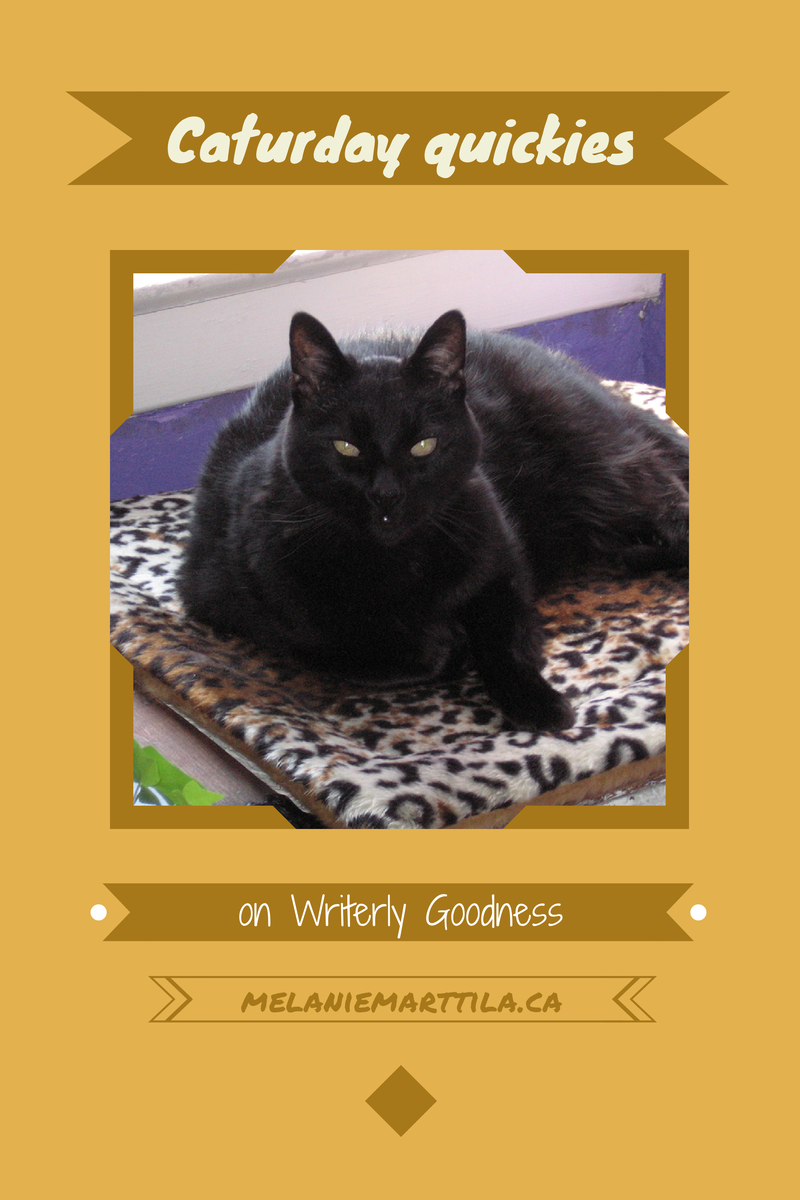
By the way, the kitteh in this blog image is our dearly departed Thufir (Howat, the Mentat Cat)

Caturday Quickies: The further adventures of hardy northern chick

So.

After my adventure getting down to Toronto last week, I thought I’d had enough of an adventure.

Seems the universe disagreed with me.

On Monday night, I got stuck in one of the hotel elevators for an hour and a half.

This was a first for me. I’d heard of, and I’ve know of, many people who have been stuck in elevators over the years.  I’ve seen it countless times on television and in movies.

Another experience for the idea file 🙂

Now, anyone who knows me, knows that I’m laid back. I’ll apologize in advance for the true story not being exciting, but here it is, for the record:

I was on the twelfth floor. I called the elevator, it arrived, I got on, and pressed the button for the main floor. The elevator descended, stopped, and then nothing happened.

I pressed the main floor button again, just in case. Nothing. I pressed the open door button. Nothing.

Swearing silently at my luck, I briefly considered hitting the “Alarm” button, but figured that it would only be loud and irritating, and I’d only be able to handle that for a handful of seconds before I went crazy.

So I looked around for some kind of call button, or an intercom. There was a phone behind a brass door beneath the button panel. I picked it up.

It connected me to the front desk. I explained my situation, and the desk clerk advised that he was sending his colleague down to reset the elevator in the control room.

They did that twice. I received three more calls from the front desk with status reports. I think I was expected to be claustrophobic, freak out somehow. The first reset had failed, and the second. They had called the service technician, but he was 45 minutes out from the hotel.

So I hunkered down on the floor and tried to get comfortable. What would be the point of When life gives you lemonsgetting upset?  I kind of dozed, but it was about as useful as trying to sleep on the red-eye back from Vancouver last fall.

The desk clerk called back as the technician opened the door to tell me that the technician had arrived. Um, yeah.

The technician advised me to jump for it. He was funny.

So that was my Monday night adventure.

It made for a great story in class the next morning: so what did you do last night?

And when I told Phil, he laughed at me. Nice one, dude.

By the way, what do you think of my first attempt at using Canva (for the picture)? From the user perspective, it wasn’t bad. Just getting used to the interface. Not sure if the wordage works either. It reflects my personality, but it’s a bit past its best before date 😛

Caturday Quickies

Sundog snippets: Hardy northern chick 1, winter highways 0

Just a quick note about today.

I was on the road, once again, for work. And once again, I was headed for Toronto (I’ll be here all week). Driving. I like to be in control of my own destiny 😉

I’m going to observing a course with an eye to future delivery. I’ll blog that once the week is over.

The issue was weather. This morning, it was snowing and blowing and I was not looking forward to the drive. I checked out the Weather Network for all points. Parry Sound and Barrie are snow belt cities.

It looked like the snow was going to follow me all the way down.

I got stuck behind ploughs not once, but twice, and stuck behind a transport toting heavy equipment.

As soon as I hit the Parry Sound city limits until I reached the district of Muskoka, I was caught in white out conditions.

There was a bizarre accident. I think a transport had stopped on the side of the road because of the white outs and an SUV didn’t see it until too late, swerved, and ended up on top of the guard rail and snow bank.

White outs again around Orillia.

Then some mystery slow down just south of Barrie. I saw no evidence of anything that would actually slow anyone down. I think it was just a chain reaction kind of thing. That cleared up by canal road.

I still made it here in five and a half hours.

I count it a triumph 🙂

Sundog snippet

Six questions with Jane Ann McLachlan

I “met” Jane Ann through a wonderful online collective, Wordsmith Studio, following Robert Lee Brewer’s April Platform Challenge of 2012.

Though I knew that many of us were writers, I had no idea Jane Ann was working on a science fiction novel. Last fall, she was even up in Sudbury, giving a reading at the Sudbury Public Library, which, because I was out of town, I had to miss.

I also had to miss her Twitterview with mutual friend Lori Sailiata for Hawaii Content Management (#HiCM), though I read the Storify afterward 🙂

Now that her novel is coming out in instalments, I decided I simply had to find out more about this virtual friend and fellow Canadian author.

Without further ado, here she is: Jane Ann McLachlan!

________________________________________________________________________

Jane Ann McLachlan

Jane Ann McLachlan

Hi Melanie. We’ll have to meet when I’m in Sudbury in September for Cinefest. My parents were both originally northern Ontarians, although I was born in Toronto and grew up in Newmarket, a small town near Toronto, Canada. I taught at Conestoga College until a few years ago, when I decided to write full-time, although I still teach a couple of evening courses a year. I have written two college textbooks, published by Pearson/Prentice Hall, a science fiction e-book on Amazon called Walls of Wind http://www.amazon.com/dp/B00HNXOG98 , and my collection of short stories, Connections, which came out last fall, published by Pandora Press.  My website is http://www.janeannmclachlan.com

________________________________________________________________________

WG: Welcome to Writerly Goodness, Jane Ann!

You are a writer of diverse talents. You’ve written two textbooks on professional ethics, a collection of inspirational short stories, and now a science fiction novel. I also understand you write historical fiction as well. How do all of your writerly personae intermingle, or do they?

JAM: I read extensively and enjoy a lot of different genres, so writing in different genres feels natural to me. But it didn’t always. I had to learn to accept the genre a story idea came to me in. I started writing science fiction, which I have always read, when I heard of a medieval superstition that really grabbed my imagination. An editor at Tor loved the idea, and liked my writing, and seriously considered it. He didn’t buy the book, but he gave me some excellent advice—he told me to re-write it as a medieval novel. I had to do a lot of research and reading in that genre (at that time I’d only read a few historical fiction authors) before I felt qualified to write historical fiction, but I’m pleased with the result. The Sorrow Stone is currently on offer with my agent. I guess I’m not a quick learner, because about the same time, I went through a traumatic event, and I tried to write it up as fiction. But it just kept dying on the page, until I gave in and wrote it as memoir. Impact: A Memoir of PTSD is now also with my agent. Now, I listen to the story and let it tell me which genre it needs to be written in.

WG: What is the origin story of J.A. McLachlan, author?

JAM: When people ask me, what made you start writing? I say, “I learned to read.” The first story I remember writing was a picture book, way back when that’s what I was still reading. It was about a pony, and I remember practicing for months to learn how to draw a horse. After that, I switched to poetry. I have a number of poems about dogs and horses my mom saved. They rhyme and they scan, but I wasn’t into very deep themes at age 8. 🙂

WG: Focusing on your fiction, what attracts you to each of the genres you write in (inspirational, historical, and speculative)?

JAM: I like a good story, with intriguing characters that are changed by their experiences in the novel, and an interesting “high concept” theme. Moral and philosophical quandaries really interest me, as well as a plot that keeps me guessing. These elements can be found in many genres.

WG: I’m a total process geek. I love to find out how people work their art and craft. Would you care to share anything about your writing process?

JAM: I need complete silence when I write, and NO interruptions. I write best when I’m all alone at home for hours, and I write on a laptop that is not connected to the internet (I have a separate computer in another room for that.) I start with a rough outline and let the characters alter it as I go. I would like to be a total plotter—that’s how I wrote my textbooks, with a very detailed outline for every chapter—but fiction, like life, just doesn’t work that way.  Stuff happens, and you have to adapt. Fiction (and life) can be a pain that way. 🙂

WG: With respect to Walls of Wind, why have you opted for publication in instalments?

JAM: It’s all about knowing your market. E-books do better in novella form, at low prices, for a number of reasons. It seems most people who read e-books like something they can read fairly quickly. If they want more, they’ll buy the next one. And since I’m an unknown author, readers are more willing to try me out if it’s not going to cost them much in time or money— Walls of Wind Part I is 4 chapters long and sells for .99c. I want people to be able to try it, because Walls of Wind is the best thing I’ve written, and I’m pretty confident anyone who likes science fiction and reads Part I will want to read the rest. Oh, and the link is:  http://www.amazon.com/dp/B00HNXOG98

But here’s an offer for your readers. Right now, book reviews of Walls of Wind are worth more to me than royalties, so anyone who will write a review on Amazon or GoodReads (or best of all, on both) for me—whatever they think of the book—I’d be happy to send them Part I for free. Just email me at:  jamclachlan@golden.net

WG: What’s next for you?

JAM: Right now, I’m editing Part III of Walls of Wind —Part II goes live on Feb. 1; Part III on March 1; and the complete trilogy, for those who want a longer read, in e-book form and in print, will be available on April 2. I’m also currently setting up a number of talks and readings in the US and Canada for Connections and will be doing the same for Walls of Wind when I have the print book. And while all that is going on, I have my next historical fiction novel—which takes place during the Third Crusade—AND a YA science fiction novel, both hollering around in my head trying to get out, so I’ll be writing them this year.

Thanks for a great interview and break a pencil in your future writing endeavours!

____________________________________________________________________

About Walls of Wind:

Walls of Wind, Part II

Walls of Wind, Part II

What if males and females were completely different species from each other?

Walls of Wind explores this question and its ramifications on a world in which males and females are two different, equally intelligent species: Ghen and Bria. They are interdependent and reproductively symbiotic, although physically, emotionally and mentally they have little in common. Or so they believe, until their city-state is threatened by increasing internal conflict and a terrifying external predator that has invaded the forests beyond their walls. A handful of Ghen and Bria struggle desperately to find a solution before their civilization is destroyed.

Walls of Wind combines anthropological speculation with the tragedy, suspense and triumph of individual characters who struggle to overcome external threats as well as their own internal fears and prejudices.

Read Part I of Walls of Wind: http://www.amazon.com/dp/B00HNXOG98  Look for Part II on February 1st, 2014.