Review of Walls of Wind by Jane Ann McLachlan

I actually started reading this novel in parts, as it came out earlier this year, before I received the advanced reader copy (ARC) of The Occassional Diamond Thief this past fall. The ARC took precedence, however, and as I generally don’t review anything I haven’t finished and enjoyed, this review had to wait a bit.

Yes, this is another bit of catch up 😉

The Walls of Wind

What Amazon says:

What if males and females were completely different species from each other?
WALLS OF WIND explores this question and its ramifications on a world in which males and females are two equally intelligent sentient species: Ghen and Bria. They are interdependent and reproductively symbiotic, although physically, emotionally and mentally they have little in common. Or so they believe, until their city-state is threatened by increasing internal conflict and a terrifying external predator that has invaded the forests just beyond their walls. A handful of Ghen and Bria struggle desperately to find a solution before their civilization is destroyed.

WALLS OF WIND combines anthropological speculation with the tragedy, suspense and triumph of individual characters who struggle to overcome external threats as well as their own internal fears and prejudices.

My thoughts:

When I started reading The Walls of Wind, I was immediately reminded of Ursula K. Le Guin’s Left Hand of Darkness, which presented an alien race with distinct gender and reproductive attributes.

McLachlan goes further, technically eliminating gender, but biologically linking two species. The unique circumstances of this biology define McLachlan’s world of Wind and form the heart of her story.

Bria and Ghen are very different, and very aware of their differences. One of the walls on Wind that must be broken down is the prejudice that exists between these two quintessentially linked species.

This is where McLachlan’s novel became reminiscent of Sherri S. Tepper for me. Tepper often explores the stratification of human society as it encounters alien worlds and species, or the post-apocalyptic changes that humanity undergoes, usually in terms of divisions along gender lines.

The dynamics between the Bria and the Ghen struck me as similar, but because the two species are effectively gender neutral, McLachlan is able to offer the reader a fresh perspective on the old challenges of equality and compassion.

A terrible secret is another of the walls of Wind that must first be revealed, and then addressed by the Bria and Ghen who have conspired—for the betterment of their peoples—to keep it hidden for generations.

There are love stories that play out through the novel, the generational stories of several families, transgressive acts by various characters that challenged species roles and capabilities, scientific discoveries, and adventures.

At every turn, the centre around which McLachlan’s story turns is the encounter with the other, whether between Bria and Ghen, Ghen and the fearsome Broghen, or Bria and Ghen society and the unknown communities of Bria and Ghen discovered elsewhere on Wind.

There is something for every reader in these pages. The novel is tremendously rewarding, and though tragic, ultimately hopeful.

My rating:

Five out of five stars. Yup. I’m a new fan. Jane Ann is amazing.

About the author:Jane Ann McLachlan

J.A. McLachlan was born in Toronto, Canada. She is the author of a short story collection, CONNECTIONS, published by Pandora Press and two College textbooks on Professional Ethics, published by Pearson-Prentice Hall. But science fiction is her first love, a genre she has been reading all her life, and The Walls of Wind is her first published Science Fiction novel. She is represented by Carrie Pestritto at Prospect Agency.

Robert J. Sawyer reviewed The Walls of Wind and had this to say:
“Look out, C. J. Cherryh! Step aside, Hal Clement! There’s a new master of truly alien SF, and her name is J.A. McLachlan. THE WALLS OF WIND is doubtless THE debut novel of the year.”
— Robert J. Sawyer, Hugo Award-winning science fiction author

You can learn more about J.A. McLachlan and her books on her website at: http://www.janeannmclachlan.com

Connect with Jane Ann on Facebook: https://www.facebook.com/janeann.mclachlan

How to get published

Once again, here’s some November catch up displaced by other priorities.

On November 6th and 7th, I travelled down to Humber College in Etobicoke (Toronto) to attend the How to get published workshop Hosted by Cythia Good and Jennifer Murray.

Humber Shcool For Writers Lakeshore Campus

About the presenters: Cynthia Good is the former president and publisher of Penguin Canada and current director of Humber’s Creative Book Publishing program. Jennifer Murray is the former director of marketing at Penguin and vice-president, marketing at Kids Can Press.

As with any of my transcribed sessions, discretion is advised. I fully acknowledge my humanity and there may be errors. If you see any, please be kind enough to let me know so I can make corrections, post-hasty.


You can’t make a living creative writing alone. (Mel’s note: It is possible to make a living writing, even in Canada. I know several people who do it, but it usually involves a fair amount of risk that most of us are not prepared to take. Do not lose heart if it is your goal to quit your day job. You just have to plan carefully and understand what level of risk you are comfortable with. As ever, do your research. /end rant)

It’s a brave new publishing world since the advent of digital publishing.

Publishing used to be a paternal system. Now it’s more like a partnership. Much more business and marketing knowledge is required of the average writer.

There have been a few big sea changes in the publishing world.

Two years ago Random House and Penguin merged (Mel’s note: officially, it’s Penguin Random House, or P/RH, but I still like Random Penguin). It’s a 51% to 49% balance of the controlling interest in the company and a shift from primarily German to primarily English oversight.

More recently, HarperCollins (HC) announced that it would be shutting down its Canadian distribution centre. This will mean the layoff of 120 people including the former president of sales, distribution, and administrative finance.

What does this mean for HC? They bought Harlequin last year. Another merger of sorts.

Another recent bit of news is that the government has disallowed new foreign publishers to set up operations in Canada. This is affecting Simon & Schuster (S&S) and their imprints, resulting in the departure of several key employees.

A Canadian publishing company that started up eight months ago may not be able to make it in this increasingly hostile publishing environment.

Will we see a HC and S&S merger?

The thing about mergers is that in order to support their infrastructure, publishers depend on authors whose sales will finance that support. Midlist authors are being dropped. Fewer chances are being taken on new authors.

These authors are going to small and boutique Canadian publishing houses.

In Canada, a bestseller is about 5,000 copies. Really, if you take into consideration returns, the print run should be anywhere from 7,500 to 10,000 copies and at least 5,000 of those must sell. 5,000 is the break-even point.

Why go for a traditional deal?

If you write non-fiction, there’s still money for public speaking. Though marketing and promotional budgets are disappearing, there is still some money to be had.

Traditional publishers are also branching out into digital. Hazlitt is an online magazine put out by RH.

They’re also getting into providing author services. Author Portal, through RH again, is much like Kobo Writing Life and offers similar metrics. Penguin bought Author Solutions (Mel’s note: BOO!) because selling author services ala carte is more lucrative.

Marketshare by format (Canada)

  • 18% ebook (24% in the US)
  • 58% paperback
  • 24% hardcover

Booknet keeps the statistics and only publishers and booksellers have access to that.

Ebooks have hit a plateau and are expected to hold. Pricing is not expected to hold, however.

Scribd, through HC, is billed as the Netflix for books. Amazon also offers a subscription-based service (Kindle Unlimited) whereby you can loan unlimited material.

In general, Amazon sells ebooks at a low price. Print prices are also falling.

Publishers in Canada can’t compete and can’t survive without government grants.

Three years back, in the battle between what was then the Big 6 and Amazon resulted in an Amazon win.

In part, it comes down to discoverability. How do readers find their books?

The traditional path between author and reader: author -> agent -> publisher -> distributor -> bookseller -> reader.

Now authors can go directly to the reader.

There are also book apps. Apps based on popular books. No one is making money on boo apps yet.

E.L. James’s success led to trends in erotica. Young adult and new adult are still strong categories.

Wattpad is a Canadian company and you can post your novels on there, chapter by chapter, for free. You can get great reader feedback that way. There are no stats currently on how releasing material on Wattpad may affect sales of ebooks or print books later on.

Of the Big 5 publishers, Canadian authors have access to three:

  • P/RH – both still take submissions seperately for the main publisher and all imprints. RH has Vintage, DoubleDay, Knopf, McClelland and Stewart, Tundra, etc. Penguin’s imprints include Viking, Allan Lane, Hamish-Hamilton. Collectively, they publish 100-150 books annually.
  • HarperCollins, which has recently acquired Harlequin.
  • Simon & Schuster, though they are, as mentioned, in the midst of transition.

There’s also Scholastic. They’re US-based, but Canadian authors can access them.

Small or independent publishers

  • Dundurn in Hamilton. Their focus in on history. They are in growth mode.
  • ECW publishes everything.
  • ChiZine is a niche publisher of horror.
  • Bundoran and Edge Science Fiction and Fantasy.

Micropublishers, or boutique publishers

  • Biblioasis
  • Gaspereau
  • Freehand
  • Goose Lane
  • Pedlar Press
  • Bookthing
  • Tightrope
  • Insomniac
  • Mansfield
  • Groundwood
  • Pyjama Press
  • Second Story

How do you choose?

If you aim for a big publisher, you will usually get a better deal.

With smaller houses, you get more attention and they will take more risks on new authors. Smaller presses are more agile and have specialties.

Editors

It’s a matter of match-making. The editor needs to make money for their publisher. They have a lot to read and a lot of work to do for their current clients.

Make sure your first page is memorable.

A well-written book with excellent sales can make an editor’s career. They receive bonuses based on sales, awards, and word-of-mouth (reviews). They usually have “stables” of writers.

They curate their authors’ best work.

Agents

Do you need one? For the big publishers, yes. The best way to get an agent is to get a publisher (ironic, isn’t it?).

You can approach editors directly. They’re always looking for new authors.

Think about why you want an agent. They can offer:

  • Emotional support
  • Editorial support
  • Career counselling
  • Access to big publishers
  • The ability to negotiate a good deal
  • Contract review
  • Interpretation of your royalty statements
  • The ability to negotiate for marketing budget or cover input
  • Advice on next books

For all this (sometimes more, sometimes less) they get 15% of every sale. Foreign rights, television, movies, audio, etc. (all subrights) generally demand 20%.

Agencies:

  • Westwood Creative Artists
  • Cooke Agency
  • Transatlantic Literary (primarily children’s)
  • Anne McDermid
  • Helen Heller (commercial)
  • Rights Factory (experimental/literary)
  • Rick Broadhead (practical/non-fiction)
  • PS Literary
  • Beverley Slopen

Always check the agency’s submission guidelines.

Other resources that might give you additional information on agents are the Association of Canadian Publishers and the Writers’ Union of Canada.

Make sure that your manuscript (ms) is complete and polished. N.B. Non-fiction should be queried with a proposal.

Why might you not want an agent?

  • Control over your career
  • Direct relationship with editor or publisher

A Baker’s Dozen (things to do before you query)

  1. Perfect your manuscript
  2. Get feedback
  3. Attend writers’ workshops and courses
  4. Hire an editor (freelance). N.B. Humber is launching its own Publishing Services.
  5. Submit to journals and magazines
  6. Research and submit to competitions
  7. Attend conferences or conventions
  8. Volunteer for or attend literary festivals like Word on the Street (WotS)
  9. Read
  10. Get to know local bookstores and librarians
  11. Have a presence on the internet
  12. Be prepared to give it away.
  13. Learn everything you can about publishing (Publishers Weekly, Quill & Quire)

Preparing to write your query

Research your comparatives/competition. Market research.

Be professional.

Submit to multiple agencies. Have your A list, your B list, etc. It’s also good to identify what you’re not interested in.

Have a strategy.

Query letters

Start with the story. Make it compelling. Get to the facts (word count, genre, etc.) at the end.

  • Introductory paragraph – if you have met or been referred to the agent. If not, show your research. Why do you think you’ll be a good fit?
  • Pitch/short synopsis – be as interesting as possible. Don’t give away the ending.
  • Comparables – be realistic.
  • Biographical info – keep it relevant.
  • Closing.

Agents will not appreciate it if you do not state the word count, call your book a “fiction novel,” use poor spelling, and/or poor grammar.

Self-publishing

This is not new. Virginia Woolf and Walt Whitman self-published.

Keep in mind that for every Hugh Howey there are thousands of self-published wannabes. Only 400 out of every 1.5 million books published sell more than 100 copies.

Consider your motivation. You may be:

  • An oft-rejected writer (this doesn’t necessarily mean your book is badly written, but consider the possibility)
  • Someone who wants to establish credibility
  • Someone who wants to help others
  • Disappointed with traditional publishing
  • Interested in establishing a legacy

If you self-publish print books, you generally need as many as 2,000 books for distribution.

Advantages

  • Certainty/total control
  • Speed to publishing
  • Increased income

Disadvantages

  • Up-front costs
  • No advances
  • Time consuming
  • Marketing and promotion are entirely on you
  • Distribution
  • Liability
  • Access to prizes and grants

Terry Fallis states he spent $1,400 for editorial review, cover layout and $2,000 for additional editing.

Use Wattpad to get reader feedback.

Use Kickstarter or Indie-go-go to fund your publication.

Check out James Altucher’s blog. Start with this post on Publishing 3.0.

Be prepared to become an authorpreneur.

Consider partner publishing with a company like Iguana Books.


As I said at the outset, my notes are not complete. I can’t write down everything said in the course of a day and a half. We also wrote query letters and critiqued them in class, as well as learning how an agent sells your book to a publisher. We also went over non-fiction book proposals, which I chose not to share with you here. There was a lot I couldn’t include.

That was the first day and a half. The last half of the second day was given over to Jennifer Murray to discuss marketing and promotion.

I’m sorry, but I didn’t take notes for the marketing piece.

You’ll have to register for the next session if you want to find out about that 😉 I’d recommend it if you’re in the Toronto area.

And that’s it for Writerly Goodness tonight. Toddling off to Bedfordshire.

Putting the team first

Back in November, I co-facilitated a team building course called Putting the Team First. I haven’t blogged about it until now, well, because NaNoWriMo, and Christmas shopping, and other stuffs.

So here’s my first learning and development related post in, like, forever . . .

Let’s get one thing straight

I attended the training for trainers (T4T) version of the course back in December of 2013 and one of the first things we needed to get straight was the name of the course. People were calling it Putting Teams First. The designer (who was also one of the trainers) was very specific on this point.

It’s Putting the Team First, thank you very much.

Why so picky? Because that’s the focus of the course, to improve performance, one team at a time. We put the team first and each class focuses on one team, the entire team, if possible.

The hand off

The T4T was being delivered to train regional advisors and consultants in the material and methodology because our internal college, which is national, was handing off delivery of the course to the regions.

While I had scheduled multiple sessions of the course for each sector in Ontario throughout the year (in my former capacity as training coordinator) this was the first occasion I’d had to deliver the course in the year since I’d received the training.

So, I jumped at the chance.

Theme and methodology

The theme was a nautical one and the one-day course was divided, as usual, into modules. The introduction was Boarding, followed by Packing for the Journey, The Crew, and Under Full Sail.

Boarding dealt with the usual icebreaker activity, establishing trust, and navigation (the agenda) for the course.

Packing involved identifying issues that the team faced and prioritizing them according to what could be addressed by the team (cargo), what was negotiable (dock), and what was out of the team’s control (warehouse).

We also did a fun exercise on prioritizing salvage in the event of a shipwreck. The team had to work together to come to a consensus regarding what the most important items would be. The answers were prioritized by the Coastguard including rationales for each.

The crew moved on to Tuckman’s Model. I’d encountered it before, but it was never given its proper name. For those who don’t know, Tuckman’s is the model of group dynamics that includes four stages: forming, storming, norming, and performing. Some thought was given to where the team thought they were on that continuum, but we didn’t belabour it.

We also delved into team player “types” with an emphasis on the fact that everyone is a mixture of all four identified types, but that one manner of “expression” may be predominant. The four types were contributor, collaborator, communicator, and controller. Participants identified themselves and gave some thought to how tasks might best be allocated based on the strengths of each type.

Finally, in Under Full Sail, we returned to the issues identified by the participants back in the Packing module and the team had to once again work together to create an action plan to address their most challenging issues.

The idea is that the team will have the tools that they need to take action on their plan after leaving the course. We don’t check up on them, however. It’s entirely up to the team to take the information and run with it.

So that’s what a day of team building is like where I work.

What kinds of team building training have you facilitated? Participated in? What did you think?

The Learning Mutt

The next chapter: November 2014 update

So. Just to get it out there, I didn’t meet my NaNo goal this year. Honestly, I thought it was going to be a tall order writing 50k words while working full time.

If you remember my pre-NaNo post, I said that if everything went to hell and I only got 20k words written, that I’d still be happy.

Well, I wrote 28,355 words on my new novel idea and I’m more than happy with that.

NaNoWriMo participant 2014

I didn’t do more than maintenance housework.

I did try to live as normal a life as possible.

I did not abandon my blog, though I was less present on social media.

I had two birthday celebrations, two weeks of training (which always drains introverted Mellie), two weeks of travel, a workshop on publishing, a Christmas party fiasco, and a new critique group meeting to attend.

I’m surprised I got as much done as I did.

I’m still in recovery.

So here, briefly, is what the month looked like.

November's Writing Progress

5,269 words on the blog and 28,355 on the new novel.

33,624 words total for the month.

Whew!

I’ve taken a few days’ respite so far in December (sorry about the time warp, folks), but I’m getting back on that wee writing horsie next week.

As Chuck Wendig says, I gotta finish my shit. As Kristen Lamb says, life rewards finishers.

Specifically, I’m not only going to work further on Marushka, which is another YA urban fantasy/fairy tale re-envisioning, but I’m also going to get back to my other draft-in-progress, Gerod and the Lions, my MG fantasy, and work on a few short stories for upcoming contests and anthology calls.

I’ve written Marushka in Scrivener, my first project using that program. To be honest, while I can see the value of Scrivener, I’m organized enough, and well-versed enough in Word that I’m content to return to it.

Unless, of course, Microsoft does what it’s threatening to do and make Office into a subscription-based service. If that happens, they’ve lost a heretofore faithful customer and I’m jumping ship to Scrivener.

I don’t know why MS has to go and screw up a perfectly good office suite.

I’ve had the pleasure of being on the launch team for a fellow author for the past few months as well. It’s been an interesting process helping Jane Ann McLachlan choose a title for her novel, a cover, reading the ARC, and writing the review for her.

I’ve also gleaned a few things for my toolbox. I knew that one must place one’s review to Amazon.com (as opposed to .ca) but now I know that I should also find other reviews helpful and click that little button on as many of them as possible.

Apparently that’s another little tip: Amazon will give preference and weight to helpful reviews, as opposed to reviews on which the button has not been clicked. Amazon also prefers it if you have purchased the book or ebook through them prior to posting the review. A verified purchase carries more weight again.

Interesting stuff. And here I thought I was helping people out by posting my reviews of their books. Now I know how to help them even more.

And that was my month.

I got a little present in my inbox this past week. See that lovely Excel spreadsheet depicted above? That was created by the wonderful and talented Jamie Raintree. I got her newsletter, and a link to the 2015 version (happy dancing commences).

You need to subscribe to that lovely lady 🙂

I spent most of today cleaning the house after my month of sloth. Phil helped (bless him) by doing the pots in the kitchen and cleaning the bathroom.

Now Mellie has to toddle off to Bedfordshire. She has five submissions to critique for tomorrow’s meeting and Christmas decorations to haul out of storage and place artfully around the house.

You know what? I love my life 🙂

The Next Chapter

Why do I write and how do I stay motivated?

The question that Bob Clary of Webeducator.com posed to me was this: We’re wondering how other writers who write more for pleasure for than for financial gain stay motivated.

  • What were your goals when you started writing?

I started writing in grade three, at the age of seven, after having been inspired by the storybooks created by the grade five class. In particular, the story created by Siobhan Riddell, of a knight who fought a dragon to rescue a princess, made me want to write something like that. I sent my first submission to CBC’s Pencil Box, a show that dramatized the stories of its young viewers, that same month.

I didn’t have goals when I started writing. Nothing so formal. I wanted to write something that could make someone else feel the way Siobhan’s story made me feel.

  • What are your goals now?

The same. More or less.

Now, however, I have read thousands of books by hundreds of authors.

I have been published as a poet. This is not something one does for money. Especially in Canada. A “bestseller” in poetry in Canada is 500 copies. In most cases, you’re lucky to break even. Many journals pay in subscriptions. Many anthologies pay in copies.

I have won prizes in short story contests, five to date, the prize money ranging from $50 to $150. This is also not a way to earn a living as a writer, but it is a way to get published.

As of this year, I have had three professional sales, all for science fiction short stories. Even with professional rates, though, it’s hard to make a living this way. I’d have to publish a story every working day of the year to make a living wage.

I have now written three novels and am working on two more. None of these have been published. Someday, they will be, if not by a traditional publishing contract and deal, then by self-publishing. I am struck with the thought at how few people in North America actually live by their writing alone if they write fiction.

Non-fiction, journalism, and technical writing all pay better. If anyone wanted to write in order to make a living doing it, I’d recommend any, or a combination, of those fields.

Not that it’s impossible, but it is challenging and it takes a kind of bravery I have to admit I lack. I will not thrust responsibility for my care and upkeep onto my spouse. I cannot let our debts go unpaid.

Having said all of that, I still intend to make a living by my writing one day. There are conditions, namely, that all our outstanding debts must be paid off, I must make enough by writing to replace my current income, or we must become incredibly lucky and win the lottery 😛

  • What pays the bills now?

I am a corporate trainer working 37.5 hours a week.

  • Assuming writing doesn’t pay the bills, what motivates you to keep writing?

That wonderful storybook from grade three. All the books I’ve since read. The ideas that I keep getting that just won’t leave me alone. The fact that my writing is my solace, my entertainment, my therapy, my passion, my calling, and one day, my legacy, keeps me typing, scribbling, and learning about my craft.

Though I started writing young, I have always struggled, and until about nine years ago, I didn’t write every day. I’ve had some very damaging experiences that have led me to distrust my talent and my skill, but the desire to write has never left me.

I can’t not write. I have often said that I will write until age and infirmity (it’s going to take both of them—I ain’t going down without a fight) rob me of the capacity.

Siobhan’s storybook has never left me either, and I can’t fulfill that childhood desire to give readers the thoughts and feels unless I publish more of my writing.

  • What advice would you give young authors hoping to make a career out of writing?

Read. Read everything. Read in your genre. Read outside your genre. Read non-fiction. Read the classics. Read crappy books. Read books that make you cry or cheer or race to the end (and stalk watch the author’s web site until the next book is out).

Write. The only way to become a better writer is to write and to finish what you write and then to start writing something else. Lather, rinse, repeat. Never stop.

Study the craft. Take workshops. Go to conferences. Read every writing craft book you can borrow from the library or afford to buy. Subscribe to blogs and newsletters. Love learning and be open. I got an MFA, but they’re not for everyone. You can often do more and or better without. Be savvy. Do your research. Trust your gut.

Be willing to work. Work your butt off. Work your fingers to the bone. If you love what you do, the work—well it won’t be easy, but it will be a burden you can bear with a glad heart, because you know that this is what you were born to do.

Invest in yourself. Join professional associations in your genre. Find the money to pay for freelance editing. Get into a critique group. Learn about the publishing industry. Hone your query or book proposal until it is perfect.

Never give up. Persistence pays.


You can see how Roger Sakowski and Janie Sullivan responded to these questions on the Webeducator blogAnd here are a few other authors who have participated:

Muse-inks

Caturday quickie: One lovely blog award

I haven’t received one of these in a while and so it was a pleasant surprise when Cassie of My Etch-a-Sketch Life nominated me for the One Lovely Blog award.

one_lovely_blog_award

Awwww . . . THANKS!

So I have to share seven things about myself (I’ve decided to list seven things that make me happy):

  1. I met my BFF in grade three. Yes, we’re still friends, and no, I’m not telling you how long it’s been.
  2. My university roomie, after a decade (at least) during which we lost contact with each other, got in touch with me recently.
  3. I’ve just joined a writing/critique group with five other women. Our second meeting will be on Sunday.
  4. My husband of twenty years (whee!) does all the cooking and consequently all the grocery shopping. This is a real blessing for writer Mellie.
  5. I have three novels drafted and two more in progress. All are fantasy of various kinds.
  6. This year, I’ve had two paid publications of science fiction short stories and won a second place prize for another short story of a paranormal bent. Writerly income (even a little) rocks 🙂
  7. Writing. It’s who I am and what I do. It makes me Snoopy-dance happy, #furiouslyhappy.

Now I’m supposed to nominate people to continue the chain. Most of the time the people I nominate don’t play along. So I’m going to take a page from another (much cooler) writer, Veronica Sicoe, who was also asked to participate in this blog award challenge.

You are all hereby nominated. Yes. I’m a big, fat cheat. Participate if you are so moved. Otherwise, I hope these seven bits of my incredibly boring life entertained.

lovely-blog

Caturday Quickies

Review of The Occasional Diamond Thief by Jane Ann McLachlan

What Amazon says:

On his deathbed, Kia’s father discloses a secret to her alone: a magnificent and unique diamond he has been hiding for years. Fearing he stole it, she too keeps it secret. She learns it comes from the distant colonized planet of Malem, where her father caught the illness that eventually killed him. Now she is even more convinced he stole it, as it is illegal for any off-worlder to possess a Malemese diamond. When 16-yr-old Kia is training to be a translator, she is co-opted by a series of events into travelling as a translator to Malem. Using her skill in languages – and another skill she picked up after her father’s death, the skill of picking locks – she unravels the secret of the mysterious gem and learns what she must do to set things right: return the diamond to its original owner. But how will she find out who that is when no one can know that she, an off-worlder, has a Malemese diamond? And how can she bear to part with this last link to her father?
Kia is quirky, with an ironic sense of humour and a loner. Her sidekick, Agatha, is hopeless in languages and naive to the point of idiocy in Kia’s opinion, but possesses the wisdom and compassion Kia needs.

The Occasional Diamond Thief

My thoughts:

The Occasional Diamond Thief is a fabulous adventure, but it also offers thoughts and feels for readers of all ages.

In The Occasional Diamond Thief, McLachlan’s protagonist, Kia, learns the truth about herself by learning the truth about others.

Kia is the youngest of three children. Her father, a space ship’s captain and merchant, returns from a trip to another planet with the illness that eventually kills him. He is secretive and haunted, but Kia wants his love and approval.

She believes her facility with languages will accomplish this and so learns the difficult Malemese. Unfortunately, hearing the language worsens her father’s condition.

Kia is also at odds with her mother, who is strictly religious and seems to resent Kia’s connection to her husband through the language of Malem. In an attempt to protect both spouse and child, Kia’s mother forbids the speaking of Malemese in the house.

When her father dies, Kia is with him, and he commends to her an incredible diamond. Determined to solve the mystery of the gem, but escape her mother’s oppressive grief, Kia applies to become a translator. Independence is a challenge, and Kia must turn to thievery to support her life as a student.

She gets caught, and as a consequence is sent to Malem as a language teacher for the Select who assisted her in the theft. Once there, Kia must solve the mystery of the diamond, risking her life and that of the Select, uncovering a conspiracy that has its roots in the highest levels of Malemese society.

Kia believes her mother harsh, but learns that she was only trying to protect the ones she loved. Kia believes her father is a thief, but learns that it was his compassion that placed the diamond in his custody. Kia believes the Select and her order, the O.U.B. are attempting to manipulate her, but discovers that they are only trying to make it possible for Kia to right old wrongs. Kia believes the Malemese people to be cold and barbaric, but experiences their capacity to love first hand and fights to free them from a fearful legacy.

McLachlan has created a simple, but compelling universe that doesn’t strain credibility and serves as the perfect backdrop for Kia’s journey. She even weaves in a sweet love interest that proves to have his own secrets. Woven into the overall plot are mystery and thriller elements that will keep readers turning pages.

McLachlan’s novel is reminiscent of Madeline L’engle and Ursula K. LeGuin’s young adult fiction.

My highest recommendation.

My rating:

5 out of 5 stars.

Jane Ann McLachlanAbout the author:

Jane Ann McLachlan is the author of a short story collection, CONNECTIONS, published by Pandora Press, and two textbooks on Professional Ethics, published by Pearson-Prentice Hall. She has a Science Fiction novel, Walls of Wind, on Amazon under her pen name, J.A. McLachlan, and a second science fiction novel, The Occasional Diamond Thief, coming out on Dec. 2, 2014. She is a professor at Conestoga College in Kitchener, and lives with her husband and daughter in Waterloo, Ontario. Her goal is to write and publish the kind of stories you hate to finish reading.

http://www.janeannmclachlan.com/

The Next Chapter: October 2014 update

The month’s been a bit of a wonky one.

I started out working on Gerod and the Lions, but with NaNoWriMo coming up, I started to work on my outline for my project more and more. That work was all done by hand in my handy-dandy Moleskine notebooks. Handwritten words are a pain to track, so I don’t.

I don’t outline like a normal person. Actually, to put it a different way, I don’t think there is a normal way to outline. Everyone will do it differently.

my outline (such as it is)

I start sketching things out, make notes, what to research, and then I’ll get to a point in the story that I have to figure out a few things. So I’ll leave the “outline” and start on a character’s backstory, because I need to know what it is. Who’s the antagonist? What’s her or his motivation?

And then I’ll go back to the outline until the next gap emerges. I’ll deviate to fill it, and so on and so forth. I finished off one notebook and started another. I hope to have time to transcribe my notes before I’m neck deep in word deficits.

The blog was my big word-producer again this month. No surprise there.

The only other thing I worked on was a short story for a contest. Sadly, I realized too late that the story was double the length of the word limit set out in the contest rules. Doh! Homer moment. I didn’t have another suitable story to offer up, so I let it go. There was an entry fee anyway, and I try not to enter anything with an entry fee these days.

Fortunately, I’ve identified another market for the story and, as ever, will try again.

Everything else went by the wayside, Initiate of Stone, Apprentice of Wind, Figments, everything. This happens when I get focused.

So this is how the month looked, production-wise:

October's writing progress

GatL – 2,852 words. Short of the 5,000 I was aiming for, but my new story is kind of obsessing me right now. That’s a good thing 🙂

Blog – 11,766 words.

Short stories – 49 words. There was a little additional writing, and a little editing.

Total – 14,667 words.

I’ve got the Excel all revved up for NaNo, with an extra project and column for November.

Eeeeeeee! Let the writing begin!

So far, we’re on track for continuing with the blogging, even during NaNo. I hope it lasts, but if it doesn’t, forgive me, won’t you?

Anyone else out there doing NaNoWriMo?

Sundog snippet: Nothing much happening here

Nobody’s been to our yard all week. I’m not sure what they’re waiting for, but this is what we’re stuck with in the meantime:

Sunday26-1

Sunday26-2

Sunday26-3

Sunday26-4

Sundog snippet: Chaotic life is chaotic

I will try to keep this a snippet, but there’s a lot happening these days.

Work

The uncertainty continues.

My former manager is continuing in her acting position as senior manager until December 31. In the meantime, one acting manager has yielded to another, this time, a colleague, talented and deserving.

Two other friends from the consultant pool have been appointed to training coordinator, the position I held as an acting consultant for sixteen months. One of my friends will be handling coordination for my business line and the other for another business line. I’m very happy for them. The position will teach them a lot.

The new training is well underway. I delivered the Sudbury session the second and third weeks in September. Then I mentored a couple of acting advisors on our team to help them learn the way we monitor our new agents, post-training.

I’ll be doing a little more mentoring, and taking on the supervision of an agent returning to work.

Then I’ll be getting ready for the next round of training in November. After that, I’m not really sure what’s going to happen.

I got my projects from the summer done, but beyond that, I don’t know if anything more will come of them.

With all the major players in acting roles, we can’t really do more than react.

Phil’s got his own burden at work, but it’s not my story to tell, so I’ll have to leave it at that.

Usually, when things are going well for me at work, they go poorly for him, and vice versa. Now we both seem to be in a bit of a jam.

Home

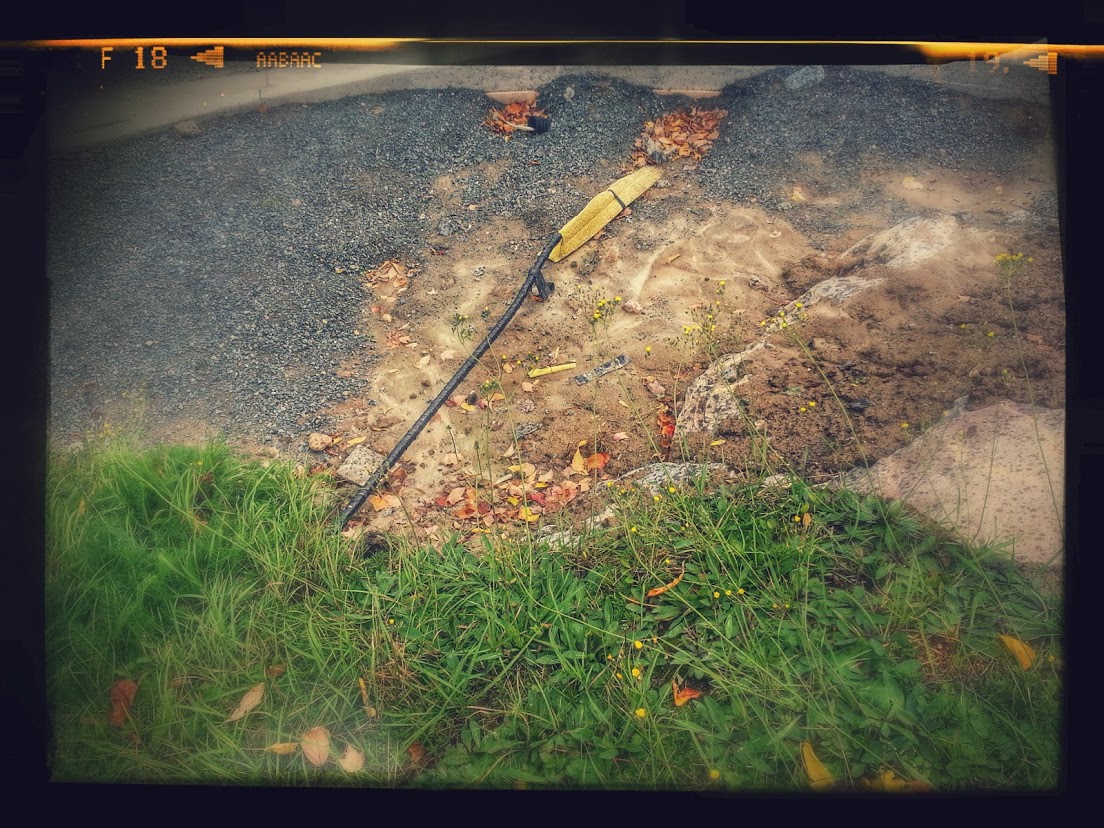
The city engineer stopped by my mom’s last week. Apparently, Union Gas will be by to bury the gas line properly again on Monday.

The Gas Line

Then, the rock will be blasted out. As you can see, the blasting mats are already in place.

The Blasting Mats

Then, they’ll be tearing up the driveway and repaving and, I suppose, getting the retaining wall up.

The engineer is supposed to be coming by with the work order for Phil to sign off on. He says he has a lovely railing for the top of the retaining wall.

You know about Nuala’s troubles from last week’s post. She’s making headway, but after the first glucose curve, the vet increased her dosage of insulin. Her sugars were too high. We’re in a holding pattern there until this Thursday, when we’ll take Nu in for her next glucose curve.

Phil and I are growing accustomed to our new schedule, but between that, the gloomy weather we’ve been having, and work uncertainty, we’re both exhausted.

At least, I’ll have my normal salary to look forward to for the next six months or so. We have some hefty vet bills to pay off.

Creatively

As you may have guessed from my Next Chapter post, I’m trying to focus my energies on my writing. It’s what keeps me sane.

Unfortunately, trying to cram everything in tends to wear me out. I know this, and still, I do it.

When a writing friend came to town last month, I’d intended to meet her. She was reading at my mom’s church on the Sunday and then at the Public Library on the Thursday.

On Sunday, I was feeling poorly and decided not to go. I’m not big into church these days anyway. The week of her visit was also one of two weeks of training I was delivering. When Thursday arrived, I got home from work and essentially collapsed. It wasn’t until after nine that I realized I had missed her presentation.

More recently, I wanted to get out to the launch of an art show another friend was having, but events conspired against me and I couldn’t get away.

It really is true that life is what happens when you’re busy making other plans.

Otherwise

I have a number of friends going through tough times.

They say news, whether bad or good, is supposed to come in threes, but it’s been far more than that, and since I’m such a hermit these days, I often don’t know what’s happened until after the fact.

I can only give them my moral support in most situations and wish them well.

I sincerely hope all of this misfortune comes to an end soon and that life resumes a better balance for everyone.

And that’s where I’ll leave you, with my very best wishes for a speedy recovery, a soothing of grief, a securing of contentment, if not happiness, and a world of ease to all your troubles. This, too, shall pass.

The warmest of hugs to you all.

Sundog snippet