The next chapter: July 2016 update

So, here we are again at a monthly update. August. Where has the year gone?

One of the great things about tracking your production (and this applies to all things, not just writing) is that you can look back and see the evidence of your work. It’s very comforting.

In addition to wrapping up my work in July this time, I’m going to review the year to date.

July
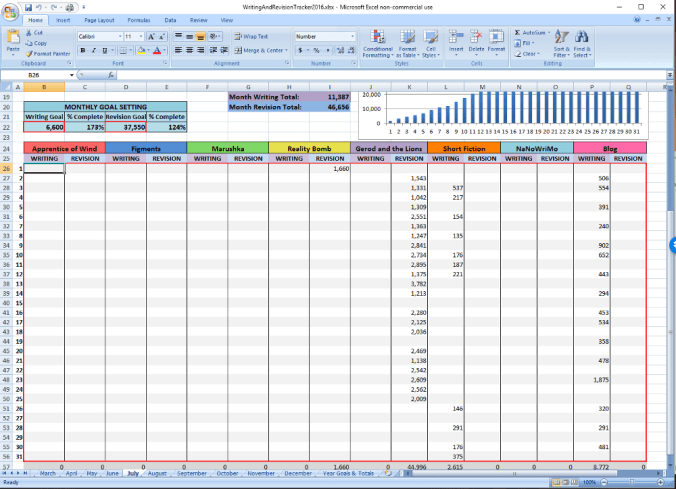
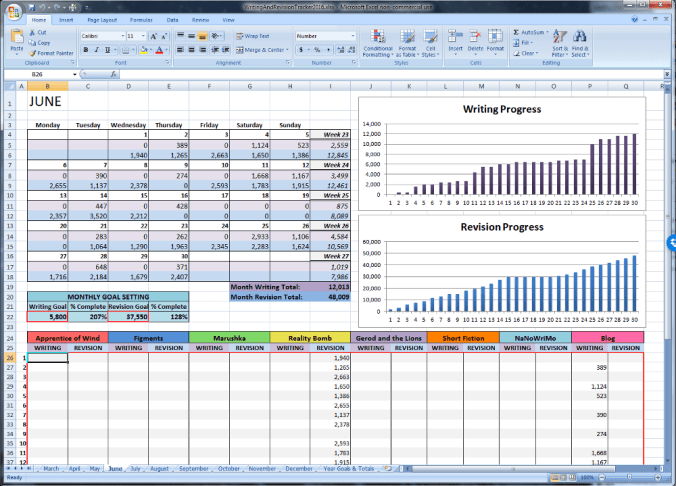
JulyProgress

This month, I finished my first review of Gerod and the Lions. As with the last couple of novels, I wasn’t twitching as I reread, reacquainted myself with the story, and worked on some of the flow issues I saw. One reason for the flow issues was that GatL was written in chunks, separated by work done on other projects.

Sometimes the gaps were months long, and it shows. I had to get my head back into Gerod’s world and each time I returned to it, it took a few days to recapture the feeling.

The draft comes in at 44,996 words, which is decent for a middle grade book and 124% of my revision goal for the month.

I also continued work on the short story, which I’ll be submitting for consideration soon. 2,615 words written on that.

And, of course, there was the blog, and since I continued to participate in the weekly challenges presented by Gabriela Pereira to her DIYMFA Street Team, I far outblogged my goal.

Between the short story and the blog, I wrote 173% of my goal for July.

I also had the pleasure of guest blogging a couple of times in July, once on Mel’s Madness, and later, on DIYMFA (holy cow!). I have another guest blog due out this month on Kristene Perron’s Warp World blog.

I continued querying.

Year-to-date

Please keep in mind that revision is a very different animal than writing. I’m not writing all these words from scratch. I’m rearranging words, rewriting sentences or paragraphs for flow, inserting or removing punctuation, and making notes for future revisions.

Writing equates to original words.

Month Revision Writing Projects
January 69,774 words 186% of goal 9,274 words 141% of goal Apprentice of Wind, blog
February 40,708 words 108% of goal 5,027 words 90% of goal Apprentice of Wind, blog
March 66,637 words 177% of goal 8,436 words 141% of goal AoW, Figments, Marushka, blog
April 37,478 words 100% of goal 10,498 words 187% of goal Marushka, blog
May 50,882 words 136% of goal 10,474 words 181% of goal Marushka, Reality Bomb, blog
June 48,009 words 128% of goal 12,013 words 207% of goal Reality Bomb, blog
July 46,656 words 124% of goal 11,387 words 173% of goal RB, Gerod and the Lions, short fiction, blog

 Now and the rest of the year

With GatL, I’ve finished reviewing all of my drafted novels. Many of them are still grossly underwritten, but at least I have a better idea now of where I’m going with each.

For August, I just finished up my short story, which I will now revise, and otherwise, the only writing I’m doing is on the blog.

I’ve taken some time off to consider the remainder of the year and what I want to do.

Under consideration are:

  • Assembling a poetry collection (going to submit to a local small press) – August
  • Organizing a collection of my non-SFF short fiction (again, targeted at the small publisher) – August
  • Outlining the third book in my epic fantasy series. I’ve already taken a shot at it, but I know I have to rework it. I’ll do this anyway, because it’s this year’s NaNoWriMo project, but it’s on the list. – concurrent with other projects through to the end of October
  • Returning to Initiate of Stone and AoW, to recapture the voice of the series and bring everything into line in light of the outlining and NaNo for the third book. I want to get to November steeped in the world and its characters. – September and October

Because the third in series is of the epic nature, I expect to be continuing the drafting well into December.

I’m also taking a bit of time to think out how I want to structure my writing year from here on out. Previous to 2016, my focus was on getting the words down. Great, but then I had six novels drafted, only one of which was ready for querying.

This year, I’m focusing on the revision of all those drafts. They won’t be completely ready to go, but I’ll be in a place where I can alternate writing and revision in the coming years.

I want to draft new work twice a year, and then work on revision in between. I don’t know exactly what form that’s going to take (except for NaNo), but I think it’s something I can do.

Other stuff

I’m heading out to WorldCon/MidAmeriCon II on the 17th. It will be my first big con, so I’m super excited. This will be my last convention or conference for the year, though. I’ve blown my budget.

As a result, though, I’m going on a blogging vacay. I’ll schedule my Thoughty Thursday curation for the 18th before I leave, but you won’t hear from me again until I’m back and recovered and ready to resume bloggage on the 27th. Sacrifices have to be made.

I’ve done the crazy and applied for Brenda Drake’s #PitchWars. I’ll find out how that goes on the 25th. Not saying more about it for now.

I’m investigating partnerships with an editor. I want something long term, a professional editor who can help me get my drafts into publishable states.

I signed up for a first five pages workshop with NLA. Again, I’ll leave the deets for later.

And that’s this writer’s life.

Next weekend, I’ll be continuing with my CWS 2016 reportage with my notes from the Writing Hard Truths panel.
The Next Chapter

Tipsday: Writerly Goodness found on the interwebz, July 24-30, 2016

Yummy, soul-feeding stuff this week.

The first post of the week for K.M. Weiland was intensely personal. It was also inspirational. It was exactly what I needed to read as the world around me seems to be falling to pieces (though that’s more apparent in my Thoughty Thursday curation posts, of late). Read it, my writerly friends, and take heart. This is why we write: five reasons why writing is important to the world. Later in the week she cautions us: don’t make this mistake with story structure.

Bonnie Randall guest posts on Janice Hardy’s Fiction University. Once more with feeling: writing emotionally strong characters.

Chris Winkle offers five ways to restore tension in your novel. Mythcreants.

Two of my favourite writerly women: Joanna Penn interviews Roz Morris for the Creative Penn podcast. Finding your author voice.

Katharine Britton guest posts on Writer Unboxed. On the road to a first draft: when you don’t know where you’re going, any road will do.

Marcy Kennedy is back with part four of her reading as a writer series.

Kelly Harms: writing a book takes how long, now? Writers in the Storm.

Jami Gold shares more lessons learned from her recent RWA conference. Do you belong, or are you a fraud?

Shawn Coyne wonders if good enough is good enough . . . This post was a bit controversial for a friend. Yes, we need mentors; we need editors. I personally don’t think there’s anything wrong with learning through experimentation, practice, and study, however. The idea that writers aren’t good enough, that they can’t be good enough without the intervention of others can result in sensitive creatives believing that they are inherently worthless. Or, it can result in the following problems, which can be just as bad . . . Just sayin’.

Karen Woodward encourages us to let go of perfectionism.

Kristen Lamb explores stress and burnout . . . and how to get your writerly mojo back.

Heather Webb has some advice on what to do when you feel like you’re treading water. Writer Unboxed.

Kameron Hurley: the wisdom of the grind.

Jane Friedman offers a definition of author platform.

Constance Renfrow writes about the do’s and don’ts of query letters. DIYMFA. AND . . . I had the opportunity to guest post on DIYMFA thanks to my participation in Gabriela’s Street Team! Five things I’ve learned from being on the DIYMFA Street Team.

Camille DeAngelis says that having her book go out of print was a pretty great thing, after all. Publishers Weekly.

Lynn Neary: can serialized fiction turn binge watchers into binge readers? NPR.

Sudburian Matthew Heiti wins the Carter v. Cooper competition! The Northern Life.

Working girls: the Bröntes. Elizabeth Hardwick for The New York Review of Books.

Alex Kulaev for BookBaby: The Jungle Book is a beautiful film with flawed storytelling.

Orange is the New Black’s Samira Wiley joins the cast of Hulu’s adaptation of Margaret Atwood’s The Handmaid’s Tale. Amy McNeill for The National Post.

Katherine Trendacosta thinks Christophe Gans’ La Belle et La Bête (Beauty and the Beast) is the most beautiful thing she’s seen in ages. i09

We are not things: shining examples of women’s autonomy in science fiction. Delia Harrington for The MarySue.

Babylon 5’s Jerry Doyle dies at the age of 60. Sadness 😦 James Whitbrook for i09.

And that was your informal writerly learnings for the week.

See you Thursday!

Tipsday

Trying new things with DIYMFA

Here is the QotW:

QOTW 14: Try a New Technique

Throughout the book, there are visual techniques, diagrams, and exercises to help your writing. These include story-mapping, the revision pyramid, the character compass, and so forth. This week, I want you to choose a technique that is new to you and try it out. Then report back and tell us how it went.

The technique I’ve chosen is TADA.

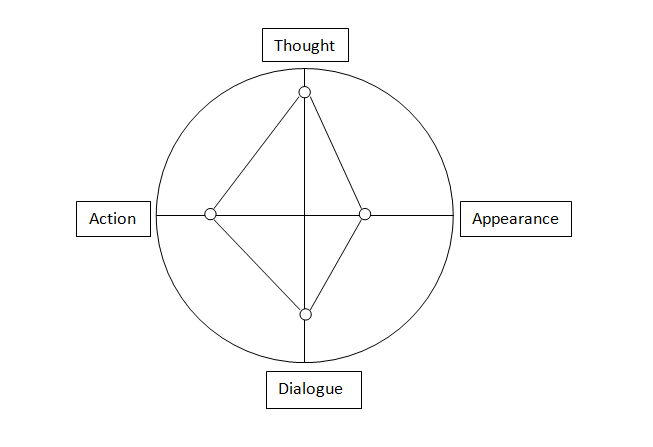
This is an acronym Gabriela created to assess character. The letters stand for Thoughts, Action, Dialogue, and Appearance.

The idea is that the writer wants to achieve a balance between all four aspects of character, and between characters, in each story. This could even be applied on a scene by scene basis.

So you can look at your characters individually, in scenes, in conjunction with one another, and overall in the story to ensure you’re keeping all of these character elements in the ratios you want.

To visualize this, Gabriela provided a graph, which she calls the character compass. It’s a circle with the letters T, A, D, and A distributed over the cardinal directions. Lines divide the circle into four with Thought and Dialogue, and Action and Appearance, in opposition to each other.

CharacterCompass

I’ve done my best to create a facsimile with Word’s drawing tools, print screen, and The Gimp 🙂

In this particular compass, I’m looking at one character, Ferathainn, in general.

She’s my protagonist and her POV is first person, past tense. There’s a lot of thought and internal monologue with Fer.

She’s studying to become a mage, but at the beginning of the novel, it’s all been theoretical. Her studies have prevented her from maintaining friendships, and so she lives in her head a lot. Part of her studies include rhetoric. Intonation and presentation can affect certain types of magick.

Fer’s been allowed (yes, allowed, it’s a plot thing) to study with her father, who is a bard, and her betrothed, who is an eleph finiris, or songmaster, because magick can be sung. She’s extended this part of her training to include dance, because she’s realized she needs a physical outlet after all this theory and rote memorization.

One of her small rebellions is that she also trains with her best friend, the forester, who teaches her how to fight. Primarily unarmed combat and survival skills.

So Fer is a heavily thinky character, with a good side order of dialogue and action. She doesn’t often consider her appearance, however. There aren’t a lot of mirrors in her little village. It’s not something she’s ever placed a lot of value on.

So I have to be careful when I write a scene about Fer alone, because she’s lopsided.

When she interacts with other characters, it’s primarily through dialogue and action, but I have to pay attention to their reactions to her physically. It’s actually very good for the show versus tell thing.

For example, Fer’s mother has to reach up to hug her, because Fer is tall. She’s of a height with her father, though. Through little interactions like this, readers form a picture of Fer in their minds over time.

When I switch POV to the other characters, they get to describe Fer, but I try not to have them do the ‘classical’ romantic inventory.

In early romances, which were often more adventure tales than what we think of as romances, when the hero meets the love interest for the first time, he waxes poetic and describes her from head to toe. Bad thing to do in a modern novel, though.

When Eoghan first ‘meets’ Fer, she’s all but dead. Having tried and failed to save victims of the war in the wake of the army’s passing, Eoghan decides he’s going to make his stand. He’s going to save this raggedy girl if it’s the last thing he does. Her appearance, other than the severity of her wounds, is secondary to his efforts.

When Dairragh first sees Fer, it’s from a distance, and it’s what she’s doing—performing magick—that makes its biggest impression on him. Dairragh hates all magi with a passion for the sake of the mage who murdered his parents and destroyed his home, including the people and gryphons that were his charge to protect.

So, of course, he hates Fer on sight and his prejudice colours his every interaction with her. At least initially.

The way I see it, readers are going to form an image of Fer in their heads that’s probably nothing like the way I see her. And that’s okay. They get ownership of my characters and my story on a reader by reader basis.

That’s what I want.

Gabriela’s TADA acronym and character compass are going to be one tool I take from the DIYMFA book and incorporate into my writing process.

Since I’m a plantser (part plotter, part pantser) I tend to pants my way through the first draft, but in revision, I can see the character compass being a very useful tool to evaluate how balanced my characters are in any given scene.

I hope I’ve given you enough of a run down that you might be able to make use of this technique yourself. Of course, you could always go buy Gabriela’s DIYMFA book and get a more detailed explanation of TADA and the character compass. The official release date was yesterday.

Jus’ sayin’.

content_QOTW-14

The next chapter: June 2016 update

Welcome to July! Half of 2016 is already past 😦

Let’s get right down to business.

June was a good month. As far as revision goes, I focused on Reality Bomb. It was another pleasant surprise. I didn’t hate what I wrote. This was just the first pass, and I’ve identified a number of things I need to work on, but I wasn’t writhing as I read 🙂 I don’t know if this means I’m a better writer now, or if I’ve just become inured to my failings (!)

I approached RB as I did Marushka before it, reading, mapping, editing, and making notes as I went. RB was my 2015 NaNoWriMo project and my second “win.”

I finished the first pass on July 1st (yes, Canada Day—the fireworks were for me, too) and the draft comes in at 282 pages and 67,808 words. Not bad for what I still consider a rough draft.

I’ve moved on to Gerod and the Lions, since. Early days, but not hating this one, either 😀 I should be finished this first run through of GatL in early August, just in time for another break—for WorldCon!

Since I’ve been a part of Gabriella Pereira’s Launch Team for DIYMFA, I’ve had extra blogging to do each weekend. As a result, I more than doubled my blogging goals for the month. I’ve also had some guest posting opportunities come my way, which has been another, validating surprise.

I went to the Canadian Writers’ Summit from June 17th to 19th and took a wee vacay from revising, blogging, and, in fact, most social media. It was a nice break.

My query, synopsis, and opening for Initiate of Stone have been revised and querying continues.

I’m starting work on some short fiction. It kind of just happened. It’s a good thing, though.

This is how the month settled out:

I achieved 128% on my revision goal with 48,009 words.

I achieved 207% of my blogging goal (yes, even with the vacay) with 12,013 words.

JuneProgress

The summer office is in operation, and I’ve been enjoying our lovely, lovely weather (so far). The garden is growing, though I haven’t been able to keep up with the weeding 😦 Still, we’ve been enjoying the fruits (literally) of what labour has been done and have had strawberries every day for the last three weeks. The raspberries are ripening. Phil’s been harvesting lettuces and herbs for the occasional meal.

It just makes you feel good to eat food out of your own garden.

In other news, I’m walking a little more, and getting some minor health issues sorted. I’ll be getting a new pair of glasses, not because my prescription has changed, but because my current pair is in disrepair. It’s time for a new perspective 🙂

Phil’s in good shape, now. He and his doctor have sorted his meds and he’s feeling well. All of his labs are showing results in the acceptable range, as well. I’m glad. Through the first few months of the year, it was not a good situation. Very stressful.

And that’s what June brought into this writer’s life.

Next weekend: I’ll be back to Ad Astra 2016 reportage.

Happy Independence Day to all of my American friends!

I’ll be back to work tomorrow.

The Next Chapter

Reviewing the four C’s of my to-be-read pile with DIYMFA

Here we are with question of the week thirteen!

QOTW 13: What’s On Your Reading List?

If you’re anything like me, you’ll never get around to reading every book on your to-read list. That’s why at DIY MFA I believe in reading with purpose and encourage you to focus on books in four main categories: comps, contextual, contemporary, and classics.

QOTW-13

As I mentioned previously, I have far too many books. It’s really to the point at which, if I were to be in my office when a serious earthquake hits, I’d probably die, buried under my to-be-read pile.

So it’s good that Gabriela limited this exercise and gave it some critical DIYMFA context 🙂

Comparative/competitive books

Because I’m working on multiple books in fantasy (and various sub-genres/categories, thereof) and science fiction, I’ve tried to line up a varied comp reading list.

  • One’s Aspect to the Sun – Sherry D. Ramsey (Canadian author, science fiction)
  • The Towers Trilogy – Karina Sumner-Smith (Canadian author, fantasy)
  • The Worldbreakers Saga – Kameron Hurley (American author, fantasy)
  • Binti – Nnedi Okorafor (American author, science fiction)
  • Signal to Noise – Silvia Moreno-Garcia (Canadian author, science fiction)

Some of these books are award-nominated and/or the authors are award-winning 🙂

Contextual books

These are books I’m reading to teach me something specific about craft/genre.

  • The Second Cadfael Omnibus – Ellis Peters
    My epic fantasy series is based in a world that is (I know, I know) derivative of medieval Europe, one of my characters is a postulant monk, and herbalism plays a role in the novels.
  • The Night Angel Trilogy – Brent Weeks
    I’m loving Weeks’s approach to worldbuilding. His world is a mash-up of European and Asian elements (and probably some others I’m not aware of, yet).
  • Under My Skin – Charles de Lint
    He’s a Canadian author of urban fantasy. A couple of my novels are YA urban fantasy. It’s good to learn from a master 😉
  • Children of Earth and Sky – Guy Gavriel Kay
    I would just love to be able to craft a story like Kay. His was one of the only books that moved me to tears.
  • Fish Tales – Sherri S. Tepper
    Just love where her books go in terms of plot and character. Science fiction with a hefty helping of social justice.

Contemporary books

  • The Madd Addam trilogy – Magaret Atwood
  • The Book of Negroes – Lawrence Hill
  • All the Light We Cannot See – Anthony Doerr
  • The Girl on the Train – Paula Hawkins
  • Quantum Night – Robert J. Sawyer

Classics

  • The Kalevala, the Finnish National Epic Poem (in translation)
    ‘Cause part of my heritage is Finn 🙂 And there’s magic and all sorts of cool stuff.
  • The Pickwick Papers – Charles Dickens
    Because I discovered I quite like Dickens 🙂
  • The Secret Garden – Frances Hodges Burnett
  • Boxen – C.S. Lewis and W.H. Lewis
  • The Great Gatsby – F. Scott Fitzgerald
    ‘Cause I never finished it in school—yeah, I know.

So there you go. You’ve had a peek at my TBR list.

I’ll be back tomorrow with my next chapter update.

Home and garden update

So this one’s not going to be much in the way of words, but there will be a lot of pics 🙂

As of last fall, the work the city had promised to do for us when they repaved Marttila Drive was still not done.

In October, one crew came by to build our new front steps. Even though I asked for an estimate on rebuilding the side steps, too, the contractor never got back to me.

But the work was done. Ok.

NoOneWillTripOnThat

No one’s going to trip on that

In December (remember we didn’t have snow until Boxing Day) another crew arrived to do the interlocking brick. They didn’t go under the front steps, though and now the side steps, our old, but very solid steps we made ourselves, overhangs the brick.

Oh well. We’ll build ourselves a new set  . . . someday.

brickwork

Notice the former garden that’s now growing out from under the front steps

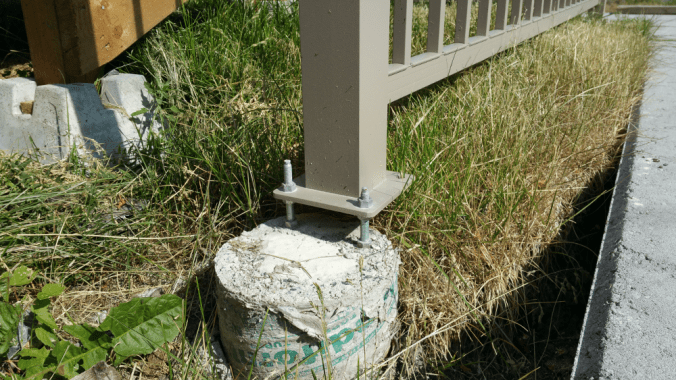
In February, in the middle of a snow storm, yet another crew arrived to install the railing on the retaining wall. It had already snowed quite a bit and they had to excavate the cement pylons they had to bolt the railing to.

RailingYay

Unfortunately, one of them was not placed properly.

railingfail

Stable as hell

With regard to the garden, I planted the raised bed Phil built for me last year.

gardenplanted

The transplanted hops vice and clematis seem to be happy.

hps

clematis

Now if I could only get around to weeding . . . 😦

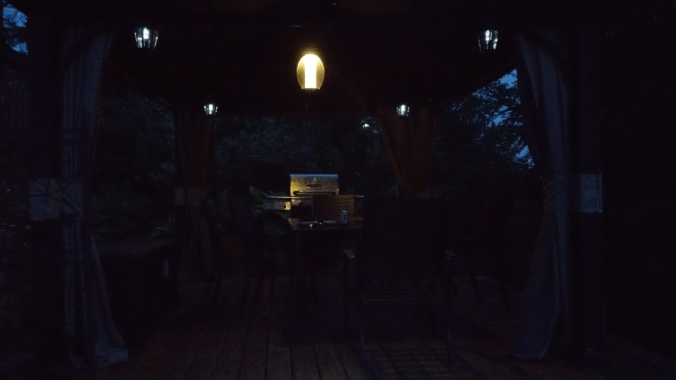
Phil has now added solar power to our gazebo.

WorkinOnTheLectrics

So we can work outside, even after sunset. Summer office: accomplishment unlocked!

GazeboAtNight

And that is this writer’s life.

I’ll be back in a bit with the latest Ad Astra reportage.

Embracing zero

This week’s prompt:

QOTW 10: Embrace Your Zero Moment

The hardest step in your creative development is the “zero moment,” the point where you go from doing nothing to doing something. The distance between the zero moment and being a newbie is far greater than the distance between newbie and pro, yet rarely does anyone celebrate this pivotal, important step.

Today, I want you to celebrate. Think back to your zero moment and do something to celebrate that incredible leap of faith. Maybe your zero moment was ages ago and you’ve forgotten all about it. Maybe you’re in that moment right now. Regardless of where you are on your writing journey, I want you to pause and celebrate that enormous first step that brought you to where you are now.


I’ve actually written about this before, but it’s been a while, so this will be a good refresher.

So . . . I was deep in my agnostic writer phase, post-MA.

What’s an agnostic writer, you ask? Exactly what it sounds like.

The angsty version: I hoped this thing I wanted for myself (writing) was out there, but I didn’t know for sure. I’d written before, fairly regularly, even, but the MA had shaken my faith and self-confidence so much that I had serious doubts as to whether I had what it takes to find it again. What if I wasn’t worthy (as certain people had suggested)?

The funny/grounded version: I couldn’t get my ass to believe in the existence of the chair long enough to sit down and git ‘er done.

I felt the need to write within me, but I also felt fear and the fear was bigger than the need.

It’s not like I didn’t write during this period, but there are only so many times you can rewrite the first fifty pages of a novel. Story ideas stayed largely buried in the pages of my journals. Every time I sat down to write one of them, the words seemed unequal to the task.

It wasn’t the words that were unequal.

I joined the local writing group. I started to attend workshops.

And then, Nino Ricci came to town for a weekend workshop. For those of you who may not know, Nino is a big name, award-winning, Canadian literary author. Part of the weekend was workshopping our stories, the other part was a series of informal talks in which he shared his thoughts on drafting, revision, process, publication, and other aspects of the writing life.

The pivotal moment for me was when he shared his struggles in graduate school when his advisor was a legendary Canadian literary author.

His experience mirrored my own.

I wasn’t alone.

After that workshop, I sat in the chair. I wrote my words. At first, I was happy if I could write anything, even a sentence or two. Some days I faltered, but I worked up to a page a day. Then I wrote two a day.

At the end of a year, I had the first draft of my first novel.

More writing workshops, conferences, online critique groups, and I had a revised draft. I started writing short stories again. I tried NaNoWriMo. I started tracking my writing progress.

Now, I’m a writing machine 🙂 I have six novels drafted and I’m working on revising them. I’m querying my first novel. Two of my science fiction short stories have been published in paying markets.

And it all started with someone sharing his hardship.

That’s why I share my story. If I can help one writer the way Nino Ricci helped me, I am happy to show my tender belly. Every writer has been there. You are not the only one.

Please raise a glass to the zero moment. We each have our journey. It has to start somewhere.

Muse-inks

Feeding my creativity

Here’s the prompt Gabriela sent this week for the DIYMFA launch team:

“Coming up with ideas takes practice. You have to train your brain to get creative on demand. You can’t sit around waiting for your muse to show up because she might take her sweet time. Instead, you have to go after your muse. Hunt her down and show her who’s boss. One writer told me he “keeps his muse chained to his desk.”

While I find that mental image of the muse-prisoner hilarious, I prefer to think of it a little differently. I have a shrine to my muse, a small box I call the ORACLE. (Like most things in DIY MFA, ORACLE is an acronym that stands for outrageous ridiculously awesome creative literary exercises.) Just like the ancient Greeks made pilgrimages to oracle temples so they could get guidance and wisdom from their gods, I visit my ORACLE whenever I feel the creative well going dry.

These contents have changed over time, but a few things have stayed constant:

  • Dice: I use dice for writing exercises whenever I need to leave something up to chance. I’ll assign each number an option, and then do whatever the roll decides.
  • Word Box: This small box contains slips of paper with words on them. I pull a few words out of the box at random, and then write a short piece that uses all those words.
  • Image Box: I keep an old chocolate tin filled with photos I clipped from magazines or postcards I picked up at museums. Whenever I’m stuck for ideas, I use those images to spark a story.

These are just a few things I keep in my ORACLE. I also have a paper prototype of the Writer Igniter app, a Writer Igniter deck of cards (also an early prototype for the app), a stack of fortune cookie fortunes, and a pocket-sized book of prompts.

Do you have an ORACLE? If not, treat yourself and start putting one together this week. It took me several years to refine and build my ORACLE, so don’t feel like you have to fill it overnight. Go out, get a nifty container, and start assembling materials to put in it.”

Muse-inks

I don’t have an oracle. I’ve bought decks of story cards, but, I have to confess that I don’t use them. I’m not fond of prompts, honestly, though the idea for one of my novels did result from a prompt. It was a Natalie Goldberg prompt, though, so that may have had an impact on how things turned out 😉

A lot of my story ideas come from my dreams, which, when I can remember them, are quite theatrical/cinematic in scope.

Other ideas come from articles that I read that trigger interesting connections in my head. I talked about the reasons I started my Thoughty Thursday curation a couple of weeks ago. I keep this curation going for myself as much as for others.

I share the posts and articles that make me think, start the mental corn a-popping. Some of those pops ignite story ideas.

I’ve always had story ideas, and more ideas than I knew how to write, especially when I was young. I used to write my stories (so-called) in Hilroy exercise books. I still have them. I still have most of the stories I wrote for school, too.

When I had an idea that I wasn’t sure how to write, I’d write as much as I could about it in one of those notebooks. Eventually, spiral bound notebooks and loose leaf paper replaced the exercise books.

That was the beginning of my idea file.

I mentioned last week as well was that when I was in university, I started making those thoughty connections with all the things I was learning in my classes. Psychology fed into sociology fed into Taoism fed into Old English fed into genetics fed into astronomy.

I started keeping my first journal in those years.

I have a stack of them now.

I keep one beside my bed to capture dream ideas.

I carry one in my purse so I can write down ideas that occur at work or when I’m otherwise away from other means of capturing them. I could use my smart(er than me) phone, but I like the feel of pen on paper. I take all my conference and convention session notes by hand as well.

Also during my university years, I worked in libraries. I learned a lot about research in those years, and, in the course of processing books and magazines to put on the shelves, if I came across an article that elicited a pop, I’d copy it. I called it being a clip rat.

These, too, went into my idea file.

I once clipped an entire series from a newspaper on families living on welfare. I also copied articles on the future of economics. And yes, both of these have story ideas that go along with them.

When the library’s collection was culled, I bought whatever books I could afford from the resulting sale. I accumulated a number of interesting, if slightly out of date, reference books, including an etymological dictionary (in two volumes), a name dictionary, and a couple of collections of popular quotations.

Currently, I read a number of blogs using Feedly. Before Feedly, I used Google Reader (when they announced the end of Google Reader, I was in a panic until Michael Hyatt mentioned Feedly in one of his blog posts).

Things that inspire an idea for a story, I clip to Evernote.

When I start working on a story, outlining, drafting, revising, I do my research in dribs and drabs. I use Evernote to capture online research as well.

Finally, my husband is a great source of ideas. We watch a lot of science fiction, fantasy, historical, and anime series. We have discussions about them. Because my man is Mr. Science, he’ll often have a few things to say about the poor science in a science fiction series. One of my stories was inspired by a discussion we had about Star Trek: The Next Generation.

He’s also very critical of story/plot quality. We can have animated conversations about what writers do and fail to do in the series we like to watch.

I can also fact check some of my SF ideas with him. He’s awesome that way 😀

So, I have lots of ideas and a lot of the resources I need to refine them.

I find that the best way to come up with story ideas is to be present, pay attention, and capture them however you can.

I like to keep things simple.

Tomorrow: It’s next chapter update time 🙂

Next week: DIYMFA will be out on the 10th! I’ll be posting my review to Amazon and Goodreads, and posting it to Writerly Goodness on Saturday.

Have a great weekend!

Resistance and where it leads

The DIYMFA QotW for week 8:

“Share an example of a time when resistance has pointed you toward a writing project that was juicy and high-stakes . . . and maybe even a little bit scary. Did you face that fear and overcome your resistance? What was the result of pursuing (or not pursuing) that project?”

To be honest, I don’t feel a lot of resistance as far as pursuing a writing project. I tend to follow my instincts, or my muse, if you prefer, and write what the heck I want.

You may see this as a naive attitude, but enough published authors, experienced editors and agents have pointed out the futility of trying to write to the market, that I’ve taken at least that much to heart.

I have an idea file that’s about fifteen novel ideas backlogged. Sometimes it’s hard to decide which one to pursue, but once I’ve decided, I generally stick with it until the draft is done . . . and revised . . . and critiqued . . . and revised . . . and edited . . . and revised . . . and beta read . . . and revised . . . and queried . . . but that’s as far as I’ve gotten (with novels).

I’ve had a couple of science fiction short stories published (for paying markets, even), but even with my short fiction, if I have a suitable idea, I write the piece until it’s done. Substitute submitting for querying in the above novel equation, and I’ve been accepted, worked with the publication’s editors to refine the piece, and been published.

When an editor suggests changes with a piece of short fiction, I’ve been very accommodating. I’ve generally accepted the suggested changes or made clarifications in the particular story elements so the changes are no longer necessary.

I can see pretty clearly and quickly with a piece of short fiction what makes sense to change and what does not.

Where I feel resistance is when, whether a critique partner, editor, or beta reader, someone suggests a major change to a novel I’ve written.

I generally have to sit with the suggested changes for a while, until I can see clearly the reasons why the changes were suggested. Then I can (more) objectively judge whether to adopt them or not.

Case in point: the editor for my first novel suggested eliminating a character. It took me a long time to realize she was right. She’d also suggested eliminating a couple of extraneous point of view characters, which I accepted and changed right away. A critique partner for the same novel didn’t like the number and types of POV I was using, and, initially, I changed everything. Later, however, I realized that my original choices made sense for the story I was telling and after I have eliminated the extraneous POV’s and the extraneous character, I changed everything back.

So, it works both ways for me. Some things I should change but am slow to act on the advice. Other things I change, but then realize there were compelling reasons why I made the decision in the first place.

Really, I’m still working through the whole process, developing my sense as a creator regarding which suggestions and advice to act on and which not to. As things progress, I find myself making better initial creative choices (I think).

I added the ‘I think’ in parentheses because I’m still not sure whether I’ve done this to avoid the criticism and/or potential conflict that results. I avoid conflict in life, generally. I kind of hate it. And really, that’s not a good reason, on its own, to change a creative work.

Ultimately, I’m always open to learning anything about my craft from anyone. I just get reluctant when I’m not sure of the motivation behind the advice I’m given.

Professional or experienced editors, I trust.

Unfortunately, it’s possible to be an excellent writer and not know a thing about editing, or critiquing, or beta reading. Telling me how you would have written the story doesn’t help me. Giving me your reasoning or thought process along with the suggestion allows me to assess your advice and accept it in the spirit it was offered, whether I choose to act upon it or not.

I think this all stems from my experience during my MA, which I’ve written about enough that you’re probably all sick of hearing about it by now 😛

So, Gabriela’s question didn’t really take me in the expected direction, but this is where I experience resistance.

Where do you experience resistance?

Muse-inks

Debunking creative myths for DIYMFA

This week’s QotW prompt is this:

Today we’re shifting gears a bit. In chapter 6 of DIY MFA, I debunk five myths about creativity. These myths are:

  1. Creativity is an exclusive club, and you can’t be part of it.
  2. Creativity is innate–you either have it or you don’t.
  3. Creativity is driven by chaos, so there’s no way to control it.
  4. Creativity is all about getting that one “Big Idea.”
  5. Creativity is focusing on an idea until it’s perfect.

We were to choose one and run with it.

Gabriela, however, wrote about her struggles with numbers three to five.

So . . . I’m going to tackle one and two.

I’m firmly of the opinion that everyone is creative in their own way and in their own realm of expertise. Just because my creativity expresses itself in the invention of stories doesn’t mean that everyone’s will work the same way.

My husband, for example, is, as I have mentioned before on this blog, Mr. Science. His first career was as a medical laboratory technologist. Now, he’s a network administrator, but he is also a programmer, and technical wizard. His hobbies include geology, astronomy, and cosmology.

Since he works for a charity, he has to find ways to do things economically. This means doing a lot of the work himself. He’s developed the registration system for his employer’s summer camp program. He’s put together their passcard system for the enhanced change rooms. He created their web page (someone else was responsible for the graphics and content) and has it set up so that the other employees in various departments can update content themselves.

Now, he’s working on a new program which will focus on finding work placements for autistic youth. His role is to develop his employer’s documentation and reporting system for the program.

He is so creative in his realm of expertise.

Creativity isn’t just about making art. It’s about making an art out of the work you do.

To shift gears a bit, my weekly curation posts are all about fostering the creativity of my followers.

I long ago realised that I’m not in a place in my career where I feel comfortable imparting writing advice. There’s so much of it out there on the interwebz and it’s shared by people who are far more articulate that I can be at this point.

I follow a lot of these people and so, when I come across a writing post or article that really speaks to me as a writer, I share it. A few years ago, I collected these posts into a weekly curation I call Tipsday. It’s kind of like an informal learning opportunity for writers. I’ve learned so much from the people I follow, I just want to share the wealth of their knowledge.

Other things pop my mental corn. Yes, just sit with that image for a minute. Your skull is a big pan, full of popcorn, apply heat (interesting posts and articles), shake it around, and pop! Pop-pop-pop-pop-pop!

This used to happen all the time in university. I’d see connections between all the seemingly random things I was learning and the ideas would go zinging around inside my head. That’s when I started journaling, and when I started working on my first novel.

I also think about the movie Working Girl in this context. The protagonist, Tess, gets great business ideas from reading the society column and business articles in the paper. Disparate ideas coming together to make awesome.

That’s what Thoughty Thursday is all about.

While Tipsday is pretty much focused on writing, Thoughty Thursday could help anyone be creative in any endeavour. I just hope that the things that interest me might have some kind of positive impact on others.

And so there you have it. My take on creativity. It’s not en exclusive club and it’s not something you have to be born with. It just takes a few juicy ideas to get things going.

I’ll be back tomorrow with more Ad Astra reportage.

TTFN!

Muse-inks