Home and garden update

So this one’s not going to be much in the way of words, but there will be a lot of pics 🙂

As of last fall, the work the city had promised to do for us when they repaved Marttila Drive was still not done.

In October, one crew came by to build our new front steps. Even though I asked for an estimate on rebuilding the side steps, too, the contractor never got back to me.

But the work was done. Ok.

NoOneWillTripOnThat

No one’s going to trip on that

In December (remember we didn’t have snow until Boxing Day) another crew arrived to do the interlocking brick. They didn’t go under the front steps, though and now the side steps, our old, but very solid steps we made ourselves, overhangs the brick.

Oh well. We’ll build ourselves a new set  . . . someday.

brickwork

Notice the former garden that’s now growing out from under the front steps

In February, in the middle of a snow storm, yet another crew arrived to install the railing on the retaining wall. It had already snowed quite a bit and they had to excavate the cement pylons they had to bolt the railing to.

RailingYay

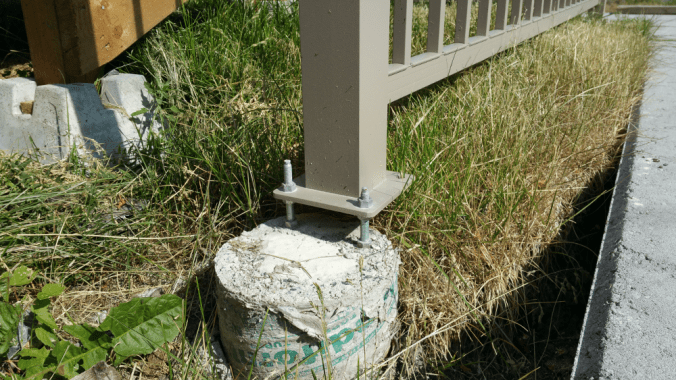
Unfortunately, one of them was not placed properly.

railingfail

Stable as hell

With regard to the garden, I planted the raised bed Phil built for me last year.

gardenplanted

The transplanted hops vice and clematis seem to be happy.

hps

clematis

Now if I could only get around to weeding . . . 😦

Phil has now added solar power to our gazebo.

WorkinOnTheLectrics

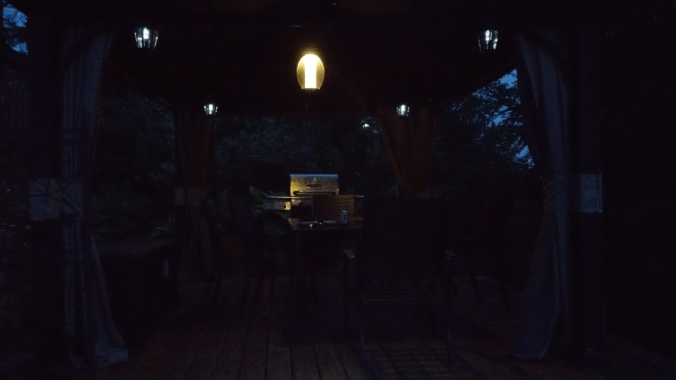
So we can work outside, even after sunset. Summer office: accomplishment unlocked!

GazeboAtNight

And that is this writer’s life.

I’ll be back in a bit with the latest Ad Astra reportage.

Embracing zero

This week’s prompt:

QOTW 10: Embrace Your Zero Moment

The hardest step in your creative development is the “zero moment,” the point where you go from doing nothing to doing something. The distance between the zero moment and being a newbie is far greater than the distance between newbie and pro, yet rarely does anyone celebrate this pivotal, important step.

Today, I want you to celebrate. Think back to your zero moment and do something to celebrate that incredible leap of faith. Maybe your zero moment was ages ago and you’ve forgotten all about it. Maybe you’re in that moment right now. Regardless of where you are on your writing journey, I want you to pause and celebrate that enormous first step that brought you to where you are now.


I’ve actually written about this before, but it’s been a while, so this will be a good refresher.

So . . . I was deep in my agnostic writer phase, post-MA.

What’s an agnostic writer, you ask? Exactly what it sounds like.

The angsty version: I hoped this thing I wanted for myself (writing) was out there, but I didn’t know for sure. I’d written before, fairly regularly, even, but the MA had shaken my faith and self-confidence so much that I had serious doubts as to whether I had what it takes to find it again. What if I wasn’t worthy (as certain people had suggested)?

The funny/grounded version: I couldn’t get my ass to believe in the existence of the chair long enough to sit down and git ‘er done.

I felt the need to write within me, but I also felt fear and the fear was bigger than the need.

It’s not like I didn’t write during this period, but there are only so many times you can rewrite the first fifty pages of a novel. Story ideas stayed largely buried in the pages of my journals. Every time I sat down to write one of them, the words seemed unequal to the task.

It wasn’t the words that were unequal.

I joined the local writing group. I started to attend workshops.

And then, Nino Ricci came to town for a weekend workshop. For those of you who may not know, Nino is a big name, award-winning, Canadian literary author. Part of the weekend was workshopping our stories, the other part was a series of informal talks in which he shared his thoughts on drafting, revision, process, publication, and other aspects of the writing life.

The pivotal moment for me was when he shared his struggles in graduate school when his advisor was a legendary Canadian literary author.

His experience mirrored my own.

I wasn’t alone.

After that workshop, I sat in the chair. I wrote my words. At first, I was happy if I could write anything, even a sentence or two. Some days I faltered, but I worked up to a page a day. Then I wrote two a day.

At the end of a year, I had the first draft of my first novel.

More writing workshops, conferences, online critique groups, and I had a revised draft. I started writing short stories again. I tried NaNoWriMo. I started tracking my writing progress.

Now, I’m a writing machine 🙂 I have six novels drafted and I’m working on revising them. I’m querying my first novel. Two of my science fiction short stories have been published in paying markets.

And it all started with someone sharing his hardship.

That’s why I share my story. If I can help one writer the way Nino Ricci helped me, I am happy to show my tender belly. Every writer has been there. You are not the only one.

Please raise a glass to the zero moment. We each have our journey. It has to start somewhere.

Muse-inks

Feeding my creativity

Here’s the prompt Gabriela sent this week for the DIYMFA launch team:

“Coming up with ideas takes practice. You have to train your brain to get creative on demand. You can’t sit around waiting for your muse to show up because she might take her sweet time. Instead, you have to go after your muse. Hunt her down and show her who’s boss. One writer told me he “keeps his muse chained to his desk.”

While I find that mental image of the muse-prisoner hilarious, I prefer to think of it a little differently. I have a shrine to my muse, a small box I call the ORACLE. (Like most things in DIY MFA, ORACLE is an acronym that stands for outrageous ridiculously awesome creative literary exercises.) Just like the ancient Greeks made pilgrimages to oracle temples so they could get guidance and wisdom from their gods, I visit my ORACLE whenever I feel the creative well going dry.

These contents have changed over time, but a few things have stayed constant:

  • Dice: I use dice for writing exercises whenever I need to leave something up to chance. I’ll assign each number an option, and then do whatever the roll decides.
  • Word Box: This small box contains slips of paper with words on them. I pull a few words out of the box at random, and then write a short piece that uses all those words.
  • Image Box: I keep an old chocolate tin filled with photos I clipped from magazines or postcards I picked up at museums. Whenever I’m stuck for ideas, I use those images to spark a story.

These are just a few things I keep in my ORACLE. I also have a paper prototype of the Writer Igniter app, a Writer Igniter deck of cards (also an early prototype for the app), a stack of fortune cookie fortunes, and a pocket-sized book of prompts.

Do you have an ORACLE? If not, treat yourself and start putting one together this week. It took me several years to refine and build my ORACLE, so don’t feel like you have to fill it overnight. Go out, get a nifty container, and start assembling materials to put in it.”

Muse-inks

I don’t have an oracle. I’ve bought decks of story cards, but, I have to confess that I don’t use them. I’m not fond of prompts, honestly, though the idea for one of my novels did result from a prompt. It was a Natalie Goldberg prompt, though, so that may have had an impact on how things turned out 😉

A lot of my story ideas come from my dreams, which, when I can remember them, are quite theatrical/cinematic in scope.

Other ideas come from articles that I read that trigger interesting connections in my head. I talked about the reasons I started my Thoughty Thursday curation a couple of weeks ago. I keep this curation going for myself as much as for others.

I share the posts and articles that make me think, start the mental corn a-popping. Some of those pops ignite story ideas.

I’ve always had story ideas, and more ideas than I knew how to write, especially when I was young. I used to write my stories (so-called) in Hilroy exercise books. I still have them. I still have most of the stories I wrote for school, too.

When I had an idea that I wasn’t sure how to write, I’d write as much as I could about it in one of those notebooks. Eventually, spiral bound notebooks and loose leaf paper replaced the exercise books.

That was the beginning of my idea file.

I mentioned last week as well was that when I was in university, I started making those thoughty connections with all the things I was learning in my classes. Psychology fed into sociology fed into Taoism fed into Old English fed into genetics fed into astronomy.

I started keeping my first journal in those years.

I have a stack of them now.

I keep one beside my bed to capture dream ideas.

I carry one in my purse so I can write down ideas that occur at work or when I’m otherwise away from other means of capturing them. I could use my smart(er than me) phone, but I like the feel of pen on paper. I take all my conference and convention session notes by hand as well.

Also during my university years, I worked in libraries. I learned a lot about research in those years, and, in the course of processing books and magazines to put on the shelves, if I came across an article that elicited a pop, I’d copy it. I called it being a clip rat.

These, too, went into my idea file.

I once clipped an entire series from a newspaper on families living on welfare. I also copied articles on the future of economics. And yes, both of these have story ideas that go along with them.

When the library’s collection was culled, I bought whatever books I could afford from the resulting sale. I accumulated a number of interesting, if slightly out of date, reference books, including an etymological dictionary (in two volumes), a name dictionary, and a couple of collections of popular quotations.

Currently, I read a number of blogs using Feedly. Before Feedly, I used Google Reader (when they announced the end of Google Reader, I was in a panic until Michael Hyatt mentioned Feedly in one of his blog posts).

Things that inspire an idea for a story, I clip to Evernote.

When I start working on a story, outlining, drafting, revising, I do my research in dribs and drabs. I use Evernote to capture online research as well.

Finally, my husband is a great source of ideas. We watch a lot of science fiction, fantasy, historical, and anime series. We have discussions about them. Because my man is Mr. Science, he’ll often have a few things to say about the poor science in a science fiction series. One of my stories was inspired by a discussion we had about Star Trek: The Next Generation.

He’s also very critical of story/plot quality. We can have animated conversations about what writers do and fail to do in the series we like to watch.

I can also fact check some of my SF ideas with him. He’s awesome that way 😀

So, I have lots of ideas and a lot of the resources I need to refine them.

I find that the best way to come up with story ideas is to be present, pay attention, and capture them however you can.

I like to keep things simple.

Tomorrow: It’s next chapter update time 🙂

Next week: DIYMFA will be out on the 10th! I’ll be posting my review to Amazon and Goodreads, and posting it to Writerly Goodness on Saturday.

Have a great weekend!

Resistance and where it leads

The DIYMFA QotW for week 8:

“Share an example of a time when resistance has pointed you toward a writing project that was juicy and high-stakes . . . and maybe even a little bit scary. Did you face that fear and overcome your resistance? What was the result of pursuing (or not pursuing) that project?”

To be honest, I don’t feel a lot of resistance as far as pursuing a writing project. I tend to follow my instincts, or my muse, if you prefer, and write what the heck I want.

You may see this as a naive attitude, but enough published authors, experienced editors and agents have pointed out the futility of trying to write to the market, that I’ve taken at least that much to heart.

I have an idea file that’s about fifteen novel ideas backlogged. Sometimes it’s hard to decide which one to pursue, but once I’ve decided, I generally stick with it until the draft is done . . . and revised . . . and critiqued . . . and revised . . . and edited . . . and revised . . . and beta read . . . and revised . . . and queried . . . but that’s as far as I’ve gotten (with novels).

I’ve had a couple of science fiction short stories published (for paying markets, even), but even with my short fiction, if I have a suitable idea, I write the piece until it’s done. Substitute submitting for querying in the above novel equation, and I’ve been accepted, worked with the publication’s editors to refine the piece, and been published.

When an editor suggests changes with a piece of short fiction, I’ve been very accommodating. I’ve generally accepted the suggested changes or made clarifications in the particular story elements so the changes are no longer necessary.

I can see pretty clearly and quickly with a piece of short fiction what makes sense to change and what does not.

Where I feel resistance is when, whether a critique partner, editor, or beta reader, someone suggests a major change to a novel I’ve written.

I generally have to sit with the suggested changes for a while, until I can see clearly the reasons why the changes were suggested. Then I can (more) objectively judge whether to adopt them or not.

Case in point: the editor for my first novel suggested eliminating a character. It took me a long time to realize she was right. She’d also suggested eliminating a couple of extraneous point of view characters, which I accepted and changed right away. A critique partner for the same novel didn’t like the number and types of POV I was using, and, initially, I changed everything. Later, however, I realized that my original choices made sense for the story I was telling and after I have eliminated the extraneous POV’s and the extraneous character, I changed everything back.

So, it works both ways for me. Some things I should change but am slow to act on the advice. Other things I change, but then realize there were compelling reasons why I made the decision in the first place.

Really, I’m still working through the whole process, developing my sense as a creator regarding which suggestions and advice to act on and which not to. As things progress, I find myself making better initial creative choices (I think).

I added the ‘I think’ in parentheses because I’m still not sure whether I’ve done this to avoid the criticism and/or potential conflict that results. I avoid conflict in life, generally. I kind of hate it. And really, that’s not a good reason, on its own, to change a creative work.

Ultimately, I’m always open to learning anything about my craft from anyone. I just get reluctant when I’m not sure of the motivation behind the advice I’m given.

Professional or experienced editors, I trust.

Unfortunately, it’s possible to be an excellent writer and not know a thing about editing, or critiquing, or beta reading. Telling me how you would have written the story doesn’t help me. Giving me your reasoning or thought process along with the suggestion allows me to assess your advice and accept it in the spirit it was offered, whether I choose to act upon it or not.

I think this all stems from my experience during my MA, which I’ve written about enough that you’re probably all sick of hearing about it by now 😛

So, Gabriela’s question didn’t really take me in the expected direction, but this is where I experience resistance.

Where do you experience resistance?

Muse-inks

Debunking creative myths for DIYMFA

This week’s QotW prompt is this:

Today we’re shifting gears a bit. In chapter 6 of DIY MFA, I debunk five myths about creativity. These myths are:

  1. Creativity is an exclusive club, and you can’t be part of it.
  2. Creativity is innate–you either have it or you don’t.
  3. Creativity is driven by chaos, so there’s no way to control it.
  4. Creativity is all about getting that one “Big Idea.”
  5. Creativity is focusing on an idea until it’s perfect.

We were to choose one and run with it.

Gabriela, however, wrote about her struggles with numbers three to five.

So . . . I’m going to tackle one and two.

I’m firmly of the opinion that everyone is creative in their own way and in their own realm of expertise. Just because my creativity expresses itself in the invention of stories doesn’t mean that everyone’s will work the same way.

My husband, for example, is, as I have mentioned before on this blog, Mr. Science. His first career was as a medical laboratory technologist. Now, he’s a network administrator, but he is also a programmer, and technical wizard. His hobbies include geology, astronomy, and cosmology.

Since he works for a charity, he has to find ways to do things economically. This means doing a lot of the work himself. He’s developed the registration system for his employer’s summer camp program. He’s put together their passcard system for the enhanced change rooms. He created their web page (someone else was responsible for the graphics and content) and has it set up so that the other employees in various departments can update content themselves.

Now, he’s working on a new program which will focus on finding work placements for autistic youth. His role is to develop his employer’s documentation and reporting system for the program.

He is so creative in his realm of expertise.

Creativity isn’t just about making art. It’s about making an art out of the work you do.

To shift gears a bit, my weekly curation posts are all about fostering the creativity of my followers.

I long ago realised that I’m not in a place in my career where I feel comfortable imparting writing advice. There’s so much of it out there on the interwebz and it’s shared by people who are far more articulate that I can be at this point.

I follow a lot of these people and so, when I come across a writing post or article that really speaks to me as a writer, I share it. A few years ago, I collected these posts into a weekly curation I call Tipsday. It’s kind of like an informal learning opportunity for writers. I’ve learned so much from the people I follow, I just want to share the wealth of their knowledge.

Other things pop my mental corn. Yes, just sit with that image for a minute. Your skull is a big pan, full of popcorn, apply heat (interesting posts and articles), shake it around, and pop! Pop-pop-pop-pop-pop!

This used to happen all the time in university. I’d see connections between all the seemingly random things I was learning and the ideas would go zinging around inside my head. That’s when I started journaling, and when I started working on my first novel.

I also think about the movie Working Girl in this context. The protagonist, Tess, gets great business ideas from reading the society column and business articles in the paper. Disparate ideas coming together to make awesome.

That’s what Thoughty Thursday is all about.

While Tipsday is pretty much focused on writing, Thoughty Thursday could help anyone be creative in any endeavour. I just hope that the things that interest me might have some kind of positive impact on others.

And so there you have it. My take on creativity. It’s not en exclusive club and it’s not something you have to be born with. It just takes a few juicy ideas to get things going.

I’ll be back tomorrow with more Ad Astra reportage.

TTFN!

Muse-inks

Best practice epic fail

How’s that for a sensational headline? 😛

Until Gabriela’s book comes out, I’ve decided to tackle her question of the week on Saturdays, and do the Ad Astra reportage on Sundays. We’ll see how things go. I just find that I can’t manage two posts in a day and combining them doesn’t do justice to either topic.

Here was this week’s question:

QOTW 6: What’s one “Best Practice” that didn’t work for you?

“There are a lot of people spouting “best practices” about writing. Write X number of words per day. Write every day. Don’t reread what you write. Don’t share your work until you’ve perfected it. And so forth. Have you ever tried one of these “best practices”? How did it go? Write about that experience.”

I had to think about this for a while.

It was a lot harder than I thought it would be.

Why?

This was the interesting part for me, so I’ll dig in a bit here.

Before I really committed to the writing life, in 2006 or so, I was creatively damaged. Wounded even.

Before that time, I took every piece of writing advice or critique I was given as literary law. I couldn’t differentiate between opinion, advice, personal experience or preference, and what would actually work for me as a writer.

I’ve always been a keener. I like to learn. I also like to be praised for learning well, being a do-bee. I used to feel that any teacher put before me would somehow magically be able to intuit what I needed to know, and give me the tools I needed to achieve my goals.

Yes. I was naive.

During my MA years, I took the opinions of my fellow students, and those of my advisor, a well-respected author of literary fiction and eighteenth century scholar, to heart. My chosen genre (a crime in itself in a literary environment) was crap; my writing was crap; ergo, I was crap.

It’s the progression that many inexperienced writers make.

When, following a few workshops by some award-winning, bestselling authors (Canadian and American, literary and genre), I committed to writing something, every day (I set my sights low at first, aimed for one page and didn’t castigate myself if I only managed a few sentences), I began to examine my process.

I also started to read a lot of writing craft books, follow authors online. I joined social media with an eye to developing my “platform.” I started to take control of my learning.

In my day job, it’s called informal learning.

Formal learning is like a classroom, or a workshop. There are good classes. There are excellent workshops. In these, the instructor offers their knowledge and experience in context and with the caveat that what works for one writer may not work for every writer.

At their worst, though, the teacher—the expert—is the talking head, mama bird, and the students are the baby birds, waiting for ‘dinner’ to be stuffed down their throats. It’s all about trying to consume, or memorize, every bit of wisdom that comes out of the instructor’s mouth.

In informal learning, the learner enters into the learning contract on their own terms and in their own time, having identified what they want to accomplish in the learning experience. Everything is filtered through that goal, and the learner takes or leaves knowledge as they see fit.

It may involve experimentation. What sounds good on the page (or webpage) may not work in practice.

Since my entry into the realm of regular writing practice, I’ve been an informal learner. I never take anything at face value, no matter the source, without examining it critically. If I think it will improve my process, or my writing, I’ll try it out. That’s the acid test. If it works, or I derive some value from the technique, I keep it. If not, I discard it, with all thanks to the teacher for the learning opportunity.

In that light, there hasn’t been much in the way of best practices or writing advice that, if it made it through my filter and I tried it out, didn’t work for me. There are a few things on which my internal jury is still out on, but I haven’t completely discarded the possibility that they could work. Some things take time.

Now, back to the QotW.

The piece of writing advice that I can say that I have considered and discarded, because I knew it wouldn’t work for me, was to dress for success. I’ve written about this before, and the post is still one of my most popular.

The idea was that being a part of the “pyjama patrol” was not showing respect for your art and craft. The writer not only has to show up, but has to “report to work” as a professional writer.

I can see the perspective of the workshop facilitator, an author whom I like and respect, but she writes full time. If I didn’t have a day job, I’d probably feel differently, but since I spend my most productive hours working for someone else, I need to make a clear demarcation between that work and my calling.

When I get home, the business casual clothes I wear to the day job come off and the flannels go on. My husband calls it becoming comfort woman. I want to come to the page having created an environment for myself that says, “this is my time.” I want to be comfortable, cozy even.

In my own way, I do dress for success, but not in the way the workshop facilitator intended 😉

Tomorrow: I’ll be looking at the relationship between self-publishers and editors.

Next week: I’ll be debunking creative myths 🙂

Muse-inks

The next chapter: April 2016 update

April was a steady month of revision. I made it to the two thirds mark in Marushka by the time I left for Ad Astra.

Drafting with Scrivener, as I mentioned before, has resulted in more, but shorter, chapters. It’s meant a more casual pace.

Though I missed a few days of revision for the convention, I made up for it by doubling up for a few days upon my return. I should be on track to finish up with this first run through of Marushka by the Victoria Day long weekend (May 21-23).

Then, I’m moving on to the first run though on Reality Bomb 🙂

I’ll probably need a couple more passes for each work in progress before I’m ready to send them out for editing . . . And I have my eye on a couple of people for that. We’ll see how that progresses, but probably not until next year.

AprilProgress1

Total words revised for April: 37,478, just a hair under 100% of my goal

Total words written (for this blog): 10,498, 187% of my goal (!)

I sent out more queries, and received more thank you but no thank you rejections.

Work on the Sudbury Writers’ Guild anthology, which the guild wants to release in time for the next Wordstock Sudbury in the fall, progresses. We want to have the content and cover ready for June. I have two speculative short stories in the anthology (yay, me!).

There are some more opportunities coming up for short fiction, so I’ll try to get something together for those deadlines.

In June, I’ll be heading to the Canadian Writers’ Summit (June 17-19) and . . . my leave for WorldCon has been approved. W00t! So I’ll be heading down to Kansas City in August (17-21). That’s one of the things I have to do now: book my flight. And check with my buddy. She’s moved recently, so I want to make sure she’s still available for visitations. It will be my first WorldCon, so I’m very excited.

I got an early start on next year’s writing events by registering for Story Masters, May 11-14, 2017. Christopher Vogler (The Writer’s Journey), James Scott Bell (author of LOTS of writing craft books, member of The Kill Zone), and Donald Maass (agent to the literary stars, Writer Unboxed member, and author of numerous publishing and writing craft books). Four days of workshops. Yum!

And that’s all that’s new in this writer’s life.

See you Tipsday!

The Next Chapter

What’s my storytelling superpower and my writer’s Kryptonite?

Because I was away last weekend, I didn’t have a chance to cover my DIYMFA question of the week (QotW) and now I have two to answer (!)

Note, before I begin: superpower and Kryptonite come into play in this context with respect to the kinds of characters I create and the weaknesses in writing those kinds of characters. I have other writerly strengths and weaknesses, but I’ll limit this post to the questions asked.

QOTW 4: What’s Your Storytelling Superpower?

I’ve done the quiz three times so far, and it’s been Protector every time 🙂 Here’s what the result of the quiz says:

Your superpower is writing superheroes! Your favorite characters see their world in danger and will do whatever it takes to protect it and those they love in it. These characters may not wear spandex and capes, but they show almost superhuman fortitude in their quest to prevent disaster, whatever the cost to themselves. From Scarlett O’Hara to James Bond to Iron Man, you’re drawn to characters who stand up to the forces of evil and protect what they believe in.

Looking at the protagonists of my novels (so far) they are all protectors, to a one.

In terms of her series arc, Ferathainn (Fer), is ultimately going to heal the world (literally, the planet). She just doesn’t do it the way the spirit of the world wants her to 😉 In Initiate of Stone—by the way, I’m considering a change in title, but I’ll hang on to IoS in terms of discussing the book on this blog—Fer is out to avenge her friends, family, and the destruction of her village. In Apprentice of Wind, Fer defeats Yllel (temporarily); Book three sees her trying to stop a continental power struggle and war while trying not to become the god-killer her father has told her she will be; In book four, she helps to stop a civil war among the dwergen and liberates the dragons; and in book five, Yllel escapes his temporary prison, forcing Fer to confront the monumental task of healing the world, which will eliminate the threat of the mad god for good. It all revolves around Fer’s solution to god killing, which is what she faces from book two on.

She’s all about saving the world, to a greater, or lesser, degree.

Charlene (Chas), protagonist of Figments, starts out trying to solve the mystery of her father’s murder and ends up becoming a protector-mage, defending the balance between Earth and Regnarium.

Marushka runs away from a distasteful destiny (becoming the next Baba Yaga) but, once out in the world, struggles with her emerging powers and a shadow organization bent on the subjugation of all womankind.

Brenda, protagonist of my new adult science fiction (and yeah, I know it’s a genre stretch, but I have seen them out there), Reality Bomb, fails to stop a fellow PhD in physics candidate from conducting his experiment to prove time travel is possible. As a result, her reality is destroyed, and she is thrown into the past of a parallel reality in which nothing is the same, especially her alternate self . . . except that her former colleague is still working toward his fateful experiment and the destruction of another reality.

Finally, Gerod, protagonist of my MG fantasy, Gerod and the Lions, just wants to save his sister from the Child Merchants. He ends up convincing the king that he should outlaw the Child Merchants altogether.

All protectors. They each become larger-than-life characters and they each want to preserve something or someone. But . . . the way in which they preserve often involves changing the way things are, or are done. So they’re all a bit on the disruptor side of things as well.

DIYMFASuperpower

QOTW 5: What’s Your Writer’s Krpytonite?

The elaboration of the question indicates that the writer’s weakness is often related to her greatest strength.

So I guess the problem for me would be that my characters, by virtue of their talents and abilities, might come off as too perfect to the reader, the stereotypical Mary Sue or Gary Stu.

Not to worry, my characters all have their challenges and foibles.

Fer fears she might become a monster because of her magickal talent (origin story stuff). She has to overcome the trauma she experiences from witnessing the destruction of her village and the murders of the people she loves. It’s some serious PTSD. Though she has to fight battles, physical and magickal, she firmly believes that killing is wrong and has to overcome a lot of self-loathing to come to terms with the reality that killing, right or wrong, is sometimes necessary to serve a greater good.

Charlene has been suffering from depression and insomnia since her father’s death and is obsessed with finding her father’s killer, which she sees as the solution to all her problems. She’s willing to lie and steal (literally—she commits a B&E) to bring the killer to justice. And when she learns that the murderer is one of her parent’s friends, that her mother might be involved, and that she’s the monster to her father’s magical Frankenstein, things get complicated.

Marushka, having been raised in isolation by what most people would understand as a supernatural serial killer and her sentient, chicken-legged hut, is just strange. She doesn’t know how to relate to people. She doesn’t understand body language or facial expressions. Her reactions are very clinical. She just wants a normal life, but comes to understand quickly that it won’t be possible for her, and not just because she’s inheriting Baba Yaga’s powers.

Brenda faces a unique challenge in the alternate reality she’s thrust into. She’s trapped inside her alternate reality self, a woman who is so different from her it shouldn’t be possible. Brenda first has to discover some common ground and a way to reach her alternate self without making her think she’s lost her mind before they can find a way to stop the time travel experiment from unravelling another reality.

Gerod is simpler. He’s small, and, as a consequence, weak, and this frustrates him to no end. Though he tries, he can’t protect either himself or his sister from the Child Merchants, only luck saves him, initially. He can’t rely on his parents, who sold his sister in the first place. Stubbornly, he follows the Child Merchants out of his village, but they are several men who know how to fight, and they have many more children than the ones they bought in Gerod’s village. A failed attempt at a night time rescue ends with Gerod fleeing through the woods . . . and right into the paws of one of the titular lions.

You could say I like being mean to my characters. They kind of have to become bigger-than-life to face the challenges I put in front of them.

My next chapter update will have to wait for tomorrow.

See you then!

An origin story and series discoveries, anime edition

As I mentioned last week, I’m on Gabriela Pereira’s DIYMFA launch team (yes, the book is coming out shortly). In preparation for the launch, Gabriela has been asking us weekly questions related to DIYMFA (the site, the newsletter, the course, and the book).

This week’s question is: What is your origin story?

How this ties into DIYMFA: Gabriela has recently asked what our writerly superpower was. For the record, mine is character, which I consider to be the well-spring of all things story. In keeping with that theme, all superheroes have origin stories.

Here’s mine.

Author origins

Even pre-origin, I was a creative wee bug. Read, I was a big fibber. The other kids were more honest. They called me a liar.

It wasn’t anything big or flashy. When I was a kid, in grade one (five years old), I really wanted a pet. I was obsessed with cats and took those books out of the library to read, well, gaze at longingly. I was just learning to read.

In show and tell every day (practically) I’d tell the tale of the latest stray cat I’d found and taken in. When the other kids (and teacher) asked me about the last cat, it invariably, and conveniently, had run away.

By the time I was in grade three, I wrote a little essay (well, I was seven), on my puppy, Friskey. I named her and misspelled her name. I’d like to say it was purposeful, but I rather think I just didn’t know how to spell.

Also in grade three, there was a special presentation by the grade five students. They’d all written and illustrated story books.

The moment I saw Siobhan Riddell’s version of St. George and the Dragon, I was hooked. Hard. I made my first submission, to the CBC’s “Pencil Box,” later that year.

And that was it. I’ve been writing—and in love with writing—ever since.

Series discoveries: Anime update

Series Discoveries

Phil and I have eased off on the anime, but we still watch Fairy Tail, and now World Trigger, as they are released (weekly). Actually, they are both now in hiatus as the animators work on the next seasons.

Fairy Tail went through some backstory in this season with Fairy Tail: Zer0. It is the tale of how a young Mavis met with some intrepid treasure hunters and through a series of adventures founded the wizard guild, Fairy Tail. Zeref even makes an appearance.

Next season promises to be about the rebuilding of the guild, which, after the Tartaros arc, had disbanded and all of its members departed for parts unknown.

The storytelling is decent, but, as with most anime, there are gaps in logic or plot that irritate. It’s still all about the power of friendship, though.

World Trigger focused mostly on rank wars, which is where the manga dwells these days as well. Osamu, Kuga, and Chika are trying to make it to A-rank so they can go on away missions to the neighbour worlds in the hope of rescuing Chika’s brother and friend, who disappeared and are assumed abducted. They’re also in search of Kuga’s companion, Replica, an autonomous trion soldier, who’d sacrificed himself to save Osamu and Chika when Aftokrator, a neighbour world, attacked.

As the season ended, not one, but two other neighbour worlds would be coming into contact with Mideen, where World Trigger takes place. Rank wars were to continue, but the A-rank Border teams  would have to defend against the neighbours.

Osamu and his team of three are in a bit of a crisis as well. Osamu, though a good strategist, has very little trion, the energy that allows Border agents to use the neighbour triggers. He also has very little experience and has come up against a wall. He is struggling, and holding his team back.

Chika, though she has an amazing amount of trion, is young and kind enough that she can’t bear to target people.

Kuga, a neighbour himself, has lots of trion and lots of experience and so the team’s success has rested largely on his shoulders.

Osamu has tried to recruit a fourth member for their team, but has so far been unsuccessful.

Log Horizon has still not returned.

We watched the second season of RWBY and the story is getting darker. The huntresses in training have watched their academy, and their world, come tumbling down around them.

At the end, Yang had her hand cut off and she and Ruby were recovering at home with their father after the attack that destroyed their academy. Blake had run away after her confrontation with her former boyfriend and his terrorist faction ended disastrously. Weiss had been recalled to her family’s estate in the city.

The enemy, still a little too amorphous and mysterious for my liking, controls the beasts of Grimm and has stolen the powers of one of the four maidens, Spring.

Ruby, unwilling to let the enemy’s apparent victory go unanswered, takes off with two other former students from the academy to try to set things right.

We’ll see if the third season appears and if it answers any of the outstanding questions the series has so far left viewers with.

A new addition to our viewing line-up has been God Eater.

Post-apocalyptic Japan has been overrun by the Aragami, fearsome beasts that seem to revel in mindless destruction. With the exception of a few huge, very powerful Aragami, they don’t exhibit much intelligence.

To combat these fearsome beasts, scientists isolated the genetic material that mutated animals into Aragami in the first place. Though early experiments were disastrous, they eventually figured out that there were certain humans who would be enhanced by this genetic material rather than be taken over by it.

Lenka Utsugi is one of these humans, a God Eater. He is trained and given a weapon called a God Arc, which bonds with the wielder.

When an Aragami is killed, its ‘core’ is harvested. These cores can be used to power God Arcs, but are more important in the construction of Aegis, a domed settlement in which the remnants of the human race are to shelter.

There’s a lot more to it than that. Suffice it to say that Phil and I are enjoying it and watching the show while we wait for the others to return. We’re getting a little deeper into backstory, but the conspiracies in this series are still a little hazy for my liking.

And that’s it for this week.

I’ll see what the next DIYMFA question of the week is, but I may tackle that and midseason follies (to date). The week following is Ad Astra, and so I probably won’t blog that weekend. I’ll be too busy taking notes of the sessions I attend so that I’ll have lots of reportage ready to go after April’s next chapter update.

Muse-Inks: Do you need an MA/MFA?

(And a couple series discoveries)

Yeah, so I kind of fibbed again on Thursday because I wasn’t aware of some of my deadlines and involvements.

Today, I’m going to be doing double duty. I’m posting my first DIYMFA launch team post and covering the two series that hadn’t debuted/returned before I went to CanCon last October and then plunged into the lost month that is NaNoWriMo (binge writing).

I’m also reading the ARC of Jane Ann McLachlan’s new YA SF, The Salarian Desert Game, as part of her launch team. That review is due up on the interwebz on Monday, and it will be, but I’ll be holding off on putting it up on my blog until next Saturday.

So. Let’s get to it, shall we?

I’ve written about my MA experience as part of the My history as a so-called writer category, which has been a bit of a confessional/lessons-learned-from-the-writing-life kind of thing.

 The story of my MA

I was in my last year of my BA in English, Rhetoric emphasis, and I was rocking it. I’d gone into university this time (I’d started, dithered, and left to learn some life lessons) with the focused intention of becoming a better writer. I’d been writing for years, since I was in grade three, but had only recently come up with my first idea for an epic fantasy novel.

That intention had provided me with the fuel to really begin my writing life in a more serious way. I’d placed in a local writing contest with a science fiction short story, excelled in my academic writing, and been asked to write an editorial piece for one local magazine and a science fiction short story for the debut issue of another.

Through the creative writing course I’d taken, I would have another fantasy story published in an anthology. I’d written poetry and read my work at various open mic nights and reading series.

In retrospect, I should simply have continued to write. I was developing a kind of momentum that further schooling would only disrupt, but I had no idea about that then.

My friends had all departed for further schooling, teachers’ college and literature MAs, and I was still at that tender stage in the process where I had no confidence in myself. I thought I needed further validation. I thought that attaining my MA would make me a more attractive property.

I was wrong.

In Canada, at the time, there were only four universities offering MFAs: the University of New Brunswick, Concordia University, the University of British Columbia, and the University of Victoria. Two others, Windsor and Saskatchewan, offered the option of doing a creative thesis along with your degree in English literature.

Initially, I just thought I’d apply, see if anyone would accept me, and then make my decision whether to go or not. I’d just gotten married the year before and my husband wasn’t finished his undergraduate degree yet. I wasn’t so keen on being separated from him for so long.

All the MFA programs rejected me out of hand (I should have seen that as a sign). Only one of them, UNB, threw me a bone: we’ll take you in the English Literature program, but not creative writing. Windsor was the only university that accepted me. It was the closest, too, though it was still a nine hour drive away.

I thought at the time that it was doable. I’d be back for breaks and summers. Phil was supportive. We could do this, if it was what I really wanted.

I went for it without giving serious consideration to my chosen genre. I write science fiction and fantasy. Even my more literary efforts contain the element of the otherworldly, ghosts, dreams, visions. I thought that, just like my BA, my MA would yield to my passion and desire.

Then, I attended my first critiquing class. My fellow hopefuls were all of a more mainstream, if not literary, mind. One eventually defended her thesis which was a collection of poetry, all sonnets. I never learned what the other students had chosen to work on.

No one was particularly keen on what I wrote. Well, there was this one guy, but he wrote genre as well. I got stubborn and dug in. My advisor looked at my submitted stories in dismay. What is this? What is real about this story? We weren’t on the same page. We couldn’t relate to each other. He couldn’t help me become a better writer. He just wanted me to be a different kind of writer.

I did my graduate assistantship, which was essentially teaching the first year composition course (without supervision), took my classes in methodology, pedagogy, and English literature of various eras, and tried to write.

I didn’t get a lot of fiction written in those years. I basically revised already existing material and scribbled poetry, the only form of writing I could manage in the time I had between other obligations.

I eventually had a blow out with my advisor, who told me to stop wasting his time (and mine). I withdrew from the program, worked contract jobs, and collected employment insurance in between.

A year later, one of my former students emailed me, telling me that my advisor was going on sabbatical. A Canadian poet, a woman, would be taking his place. I reenrolled, and, over the next year, emailing, and flying down at intervals to meet in person, I wrote my creative thesis, defended it, and fulfilled my final requirement to achieve my MA in English Literature and Creative Writing.

Even so, I’d compromised. I chose the more literary of my stories and, framing the collection in the context of shamanism and shamanic awakening (anthropology and religious studies), I cast an academic light on my fantastic tales.

In the wake of that experience, though, I went into creative withdrawal. I’d internalized the criticisms of my first advisor and was, essentially, blocked.

Throughout the years of my MA and afterward, I continued to win writing contests, in both fiction and poetry, and continued to get published. I tried my hand at publishing a poetry journal with another writer friend of mine, but, after a couple of years, the effort folded.

I continued to work contract jobs until I was invited to apply for my current job by my sister-in-law. Once I worked full time, the writing went underground altogether.

It took me six years and a bout of depression to begin to come back to writing as something I loved, something I needed in my life, rather than an unrealistic dream. I began with a few workshops, and graduated to conferences and conventions. I took online courses. I started to build my platform (such as it is). I tried online critiquing. I tried beta readers. I tried freelance editors.

I pretty much try anything that I think might help me improve.

I’m a writing craft book junkie and I’ve learned over the years that my process is my own. I never take anything at face value. Like a writerly scientist, I experiment. I try a new technique and see if it has value for me. If it does, I incorporate it into my process. If it’s only partly useful, I’ll adapt those pieces to my process (note, my process does not change to accommodate a particular technique, the technique is adapted to fit my process). If it doesn’t work at all, I discard the technique and chalk up the time and effort to a learning experience. We have to fail—many times—before we succeed.

Two of my science fiction short stories were published in paying markets in 2014. I’ve participated three times in NaNoWriMo, “winning” twice. I now have six novels drafted, one of which I’m actively querying. The rest are in revision.

The bottom line is that writing is a way of life for me. It’s not a get rich quick scheme. It’s not my grab for fame and fortune. I’m going to do this for the rest of my life regardless of whether I get the publishing deal I want or not. I’m doing the work and spending the time to make it happen, though. The two short stories weren’t a fluke.

I’ve been published quite a lot over the years. It’s just that most of those were not paying markets. I just haven’t connect with the agent or publisher who thinks my novel is the bee’s knees yet. Yet. It will happen. And if it doesn’t happen with the novel I’m querying now, it will happen with one of the others.

I persist in hope and continue to revise.

And, I continue to learn. I’m a bit of a learning mutt that way 😉
Muse-inks

Bonus content: Series discoveries Fall 2015 con’t

There were only two series that I didn’t get around to reviewing before CanCon and NaNoWriMo monopolized my time in the fall. I’ll try not to be spoilery.

Supergirl

This is another entry in the DC Comics universe, or should I say universes.

Supergirl started out sunny and entered some darker territory toward the end of the season. On the spectrum, it’s between The Flash and Arrow, but, as The Flash has also started treading dark waters, I guess Kara Danvers is closer to Barry Allan than Oliver Queen.

There’s an almost cloying sense of hope in the series, though, that keeps it from being compelling for me. If I miss an episode, I’m not distressed.

I like the character of Cat Grant, who can be surprisingly inspirational. I also appreciate Kara’s adoptive sister, Alex (so nice to see Lexie Grey back on screen), who works for the DEO, a government agency dedicated to defending earth from alien threats. Kick ass, but real, women characters are something I like in a show.

Bringing Dean Cain (the Superman of Lois & Clark) in as Alex’s father was a fun and smart bit of homage.

Sadly, some of the other elements of the show are lacking. The love triangle (no, quadrangle, no, sorry quintangle) is a bit trite and while I believe Kara’s crush on James Olsen, I never quite bought into James and Lucy Lane, Winn and either Kara or Siobhan. Oh, and I forgot the brief flirtation between Kara and Cat Grant’s son, Adam. Man, it’s a soap opera (!)

Hank Henshaw/J’onn J’onzz is underwhelming. My Martian Manhunter is so much more awesome.

Astra/Non have been weak sauce as Kara’s enemies. Maxwell is a bit better, but still one dimensional.

So it’s a solid meh. My apologies.

Grimm

Things took a left turn last season. Sure, Nick and Juliette’s relationship wasn’t going anywhere, so they had to do something. Her transformation into a Hexenbeist was actually a good thing.

Until it wasn’t.

Juliette’s abrupt departure from sanity and eventual (and apparent) death at the hands of Trubel (the other Grimm) felt more of a convenience than true plot development.

The big question for Nick last season was how he, a Grimm sworn to protect humanity from the evil wessen that roam the world, could live with and love a Hexenbeist, the wessen that is the basis of all wicked witches, ever.

So what do they do this season? They pair Nick with Adalind Schade, a Hexenbeist whose wessen aspect has been temporarily suppressed by Rosalee’s folk cure (herb craft).

Yes, Adalind is the mother of Nick’s child (conceived in a convoluted magical plot that resulted in Juliette’s transformation into a Hexenbeist in the first place), but things progressed quickly from “I have to protect my child and therefore the woman who gave birth to him,” to “I’m having sex with the mother of my child while he cries in the other room.”

Yeah. That’s what I thought.

Worse, Juliette returns, somehow deprogrammed, as Eve, who is more Terminator than either human or Hexenbeist.

While the Black Claw plot line holds promise, things aren’t happening fast enough as the writers insist on offering a monster of the week for Nick and his fellow detective, Hank, to fight. Even a trip to the Black Forest and the recovery of an ancient Grimm artefact haven’t saved the show for me.

There are too many moving parts, too many players, to discern the true core story arc.

I wouldn’t be surprised if Grimm doesn’t return next year.

So that’s what I thought of the final two shows I chose to watch in the fall 2015 television season.