Tipsday: Writerly Goodness found on the interwebz, June 11-17, 2017

A smaller trove from the Tipsday vault this week.

Jane Friedman coaches you on how to immediately improve your query letter’s effectiveness.

K.M. Weiland shares five ways to write a (nearly) perfect first draft (and why you should try). Helping Writers Become Authors

Later in the week, Kate shows you how to use the Myers-Briggs Type Indicator to improve your characters.

Piper Bayard discusses the art of physical surveillance. Writers in the Storm

Emily Wenstrom answers the question, can Facebook ads really boost your author platform? DIY MFA

Oh yeah. It’s me. Talking about time travel. DIY MFA

And so I had to cram this in here: Natalie Zutter wonders, is time travel is science fiction or fantasy? 🙂 Tor.com

Gabriela Pereira interviews DIY MFA columnist and romance author Robin Lovett for her podcast. Now I have an earworm … Let’s talk about sexy, baby / let’s talk about you and me … 😀

Becca Puglisi demystifies worldbuilding. Writers Helping Writers

Remember that post I shared a couple of weeks ago that Foz Meadows took exception to? Yeah, well Janice Hardy takes on the topic, too: why you shouldn’t write every day. Janice makes some points that I seriously considering. I do work a day job and I regularly face burnout because I write like a maniac when I’m not working. Food for thought. Fiction University

Oren Ashkenazi lists five tropes that make a villain look incompetent (and how to avoid them). Mythcreants

Jenna Moreci: how to choose an editor.


Joanna Penn interviews Dan Blank on changes in the publishing industry and launching non-fiction books. The Creative Penn

Claire Light reviews WisCon, the world’s preeminent feminist speculative fiction convention. Literary Hub

Foxy Folklorist, Jeana Jorgensen, explains why the translation of the fairy tale collection you read matters. Patheos

And that, my friends, was you informal writerly learnings for the week 🙂

Come back for some thoughty on Thursday, and in the meantime, be well.

tipsday2016

Muse-Inks: A week in this writer’s life and more lessons in vulnerability

Greetings, writerly folk!

Fun stuff first.

On Tuesday of this past week, the Sudbury Writers’ Guild held its annual picnic on the lovely patio of one of our members 🙂 This is the first year in … several, that we’ve actually had a picnic outside. In recent years, because we’ve paid for the rental space, we’ve held the “picnic” in our regular meeting room.

Though the point is to get together and socialize before our summer break, it was nice to enjoy the lovely weather we’ve had recently.

Also on Tuesday, my latest column for DIY MFA went live. It was on time travel. I kind of gravitated to the topic because one of my works in progress deals with time travel, in a way, and so I’ve been researching the various theories. I’m kind of proud of this one. I’m proud of all of them, really 🙂

On Wednesday, I took part in the quarterly DIY MFA call. Gabriela has a number of new columnists and interns. It was great to get in touch with everyone and meet all of the new additions to the team.

Thursday was the final meeting of the Canadian Authors Association CanWrite! sub-committee prior to the conference. That’s next weekend, and will necessitate a brief blogging vacay. Just for the weekend. Curation will go on as usual 🙂

Then, just today, I participated in my first urban hike, a cooperative event put on by the Rainbow Routes Association and The Greater Sudbury Poet Laureate, Kim Fahner. The poets from the Sudbury Street Poetry Project were invited to accompany hikers on a downtown route which visited the various businesses and organizations where our poems were posted.

PoetryHike

We paused to read our poems at each location, and chatted between. Just after my stop at NISA, it started to drizzle, and then to rain. We ended up at the Farmer’s Market and the drumming circle performing there, where Louise Visneckie crashed the performance and read her work with drum accompaniment 🙂

As I mentioned last week, I was courting burnout and so, I decided to take a break from writing and revision for a while.

In the meantime, writers have continued to post their thoughts about writing every day, especially if the writer has a day job. Even for writers who work on their craft full time schedule days off. It’s important to give yourself space.

What I discovered this week is that even if I’m not writing and revising, I’m still writing and revising. I carry a small moleskine with me all the time and I made a number of notes on my various works in progress. Even when I’m not writing, it’s where my heart and soul live.

This weekend, Phil and I are also pupsitting for Phil’s sister.

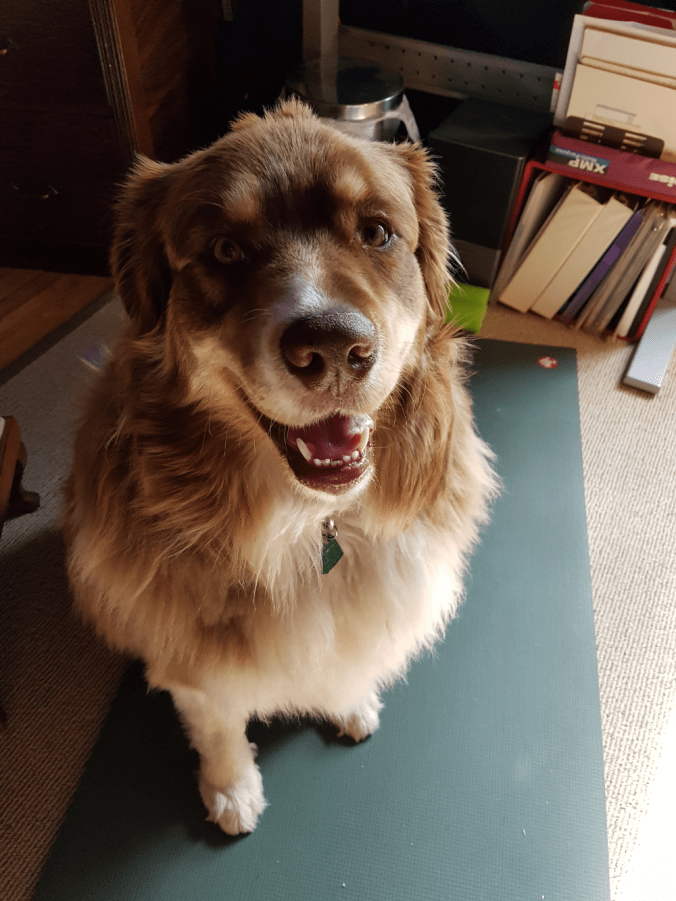
Buster

Isn’t Buster a lovely boy?

So, I’d thought that, perhaps, I’d get back into the habit this weekend, but I have to put the final SWG newsletter together, and I think I might defer until Monday.

I’ve been considering giving myself a regular day off. Perhaps Friday.

I am feeling better, though. More centred.

Another reason for this is that I’ve continued to listen to Brené Brown’s The Power of Vulnerability sessions.

Stuff I’ve learned:

I’m addicted to shame. I said this last week, but now, I want to unpack that statement. When things go to shit, it’s always my fault. I don’t think, “It’s unfortunate this happened.” I think, “I’m a bad person because I let it happen/couldn’t stop it.”

That’s the core difference between guilt and shame. In guilt, you’re accountable, you take responsibility but, because it’s the action that was thoughtless or hurtful, you can take ownership and change your behaviour. With shame, it’s not the action, but the actor, who is thoughtless or hurtful. It’s much more difficult to change behaviour when the story you tell yourself is that you’re hardwired that way.

I live in a continual state of low expectation because it’s easier than getting excited about things and being disappointed.

You can’t love anyone else more than you love yourself. This gets people’s backs up, but it’s true. If you don’t have compassion for yourself, how can you ever show it to others?

I overshare as a defence strategy. Brené Brown calls it spotlighting. I don’t know if I do it consciously, with intent, but I’m very open with some parts of my life, sometimes with people who might be classed more as acquaintances, than as friends. It makes people back off and confirms my bias that I’m a bad person. I’m not worth knowing.

I’m not sure what I’m going to do with all this new insight. Yet. I now know that I have these issues and I’m learning some strategies to address them. I’m just not sure how I’ll get from point A to point B.

Mindfulness and baby steps. Like anything else, it’s a matter of patience and practice.

I also think I’m going to start gratitweeting. Blame Brené Brown and Kim Fahner, who is half way through her second year of the daily gratitude practice. I’m not sure when, but I think it’s a way to bring the good stuff to mind. It’s too easy to take those things for granted, and then you can too easily slip into hopelessness and depression.

I don’t expect the transformation to be immediate, but I do expect that it will help me manage my mood.

As always, I’ll keep you informed.

As I mentioned, next weekend there will be no post, and the weekend after will be July 1st (Canada Day!) and it’ll be time for my next chapter update.

Until next I blog, be well, be kind, and stay strong.

Muse-inks

The latest Speculations is live at DIY MFA

Hey all!

This time (lol) around, I’m tackling time travel:

The science in your science fiction: time travel

Come on over and visit, and while you’re there, check out all of Gabriela’s awesome writer’s resources 🙂

timetravel


Muse-Inks: My day at Graphic-Con and the struggle for balance

Greetings, writerly peoples!

Before I get to the meat of this post, I’ll give you a little update on the writerly happenings of the week.

This past week, there was just one. The Sudbury Writers’ Guild booked a table at Graphic-Con, which was held at the Sudbury Arena, Saturday, June 10th. While it’s not a huge event as comic cons go, it was big for Sudbury.

Fandom was well-represented. There were cosplayers, LARPers, gamers, table top gamers, RPGers, comic fans, art fans, and television and movie fans (Degrassi actors were in attendance). And there were readers.

SWG co-chair, Andy Taylor, committed to be present for the full day as this was our first year booking a table and he wasn’t sure whether it would be worth it or not. Liisa Kovala helped out from opening to noon. I helped out from noon to 6 pm, Clay Campbell walked over after his CKLU radio show and stayed through to 7 pm, Liisa returned to finish off the day and help Andy pack up the table, Kristan Cannon had her own table (right beside the SWG table), and members John Jantunen and Sabine Gorecki stopped by and hung out for a while. It was a team effort 🙂

GraphicCon

Andy took this picture just after Clay (Rincewind) and I arrived and before Liisa left (noonish).

We had on display various books by Guild members, including a few copies of my wee poetry chapbook, NeoVerse. We sold just about one of everything (well, except NeoVerse—I didn’t expect poetry to be a big seller, though there was some interest), sold out of Creepy Capreol, which our other co-chair, Mat del Papa edited, and sold five of the SWG anthology, Sudbury Ink.

Sales weren’t the purpose of our booking the table, however. Reaching out to the writing community in Sudbury was. In that respect, the table was a total success. We had 19 people sign up to find out more about the Guild. We’re going to try to get together in late June for a special meeting for these individuals. If the timing doesn’t work out, we’ll at least send them a copy of our June newsletter to give them an idea of who we are and what we do.

Which leads us to balance

When I got home from Graphic-Con, I was pretty much bushed. Phil had the moms over for BBQ, but afterward, I decided to forgo my usual Saturday post.

Work/home/creative balance is a recurrent issue for me.

As a writer with a day job, I’ve chosen to devote nearly all of my non-work, non-sleep time to writing. Thus, a lot of other things go by the wayside. Physical fitness, family and social events, friends, support of artistic and professional organizations and events. Still. I can’t shut all of that out of my life. So, I try to squeeze it all in. Therein lies the rub.

When I can drag myself out of bed early enough, I do yoga or other exercises in the mornings. When the weather and other commitments permit, I walk home from work. I spend time with Phil and with my mom. I volunteer for the SWG and for the Canadian Authors Association. I try to get out and do something creative and soul-feeding in the community.

I try to get out and garden, or use my summer office. I try to keep the house clean(ish). My standards have fallen significantly in recent years …

I also try to write or revise my novels and short stories daily, keep up with my blog posts, keep up with my commitments to DIY MFA, read, study my craft, improve, attend writing workshops in person or online … and it all takes its toll.

Add to that my persistent issues with depression and anxiety which I must manage carefully, and a myriad of aches and pains that only seem to multiply the older I get, and there are times when I have to step back.

Phil’s supportive. He does the cooking, the groceries, the heavier household chores, and the renovation on his own. He knows my writing time is mine and, except for the odd hug or kiss—we need a fairly steady supply—he leaves me to do my thing. He doesn’t insist on coming along (he hates travelling and would just be miserable) or that I stay home when I have a conference or convention to attend. He listens when I have to blow off some frustration about work or professional obligations. He’s learned, for the most part, not to try to offer solutions. I’m very fortunate.

The heady rush of positive feeling and energy that returns with the sunlight in spring gives way to my first bout of burnout around this time every year. The second battle with burnout usually hits in the fall. This is why I have usually tried to take a self-funded leave from work every 18 months or so, May into June and then October into November.

It’s how I’ve managed my physical and mental health.

It’s been two years now since my last self-funded leave and the continual issues with our pay system at work have meant that I’ve had to defer my plans to take a leave yet again. I won’t be able to manage much longer if I can’t get a leave this fall. I’ve pushed through before, but never longer than two years. I used to work part time when I was in the call centre. That’s probably a better long-term strategy, but this next leave will involve a new pup as well, I don’t have enough leave aside from the self-funded to house train a pup.

I’m hoping that the larger part of our pay issues will be resolved by then and that it will be a possibility. Even if it’s not, I can’t afford not to make the request.

For now, all I can do is take things easy for a few days, give myself a break, and then get back to it.

I’ve been listening to Brené Brown’s The Power of Vulnerability sessions on Audible. Vulnerability is at the core of a satisfying life, of contentment (which is always my goal, not happiness—I’m pretty sure that’s a mythical beast), and of achieving healthy goals. And self-love is at the heart (lol) of vulnerability.

Unfortunately, I’m kind of addicted to shame and I tend to wall myself off from other people so I don’t have to be vulnerable with them, one on one. Everyone else thinks I’m doing great. I’m that high-functioning person living with mental illness. I can simulate vulnerability on this blog because it doesn’t cost me as much as opening up in person can. All the self-hate takes place in private. I operate from a scarcity mindset. There’s never enough time, energy, you name it, and I am certainly never enough.

I know that none of this is true, intellectually. I know time can be managed, found. A healthy lifestyle can provide me with more energy. I can tell my friends and family that they are enough often, but I can rarely turn that compassionate lens on myself.

So I’m going to goof off for a few days, except for the absolutely necessary stuff, like blogging and housework, professional obligations, and, well, the day job. I’m going to try to be present enough to listen and be kind to myself and to others. I’m going to try to enjoy myself.

We’ll see how it goes and I’ll check in with you next weekend after the poetry walk. The post may go up on Sunday again, but that’s just my way of shifting things to give me enough intellectual and emotional space to recover.

In the meantime, be well, be kind, and stay strong.

And I’ll “see” you on Tipsday!
Muse-inks

The next chapter: May 2017 update

Hey, all you wonderful writerly types!

May was a great month. I completed the Writing the Other course with K. Tempest Bradford and Nisi Shawl and I attended Story Masters in Toronto with Christopher Vogler, James Scott Bell, and Donald Maass.

Writing and revision-wise, I zipped through revisions on Apprentice of Wind, and identified some structural issues that I need to tackle before the next revision. Specifically, there are a few places in which I’m covering the same event from three perspectives. There’s too much overlap, so I’ll have to see about rewriting these sections to that the forward momentum doesn’t stall, and yet the critical events are still covered. Sections may have to be moved around, too.

It’s a bit of a brain-twisty problem, which is why I probably wrote it the way I did to begin with. I couldn’t see any other way at the time. It’s only my second revision, though, so I still have time to work out the kinks.

Darlings may have to be sacrificed (!) I do, however, keep versions of all my revisions, so nothing’s ever really lost. It’s a security blanket kind of thing. It’s easier to let go if you know it still exists somewhere 🙂

I’m closing in on 110K with this novel, so it’s a much more manageable beast. Initiate of Stone remains around 130K 😦 In my defence, it used to be 150K. I’ve made great progress.

I’m working on a new piece of short fiction, which, while the progress on the writing and revision tracker doesn’t look like much, I’m really enjoying. Thus the leisurely. The deadline was extended 🙂

MayProgress

This is how the month looks, by the numbers:

99,248 words revised on AoW of my 60,000 goal, or 165% of my goal.

2,000 words written on short fiction of my 2,500 goal*, or 80% of goal.

7,457 words written on this blog of my 5,800 word goal, or 129% of my goal.

*I amended my monthly goal after I took the screenshot from 5,000 to 2,500 because I realized I didn’t have a word goal for short fiction for June.

So that’s 9,457 words written and 99,248 words revised.

I’m once more going to juggle goals for the next few months. There are some projects pushing to the fore, so I’m going to tackle them sooner rather than later.

I’m going to finish the new story and then revise another. Aaaand I hope to get them both submitted on deadline 🙂

I’m moving on to revisions on Wavedancer (yes, I just finished the draft in February) and because I’m ahead of the game, I’m going to tackle revisions on Reality Bomb as well. We’ll see how things go.

With RB, I’ve had some time to work through, mentally at least, what I need to do to conquer the issues with this novel. I also chatted some things through with my science advisor (Phil) and he gave me an awesome idea that is going to add a lot to the novel as well as solving some plot issues.

And, of course, I’ll be continuing to blog.

June is going to be a busy month, though.

Next weekend, I’m volunteering at the Sudbury Writers’ Guild book table at Graphic-Con. I’ll be bringing some of my poetry books with me, in the event someone wants to take a walk on the wild side.

On the weekend of the 17th, I’m participating in a poetry walk downtown. This is a follow up event to the Sudbury Street Poetry Project. We’ll be touring downtown and stopping at each business or organization that agreed to post our poems, read and chat as we go, and then end up at the Fromagerie so that all the poets whose work is posted outside the downtown core can read as well.

On the weekend of the 24th, I’m heading down to CanWrite! 2017 (in the Toronto area the last weekend in June? Come on out! Day rates available.). Because of my big plans later in the summer, I’ve had to conserve my leave and so I’m heading down Friday night, volunteering through the day on Saturday, attend the AGM Sunday morning, and then heading home. It’ll be a whirlwind.

On the home front, a cool spring has meant that outdoor stuff has been delayed. Finally, though, the (pin) cherry blossom festival has yielded to lilacs and the honeysuckle will be in bloom shortly. In the meantime, I’ve cut some lilacs to scent up the joint 🙂

20170603_194134

Phil built our new steps and he’s constructing raised garden beds for my mom.

steps

I’ve weeded the main garden bed and we received a delivery of aged manure from Phil’s brother-in-law. The gardens should be ready for planting in a week or so, depending on weather. The rhubarb, strawberries, raspberries, and herbs are going wild, though, so we’re happy enough with that.

gardenpreprhubeast2017

raspberriesbin

And we have a bin for the rest of the renovation waste that didn’t get hauled off last year. So we’ll be able to access more of the yard. Yay!

BBQ tonight, so I have to get going and clean off the table for burgers and salad 🙂

See ya on Tipsday, people!

Until then, be well, be kind, and stay strong.

Love ya!

The Next Chapter

Story Masters: May 11-14, 2017

This lovely workshop came to my attention last year through Jenny Madore, a writer friend. It was put together by Lorin Oberweger and Free Expressions. Jenny sent me a notice last spring, yes, that was waaaay back in March of 2016, with the notification and a special early-bird discount.

The notification? Christopher Vogler, James Scott Bell, and Donald Maass would be coming to Toronto to present their Story Masters workshop. Needless to say, I registered on the spot.

Fast forward to May 10, 2017, and I was on my way to the Crowne Plaza Airport and excited to learn from these three masters of story.

Day one: Christopher Vogler

ChristopherVoglerI’ve read The Writer’s Journey (and Campbell’s Hero with a Thousand Faces, Murdock’s The Heroine’s Journey and The Hero’s Daughter, as well as watching Campbell’s series with Bill Moyer, The Power of Myth), and I was looking forward to meeting Christopher Vogler in person.
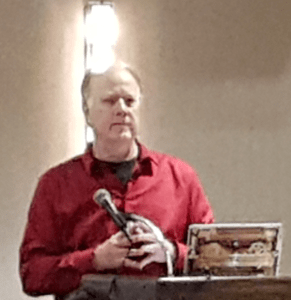
One thing I’d forgotten, having read his book years ago, was that Vogler is a screenwriter. He’s been working with the hero’s journey for forty years, since his film school days.

Highlights of the presentation:

  • A knowledge of structure will help you see the bones of a story.
  • The map is not the journey.
  • Get all five senses on the page – Ray Bradbury.
  • They won’t remember your words but they’ll remember how you made them feel – Maya Angelou.
  • Economy of language.
  • Make invisible things visible.
  • Use dissonance.
  • Theme – boil it down to one word.
  • The chakra system can be used to orient where your story comes from. There’s a parallel between the chakras and Maslow’s Hierarchy of Needs.
  • Vogler’s rule – the story’s good if two or more organs are leaking fluids. Visceral, but accurate (blood, sweat, tears, vomit, pee—from fear or laughter, and, erm, sexual fluids—it’s true; a well-written sex scene gets the juices flowing, doesn’t it?).
  • A story should be focused, “in alignment with the grid,” a term from dance.
  • How your protagonist/main character enters the story is critical. Classically, protagonist means the first person to struggle. Now, that’s your hero or main character.
  • A story should evoke catharsis. The classical definition of catharsis was vomiting. Now it’s an emotional cleansing.
  • How stories work: want vs. need. Want is generally external or physical. Need is internal or emotional. There are two story questions, one inner and one outer. It creates suspense. There’s always a price.
  • Every world/milieu is polarized. The hero brings synthesis.

Vogler also showed us a number of movie clips to illustrate the 12 stages of the hero’s journey, discussed the two founders of screenwriting, Aristotle and Syd Field, three-act structure and how the hero’s journey works with it, storytelling aesthetics, and his own meeting with Campbell.

Day two: James Scott Bell

I’ve read some of Bell’s writing craft books and followed his collective/blog – Kill Zone. Again, I was looking forward to meeting JamesScottBellsomeone I’d only ever known as a virtual presence.
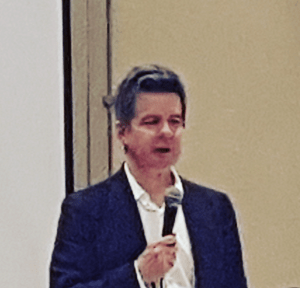
  • A writer needs to have an edge. What is it? Unforgettable writing. Seductive believability.
  • Write from the middle. The mirror moment. What’s happening to the character at that moment is what the story’s about.
  • The mirror moment can focus on one of two things: 1) Who am I? What have I become? What will I become? [emotional/spiritual struggle] Or, 2) I’m going to die. [Physical] The death can be metaphorical. Both result in the transformation of your character.
  • Once you know what your story’s about, you have your focus, your theme.
  • Pre-story psychology. Does your character have a moral flaw to overcome? Do they change or get their comeuppance? Is your character ordinary? What circumstances force the character to change?
  • Short fiction is about a shattering moment rather than a mirror moment.
  • Bell’s golden triangle: pre-story psychology leads to the mirror moment, which leads to the transformation. It can be applied in an individual novel, or over the course of the series, or both.
  • The shadow story – what’s happening elsewhere?
  • Keep a story journal to keep track.
  • Great characters jump off the page. They’re unpredictable, burning, wounded, complex, resourceful, courageous, noble.
  • Bell’s corollary to Vogler’s rule: you must have a fluid fight inside your character.
  • Ways to develop character: 1) The closet search – what’s the skeleton? 2) Throwing the chair (out the window) – why do they do it? 3) Best day/worst day. 4) What tattoo do they have, where, and why? Or, why would they never get a tattoo? 5) what would they do or think about in jail?
  • Opposition character: you must know what they yearn for, why they deserve it, and then make your closing argument (convince the reader).
  • Cut the boring parts, or, make them interesting.
  • Fear is a continuum. It raises the stakes. Fear of the known. Fear of the unknown.
  • Scene structure: every scene must have an objective, obstacles, and an outcome [yes, but/no, and].
  • SUES = something unexpected in every scene.
  • Every scene has a reaction: time for thought, perception, emotion, backflash (short remembrance), or flashback (full scene – use sparingly).
  • Dialogue: every character has an agenda. If those agendas are conflicting, even better. Dialogue creates conflict/tension, subtext, sets the tone for the scene, and sets the tone for the characters. Specific concerns: vocabulary, expressions, syntax. They should vary between characters. Dialogue should be unpredictable and compressed. Dialogue should reveal character webs, backstory, and theme.
  • Tools: Orchestration, transactional analysis (Google it), curve the language.

Bell, also from a screenwriting background, showed us clips from Casablanca and Now, Voyager and cited a number of novels (ranging from Gone with the Wind to The Hunger Games) to illustrate his points, linked to Vogler’s hero’s journey, and set us up for Donald Maass’s presentation on the next day.

Day three: Donald Maass

DonaldMaassI think Donald Maass was the story master I was most excited to meet. I’ve bought and read all of his books (except The Emotional Craft of Fiction, which I bought at the event), and I’ve read and shared all of his Writer Unboxed contributions.
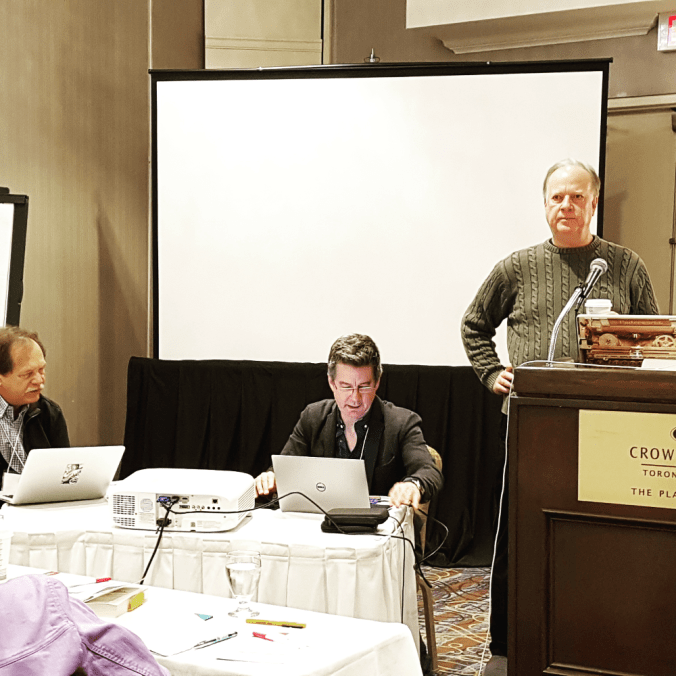
I’m such a fan that when I met him in the elevator, I blurted out, “I’m here to see you!” like a total fangirl.

He paused. “Do I know you? You look familiar …”

“We’ve never met in person, but you may have seen me online—the white hair’s distinctive. I share all of your posts. I’m a big fan.” And then, mercifully, we reached the lobby and debarked. I was completely mortified, certain Maass thought I was a stalker.

It reminded me of a recent post by my friend, Kim, who said she becomes so distracted in the presence of a writer that she says the most inappropriate things. Happens to me all the time.

For those of you who haven’t been to a Donald Maass presentation, it’s a bit different from what you might expect. He presents a topic, speaks briefly, and then, he begins to ask questions. The questions are intended to guide you into the heart of your characters, your scenes, your story.

It’s very meditative, very zen. And totally effective.

Unfortunately, after a few hours, the brain stops working and you just write down the questions for future review and examination. At least, that’s what happened to my brain.

I just wanted to give you a flavour of Maass’s style.

Openings

  • Too many novel openings are written objectively despite the prevalence of first and close third person narration.
  • Where does the story truly begin?
  • Story does not equal plot.
  • What’s different and how does your protagonist know things will never be the same? What symbolizes this? What do they do differently? What needs to be explained? What expertise does your protagonist have? What do they know that the reader needs to know? How does the trouble come? Why?

Voice

  • Writers adopt a voice that suits the genre, but not the story.
  • What happens? What’s unique to the setting? What anchors you? What wakes you up to your reality? What’s unique to the character? Name, role/occupation, what task/goal/purpose do they think they have? What’s on the “to do” list of your character?
  • [We then did an exercise in which we rewrote the beginning of our works in progress with three different voices: ironic, academic, and spiritual.]
  • The inner life of the character is the true story.
  • Plot does not equal story.

Emotion

  • You have to write with emotion about emotion in a way that deeply engages readers.
  • What makes you angry?
  • Your protagonist feels a new emotion. Pause. Slow things down. Go deeper. How does that change your protagonist? What will they never do again? What will they never feel again? What will they never feel the same way about again?
  • How do you create the sense of an evolving human being rather than someone to whom stuff happens?
  • Does your character have flaws?
  • My Writer Unboxed colleague Lisa Cron wrote a book called Story Genius that I highly recommend. She states every character has a misbelief that shapes their story. What is your character’s misbelief? Who will be hurt because of their misbelief? What does the character get wrong? What do they believe that will cost them dearly? Who will walk away from them because of the misbelief? What will they lose? What can they do that shows they’ve changed? Is it big? Symbolic? What’s the secret they’ve never told anyone? Is your protagonist concealing something from someone else?
  • What’s the character’s origin story?

Other facets of novel construction

  • Summary. Lorin Oberweger posted on Writer Unboxed about this. When should you use it?
  • Scene structure. Things have changed by the end of the scene. Subvert expectations. Show the inner shift in the novel. Scenes must change either the plot or the character.
  • Enhancing the story world. What’s the environment? What does your protagonist see that no one else sees? What does your antagonist see? Is there a class structure? How does that play out with your characters? What historical events have shaped the world? What are the political structures? What is just not done? Is there a code of honour? How do you make a deal? How do you pay respect?
  • Telling and showing. Both have value.

What do readers want?

  • They want an emotional experience. They want to engage with your protagonist. They want a satisfying payoff. They want aesthetic value. They want a challenge. They want to figure it out. They want a feeling of success.
  • Readers have their own journey.

Third level emotion

  • Pick a pivotal scene in your novel. What is the character feeling? What else are they feeling (cancel out any similar emotions)? And again, what else (that is like neither of the first two)?
  • Use the third emotion you identify to frame the character in the scene. It seems counterintuitive, but it’s very effective. Readers use cognitive evaluation.

Mythic roles (archetypes)

  • What fairy tale character is your protagonist most like? Shakespearean? Biblical? Greek or Roman mythos? Indigenous or other cultural figure? Urban legend?
  • What symbology have you built around your character?

The four things your story must do

  • The macro level: structure/plot/character arc.
  • Scene level: structure and goals.
  • Microtension: every page, every line. Court cognitive dissonance.
  • Subvert reader expectations.

The big event

  • Think of the event that changes everything for your protagonist and the story world. What causes people to think it’s never going to happen? Think of three reasons why. How do we know it will happen? Think of three reasons.
  • Take out foreshadowing. Include misdirection. Manipulate expectations.
  • Choose a secondary character who is good. Invent a way to create doubt. Cast suspicion.
  • Make the reader wait for the payoff. What are three reasons it might be the wrong thing for your protagonist to do? Build a case for doing something different.
  • Every story has a moral map. Point the reader down the path. What makes a reader care even when nothing is happening? Hope. What is good? What can be saved?

StoryMasters

Day four was an analysis of To Kill a Mockingbird in which all three story masters brought their individual strengths to bear.

My brain was mush by the end, but I brought a lot of awesome back with me and twice as many pages of notes as what I’ve shared with you here.

RobertJSawyerOther writerly goodness: I met Jenny Madore in person, saw writer friends Jeanette Winsor and Sue Reynolds, and hung out with Robert J. Sawyer for a bit. It was comforting to know that someone I consider a story master in his own right is still learning 🙂

I had a fabulous time and suggest you check out the Free Expressions web site if you’re interested in attending one of their workshops.

As always, my friends, be well, be kind, and stay strong. The world needs your stories.

Muse-inks

How to dream your way to a great story at DIY MFA

There’s this thing I do over at DIY MFA. It’s a semi-regular column called Speculations all about fantasy and science fiction.

dreams


This is my third column, on sleep and dreaming. Come on over and visit. There are a lot of great columnists on lots of different genres and topics. Plus, Gabriela has a tonne of great resources, a podcast, courses, and other tasty writerly goodness for you to check out.

I have a little anecdote to share with respect to dreams and writing.

It has to do with this little tip:

  • Sleep on a creative problem. Similarly, if you’re stuck on a scene or a plot point, ruminate calmly on it before you sleep. Even if you don’t dream up a solution, your mind will be working on the problem and when you head back to the page, the answer might just appear. Like magic.

So it happened, just the other night.

I’d just finished writing and posting my Next chapter update and went to bed thinking about the short story I’m hoping to write this month. I had an idea that’s been simmering since January.

That night I had a dream that, taken at face value, had nothing to do with my story idea. Except that it did in that weird way dreams have. And now I have three quarters of the story sketched out in my moleskine. I just have to figure out an ending that will work.

It makes me furiously happy when my dreams cooperate with the muse. Or maybe they’re scheming. Whatever they’re doing, it works. Like magic.


The next chapter: April 2017 update

Greetings, writerly friends 🙂

Yes, it’s that time of the month again—no, not that time—it’s time for my next chapter update. Yay (flailing Kermit arms)!

Ok, maybe that’s a little too enthusiastic.

That’s what spring does to me, though.

Even though we haven’t had a particularly warm spring up here, the fact that there are more hours of sunlight each day really helps me find my energy.

And what do I do with that energy? I overcommit. That’s what I do.

What does that look like in 2017? Let’s see …

  • work full time;
  • write as much as I can, evenings and weekends;
  • produce the monthly Sudbury Writers’ Guild newsletter;
  • serve on the Canadian Authors Association Program Committee (and various sub-committees); and
  • sign up for Writing the Other with Nisi Shawl and K. Tempest Bradford (yay—it’s awesome, but I can’t keep up with the assignments and so feel crap about it).

Truly, though Writing the Other is one of the bit of writerly awesome to happen this past month. It continues through to the middle of May, so I’ll save the deets for a future weekend wrap-up post. Suffice it to say for now, though, that I would recommend the course to anyone.

A second is my continued semi-regular SF&F column with DIY MFA, Speculations. As I mentioned last week, I’ll be posting to share those columns on the blog. The next one should be coming up Tuesday, and it’s a dreamy one, so stay tuned 🙂

A third bit of awesome was that I participated in was the Sudbury Poetry Project. April was National Poetry Month, after all. When Kim Fahner, Sudbury’s Poet Laureate put out the call, I wrote a new poem and submitted it.

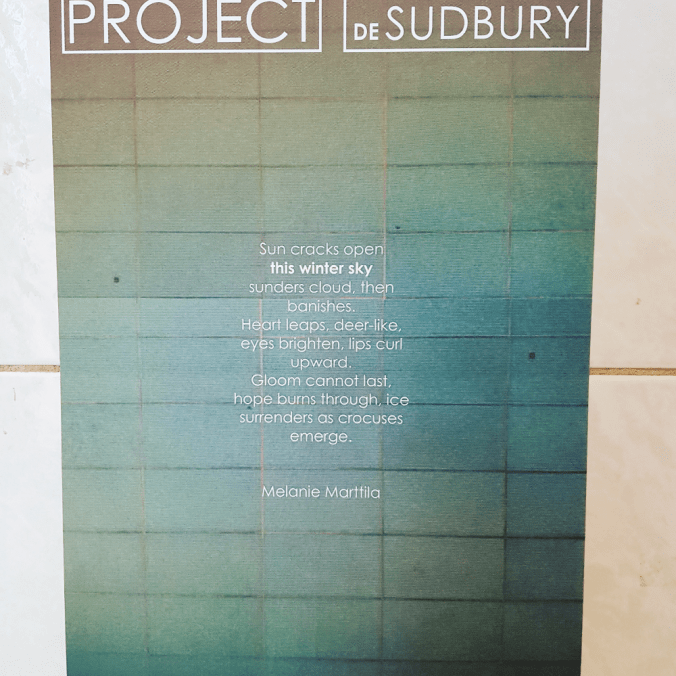
thiswintersky

“this winter sky” was inspired by what has been a particularly gloomy winter here in Northern Ontario. I believe that almost everyone who lives in the northern hemisphere experiences some degree of seasonal affective disorder (SAD) and those of us predisposed to depression tend to feel the effects of SAD more than others.

More than, that, though, the poem is about the hope that blossoms when one recovers, or learns to live with, mental illness. This is why I was honoured to have the poem posted outside the Northern Initiative for Social Action (NISA) which is a safe place where survivors of mental illness and consumers of mental health services can gather, learn, and heal.

And now, onto the writing progress report 🙂

April was a decent month. I finished my latest revision of Initiate of Stone. Unfortunately, it only reduced the overall word count of the novel by a few thousand words 😦 I was, however, after a short respite, move on to Apprentice of Wind.

I also revised two short stories for submission to a contest and an open anthology call. We’ll let you know how that goes in the future.

All the new writing in April was once again on this blog.

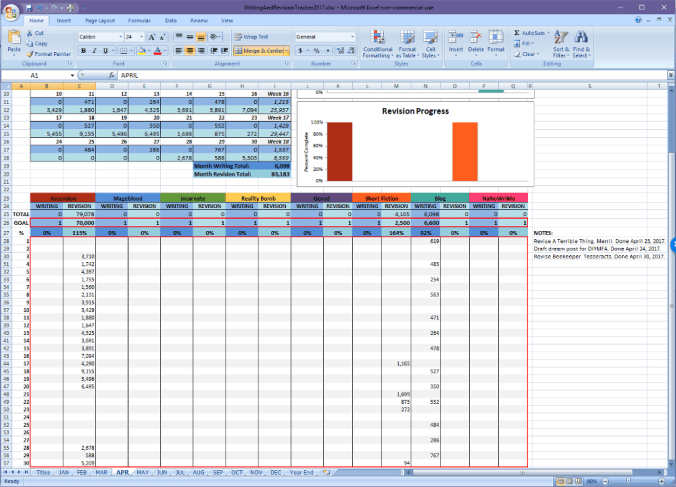
AprilProgress

Here’s how the numbers break down:

  • 79,078 words revised on the Ascension series, or 113% of my 70k goal.
  • 4,105 words of short fiction revised, or 164% of my 2,500 goal (makes up for not revising any short fiction in the last two months).
  • 6,098 words written on the blog, or 92% of my 6,600 goal.

That’s a total of 83,183 words revised and 6,098 words written. That’s not counting my column for DIY MFA, which I really don’t have a place for on the tracking sheet.

What’s up next: I’m going to continue work on revising AoW, which I don’t anticipate will be finished until next month. Revision will yield (I hope) to writing with respect to short fiction. We’ll see how everyone likes the new plan for the blog.

Next week, I’m heading down to Story Masters in Toronto, with Donald Maass, James Scott Bell, and Christopher Vogler, but that, of course, means that there will be no post next weekend. I’ll have another wrap-up post to share on this lovely event later in the month.

And then we’ll see. This writer’s life is never boring, that’s for sure.

Until next I blog, be well, be kind, and stay stong, because this winter sky will always yield to the light.

The Next Chapter

Changing things up and the reasons why

A few years ago, I decided to change things on the blog. I started curating Tipsday and Thoughty Thursday, and then, on weekends, I mostly blogged my session notes from various conferences and conventions I’d attended.

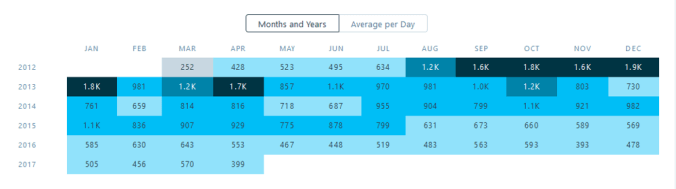
It was easy for me, with respect to generating content, and I sincerely thought I was offering something of value to my readers. My WordPress stats do not bare this out, however. Round about 2014 (when I started the curation and session notes), my views drop and are consistently below a thousand per month.

views

Views dropped again after Nuala died in 2015. My pupdates were clearly some of my more popular posts, as well.

Even looking at it by day, I only seem to have a peak in views (40+/day, which I know is nothing when it comes down to it) about once a month. When those peaks occur varies. It could be after a Tipsday post (most often), or a Thoughty Thursday post. Sometimes, it’s on a weekend, but it could be session notes, or a monthly update. There’s really no pattern that I can pull out.

But clearly, this means I’m not doing my job.

I have therefore decided that it’s time to shake things up again. Not too much. ‘Cause I’m cautious that way.

I’ve had the most views, likes, and comments on my curation posts, so I’m going to keep blogging those. I’ve created better graphics for them (thank you, Canva) and I still believe they have value.

It’s the weekends I’m going to rethink.

I’m also going to continue my monthly updates. I like sharing my progress on various projects and it keeps me accountable.

I’m no longer going to blog session notes, though. Instead, I’ll do a summary/highlights post of any writerly events I attend. There are enough of those that it will keep me producing quality content. In the past couple of years, I’ve actually glossed over some of these events, or only given them a passing mention in my monthly updates, because I really haven’t had the time to write a post devoted to every event I attended.

I’m going to revisit some of the topics from the blog posts that, even five years on, continue to receive the most traffic.

I’m also going to post a referral to my DIY MFA columns when they come out.

Finally, I’ll fill in the gaps with Movie Madness, Series Discoveries, and the odd book review. There may also be the occasional Muse Inks post on this writer’s life, which won’t focus on the writing, but the other stuff that fills up my life around writing.

When Phil and I get our next fur baby (this fall is the new goal … we hope) Sundog posts may even return 🙂

Because writerly goodness is a solo effort, though, I’m still going to have to take the occasional blogging vacay for some of the bigger events I attend. It’s the way things have to go while I’m still working a day job.

If I want to set the time aside to write and to attend my various writerly professional development opportunities, I really don’t have the time to generate a lot of content to pre-schedule and fill in the gaps. I find myself at the limit as it is, but that may be because of the various commitments I’ve made to some of the professional writing organizations of which I’m a member.

I’m considering a re-envisioning of those commitments, too. There’s only so much of me to go around. Do I want to be writing, or do I want to be contributing to the success of writing organizations? It’s going to be a tough decision, ‘cause I’m like Eek! the cat. I always think it never hurts to help. Until it does.

The next few weeks in writerly goodness:

Next weekend, it will be my monthly Next Chapter update. The weekend following, I’ll be away at Story Masters and won’t be posting, but I’ll tell you all about it the weekend after. I’ll have a few more events to discuss in upcoming weeks, but I’ll get into that in my Next Chapter post.

So stay tuned as I work my way through this transition.

And let me know what you think, please. Will this shift be a pleasing one for you? Perhaps only time (and stats) will tell, but if you have any thoughts to share, I’d love to hear them. And if you have requests to make, I’m all (virtual) ears. I know I can’t please everyone, but I’m willing to incorporate some of your suggestions into my ongoing plan.

Thanks for your time and attention.

You’re the bestest!

Muse-inks

Tipsday: Writerly Goodness found on the interwebz, April 2-8, 2017

There’s so much writerly goodness out there, I wish I had more time to devote to curating these informal writerly learnings for you.

Aliette de Bodard guest posts on Terribleminds: in defense of uncanny punctuation. I love semicolons, too!

K.M. Weiland adds number 58 to her most common writing mistakes series: too much description. Helping Writers Become Authors

Later in the week, Kate shows you how to write stories your readers will remember.

Then, Kate pops over to Jerry Jenkins’ blog: two ways to find out if a scene deserves a place in your story.

Kathleen Jones guest posts on Jane Friedman’s blog: six ways to prepare for writing as a second career.

Angela Ackerman shows you how to use timelines to organize story details. Writers Helping Writers

Lisa Preston offers seven strategies for revising your novel. Writer’s Digest

Penny Sansevieri helps us decode Amazon keywords. Writers in the Storm

Fae Rowan shares five tips to get your characters—and you—through adversity. Writers in the Storm

Janice Hardy introduces us to a fun way to learn story structure. Writers in the Storm

Chris Winkle shares five signs your story is ableist. Mythcreants

Oren Ashkenazi looks at six objectively good stories and finds ways to make them better. Fabulous analysis. Mythcreants

Laurel K. Denton guest posts on Writer Unboxed: changing horses mid-stream (or how not to panic over a mid-book structure revision).

James Scott Bell asks, is your fiction big enough? Writer Unboxed

Donald Maass wants you to captivate readers with your opening lines: casting the spell. Writer Unboxed

Bryn Greenwood: write a book, save the world. Writer Unboxed

Kathryn Magendie explores this writing life. Writer Unboxed

Emily Wenstrom helps you grow your online platform in real life. DIY MFA

Shameless self-promotion time again: it’s me! Defining speculative fiction. DIY MFA

Gabriela Pereira interviews Susan Perabo for DIY MFA radio.

Bess Cozby offers five tips for revising your trunk novel. DIY MFA

Kristen Lamb: the single best way to become a mega-author. Later in the week, she follows up with how you can make all ads, marketing, and newsletters work better.

Jeff Lyons visits Jami Gold’s blog again: creating a strong moral premise for our story.

Michael Everest responds to a provocative post and explains the difference between giving up and giving in. Fantasy Faction

David Barnett responds to the same “failed novelist” post. The Guardian

Alex Brown unpacks Marvel’s “diversity doesn’t sell” argument and explains what diversity really means. Tor.com

The Hugo and Campbell awards finalists announced! Locus

This grammar vigilante stalks the Bristol night putting apostrophes in their right places. Ladies and gentlemen, the BBC gives you, the Apostrophiser!

I hope you learned something tasty 🙂

Be well until Thursday when you can come back for some thoughty inspiration!

tipsday2016