The next chapter: October and NaNoWriMo 2016 update

I’m baaaa-aack!

Didja miss me?

Let’s just get right to the good stuff.

October

As was the case with September and August before it, October was a month in which I was focused on non-word-count-y stuff.

I finished off my read through and note-taking on Apprentice of Wind and the rest of the time I was making notes in preparation for tackling Wavedancer (book three of the epic fantasy series) as this year’s NaNoWriMo project.

I knew that I’d likely be writing the novel into the New Year. 50k is only half the length of any epic worthy of the name 😉

I had some trepidation, however, as I knew I’d be out of town, training for the day job for the first week of November, and I had Wordstock Sudbury upon my return, the launch of the Sudbury Writers’ Guild anthology, Sudbury Ink, the weekend following, and my own, belated birthday celebration the weekend after that.

And I was only able to use two days of vacation leave in November. Otherwise, I was working.

I fully expected a repeat of 2014, during which I was also working. That year, I didn’t even crack 30k, but I went on to finish the draft over the next months.

So, zero words revised in October, but, amazingly, that still puts me at 96% of my revision goal for the year. Yup. I’m just that awesome 😉

And I have my work cut out for me with regard to some additional amendments to Initiate of Stone (one more run through, methinks), as well as a whole slew of revision notes for AoW. As the series arc progresses, I get further insights into what I’ve already written. It’s all good.

I think, more than anything, it was good to immerse myself in the world and characters of the story. It put me in a good place, mentally, to tackle Wavedancer.

As for the writing done in October, all 7,939 words of it were written on this blog.

octoberprogress

NaNoWriMo 2016

I’m a traditionalist. I work on a new novel each NaNo challenge and, this time, I was tackling a work I knew I wouldn’t complete in November, even if I could achieve the word count necessary for a NaNo win.

As I mentioned, above, I had my doubts I’d even manage that.

As a result, I made some decisions, one of which was, with the exception of the curation posts I had prepared for the first week of November (960 words between the two of them), I wasn’t going to blog.

Working around professional and personal commitments, I fought for my writing time.

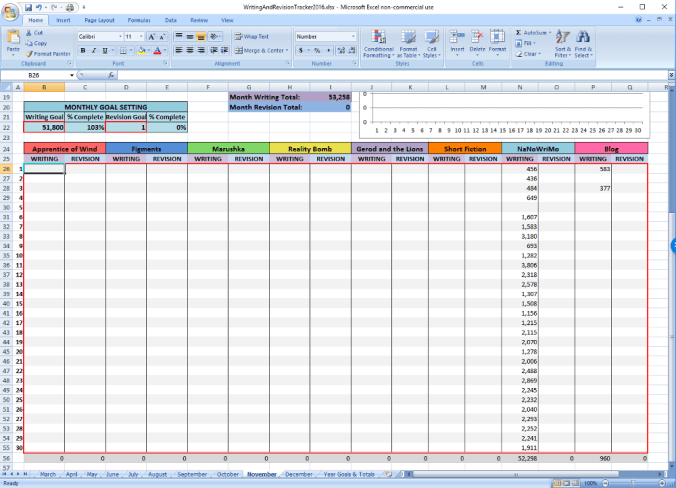
Here’s how things shaped up:

While I was out of town, I didn’t even manage a thousand words a day, and I didn’t write one word on the day of Wordstock Sudbury. I was out, manning the book table, participating in a panel on commercial genre fiction (specifically SF&F), attending a book launch, and reading my poetry. It was a full day.

I started to gain ground on the weekend, though, and though there were still a number of days on which I didn’t achieve the average 1,667 words, there were more days on which I wrote 2,000 or more.nanowrimo_2016_webbadge_winner
And . . . drum roll please . . . I reached November 30 with 52,298 words written.

Flailing Kermit arms! Yaaaaaaaa!
novemberprogress

I also don’t hate what I’ve written, not even during those hard slogging early days. That is, in itself, a triumph 😀

I continue to draft at a more reasonable pace. I’m aiming for 500 words a day, and so far (a whole three days in) I’m exceeding that goal.

Other stuff

I received a very kind rejection for one of the short stories I’d submitted to an anthology call earlier in the year.

Phil finished the renovations on the living room. We’re now, very slowly, cleaning up the house and purchasing our new furniture.

My love isn’t getting any younger, and had decided that next year (after a winter of building bookshelves and stocking them) he’s going to renovate the kitchen, bathroom, and side entry.

I’m happy to report that Phil and I are in good health.

The regular blogging schedule will resume, starting with this post. Tipsday and thoughty Thursday will also be returning. Next week, I’ll be moving on with the next session I took notes on at WorldCon.

I tried a new system for my curation posts in October, leading up to NaNo, that I’m going to return to.

In the past, I spent several hours every Sunday, reviewing my social media shares for the week and linking them with a brief framing sentence in my curation drafts in Word. Then, on the day, I’d copy the text into WordPress, format the links, add the picture, post, and then share to my social media accounts.

I’ll still have to do that this week, but now, I’ll be working smarter, not harder.

Every day, I’m going to spend a little time reviewing my posts of the day and copying them into the curation draft in Word. Then, on Sunday, I copy the text into WP, format, add the pictures, and schedule the posts, so that all I have to do on the day of is share it to my various social media accounts.

Much easier.

If I weren’t so paranoid about hackage and losing work, I might choose to draft right in WordPress, but once bitten, and all that 😉

I just thought I’d share in the event that this might make sense for you.

Next month: It will be another double update. I’ll be reviewing December’s progress and 2016 as a whole (goals and other gorgeous stuff). W00t!

Have yourselves a wonderful week.

Until Tipsday!
The Next Chapter

Thoughty Thursday: Things that made me go hmmmm on the interwebz, Oct 23-29, 2016

Let’s get that mental corn a-poppin’, shall we?

Terri Windling muses upon the death of the year. Myth & Moor

Shahan Russell writes about the mysterious death of Rasputin, the Siberian monk who brought down the Tsar of Russia. War History Online

The Medievalists present the medieval walking dead. Better that the latest series premiere? You be the judge.

Michael Livingston delves into the medieval origins of Hallowe’en. Tor.com

Debby Banham and Christine Voth explore the diagnosis and treatment of wounds in Old English medical collections. Medievalists

Archaeologists make a baffling Celtic find in France. The Vintage News

Ben Thomas shares his research into four great African empires that astonished the world. Medium

Discover Sanxingdui, the ancient Chinese city that’s older than Rome. The Vintage News

The tragedy of Meagen Pilon and human trafficking in Sudbury. Laura Stradiotto for The Sudbury Star.

Ashton Kutcher’s mission to end human trafficking has rescued 6000 people so far. The Earth Child

“Bitch.” Brave New Voices


Anxiety is an invalid excuse. Just Cut the Bullshit

Ephrat Livni: scientists explain how happiness makes us less creative. Quartz

Alan Watts – why your life is not a journey.


Andrew Griffin reports on signals from outer space that scientists believe could be messages from aliens. The Independent

Laura Parker digs into bioinspiration, the thrilling new science that could transform medicine. The Guardian

The man once thought to have spread HIV to America has been cleared by science. James Gallagher for the BBC.

Adam Capay’s treatment reflects poorly on corrections and on government. On all of us, really. The Globe and Mail

Remember Jumpy, the dog who does parkour? Well, he’s also the smartest dog in Hollywood. Amy Nicholson for MTV News.

Moar dog shaming?  Oh yeah! I waste so much time

Cosmic guinea pig.


The Pentatonix cover Hallelujah.


Thoughty Thursday will return, December 8th.

And watch for my two-month next chapter update on December 3rd.

Then, you can find out what I was doing instead of blogging in the month of November 🙂

Be well until then!

thoughtythursday2016

Tipsday: Writerly Goodness found on the interwebz, Oct 23-29, 2016

The informal writerly learnings are here!

Your #NaNoWriMo round up for the week:

Danielle Daniel discusses her memoir, The Dependent, with the ladies of The Social.

Sudbury’s Poet Laureate, Kim Fahner, writes in defense of school libraries. The Republic of Poetry

K.M. Weiland: how to properly motivate your bad guy. Helping Writers Become Authors

Roz Morris shares some thoughts on book marketing. Nail Your Novel

Robin Lovett explains why deadlines are not your worst enemy. DIYMFA

James Scott Bell: writer, this is your job. Kill Zone

Barbara O’Neal explores writing with the knowledge of time. Writer Unboxed

Dan Blank: dealing with a slump. Writer Unboxed

Karen Woodward writes in defense of constraints.

Janice Hardy guest posts on Writers in the Storm: how filtering point of view affects show, don’t tell.

Marcy Kennedy blogs about conflict.

Veronica Sicoe continues her storyworld design series with transportation technologies.

Chris Saylor returns to Marcy Kennedy’s blog with his monthly editorial clarification post: “I could care less.”

Jamie Raintree shares her path to publication (part two!).

Janet Reid addresses the issue of young writers. “Publishing will break your heart. Writing will fill your heart.” Truer words . . .

Joanna Penn interviews Kristine Kathryn Rusch and Dean Wesley Smith on The Creative Penn podcast.

Tamerra Griffen unpacks a situation of academic racism on Buzzfeed: a professor circles the word “hence” on Tiffany Martinez’s paper and notes “This is not your word.” Bonus: here is Tiffany’s response to the incident (linked in the Buzzfeed article).

Foz Meadows explores the relationship between romance and queerness, and the difference between genre and device. Shattersnipe

Meg Elison: if women wrote about men the way men write about women. McSweeney’s

Katherine Langrish explores death in classic fantasy. Seven Miles of Steel Thistles

Sadness. 2016 has taken so many great creators from us. Sheri S. Tepper, 1929-2016.

Award news:

The Governor General’s Award winners announced.

The OAC presents its indigenous arts protocols:


Joseph Boyden speaks out for the #WeMatterCampaign


Baihley Grandison shares a lovely infographic with untranslatable words from other languages. Writer’s Digest

Rajeev Balasubramanyam states that the Nobel committee got it wrong: Ngugi wa Thiong’o is the writer the world needs now. The Washington Post

Christopher Marlowe will be credited as Shakespeare’s co-author in New Oxford editions of the Henry VI plays. Dalya Alberge for The Guardian.

Connie Verzak considers Tobias Menzies to be the Snape of Outlander. The Daily Record

And that concludes my first and last Tipsday for the month of November.

The next Tipsday will be coming your way on December 6th, after the furor of #NaNoWriMo has subsided.

Be well until then, my writerly friends.

Honour your creative path.

Virtual hugs to the awesomesauce that is you!

tipsday2016

Book review: K.M. Weiland’s Creating Character Arcs

What Amazon says:

Have you written a story with an exciting concept and interesting characters—but it justcreatingcharacterarcs isn’t grabbing the attention of readers or agents? It’s time to look deeper into the story beats that create realistic and compelling character arcs. Internationally published, award-winning novelist K.M. Weiland shares her acclaimed method for achieving memorable and moving character arcs in every book you write.

By applying the foundation of the Three-Act Story Structure and then delving even deeper into the psychology of realistic and dynamic human change, Weiland offers a beat-by-beat checklist of character arc guidelines that flexes to fit any type of story.

This comprehensive book will teach you:

  • How to determine which arc—positive, negative, or flat—is right for your character.
  • Why you should NEVER pit plot against character. Instead, learn how to blend story structure and character development.
  • How to recognize and avoid the worst pitfalls of writing novels without character arcs.
  • How to hack the secret to using overarching character arcs to create amazing trilogies and series.
  • And much more!

Gaining an understanding of how to write character arcs is a game-changing moment in any author’s pursuit of the craft.

My thoughts:

Creating Character Arcs: The Masterful Author’s Guide to Uniting Story Structure, Plot, and Character Development is a fabulous writing craft book.

K.M. Weiland digs deep into the three types of character arcs and how they work with and influence story structure.

Then, she offers a few ideas on how to use character arcs in your main and supporting characters (and whether it’s worth making the assay with the latter instance), layering character arcs, how to use character arcs over series, and whether or not it’s possible to write a story without a character arc (*spoiler alert,* it is, but there are specific considerations the writer must address).

At the end of each chapter, Kate has a slew of helpful questions that will focus your new understanding of character arc and apply it to your current work in progress. As she has with Outlining Your Novel and Structuring Your Novel, I wouldn’t be surprised if a Creating Character Arcs Workbook is in development 🙂

As with Kate’s other writing craft books, Creating Character Arcs emerged from a blog series on the same topic. Even if you’ve read/listened to the entire series, there’s something about having the reference at your fingertips.

This book works well in conjunction with the other Helping Writers Become Authors books and each builds on the others to form a rich body of writing craft knowledge.

For me, every story begins with the characters and they inform everything else. Creating Character Arcs will help you to connect the dots between your characters, their arcs, and your plot. Using Kate’s method, you can craft a tight, compelling story that works on multiple levels.

Every writer should own a copy.

My rating:

Five out of five stars!

About the author:

kmweilandK.M. Weiland lives in make-believe worlds, talks to imaginary friends, and survives primarily on chocolate truffles and espresso. She is the IPPY and NIEA Award-winning and internationally published author of the Amazon bestsellers Outlining Your Novel and Structuring Your Novel, as well as the portal fantasy Dreamlander, the historical/dieselpunk adventure Storming, the medieval epic Behold the Dawn, and the western A Man Called Outlaw. When she’s not making things up, she’s busy mentoring other authors on her award-winning blog http://www.helpingwritersbecomeauthors.com. She makes her home in western Nebraska.
Book review: K.M. Weiland’s Structuring Your Novel

So I lied. Again.

I thought I was going to proceed with my WorldCon reportage, but I realized I have a book review due (not this one, it’s yet to come). So I’ve decided to write two book reviews today, both for K.M. Weiland books 🙂

The reason for this is that I read Structuring Your Novel and Creating Character Arcs together. I would recommend the practice to anyone, because character arcs and story structure work with each other to deepen the writer’s understanding of story overall.

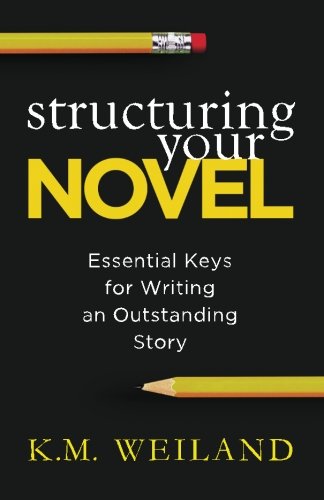
First up: Structuring your Novel: Essential Keys for Writing an Outstanding Story

What Amazon says:

structuringyournovel

Is Structure the Hidden Foundation of All Successful Stories?

Why do some stories work and others don’t? The answer is structure. In this IPPY and NIEA Award-winning guide from the author of the bestselling Outlining Your Novel, you will learn the universal underpinnings that guarantee powerful plot and character arcs. An understanding of proper story and scene structure will show you how to perfectly time your story’s major events and will provide you with an unerring standard against which to evaluate your novel’s pacing and progression.

Structuring Your Novel will show you:

  • How to determine the best techniques for empowering your unique and personal vision for your story.
  • How to identify common structural weaknesses and flip them around into stunning strengths.
  • How to eliminate saggy middles by discovering your “centerpiece.”
  • Why you should NEVER include conflict in every scene.
  • How to discover the questions you don’t want readers asking about your plot—and then how to get them to ask the right questions.

My thoughts:

I’ve been following K.M. Weiland’s blog and podcast for a number of years, since, in fact, she started her series on story structure.

Yes. Everything you will read in this book was originally on Kate’s blog, Helping Writers Become Authors, and you can easily access the whole series (because she’s so organized and so focused on her audience), but it’s so much more convenient to have a condensed, edited, and physical copy of the book, accessible to you at any time, so you can refer to it as you work on your story.

Kate has cracked the code of story structure for me. I’ve read a lot (a freaking lot) of writing craft books and methodologies and Kate’s is the only one that has enabled me to get inside my stories, even those that are already written.

Using Kate’s method, I can dissect my novel structurally and reassemble it in a better, more compelling form. I also use it when preparing for my annual #NaNoWriMo challenge, and when I think about outlining a new work in progress.

I’ve also read a number of her other books, both fiction and writing craft. Each work builds on the others and, because they’re all written in the same voice (excepting the fiction), it helps to form a cohesive body of knowledge that can be accessed and utilized as you need.

With respect to her fiction, you can see that she practices what she preaches. Kate doesn’t instruct from a “do as I say, not as I do” position. She’s field tested everything she presents. You can trust her. I do. Implicitly.

Kate is very much a writerly friend and mentor and this comes across in her authorial voice. She’s all about building writers up, not tearing them down.

Suffice it to say, I loved Structuring Your Novel, and I would recommend it to any writer at any stage of development.

My rating:

Five out of five stars!

About the author:

K.M. Weiland lives in make-believe worlds, talks to imaginary frienkmweilandds, and survives primarily on chocolate truffles and espresso. She is the IPPY and NIEA Award-winning and internationally published author of the Amazon bestsellers Outlining Your Novel and Structuring Your Novel, as well as the portal fantasy Dreamlander, the historical/dieselpunk adventure Storming, the medieval epic Behold the Dawn, and the western A Man Called Outlaw. When she’s not making things up, she’s busy mentoring other authors on her award-winning blog http://www.helpingwritersbecomeauthors.com. She makes her home in western Nebraska.


Thoughty Thursday: Things that made me go hmmmm on the interwebz, Oct 16-22, 2016

Let’s get that mental corn a-poppin’!

Carol Mulligan explores the lore of the pour. The Sudbury Star

What are dreams? Drake Baer shares five of humanity’s best explanations for dreams. Science of Us

Anna Lovind: the shameless introvert.

Suzanne Lucas to employers: please stop punishing your employees for being introverted. Inc.

UpWorthy recommends Marzi’s cartoons to help others relate to intorversion and anxiety.

The Born Again Minimalist examines the gaslighting of the millennial generation.

Transgender rights bill passes key commons vote and heads to committee. The Globe and Mail

Too sweet, or too shrill? The double bind for women. Shankar Vedantam hosts the Hidden Brain podcast for NPR.

The transformative power of Moko. Michelle Duff for Broadly/Vice.

Cath Pound considers the great women artists that history forgot. BBC

Artist Toby Allen, who suffers from anxiety, illustrates mental illnesses as monsters. Bored Panda

Regina activists place warning labels on indigenous Hallowe’en costumes. CBC

I’m just going to leave this here. To the new culture cops, everything is appropriation. Cathy Young for the Washington Post.

Avaneesh Pandey: self-awareness may be a side effect of the brain trying to maximize entropy. International Business Times

Ben Paynter shares news about how the world is slowly winning the fight against Malaria. Fast Company

Sarah Knapton reports on how tool-making monkeys are prompting scientists to reconsider human evolution. The Telegraph

Bec Crew: scientists accidentally discover the process that turns CO2 into ethanol. This could change the world. Science Alert

Ross Pomeroy explains why Bill Nye changed his mind about GMOs. Real Clear Science

The mystery of the Bermuda Triangle may finally be solved . . . by meteorology. Cory Charlton for The New York Post.

Loren Grush explains how the ExoMars spacecraft will make its way to the surface of Mars. The Verge

Catch Space.com’s coverage of the landing and other astro-news.

Maddie Stone: Pluto’s skies look more Earth-like than we’d imagined. Gizmodo

A spiral galaxy defies the cosmic flow. In an expanding universe, it’s actually getting closer to us. Also: how big is Proxima Centauri’s planet? Later in the week, we learn that the Schiaparelli lander (crash) site can be seen from orbit. Phil Plait for Slate.

Can the multiverse explain the course of human history? Andrew Crummey for Aeon.

Puppers! Buzzfeed

Alex and Jumpy, the parkour dog 🙂


Just a reminder, this is your penultimate thoughty Thursday prior to my #NaNoWriMo break.

I’ll see you next Thursday, but after that, you won’t get your weekly dose of thoughty until December.

Respect your priorities.

Be well.

All my (virtual) love.

Mel

Thoughty Thursday

Tipsday: Writerly Goodness found on the interwebz, Oct 16-22, 2016

Just to let you know. I’m participating in #NaNoWriMo this year, but I wasn’t able to take much time off in November. So I’m working. And, I’ll be out of town, training for the day job, for the first week. And I’ll be at Wordstock Sudbury the weekend I get back. And I’ll be helping to launch the SWG anthology, Sudbury Ink. On the weekend of the 12th/13th (the day/date is yet to be determined).

So, it’s going to be a busy month.

As a result, I’m not going to be blogging at all in the month of November. I will be able to complete and schedule the curation posts for the first week (Tipsday on Nov 1st and Thoughty Thursday on Nov 3rd), but, after that, you won’t be seeing another post until December 3rd, when I’ll be doing a double monthly update for October and November.

I just wanted to let you know ahead of time, so you won’t be expecting posts, or wondering where the heck I am.

I’ll be well, and writing 🙂

Your #NaNoWriMo round up for the week:

K.M. Weiland reviews the WriteMind Planner (plus a chance to win!). Helping Writers Become Authors

Janice Hardy guest posts on Kate’s blog: three ways to instantly spot telling.

Chris Winkle shares five ways to hide your foreshadowing. Mythcreants

Vaughn Roycroft suggests the synopsis as a way to revision success. Writer Unboxed

Dave King helps you meet your characters on Writer Unboxed.

Janice Hardy asks, which character is the heart of your story? Fiction University

Writing a series: how much do you need to plan ahead? Jami Gold.

Alex Bloom makes a guest appearance on The Write Practice: what most writers don’t know about screenplay structure.

Steven Pressfield: what works and what doesn’t.

Gail Carriger discusses one of her literary influences, Mercedes Lackey.

Sabaa Tahir picks Patrick Rothfuss’s brain about writing sequels and impostor’s syndrome. Tor.com

Sarah Gailey wants to see more mentally ill women protagonists. Tor.com

Authors share their views on cultural appropriation. The Guardian

Marlon James: why I’m done talking about diversity. Literary Hub

Finally! An infographic that breaks down the big five and their imprints.

Kelsey Campbell-Dollaghan reports on a gorgeous typeface that drove men mad and sparked a 100-year mystery. Gizmodo

Charles Dickens and profanity. Bryan Kozlowski for The Millions.

Azhar A. Alkazwini documents the influence of the Norman Conquest on the English language. Medievalists.net

Five portmanteau words you want to start using. Sad and Useless

Hephzibah Anderson settles in with The Wide Sargasso Sea, the book that changed Jane Eyre forever. BBC

Looking forward to Guardians of the Galaxy, vol. 2? Check out this teaser trailer! Brian Raftery for Wired.

Women will direct every episode of Jessica Jones, season 2. Beth Elderkin for i09.

All the best until Thursday 🙂

See you then! *waves*

Tipsday

WorldCon 2016: Science fiction as epic

Disclaimer: I am not perfect and neither are my notes. If you notice anything that requires clarification or correction, please email me at melanie (dot) marttila (at) gmail (dot) com and I will fix things post-hasty.

Panellists: Frederick Turner, Walter Jon Williams, Cynthia Ward, John Kessel (moderator), Elizabeth Moon

kcpubliclibrary

The Kansas City Public Library

Quick note: What’s with the non-panel pictures? In the first day, I wasn’t sure if it would be acceptable to take pictures without first asking permission. So I’m sharing pictures from Kansas City, which hosted WorldCon this year, because I took walking tours of the city Friday, Saturday, and Sunday mornings. Panel pictures will arrive with the Friday sessions.

Joined in progress.

FT: The classic epics were the science fiction of the past. They shared common themes and fundamental elements. They were from the oral tradition (storyteller). They featured a creation myth (cosmology), a hero, a quest, kinship and kinship troubles, the interplay of nature, culture, and the supernatural, descent into and emergence from the underworld, and/or the founding of a city.

EM: The SF epic can be set in a different world. One of the features in that case would be the technological difference between our world and the other one.

JK: Does scope equal epic? Northrop Frye espoused the high mimetic (imitative) as central to the epic form. Is there no everyman in the epic?

EM: The genius has epic intellect. The protagonist must be exceptional in some way.

CW: Walter Mitty is not epic.

FT: Many heroes start out as foundlings or shepherds.

WJW: Dune is a science fiction epic. Zelazny’s Lord of Light is an SF epic.

JK: Star Wars is an SF epic, a space opera. Edith Hamilton and Joseph Campbell have both analyzed it in their work.

CW: Foundation is an epic.

FT: Epic goes to the edge of the world, or humanity, or the universe. The world has to change as a result of the story.

WJW: So Epic science fiction is about man’s place in the universe.

FT: There’s an emotional, almost musical resonance.

EM: Modern readers need humour. That’s the secret spice in the stew.

JK: Economics doesn’t seem to be a factor.

CW: Not everyone appreciates an empire. Post-colonial narratives.

FT: Mad Max is dystopian and epic.

Aud: Wilson Tucker coined the term space opera in the early 40’s. It was meant to connote second rate science fiction that focused on adventure. It’s from horse opera, which was a pejorative term for a western.

Other epics were proposed by the panel and the audience: C.J. Cherryh, Leviathan Wakes, Hyperion, Babylon 5, Sagan, Clarke, David Brin, Gene Wolf. The theme of faith and religious belief was also proposed as another feature of the epic.

And that was time.

Next week: Mythology as the basis of science fiction.

Be well until then 🙂

Thoughty Thursday: Things that made me go hmmmm on the interwebz, Oct 9-15, 2016

Time to get your thoughty on!

This is the only post I’m sharing on the Trump thing from last week: every woman in America knows Donald Trump and Billy Bush. Erin Gloria Ryan for The Daily Beast. Seriously, after hearing him say that rapacious shit—I have no words.

Michelle Obama had plenty, however. I’ll let her speak for the outrage we should all be feeling right now:


John Ralston Saul on the CBC’s Unreserved: indigenous peoples don’t need your sympathy. They need you to take action.

And though he’s dying of brain cancer, this man is acting: watch Gord Downie’s Secret Path on CBC, October 23, 2016. It should be streamed on their web site, too, in case you’re not in Canada.

Colin Schultz remembers the day Canada burned the White House. The Smithsonian Magazine

The Roma in Peterborough. John Tyler Lyon for Canada’s History.

Medievalists.net lists ten great Anglo-Saxon girls’ names.

Marianne Ailes shares new Charlemagne research for the Medievlists.net.

This is what 18th century Paris sounded like. Erin Blakemore for The Smithsonian Magazine.

Lindsay Baker looks at the 20’s, the era that changed the way we dress. BBC

Meet the woman correspondent who scooped the world. Dominique Rowe for Time.

You know how much I love abandoned places and urban exploring. Sarah Laskow of Atlas Obscura takes us on a tour of the New York public library’s last, secret apartments.

Is there a limit to how long humans can live? Richard Faragher for Quartz.

Omid Safi states that being busy is a disease. On Being

Annette Heist looks at living with anosmia. NPR

Rose Eveleth reports that people put too much emphasis on Myers-Briggs Type Inventory results. The Smithsonian Magazine

Conversations with dolphins. CBC‘s The Nature of Things.

MIT creates a world of eternal May to help save bees. Mark Wilson for Fast Company.

The colonization of Mars could put astronauts at risk of chronic dementia. Victoria Woollaston for Wired.

Neil de Grasse Tyson and Bryan Cox debate the physics of lightsabers on StarTalk. National Geographic Channel

The good people of Minute Physics explain time’s arrow. Phil Plait for Slate.

Will you become a citizen of Asgardia, the first nation state in space? Nicola Davis for The Guardian.

And if you want to find out more, here’s the Asgardia web site.

Marcel Schwantes lists twenty ways to reduce your stress. Inc.

Grace Eire offers twelve signs that you may be an old soul. Little Things

Take a first listen to Tanya Tagaq’s Retribution, courtesy of Katie Presley of NPR.

And that’s how we pop your mental corn 🙂

See you Saturday for more WorldCon reportage.

Thoughty Thursday

Tipsday: Writerly Goodness found on the interwebz, Oct 9-15, 2016

Another harvest of informal writerly learnings for you 🙂

Moar Wordstock Sudbury 2016 news from Kim Fahner, Sudbury’s Poet Laureate. CBC

Emily Franceschini interviews Danielle Daniel for Our Crater.

This week’s #NaNoWriMo round up:

Eleana Sbokou guest posts on Kate’s blog: seven things you need to know about writing and editing.

Roz Morris provides a blueprint for keeping the reader gripped. Nail Your Novel

Juliette Wade guest posts on Janice Hardy’s Fiction University: backgrounding your world through point of view.

Veronica Sicoe continues her series on storyworld design with this instalment on communication technologies.

Gabriela Pereira interviews Amor Towles for DIYMFA radio: worldbuilding from the inside out.

The book monster, or, when writing gets hard. Kate Moretti on Writer Unboxed.

Allie Larkin writes about finding confidence. Writing Unboxed

David Corbett shares what he learned at the beach this summer. And I have another book for the TBR pile 🙂 Writer Unboxed

Lisa Cron explains where drama really comes from. Writer Unboxed

Orly Konig Lopez gives three reasons quitting is an option, and the one reason you won’t. Bonus: guinea pig pictures! Writers in the Storm

Steven Pressfield reminisces about writing “as if.”

Ok. I just can’t resist Harper Lee Hodges. The four steps cats use to explain how to do something. The Write Practice

Julie Phillips: the fantastic Ursula K. Le Guin. The New Yorker

Jamie Raintree shares her story: from agent to publisher, part 1.

Why is it so difficult to get an agent? Liza Dawson Associates

Kristen Lamb explains why we need a synopsis before we write the book.

Catherine Ryan Howard explores her hate/love relationship with writers’ workshops.

Susan Spann helps us understand advances in publishing deals. Writers in the Storm

Adrienne Raphel: a history of punctuation for the internet age. The New Yorker

Four writers share their stories about the search for happiness. The Telegraph

Claire Kirch reports on We Need Diverse Books new curated reading app. Publishers Weekly

The publishing industry risks becoming irrelevant. Tom Welson of Penguin Random House UK. The Guardian

Here’s a lovely bit of storytelling for you. Dia de los muertos from Film School Shorts.


And another  video on the role of geometry in visual storytelling. Now you see it


The indigenous science fiction film, Northlander, will be screened across Canada. CBC

Kameron Hurley digs into the first couple of episodes of Westworld.

Alex Cranz reviews the season premiere of Supergirl. i09

James Whitbrook says that DC’s Legends of Tomorrow is trying to be Doctor Who with superheroes, and that’s just fine by him. i09

Clara and Eleven were a couple. What we’ve all known, finally confirmed. Caitlin Busch for Inverse.

Katharine Trendacosta reviews the first Iron Fist footage from NYCC. i09

And The Nerdist shares the Iron Fist trailer.

Katharine Trendacosta shares what she learned about The Dark Tower trailer (leaked). i09

The Outlander, season two, gag reel 😀


I hope that you find some news you can use to help improve your craft.

All the best.

See you Thursday!

Tipsday