Thoughty Thursday: Things that made me go hmmmm on the interwebz, Jan 8-14, 2017

It’s like, wow (it’s like right now)! Sorry, I have a Beck ear worm 😉

The Kounotori electrodynamic tether hopes to displace space debris and clear the upper atmosphere. Bill Chappell for NPR.

Matt Novak replays an interview with David Bowie in which he argues the point about the subversive nature of the internet. I miss starman 😦 Paleofuture

Imogen Heap’s Mi.Mu gloves.


Dan Nosowitz discovers why Canadians say “eh.” Altas Obscura

ASAP Thought debates early birds vs. night owls.


Timothy Joseph Elzinga captures an amazing photograph of light pillars. Marina von Stackleberg for the CBC.

Listen closely to what this crow says 😉 Best Source of Fun

Bernese Mountain pup vs. lemon.


Here’s hoping that something in this selection popped your mental corn. Get those creative connections going.

And let me know if anything comes of it.

Be well until the weekend.

thoughtythursday2016

Tipsday: Writerly Goodness found on the interwebz, Jan 8-14, 2017

I even have a video in the informal writerly learnings mix this week. W00t!

K.M. Weiland offers her top ten ways to rivet readers with plot reveals. Helping Writers Become Authors

Later in the week Dave Chesson guest posts on Kate’s blog with Boba Fett’s guide to writing cool characters.

Jordan Rosenfeld guest posts on Writer Unboxed: perception and how to identify POV leaps.

Bess Cozby offers five tips for mastering multiple points of view. DIYMFA

Oren Ashkenazi explains how to craft a character-driven story. Mythcreants

Becca Puglisi guest posts on Writers in the Storm: crafting a powerful set up.

Sophie Masson helps you craft the perfect back cover blurb. Writer Unboxed

David Corbett explores the topic of reading while writing. Writer Unboxed

Roz Morris joins the awesome line up of writing coaches on Writers Helping Writers: read more fiction.

Jami Gold explains how writing goals are really about finding out what works for you. Later in the week, she offers some insight into how to make your story meaningful.

Janice Hardy shares some outlining tips. Fiction University

Chuck Wendig tell you how to finish revising, you filthy animal. Terribleminds

Should you submit your work to agents or editors? Jane Friedman

New contributor Kathryn Magendie writes about giving up and giving in. Writer Unboxed

Susan Spann educates us on negotiating options in publishing deals. Writer in the Storm

Gabriela Pereira and Manjula Martin talk money on DIYMFA radio.

Joanna Penn and CJ Lyons talk about the dream of quitting the day job to write full time. The Creative Penn

Indigenous readers recommend books. 49th Shelf

Danielle Dutton lists her top ten books about wild women. The Guardian

Terri Windling: old stories made new. Myth & Moor

John Yorke: all stories are the same. The Atlantic

Liz Bourke reviews Certain Dark Things and Sparrow Falling. Tor.com

Man Booker prize winner, Marlon James, is writing an epic fantasy trilogy drawn from African mythology. Natalie Zutter for Tor.com.

Foz Meadows muses on Westworld: (de)humanizing the other. shattersnipe

Heather Wolfe, the “Sherlock of the library” cracked the case of Shakespeare’s identity. Robert McCrum for The Guardian.

A Writer’s Life. Two men have words.


Leah Schnelbach looks back at Princess Mononoke after 20 years. Tor.com

I hope you found something to enrich your skill set.

Come on back on Thursday for some inspiration 🙂

Be well until then.

tipsday2016

WorldCon 2016: Humans and robots

Disclaimer: I am not perfect and neither are my notes. If you notice anything that requires clarification or correction, please email me at melanie (dot) marttila (at) gmail (dot) com and I will fix things post-hasty.

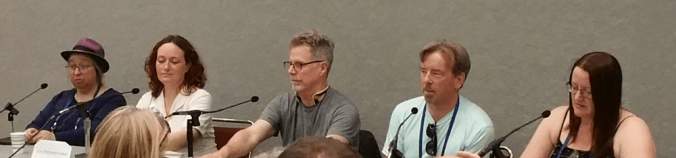
Panellists: Kevin Roche, G. David Nordley, Brenda Cooper (moderator), Walt Boyes, Jerry Pournelle

humansandrobots

Joined in progress …

KR: They have built and programmed competent bartending robots.

GDN: There’s an S-curve with any technological development. If you picture the letter S and start from the bottom of the letter, robotics is at the first upsweeping curve.

WB: Google is the largest robotics company in the world. Boston Robotics sells services in robotic hours.

JP: With regard to artificial intelligence (AI), every time we started something that looked like AI, people said nope, that ain’t it. Unemployment is higher than the statistics report. In the near future, over half of jobs will be replaced by robots or other automation. The unemployable won’t be visible. They won’t be looking. We’ve not lost jobs to overseas corporations, or not as many as we think. We’ve lost jobs to automation. The “useless” class is on the rise. Look at it this way, an employer saves an employee’s annual salary and spends maybe 10% of it to maintain a robot doing the same work. They’d need one human to service 20 robots.

BC: How do you assign value to human work?

WB: In 1900, the second industrial revolution saw farm workers move to the cities and the factories. The real issue is a philosophical one. We’ve been assigning value to people by the work that they do. A corporate lawyer has, subjectively, greater value than a garbage man. What happens when automation and artificial intelligence replaces both?

KR: When workers are underpaid, the social contract bears the cost. Increasing the minimum wage and increased automation are exposing the dirty little secret. People need to be valued differently. Teachers and artists, in particular, can’t be replaced.

GDN: The top level docs of our society assign value to every citizen. The big question is how do we realize that? The recession has meant fewer tax dollars dedicated to the arts and infrastructure. We have to have the social conversation.

JP: Will advances in artificial intelligence implement Asimov’s three laws? Drones don’t use the three laws. IBM created an AI that beat a human at go [the game]. They took two machines, programmed them with the rules of the game, and let them play each other. After ten million games, they could functionally beat anyone. If you ask a robot to stop humans from killing each other, what’s to stop the robot from coming up with the solution to kill all humans? We have to proceed carefully.

KR: Watson won Jeopardy. Its job is to parse huge amounts of information and look for patterns. It’s humans who decided to test the system by putting it on the show.

GDN: Right now, computers are still, by and large, working on bookkeeping tasks. As we get to the point where we have to consider the three laws, we have to be cautious.

WB: We have to expand out definition of robotics. We have the internet of things with programmable thermostats and refrigerators we can access through our phones. Though still imperfect, we have self-driving cars. We need to figure out how to program morality.

GDN: Human beings don’t consistently make the same moral choices. Fuzzy logic and data sets would be required. Positronic brains would have to deal with potentialities.

KR: We don’t have an algorithmic equivalent for empathy.

And that was time.

Next week, we’re going to explore the steampunk explosion 🙂

Until then, be well, be kind, and be awesome!

Thoughty Thursday: Things that made me go hmmmm on the interwebz, Jan 1-7, 2017

It’s quality over quantity this week.

Charles Foran wonders if Canada is the world’s first post-national country. The Guardian

Wab Kinew: there is room in our circle for Joseph Boyden. The Globe and Mail

Matt Ayton asks, why don’t we stand with Turkey like we did with Orlando and Paris? The Independent

William Deresiewicz: how to learn how to think. Farnham Street

Medievalists.net explores the sleeping habits of the Middle Ages.

Jo Marchant digs into this 3,500 year old Mycenae tomb and how it changes what we know about history. The Smithsonian Magazine

George Dvorsky reports on the discovery of a stunning new type of galaxy. Gizmodo

Maddie Stone shares the most detailed view of black holes in the universe. Gizmodo

Lauren Jarvis-Gibson lists eleven things people don’t realize you do because of your anxiety. Thought Catalog

On the Hearty Soul: how complaining rewires your brain to be anxious and depressed.

Daily Health Records lists fifteen things you’ll notice when you’re in the presence of an empath.

Here’s hoping something got your mental corn popping 🙂

On Saturday, I return to WorldCon 2016 reporting.

Be well until then!

thoughtythursday2016

Tipsday: Writerly Goodness found on the interwebz, Jan 1-7, 2017

Welcome to your informal writely learnings of the week 🙂

K.M. Weiland continues her common writing mistakes series with part 55: beginning your story too late. Helping Writers Become Authors

Immerse yourself in POV with Donald Maass. Writer Unboxed

Chris Winkle helps you choose your perspective. Mythcreants

Do you work on your stories character first, or worldbuilding first? Jo Eberhardt says it really doesn’t matter. Writer Unboxed

Zara Quentin guest posts on Fiction University: how to build a world (and why), an evolutionary approach.

Chuck Wendig encourages us to write despite. Terribleminds

Kristen Lamb gives ‘em hell: NYC gooood, self-pub baaaaad. It’s an author animal farm out there!

Janice Hardy guest posts on Writers in the Storm: how bad times and new starts affect our writing.

Writing coach C.S. Lakin offers some tips for weaving romance into your novel. Writers Helping Writers

Blake Atwood shares ten easy ways to self-edit your novel. The Write Life

Gabriela Pereira interviews Alexia Vernon on the art of public speaking for DIYMFA radio.

Joe Fassler compiles the best writing advice of 2016. The Atlantic

Glenn Leibowitz recommends the one book you must read to become a better writer. Inc.

Terri Windling muses upon a parliament of owls. Myth & Moor

Jessica Stillman lists the most misused words according to Daniel Pinker. Inc.

Libby Coleman examines Ken Liu’s body of work so far. Ozy

Cheryl Eddy shares a list of January’s must-read science fiction and fantasy. i09

I’m so excited! James Whitbrook gives us a first look at the live action Fullmetal Alchemist movie (!) i09

Connie Verzak has some fun with the animals of Outlander for her 2017 resolutions. The Daily Record

Beth Elderkin (I lurve her name, don’t you?) shares The Handmaid’s Tale teaser on i09.

I sincerely hope you found something you wanted to learn about among this week’s offerings.

If you’re interested in writerly inspiration, come back on thoughty Thursday to get your mental corn a-poppin’!

Be well until then!

tipsday2016

The next chapter: December 2016 update and year in review

My goodness, here we are in 2017 (!) and now it’s time for me to take stock of my year. Did I accomplish what I hoped to at the beginning of the year?

We’ll get back to that in a few.

First, I have to sum up (‘cause there is too much—I live by PB references) December 2016.

I knew when I decided to tackle Wavedancer, the third book in my epic fantasy series, for NaNoWriMo 2016 that I wouldn’t even come close to finishing the draft (it is EPIC fantasy, after all) in November. I was, however, foolish enough to think, initially, at least, that I’d write another 50k words in December and finish the draft by the end of the year.

I should have known better.

This is the fourth year I’ve done NaNo, and my third win. Each year, I enter December in a fog, still half-living in the world of my novel. I work a day job. There’s no way I could keep up the NaNo pace for another whole month.

Accordingly, I adjusted my expectations to 500 words a day and, though there were two days I didn’t write at all and a few assorted low-count days in the mix, there were also five days in which I wrote over a thousand words, so it all came out in the wash.

decemberprogress

To be more specific, of the 15,500 word goal for the month, I wrote 18,859 words, exceeding my goal by 3,359 words 🙂

Blogging 5,610 words brought my writing total for the month to 21,600 words.

Not 50k, but not bad at all 🙂

Back to my year-end review.

2016 was the first year that Jamie Raintree incorporated separate columns and totals for revision in her Writing Tracker, now called the Writing & Revision Tracker.

Though I’ve looked back at 2015’s and 2014’s trackers, the totals were skewed because in 2014, I didn’t track my revisions, and in 2015, I was tracking my revisions at one counted word for every two words revised. So there’s no real point in trying to compare.

What I set out to do at the beginning of 2016 was to go through all of my written novels to date and start to revise.

I’m happy to say that I accomplished this goal, but things didn’t go quite as I’d hoped. They never do. Quite.

For most of the novels, it was more of a getting reacquainted with the stories and the characters. I didn’t do a lot of revising, but now that I have the lay of the land, so to speak, the next passes will all be more in-depth.

I already mentioned that, having revised my goals post-NaNo, I did write two thirds of Wavedancer. To be specific, I wrote 71,157 words between November and December, and I will continue in that vein until the draft is done in my estimation.

I continued to query Initiate of Stone, but finally got it through my thick skull that it’s not the best project to use when trying to get a deal. So I’m changing gears and going to prepare another project for querying this year. We’ll see how it goes.

How did all this shape up as far as numbers went?

yearend

Of my 138,100 word writing goal, between all projects, I wrote 169,288 words, or 123%. Considering all the revision I was doing, that’s a lovely total.

With respect to revision, I managed 359,114 words of my 375,000 goal, or about 96%.

Some things happened in the year that I didn’t plan on, however.

Though it didn’t happen until July, I wrote a new piece of short fiction. I hadn’t expected that with my focus on the novels. It was a good surprise 🙂

January through March, I participated in the first offering of the Story Genius course created by Jennie Nash and the story genius herself, Lisa Cron. It was something unexpected, but I couldn’t let the opportunity pass. I had to try to make space for the course in my overall plan for the year and ended up making some poor decisions that didn’t serve me well.

While my experience in the course wasn’t, overall, a positive one, I still love the Story Genius method (and book—go get it!) and I would recommend it highly to anyone who can devote 100% of their time to the work. You will reap the benefits.

I just learned, in the most ego-wrenching way possible, that I cannot learn on someone else’s schedule. Especially while I’m working full time. I also made the decision to use Apprentice of Wind, the second in my epic fantasy series, as the project for my work in the course. Story Genius, in the form I took it, was not intended for novels that are already drafted, or for books other than the first in a series. I understand that strategies and approaches for projects of this type have been developed since.

These issues were entirely of my own creation and should not cast any doubt on the excellence of the course, of Lisa or Jennie, or of their dedicated team of editors.

I signed up for K.M. Weiland’s Character Arcs course through the Digital Freedom Academy. It’s entirely self-paced and Kate has loaded her usual extras into the course materials. Her Creating Character Arcs book also came out in the fall, and I definitely recommend both. I am a fangirl, though.

In August, I signed up for another Nelson Literary Agency course on the first five pages. NLA courses are excellence sources of feedback from professional agents who know what makes a successful submission.

At the end of September, I enrolled in a Mary Robinette Kowal Short Fiction Intensive. Blew my mind.

Finally, as far as courses go, I signed up for a course by Kristen Lamb on writing query letters and synopses.

I also tried my hand at #PitchWars for the first time with Reality Bomb, and while I didn’t make the extremely competitive cut, I did have a positive experience thanks to the team who considered my proposal, Michael Mammay and Dan Koboldt. It’s quite an eye-opener, and I’d recommend it to anyone who wants to test the waters with one of their novels.

It was a lot of fun and another pleasant surprise.

As far as conferences and conventions, I attended Ad Astra, The Canadian Writers’ Summit, and my very first WorldCon last year.

I was also pleased to participate as a panellist at Wordstock Sudbury 2016.

And I had two stories published in the Sudbury Writers’ Guild anthology, Sudbury Ink, which launched in November.

Complicating all that, Phil had some significant health issues to deal with at the beginning of the year (now resolved), and, from August through to November, he renovated our living room after work and on the weekends.

We’re still waiting for the last pieces of furniture to be delivered, and he’ll be working on building wall-to-wall bookshelves, as the weather allows (he’s working in the unheated garage) throughout the winter. Pictures will be forthcoming in a future post.

Looking at all of that written out, I accomplished a helluva lot last year.

I think I’m going to have to ease back a bit in 2017, work smarter instead of harder.

Yeah, that’s the ticket.

What are my plans for 2017?

Well, you know I’m not one for resolutions. I have goals that I work steadily toward and amend as required.

First, I’ve nabbed my copy of Jamie Raintree’s 2017 Writing & Revision tracker. I’m setting up the projects in series this year, and will identify different novels in my Ascension series with different colours so I’ll be able to distinguish them and extract the numbers I need to feed my production geek.

I’ll continue to finish drafting Wavedancer, as I mentioned (way) above. At my current rate, I should be finished by the end of February.

Once drafting is done, I’m going to return to revising. I should be able to get through all of the novels in the course of the year. Again, as I mentioned above, I intend these revisions to be more in depth and to address some of the structural issues, as I see them, in the stories.

I’m going to be working with a coach to get Reality Bomb reworked. It’s something else I’m trying in my quest to improve my craft. My hope is that I’ll be able to query RB later this year.

With the short fiction surprise last year, I’ve actually had another idea I want to work on, and some other ideas for revising a couple of my other stories to improve them. Accordingly, I’ve made some room for these projects in my plan.

For NaNoWriMo, I’m going to tackle the fourth novel in the epic fantasy series, tentatively titled Playing with Fire.

I may also have a new, semi-regular writing gig to tell you about. I don’t want to let the cat out of the proverbial bag yet, but if it materializes, you can be sure I’ll let you know all the tasty deets I can 🙂

I’ve already signed up for the Story Masters Workshop in May. Donald Maass, James Scott Bell, and Christopher Vogler are coming to Toronto. This is a squee-worthy score, in my books. It was another opportunity I couldn’t let pass.

When I heard that the No Excuses cruise was going to be in Europe this year and timed to immediately precede WorldCon in Helsinki, I was seriously considering signing up. Unfortunately some non-writerly priorities make both the cruise and WorldCon impractical. Mellie haz a sad.

In fact, I may not attend any conferences or conventions at all this year. We’ll see how things shape up.

The reason for this dialling back is that Phil, who’s in his 50’s now, wants to proceed with renovations to the kitchen and bathroom this year. Though he will continue to do as much of the work himself as he can, these two projects will require a significant financial investment. And we haven’t paid off the living room renovation yet.

We also want to get another puppy. This will depend on whether my employer sorts out their payroll issues and I can apply for another self-funded leave. I will need the time to train our new dependent, furry quadruped. Again, deets will be forthcoming as I can share them.

On that front, if the payroll issues at work are sorted, I’ll finally see my acting pay from mid-February to the end of September last year, less about a thousand dollars outstanding from my last self-funded leave.

We’ve heard that union negotiations have resulted in an offer, the terms of which look reasonable. If we vote to ratify the new contract, it will mean about two and a half years of retro pay and a signing bonus, again, dependent on when the payroll issues can be sorted.

Our car loan should be paid off in late spring, as well, and so, between it all, we’ll have a little extra money to use to pay down our debts.

Phil got a promotion and raise last year from his employer, so we figure this will be the year to finish the renovations.

As you can see, this is going to be a different kind of year, but I’m hopeful that everything will work out.

Besides, come the end of February, it will be the Chinese Year of the Rooster (I’m a rooster!) and I think the powers that be might finally be aligning in my favour 😉

Here’s to a fabulous and productive 2017 for everyone.

Love and light and loads of good words to you all!

The Next Chapter

Thoughty Thursday: Things that made me go hmmmm on the interwebz, Dec 25-31, 2016

It’s a right mix of edutainment this week, but I hope it still pops your mental corn!

A Sudbury teen, missing since December 20, is found on Christmas Eve. Sudbury Star

Petula Dvorak: the Hannuka/Christmas convergence couldn’t be more symbolic of the light we need to embrace. The Washington Post

Oliver Burkeman reports on why time management is ruining our lives. I might argue that this would only apply to those for whom the skill does not come naturally. The Guardian

Feeling less than grateful? Some people are just wired that way. Katherine Hobson for NPR.

Emily Hartridge talks about her top four anxiety challenges.


Depression is all in your head—and now, doctors know where. Second Nexus

Alan Yu explains how a diet high in fat and sugar affects your memory. NPR

Becca Martin hates to break it to you, but you are the reason your life sucks. Thought Catalog

Madeleine Davies: becoming ugly. Jezebel

Bec Crew reports on a new Alzheimer’s therapy that fully restores memory function. Science Alert

Antonio Regalado: everything you need to know about gene therapy’s most promising year. MIT technology review

Phil Plait shares a fabulous photo of a lunar fogbow. Slate

In England, you can camp in abandoned medieval churches. David Wilson for Atlas Obscura.

I’m all about Immie (Imogen Heap) this week. Lifeline:


Canvas:


You know where to find me:


Neglected space:


Coming up on the weekend: I’ll be looking at December’s writing progress and wrapping up 2016.

Be well until then, my lovely people 🙂

thoughtythursday2016

Tipsday: Writerly Goodness found on the interwebz, Dec 25-31, 2016

We have a small, but select group of informal writerly learnings this week 🙂

K.M. Weiland explains how to deepen your story with character misdirection. Helping Writers Become Authors

Janice Hardy shares the easiest way to create conflict. Fiction University

Leanne Sowul tells us how (and why) to write a mission statement. DIYMFA

Gabriela Pereira and Joanna Penn on DIYMFA radio!

Finally, Bess Cozby shares five writing resolutions besides writing every day. DIYMFA

Following up on her guest post on Writers Helping Writers, Jami Gold explains what a writing coach is and why you might want one.

Kristen Lamb helps you rock 2017 (after the dumpster fire of 2016).

Jami Gold offers advice on how to find (and vet) a developmental editor.

Chuck Sambuchino compiles 38 query letter tips from literary agents. Writers Digest

And here are 34 submission no-no’s for you to check out, too.

John Foley explores the legacy of hard science fiction. Omni

I hope this helps to get your 2017 off to a great start!

See you Thursday for some of the old thoughty 😉

tipsday2016

WorldCon 2016: Class and equality in fantasy and science fiction

Disclaimer: I am not perfect and neither are my notes. If you notice anything that requires clarification or correction, please email me at melanie (dot) marttila (at) gmail (dot) com and I will fix things post-hasty.

Panellists: Jennie Goloboy, Jennie J.R. Johansson (moderator), Eleanor Arnason, William Hayashi

Note: Terra LeMay was scheduled to participate in this panel, but could not make it. Agent Jennie Goloboy graciously agreed to participate.

classandequality

Joined in progress.

EA: Barbara Jenson said that economy and society cannot be separated.

WH: It’s useful to use familiar tropes to reach your readers, but be wary of stereotypes.

JG: The cultural pressure to categorize people opposes the personal feeling that it’s wrong.

JRJ: You have to question it, though. It’s a useful tension to explore.

WH: Look at how other authors have addressed the issue. Young adult novels turned movies like The Hunger Games and Divergent. Frank Herbert’s Dune. Asimov’s Foundation.

EA: Melissa Scott writes about marginalized characters. Science fiction under-represents the working and middle classes.

JRJ: Marie Lu’s The Young Elites explores issues of class.

JG: What do class and equality look like in the future?  If we extrapolate from current trends, there will be more automation, shorter attention spans, but more independence.

WH: Robert Heinlein pitted the working class against the upper class. It’s a common trope, but it’s realistic. The 1% versus everyone else. Where does hope come from? In Snowpiercer, society at its worst is contained in a train. They’re the last survivors. It’s a microcosm.

JG: Young adult science fiction has focused on the dystopia. What about utopias? Utopias contain the seeds of dystopia and vice versa. But it’s not so simple.

WH: Madeleine L’Engle’s A Wrinkle in Time is hopeful.

JG: There are the working, middle, and upper classes. Are there any others to explore?

WH: Why not transcend class? It’s a spectrum.

JRJ: It’s easier to look at issues in another society, a fictional society, rather than to look at our own.

JG: A reader might say, “I identify with Katniss, so I must be a good person.”

WH: Why do we focus so much on dytopias?

And that was time.

Next week: It will be my December next chapter update and my 2016 year in review post.

Happy New Year (calendrically speaking), everyone!

Thoughty Thursday: Things that made me go hmmmm on the interwebz, Dec 18-24, 2016

The holiday edition of thoughty Thursday will help get your mental corn a-poppin’ after your turkey coma wears off 😉

Was Hildegard of Bingen right about the herbal cures she proposed? Medievalists.net

Sarah Sloat reports on how evolution made really smart people long to be loners. Inverse

Lady Gaga opens up about her PTSD. Good Is

Anna Lovind: avoid the bad and you’ll miss out on the good.

The first female doctor in Britain spent 56 years disguised as a man. Lauren Young for Atlas Obscura.

Nicolas DiDomizio introduces us to the Purple-Red Scale, a new way to understand the sexuality spectrum. Mic

Mike Murphy reports on the world’s first solar panel paved road. Quartz

Las Vegas is now powered entirely by renewable energy. Avery Thompson for Popular Mechanics.

Apparently, there’s a massive metal dragon hiding inside the Earth’s outer core. IFLS

Bob MacDonald reports on climate change, as seen from space. CBC

Phil Plait wishes us a happy solstice with this video of 24 hours of light. Slate

And, for the non-science-y among you, here is the magical history of Yule, the winter solstice celebration.

Enjoy this lovely video by Angie Pickman: the longest night.

I must commend the Welsh for having some of the strangest traditions. A rhyming, skeletal horse comes a-knocking? Allison Meier shares the tale on Hyperallergic.

Hudson, a pup nailed to a rail road tie and abandoned, gets a prosthetic paw.


And just to end on a light note, here’s a golden retriever pup playing with a door stop.


Come on back on Saturday for my last post of the year. It’s all about class and equality in fantasy and science fiction. Yes, it’s another WordlCon 2016 report 🙂

Be well, be kind, and be loved. Virtual hugs!

thoughtythursday2016