WorldCon 2016: Mining history for the future

Disclaimer: I am not perfect and neither are my notes. If you notice anything that requires clarification or correction, please email me at melanie (dot) marttila (at) gmail (dot) com and I will fix things post-hasty.

historyfuture

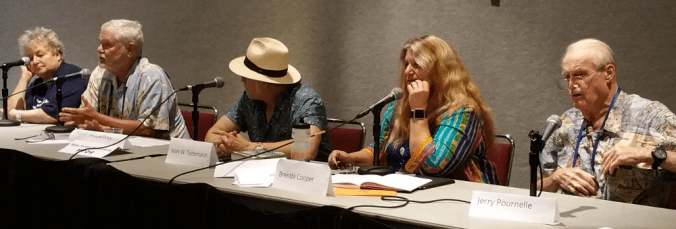
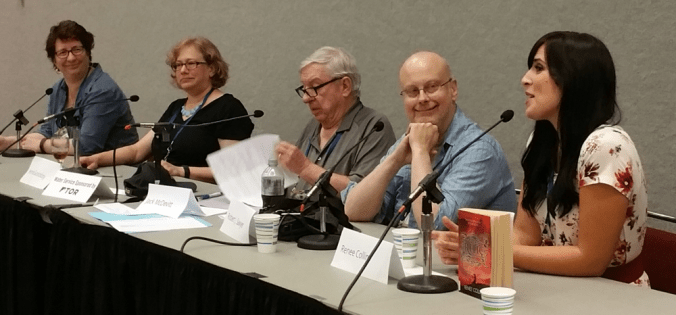
Panellists: Dana Cameron, Jennie Goloboy, Jack McDevitt, Robert J. Sawyer, Renee Collins (moderator)

Joined in progress …

RJS: Alternate history does what science fiction does, but takes a step back in time rather than looking to the future. Jean Auel’s novels and Philip K. Dick’s Man in the High Castle are examples.

RC: What are we mining history for?

JG: History is a great way to see how things could have been, “if only.” What if Shakespeare lived in Native North America?

DC: There’s a hashtag: #whatshouldhavehappened  It gives us a great opportunity to look at our tropes and culture through the lens of the other.

RJS: History teaches us the rate at which events happen. You can see the cause and effect in retrospect.

JG: The thing about historians is that they’re always looking at what’s different between then and now. There’s something inspirational about the possibilities of change.

DC: The rate of change is faster now, though.

RC: The contrast and comparison is fascinating.

JM: Another approach is that we are the past. What do people in the far future think of us?

RJS: Science fiction is the literature of human contingency—Robert Charles Wilson. We engage in thought experiments. How could things have gone differently?

RC: What are the advantages of using history as the basis for science fiction?

JG: Usually science fiction and fantasy writers get the details right.

RJS: In my Neanderthal Parallax series, I researched heavily in paleoanthropology texts and journals. I looked for the more interesting theories. One of them was that Neanderthals didn’t have religion. My Neanderthals did.

DC: Coming from my background, I had a difficult time writing alternate history.

JG: It’s worldbuilding, not a mistake.

JM: Science fiction writers have an advantage. We can manipulate time. We value history.

And that was time.

Next week, I’ll be transcribing my notes on generation starships.

Be well and stay strong until then!

Thoughty Thursday: Things that made me go hmmmm on the interwebz, Jan 29-Feb 4, 2017

Just a little bit of thoughty this week.

Frank T. McAndrew, PhD explains why our grief over a dog is so intense. Psychology Today

Heather Plett: what it really means to hold space for someone. Uplift

Pallab Ghosh reports on the discovery of our oldest human ancestor (and, boy, is it a beauty). BBC

John Walsh examines how doctors measure pain (and whether it’s of any help to patients). The Guardian

John Broich revisits how journalists covered the rises of Mussolini and Hitler. The Smithsonian Magazine

An open letter from the Canadian tech community: diversity is our strength. BetaKit

Rachel Browne covers Prime Minister Trudeau’s fight against fake news. Vice

Toronto’s Sick Kids hospital will provide surgeries for patients affected by the U.S. travel ban. Maclean’s

Jenny Zhang shares an amateur’s guide to activism for frustrated Canadians. Medium

Johnny Silvercloud: why isn’t anyone talking about the radicalization of whites? AfroSapiophile

Rae Paoletta reports on NASA’s twin experiment. Gizmodo

John Newsom: science illiteracy in the U.S. is a serious threat according to Neil deGrasse Tyson. Greensboro

ASAP Thought: a brief history of the fear of immigrants.


Detroit’s muddy bottom conceals cars, cannons, and guns. Robert Allen for the Detroit Free Press.

Hope it was enough to get your mental corn popping, ‘cause you know I want to inspire you to create great things 🙂

See you on the weekend.

Be well until then.

thoughtythursday2016

Tipsday: Writerly Goodness found on the interwebz, Jan 29-Feb 4, 2017

It was another fantabulous week of writerly goodness 🙂

K.M. Weiland helps you find the exact right story hook. Helping Writers Become Authors

Nina Munteanu helps you make your opening count.

Over on Writers Helping Writers, Angela Ackerman writes about describing your character: making every detail count.

Jessica Stawser is acting out of character. Writers in the Storm

Cathy Yardley: writer, know thyself. Writer Unboxed

Donald Maass bid us add a touch of romance to our stories. Writer Unboxed

Susan Spann explains how to evaluate a publishing contest. Writer Unboxed

Porter Anderson: “… when authors hunker together to kvetch about “writing is so hard,” they’re romancing the career in a profoundly counter-productive way.” Writer Unboxed

Jo Eberhardt: be the encouragement you want to see in the world. Writer Unboxed

Janice Hardy: how to write a teen voice. Fiction University

Fae Rowan invites us to use the energies of 2017 to jumpstart our writing careers. Writers in the Storm

Naomi Hughes returns to Jami Gold’s blog with her top three scene issues.

Becca Puglisi delves into overcoming mental illness for the character motivation thesaurus. Writers Helping Writers

Gabriela Pereira interviews Shanthi Sekaran about capturing diverse experiences on the page. DIYMFA

Bess Cozby: three questions you should ask before committing to a revise and resubmit. DIYMFA

Michelle Chalkey lists five benefits of the writer-editor relationship. DIYMFA

Brandon Taylor helps you escape the slush pile. Electric Lit

Blake Atwood launches his new column, editorially speaking, with this post: how to find a book editor you can trust. The Write Life

David Robson introduces us to the untranslatable emotions we never knew we had. BBC

Chris Saylor reminds us how to use apostrophes properly. Marcy Kennedy’s blog

Meet the 2017 Canada Reads contenders. CBC

Ursula K. Le Guin writes a letter to the editor, responding to a comparison between “alternative facts” and fiction. Oregon Live

Andrew Postman’s father, Neil, in his book Amusing Ourselves to Death, posited Brave New World as our probable dystopic future as opposed to Nineteen Eighty-Four. It turns out, he was right. The Guardian

David Tennant, the eleventh Doctor himself, tells us everything will be all right.


Alisdair Stuart believes it’s time for Doctor Who to change television history for the better. Tor.com

And that was your informal writerly learnings for the week!

Stay strong until Thursday!

tipsday2016

The next chapter: January 2017 update

Hey all you lovely people 🙂 *waves*

This is probably going to be a shortish post.

January was a quiet month. So, I worked and I wrote.

I exceeded my drafting goal for Wavedancer and for blogging, but didn’t meet my revision goal for short fiction. I find it difficult to pull my head out of one form and stick it into another. Also, the publication I’d intended to submit it to has closed to submissions. Though there is an anthology call looming, I don’t know that I’ll be able to write a new piece of short fiction to the theme. Again, it’s not where my creative head is at right now.

But I got a start on a new version of a story and a few ideas for revising others. Yay me 😉

januaryprogress

I wrote 17,943 words of my 15,500 word goal for Wavedancer, or 116%. I’m well on my way to a finished first draft by the end of February.

I only revised 500 words of my 2,500 word revision goal for short fiction.

And I wrote 6,388 words of my 5,800 word goal for this blog.

That’s 24,331 words written and 500 revised.

The way I figure it, my overages more than compensate for the lack of revision 😀

For my off-book goals, I drafted and revised a guest post and submitted some material to my editor/mentor for review.

I booked my hotel for the Story Masters workshop in May, submitted my eligible short fiction for consideration in a year’s best anthology and to the Auroras. It never hurts to try 😉

I’ve also updated some of the information on my website and I’ll be reviewing the information on various social media profiles for consistency shortly.

That’s really all she wrote this month (pun intended).

We’ve received most of the furniture for the living room/dining room, but it’s been too cold for Phil to continue work on the bookshelves. The garage is not heated.

Once the last of the furniture has arrived, I’ll share the pictures.

As I said at the outset, January was a quiet month. February promises the same. The older I get, the more I feel like hibernating in the winter.

It’s good for the writing, but not much else.

Be well until next I blog!

The Next Chapter

Thoughty Thursday: Things that made me go hmmmm on the interwebz, Jan 22-28, 2017

Lookie, lookie, there’s a lot here to get your mental corn popping.

Chris Lonsdale reports on how Silicon Valley is teaching language to machines. Venture Beat

Jackson Landers: Harry Houdini was an ingenious inventor but didn’t want anyone to know about it. The Smithsonian Magazine

Alice Park discovers that a sedentary lifestyle can age you as many as eight years. Time

Chris Buckley and Adam Wu report on the disappearing Datang fishers. The New York Times

Medievalists.net reports on Rheged, the early medieval kingdom recently discovered in Galloway.

Hedges are the life-giving arteries of the land. Fionnuala Fallon for The Irish Times.

Liz Langley reports on how hummingbirds survive the winter. National Geographic

Carolanne Wright reports on the Harvard psychologist who says ADHD is largely a fraud. Wake Up World

Chitra Ramaswamy shares the secrets of people who never get sick. The Guardian

Alexandra Shimo learns first-hand about the high cost of food on First Nations Reserves. TVO

Gloria Galloway: a private donor funds Wapekeka’s suicide-prevention program. The Globe and Mail

Waking Times points out that 20 million Muslims marched in protest against ISIS, and mainstream media ignored it.

Matt Novak shares Carl Sagan’s eerie prediction. Paleofuture

You need to watch Aziz Ansari’s wonderful SNL monologue. Mother Jones

And here’s Ashley Judd’s epic rap:


For a little balance, Kid President explains how to disagree with someone 🙂


ASAP Thought: why you should never stop protesting.


More social consciousness raising. Prince EA: I am not black.


Now for some kawaii. Zoos get into epic #cuteanimaltweetoff. Bored Panda

Be well, be kind, and keep protesting!

thoughtythursday2016

Tipsday: Writerly Goodness found on the interwebz, Jan 22-28, 2017

A fair number of vids this week, just to appeal to the visual learner 😉

K.M. Weiland: six pieces of common writing advice you’re misusing. Helping Writers Become Authors

Kathryn Craft wonders whether your novel’s good enough. Writers in the Storm

Lisa Cron, the Story Genius, answers questions about backstory on Writers in the Storm.

Jami Gold: “Why?” is the most important question in storytelling.

Brunonia Barry helps you create your book talk. Writer Unboxed

Elizabeth Huergo, new contributor to Writer Unboxed, gets metaphorical: writing as tango.

Barbara O’Neal helps you recognize the signposts to your writer’s voice. Writer Unboxed

Heather Webb offers her thoughts on speaking your truth through fiction. Writer Unboxed

Becca Puglisi explores some lesser-known character archetypes. Writers Helping Writers

Sara Letourneau examines man and the natural world for DIYMFA. Later in the week, Sara is back with five things you should ask beta readers when they critique your manuscript.

Gabriela Pereira recaps her experience at this year’s Digital Book World (DBW) for DIYMFA radio.

Kimberly Brock: when the stories have all stopped. Writers in the Storm

Janice Hardy wonders, is a lack of action really the problem? Fiction University

Then, Bonnie Randall guest posts on Fiction University: juxtaposition in your story.

Chris Saylor shows up on Marcy Kennedy’s blog to advise how to format dialogue within dialogue.

Oren Ashkenazi shares some tips on how to realistically depict evil. Mythcreants

Naomi Hughes guest posts on Jami Gold’s blog: three common storytelling issues.

This is just fun! Jenna Moreci: writers do weird sh*t.


James McWilliams believes the physical book will endure, but will it endure for the right reason? The Millions

John Cleese on creativity. Brilliant man.


James Lizowski lists his top space colonization novels. OMNI

Cheryl Eddy interviews J.Y. Yang on her silkpunk series. i09

It’s the 40th anniversary of the Doctor Who episode, The Face of Evil (one of my favourites, by the way—Tom Baker was my Doctor). Watch this clip. Relevant, much? Beth Elderkin for i09.

Josephine Livingstone explains why Nineteen Eighty-Four is not the novel we need in the Trump era. New Republic

The Black Eyed Peas re-release Where’s the Love. THIS is why we must keep creating in dark times.


Sarah Slean: real love demo. Another sad but hopeful song that speaks to me.


Hope you’ve had your fill of informal writerly learnings this week.

If not, come back next week, they’ll be more 🙂

Be well until next I blog.

tipsday2016

WorldCon 2016: Nifty narrative tricks

Disclaimer: I am not perfect and neither are my notes. If you notice anything that requires clarification or correction, please email me at melanie (dot) marttila (at) gmail (dot) com and I will fix things post-hasty.

Panellists: Jo Walton, Mary Robinette Kowal, Steven Gould, James Patrick Kelly, Elizabeth Bear (moderator)

nifty

Joined in progress …

EB: It’s not all about creating an engaging character.

MRK: People want the familiar and the strange. So, a familiar emotion with a strange activity, for example.

JPK: Before you write, walk into your character’s room, their car, their locker. In describing these places, you find stuff you can use later in the plot.

JW: Characters are something I could write well before I could do anything else (dialogue, description, etc.) I decide that this is the story I am telling and this is how I’m telling it.

EB: You have to figure out what makes the character someone readers want to spend time with. Give them a goal. Give them agency. Give them something, or someone, to love.

SG: If you want to show how a technology works, show it when it breaks down. Added benefit: it frustrates your character, it’s a setback.

MRK: They need to have a sense of their own competence, or lack thereof.

EB: Add conflict.

MRK: Action is reaction. That’s something from theatre. Map out the easiest path to the character’s goal and then deny it. Conflict is not necessarily a fight scene.

JW: A character desperately needs a bathroom. Everything they say and do will be coloured by this desire. If a character is making dinner, discover everything in the course of that day-to-day action. Including backstory this way becomes seamless. There has to be a sense of jeopardy, but it doesn’t have to be a battle for life and death at every turn.

JPK: You want to have conflict everywhere, but it all has to relate to the plot. Keep an eye on your main conflict. It’s a through line. From the beginning to the middle, it’s a one way door. The same goes for the middle to the climax. There’s no going back.

MRK: The stakes must be personal and specific to the character.

JW: Unless you can make the reader care about the character in jeopardy, it won’t work.

MRK: Focus indicates thought. Everything has its own breath and rhythm. Pacing can be controlled by how long the character’s attention lingers. [Mel’s note: Mary then removed her boots and demonstrated what she was talking about in a tour de force of shoe puppetry. I wanted to take a picture, but couldn’t tear myself away from the spectacle—it was that AWESOME!]

JW: Pacing is one of the strongest indicators of genre.

JPK: When I was at Clarion, they didn’t have the money to make a copy of every story for every participant, so one copy of each was posted in the hall. If you look at a piece of writing and you see solid blocks of text, you probably need to break it up. A story needs to breathe and so does the reader.

JG: I think of it in terms of pixilation, granularity. If you increase the resolution, you increase the pacing.

EB: One common misconception is that starting in medias res means starting with a blood bath. The reader has to care about what happens to you characters.

JPK: Another common failing is not having a denouement.

JG: Being too coy with the reader, or telegraphing everything.

MRK: If you include too much backstory, try getting deeper into the point of view character.

JW: A lack of description results in too much fuzziness. Either the character, or the world, is not in focus.

And that was time.

Next week, I will be writing my first next chapter update of 2017 (yay—crazy Kermit arms) and then I’ll return to WorldCon reportage. And, of course, in the meantime, you can expect more great curation on Tipsday and thoughty Thursday.

Happy Chinese New Year!

And be well until I see you next 🙂

Thoughty Thursday: Things that made me go hmmmm on the interwebz, Jan 15-21, 2017

Another small curation this week. With all those #alternatetruths out there, I guess the world isn’t feeling too thoughty 😦 Or maybe that’s just me.

Timothy B. Lee gets a bird’s eye view of Women’s Marches all over the US. Vox

Sarah Kaplan reports on the astonishing science behind fairy rings in the desert. The Washington Post

Rae Paoletta interviews Dr. Chandra Prescod-Weinstein about the importance of Hidden Figures. Gizmodo

Nunavut’s 96 year old seamstress models her clothes and advocates for traditional design. Priscilla Hwang for the CBC.

Emma Young: Iceland knows how to stop teen substance abuse, but the rest of the world isn’t listening. Mosaic

Phil Plait offered this lovely astronomical metaphor to those saddened by inauguration day: if you need strength, be like Daphnis. Slate

Katy Koontz considers fireflies: a surreal synchronized wave of light. BBC

Emily Laurence: what to do when meditation doesn’t work for you. I must admit, I’m not a good meditater. Well and Good

Samoyed sings while squeezing toy. #sammytude


All the best.

See you on the weekend for more WorldCon reportage!

thoughtythursday2016

Tipsday: Writerly Goodness found on the interwebz, Jan 15-21, 2017

And here it is, your informal writerly learnings for the week!

K.M. Weiland offers her insight into how to outline a series of bestselling books. Helping Writers Become Authors

Janice Hardy starts a two part series about finding your voice. First up: how to find your character’s voice. Fiction University

Are you revising? Then check out April Bradley’s tips on pacing and momentum. Writers Helping Writers

Dianna Gunn shares her experience with resistance: letting your story end at the end. DIYMFA

Sloan Tamar: five things psychology can teach writers. Writers Helping Writers

Dave King revisits the power of words. Writer Unboxed

Annie Neugebauer muses on the challenge of finding the balance between dreaming and working. Writer Unboxed

Writer Unboxed obtained permission to reprint this fabulous post by Christie Aschwanden: stop trying to be creative.

Jamie Raintree gives us a productive two-for this week: a different kind of writing productivity and the importance of knowing your priorities and sticking to them.

Jami Gold: what if I can’t find beta readers?

Kristen Lamb says, never tell me the odds—how to get your head right for success.

Jenny Hansen shares Maya Angelou’s writerly wisdom on Writers in the Storm.

A moment of tangency. The Dictionary of Obscure Sorrows (apparently soon to be out in book form!). This guy’s a poet.


Charles Chu looks back at Frank Herbert and his definition of success. You don’t write for fame and fortune. You write so you can have more time to write. Medium

Fiona Macdonald peeks at the racy side of Jane Austin. BBC

Punny. The quick brown fox jumps over the lazy dog … after a few tries 😉


Alexandra Alter reports on an unfinished Mark Twain fairytale that will soon see the light of day. The New York Times

Swapna Krishna looks at the time travel in Timeless. Is it possible? Tor.com

Spencer Kornhaber interviews Brit Marling about The OA and the dark side of science. As I said when I posted this to FB, I enjoyed the series … until the last episode. Though I called it, that couldn’t compensate for the deep dissatisfaction I felt in the wake of the final episode. Still, it’s nice to find out more about what inspired the series. The Atlantic

Looking forward to this, because Emma. The full set of Beauty and the Beast trailers.


Hope this curation gives you what you need to keep creating. The world needs your stories!

tipsday2016

WorldCon 2016: The steampunk explosion

Disclaimer: I am not perfect and neither are my notes. If you notice anything that requires clarification or correction, please email me at melanie (dot) marttila (at) gmail (dot) com and I will fix things post-hasty.

Panellists: Carrie Vaughn, Jeffrey Cook, Laurel Anne Hill (moderator), Gail Carriger, Nina Niskanen

steampunk

Joined in progress …

GC: The term steampunk emerged in the 70’s as an evolution of cyberpunk. The first iteration was dark. Then, steampunk became an aesthetic and finally, humour worked its way in. Whimsy was a reaction to darker iterations. It romanticizes the Victorian era and deals with the class system and double standards of the era. The historical time period was actually very chaotic.

NN: The interaction with class is attractive to both writers and readers. Science fiction doesn’t typically feature a lower class.

CV: The current wave of steampunk is deconstructive.

GC: It’s subversive, commenting on colonialism and class.

LAH: It’s a reinvention of the Victorian age. There was a great excitement then with the industrial revolution and technological advances. People want to recapture the excitement and inspiration of that time.

NN: In Vernor Vinge’s Rainbow’s End [about a man recovering from Alzheimer’s disease who has to renegotiate a world that’s advanced technologically while he was ill], computers have no serviceable parts.

CV: There was an anxiety about science. Frankenstein expresses that fear that we will not be able to control what we unleash.

GC: That was the dichotomy—can technology solve all our problems, or will it cause them?

JC: Rockets were being developed at the time, but the inventor also supported women in STEM [science, technology, engineering, and math].

LAH: The anxiety about science was a reaction against putting all of humanity into a box.

CV: There was a hope and drive to fix things socially as well. Technology wasn’t the answer to everything. Now there’s an environmental aspect in steampunk and that’s a reaction against our disposable society.

NN: Steampunk has avoided painting Victorian London in a “dirty” light. Historical accounts relate that at times there were seas of horse shit in the streets.

CV: Steampunk outside of Victorian Europe are appearing as a reaction against colonialism.

JC: You can have clockwork in 5th century Japan. You can do a lot within the genre. It’s not just the comedy of manners and history heavy stories. There’s more of a spectrum to be explored.

And that was time.

Next week, we’ll delve into some nifty narrative tricks (with shoe puppetry!).

Sending out a huge hug to all my American friends. Stay strong, speak out, and always, keep telling your stories. Sweet Jesus, we need them.