The first draft

Last time on Work in progress: I finally found a way to wedge my butt in the chair!

I wrote through, just like Nino said.

In the years previous, I’d tried a number of different tactics: outlining, character sketches, plotlines for the major characters, world building, timeline, research.  None of it got me writing … like writing.

I’d always heard that if you want to write, then write.  I’d even said it to students.  It’s true, but you have to be ready to see the truth, to accept it fully, and live it.  After years of struggling with my inner critic, informed as it was with all of my weaknesses and doubts, all my past experiences … I finally got it.  I finally wrote.

I’d never gotten past the first hundred pages before.  They were written and rewritten many times, but I’d never gotten past them.  This time, I tried a new strategy: ctrl-g 🙂  I’d note the page I stopped on, and went right to it the next day.  Starting from the beginning every day merely trapped me in an endless loop of editing.  Another authorial truism: the work is never finished, only abandoned.  The first draft isn’t the time to tweak and fine-tune, it’s the time to get the words out.
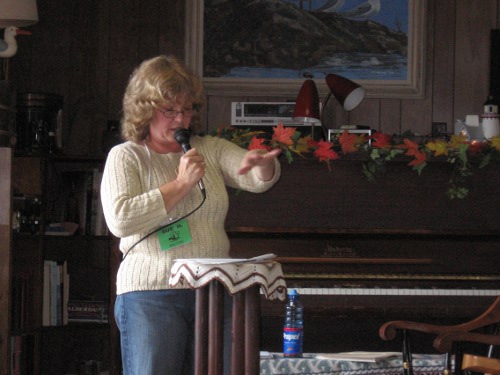
By September of 2008, I’d written my way to 1000 pages.  It was scary, and exhilarating.  Then it was called Initiate of Wind.  As a reward, I treated myself to a writing workshop with Sue Harrison at the W.O.W Retreat in Bruce Mines.  Loved it, loved it, loved it!  Watch Authorial name dropping for my post on the lovely Sue 🙂

I’d started out writing the novel as I’d intended, changing point of view in sections, cycling between the major characters.  Then, some of the plot points started to change as I wrote.  New sections wanted to be included.  New characters.  Toward the end, I was working on fumes and dropped all the fancy stuff.  The last three chapters were written in the same p.o.v.  I just got the words out.  All of them, good or bad, were out.

That year, I went as "The Sander" for Hallowe'en

My refractory period was the renovation of my office.  Five weeks of nothing but physical work: demolition, insulation, vapor barrier, mudding, sanding, painting, floor refinishing, and furnishing.

At the end of it, I had a room of my own.  An office.  A place to write.  I think that helped me to keep at the writing too, but by then, I’d been writing every day for two years, so I guess the office was a kind of reward too.

A room with a view, no less

Then it was back to real life, back to work, and back to writing.

What I learned: Write.  The first draft is no place for revision.  Write.  Commit to your relationship with your creativity, and you will go back to it, every day.  Write.  Just write.

Have you completed the first draft of a novel?  What did it teach you and how did you feel?  What did you do to reward yourself/celebrate?

What got me going again

Last time on work-in-progress:

In an environment rich in creativity and ideas, I started to write my first novel.  When I left that environment, I abandoned the project … sort of.

The thing is that those two spiral-bound notebooks full of my scribbling, typewritten pages full of corrector tape, and the few scattered dot matrix print-outs, never really left me. The novel was called Rain then, after the main character.  As the title might tell you, my idea started with my protagonist.  The story was hers, and all about her journey.  All the other characters grew out of her story.

Over the next years, I tried refining my opening paragraphs.  I worked on a prologue, and a couple of pivotal scenes.  I wanted scope, breadth, space.  I felt I had to develop my world and my characters kind of got lost in the shuffle.

I enrolled in a creative writing course by correspondence and received my first computer as a part of that deal.  In between writing assignments, I worked at my novel again.  It was in fits and starts though, no dedicated time.  I wasn’t really sure what I wanted to do with the story and where I wanted it to go.  The name changed to Rayne.  Could that count as progress?

After some soul searching about what I wanted to do with my life, I decided to complete the bachelor’s degree I started at the University of Guelph.  I chose Laurentian University in Sudbury, and felt that focusing on an English degree would be my best bet.  My ambition was to become the best writer I could be.  I’d turn the academic world to my purpose.

My writing improved substantially during my years at LU and workshops like Susanna Kearsley‘s gave me a boost.  So too, did my slew of writing successes: a contest win; a short story written for the premiere issue of Parsec Magazine; a regular column in Llambda (LU’s student newspaper); an article in Slin Roller Magazine.  It never translated into my opus though.

I made another fateful (and ultimately foolish) decision to pursue my education by completing a master’s degree in English literature and creative writing at the University of Windsor.  Though I trotted out my novel (and other novel ideas) there, because my chosen genre was fantasy, my work was disparaged.  After leaving discouraged, and returning to complete my degree with a thesis composed of vaguely literary short stories framed by the shamanic journey, I felt defeated rather than victorious, and couldn’t look at my novel for a long time.

After Windsor, I had some modest success in other creative endeavors: poetry and short stories.  Every once in a while, though, I’d have to pull out the old notes.  Once I got my lap top computer, things took off a little more.

By the time I’d joined the Sudbury Writers’ Guild in 2004, and attended Rosemary Aubert‘s workshop in 2005, I’d closed in on the fifty-page mark (oft-revised and agonized over).  I still wasn’t writing every day though.  I just couldn’t get my butt wedged firmly enough in the chair.  There was always something else that needed to be done first.

Then came Nino Ricci.  One of the SWG had met him and managed to arrange for him to come to Sudbury.  It was to be a weekend of workshopping our stories/novels/poetry.  In the course of the workshop, Nino talked about his own development as a writer, his years at York University, and his own challenges with his thesis advisor.  From that weekend, I learned that perseverance and passion win out.  I also knew that I had a long way to go on my novel, but the only way I could get there would be to write it.

Writing

Writing (Photo credit: J. Paxon Reyes)

Another thing Nino said that settled in was that his first drafts, at least at that time, were written to get his ideas out.  Sometimes the next draft was completely different.  Sometimes, he didn’t even refer to the first.  I’d heard the message many times over the years that first drafts didn’t have to be perfect, or even particularly well-written.  First drafts have to be written, though.  I finally understood.

I started writing every day and was amazed at how easy it was.  I made a commitment, a decision.  I was finally taking control of my creative life.  The initial goal was simply to write.  Once my practice was consistent and the habit ingrained, I aimed for a page a day, then two.

I emailed Nino after the workshop to thank him for the opportunity and to let him know the influence he’d had on my creative life.  Always gracious, Nino wrote back with some kind words of his own.

Even though I had a full time job by this time, I kept at it, and two years later, I’d finished my first draft.

How did you start writing your novel?  Was it a focused effort, or did you struggle?  Did mentors appear to guide you, or were you confronted by guardians at the gates?

How it all started

Maid’s Hall: University of Guelph

So there I was, away at university for the second year, and still no idea what I wanted to do.

I’d started September of 1987 as a fine arts major, but after being dismissed as “an illustrator,” I flirted briefly with psychology before changing to music in January 1988.  In the fall of 1988, I had a rather disastrous classical guitar audition for the practical music program involving performance anxiety and was seriously considering English as my major.

I wrote music and book reviews for The Ontarian, the University of Guelph student newspaper, and helped them with layout.  This was the old fashioned layout with waxed prints of the columns that had to be precisely trimmed and placed on the board.  It was work that suited my wall-flower personality.

My roommate, Sandra Reynolds, though floundering similarly, always had more direction than I did and was a steadying influence on me.  Her sister is Susan Lynn Reynolds, who published Strandia in 1992.  She had drawn maps for Guy Gavriel Kay’s first novels.  He continues to be one of my favourite authors.  Sue’s ex, Michael Hale, had just published The Other Child.  Sandy was working on her own story ideas and with all of this creativity bouncing off the walls of our little dorm room I caught the bug to do more than record my dreams.

I’d started keeping a journal the year before, not only to capture my dreams, but also to capture insights I had in my classes.  It was a wonderful time for me intellectually.  Everything seemed to interrelate in the most interesting ways: my English literature survey course, Introduction to Psychology, Anthropology, Biology, the History of the Language and Old English courses.  Chinese Philosophy kind of blew my mind.  Sadly, little of it translated to academic success.  I was rather mediocre.

With all of these thoughts ping-ponging off one another in my head though, ideas started to occur to me, including the idea that would eventually become Ascension: Initiate of Stone.  I started writing notes.

Sandy invited me out to Mike’s place.  It was winter, snowy, and I ditched the car on the way.  A tree was mere inches away from the passenger side of the car and Sandy (!)  We were able to get a tow out of the ditch and made it to Mike’s, though late.  We still managed a lovely evening of creative chat, I got a tour of Mike’s graphics studio, and we made pie.  We all decided that since the crust was the best part, we’d make a crust pie.  It was fantastic.  Through Sandy and Mike, I learned some great techniques for character development.

I’ll share one:

Early in the character development stage, while you’re still getting to know them yourself, get together with some friends/fellow writers and have them ask you random questions about your characters.  Rapid fire.  You’re not to think about the answers, just come up with them and make notes as you go.  The idea is to access the inner writer who already has a handle on your characters and let that voice answer the questions.  The questions could be anything: what colour are his eyes?  What’s her middle name?  What happened when he was three?  What was her grandmother like?  Did he ever experiment sexually?  No question is forbidden.  It’s organic and very effective.  Nothing is written in stone, either.

If, in the course of your writing, some of those answers no longer hold true, or other answers that seem more appropriate present themselves, then the character changes.  Even to be thinking of these questions and answers through the writing process is helpful for your character development and therefore for the work.

Try it.  You may be amazed.

Sandy was taking Children’s Literature with the incredible Jean Little and Jean was bringing a friend into class to talk about her work.  That friend was Welwyn Wilton Katz.  Though she waggled a finger at me for my lack of research, I did get a chance to talk to her and was inspired by the lecture.  Subsequently, I started reading her novels, and became a fan.

By this time, I had one spiral notebook full and another started.  I had an old portable typewriter that I typed my essays on and started to type bits and pieces out in between essays.  I had no confidence however, and declined to show my stories to anyone.

My lack of direction in school eventually reached a crisis point and I decided to take some time off.

How did you get started on your magnum opus?  What or who inspired you?