The Next Chapter: Progress by inches (and bounds)

It’s been a while since I’ve posted about my progress, or lack thereof, on my writing.

Initiate of Stone

I’ve been struggling to rewrite my first chapter.  I’ve now made progress, after writing, and rewriting it several times.  I really had to go back and decide what it was necessary to accomplish in my opening chapter.

A short list:

  • Introduce my protagonist – Ferathainn, or Fer, is fifteen, and her coming of age is in two moons, at the next goddess festival, Sestaya.  She wants to become an Agrothe mage, and will be the first girl to do so in a very long time, but she chafes under the tutelage of her master, Aeldred.  Fer has been studying from the moment she wakes to the moment she sleeps (except festival days) with Master Aeldred for 12 turnings of the sun through the seasons, but it’s all been mundane. He’s forbidden her from using her innate talent, to speak with the spirits, or souls, of animals, plants, elements, and perhaps even people, like he controls who the spirits speak to …  Fer desperately wants to be initiated so she can start using her talent and learning “real” magick.  She knows she’s capable of more than what Master Aeldred permits her to do.  The process is long and demanding, though, and she will have to make sacrifices.  She loves Leaf, the eleph finiris, or song master, and will marry him on Sestaya as well.  She sees her astara, or soul-lights, in his eyes, something that only the eleph are supposed to see.  She’s not so sure about children, though they seem to be the natural consequence of marriage.  She’s just been so long separated from other girls her age by her studies that she wants something that everyone else takes for granted.  Fer worries that love, marriage, and family will be the sacrifices that she will have to make to become a mage.  She’s determined to have at least love in addition to the solitary life of a mage.
  • The “normal” world – Hartsgrove, Fer’s village, is a “free town” and the eleph and people of Tellurin live side-by-side in relative peace.  It’s an agrarian village that sends tributes to the surrounding, larger, towns and cities to show fealty and secure support in times of need.  The predominant religion is worship of the Goddess Auraya, creatrix of Tellurin.  Every year the season of Vedranya brings deadly storms to besiege the land.  This has been the way of things since the Cataclysm, two centuries before, changed the face of Tellurin and reduced much of Tellurin civilization to rubble.  Fer lives in a small, but sturdy cottage, with her mother and father, Selene and Devlin, a seer and a bard respectively, and her younger half-sister, Aislinn.  She has never left Hartsgrove.
  • Hook the reader – What’s the root cause of Fer’s resentment of her master, the man who could grant her wish to become a mage?  Why does he want to keep her from using her talent?
  • Ask a question (that needs to be answered by the end of the novel) – What is the secret Master Aeldred feared so much he magickally bound Fer’s friends and family to silence?
  • Foreshadow the inciting event – An earth elemental, or nomi, tells Fer the secret is a potentially deadly one though it cannot more than hint at the nature of the secret; she must be strong to face the trials to come.

So I’m slowly working my way through the list without dumping too much backstory or world building on the reader.  Beginnings, why are you so hard?

Some links about beginnings:

On a whim, I’ve signed up for Margie Lawson’s course, A Deep Editing Guide to Making Your Openings Pop, starting May 6, 2013.  She focuses on psycho-linguistic and rhetorical techniques to improve your writing.  My undergrad was focused on rhetoric and I love psychology, linguistics, and brain science, so this looks like it’s right up my alley.  Will let you know how it goes.

I might do the crazy and send my beginning (when I’m more or less happy with it) to Ray Rhamey’s Flogging the Quill to see if it passes his test.  Stay tuned.

Short Stories and poetry

Well, so far, I’ve kept up with Kasie Whitener’s Just Write short story challenge.  I’ve written a completely new short story for each of January, February, and March.  I’m a little behind in April, and may opt for flash fiction to make up the short fall.

The short story that I revised and sent to On Spec in January has been accepted (!)  I am very (like !!!!!!!!!!!!!!!!!!!!!!!!!!!!!!!!!!!!!!!!!!!!) excited about this, even though I know that it won’t be in print until sometime next year.  I’m looking forward to working with their editorial team to whip “Downtime” into shape.

“Beneath the Foundations (original story #2),” my attempt at medieval Cthulian for Sword and Mythos was rejected.

“A Terrible Thing” was rejected by the editors of Tesseracts 17.

It’s too early to have heard back from either Writers of the Future, to whom I sent “The Gabriel,” or In Places Between, to which I submitted “Molly Finder (original short story #3).”

There wasn’t room for my poem “peregrine” on the League of Canadian Poets National Poetry Month blog, but I have subsequently submitted that poem plus two more, “contain you” and “infant crawls,” to Sulphur.

From last year’s submissions, I learned that my submission to Mark Leslie’s Spooky Sudbury will be included in the publication, and my poem, “north of thule” was included in the fabulous Sopphey Vance’s Enhance no. 11.  It’s been a good month (and a bit) for happy dancing!

I’m going to work on something flashy this week to round out April’s short story quota, and set to work on another original for May in hopes of garnering some attention in the Rannu Fund competition.May Submit-o-rama Choice
I’ve joined Khara House’s May submit-o-rama and have committed to 1 submission per week in the Choose Your Own Challenge category.  Rannu will make up only one of those, so I’ll have to get my arse moving on identifying other submission opportunities (!)

Critiquing

Actually finished the BIG critique for my online group and am working on a review of the first 100 pages of another online critique buddy.

Have only three people left to critique for the Sudbury Writers’ Guild before I’m caught up with them.  We’re trying to get our stories and poetry together for an anthology.  I put forward “A Terrible Thing” and “Old Crow,” another short story of mine that was rejected by Tyche Books last year (Masked Mosaic anthology).  It looks like “Old Crow” might be salvageable as a short story, but that “A Terrible Thing,” as editors have said—and I’ve thought—in the past, is really a novel in the making.

Conferences

A local effort, Wordstock, will be happening June 7 and 8 at the Sudbury Theatre Centre.  This is the first year for the event, and the organizers are hoping to build on what they hope to be this year’s success.  The SWG has a block of time for readings.

I’ve registered for the Canadian Authors Association CanWrite! conference in Orillia, June 12-16, and booked my room in the Orillia campus of Lakehead University.

I’m still waffling about When Worlds Collide August 9-11.  The registration fee is reasonable in the extreme, but I still have to bear the cost of the flight and accommodation.

One reason I’m waffling is because I want to go to the Surrey International Writers’ Conference this year (Oct 25-27).  Domestic flights are sooooo expensive.  Right now, a return to either Calgary or Vancouver for the conference dates is showing as over $1000.  It may be an either/or kind of thing for me.  Or I might just cash in my Avion or Aeroplan points for one or the other flight.  That’s an idea!  Thanks for letting me suss that one out online 😛

I think that’s all the conferencing I can take for this year.  Next year, I hope to add some fancons like Ad Astra.  We’ll see how the financial situation sits.  And my various air rewards plan balances 🙂

Other stuff

Taxes done and refund received 🙂

Am still putting off the decision to move to WordPress.org.  I think I just need some dedicated time to devote to research and reflection.

Hope all is well with you and your writing lives.

I’d love to hear from you about your latest literary adventures!

Tonight’s viewing line-up: Doctor Who and Orphan Black!

Tomorrow, I’ll share my thoughts on happiness and how my experiences have influenced my writing in the final instalment of a life sentence with mortal punctuation.

The next chapter: Diving back in

The last of my caturday quickies is a bit of an update on the work in progress (WIP) and other writing projects I’m tackling these days.

I revised my short story “A Terrible Thing” for Tesseracts 17 and submitted that on February 27, just one day before the deadline (!)  I submitted a short story back in October for the competition, but was not successful at that time, though the rejection letter was of the very encouraging variety (please send us something else).  I followed the editors’ advice, and ATT is sufficiently different from the story I submitted last fall that I hope it will tickle some fancies 🙂

I also submitted a poem for the League of Canadian Poets’ National Poetry Month blog: “peregrine.”  I’ll link through when it’s posted.

In related news, I forwarded an opportunity to my friend, Kim Fahner, a couple of months ago, and she, in turn, asked her publisher to submit her poetry collection, The Narcoleptic Madonna, to the powers that be.  The result?  Kim will be participating in the Battle of the Bards at Harbourfront Centre April 3rd!

It’s inspired me to think more seriously about submitting some of my poetry to various publications.  We’ll see where that leads.

As of today, I’ll be diving back in to Initiate of Stone and the next set of revisions.  I’ll also be revising “The Michael” for the Writers of the Future competition and working on a new story, “Way Station,”  (which the Retro Suites inspired) for In places between.

Finally, after my bout of training fury and certification regret, I’ll be catching up with my critiquing crew.

I never did work further on Gerod and the Lions.  I am hoping that I got far enough into it that I’ll be able to pick up the threads when the time comes.

A not so pleasant writing-related task that I’ll be picking up shortly, is collecting all my various financial bits and pieces and submitting my taxes.  I claim writing as self-employment on my income tax.  My lack of recent publishing success is a bit of a concern, but it’s certainly not for lack of effort 🙂  Do you think auditors would accept this blog as evidence of my industry? 😉

Writerly Goodness

Writerly Goodness

What’s been happening in your writerly lives lately, my friends?  Are you writing “hard”?

What’s coming: I’ll continue my series, A life sentence with mortal punctuation, tomorrow, and in the future, I hope to have an interview with Amazon Breakthrough Novelist Award 2012 quarter-finalist Alon Shalev regarding his writing life and the second book in the Wycaan Master Series, The First Decree.

The next chapter

Have desk, will write

Have desk, will write (Photo credit: Bright Meadow)

Today, I’m going to share some of what’s happening next with my work in progress (WIP).

Early in the life of Writerly Goodness, I blogged regularly about my WIP, from its origins, through various drafts, to the lessons the whole process taught me.  I also blogged my character sketches and world-building fairly extensively.  I’ve been a little quiet on the subject in recent months however.

The reason for this is that I have been focusing on the revision of my latest draft, and in keeping with my reasonable and malleable goals for the new year, I have now finished that work (to the degree I am currently able) and have sent my manuscript for a content edit.

This is scary.

Why?  Because it means that I’m taking this whole process seriously.  I’m getting closer to perfecting Initiate of Stone for submission and/or publication.

Given the responses I’ve gotten from various writerly authority figures in my early life, my internal editor is very well-versed in the whole “what the hell do you think you’re doing/you can’t write/your ideas are crap/your writing is puerile/you’ll never make it” brand of advice.  I’ve had to tame that beast and try to get over it.

But … there’s still this voice in my head that says: “but what if this investment (the content edit) backfires?”  What if the result is the confirmation of all my worst fears and neuroses?

I can’t think about that.  So, while I wait to hear back from the editor, I’m moving on.

What’s up, buttercup?

First, I’m going to make a few submissions of short stories.

I’m revising one for submission to an SF magazine, which I will have to do this weekend.

I’m going to participate in a few flash fiction challenges.

I’m also going to aim for a couple of anthology submissions:

  • Sword and Mythos – January 15-February 15, 2013
  • Tesseracts 17 – February 28, 2013
  • Plus, I’m going to keep my eye out for the open reading period for Fearful Symmetries.  I don’t know if I’ll have anything appropriate for the publication, but I’ll certainly give it a try.

Second, I’m going to move on to a new novel.  As of my last writing on the subject, I hadn’t decided what.  The logical next step would be the second novel in the Ascension series, Apprentice of Wind.  I’m thinking that something completely different might be in order though.

So just to give me a complete break from Ferathainn for a while, I’m going to tackle Gerod and the Lions.  I’m just going to leave you with the title for now and I’ll let you know how it goes 🙂

Finally, I’m getting back to work on my critiquing.  I’ve been inactive on this front for a while, again because I’ve been focusing on my novel, but I’m waaaaaay overdue in this department and I have to get back into it.

This will have to wait one more week, in the event, because I’m traveling for the day-job again.  My apologies to my peers.  Zombie Mel will return from the land of the critiquing dead, just not quite yet.

Set yourself up for success

The deal here is that if you are progressing on one project, but not actively working on it,

St. Augustine writing, revising, and re-writin...

St. Augustine writing, revising, and re-writing: Sandro Botticelli’s St. Augustine in His Cell (Photo credit: Wikipedia)

you may need to pick something else up.  Take on a new challenge.  Keep honing your craft.  Get over your bad self.

Now this is not something you might just choose to do while waiting to hear back from your beta-readers or an editor.  You could be querying, or trying to get your self-publishing ducks in a row.  Keep in touch with your creativity.  A writer writes above all else.

Some people may think that juggling projects is a bad idea.  They want to see one project through from beginning to end and believe that they can’t divide their attention with another novel.

There are going to be those fallow times though, and I’m not just talking about those times when you have to “get distance” from your novel between drafts, when you might want to do something non-writing related (I’ve done home reno projects, or some other form of artistic expression for this, drawing, pottery, or taking part in a play).

I’m not talking about keeping your creative reserves replenished with reading and movies and creative dates either.

I’m talking about those times when you’re waiting.  Fill up those fallow times with new creative projects so you don’t stall out entirely.  Don’t let your muse get lazy.  Keep him, her, or it, active and healthy.

This is just my opinion.  In no way am I suggesting that this approach is the only one.  It’s just the strategy that I’m using, and that I’ve seen other successful authors use.

How do you fill up your fallow times?  How do you manage your writing projects?  Do you work multiple ones at the same time, or focus on a single project until it’s completed?  Do share 🙂

Resolve not to resolve

(A.K.A. Just make reasonable goals and reach them!)

New Years Resolutions (1/52)

New Years Resolutions (1/52) (Photo credit: lucidtech)

This is the time of year when everyone starts off fresh and hopeful and makes a bunch of promises to themselves without first considering whether they really want to keep them or not.

My advice is to take a step back and give this whole resolution thing some careful consideration.

First, try not to get caught up in the whole resolution furor and just make SMART (more on this in a bit) goals that you can actually achieve.

Review these goals periodically and change them if you need to.

That’s what irks me about resolutions.  For many, they hold the impression of being set in stone.  As human beings, we change, so will our goals.  Be flexible and make adjustments where necessary.  Shit happens.  Put another way, life is what happens to you while you’re busy making other plans.

If you abandon your expensive gym membership after three months and fail to lose twenty pounds by June, then, like as not, either the goal you set for yourself was unrealistic, or something happened to make the goal unrealistic to pursue in the way you first imagined.

I set goals all the time, sometimes they change and sometimes they don’t work out the way I planned.  So I change course, adjust my expectations, and set more goals.  Goals are healthy and shouldn’t just be reserved for January 1.

This year, resolve not to resolve 🙂

Step one: think about it

The first step, as always, is to give your goals some consideration.  Do you really want to achieve them?  Are you setting a goal because of external factors?

Take the “lose twenty pounds by June 1st” goal, something a lot of people list in their resolutions, sometimes every year.  Are you truly invested in making this happen?  Are you only doing it because your stepsister called you fat at Christmas dinner?  Are you happy at what others might consider twenty pounds overweight?  Do you feel healthy?  Do you otherwise conduct yourself in a healthy manner?

Once you’ve determined whether you really want to do this, think about ways that you might be able to make this happen, and how you can make the goal easier to achieve.

An expensive gym membership may not be the best choice given your circumstances.

It might be better to enlist your friends and family in the project, get a support system gathered around you.  Often, when you put your goals “out there” in concrete form, that is, you tell people what you want to do and why, it’s less acceptable to renege on the deal.

In this case, you can tell your family that you want to begin to eat healthier and get their support (yes, Mom, we’ll eat fish three times a week with you and we’ll try soy if we can have a day off on the weekend to indulge our collective red meat/fat/sweet cravings).  Tell your friends to help you make wise choices at the restaurant without making you feel bad in the process.  Tell your mom that while you think her roast of beef with Yorkshire pudding is drool-worthy, that this year you might want to try some Cornish hens and green veggies for your birthday dinner instead.  It’s the little things that add up to goals achieved over time.

Is there something that you can buy that’s not expensive and will still facilitate your achievement of your goal?  For example, maybe you know that a full, sweaty workout is not for you, but that you could commit to walking every day.  So buy yourself some properly-fitted walking shoes, maybe some clothes that will make walking in inclement weather less unpleasant.  Perhaps you could buy yourself a simple journal to diarize your eating habits and emotional responses to food.

Recognize when you start seeing or feeling results and give yourself a reward.  Maybe by March, with your reasonable eating and exercise plan, you’ve lost eight to ten pounds.  Celebrate by getting some clothes in a smaller size.

Think that you feel pumped enough to up your game?  Maybe now’s the time to buy a well-fitted pair of running shoes and see when the members of the local Running Room are starting their next beginners class.  Save the marathon for next year.  There are always more goals you can set in your future.  Leave room for them, work up to them gradually.

Setting and achieving goals is a continual process, not a “Ding! I win!” moment.  If you’re not invested in the goal, if the wish to attain it does not come from within, and if you fail to plan for success, then, as the saying goes, you’ve only planned to fail.  Then again, planning the hell out of something can be overrated …

Back to that SMART thing

Smart goals

Smart goals (Photo credit: shaggy359)

So SMART is an acronym which stands for Specific, Measurable, Attainable, Relevant, and Timely.  While the acronym is drawn from project and time management in a business context, it can be applied to personal projects as well.

I’ll let you explore making SMART goals on your own, if you’re so inclined.  Just Google it, and you’ll see how much is out there.

Some people benefit from a well-structured approach.  Some people don’t.  This is why the thinking part comes first.  You have to know yourself well enough to know what approach you’ll respond best to.

Advice from better minds than mine

Dean Wesley Smith wrote an excellent series on goal-setting in writing over November and December:

Here’s the ever-amusing but always on-target, Chuck Wendig’s ruminations on the topic:

Writer’s Digest has a few thoughts on the topic as well.

Finally, for those whose 2013 includes a new novel:

If you follow any blogs whatsoever, you will find lots of advice on goal-setting.  Research is a good idea, but always, think about it for a bit.  You don’t want to adopt someone else’s methods or techniques blindly.  That’s one of my biggest takeaways from 2012.

Whether it’s with respect to platform development, writing, blogging, weight loss, or any other aspect of your life, to thine own self be true.

Now … what you’ve all been waiting for … drum roll please …

Mel’s resolutions reasonable and malleable goals

My goals are largely determined by my life circumstances and as my life is quite chaotic right now, my goals need to be adjusted periodically because … well, shit happens.

Personal:

First, I’ll tell you what I’m not going to do 🙂

Though it would be nice to lose some weight, I feel pretty good and I am happy with my overall health, so, though it may be a disappointment to some, I will not be quitting smoking, becoming a workout maniac, or going on some fad diet that will only make me miserable.

What I will do:

  • Walk more (not specific or measurable because any gain in this area will satisfy me).  I used to walk a lot, like 60-75 km per week.  I’d walk Nuala in the morning, walk home from work in the evening, go for longer walks on Saturdays, and hikes in the bush on Sundays.  I even jogged for a few years.  When my dad went in the hospital in 2010, I stopped walking home and started walking to the hospital to visit him after work in stead.  When he was admitted to the Nursing home, I stopped walking so that I could get home and drive out to visit him with my mom.  When he passed away, I really didn’t feel much like walking at all.  Last year, Nuala developed arthritis and now she has an ACL injury and that’s curtailed some of the morning walks.  I do want to start walking more though, and I have purchased a new set of waterproof boots to make the decision to walk home after work in the winter easier, but I’ve found, since I’ve hit 40, that my tolerance for inclement weather has definitely decreased.  I’ve also got a referral from my doctor to get my orthotics updated, so that will also help.
  • Continue to eat sensibly.
  • Start massage therapy.  My colleagues at work rave about this, and I can only hope that it will help me as well.
  • Continue to accept and love myself as I am.
  • Take care of myself, my husband, my mom, and my dog.
  • Be the best friend I can be.

Professionally (day-job):

I’ve recently been advised that my acting assignment will be extended to June, with a further potential extension to September.  So, given that … I aim to:

  • Continue to learn and master the duties of my position.
  • Achieve my training certification.
  • Learn to become as a leaf in the wind.  This is important.  With all the change occurring at work these days, I never know what’s going on and half the time, events are not stable until after they’re already in motion.  Even then, cancellations are possible.  I fully understand my limitations and commit to do the best I can within those restrictions.  That’s all I can promise and I’m good with that.  We’ll see if my manager is good with that too 🙂

Professionally (writing life):

  • Finish my current edit of Initiate of Stone (I’m nearly there, at long last).
  • Send my MS for a professional content edit.
  • Start on a new novel (haven’t decided yet which one).
  • Submit to anthologies and calls for submissions of interest to me throughout the year.
  • Revise IoS given the content edit.
  • Share out to select beta-readers.
  • Submit first three chapters to the agent who indicated her interest at the pitch conference I attended.
  • Submit the entire revised MS to the editor who indicated his interest.
  • Revise based on beta-reader response.
  • Recommit to my online critique group.
  • Continue to read widely on a variety of subjects and across genres.
  • Participate in Khara House’s I ❤ my blog challenge.  I’ve struggled in recent months with consistency on my blog and I think this is just what I need to get me back up and running.
  • Set up a newsletter via mailchimp when my followers reach 100 (I’m at 85 right now).  This will be quarterly to begin with.
  • Consider a redesign of the blog and (gasp) a hosting service.  Yup.  Thinking about it.  Bears more thought however.  Still shy after last February’s hacking bite.
  • Go on a few writing dates.  Trying to negotiate this with a writing friend, but already have the first “big” one set: Susan McMaster poetry workshop in February.  Yay!

And I think that about covers it.  Notice that I don’t have time frames on any of these goals.  Life/chaos/shit happens, remember?  This is a trick I learned from participant-centered training.  An agenda that does not have time limitations allows for flexibility and adjustment on the fly.

A lot of this will be blogged in coming months, so I’ll keep you up to date on my progress.

What goals have you set for the coming year?  If you call them resolutions, I won’t mind, but please, do share!

The best of Writerly Goodness 2012

Well, since I only started blogging (in this incarnation) in March, it’s not been a year yet online, but I’ll give you an idea about what I think has been the best of 2012.

Best movie:  Definitely Cloud Atlas.  I don’t know why, but this movie really had me thinking and feeling.  I know that not everyone shares my inclinations, but Cloud Atlas blew me away.

Kim and I will be going to see The Hobbit tomorrow, but I honestly don’t anticipate that it will impress me as much.  I’ll enjoy the heck out of it, but Cloud Atlas affected me …

Best writing book: (A.K.A writing book porn): The Right to Write.  I’ve had the book on my shelf for years and it wasn’t until the Wordsmith Studio Goodreads group chose it that I actually cracked the cover.  I love Julia Cameron’s philosophy even if I am still struggling with morning pages.  Yum.  Yum.  Yum.

Runners up include Larry Brooks’s Story Engineering and Syd Field’s The Screenwriter’s Problem Solver.

Best fiction: The Hunger Games.  When my Mom read it before I did, I figured I better get around to the dear little thing.  I was pleasantly surprised.  Mind you, Larry Brooks’s 11 part analysis of the book was fantastic too, and made me think that I’d have some substantial writerly lessons to learn from it.

Riding Suzanne Collins’s heals are Hugh Howey’s Wool Omnibus and Juliet Marillier’s Daughter of the Forest, both of which I’m still reading, so I’m not sure, strictly speaking, that they count (!)

Best non-writing, non-fiction book: The Happiness Project, by Gretchin Rubin.  Again, still reading it, but it does speak to the control freak in me 🙂

Best writerly experience: The New York comes to Niagara pitch conference.  Fraught, yes.  Learning experience, double-yes.

Best local arts event: Hands down has to be the Launch of Kim Fahner’s The Narcoleptic Madonna, though Jon Bulter’s The LaCloche spirit: The equivalent light exhibit and Scott Overton’s launch of his novel Dead Air are close seconds.  Nor can I forget the 100 thousand poets for change event in North Bay.  Poetic road trips are the bestest.

Best posts
These have been selected due to the number of all-time views.

  1. Do you dress for success?
  2. The cadre … or should that be cabal?
  3. Feminist lunacy from Battle Chant
  4. Why did I call this category Alchemy Ink?
  5. Eight metaphors for persistence and why you’ll want to read this anyway – my very first post!  Awww … you guys 🙂
  6. Character sketches, part 2: Eoghan
  7. Character sketches, part 3: Dairragh
  8. Rethinking my online strategy
  9. Why spoilers are good for writers
  10. An Interview with Kim Fahner
hAPPY NEW YEAR

hAPPY NEW YEAR (Photo credit: Helgi Halldórsson/Freddi)

I’ll wait until New Years Day to post on resolutions.  So have a happy New Year all, and thanks a bunch for all of your support!

Virtual hugs!

Writerly Goodness.

Where my fascination with language got me

I’ve always loved language.  Well, except in high school when, though I was good at it, I couldn’t wait until grade eleven when French class would not longer be a requirement.  I think that had more to do with my overall dislike of high school rather than any particular issues I might have had with learning French.

In university though, my favourite courses were Old English, Chaucer, and the History of the Language.  I think I had a crush on my OE professor just because of the passion he had for his subject.  He worked up a sweat during his lectures, so enraptured was he with the poetic forms.

I also took Latin for a semester in university and enjoyed that considerably as well.  Plus, during one of my contract jobs at Laurentian, I enrolled in conversational French.  See, I don’t hate it; it’s simply that I have no family and few friends who speak French.  Every time I learn a few things, they quickly fall away from disuse.

More recently, I downloaded a few Oxford lectures from I-Tunes University on Tolkien, and in particular, the linguistic basis for his languages in the Lord of the Rings trilogy.  He based his elvish language, in part, on Finnish 🙂  I think I might have mentioned my Finnish heritage once or twice?

Then there’s my husband, Phil.  He started to teach himself Japanese a few years ago, and more recently took some lessons in Chinese through one of the Y’s temporary employees in the Newcomers’ Centre.

Finally, there’s my own fascination with all things Celtic.

So I’m sure it’s hardly surprising that in writing my novel and developing my world, that I’d spend some time on my languages and that a little bit of everything got thrown into the mix.

The old language

This is the language that we might equate with proto-European, a language that we have no way to trace or understand except in its influence on the languages that developed from it.  This is the language that the Tellurin first spoke when communicating with each other, Auraya, and the akhis.

It only survives in the traditional names of the seasons and festivals, the names of the moons, weeks, and days.  It is also the language that the magi use in their rituals, though much of it has been bastardized since there is no written record of the language.

It’s also related to the language of the anogeni, but I’ll get to that in a bit.

I listed all of these, purely made up words, in my world info post.  I’ll just offer a couple of examples for clarification.  “-staya” is the suffix I chose to mean celebration of.  The prefixes combine to explain what celebration.  Kiestaya is the awakening; Anestaya, the engendering, and so on.  “-dranya” means the season of.  Thus, Shoudranya is the season of spring forth; Zaidranya, the season of the baked earth (though most people remember it as the season of the hot sun), etc.

The names of the moons are based on a rudimentary numbering system and you’ll notice the European influence there.

The days of the week are derived from the names of the akhis, which are also words from the old language.  “-akhi” means the spirit of. So Zaidesakhi is the spirit of the earth; Augesakhi, the spirit of the waters, and so forth.

The anogeni language

The anogeni were the special children of Zaidesakhi and Augesakhi.  They never communicated with anyone else and have lived in isolation, so it shouldn’t be surprising that while their language has some words in common with the old language, that it also has many of its own terms.

For their language, some of the words are made up, but others derive from some research into native languages, Ojibwe, Cree, and Oji-Cree, which are all slightly different.  Some Finnish and Japanese influences crept in here too.

Here’s a brief list of some of the words and phrases in anogeni:

  • mejni – eat
  • bizan – be still
  • hine – nothing
  • kabec – wait
  • gajachi – Tellurin (the pale people)
  • dimanzo – sight maker
  • oni – why
  • neesaimeno – prophecy
  • dimanzine – journey (shamanic)
  • mudashkiwine – bad medicine
  • namadiwine – bad thinking
  • bagan – if you/could you
  • gadga – explain, help understand, the ano understand through love
  • nimawe – contents
  • gadashki – love the greatest of the medicines
  • baska – head
  • gada – heart
  • onu mina – little teacher (f)
  • onen mina – little teacher, master (m)
  • no ashkida gadashki – there is no power greater than love
  • sagan nebawin – sword dancing
  • Ashki-Na – Grandmother, Auraya
  • Ashki-An – Auremon
  • Ashki-Nisa – Tryella
  • Namad-Ashki – Yllel, the destroyer
  • anzi – let’s go
  • anzi an dabo – let’s go to the one
  • ish nibi – she tries
  • ni – I am
  • gadana – thank you/I love you (they mean the same thing to the ano)
  • Anoashki – the great mystery (the spirit of the world)

Here is a list of the ashkiwine, or medicines:

agenewa – tea of three herbs; tadawa – cactus; swinnis – mushroom; yudana – woody herb; nabanda – tea again – cleansing; bishido – leafy herb; keshwara – nut (like nutmeg); angali – ground to a paste – placed in the cheek (stains the mouth); guryami – desiccated leaves easily powdered; shouba – like tobacco; nindaya – mushrooms again; gagini – seeds – crushed and held under the tongue.

To find out what they all do, you’ll have to wait for the book 🙂

The eleph language

Latin, Finnish, Japanese, and stuff I just made up.

Here’s another list:

  • finiris – Songmaster
  • sulonis – Dreamsinger
  • kaidin – sourceror/mage
  • damnasca – crazy one
  • shuriah – unwanteds
  • kishida – eleph kata
  • kishan – eleph martial arts
  • kishan-roh – the art of the sword
  • kishani – warrior
  • Felias es durithan – destiny is near
  • Felias es turia – what is your destiny? (formal)
  • Felias mariel es offiri portel – My destiny is to open the way (formal)
  • Tu kolue – I’ll kill you
  • Felarah, dalin – greetings sister
  • astaru – soul mate
  • astara – soul lights
  • umbriel – the shadow court
  • arbraith – special talent with the trees
  • norai, singular noraia – healer, healers
  • anathas – the Council of Elders
  • ardait – bastard
  • Ardai-rhone – the Destroyer – Yllel
  • rhanda – army (rhanda umbrielis)
  • kunia – queen (kunia umbrielis) (kunia me)
  • kaides esse – the powers that be
  • no te agi, astaru me – worry not, home of my soul

So that’s all of the original(ish) languages in Tellurin.  So far.

Next week: world building resources.  I’m certainly no authority.  You don’t have to do what I did, or do it in the way that I did it.  I just like to share 🙂

Have a fantabulous long weekend everyone!

Writerly Goodness, signing off.

The cities of Initiate of Stone

World building is winding down.  After this post, I’ll probably have one more about the languages of Tellurin, and another to cover some of the odds and sods I haven’t described elsewhere.  Following that, there will be a final post on world-building resources.

Cities, towns, villages, etc.

I’ll start with Hartsgrove, Ferathainn’s village.  Situated west of the mountains, Hartsgrove is one of many free towns, or free holds.  Except for the Parimi, Haldane, and Espanic lands, which are proper provinces, most of the people who live in the west are clustered into such communities.

The village proper contains The Silver Swan, Willow’s public house, which is a structure half built, and half shaped from a massive oak.  In the back rooms, she brews her beer and ferments her wine.  Her distillery is off-site, for safety’s sake.  The Swan is the closest thing Hartsgrove has to a town hall.  It’s where most community business and assemblies are held.

A small stable, blacksmith, and a builder complete the village’s services.  There is a mill down by the Chance River, built to withstand the seasonal floods, and with a mill-wheel that can be raised and lowered given the water level.

The rest of the village, set well back from the river, consists of families that work on the farms in the surrounding countryside to earn their share of the harvest.  Willow’s orchards and fields (behind The Swan) are tended only by her and her brothers, though they recruit assistance for the harvest.  Even Fer does her share during the sowing and reaping periods.

Hartsgrove is just north of the Deep Forest and many of the trees around the village are ancient.  Think about pictures you might have seen of century trees.  The eleph have shaped their homes from these.

North of the village is a sacred grove, planted hundreds of years before.  It’s where the name of the village derives.  That’s where all of the seasonal festivals are held.  They’re mostly communal affairs, as Hartsgrove isn’t big enough to rate a priest.  They have to petition one to be sent from one of the larger centres for important events like marriages.

Selene and Aeldred share the responsibility of the physical health of both animals and people.

Hartsgrove sends annual tributes to Aurayene, Drychtensart, and Gryphonskeep in the form of food and Willow’s excellent brews.  There is a fair demand for The Swan’s beer, wine, and whiskey.  These might be the village’s only export.

There is no wall.  Only ones made of stone can withstand Vedranya, and there is no quarry nearby.  There is rarely any need of defence, and the men of the village, with Aeldred’s magickal support, are more than equal to the few bandits who choose to try their luck.

Aurayene is a sprawling city state founded by the Parimi.  It is the capitol of Parime, and the spiritual centre of Tellurin.  The Archbishop, the highest ranking prelate in the land, makes his home there, and the Monastery of Aurayene is the biggest of its kind, taking up fully one third of the city’s area.

The Archbishop’s compound and tower are palatial.  Not only the compound, but the city as well, are guarded by massive stone walls.

Aurayene is one of the few cities to have survived the Cataclysm, though only barely.  When the western coast sheered away from Tellurin, Aurayene stood on the very brink.  In succeeding generations, they adapted to their inconvenient perch atop a cliff that dropped several hundred feet to the Jagged Sea below. 

Miners and stone masons excavated The Long Stair, which descended through the stone beneath the city to the floating mass of docks that formed the port below.  A lift was also constructed to convey cargo up the cliff face to the city.

The Chance and the Aurayene Rivers flow respectively south and north of the city, cascading in incredible waterfalls to the sea below.  The land around Aurayene is mostly plain, though the coastal mountains, Les Bras d’Auraya, surround it.

Riversway is essentially a mercantile centre on the Aurayene River a day’s ride out of Aurayene.  Because goods coming into Aurayene from the port side have to be hauled up the cliff, and the city is so well developed, there’s not a lot of space, literal or figurative, to bundle things off to specific destinations.

Riversway serves as the place where shipments are sent in bulk, to be divided and repackaged for shipping further up the Aurayene, or by land into the continent.

Gryphonskeep is on the north shore of the Aurayene River.  Originally built by a discontented Alban lord (Murdo Christie)  who’d left the Island Kingdoms before the Cataclysm, the keep earned its name and reputation by virtue of several gryphon fledglings that the lord managed to capture on his journey through the mountains.

The keep was built for defence with thick walls and multiple sets of doors.  Christie was jealous of his new prize and distinction, and unwilling to lose either.

The aerie tower was built to simulate the gryphons’ mountainous home with broad balconies at the half-way mark and the top level allow the gryphons access.  During Vedranya, these are covered with massive wooden “shutters.”  The gryphons would much rather be up in the mountains, safe above the storms, but they like to humour their Tellurin caretakers.

Gryphonskeep has come into the hands of many lords over the years.  It is both a desirable reward—who wouldn’t want to be the Gryphonskeeper?—and a kind of back-handed compliment—who wants to be exiled to the western wilds?

The west of Tellurin is considered a barbarous and lawless land.  Few families have been eager to assume the burden when they could be living a life of relative comfort in the civilized east.

Killian’s father held Gryphonskeep before him, but his disreputable behaviour and abuse of the noble beasts caused him to be stripped of the honour.  Killian had to fight to prove his right and worthiness to hold Gryphonskeep.  Dairragh might be the first third generation Gryphonskeeper, if he can regain the honour.

Aumenburg is a small village nestled in a valley of the Great Ring Mountains southwest of Kriegstaff.  The mountains are Saxon land.  It is ruined by the time Ferathainn and Dairragh reach it, having been ravaged by Kane’s army and then abandoned to the storms.

Like Hartgrove, it has a grove.  Unlike Hartsgrove’s, Aumenburg’s grove has been forgotten and left to the wild things.  It also happens to be the site of a great sourcerous battle and the resting place of Jareth’s amulet.

Finally, there are five mountain keeps that guard the passes through the mountains.  These were built by the Saxon in the days when defence, or at least provision for travelers and protection from Vedranya, were deemed necessary.  All five keeps were constructed in much the same manner; all tall, rectangular, utilitarian structures built out of the mountains themselves.  Each was built on top of caverns which served as storage and dungeons, the foundations of each keep reaching deep into the stone.

Each has an outer baily, or commons area, and an inner fortification.

That’s it for tonight.  Have a wonderful weekend everyone!

What does everyone else in Tellurin believe?

5 religions

Last week, I wrote about the two main religions of the Tellurin (humans): The Faithful, and the Holy Mother Church (HMC).  But what does everyone else in Tellurin believe?

You didn’t think I was going to stop at two, did you?

Well, I’m not.  But I’m not going to go into great gaudy detail about them either.  In the process, you’ll learn a little more about the various inhabitants of Tellurin.

Other Tellurin religions/belief systems

While the Parimi, Haldane, Espanic, Island Kingdoms, Saxon, Sami, and Skaldic all believe to a greater or lesser extend in Auraya and espouse The Faithful religion (some distinctively coloured by their own pagan belief systems), and the Caldone alone believe in the HMC, there are still other Tellurin cultures that believe in neither.

The Nubiin espouse a faith based in the divinity of their ruler, or Osire, and resulting cult of death.  The Osire (a man or woman) is tied to the land, responsible for the weather and tides that provide for a fruitful growing season in a relatively arid region.  Prosperity in the form of abundant crops and livestock result in a long rule, the opposite can result in a short one.

When an Osire ascends, work begins on his or her funerary monument.  The relative greatness of that monument and the treasures enclosed with the deceased is tied to the length of their rule.  Sound familiar?  It should.  The Nubiin are based losely on the Egyptian culture.

In the wake of the Cataclysm, and the advent of the devastating storms of Vedranya, the Nubiin faith was shaken.  If the Osire held no power over the storms, how could they be considered divine?  For nearly a hundred suns, the Nubiin struggled, even adopting a bastardized form of The Faithful religion for a while, but eventually, they returned to their traditions, rationalizing Vedranya as the cost of their prosperity otherwise.

The Hussar of the plains believe that the gods exist, but that they have no interest in what happens in Tellurin.  They believe in the power of a good horse, the strength in their limbs, and the pleasures of a life honourably lived.  They have an ethical code rather than a religion per se.

The Shooksa-Nai of the north-western region of Tellurin still live in a tribal fashion and have an animistic belief system, that is they believe in the spirits of things.  Their shaman are their spiritual leaders, healers, and advisors.  The Shanzu of the Deep Forest are similar.

A word about those pagan belief systems I mentioned off the top.  They relate to the first gods, the akhis.  Most revolve around the lord of the land (Zaidesakhi) and the lady of the waters (Augesahki).  Sacred groves were often consecrated to them.

Non-Tellurin religions

The okante (think orcs) territories are just south of the Shooksa-Nai and they too are a tribal, animistic people, and were largely peaceful until Yllel co-opted them into soul-slavery.  Now they live in fear of the mad god and do his bidding in the hope of saving their people from his wrath.

The krean (think trolls) are a seafaring people and revere the oceans and weather as their deities.  This has its roots in the akhis as well, Augesakhi and Freyesakhi.  Like the okante, they have been enslaved by Yllel and live in a similar fear of him.

The grunden (ogres), who live in the mountains, and blinsies (goblins), who live in the Deep Forest and love to harras the Shanzu, have no religion, but are also enslaved to Yllel.

The anogeni, as I’ve written in the past, were once the hands of Zaidesakhi, the fingers of Augesakhi.  The hidden people are special.  Though they’ve lost both “parents” they live in the belief that they will return to their children.  They have no true religion, because they know the true nature of the gods.  They do not require a structured religious practice as such.

They not only believe in the spirits of things, they actually study them and know them as friends.  There are twelve plants whose spirits have proven especially powerful: the ashkiwine.  It is through their relationships with the spirits that the anogeni practice their form of magic.

Because of their relationship to the akhis, they also know the spirit of the world, which they call the anoashki, the great mystery.  He is their grandfather, and they serve his purpose, one of the primary goals of which is to resurrect the fallen akhis.

Though the anogeni we meet in Initiate of Stone live in the earth, there are other groups of the anogeni that make their homes in the great trees, and in the oceans.  These last are an aquatic form of the anogeni, but they don’t have fish-tails 🙂

Another interesting thing about the anogeni is that they hold the memories of their ancestors, are born with them in fact.  As a result, they have a complex system of prophecies based on these memories and the patterns they have seen in them.  These prophecies and the anoashki guide them.

The dwergen, similarly, have no structured religion.  Dwergesakhi still lives in the heart of the earth, still speaks to them, and they know him well.  A self-evident god requires no faith.  Dwergesakhi is their creator, though, and as such they offer him respect and will do his bidding unquestioningly, as any good children might.

The eleph, being from Elphindar, are a little different.  Elphindar has no gods, but the eleph still revere the kaides esse, or the powers that be.  They believe in a kind of clock-maker, something beyond their understanding that created the universe, but then left the experiment to tick itself out in the fullness of time.  Like the Hussar, they have an ethical code by which they live.

When the eleph first arrived to Tellurin, Auremon came to them to try to make amends.  They were startled that the kaides esse of this new world took corporeal form and that they intervened in the affairs of mortals.  Since he confessed his role in their eviction from Elphindar and his inability to restore them, the eleph had no use for Auremon, and rebuffed him.

Not long afterward, the eleph encountered Yllel, when the mad god attempted to enslave them.  Yllel could not trick them, however, and this encounter only served to entrench the eleph enmity of the Tellurin gods and the people who worshiped them.

Finally, the favrard espoused an intricate system of ritual and discipline that did not focus on one god, but on all of them, past and present, known and unknown.  When Yllel enslaved them, he made them abandon their spirituality.  Some attempt to cling to their past, but Yllel punishes them for it.  The favrard are Yllel’s special pets, and one of the few peoples that he can possess.  The tortures he can inflict from within are fearsome indeed.

With this, we’re almost at the end of my world-building epic.  Next week, I’ll talk about some of the other distinctive features of Tellurin, some of the cities, keeps, towns, and villages that figure in Initiate of Stone, as well as a few odds and sods.

I hope you’ve enjoyed hearing about Tellurin and the characters in my novel.

I’m Writerly Goodness, circling three times and settling down for a nice sleep.  Until next week!

Speaking of speaking to the spirits

English: Religious symbols from the top nine o...

English: Religious symbols from the top nine organised faiths of the world according to Major world religions From left to right: 1st Row: Christian Cross, Jewish Star of David, Hindu Aumkar 2nd Row: Islamic Star and crescent, Buddhist Wheel of Dharma, Shinto Torii 3rd Row: Sikh Khanda, Bahá’í star, Jain Ahimsa Symbol (Photo credit: Wikipedia)

A.K.A. Religion and spirituality in Tellurin, part 1

After last week’s lovely vacation from worldbuilding … it’s ba-ack 🙂  If you recall, last instalment, I talked about the specifics of how the magick works.  Part of that dealt with the nature of Ferathainn’s talent: her ability to communicate with the spirits of things.  We’re going to take that metaphor in a different direction this week.

So I’ve already covered the gods, and given a basic rundown of the history of Tellurin.  What’s left to say about the religions?  A fair amount 🙂

The two main religions in Tellurin, The Faithful and The Holy Mother Church are based on Auraya.

Once upon a time, on the eastern coast of Tellurin, the Parimi, Espanic, and the Haldane peoples lived in harmony with the Caldone.  Though all from tribal origins, all but the Caldone had settled into stable, agrarian territories that grew into allied provinces.

The Haldane were great artists and philosophers.  Their main tenet was to live every day to its fullest, to be joyful in the moment, and to follow their bliss.  This led them to strive for excellence in whatever profession they pursued.

The Parimi were of a similar disposition, but they were epicures verging on hedonism (eat, drink, and make love today, for tomorrow, you may die).

The Espanic expressed their philosophy in a different way.  They were great engineers, navigators, and scientists.

All Tellurin knew of the gods, but there was no codified religion yet.

In those days, Auraya, Auremon, and Tryella were active in the affairs of the Tellurin.  Auremon and Tryella weren’t interested in thanks or recognition, however.  Their efforts were altruistic.  Auraya loved the adoration and her partner and daughter were more than happy to let her take credit for their good deeds.

One of the Haldane began to collect tales of divine providence and intervention, and wrote them down.  He signed each story, The Faithful Scribe.  This collection became the Kas’Khoudum, or book of light.

The Parimi took these writings, and developed the set of practices that became The Faithful religion.  Mostly, they gathered at the full and new moons to share tales of wonder, to sing songs about them and to recite poetry based on the tales.  They shared food and drink.  In short, it was a big party that made everyone in attendance happy.  The Haldane and Espanic took to this form of gathering like bees to pollen.

Word of The Faithful gatherings spread beyond the borders of it home provinces and others began to adopt those practices.

The Cadone, however, were still largely a tribal culture.  Though they had cities, these were military strongholds and training centres.  They raided and attacked their neighbours, taking the conquered people as slaves.  When they observed The Faithful gatherings among their slaves, they thought it was pure debauchery and the Kas’Khoudum, a work of heresy.

Their Auraya was a warrior queen, champion of the bold and fearless.  They had established The Holy Mother Church in her name as an administrative branch of their great armies.  They determined that The Faithful had to be stamped out.

Though they drove the Parimi, Haldane, and Espanic peoples from their homelands and pursued them across the continent, Auraya intervened and chose one of The Faithful, Alain de Corvus, to be her Kas’Hadden, or hammer of light.

He saved the refugee peoples, turned back the Caldone, and the Parimi, Haldane, and Espanic settled peacefully on the western coast of Tellurin.

Over time, the religion of The Faithful became ritualized and the practice less joyful.

Yllel, trying to influence The Faithful for his own nefarious purpose created his own book, the Rada’Khoudum, or book of darkness (misleadingly translated as the book against darkness).  This was a book of ceremony and ritual, including a number of spells that when used, would actually bind and drain Auraya’s power, eventually weakening her.

After the Cataclysm, Yllel directed his soul-slaves to place the Rada’Khoudum into the hands of the surviving Faithful.  The Rada’Khoudum became the basis of modern Faithful practice and the Kas’Khoudum became a pleasant book of incredible tales, eventually laying forgotten and gathering dust on a shelf in the Great Library at Aurayene.

It might be helpful to think of The Faithful in the time of Initiate of Stone as analogous to the High Anglican Church in its early days, when multiple sects of Christianity were emerging and religious persecution was rife.

Think of the Holy Mother Church as Christianity in the time of the crusades, except that their collective target is any religion that is not HMC, magi, and any people not Tellurin.  They’ve been waiting and planning for years to execute their holy war.

Next week: The other religions of Tellurin.  You didn’t think I’d stop with two, did you?

Have a great long weekend!

Writerly Goodness, signing off.

The endless, stuttering, intermittent draft

As promised, I’m taking a break from worldbuilding, itself a fairly endless task, to talk about my most recent draft.

Officially, this is number six (oh gawd, will I ever be finished?) but I’ve actually been through the MS once, and now I’m editing in fits and starts between critiquing and platform-building, and working.

I’m so tired, I feel like I’m sleepwalking.  With my somnabulant history, maybe I am …

I started honing number six in January when I joined my critique group on Author Salon.  The focus, at first, was my profile, which only featured about six pages of my writing, plus a short synopsis, hook line, conflict statement, protagonist, antagonist, and other character sketches, unique world, climax and denouement.

I still haven’t got the hang of it.

In February, AS announced their first Showcase, and I submitted my bits and pieces, only to be advised that my novel was far too long to be considered.  This happened at the same time that my original blog, labbydog, was hacked.

Faced with two fairly substantial pieces of bad news, I was initially paralyzed.  As I cobbled together my online life, I tried to figure out how I was going to compress a 250,000 word novel into 110,000 words (the AS upper limit).  I sat in a stunned boggle for days trying to think of what I could cut without sacrificing the story.

When my mind stopped spinning long enough to have a coherent thought, I realized the solution was simple, and had been staring me in the face the whole time: cut the bloody thing in half, revise, and edit down from there.  It was a far less daunting task that the one I was considering, and eminently doable.

So I cut, and went through the whole thing, tweaking as I went.  My mid-point was actually a little more than half-way through the original MS and even after that first review, I was still at 150,000 words.

In March, I also posted my first 50 pages to the AS critique group.  Well it was supposed to be the first 50 pages, but mine was close to 90.  The feedback I got was great, but meant that I would have to rewrite a fair chunk of my first act.  I started thinking about how I was going to do that.

Then life got a bit crazy.  March 14 would have been my dad’s 71st birthday, followed in quick succession by the anniversary of his death and funeral in April.  I wanted the world to stop at that point, but the crazy continued with some unexpected kudos at work and a new position in May.

At that point, I was just struggling to keep up, treading water and taking big gulps of air while the waves washed over me.  I know I was overwhelmed.  I knew it even then, I just didn’t have the time to feel it.  I didn’t work on my novel for the entire month of May.

Since then, I’ve conquered the rewrite, revised 30 pages out of the first part of Initiate of Stone, and just recently returned to the critiquing world.

So I haven’t finished this strange draft yet.  I have to work through the three remaining parts of the novel and cut the words/pages to the point where IoS is a streamlined machine, within the AS word limits, and hopefully suitable for a future AS Showcase.

I also have to revise my profile (again) to try and reflect the unique angle my novel presents.  This is a challenge, because IoS is a straight up, traditional fantasy.

What this process has taught me so far:

  • Life continues to happen while you’re making other plans.  It doesn’t stop because you want or even need it to.  The good and the bad crop up at the most inconvenient times and you just have to deal, take care of yourself, and stop worrying about what everyone else thinks.
  • Balance is the thing.  Time and project management skills come to the fore when you’re under stress.  Do what you can and don’t feel guilty.  It is enough.  You are enough.  All will be well.
  • Don’t stop writing.  Even though I wasn’t working on my novel, I was still writing, critiquing, and blogging.  Return to the words every day, and they will reward you every time.
  • Have a plan, or, if the plan you have isn’t working, change it up.  You can be the most meticulously organized person in the world, and something will always happen that sets everything awry.  It’s not a failure unless you quit.  Sometimes you just have to angle into the wind a bit more to keep sailing in a straight line 🙂
  • Write what you want to write, but then you have to find a way to make the concept of your novel interesting to an agent or publisher.  I’m still working on this one.

Will let you know how it goes.

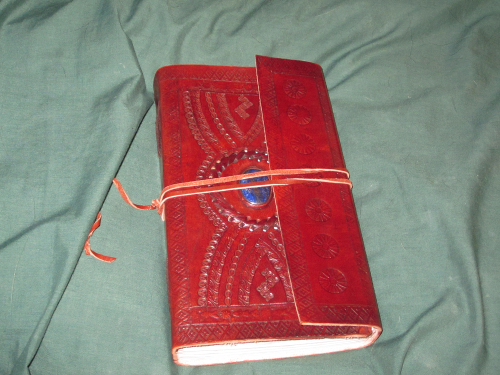
A wee side note here: I’ve started using the super-cool journal my friend Margaret gave me for Christmas.  Embossed leather cover with a nifty semi-precious stone embedded in the leather, home-made, recycled paper laced into the cover.  I even have a refill that I can lace in when I’ve used up all of these pages.

Isn’t it just the coolest writer-gift ever?  I think so.

How is your creative project going?