Training trainers in Toronto

This past week, I was out of town.  The purpose: to teach a bunch of trainers the content of Business Writing Made Easy, so that they, in turn, can teach others.

The class was composed of three trainers from one business line and 6 from the other.  BWME Nov 19-22 001Though I may, as I mentioned last week, be returning to the training team in September, there are several possible alternatives that might prevent this from taking place.  I have to be prepared for the possibility that I won’t be able to help train staff much or at all in the future.

This was my fourth time co-facilitating the course, and I’ll be training it one more time this week coming.

The course is 15 hours, or two days, spread over three.  I added a day onto the end so that the participants could adapt portions of the course, present them, and get some focused feedback from the rest of the class.

The class is very participant-centered, that is, there are a lot of activities and the facilitators are constantly using questioning techniques to engage learners in their own learning.  This last is a challenging bit for me, because I’m a word-nerd and a total grammar-Nazi.  I have to restrain myself from talking about the things that I love.

The course went well.  I was able to help one of my colleagues get some experience co-facilitating the course because she may be turning around and delivering it to her business line in the future.  I also got the trainer’s high that come when you see the participants getting enthusiastic about the subject matter.

I think they’re all going to be brilliant 🙂

As I’ve mentioned before, the course involves learning a business letter writing model, tips on clarity, concision, and readability in writing, and a final module on grammar review.  The practical component is a letter that the participants draft as part of their pre-course work and revise as the course progresses.

Actually, looking back, every time I’ve blogged about BWME, it’s been about the process surrounding the course, not the course itself (eeps!).

I learn, or have something confirmed for me every time I teach this course.  I hope that my newly-minted business writing teachers feel the same way.

I still get nervous every time I have to train too, but I hide it well.  I’m introverted (as all get out) and training, though enjoyable, tires me.

I’m reading Susan Cain’s Quiet right now, and will likely post about introversion in the future.  For now, let’s just say that I’m learning a lot about myself 😉

Just yesterday, I saw a post on Facebook by the wonderful Nancy Kress, who said that in preparing for a 4-hour workshop, she was nervous, even after her many years of writing and teaching.

One of the comments that followed mine was that, if you care at all about the subject you are teaching, or presenting about, you will be nervous.  Every time.

I do find this to be true.

Getting back to the course, since it’s only two days, I can’t teach anyone who to write properly or how to use the principles of grammar.  The course is a combination of review and resource-building that we hope will give participants the tools to continue improving on their own.

Practise makes perfect.

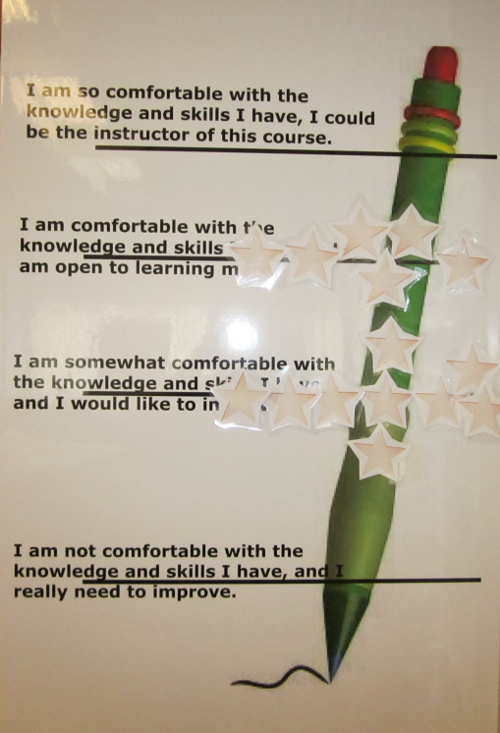
bunch of starsThe participants seem to enjoy the word pairs exercise most (affect/effect, practice/practise, principle/principal, further/farther, etc.).  The “snowball” fight is a great energizer, and the subject/verb agreement and punctuation exercises tend to confirm that most participants already know a lot about grammar, it’s just not something they’re aware of in their everyday work.

The key with BWME, as with so many other topics, is to cultivate that awareness, and promote its continuance on the job.


Have you had the opportunity to learn or teach something that you’re passionate about? How was the experience?  Do you practise after the fact?  What stayed with you most?


Sundog Snippet: Uncertainty

English: Circumzenithal arc and sundog over Ci...

English: Circumzenithal arc and sundog over Cirrus clouds (Photo credit: Wikipedia)

I just wrote about being a little overwhelmed and stressed recently.  Part of that is my work situation.

Without getting into too many details, I’ll give you the quick picture.

My current acting assignment as regional training coordinator will end August 31, 2013.  I’ve already been extended once, and while there is a possibility that I’d be kept on, I’m not sure if that’s in the cards.

As an actor, I really don’t have the option of applying for a self-funded leave, but I’m really in need of one.  I’m approaching burnout.

My main duties, to manage the regional training plan and budget for my business line are a continual source of stress.  Change is the name of the game, and I try my best to make sure that things work out by redoing several tables and excel worksheets every time there is a change, but it’s a lot of work.

To keep myself motivated, I keep my fingers in the training and training design pots, but that only adds stress (good as that kind may be) because I have to do these extra duties in addition to what I’m supposed to be doing.

I’ve applied for a couple of positions recently with our internal learning college.  One is as an instructional designer, and that’s where I want to be.  The other seems to be a position much like the one I currently occupy.  I haven’t heard anything about either of these processes yet.

We are reaching a point where, after the tumult of business transformation last year, a number of our boomer employees will be retiring.  This will open up another couple of consultant-level opportunities for me, but I don’t know that I’d enjoy either position.  We expect further retirement announcements in the coming months, and some at significantly higher levels.

These executive-level retirements will have a trickle-down effect and as our structure shifts to accommodate these new absences, even more opportunities may become available.  It will also throw us into a new round of chaos.

I’m not looking forward to it.

Part of me hopes that I’ll be back to my substantive position and that I’ll be able to take a break in the fall.  Another part of me is invested in the instructional designer assessment process.  It’s where I think I need to be.

The bottom line is, I don’t know where I’ll be situated in my work world in a few months time.

Writerly GoodnessChange may be the new constant, but I’ve had enough.  I am not agile.  I may rise to the occasion, but not without cost.

This is it for the Learning Mutt this week.

Next week, I’ll blog about my first training for trainers gig.

Caturday Quickies: What’s the deal with Briefing Notes?

The first time I heard the term ‘briefing note’ was when I was serving on a working group to set up a new unit to handle special enquiries for my business line.  Part of my roll on the working group was to source no-cost training for the unit as we did not have a budget.

Of course, I wasn’t informed of this particular lack of resource until after I’d found and started making arrangements for some fairly cost-intensive training on the subject.

The only free resources I could find were a couple of templates on our intranet.  No examples.

The next time I encountered a briefing note was during an exam for the assessment process that resulted in my current acting assignment as a Business Expertise Consultant (BEC).

I was asked to write one for the exam, and using only those two skimpy templates, I managed to write a briefing note sufficient to pass, and apparently with high marks.

Though the position of BEC includes the responsibility of writing briefing notes, I haven’t been clear on whether the reports, learning plans, proposals, etc. that I’ve been writing for my manager fall into that category.

I had had a course on briefing note writing on my personal learning agreement (PLA) for years, and this past week, I finally got the opportunity to attend.

So what is a briefing note?

A briefing note is a document used, as the name implies, to brief high level executives on various topics for various reasons.

I know that sounds vague, so I’ll give you a few examples to clarify:

  1. A news article appears that discusses a product or service that your business is implementing, but no formal press release has been made.  Executives responsible for that portfolio may need to be briefed on the nature of the coverage to see it there may be any impact, positive or negative, on the product’s or service’s release.
  2. An ongoing project needs to be altered due to unforeseen or uncontrollable issues (read scope creep).  The executive officer will need to be made aware of these changes, though they may have no direct oversight of the project in question.  If it’s under their umbrella, they need to know in the event their superiors, or external partners, ask.
  3. A court case involving your business is ongoing, or an appeal has been launched.  You will have to keep chief executives informed of the progress without weighing them down with a lot of superfluous legal information.

Does that help?

What I learned

  • What I’ve been writing does not fall into the category of briefing notes, though many of these documents serve the same or similar purposes.  What I learned in the one-day course can still be applied to the documents I need to produce.
  • If my unit has to write briefing notes of any description, there should be a set of unit-specific templates and examples on our shared drive (there are not).  I think I may have to see if we can gather some of these together (!).
  • Audience analysis is the single most important factor in writing a briefing note, or any other correspondence to upper management.  You need to know what they need to know.  If you don’t, make sure that someone who is privy to this information reviews your document before you submit it.  For me, this would be my manager.
  • Always think in terms of the absolute minimum that the executive needs to make decisions and otherwise conduct the business.
  • The directors, executive directors, and senior executive directors who might see my communications are a little lower on the totem pole than the chief executives to whom a briefing is generally directed.
  • The difference between an annex and an appendix: an annex is referred to in the body of a briefing note; an appendix is additional information that has not been referenced in the main document.
  • Summaries are optional unless the briefing note exceeds one page, or the summary is required in your unit or business line (which would be reflected in your template set).

Other than that, it’s a matter of using proper business writing principles, plain language,

pen.jpg

pen.jpg (Photo credit: new1mproved)

and impeccable grammar.

I have another tool in my writing arsenal now, something I’ll be able to keep in my back pocket until I need to use it.

Do you have to write briefing notes for your employer?  Will any of the information I shared be of use to you?  I won’t claim to be an expert now, but if you have any questions, I’ll do my best to answer them.  The research will help me to retain what I’ve learned 🙂

Caturday Quickies: The certification run

This past week, I travelled to Chatham to deliver yet one more session of Business Writing Made Easy.  The critical difference this time?  I was assessed for my trainer certification.  Eeps!

An omen?

What started my week was the journey to Chatham, some six and a half hours away.  Phil dropped me off at the car rental place at 8 am (we only have the one car).  Past experience taught me that I’d be in and out in less than 15 minutes, back home to load up my luggage and boxes, and on the road by 8:30 am.

When I walked in, there were four people waiting, one of them had an insurance claim to deal with due to a dent in the rental, and another was returning a car from another rental company.  The rental location was two employees short-staffed, and I settled in for a wait.

The first car I was given had some issues.  I couldn’t afford to wait any longer, so gratefully accepted an upgrade and was finally on the road shortly after 9 am.

The loveliness of the ETR

The journey itself was great.  For the first time, I used the 407 express toll route (ETR).  In the time it would have normally taken me to reach the hotel near our regional headquarters from the ETR on-ramp, I was exiting at Halton Hills, not far away from Guelph.

The ETR saved me precious time and allowed me to reach Chatham before the end of the day.

Lusting after the Zzzzz’s

I quickly checked into my hotel (more about that in another caturday quickie to come) and toted my boxes to the office, arriving just before 4 pm.  I spent the next several hours setting up the training room with my co-facilitator, Carole.  About 8 pm, we gave up for the night, Carole checked into the hotel, and we enjoyed a late supper at the hotel’s rather excellent restaurant.

I rarely sleep well when I’m on the road, but that first night was especially challenging.  I don’t know whether it was nerves, the trains that passed by periodically all night, or something else, but from 2:25 am on, I couldn’t sleep.  I’d gone to be just after 11 pm, and there’s no way I can function properly with only three hours’ sleep.

Despite that, I met up with Carole for breakfast the next morning, we finished setting up the room and our activities, I met my assessors, and class got underway.

The assessment

Really, I’m trying not to think about it much, because every time I do, I start thinking of all the things I did wrong, all of the technical difficulties I encountered, and all of the other things that could potentially have done me in so far as certification went.

I started asking closed questions.  My SMART Board activity bombed.  Toward the end of the second morning, I was exhausted and running on instinct rather than cultivating the Zen awareness critical to my success.  I curtailed a couple of side bar conversations clumsily.  I forgot participant names.  What’s the expression?  I sucked so hard …

The assessors were very kind.  I’d actually worked with one of them before, delivering workshops in Cornwall a few years ago, but their job is to make sure that I can facilitate in a participant-centered manner in accordance with a set of 18 competencies.  They assessed me for a full day, 1 pm to 4:30 pm the first afternoon, and again from 8:30 am to noon the second day.  I had to facilitate the class solo.

At the end of the first afternoon, the assessors asked me a series of questions about the competencies that weren’t clearly visible in my facilitation and presentation skills.  Things like the room set up, placement of visuals, the joining instructions, utilization of pre-course assignment materials, continuing professional development, and so forth.

At noon the next day, I bid them farewell and was advised that I would be informed of the outcome of the assessment within a couple of weeks.

I’m kind of dreading it.  I think that having to go through the assessment again would be a little bit more than I can handle moving into the new fiscal year.  Thus the avoidance tactics 🙂

The good parts

My co-facilitator bought me a wee gift.  Isn’t it lovely? congratulations

I tried not to tell her she was counting my chickens before they were hatched and just appreciated the gesture.  Carole also asked me to focus on all the things I had done well in the class.  Though I was able to list several things, my mind quickly gravitated toward the negative and I returned to avoidance.

The final day of class, with Carole at my side, went well, and by the end of it, several of the participants not only told us how much they enjoyed the class, and what good resources they got out of it, but also told us that their colleagues were asking how they could get on the list to attend the course.

That kind of validation warms a facilitator’s heart 🙂

After class, we packed everything up, and had an hour or so to enjoy Chatham and some of the quaint shops in the area.

At breakfast on Friday morning, Carole asked me some very helpful questions about the certification process.  She has an interest in pursuing it, and was curious about what might be next for me given her expectations for my success.

It was another very helpful way of keeping my mind from dwelling on all of my short-comings.

I dropped the set of posters I’d borrowed for the delivery of the course back at regional headquarters on my way through Toronto, and was home by 4:30 pm.

At home, Phil reminded me that my focus on the negative wasn’t necessarily a bad thing.  Being conscious of what I did wrong means that I’ll be less likely to repeat those errors since I am, as always, my toughest critic.  I get so embarrassed about it that I determine never to fall into the same trap again.

It’s all about doubt, something that plagues me in both spheres of my professional life (training and writing).  I constantly question the value of what I do, regardless of the evidence to the contrary.

So … the next you’ll hear about this is whether I have, in fact, been successful or not.

Have you been assessed, or tested recently?  How did you feel about the process?  What did it teach you about yourself?

Caturday Quickies: Business Writing Made Frozen, er Easy

The road to certification

A couple of weeks ago, I went to Timmins to deliver the second of three sessions of Business Writing Made Easy.

BWME Nov 19-22 001The first delivery was back in November and in the much warmer Toronto.  At that time, I was observed by the person who designed the course and who was, at the time, one of the leads in the trainers certification program.

Then, my hope was to certify in Timmins.  My observer told me, point blank, that I wouldn’t pass.  We then made plans for another delivery of BWME.  Timmins would be a practice run, to let me become more familiar with the material and more practiced in my participant-centered training delivery methods and techniques.

My mentor was unable to continue coaching with me and my observer volunteered to take over.  An opportunity arose for me to co-facilitate Introduction to Participant-Centered Training Delivery in January, further cementing my skills.  My co-facilitator, a recently certified trainer herself, said that I was ready.

In February, however, things began to devolve.  My observer-turned-mentor was assigned a project and could not continue to coach me.  No one would be able to take over.  In a final meeting, we whizzed through the remaining material we had to cover.  I was again told that I was ready for assessment.

My own workload did not lessen and as I started to prepare for my delivery in Timmins, I realized that I was within the six-week deadline to arrange my observation.

Frantically, I contacted the certification program lead.  I had to complete an assignment on the 18 trainer competencies, showing how I’d been working to develop each one, and complete a pre-evaluation interview to ensure that I was, in fact, ready.  She felt confident that I was.

While I worked on Joining Instructions, pre-course assignments, and prep for the delivery, I waited on pins and needles to find out if assessors could be located for my certification run.  Just before I left for Timmins, I was informed that I had one more assignment to complete.  I did, and was propmtly introduced to my certification team.

The drive up to Timmins was lovely.  It was a bright, brisk, winter day and we made excellent time.  We set up the room and started organizing the activities.

That night, the weather grew stormy.  10 cm of snow, followed by another 20 or so the next day.  Then the deep freeze descended and for the rest of the week was less than pleasant.

The training went well, thankfully.  There were a few rocky places, but there always are.  No training ever goes perfectly.  I firmly subscribe to the good enough theory of life, the universe, and everything.  I wonder if good enough = 42 😉

The weather improved for our journey back to Sudbury on Friday.

Sunrise over downtown Timmins, Ontario, Canada

Sunrise over downtown Timmins, Ontario, Canada (Photo credit: Wikipedia)

This week, I strove to catch up on my regular work and still conserve some time to prep for next week’s delivery.  The certification program lead emailed me to once again offer a few words of support, and here I am, with a skimpy weekend between me, a six and a half hour journey, hasty room and activity set up, and a full 8 hours of solo assessment of my facilitation skills.

My main goal?  To remain mindful in the moment.  Yes, training is a Zen kind of thing.

Will let you know how the certification attempt goes, but I won’t know anything for a while after.  The earliest I can have my debrief is April 4 (!)  While the report should be released within a couple of weeks, I’m not certain if they’ll give me a definitive ‘yes’ or ‘no’ before the debrief can happen.

The nerves come and go in waves.

Keep me in your thoughts trainer types.

Meanwhile, back at the day job

What my position/title says I do

I am the acting regional training coordinator for my business line.

The two main duties I perform in the course of my job are to maintain the training plan, and manage the training budget.  These two aspects of my job have been occupying me for most of the past two months.

Challenges:

  • The current year’s training plan has been constantly changing, mostly due to the ongoing business transformation process.  This is the busiest year the training team has ever seen, and the team is losing members. While these losses are due to promotions, deployments, or acting assignments (and are therefore good things to have happened), it still means doing more with fewer resources.
  • We have five functional trainers.  That means we don’t have enough trainers to facilitate the training we are already committed to deliver.
  • Since our plan is based on the fiscal year, which runs April to March, we’re in the home stretch, and I sincerely hope that no further changes come to light.  Then again …
  • Planning next year’s training schedule is already underway. Since this is my first time going through the process, I’m understandably nervous.
  • Our business line is over budget, once more due to the non-negotiable and afore-mentioned business transformation.  I’ve been assured that we’ll be okay, but like the planning, I’m in new territory with budget management.  Further, my position is an acting one and failure could cost me.  Once again, I’ve been reassured, but one thing the last year has taught me is that no one is safe.

In addition to my two main challenges, my job also entails soliciting nominations for training, establishing participant lists, inputting those lists into the learning management system, and a slew of weekly, monthly, and quarterly reports, some of which I’m still not certain about (there’s one quarterly report in particular for which I don’t have access to the information I’m asked to report on = boggle).

Because of my proficiency with SharePoint, the setting up of training rooms has become

The SharePoint wheel

The SharePoint wheel (Photo credit: Wikipedia)

one of my duties as well.  Though it doesn’t take massive amounts of time, it’s nonetheless time that I could be devoting to other tasks.  Should I be fortunate enough to become indeterminate as training coordinator, this will have to change.  For now, if I don’t do it, it won’t get done.

The training team would like me to send out the invitations to training too.  This is another task that is not difficult, but it can be time consuming.  Thus, I am extremely grateful to the team for taking on this responsibility for me.

Big shout out to my lovely ladies!  The training team rocks/is fabulous/is awesome-sauce!

What I’ve chosen to take on

I want to become a certified trainer.  So I have been delivering training, meeting with my mentor, and the lead of the certification program.  I also meet with my co-facilitators to plan our delivery, prepare for each training, and complete many of the coordination duties that I assume for other training in the business line.

Though it’s only taken one short paragraph to cover this self-imposed responsibility, it currently eats up more of my work-week than my main duties do.

I’m not complaining (since this is something I’ve elected to do, I really can’t), merely stating a fact.  You already know from my past posts how much I love training, so this isn’t a burden.  It is additional work, though.

Other stuff

These are the things that I do for professional development, sitting on working groups and the like.

My manager is very concerned with the career mobility of his staff, and I am grateful for the attention he pays to this aspect of his duties, but sometimes, I think it’s a bit much.

I have no interest in climbing the career ladder further.  Doing so would mean, in most cases, moving, which I’m not interested in, or becoming functionally bilingual, which I don’t think I’m capable of at this point in my life.

I’ve never had the least interest in managing others, even though my current position means I work closely with managers and some of my duties require what I’ll call para-managerial skills.

So I sit in on conference calls on projects that I have little or no influence over and little subject matter expertise to share.  When I do come across a topic on which I have a strong opinion, I do opine, but often it’s not something that’s acted upon.

Ultimately, many of these working groups result in further training for staff, which strains an already overburdened training team and an already overtaxed budget.

I might figure out how to get blood from a stone (without smacking someone in the head), but short of a miracle, I’m not sure how to do this.

I began the year with the mantra, “I am a leaf in the wind.”  It’s a two-fold touchstone.  First, it’s all about going with the flow, and letting go.  In Managing Transitions, I learned that you have to focus on the things that you have control over and the actions you can take in that context to improve your situation.  For those things over which you do not have control, you have to let go, stop fighting the losing battle.  This is what I’ve strived to do.

The second meaning, for you Whedonesque geeks out there, is that this is a line from the film Serenity.  Hobediah Washburn (Wash) is piloting the titular Firefly class spaceship through a raging battle zone.  He’s dodging the Alliance and the Reavers at once, and it looks like he’s just about to make it through the collisions, explosions, and hurtling debris.  In a zen moment, he says, “I am a leaf in the wind: watch me—” and then he’s impaled by a rather narsty-looking piece of debris.

This might give you some insight into my character, but when I thought of adopting that mantra, I couldn’t stop laughing.  I simply find it hilarious, and I’m striving to pilot my version of Serenity through its battle zone, all the while watching for that deadly metal spar.

Complicating factors

What, you say, there’s more?

Why yes.  There’s always more 🙂

The device pictured is a 128MiB PNY Attaché US...

The device pictured is a 128MiB PNY Attaché USB flash drive. Like many such drives, this model features a removable cap (which protects the type-a male USB connector) and a hole or loop through which a string or wire loop can be attached (barely visible in this photo, on the flash drive’s lower right corner). (Photo credit: Wikipedia)

A couple of recent security breaches have eliminated the use of USB storage devices throughout the organization, as well as external hard drives, and even CDs and DVDs created to back up important information.

This has the potential to affect the use of lap tops (VPN), faxing, and even scanning.  This last is particularly concerning as my employer has established a centralized imaging program in an effort to reduce hard-copy storage and maintain a green workplace.

I had to return three USB devices even though the information contained on them could never have compromised the security or privacy of anyone.  I have a lap top and a VPN account, though I’ve only ever used it on site, with a network cable, within our secured network.  I don’t even know if I remember my VPN login (!) because I’ve never had need to use it.

I have had need to transport my laptop to a training location, however, and while I make every effort to ensure that the lap top is never out of my sight unless locked up or away, I could be heading for some serious curtailing of my privileges.

My team also recently reviewed our employer’s code of conduct, values, and ethics.  As a result, I had to submit a conflict of interest declaration because my writing is considered self-employment.  As part of that submission, my manager gets to, and in fact must, review my blog.

I’ve read our employer’s policy, and so far as I know, I’m adhering to it.  I’m sure I’ll hear about it, otherwise.

So that, in a nutshell, is my life at work these days.  It’s complicated and I strive for complexity in the midst of the chaos, but there are so many things beyond my control.  I do what I can.  It’s all any of us can do.

_________________________________________________________________________

How is your work world shaping up in the New Year?  Is the pace of change complicating Writerly Goodnessmatters? How is your workplace dealing with the growing spectre of security breaches?  Have you chosen to do something beyond your job description?  Anyone undergoing a business transformation process?  What do you do to stay positive?

The learning mutt is circling three times before curling up to nap.

Introduction to Participant-Centered Training Delivery

Or, how I spent last week 🙂

Nothing is more fun than three ring binders.

Nothing is more fun than three ring binders. (Photo credit: Wikipedia)

So last week I was down in Toronto, the Big Smoke, Hogtown (never figured out why they call it that—oh, my friends Google and Wikipedia have discovered the answer: livestock processing was a big part of Toronto at one time) co-facilitating the Introduction to Participant-Centered Training Delivery (IPCTD) course.

Ostensibly, this is part of my attempt to become certified as a trainer through my employer.  The co-facilitation of this course was listed as a recommendation to anyone going through the process.  I didn’t think I would have this opportunity, having been told in the fall that the delivery of this and all other certification courses was being outsourced.

When the opportunity arose, I could not pass it up.

My co-facilitator and mentor for this part of the journey had just been certified in November herself and part of the purpose of our training together was so that she could give me a few pointers, watch out for those unconscious bad habits of the past.

I’ve blogged about Participant-Centered Training (PCT) before, but just to recap for those of you not interested in reading the whole post:

[In PCT, t]he trainer is merely present to elicit the desired knowledge from the learners, to encourage the appropriate behaviours, and to facilitate the process of discovery that will lead the learners to exhibit the desired performance in the workplace.  It’s no longer about [the trainer] having all the answers, but about being able to help the learners, now active participants in their own learning, find the answers for themselves.

The tag line is: Instead of the “sage on the stage,” be the “guide on the side.”

The course is two and a half days long and includes a practical demonstration by the participants, of the techniques they’ve learned.

Prior to the course, I met virtually with my co-facilitator a couple of times.  We divided up the material so that neither one of us would be leading the class for very long.  I read through the material to refresh my memory (when I took the course as a participant, it was 2009 and the course had subsequently been revised) and made copious notes.  I also brought a second copy of all the manuals, flipcharts, and PowerPoint presentations on a USB.

I travelled down on Tuesday morning and helped my co-facilitator set up the room.  That’s one thing to keep in mind with PCT: it may demand less of the facilitators in the classroom, but it requires much more preparation.  There are usually tonnes (I’m Canadian, eh?) of flip charts, visuals, learning aids, and activities to be set up in order for the session to go as planned.

The facilitators’ manual is critical as it lists times and required elements for each section of the course.  Most PCT courses are crammed full of information, the enrichment materials marked as “optional.”  Most of the time, there is no time to address much of the “optional” material, but every attempt is made to at least refer to it and ensure that the participants have access to those additional references and resources.

The course

The course was designed with a nautical theme and contained four sections: Opening and introduction; Methodologies and techniques; Communication, group building, group management techniques, and co-facilitation skills, with the practical component thrown in for good measure; and the Course closing.

The pre-course materials and assignments were to have been printed out, reviewed, completed, and brought with the participants.

The course opening includes an activity first thing to immediately engage the participants in the topic, review of some of the pre-course materials, expectations, comfort rating, course objective, agenda, participant introductions, and an introduction to PCT.

A note on objectives: prior to getting into PCT myself, I didn’t know the criteria for a good course objective.  A course objective should include performance, process, and standard or method of evaluation.

Examples: By the end of this course, you will be able to build a bird house using the bird house building instructions so that the result will meet the criteria described in the bird house schematic.

Or: By the end of this course, you will learn how to process an application, using the application policy, such that you will be able to achieve our 80% quality assurance goal on the simulation test.

Or: By the end of this course, you will be able to use Microsoft Word, in accordance with the Microsoft Word for Dummies Tip Sheet, so that you will be able to create documents for your employer more efficiently and confidently.

And yes, the standard or method of evaluation can be the participant’s own comfort level.

The methodologies and techniques section deals with the different PCT methods of delivery and the specific techniques, or activities that can be used to effectively engage participants.

The next section is the big one.  Communication skills, group building, group management, and co-facilitation are all covered, and then the participants are divided into groups, assigned a topic, and given an hour and a half to work on a 20 minute presentation in which they will demonstrate the skills, methods, and techniques they have learned.

The closing section revisits much of the material presented in the opening to answer the following questions:  Did we meet the course objective and participant expectations?  Do the participants feel they have learned valuable tools that they will take back to their jobs?  Review and transfer strategies are also incorporated.

Throughout the course, the co-facilitators are actively demonstrating all of the skills that we teach.  That’s another difficult aspect of adopting PCT: developing your awareness.  Though PCT takes the pressure off the facilitators to be the “talking head” or subject-matter expert, they have to be aware of everything that’s happening in the class: the participants’ attitudes, changing levels of engagement, the environment, and their own behaviours.

If you’ve done any training in a traditional environment, it’s essentially lecture.  Students sit there like baby birds waiting for their meal to be shoved down their throats.  This establishes some habits that have to be consciously broken when the trainer moves to PCT.

Questioning techniques are paramount.  Relays and overheads fly and form the foundation of debriefing every activity and conducting every review.  Knowledge must be drawn out of the participants, not fed to them.

This can be demanding, especially for someone like myself.  Though I enjoy training and think that I am good at it, I am, at my core, a shy person, and more fond of information than of social interaction.  This makes delivering training an exhausting activity for me.  I’ve noticed that even in the last six months that my tolerance seems to have decreased.  The need to retreat at the end of the day is nigh on irresistible.

Despite this, my co-facilitator said that after the first day, she didn’t notice any bad habits or poor behaviours on my part.  I was a little too fond of the closed questions at the start.  We worked well together and delivered a course that was well-received by the participants.

I won’t be able to review the assessments for a while yet, but there was nothing but compliments flying about the room that last day.

So that’s the Learning Mutt’s adventure for this week.  Tomorrow, I’m heading out of town again and we’ll see if the life of a training coordinator will provide any more fodder for Writerly Goodness in the future 🙂

Next weekend, look forward to an interview with Laura Conant Howard in conjunction with her cover reveal blitz for the upcoming The Forgotten Ones, another pupdate, and, if I have the gumption, my review of the Galaxy Note II as the smart phone writers want 🙂

Goodnight everyone!

Sunday night line up: Once Upon a Time; Beauty and the Beast; and Lost Girl 🙂

Adventures in professional development October 2012

In-person team meeting, Oct 16-17

My team works virtually.  We’re scattered all over Ontario and so when we can meet in person, we take the opportunity.

This year, our in person team meeting was held in Toronto and we assembled from our respective offices: Timmins, Sudbury, Scarborough, and Chatham, to meet with the three of our colleagues that lived and worked in Toronto.

The focus of the meeting was professional development, but there were a couple of specific things that we had to accomplish: review our accomplishments to date, and plan our activities for the remainder of the year.

My team is diverse with respect to skills and relative areas of expertise.  I contribute to subject matter expertise in my business line, technical, facilitation, instructional design, and other communications skills.  Others bring subject matter expertise in other business lines, project management, instructional design, presentation, and specific business communication skills.  Some have great budget management skills and a holistic knowledge of our business that I lack.

We all come together to support one another and get things done.  As the result of our accomplishments/planning session, I once more find myself entering uncharted territory and helping to put together professional learning agreement (PLA) templates for various positions my business line.  This will be interesting work.

In the professional development category, we were reintroduced to a tool called the Passport to Service Excellence (PSE), which is supposed to help us chart our career path.  Talent management is something still fairly new and very much in development at my employer.

We have several tools and platforms to help us do this.  One is, of course, the PLA, where outside our departmental mandate and goals, we list activities that we would like to engage in and what positions we’d like to move into, job shadowing or acting roles we might like to adopt.

There is a Renewal Gateway site onto which we can post our resumes and where managers from various departments are supposed to look for individuals to suit their needs.  There are also formal and informal assessment processes for various jobs occurring all the time.  There is the PSE, and I’ll be helping out with another project geared to assist employees in planning their professional development activities in the coming weeks.

It seems to me that there’s a little too much duplication in these tools.  So if I were to take a course, I would have to update my own resume, the one posted on the Gateway, then open up my PLA and list it there, go to the PSE and make the appropriate alterations there, and soon possibly also update the new tool that’s being proposed.

That’s a lot of work.  It’s almost enough to make one reconsider taking part in any professional development activity.

What would be better is to work into one of the tools the ability to export information into other forms.  So that if I complete a course, I then go into one tool, for sake of argument, the PSE, update it, and then have the tool communicate with and update the other tools (PLA, resumes, etc.)  It makes sense to me, but when I made the suggestion, it seemed something beyond what could be provided.

This kind of thing happens a lot at my employer.

The Business Expertise Forum, Oct 29-31

Along with the SMART Board training that I delivered with my colleague Monica in September, I was to deliver a workshop at the BE Forum.  It soon turned out to be three workshops offered to a portion of the attendees in rotation with two other presentations.

Monica ended up having to deliver other training and couldn’t help me, so I said for convenience’s sake that I’d deliver the workshops solo.

I thought I’d have time in October to develop the presentation, handout, and complete the work necessary to have a translated version of the handout ready in time.  Unfortunately, other priorities emerged.  My job as training coordinator is not a boring one, to be sure.

Then two days before I was off on leave to attend a writing conference, one of my team mates volunteered to co-facilitate.  At that point, I didn’t really have the presentation hammered out, but I gratefully accepted the offer and shared what I could put together in a day.

Another issue was that the training room that I was assigned and that I wanted to get in early to set up was in use the day previous.

So making the best of the chaos, I travelled down with my colleague and attended the first part of the Forum.  There were a pile of work friends from various departments and locations that I got to see again.

Our regional head delivered a welcome address and expressed interest in attending the SMART Board workshop.  <gulp!>  Fortunately, her schedule was too full to allow it, but I had a momentary wiggins 🙂

One of my training team colleagues did a presentation on creating a quality monitoring program.  She’d been called in at the last minute when the original presenter was unable to attend.

Finally, at the end of the day, I got into the training room, hooked up my computer, and tested the SMART Board out.  Joy.  Everything was working.  Linda and I started to go through the workshop and had to finish off our mini-run through the next morning, as the training rooms were being locked down for the night.

Ultimately, all went well, and I ended up having a great time.  I went out with all of my work friends and caught a couple of great presentations, on training in a multi-generational environment and on managing transitions (another course that I will be delivering at some point in the future).

Now I’m in recovery 🙂

On taking breaks and lunches

One of the other things that came out of my team’s in-person meeting was that we all need to take care of ourselves.  A former member of the team, who’d left it prior to my coming on-board in May, had passed away in the summer at the young age of 51.

So we were all encouraged to take our lunches and breaks, and to take care of ourselves.

I have to confess that I haven’t taken more than a handful of legitimate lunches or breaks since starting with the team.  I tend to take on too much.  I know this about myself, but when I have something that I’m interested in, I can’t help myself.

Unfortunately, the things I’m interested in are not the kinds of things anyone else shares a passion for.  So I end up being a niche specialist because no one else has the time or aptitude to take up the torch.

I’ll have to let you know how my quest for personal time and balance at work goes.

The Learning Mutt has a couple of weeks at home before she’s on the road again, and hopefully for the last time this year …  I can dream, and whuffle in my sleep 😉

Getting smart with SMART Board

Back in April, I posted about a gift I received back in May of 2010: a SMART Board.  Now I never did a dedicated post about what became of that wee gift.

English: A Smartboard

English: A Smartboard (Photo credit: Wikipedia)

In March of 2011, my then brand-new manager started an initiative.  She wanted the training team firmly in the 21st century, designing and delivering elearning.  Unfortunately, that was also about the time that my father passed away, and though I was considered the expert in  SMART Board, I only had time to complete part of the training course before I was off on leave.

My colleague completed the course for me, created a video segment for it, and delivered it, not only to our fellow trainers, but also to the regional learning governance committee, and at the business expertise forum.

The result: we received, as a team, a service excellence award for the project.

Getting even smarter with SMART Board

Fast forward a few months, and riding close on the heels of that success, it was determined that additional training should be delivered.  In person training.  Not only to our fellow advisors and consultants, but also to managers and other individuals in need of additional tools to present and conduct meetings.

Plus, there would be additional workshops to be held at this years’ business expertise forum.

Reunited for this next project, my colleague and I reworked the training, which was previously delivered as a combination of self-study and virtual delivery, into a 1-day, in class session.  The idea was that to cement the learning, hands-on application would be required, and lots of it.

Today was the first of two sessions, and though things were a little rough, we’ve received some very positive feedback.  I’m relieved.

Bumps on the road

Earlier in the summer, I was notified by the updating utility that Notebook, the software that accompanies the SMART Board, needed to be updated, so I dutifully put in my ticket with the techies, and was promptly updated to the wonderful Notebook 11 🙂

I realized that this was a major change that would necessitate the rewriting of the package.  Unfortunately, I wasn’t able to dedicate any time to the SMART Board until early August.  At that time, I booked a room, set up the SMART Board, and started playing again.  I also took scads of screen shots 🙂

The rest of August was spent re-writing the training package, given the new version of Notebook.  Dates were set, the course entered into our learning management system, invitations to participants were sent, and another ticket was submitted to the technical team to install Notebook 11 onto all the computers in the training room.

Pre-course assignments, including the participants’ guide, were sent out and submitted by the participants.

Then, last week, when I returned home after being out of town for the Managing Transitions training for trainers, I received a note that the computers were all updated … to Notebook 10.7.

Essentially, all the work that I had done on the revisions was a waste.  That was Friday, and I was on the road Monday morning to come down and set up the room prior to training.

There wouldn’t be time to work on anything.

Further, the versions of Notebook installed on the participant computers were all trial versions, and missing a few key elements.  This meant that some of the parts of the program that we were demonstrating could not be accessed by the participants at their desks.

That was a bit frustrating.

Nothing like rambling on for five minutes about this really cool feature when one of your participants pipes up and says, “where are you?  I can’t find that Icon.”  Then you realize that they’re missing something that it would really have been nice if they had.

Chameleons by any other name

So, as facilitators, we adapt on the fly, to a greater or lesser extent, and to more or less success.  Again, it seems we managed well, and that everyone got what they needed out of it.

It’s just frustrating.

I would have liked to have had more time to complete a proper facilitators’ guide.  I would have liked to have had the most up-to-date version of the software available to the participants.

As the song says, though, you can’t always get what you want 🙂

I guess all of this speaks to my perfectionism.  I’ll deal with good enough, and not stress over it (I’ve learned to let go of things at work), but I can’t help but think how much more successful the package could be.

There are so many things that I’ve done in the last couple of years that have been good enough, and that I’d love to have time to get back to and revise/update/complete.

Happy Dog

Happy Dog (Photo credit: jmckind)

How are things going in your work lives?  Are you too, plagued by persistently frustrated perfectionism?  How have you addressed the issue?  Is being able to let go enough?  Is good enough really enough?

Let me know!

The learning mutt, signing off 🙂

Four things I learned about project management

1. My biggest take-away

Back in February, I spent five days in Toronto, taking Project Management training.  While this was ostensibly for my day-job, my biggest take-away is that anything can be a project: my novel, a poem, a short story, training, training design, home renovation, a conference or vacation, even going out to celebrate a birthday, all of it.  And anything that can be considered a project can be made more successful by solid project management practices.

Our instructor for the week was Paul  S. Adler of Paul S. Adler and Associates, a certified Project Management Professional through the Project Management Institute (PMI).   In a practical demonstration of participant-centered training in action, Mr. Adler guided the class through content-relevant activities, integrated lecture and video segments, and tied the whole together with practical application sessions that culminated in a presentation of our team projects on Friday morning.

2. The PMBOK and the PMBOX

PMBOK stands for the Project Management Body of Knowledge.  The PMBOK Guide is the Bible of project management and is produced by PMI.

One of the mini-projects that the class had to produce was a commercial for a product.  My group chose the PMBOX, containing everything you would need to manage your next project.  While our tagline was “With the PMBOX, your projects will manage themselves,” there is no magic solution to project management.  The toolkit is in the project manager’s head and reference library, and it will take years of practice to implement, understand, and perfect those skills.

3. The Spectre of Groupthink

While I think Mr. Adler’s video library could stand some updating, each was relevant and elucidating.  In a serendipitous bit of media tie-in, Roger Boisjoly, the central figure of the video on “Groupthink” passed away on January 6, 2012.  His passing was publicized on February 8, 2012 in newspapers across the US.  I found the video challenging and the difficulty of Roger’s position tragic.  Moreover, his story following the Challenger disaster he tried to avert was compelling. 

Groupthink is a phenomenon in which coverconfidence, looming deadlines, and pressure to conform can conspire to silence conscientious dissenters.  In Boisjoly’s case, he warned of the potential failure of the O ring that ultimately resulted in the Challenger disaster.

Groupthink in my workplace (not my team specifically – we’re pretty awesome) is a hazard, and extremely difficult to overcome.  I’m now dreading the possibility of having to confront the beast.  Thankfully, I don’t think it’s imminent, and the projects I might work on would not involve life-or-death decision, but still … it’s both haunting, and daunting.

4. Let’s Talk Again

On Wednesday evening, the day after we discussed Groupthink, I watched the CTV broadcast of Michael Landsberg’s interviews with Darryl Strawberry, Stéphane Richer, and Clara Hughes about depression.  It was significant for me in the context of the course, because Mr. Adler had spent some time discussing stress management that day.  As someone prone to depression, I do what I can to combat negative stress every day.  Walking my dog, or walking home from work, making a physical as well as mental “switch” between work and home lives, and seeking the happy are all important parts of my life and my “process.”

Kim Covert, of the Postmedia News service calls depression in the workplace the “trillion dollar elephant in the room.”   It’s an issue that has a huge impact on both our professional and personal lives and people have been silent with respect to depression for too long.

Bottom line: find your bliss; follow your joy; do whatever you can to find the happy in your life.

In the end

There was too much course to cram into a little blog post like this.  We covered at least ten important topics every day.  That’s a lot of learning!  Project Management isn’t something that can be done, or done perfectly, out of the gate.  As Mr. Adler told us, we just need to start with one thing, practice it, and build on that practice gradually.  Also, he encouraged us to use project management at home.

I’d highly recommend the course, or one like it, to everyone.

As Drew Dudley says so succinctly and so beautifully, leadership in everyday life can change the world.

Have you attended a course recently that has had an impact on you?  What was the course?  What was its impact?  Do share!