The plan was to finish my Speculations column and submit it, and to continue revising Reality Bomb and working on my first short story. If I was so lucky as to finish the first story, I’d start a second. There are several open calls and contests coming up. I know I won’t hit all of them, but I’m going to try for a couple.
The progress
I wrote 748 words to finish my column. It’s 1,653 words in total. A little long, but it’s another personal post.
Between revisions and my evolving map of RB, I racked up 12,446 words. I’ve finally made it past the point where I realized I’d have to change the POV to first person and start over. It’s good to be forging ahead.
I wrote 112 more words on my story. It’s a cute one. I’ll tell you about it later in the year.
This update is 359 words.
And … I did a little personal project that amounted to 360 words.
This week’s total word count: 14,025.
NaNo 2021 running total: 26,771 words. That’s an average of 1,912 words a day.
The pivot
Tomorrow is my first day back to work after two wonderful and restorative weeks off. I expect that my productivity will be significantly lower during the week. It’s to be expected. I usually write or revise 250 to 500 words a day when I’m working. It’ll be a bit more than that because I’m not curating. Optimistically, we can probably double that to 500 to 1,000 words a day. But that’s being optimistic. I might catch up a bit on the weekends, but I doubt I’ll “win” this year.
It’s all about the motivation, though. Writing something every day has been good for me. I’m feeling refreshed and inspired. I’m remembering why RB was important to me (actually, I didn’t forget, but autistic burnout messed with my head for a couple of months).
My best wishes to everyone who’s participating in NaNoWriMo 2021 in any capacity. You can do the thing!
Until next week, be well and stay safe; be kind and stay strong. The world needs your stories!
Today is November 7th and I’m happy to report that I’ve written 12,746 words so far.
The plan
I named my project this year “NaNo Rebel Combo.” And it’s exactly that. I’m working on next round revisions on Reality Bomb, including the work I’m doing on my scene map as I go, some pieces of short fiction, and my next Speculations column for DIY MFA. I’m even counting these blog posts (and my curation posts) toward my goal. It’s a real mixed bag this year 🙂
Also, I have the first two weeks of November off from work. I expect my productivity to take a nosedive starting on the 15th.
The progress
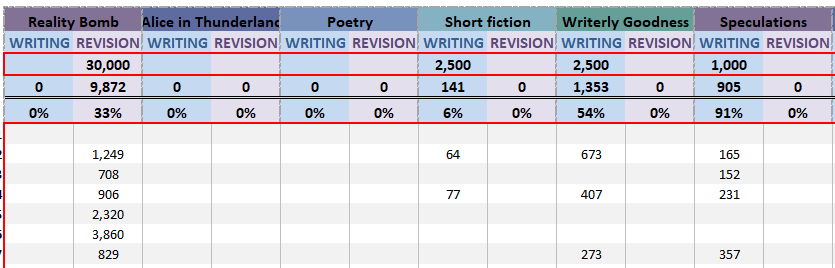
On RB and the scene map, I’ve written 9,872 words;
I’ve written 141 words on a short story;
I’ve written 905 words of my Speculations column; and
Including this post … I’ve blogged 1,353 words.
Grand total for week one: 12,746 words (1,820/day).
The pivot
Once my Speculations column is submitted, I’m going to refocus on RB and the first short story. When that short story is finished, I’ll start another.
As I mentioned, I’ll be returning to work on the 15th and don’t expect to accomplish as much after that. But I’ll keep plugging away, as I’m able, and see what I can put together.
We’ll see what I can do in the next week, but I’m not set on winning this year. This is just motivation for me to get back to a more regular practice. As you can see, I’ve only set myself a goal of writing 36,000 words on my spreadsheet. I think that’s reasonable, but what I often think is reasonable turns out to be a stretch.
Until next week, be well and stay safe; be kind and stay strong. The world needs your stories!
Hallooo, writerly friends! At the last minute, I have decided to NaNo. I am once more a rebel, hoping to make some progress on this next round of Reality Bomb revisions as well as penning some short fiction. The hope is that, between the two, I’ll rack up a reasonable word count.
I am not, however, striving for 50k. I’m not going to stress. This is going to be a casual NaNo this year and my emphasis will be on trying to get back my writing mojo. My practice has been spotty since my burnout and I really just want to get some words on the page. Or revised. Or something. It just doesn’t feel right, not writing.
To facilitate this recapturing of joy, I’m going to hold off on my next chapter update until December. I will not be doing my regular curation beyond this week (because I already have the Tuesday and Thursday posts completed). I will be scarce on Twitter.
I will offer mini-updates every week, however, to make up for the lack of content otherwise.
Then, in December, I’ll do a double update (October and November), resume curation and Twitter, and I’ll let you know if this little experiment works out 🙂
If you want to be my buddy on the NaNo site, I am (unsurprisingly) MelanieMarttila.
Following up on her last instalment on planting bugs, Piper Bayard explains how to find bugs (writing spies). Then, Kris Maze compares pros and cons of using Scrivener and Plottr for outlining. Writers in the Storm
Here in Canada, we had a federal election that changed nothing, our first Truth and Reconciliation Day, and a slew of continuing political scandals and health crises. We’re still in dumpster fire territory.
Your monthly PSAs:
All lives cannot matter until BIPOC lives matter.
Please continue to wash your hands, mask in public places, maintain physical distance, and if you haven’t been fully vaccinated yet, please do so, soonest. And get your flu shot, too. It’s forecast to be a narsty flu year now that reopening is happening and kids are back in school.
The month in writing
The month in writing kinda wasn’t. I’ll get to the why of it in the next section. Suffice it to say, I didn’t write for more than half the month.
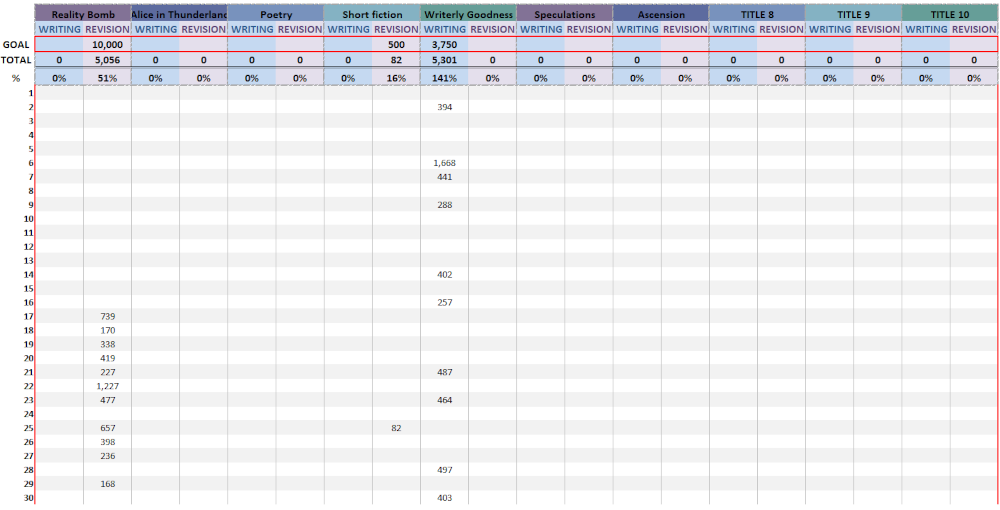
It’s probably not surprising, then, that of the 10,000 words I’d hoped to revise/rewrite on Reality Bomb, I only managed 5,056 words, or 51% of goal.
I revised a whole 82 words of my 500-word short fiction goal, or 16%.
The only thing that I kept up with was blogging. I blogged 5,301 words of my 3,750-word goal. 141%. I’ll take it.
My latest Speculations came out mid-month.
And that’s about it.
I’m slowly getting back into the groove. I’m not stressing when I have too much going on to pay proper attention to writing. If it happens, it happens. If it doesn’t, it doesn’t.
Filling the well
I attended three virtual writing-related events in September. First, I took part in Suzy Vadori’s virtual writers’ retreat Sept 10 – 14, which was flexible enough to fit in around work.
Then, CanWrite! 2021 and FiyahCon were both on the same weekend. Fortunately, I was able to watch the FiyahCon panels I missed in replay. So, it wasn’t terribly stressful. I caught Terry Fallis’s and Farzana Doctor’s sessions at CanWrite! and that was really what I wanted to catch.
I went out to my sister-in-law’s for an outdoor family BBQ. Phil made the burgers. Ger made fresh-cut fries. My mom made a three-bean salad, and Steph made the BEST cherry pie EVAR.
In health-related news … there was a lot.
After the end of my acting, I returned to my position as an instructional designer on a short week, which was made even shorter by a dental checkup and taking my overtime as compensatory time. I still wasn’t feeling quite right, though. I had a doctor’s appointment the following Monday, and I got a sick note for two weeks off work.
While I was off, I took care of some other stuff (shingles vaccine 1 of 2, blood work, orthotic check, that kind of thing).
I’ve also been trying to find myself a therapist. I think I’d really benefit from having someone to help my navigate this sea-change in my life. There’s really no one who specializes in women who are diagnosed as autistic later in life. At least not locally. I have some feelers out, thanks to a friend, but I haven’t heard back yet.
I’ve been using the quality of my sleep, the amount and nature of my rumination, and my relative level of brain fog as my barometers. My sleep has improved—I’m dreaming non-work-related dreams—I’m not ruminating about my work-related failures, but most mornings I’m still foggy.
I was back at work last week and it was really hard.
This weekend has been restorative, though.
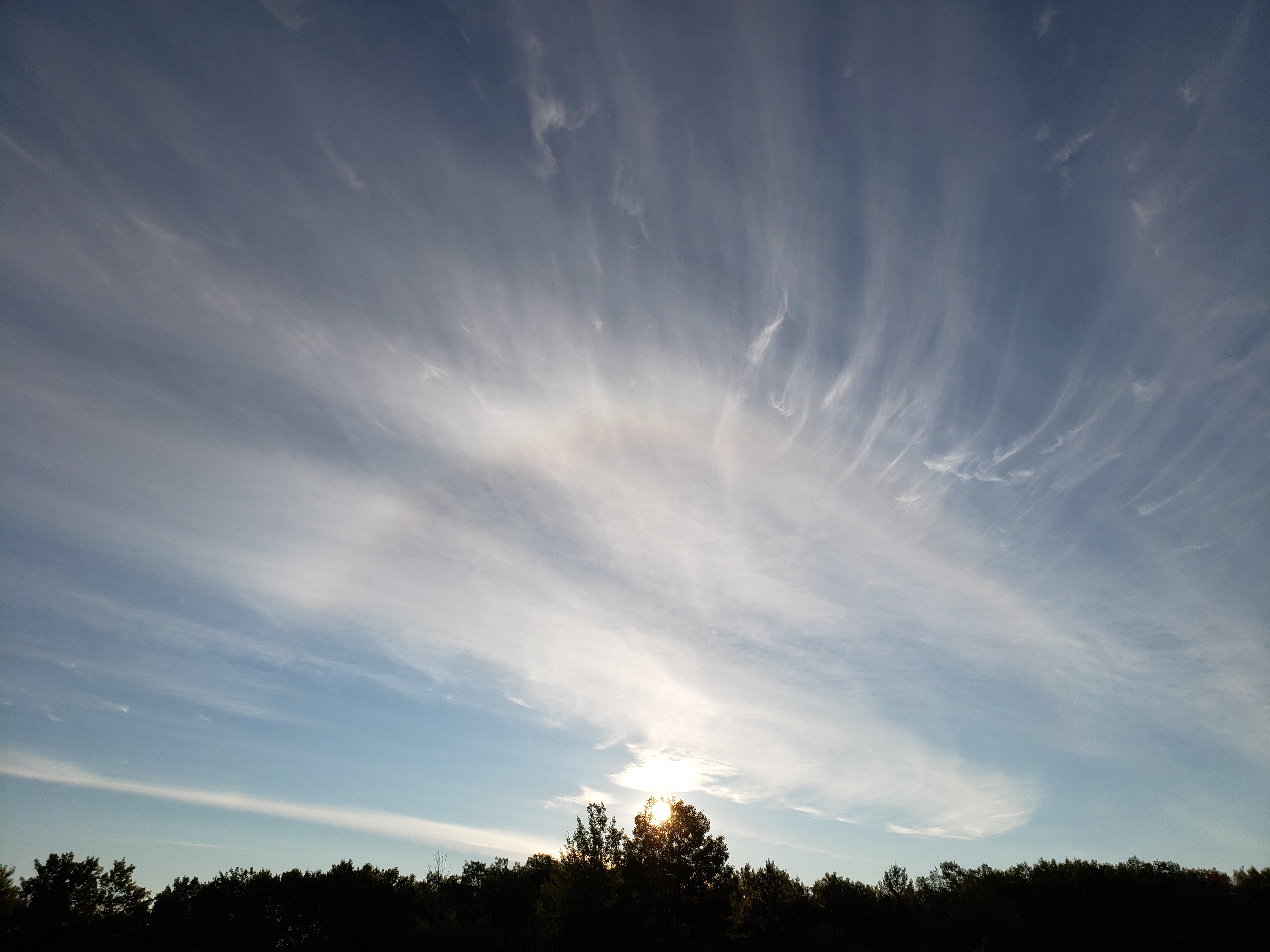
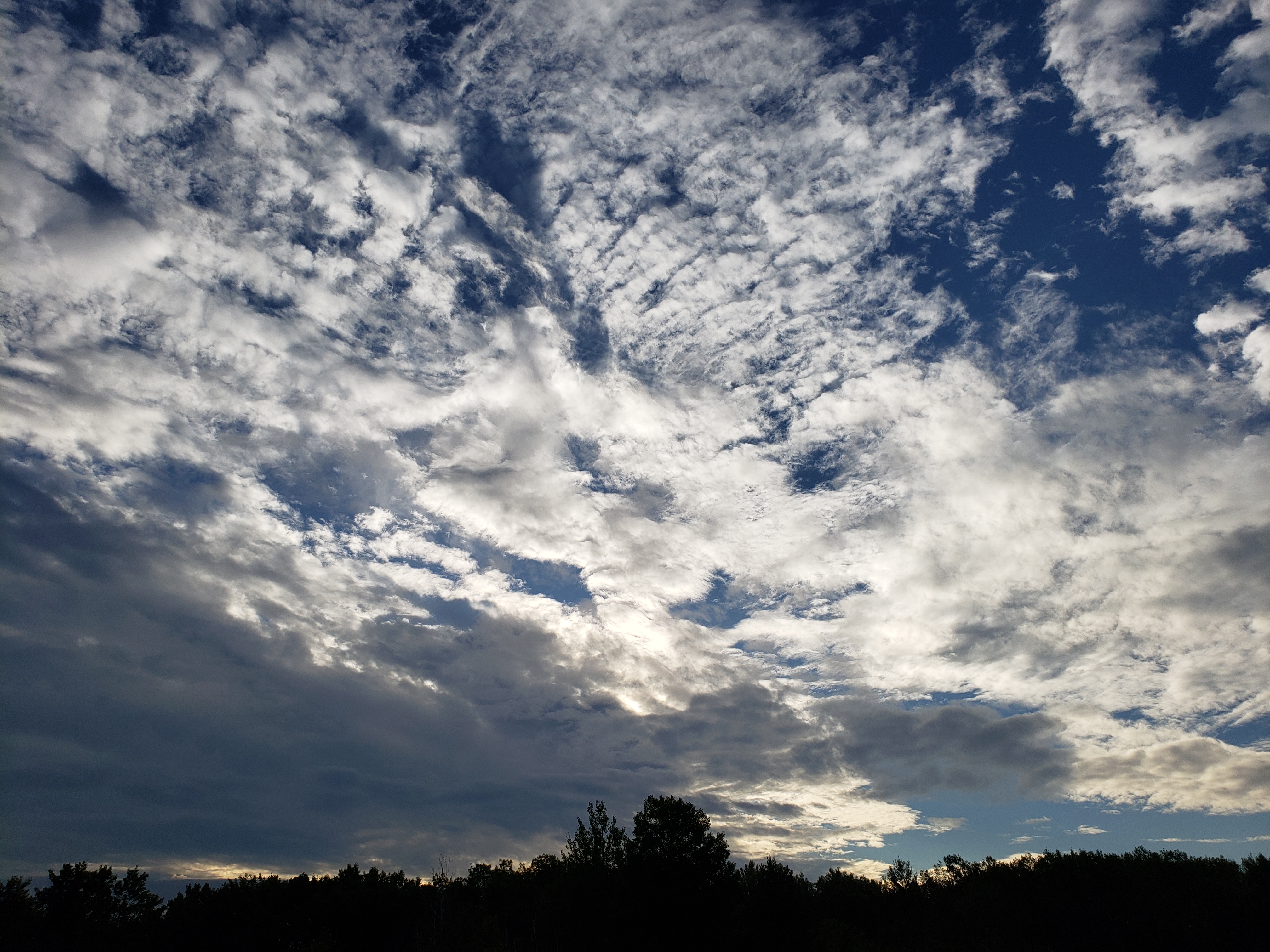
A little morning halo for you.
What I’m watching and reading
I’m going to short-form my list this month because I watched a lot in my time off, and a number of mid-season series finished their runs. My reading’s back on track as well.
DC’s Legends of Tomorrow. The whole season could be summed up by saying … and wackiness ensues. John Constantine’s arc was a bit dark, but the rest was so outlandish that I couldn’t take anything seriously.
The Flash was its usual schmaltz.
The Falcon and the Winter Soldier wasn’t as bad as I was led to believe. Yes, there were obvious gaffes that resulted from rewriting and reshooting during a pandemic to avoid a viral subplot, but I enjoyed it.
I May Destroy You was brilliant, but traumatic to watch.
Fleabag was similar but not quite as traumatic.
Black Lightning finished its run in typical DC fashion. Tobias Whale is dead, and everyone is ready for their HEA except poor painkiller, who had to forget he ever knew the Pierces as the cost of removing his kill order on them.
I also watched three movies.
Soul was quite good, as Pixar movies tend to be.
Amazon’s take on Cinderella was an interesting twist [SPOILERS], with Ella’s desire to be a fashion designer causing the prince to abdicate and follow his heart.
Raya and the Last Dragon was another show that I felt was better than some reviews made it out to be. The ending made me teary. Yup. I’m a sap.
Finally, I watched The Death Cure. I’d seen the ending before, so I knew what was going to happen, but I watched it anyway. The thing that got me was that there was evidence in the second Maze Runner movie that showed Thomas’s blood had curative properties, but nobody figured it out. They could have saved Newt. His death was pointless. A lot of the character deaths were.
I finished or read six books in September.
First was Redemption in Indigo by Karen Lord. Wonderful storytelling. It was an easygoing story with an uplifting ending.
[SPOILERS] Rebecca Roanhorse’s Black Sun was interesting, but it would appear that the two main characters are dead at the end. I wonder how the author’s going to walk that back.
[SPOILERS] M.R. Carey’s The Girl with All the Gifts was typically post-apocalyptic. In the end, all the humans die but the teacher, and she gets to teach the hungry kids, who are apparently the evolutionary future of the human race.
I enjoyed Ashley Shuttleworth’s A Dark and Hollow Star despite the rampant infodumping. The world; the connections between the seelie and unseelie fae, fairies, ironborn, gods, and titans; the interplay of science and magic, kind of required it. And I liked that it was partly set in Toronto.
Susanna Clarke’s Piranesi was the perfect read for my recovery. Short and yet complex. Gentle and kind and even if the ending isn’t particularly happy, it’s hopeful. LOVED.
Finally, Bethany C. Morrow’s A Chorus Rising focuses on Naema Bradshaw, the secondary antagonist from A Song Below Water. A deep dive into what social media and being an influencer can do to a person … until she gets a reality check in the form of her true nature as an Eloko.
And that was the month in this writer’s life.
Until tipsday, be well and stay safe; be kind and stay strong. The world needs your stories.
September’s almost over (!) Not keen on how time warps these days. In any case, another week has passed and here’s another batch of informal writerly learnings 🙂 Enjoy!
Welcome to another week of informal writerly learnings! Notice the change in the title of this curation. After years of writerly goodness found on the interwebz, I thought it was time for a change.
There’s something about the quality of the light in September that I love. The position of the sun in the sky, its later rising as we near the autumnal equinox. They instil peace and evoke memories of happy times in my life. Lying in my bed with the light flooding into my room as a gentle nudge to waking. Sitting on a covered porch in a comfy chair, wrapped in a sweater, with a cup of tea and my journal, writing. Solitary moments when I felt wholly myself.
I hope you find some joy in the season, too.
Before we get to the update, here are my monthly PSA’s:
All lives cannot matter until BIPOC lives matter.
Keep washing your hands, wearing a mask in public, maintaining social distance, and, if you haven’t been fully vaccinated yet, please get on that, won’t you? Delta’s still raging and new variants are on the horizon.
The month in writing
August started off well, writing-wise, but something happened (more on that in filling the well) that sent my train off the rails. Originally, I’d set myself an ambitious goal (as you do), but around the middle of the month, I realized I wasn’t even going to come close. I adjusted down and still didn’t reach it.
Of my 10,000-word goal, I wrote 6,703 words, or 67%.
I wrote my next Speculations. 1,080 words, or 108% of my 1,000-word goal.
I wrote 5,385 words on this blog. That’s 144% of my 3,750-word goal.
I worked on a couple of pieces of short fiction, trying to get them ready for open calls, but that fell by the wayside after mid-month as well.
Filling the well
The three writerly events I attended in August were closely clustered. I signed up for Fonda Lee’s Revision Boot Camp, on August 12th. It was offered in conjunction with When Words Collide, which was free and ran from August 13th to the 15th. On Saturday the 14th, I also attended Margaret Dunlap’s Demystifying Outlines offered through the Rambo Writing Academy.
It was a packed weekend, and I didn’t get to attend as many WWC sessions as I would have liked, but they will be coming out on their YouTube channel. Eventually.
Torvi on kiltti koira. Yes. I’m still enjoying learning Finnish.
So … the thing that happened.
For the month of August (August 3rd to September 3rd, actually—so five weeks) I was acting for my team lead in instructional design. I was the project manager for everything my team was working on, including a very important and time-sensitive project (henceforth known as the VITSP) that had to be completed. I knew it would be challenging and had booked the last two days of July off, leading into a long weekend, for a nice break to muster my resources.
Unfortunately, in the two working days I was off, the scope of the VITSP changed drastically. Originally, we were to have the learning products published on our learning management system (LMS) on the 9th of September. Now, it was to be published August 27th. That was two weeks cut from our timeline.
The instructions I was left with indicated that we would have to have the validated and translated documents for the self-instructional modules (SIMs) in the week of August 16th, so that we could edit, send for review and approval, convert to PDF documents, and submit them to our technical partners for posting to the LMS in time for the due date.
My first meeting of that first day of my acting made it clear that the SIMs would not be validated and translated until August 25th or 26th. I panicked. But I couldn’t be seen to be panicking. Add to this the fact that my manager was also absent for most of the week, and I was spiralling.
I tried to power through, but I found even thinking difficult. I couldn’t seem to make a decision (a deadly shortcoming in project management), and I certainly couldn’t articulate what was happening to me. My brain literally could not brain.
On the evening of August 12th, the situation had been diffused sufficiently that my brain began to brain again. What I was experiencing was related to my autism. Had I had some kind of meltdown? I did some research over the weekend and learned that what I’d experienced was called autistic burnout. I’ll let you click through if you want to find out more about it.
The best remedy for autistic burnout is rest. Unfortunately, I did not have that option, so I powered through. The brief rest of weekends was insufficient for recovery. I was plagued by insomnia, spent hours ruminating about the mistakes that resulted from my autistic burnout.
Proactive about my mental health as I am, I again reached out to my employer’s employee assistance program (EAP). After two weeks of playing phone tag, however, I gave up on the idea of getting counselling support. People were probably on holidays and demand exceeded supply. I only had one week remaining in my acting assignment, anyway, and the crisis would likely be over by the time we finally connected.
I explained to my manager and critical partners what was happening, and the situation improved. But it was still extremely stressful.
Somehow, I managed to get the VITSP done on time, but not without days of foregoing proper breaks and lunch, working overtime, and shaking like I was standing naked in a snowstorm.
I’m still not fully recovered, but I have a doctor’s appointment on the 13th. I’ll see if I can get some support then. I also have a couple days of leave coming up and will take my overtime as compensatory leave. I’ll make it through, but I’m still feeling foggy.
I tried to persist in writing, because my creative pursuits are one of the things that bring me joy but bullying through wasn’t serving me. The quality of my work was not satisfactory. So, I’ve stepped away from writing, too. I’m trying to be kind to myself.
What I’m watching and reading
Due to the above difficulties, my reading and watching habits have suffered as well. Concentration is hard, right now, so I have less than usual to report for August.
In the watching department, I only finished two series.
First, I watched the series finale of The Good Witch. It’s a positive and uplifting kind of series, and the last season was no exception. Though the writers tried to insert some romantic tension and uncertainty, nearly everyone paired off by the final episode. After a brief disconnect about Sam’s workaholic nature (aside from the season’s big arc of the red haloed moon), he retired and embarked on a world tour with Cassie.
Joy ends up with her girlfriend, Zoey, who was nearly frightened off when she discovered that Joy was a witch. Adam and Stephanie get back together, and even George gets a love interest. But Abigail and Donovan, who were engaged to be married, abruptly call it off. What about her happily ever after? And her flower shop is in danger from a big floral chain that’s moved into town. It seems that there’s more story to tell. Too bad the series was cancelled.
I also watched the end of the first season of Superman and Lois. It was a short season, because pandemic, I suspect, but it was typical DC network fare. Clark and Lois are devoted partners and the parents of two boys. Clark is fired from the Daily Planet and Lois quits because of the new owner of the paper, Morgan Edge. They move to Smallville after Martha dies.
Jonathan and Jordan, their sons, are day and night. Jonathan is the golden boy, popular, QB on the football team, and otherwise typical teen. He adjusts poorly to small town life, having left his girlfriend behind in Metropolis. Jordan is shy and awkward and plagued with social anxiety. It’s a surprise to no one and everyone when Jordan turns out to be the one who inherits Kal-El’s powers.
I really liked John Henry Irons.
I only finished reading three books in August.
The first was We Set the Dark on Fire by Tehlor Kay Mejia. The book starts with the origin story of the land of Medio. It establishes the social contract between men and women, as well as the class structure of the island nation. In Medio, every affluent man is married to two women. His Primera manages his household and is his intellectual and political partner. His Segunda is his social partner and bears his children.
Daniella is about to graduate from Medio School for Girls and enter into her marriage contract as a Primera when she is approached by a member of a resistance group who blackmails her into spying on her new husband for them. His price? Silence about her impoverished background and family.
It was definitely a heroine’s journey novel, a la Gail Carriger. Dani has little power throughout the novel, and it’s only her compassion and desire to do right that allows her to prevail. It’s also an enemies to allies to lovers story between Dani and her Segunda. I enjoyed it.
Then, I read Nancy Springer’s The Case of the Missing Marquess. Yes, the novel that inspired the Enola Holmes movie. I attended a literary event back in the spring that featured Springer, and everything she said about the adaptation was true. It was a short, but lovely story, and Enola is much more resourceful in the novel. She has to be. Basilwether is also much younger, so no romance in the book.
Finally, I read P. Djèlí Clark’s A Master of Djinn. Loved! I’ve heard some negative things around the interwebz, but I loved the story. I loved Fatma. I loved the world. Read this book. I will say no more.
And that was a month in this writer’s life.
Until tomorrow, be well and stay safe; be kind and stay strong. The world needs your stories!