Tipsday: Writerly Goodness found on the interwebz, June 4-10, 2017

It’s another week chock full of informal writerly learnings!

K.M. Weiland wonders, are you a writer, or a storyteller? Helping Writers Become Authors

Julia Fierro guest posts on Writer Unboxed. The three tiers of point of view technique: observation, interpretation, and imagination.

Gwendolyn Womack also stops by Writer Unboxed to write about intuition and writing: what happens next?

Kathryn Craft: early hints of backstory. How to work backstory into your story from the first line. Writer Unboxed

Kathryn Magendie explores mind to muscle focus (self-awareness) for writers. Writer Unboxed

Sara Letourneau shares part ten of her developing themes in your stories series: the act II crisis. DIY MFA

G. Myrthil teaches SCBWI conference 101. DIY MFA

Gabriela Pereira shares her experience at this year’s Book Expo for DIY MFA radio.

Dawn Field shares five ways to improve your verbal imagery. DIY MFA

K. Tempest Bradford writes about WisCon and who is allowed to feel welcome (hint: it’s everyone).

Janice Hardy helps us shift between drafting and editing. Fiction University

Later in the week, Janice wonders, how many settings does your novel need? Fiction University

James Scott Bell explains how to let your characters live and breathe. Writers Helping Writers

Jami Gold explores Wonder Woman as the essence of a strong female character. [For moar Wondy, see below!]

Sonja Yoerg guest posts on Writer’s Digest: how to treat mentally ill characters in your novels.

Fae Rowan lists eleven writers’ survival tools. Writers in the Storm

Chris Winkle examines the four critical elements that make stories popular. Mythcreants

Kristen Lamb shows us how to remain calm when it all goes pear-shaped.

Tanya Huff shares her experience writing a series: what goes around, shoots back. Unbound Worlds

Jenna Moreci shares her self-editing process:


Elise Holland visits Jane Friedman’s blog to offer advice on the perfect cover letter.

Nathan Bransford offers a brief but comprehensive guide on how to research literary agents. Later in the week Rachel Stout visits Nathan’s blog to talk about personalizing your query.

Joanna Penn interviews Orna Ross on the Creative Penn podcast.

Kameron Hurley posts about carrying the weight of the world.

Kate Laity explores Finnish folklore: Louhi, the witch of the north. Folklore Thursday

Nathan Gelgud: how George Orwell’s 1984 almost didn’t get published. Signature

Mary Hines interviews Margaret Atwood on how religion influences utopias and dystopias. CBC’s Tapestry.

Wonder Woman takes over Tipsday:

Charles Pulliam-Moore shares the epic Black Panther teaser trailer. i09

And with that, I shall leave you until Thoughty Thursday!

Be well until then, my friends.
tipsday2016

Tipsday: Writerly Goodness found on the interwebz, May 21-27, 2017

Another week of informal writerly learnings? Get set to open your goodie bag 🙂

K.M. Weiland debunks five misconceptions about writing. Helping Writers Become Authors

Later in the week, Kate posits that great comedy is meaningful, and shares four tips to help you make it so.

Kathryn Craft reviews the decade in publishing. Writers in the Storm

Kimberly Brock says, you’re writers, not waiters. Writers in the Storm

Jane Friedman advises on how much you should personalize a query letter.

Elizabeth Huergo pays tribute to C.D. Wright: songs and their landscapes. Writer Unboxed

Heather Webb teaches a survey course in time management: writing through our busy lives. Writer Unboxed

Dan Blank says, if you want to be successful, surround yourself with success. Writer Unboxed

Jamie Raintree: let your writing process be your own (and how to discover it).

Bonnie Randall gets into character minutiae and seemingly irrelevant details. Fiction University

Stacy B. Woodson shares her fantastic experience at Malice Domestic 2017. DIY MFA

Jami Gold challenges us to deal with character stereotypes.

Kristen Lamb reveals how shame is at the heart of good fiction.

Will Hindmarch explains how to give great notes a writer can use. Magic Circles

Nina Munteanu gives you the tools you need to make a believable world.

Writer and geologist Alex Acks examines Arakkis, Tatooine, and the science of desert planets. Worldbuilding advice from Tor.com.

Jo Walton looks at genre fiction’s obsession with Belisarius, with a lovely recommendation for Guy Gavriel Kay’s Sarantium novels. Tor.com

Darlene Naponse is a Reveal – Indigenous art award Laureate.

Emily Temple curates some pearls of wisdom—on writing and life—from Jamaica Kincaid in honour of her 68th birthday. Literary Hub

These are old human themes: Margaret Atwood on the enduring power of The Handmaid’s Tale. CBC

James Whitbrook watches the new Game of Thrones trailer. i09

I hope you’re having a lovely week.

Be well until next I blog 🙂

tipsday2016

Ad Astra 2016, day 2: How to get an agent

Disclaimer: I am not perfect and neither are my notes. If you notice anything that requires correction or clarification, please email me at melanie (dot) marttila (at) gmail (dot) com.

Panellists: Amanda Sun, Mary Fan, Gerald Brandt, Matt Bin

HowToGetAnAgentPanel

AS: Online resources that can help you get an agent: #MSWL, Miss Snark, Query Shark, Guide to Literary Agents blog.

MB: #MSWL is critical these days.

GB: You have to do the research.

MF: There are writers who get an agent and their first novel fails to sell, their second novel fails to sell, but then their third sells big.

MB: The agent has to love your book.

GB: If your query doesn’t match their submission guidelines, it will be rejected.

AS: I used to be an acquiring editor for Room. If a submission didn’t meet the submission requirements, I’d never see it. It would go straight to the spam folder.

Q: How formal does your query have to be? I write YA.

GB: You have to be professional up front. Your second paragraph, where you’re pitching the novel has to have the flavour of your book, but it’s a sales pitch.

MB: The agent wants to understand how your book works and why it will appeal to readers.

MF: 250 words is a good goal length for your query.

Q: At what point do you look for an agent?

GB: As soon as you have a book that’s finished and ready to go out into the world.

MB: Query agents first. If you submit to publishers, agents will have their sales channels limited. Remember, it’s your agent’s job to sell your book to publishers.

GB: Take advantage of pitch sessions at conferences and conventions.

AS: And work on your next book.

GB: The agent is in it with you for the life of your career.

Q: So querying an agent first is better? Is that because editor A might love you book and editor B might hate it?

GB: At Penguin Random House, if one editor rejects the book, all of them do.

MF: That can happen at agencies, too. Agents can move around, too.

Q: What happens when your agent leaves the agency?

GB: In my experience, I was given the option to follow the agent or stay with the agency.

MB: When agents send your novel to publishers, they do so with a different perspective.

MF: I know a writer whose agent is all business. Some agents will want to help edit or develop the work prior to submission to publishers.

MB: Look at the agent’s reputation before you sign with them. You have to be able to work with them.

GB: When an agent is interested in your work, the tables turn.

MF: When you get an offer, don’t be afraid to ask for references.

AS: Don’t be too eager. You don’t have to back down 100% of the time. It’s a partnership.

MF: There are some Schmagents who aren’t legitimate. There should be no reading fee.

GB: The money should flow to the author. Check out Writer Beware and Preditors and Editors.

MB: Querying is the traditional road. Networking at conferences and conventions can help.

GB: But don’t be stalkery. Have your elevator pitch ready, just in case.

AS: Don’t burn your bridges. Publishing is a surprisingly small world.

MF: Maybe we should talk about the structure of a query? It’s three paragraphs. Introduce yourself and your book. The second paragraph is your pitch. Then the third paragraph is about you and your qualifications.

GB: List publication credits if you have any, memberships in any writing organizations. Make sure you look serious.

AS: Your introductory paragraph should focus on the reasons you’re querying this particular agent. Have you met at a con? Do you write books in the same genre as other authors they represent?

Q: Do you use Canadian, or US spelling?

GB: Everything should be in US spelling.

MF: Your comps (comparative novels) should be published in the last three years.

AS: X meets Y is a popular formula to use. Agents can use it to pitch to publishers.

MB: We should also mention online pitch contests like #PitMad. Look them up. Most of them are on Twitter and you have a limited time to pitch directly to agents. Use the hashtag. If an agent likes your 140 character pitch, they’ll respond to you. The rules are all online.

Q: How long should my book be?

MF: It really depends on your genre and category. There are a lot of resources for this online.

Q: Should you query to an agent if you mostly write short fiction?

AS: You can do that without an agent and, in fact, most agents won’t represent short fiction, even for authors they represent for novels.

GB: Collections of short stories are a hard sell.

And that was time.

Next weekend, it will once more be time for a next chapter update (already?).

Be good and write well!

The next chapter: September 2015 update

What can I say about September? First, I’m back on track. Second, I finished drafting Marushka and am well on my way to having a finished draft of Gerod and the Lions.

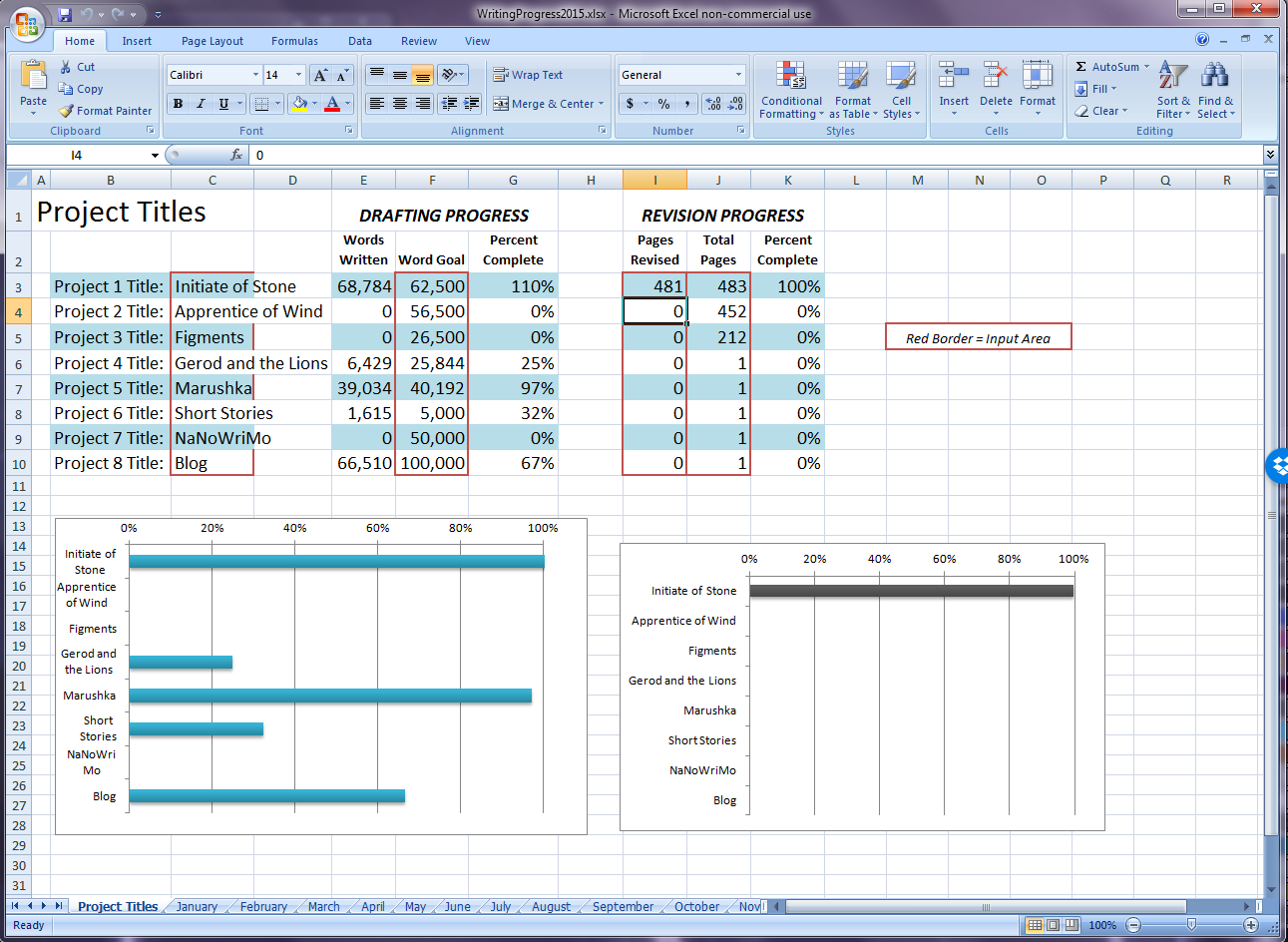
Marushka ended up at a tidy 73,961 words altogether, or 97% of my 75k goal. As it’s a YA fantasy, I’m quite happy with that.

I’m going to set my sights a little lower with GatL than my original 50k goal. I think 40k should be enough. With revision and editing, It will likely settle somewhere around 45k, which is pretty perfect for a middle grade (MG) novel.

I did some more work on my query letter and am now preparing my next batch. To make up for missing August and September, I’m going to send out in batches of 10 queries for the next two months. I might do this in batches of five every couple of weeks. We’ll see.

I’m also making good progress on my outline for Reality Bomb (working title), which should be complete in time for its drafting in NaNoWriMo 2015. I’m on chapter 21 of 36, so I think I’m in a good place. I should note that as I’m writing this outline in a notebook, by hand, in my own, rather chaotic, cursive, that I’m not counting these words on my spreadsheet.

As far as the short fiction is concerned, I continue to revise and submit, but I haven’t had any positive response recently.

September's progress

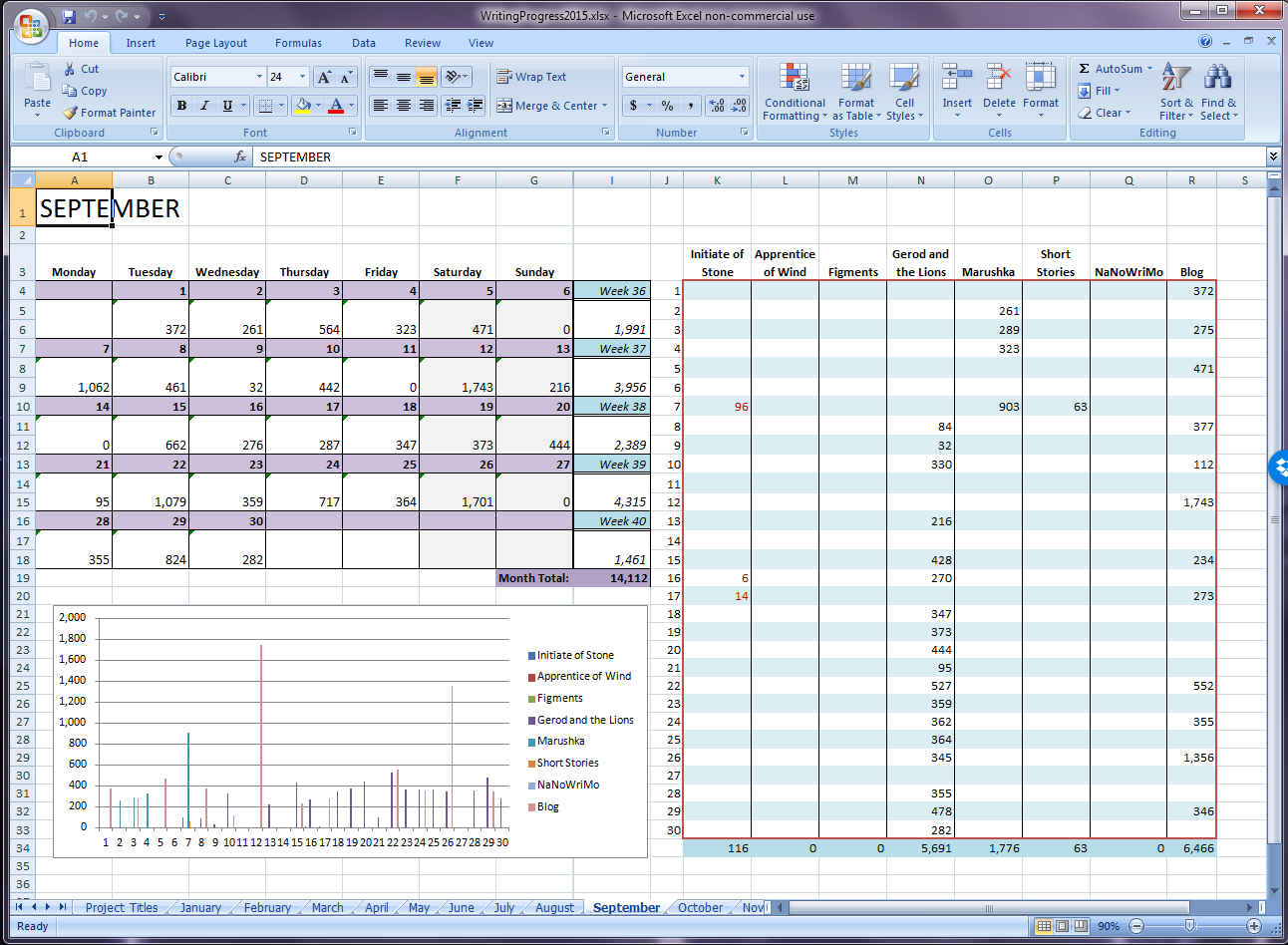
Here’s how things broke down in September:

  • The blog has once again taken over as my most productive medium with 6,466 words;
  • In second place is GatL with 5,691 words;
  • Marushka clocked in at 1,776 words;
  • My query rewrites totalled 116 words; and
  • I revised 79 words of short fiction.

Total words generated in September: 14,128.

September's summary

There were only four days where I didn’t record any word count, but those days, I was likely working on my outline.

I’m settling into the writing life again after all my trials and tribulations this year. It feels good. It feels freaking fantastic.

And now, I’m going to try to get a few words in for October 3rd before Doctor Who 🙂

Have a wonderful weekend, all!

And we’ll see you again on Tuesday for more Writerly Goodness.

The Next Chapter

The next chapter: August 2015 update

Ok. Let’s just get this out of the way. August sucked for writing.

I had every intention of writing when I was down in London, but I should have kept in mind the lesson I learned back in the spring. Mel + travel to deliver training = no writing.

Well, it wasn’t absolutely zero writing. I revised a short story and submitted it, and I revised my query letter based on feedback from Kristen Nelson (more on this in a bit), but that amounted to very few words.

As I’ve mentioned in other posts, delivering training, though I’m good at it, drains introvert me something fierce. Add that to travel, not feeling well for most of my time away, not being around home to help Mom with her first cataract surgery, and not being around my support system, and you have the perfect storm of non-productivity.

Plus, it was two and a half weeks away. That was a fair chunk of the month. I shouldn’t have been surprised.

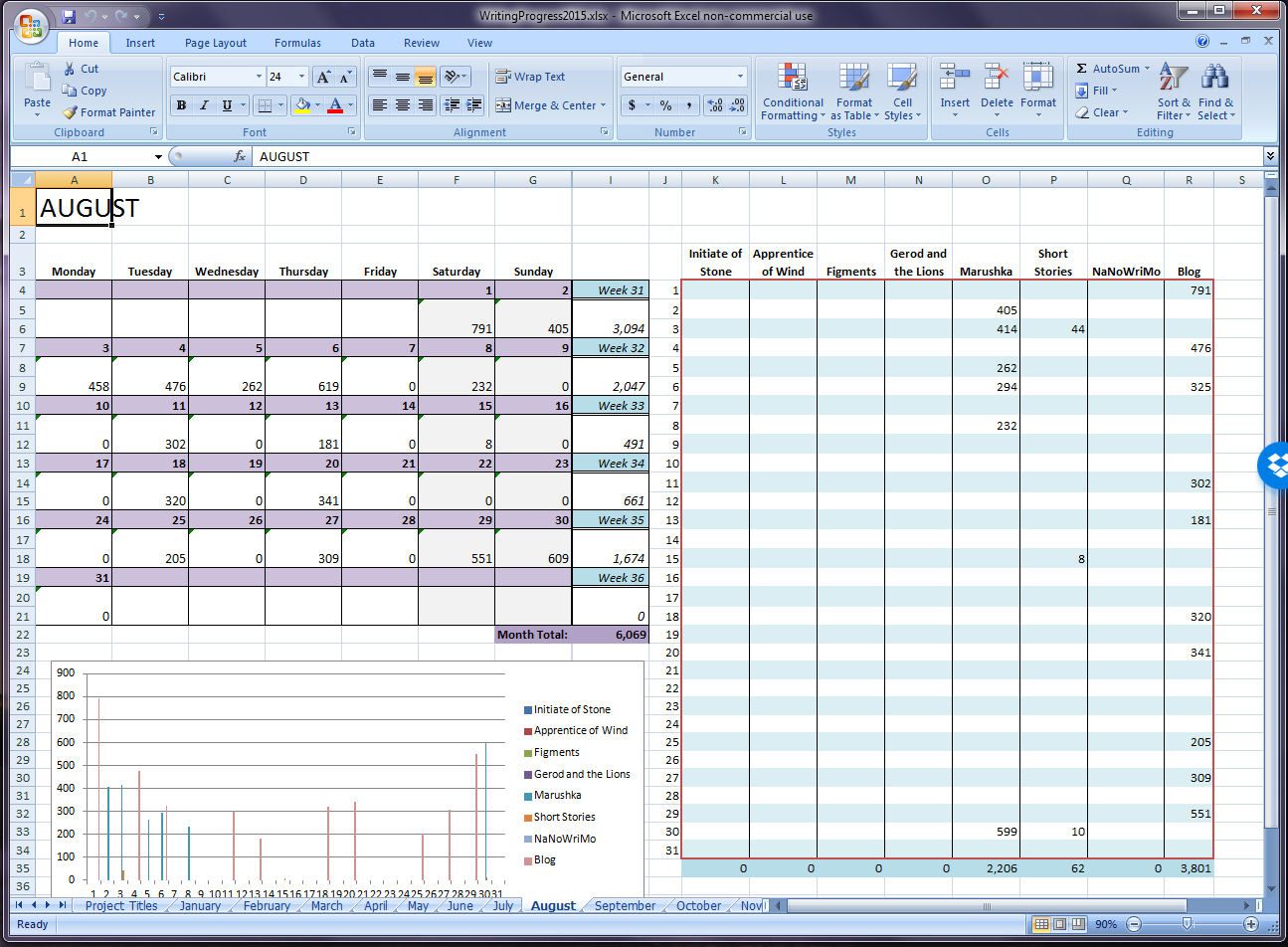
Here’s how the month broke down (pun intended):

August progress

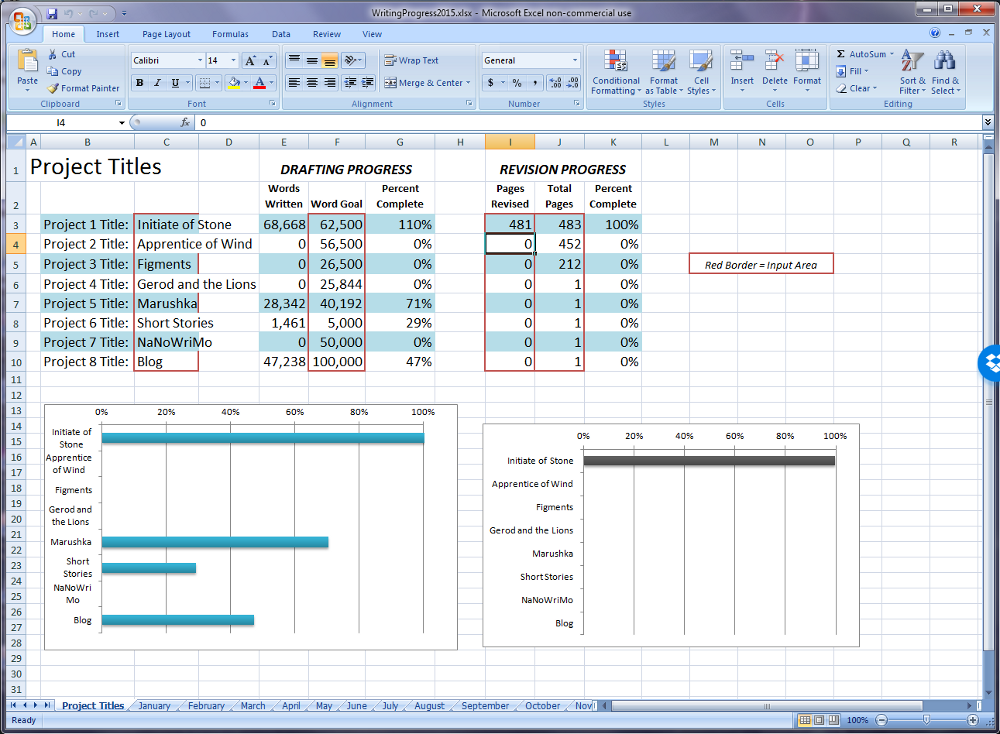
I drafted another 2,206 words on Marushka, but am still not quite at the end. I hope this month will see the end of the draft (at last). I am 95% toward my 75k word total goal for the draft, so that’s something.

I revised 62 words on short stories, only 8 of those while I was down in London. I sent two stories out and received two rejections.

I blogged 3,801 words, and I decided not to blog on the weekends while I was away. Ostensibly, this was to make it easier to write, but I’ve already mentioned how that went.

Total words for the month: 6,069. That’s my lowest monthly total all year.

August Summary

Other stuff I did in August:

When Roz Morris shared HodderScape’s open submission period, I had to submit Initiate of Stone. I’ve had no word, but I’ll definitely fill you in on the results.

Last year, I missed out on Kristin Nelson’s query letter intensive. It was that whole work thing, again. So, this year, I signed up, hoping against hope that my manager would find someone else to go to London in my place. It was not to be.

So I emailed NLA and advised that I would not be able to join the webinar. And Kristin offered to meet with me one-on-one when I got home.

That meeting took place this past Thursday and Kristin gave me some excellent direction.

Kristin was great, and though I think I was still a little fan girlish, I tried to make the most of the opportunity.

Yeah, I get star struck by agents. That’s the kind of geek I am.

So that’s it for my very unproductive month.

Rest assured, I’m back on track and aiming high.

The Next Chapter

The next chapter: June 2015 update

As expected, with the revisions of Initiate of Stone complete(ish—I’m still getting the final sections from outstanding beta readers), query letter and synopsis written, and the query process started, my productivity is back to normal.

June 2015 progress

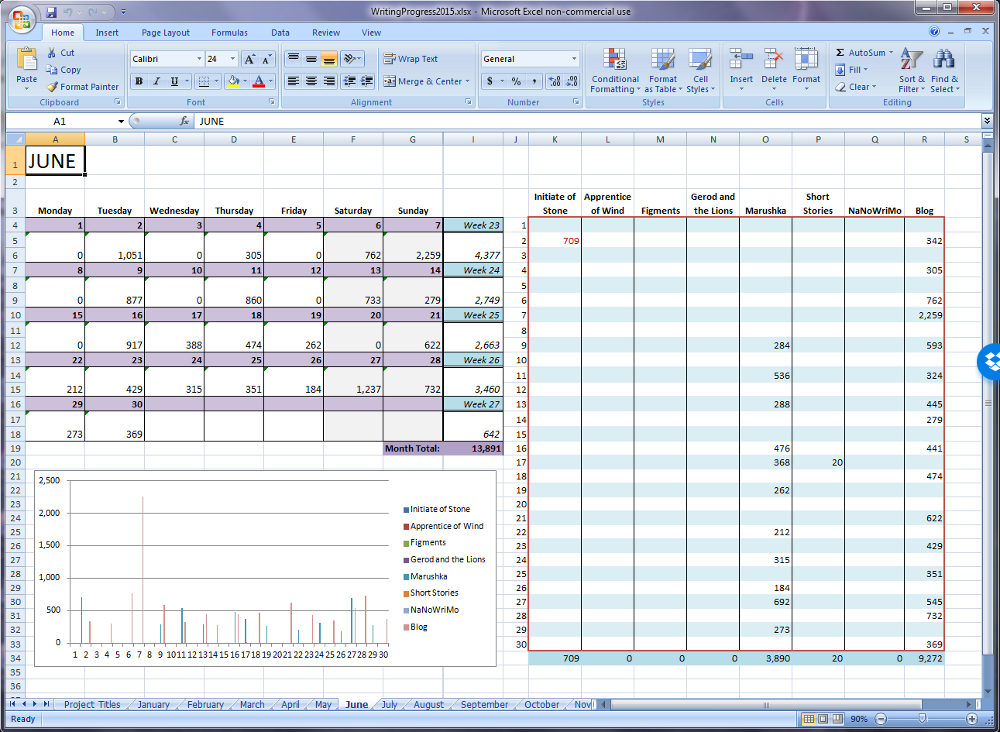
The 709 words written in the IoS column represents my third and final (for now) stab at the synopsis.

I’ve already received my first “not for me” response from my first batch of queries. In typical Canadian fashion, I seriously considered writing the agent back and thanking her for such a prompt response. LOL!

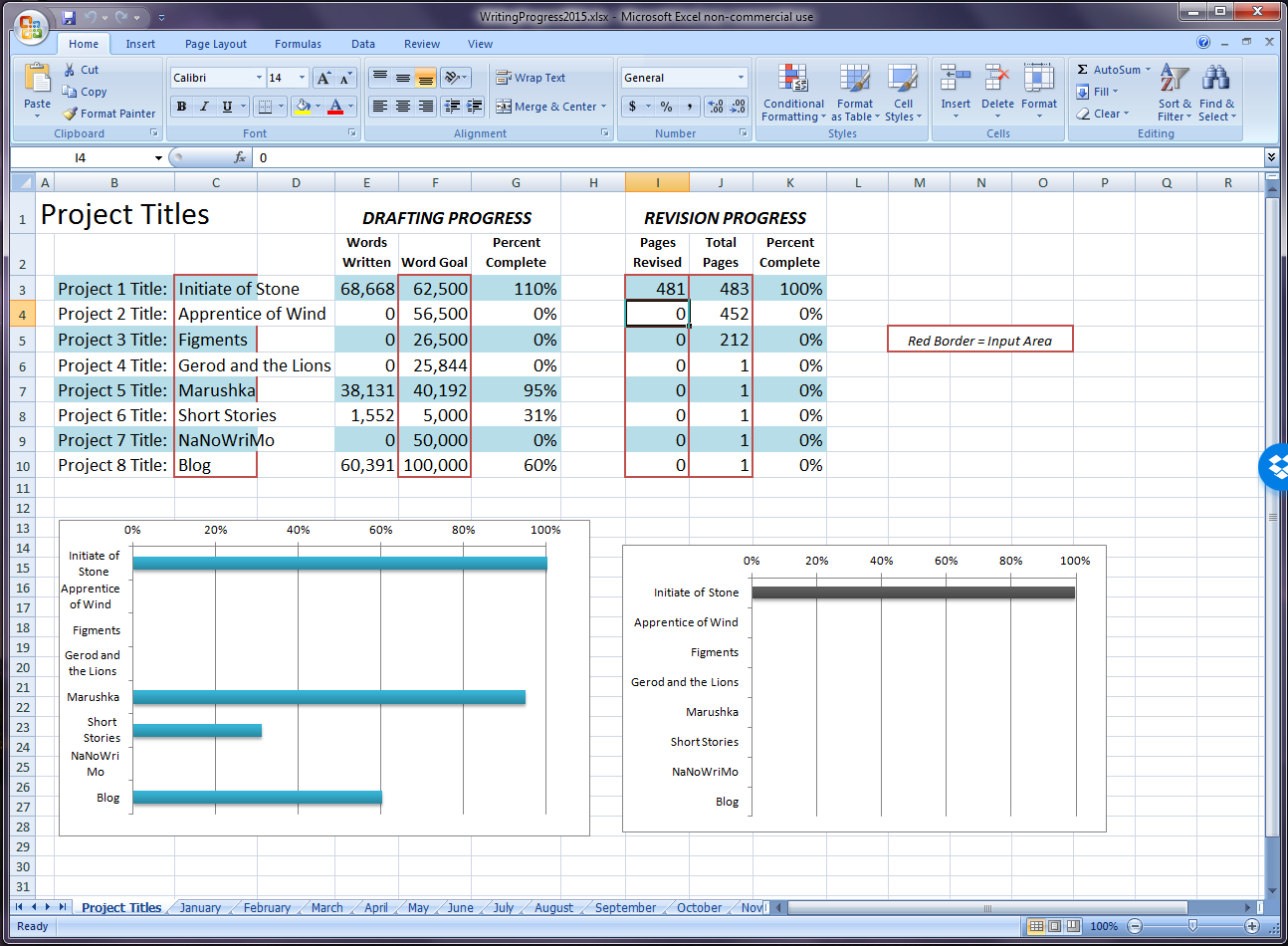
You’ll notice on the summary (below) that I’ve now written/revised 110% of my goal on IoS.

On the short fiction front, the story I’d sent out in May was rejected, and the two stories I sent out in June have also been rejected (just found out about the second of those yesterday). I’m persistent, though, and I’ve turned around and sent in another story to the anthology that is still open to submissions.

The one thing I’ve discovered is that, with each rejection, they are getting easier to handle. You get desensitized after a while. It is very much a part of the business of writing, but it’s only experience that takes the sting out of it. I barely blink now. I’m not really sure if that’s a good thing or a bad thing . . .

First time rejectees can rarely expect to receive negative feedback with such equanimity.

No story is submitted without some form of revision and/or editing, however.

So, though the short fiction word count was only 20 words, that number represents the revisions on two short stories.

I drafted another 3,890 words on Marushka and expect that I will finish up in July (yay!). I’m at 71% of my goal. I might make 60K on the draft yet 🙂

And now the blog has resumed its place as my primary new word generator at 9,272 words.

My total word count for June is a modest 13,891. It’s pretty much where I figured I’d be, though, so I’m good with that.

June 2015 summary

I’m going to start actively revising, editing, and submitting my short fiction until all of my existing pieces find homes. I haven’t really had any further ideas that fit the short story format and until I do, I’m going to stay focused on my novels.

After I finish up my draft of Marushka, I’m going to return to Gerod and the Lions and finish up that draft. Once GatL is finished, I’m moving on to Apprentice of Wind, the second book in my epic fantasy series. I don’t know how far into that I’ll be when NaNoWriMo rolls around again, but then I’m going to be moving forward with Reality Bomb (working title for my NaNo 2015 project).

My goal in NaNo will be to write more words on the project than I managed last year. Since I will once again be attempting NaNo while working, and I already know I’ll be out of town for a full week in November for training, it’s going to be a tough goal to reach.

I think that will take me through to the end of the year rather nicely 😉

So that’s been my month in writing.

How about all of you? Achieve your goals? Fall short? Acceptances or rejections? One way or the other, it’s all Writerly Goodness. Share yours in the comments 🙂

The Next Chapter

The next chapter: April 2015 update

Where I’ve been

I don’t know how to say this, but April kind of sucked.

Due to the situation at work, I decided to give myself a true break for the Easter long weekend. So, no writing there.

The next weekend was Ad Astra and I knew better than to even promise a blog post. No writing that weekend either.

After having left things for so long, it took a while to get restarted.

I didn’t get either of the two stories written that I had wanted to, and only revised one story, but incompletely.

You won’t be surprised by my progress, or lack thereof.

April 2015 progress

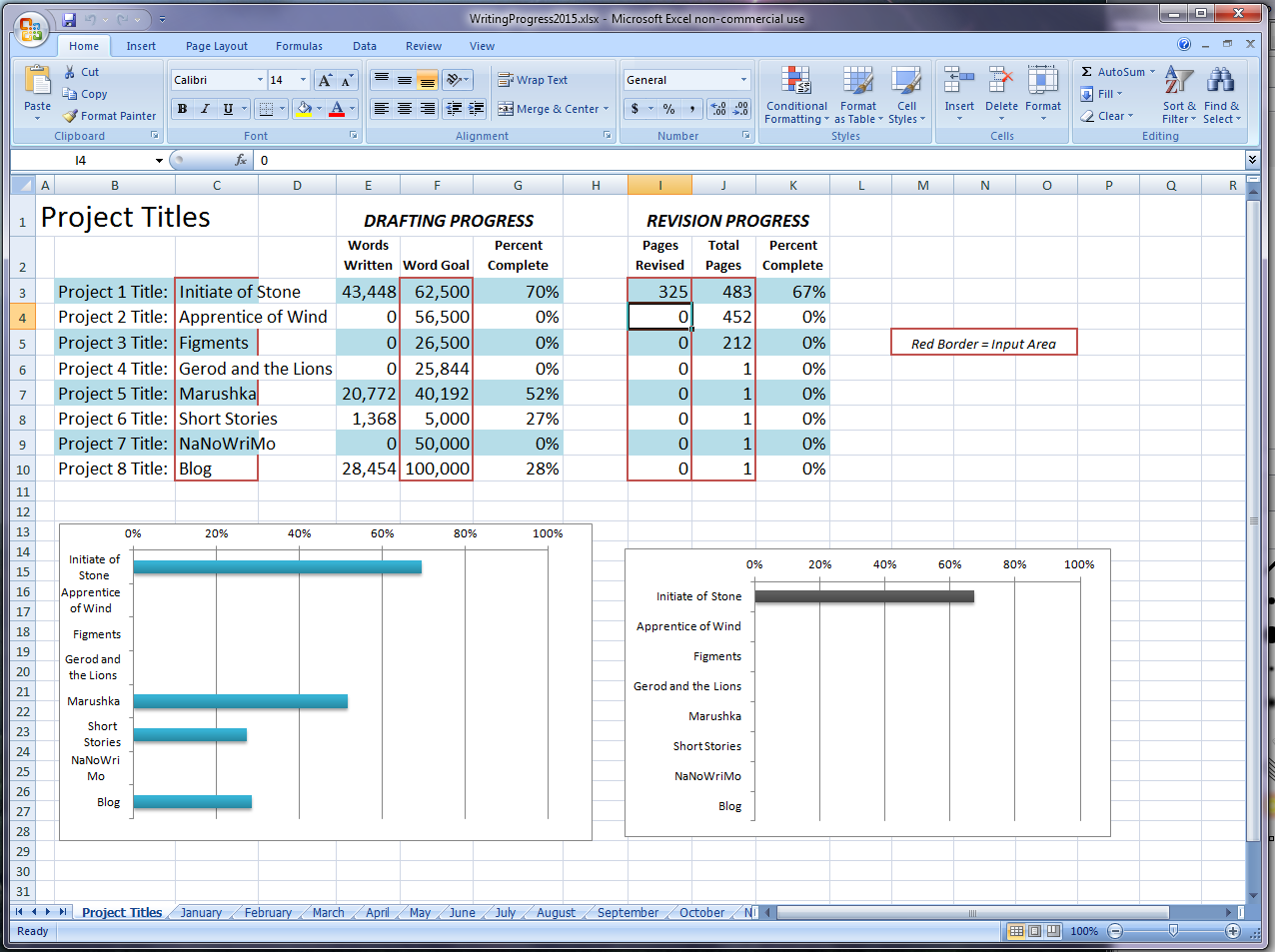
11,907 revised words on Initiate of Stone. I’m about 70% finished.

5,541 words written on the blog.

2,931 words written on Marushka. This is so far below what I’d hoped for in progress that it makes me weep a little. According to my original goal, I’m just over 50% of the way to finishing the draft. I’m closer than that, but I don’t know how much more.

38 words is all I managed on my short story.

20,417 was my total for the month.

April 2015 summary

I submitted my story “The Broken Places” for consideration to the Aurora Awards and several people were kind enough to nominate me.

I’ve also sent it to Sandra Kasturi for consideration in the next Imaginarium anthology.

Will be sure to let you know what happens.

Where I’m heading

Friday was my last day as a consultant. It’s truly a relief to be back at my old position with the training team. I’ve realized that I appreciate my position so much more now because I actually get to see the results of my work.

Even if I’m frustrated because my learners tend to hear what they want rather than what I’m actually teaching them, I maintain relationships with many of them and can see how they’re doing.

I’m burnt. I’ve actually been so tired I’ve felt sick, but when I’ve tried to nap, I don’t actually sleep. I close my eyes and my mind won’t settle down. It happens at night, too. I just need a break.

I have only two weeks at work and then I’m off for five.

Since I need the rest, I’m not going to be slaving away over my break, but I do intend to get some work done and finish a few small projects around the house.

I aim to have my revisions on IoS and my drafting of Marushka all, or mostly, done by the time I start my leave.

Then, I’m writing my query and synopsis, researching agents, and I’m going to send IoS into the world to see how she does.

I’m trying to arrange a bit of a promotional visit for a new author friend, Madeleine Callway, some time in June as well.

Because of that, I’m not aiming high for the next couple of months, though I do intend to pick up with drafting Gerod and the Lions once I’m finished Marushka, and trying to pull together Apprentice of Wind, the second book in the Ascension series.

Since I’ve been working toward the goal of querying, I’ve taken a load of courses, including Jane Friedman’s MBA for Writers and I’ve picked up Jeff Goins’s The Art of Work.

I’ve had Julie Czerneda and another author friend review my opening (‘cause openings still kick my arse).

I’ve ordered the 2015 Guide to Literary Agents and signed up for Publisher’s Weekly, ShelfAwareness, and Publisher’s Lunch free newsletters.

I’m getting serious about this writing gig in a whole different way.

Of course, I’ll let you know how all of this pans out.

One more post today and then I think I’m done.

See you in a few!

The Next Chapter

WWC 2014, Day 3: Querying your YA novel

Panellists: Jacqueline Guest, Danielle L. Jensen, Jessica Corra, Shawn L. Bird, Karen Bass

Jacqueline GuestDanielle L. JensenQ: Do you query a trilogy?

DJ: It depends on your genre. Some say your novel has to be a standalone, but I’ve been successful querying a trilogy.

JC: It’s okay to mention that your novel has series potential, but you can go too far with this. I was once queried with a nine book series. That was too much.

SB: It’s good to know the career potential of the author, though.

DJ: Focus on one book in your query.

JC: It’s a business letter.

KB: It’s your pitch. Three sentences. Short, punchy, and pithy.

JC: Think about the backbone of your book. That’s your through line.

JG: You’re not selling to a reader. You’re selling to an agent or publisher. Don’t tease.

SB: The basic structure of a query letter is three paragraphs: pitch, comps, and bio.

JC: You need to mention genre, word count, and title.

DJ: You Jessica Corracould write: I am seeking representation for TITLE, a GENRE novel, complete at LENGTH (in thousands of words, rounded to the nearest thousand). I actually got my agent through a logline contest for Ms. Snark.

JC: Sometimes you don’t need an agent, though.

KB: Small Canadian publishers, no. Big publishers or genres, yes. Anything in the States, yes.

DJ: I’d die without my agent. She takes care of things

like foreign riShawn L. Birdghts. It really depends on your skill set.

SB: Sometimes, it depends on the agent.

DJ: I’d recommend Query Tracker.

JC: Jim Butcher proposes this formula for youKaren Bassr log line: *WHEN SOMETHING HAPPENS*, *YOUR PROTAGONIST* *PURSUES A GOAL,* but will he succeed when *ANTAGONIST PROVIDES OPPOSITION*?

JG: Spell check, for God’s sake. You have two sentences to hook an agent or editor.

DJ: Your first five to ten pages must be perfect.

JC: We know you’re human, though. We’ll overlook something small.

JG: There are lots of library books that will help you.

DJ: Online critique groups can help as well.

Q: How do I know the agent is reputable?

DJ: Writer Beware, Preditors & Editors, and Absolute Write are three sites where you can check out questionable agents, agencies, or scams. If you post on social media or forums, don’t bitch about being rejected.

Q: How many queries do you receive and how many of those do you read?

JC: We have readers, so I don’t see them all, but everyone I receive, I read.

Q: You’ve published several books. Do you still slave over your letters?

JG: Yes. Every time.

WWC2014 Day 1: The Perfect Pitch Package with Jacqueline Guest

Before we begin, some context

Jacqueline publishes, and always has published, in the Canadian market. As such, she doesn’t have, nor does she need, an agent. Jacqueline pitches her publisher directly. This is a little different that pitching an agent, or querying an agent.

It’s more like a book proposal. Many of Jacqueline’s tips can be amended slightly for agent queries.


First, you have to make sure your manuscript is perfect. Edit it. Print it out. Read it aloud. Don’t edit on the computer screen. You’ll miss too much on the screen.

There’s an editor’s checklist for writers in the package. This document covers the basics that every editor looks for.

Mel’s note: Jacqueline’s package included a sample query letter, tips on submitting to a publisher, the editor’s checklist for writer’s, a tip sheet from Frank L. Visco called “How to Write Good,” and a page of resources about free and purchased writing software, and recommended writing craft books.

Know your audience.

Do you need an agent? In the American market, yes, but not in the Canadian one. You can pitch directly to a Canadian publisher. Best to make sure that the publisher has American distribution, however.

Contracts are tricky. Check out the Writers’ Union of Canada (WUC) site for assistance.

Everything is electronically generated these days.

Start with the Writer’s Market. It’s published in print annually, but there is also a web site that you can access that is continually updated.

Do your homework. Identify the publishers that publish the kinds of novels you write.

If you use the print version of the Writer’s Market, go to the publisher’s web site to make sure there have been no changes to the editors since the publication date. I’d recommend that you call the publisher to confirm.

What goes in your package:

  • Your query letter.
  • A 1-2 page synopsis.
  • 3 chapters, or the number of chapters/pages/words the publisher specifies.

Format:

  • Double spaced
  • Single sided
  • 1” margins
  • Header: On the left, type the title of the novel and beneath it, your name. On the right insert the page number.
  • Use clips for synopsis and sample pages. Use an elastic when sending a whole manuscript.

There are lots of “How-To” books out there on how to write a query or proposal. Get them from your public library and read them.

I use what I call the two-sentence sell.

In the first sentence, you identify your audience, the word count of your novel, and the story line (Mel’s note: Think tag line).

In the second sentence, identify your novel’s unique qualities, and any marketing points (Mel’s note: For example, if you write middle grade fiction, mention if you’ve prepared teaching guides, or activity guides for librarians. If your book is for adults, you may consider mentioning, or suggesting, book club notes.)

These two sentences must be succinct and on target.

Jacqueline then set us the assignment of writing our 2 sentence pitch.

If you need to include a chapter outline, write no more than 1 or 2 sentences on each chapter.

Everything needs to work together. Print it out and read it aloud. You’ll find more errors and awkward phrasing that way.

If you want to write and learn to write better, you must read.

Jacqueline brought out several resource books that she recommends, including Strunk & White’s Elements of Style.


Jacqueline GuestAbout Jacqueline:

Jacqueline is a Metis writer who lives in a log cabin nestled in the pinewoods of the Rocky Mountain foothills of Alberta.

Her award-winning books are unique in that many of the main characters come from different ethnic backgrounds including First Nations, Inuit or Metis. Her well-drawn characters face issues common to every child such as bullying, blended families and physical challenges and are strong role models for today’s youth. Jacqueline’s historical novels for young readers’ present Canada ’s vibrant past as an exciting read every child will enjoy. Her young adult mysteries address teenage problems in a sensitive way while still providing a great page-turner.

Jacqueline’s interactive curriculum-based History & Literacy Presentations appeal to students in all grade levels and are of interest as they incorporate her own background as she shows how the Metis people are a strong part of the fabric of Canada ’s past. Her Easy Key Writing Workshops provides the EasyKey Method to facing a language arts exam and passing! She also teaches writing how-to’s and encourages children to follow their own literary dreams.

Jacqueline has participated in Mamawenig, the Saskatchewan Aboriginal Literacy Gathering, where she helped shape the direction of Native literacy in Saskatchewan . She has performed pro-bono workshops at the Edmonton Young Offenders Centre, presented for the Cultural Diversity Institute, University of Calgary , Batoche Historical Site and participated in Back to Batoche Days, and Fort Calgary ‘s Metis Cultural Festival. Jacqueline has also presented at the Manitoba Association of Teachers of English, the Alberta Association of Library Technicians as well as numerous Writers’ Conferences.

She is the current Writer-In-Residence for the Marigold Library System and a member of Calgary Arts Partners in Education Society.

Jacqueline has been nominated for a National Aboriginal Achievement Award and the prestigious Esquao Award for outstanding achievement by an Aboriginal woman. She has travelled extensively and as far away as Nunavut to spread the good word on literacy.

A strong advocate of reading, Jacqueline believes the key to the future is through better literacy today.