Tipsday: Writerly Goodness found on the interwebz, July 9-15, 2017

And here we go with another batch of informal writerly learnings 🙂

Sophie Masson expounds on the joys of writing in an unfamiliar setting. Writer Unboxed

Kathryn Craft says you need to earn the backstory by raising a question. Writer Unboxed

Becca Puglisi teaches subterfuge in dialogue. Writers in the Storm

Jenny Hansen shares … a story of balls. Writers in the Storm

Chuck Wendig: so, you’re having a bad writing day. Terribleminds

Roz Morris stops by Writers Helping Writers to improve your suspense in stories with … the big tease.

Angela Ackerman looks back: why we must invest if we want a writing career. Writers Helping Writers

Janice Hardy continues her birth of a book series: creating the characters. Fiction University

Kristen Lamb explores the creative benefits of being bored.

Terri Frank joins the DIY MFA team: five ways to use the library to nurture your reading life.

Gabriela Pereira stops by Jerry Jenkins’ blog to teach us how to write dazzling dialogue.

Then, Gabriela interviews Ann Kidd Taylor for DIY MFA radio.

Gary Zenker returns to DIY MFA: how to get the most out of a critique.

Elise Holland offers five poetic tools to enhance your prose. DIY MFA

Jane Friedman explains how to pitch agents at a writers’ conference.

Chris Winkle lists seven ways to bring characters together. Mythcreants

Nancy Kress looks at the science in science fiction: the good, the bad, and the ugly. Tor.com

Richard G. Lowe Jr.: how better world building will keep you out of trouble. AutoCrit

Brandon Taylor: who cares what white people think? Literary Hub

Emily Van Duyne wonders why we’re so reluctant to take Sylvia Plath at her word? Literary Hub

Jane Austen comments on love and happiness. Oxford University Press.


David Barnett: how traditional British folklore is benefiting from modern culture. The Independent

Emma Watson interviews Margaret Atwood about The Handmaid’s Tale. Entertainment Weekly

Nancy Kress shares seven things she’s learned so far … Writer’s Digest

Karen Grigsby Bates: how Octavia Butler wrote herself into the story. NPR

Charles Pulliam-Moore reports that after four years in negotiation, HBO and George R.R. Martin are producing Nnedi Okorafor’s Who Fears Death as a series! i09

Marc Snetiker gives us a first look at A Wrinkle in Time. Entertainment Weekly

Charles Pulliam-Moore: the reason publishers rejected A Wrinkle in Time is the same reason Ava DuVernay is making the movie. i09

And Cheryl Eddy shares the A Wrinkle in Time trailer! i09

It’s been an exciting week for series and movies. So looking forward.

Come back on Thursday for your weekly dose of thoughty!

Until then, be well.
tipsday2016

Training trainers in Toronto

This past week, I was out of town.  The purpose: to teach a bunch of trainers the content of Business Writing Made Easy, so that they, in turn, can teach others.

The class was composed of three trainers from one business line and 6 from the other.  BWME Nov 19-22 001Though I may, as I mentioned last week, be returning to the training team in September, there are several possible alternatives that might prevent this from taking place.  I have to be prepared for the possibility that I won’t be able to help train staff much or at all in the future.

This was my fourth time co-facilitating the course, and I’ll be training it one more time this week coming.

The course is 15 hours, or two days, spread over three.  I added a day onto the end so that the participants could adapt portions of the course, present them, and get some focused feedback from the rest of the class.

The class is very participant-centered, that is, there are a lot of activities and the facilitators are constantly using questioning techniques to engage learners in their own learning.  This last is a challenging bit for me, because I’m a word-nerd and a total grammar-Nazi.  I have to restrain myself from talking about the things that I love.

The course went well.  I was able to help one of my colleagues get some experience co-facilitating the course because she may be turning around and delivering it to her business line in the future.  I also got the trainer’s high that come when you see the participants getting enthusiastic about the subject matter.

I think they’re all going to be brilliant 🙂

As I’ve mentioned before, the course involves learning a business letter writing model, tips on clarity, concision, and readability in writing, and a final module on grammar review.  The practical component is a letter that the participants draft as part of their pre-course work and revise as the course progresses.

Actually, looking back, every time I’ve blogged about BWME, it’s been about the process surrounding the course, not the course itself (eeps!).

I learn, or have something confirmed for me every time I teach this course.  I hope that my newly-minted business writing teachers feel the same way.

I still get nervous every time I have to train too, but I hide it well.  I’m introverted (as all get out) and training, though enjoyable, tires me.

I’m reading Susan Cain’s Quiet right now, and will likely post about introversion in the future.  For now, let’s just say that I’m learning a lot about myself 😉

Just yesterday, I saw a post on Facebook by the wonderful Nancy Kress, who said that in preparing for a 4-hour workshop, she was nervous, even after her many years of writing and teaching.

One of the comments that followed mine was that, if you care at all about the subject you are teaching, or presenting about, you will be nervous.  Every time.

I do find this to be true.

Getting back to the course, since it’s only two days, I can’t teach anyone who to write properly or how to use the principles of grammar.  The course is a combination of review and resource-building that we hope will give participants the tools to continue improving on their own.

Practise makes perfect.

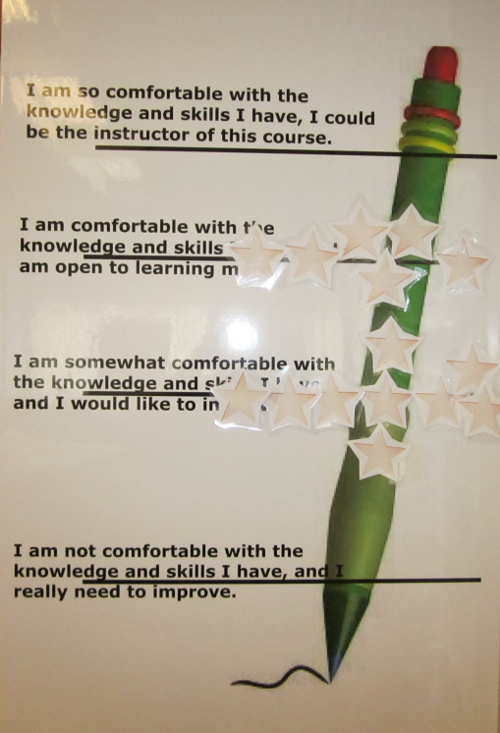
bunch of starsThe participants seem to enjoy the word pairs exercise most (affect/effect, practice/practise, principle/principal, further/farther, etc.).  The “snowball” fight is a great energizer, and the subject/verb agreement and punctuation exercises tend to confirm that most participants already know a lot about grammar, it’s just not something they’re aware of in their everyday work.

The key with BWME, as with so many other topics, is to cultivate that awareness, and promote its continuance on the job.


Have you had the opportunity to learn or teach something that you’re passionate about? How was the experience?  Do you practise after the fact?  What stayed with you most?