Thoughty Thursday: Things that made me go hmmmm on the interwebz, Dec 4-10, 2016

Time to get that mental corn a-poppin’!

Viola Desmond is chosen as the first Canadian woman on the ten dollar bill. CBC

Rossalyn Warren lists seventeen badass women that made a difference in 2016. Buzzfeed

Brene Brown on the importance of boundaries:


Recent grads share their college experiences on NPR.

David Amsden tells the tale of the gridiron gangster: how a vigilante gambler took down an alleged crime boss. Rolling Stone

Prince EA: Everybody dies, but not everybody lives.


David Szondy reports on how diamonds can turn nuclear waste into nuclear batteries. New Atlas

Nicola Davis reports on the feathered dinosaur tail preserved in amber and what it’s taught us about evolution. The Guardian

Erin Ross: pets help people manage the pain of serious mental illness. NPR

With that in mind, here are some lazy cats:


Meet Radamenes, the caretaker cat:


Juniper Foxx befriends Moose, the dog:


And that’s your edutainment for the week 😉

See you Saturday!

thoughtythursday2016

Thoughty Thursday: Things that made me go hmmmm on the interwebz, Sept 25-Oct 1, 2016

I’m taking it easy on your mental popcorn, this week 🙂

Katie Hafner reports on the epidemic of loneliness among the elderly. The New York Times

Human trafficking is a hidden problem in north-eastern Ontario (and everywhere, unfortunately). CBC

Nora Caplan-Bricker reveals the risks of sexual assault on long haul flights. Slate

Marissa Fessenden shares how women in the early 1900s dealt with harassment. The Smithsonian

Library worker defends free speech and is arrested for it. The Bill of Right Defense Committee

Ronald W. Pies discusses the astonishing non-epidemic of mental illness. Psychiatric Times

Ivan Dikov reports on a shrine to Demeter and Persephone discovered in Bulgaria. Brewminate

Ria Misra reports on SpaceX’s major milestone en route to Mars. Gizmodo

Phil Plait shares Judy Schmidt’s astrophotography. Slate. Later in the week Phil shares the first photograph ever taken of the sun.

Maddie Stone shares the last image Rosetta captured before it crashed. Gizmodo

Fiona MacDonald reports on a 25 year old PhD student, Shu Lam’s, solution to antibiotic-resistant infections. Science Alert

Julien d’Hoy reports on how scientists have traced society’s myths to their primordial origins. Scientific American

The Vintage News shares the discovery of Britain’s Atlantis.

Medievalists.net lists the top ten scandals of the Middle Ages. Story fodder, anyone? 😉

Uninhabitable 1887 Queen Anne house is restored to its former glory. Laura Caseley for Little things.

Here’s a lovely local piece on NISA’s annual art show. South Side Story

Sad and Useless shares a Twitter stream on how God created some animals. Lolz aplenty.

Two guinea pigs discuss everything pumpkin spice.


Teddy Bear the porcupine’s Hallowe’en feast. He sounds like Woodstock from the Peanuts 🙂


Sheila Carabine releases her solo album 🙂 Here’s one of her songs: The Oak and the Maple.


Hope you enjoyed this week’s offerings.

See you on Saturday!

Thoughty Thursday

Canadian Writers’ Summit 2016: Writing hard truths

Disclaimer: I’m not perfect, and neither are my notes. If you see anything that needs correction or clarification, please email me at melanie (dot) marttila (at) gmail (dot) com and I will action it post hasty.
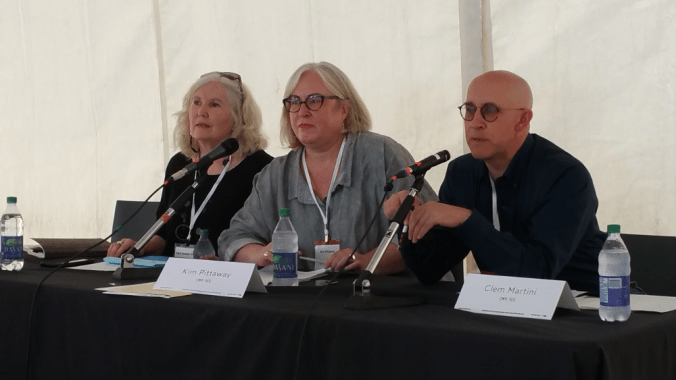
HardTruths

Panellists: Lorri Neilsen Glenn (moderator), Kim Pittaway, Clem Martini

LNG: So many people are struggling with how to approach difficult topics and hard truths in their writing. Each presenter will have the opportunity to frame their work, each will give a reading, and then we’ll open the floor to Q&A.

CM: In 2010, I wrote Bitter Medicine, which is about my family’s struggle with mental illness. It ends on a positive note, but the story itself is difficult in that it documents our journey with my brother’s schizophrenia and my mother’s developing dementia. When I recognized the first signs of my mother’s dementia, the support structure we’d had in place for my brother collapsed. They were living together, and had been able to take care of each other, with my support, until then. I’m now working on the continuing story, the working title of which is The Book of Lies. Caregiving is a verb. Ideally, it’s perfect, like a spider web, a delicate network of mutual and community support. In reality, it’s more like a spider web that’s been woven by a spider on LSD. It’s full of flaws. My problem now, because I’m writing our story as I’m living it, is to decide what’s safe to write about. What do I include? How far do I go? Those are cogent questions for all writers facing true stories with demanding subject matter.

KP: My current manuscript is about families and unforgiveness. The concept of difficult knowledge versus lovely knowledge is used in curation. Deborah Britzman defines lovely knowledge as easily assimilatable. It confirms what we know, or think we know, about the world. Difficult knowledge does not confirm, or conform with, our reality. How do we curate suffering? Are we showing it?  Are we turning suffering into something productive? How is truth-telling gratuitous? How is it harmful? This is intriguing to me as a writer because most memoirs are full of lovely knowledge. There’s nothing wrong with sweetness and nostalgia, but we have to be aware that everything contains within it, its opposite. Do you face it head on, or obliquely? We have to question our tools, our strategies, and our craft.

LNG: I was reading Martha Nussbaum. She states that the heart cannot change without story. I found myself thinking about readers and readers’ responses. My students ask me why I don’t have any happy stories or poems. It’s a valid question, but it made me think. Writing hard truths forces us to confront our shadow selves as writers and as readers. Despite what you think you’re writing about, the tough stuff is already there. Do we really need those details, though? There is a hunger for stories that get close to the bone. Take a look at the stories that have come out as a result of the Truth and Reconciliation Commission for residential school survivors. Those are terrible stories, but they’re also healing stories. Stories about difficult truths invite us to remove our masks. They can be, and often are, gendered.

Readings ensued, with the attendant and courteous trigger warnings, followed by Q&A.

Remember: I’ll be on blog-vacation, so there won’t be a post next weekend, though this week’s curation posts will be scheduled and should be posted on their regular days. No curation on the 23rd and 25th, though. I’ll be back on August 27th with my notes from Robert Sawyer’s presentation on diversifying your income and regularly scheduled blogging will proceed from there until November.

Tipsday: Writerly Goodness found on the interwebz, May 15-21, 2016

Fact and fun, all rolled into one . . . curation post 😉

K.M. Weiland shares strategies for writing faster (and why maybe you shouldn’t). Helping writers become authors. Later in the week she shares her number one tip for writing books readers can’t put down.

Chuck Wendig explodes more writing myths as he invites us to crotch-punch the creative yeti. Terribleminds.

Kristan Hoffman puts forth an argument for letting your creativity rest. Writer Unboxed.

Kameron Hurley writes about fame, publishing, and breakout books: dancing for dinner.

Jami Gold helps us understand how plot obstacles affect character agency.

Dave King continues to explore historical fiction pitfalls with this post for Writer Unboxed: sympathetic characters in unsympathetic worlds.

Carly Watters shares five secrets to publishing your debut novel.

Porter Anderson looks at book prices and writing value. Should we have been careful what we wished for? Writer Unboxed.

Five signs your novel may be sexist – against men. Chris Winkle brings a little balance to the table for Mythcreants.

The establishment has always hated the new kids. Kameron Hurley.

Monica Alverado Frazier wonders, do you know how to use a curandera?

Modern witches are so much more than Maiden/Mother/Crone. Natalie Zutter for Tor.com

Daniel José Older reads from Half Resurrection Blues. This man reads like a poet. I could listen to him all day 🙂


John Mullan explores how plots grip us, from Dickens to Line of Duty. The Guardian.

Women swept the 2015 Nebula Awards. Andrew Liptak for i09.

Five science fiction and fantasy novels that treat mental illness with compassion. Barnes & Noble.

This is COOL. Boston’s sidewalks are covered in secret poems. Atlas Obscura.

Lincoln Michel explains why fairy tales are magic for modern fiction. The Guardian.

Dig at the Curtain theatre unearths a Shakespearean surprise. Jill Lawless for Phys.org

Do overused words lose their meaning? Jonathon Sturgeon for Flavorwire.

CBS passes on Nancy Drew adaptation for testing “too female” for line-up (whatever that means). Carly Lane for The Mary Sue.

The BBC shares nine life lessons from Doctor Who.

Two of the shows I liked got cancelled. Fortunately, the end is only the beginning for Supergirl and Marvel’s Agent Carter. Alisdair Stuart for Tor.com

Honest trailers – Game of Thrones, vol. 1 Bewbs!


Come back Thursday for your weekly dose of thoughty!

Tipsday

Tipsday: Writerly Goodness found on the interwebz, May 1-7, 2016

And we’re still on a roll 😉

K.M. Weiland offers six tips to help you finish your book. Helping writers become authors.

Janice Hardy helps you get your novel to the finish line: staying focused enough to write (part two). Fiction University. And part three: resisting the shiny, new idea.

K.M. Weiland shares how to harness the dark side of your impact character. Helping writers become authors.

Jami Gold answers the question, what’s the difference between plot and story?

Talking yourself down and talking yourself up: the two-headed dragon of insecurity. Ella Joy Olsen on Women Writers, Women’s Books.

Donald Maass: pixie dust, the secret ingredient to adding sparkle to your writing. Writer Unboxed.

Fantasy Faction explores languages in fantasy.

Chris Winkle offers four tips for depicting characters with disabilities. Mythcreants.

Chuck Wendig: Hello, I have anxiety. How are you?

Sarah Selecky is back with part three of her writing retreats for your wish list series: make your own retreat 🙂

Sarah Letourneau offers five reasons to do market research on your work in progress. DIYMFA.

New research explains how the pen is mightier than the keyboard. The Literacy Site.

Mallory Ortberg looks at publishing, weight, and writers who are ‘hard to look at.’ The Toast. This really pissed me off.

Jael Richardson launches the Festival of Literary Diversity. Donovan Vincent for The Toronto Star.

CBC Books lists twelve Canadian novels that describe living with mental illness.

Buzzfeed shares 21 examples of exquisite handwriting.

Gregory Woods offers his top ten landmarks in gay and lesbian literature. The Guardian.

Nicholas Lezard reviews Seven Miles of Steel Thistles.

Book Riot shares this massive list of 100 science fiction and fantasy novels by women.

Wil Wheaton mansplains the Star Wars: Rogue One hate. The Nerdist.

Alisdair Stuart reviews Captain America: Civil War (without spoilers!). Tor.com

Fire and Launch wonder if Brandon Stark is the hero of Game of Thrones (contains spoilers). Tor.com

Norman Descendants explores the historical truth of Ragnar Lothbrock.

This Harry Potter themed wedding was tasteful as fuck. Buzzfeed.

See you with your weekly dose of thoughty on Thursday!

Tipsday

Thoughty Thursday: Things that made me go hmmmm on the interwebz, April 3-9, 2016

I hope you’re all visual learners, ‘cause this thoughty Thursday’s jam-packed with videos!

It’s autism acceptance month 🙂

Photographer, Michelle Marshall, documents Afro-Caribbean gingers. Black Girl Long Hair.

Ten inspiring Muslim women every person should know.


Mike Veny: Mental illness is an asset. TED Talk.


A psychiatrist thinks the key to happiness might be swallowing the right bacteria. Business Insider.

Things about anxiety nobody talks about. The Mighty.


Six reasons why touch is amazing. ASAP Thought.


Vi Hart muses on the tools we use.


Crash course physics is here! Phil Plait for Slate.

The first photograph of light as both particle and wave. Phys.org

The music of the spheres. Literally. EWAO.

Jessica Cail on NOVA’s secret lives of scientists 🙂


WWF Hungary released this amazing video – Paper world. Vimeo.

It’s okay to be smart asks, how do bees make honey?


And for your entertainment:

MsMr – Wrong Victory


And Florence + The Machine. Queen of Peace & Long and Lost.


Enjoy, my friends.

See you on Saturday for an origin story and some anime series discoveries.

Thoughty Thursday

Tipsday: Writerly Goodness found on the interwebz, March 20-26, 2016

Holy shemoley! Lookit all the Writerly Goodness!

Ok. This is big news around here. Sudbury has a new poet laureate, and its first woman in the role, my awesome soul sister, Kim Fahner! The Northern Life. And here’s the interview she did with Markus Schwabe of the CBC’s Morning North. She had a cold, but it’s still a fabulous interview 🙂 She’s on her way to Banff right now to work with the wonderful Mr. Lawrence Hill!

Jane Friedman points out the pros and cons of maintaining a personal profile versus a professional page on Facebook.

Susan Spann advises us when a book is considered out of print. Writer Unboxed.

Jed Herne guest posts on The Better Novel Project with The Half-Blood Prince guide to question arcs.

Michelle Hoover writes an excellent guest post for Writer Unboxed on the duplicity of a character’s desire.

John J. Kelley explores the art of the plausible for Writer Unboxed.

Barbara O’Neal discusses the matter of talent. Writer Unboxed.

C.S. Lakin offers three ways to keep readers reading past page one. Live, write, thrive.

Tiffany Lawson Inman explains how to build dramatic momentum in fiction. Writers in the Storm.

Janice Hardy explores the ebb and flow of plotting a novel. Fiction University.

K.M. Weiland’s back with five more ways to trim your novel’s word count. Helping writers become authors. Later in the week, she helps us choose the right protagonist.

Kate Elliott gives us the tools to write women characters into epic fantasy without quotas. Tor.com

Awesome: How do we write about diversity when the word has lost its meaning? With Daniel José Older, Ashley Cassandra Ford, and Tanwi Nandini Islam. Elle. (Really? Yuh-huh.)

Steve Kettmann: On knowing what to leave out. Medium.

Victoria Mixon shares her super-easy formula for creating a blurb.

Ruthanne Reid points out the two most important words for writers: don’t quit. The Write Practice.

Kerry Lonsdale writes an open letter to writers at every stage of publishing. Books by Women.

Kameron Hurley ponders her sales.

J.K. Rowling shares rejection letters on Twitter to help beginning authors. The Guardian.

Jamie Raintree explores how to decompartmentalize your art.

Anna Lovind bares herself in this post on the process of creative transformation.

Dan Blank shares what he’s learned from 30 days of vlogging.


Thinking about a writers’ retreat? Sarah Selecky gives you a place to start looking.

Madeleine Dore offers 50 ways to take care of yourself in the arts. Performing Arts Hub.

Robert J. Sawyer shares his creative process with Inverse’s Lauren Sarner.

Where five Canadian authors read. The Globe and Mail.

Buzzfeed lists 21 German words we should be using in English.

Victorian doctors thought reading novels made women incurably insane. History Buff.

On the other hand, art is proven to have mental health benefits. The Butler Collegian.

National Geographic lists its top ten book stores in the world.

Daniel José Older: Notes on love and revolution. Guernica Magazine.

Brainpickings shares Charlotte Brontë’s love letters.

The Telegraph lists ten novels with titles from Shakespeare.

Shakespeare’s skull stolen from grave. BBC.

15 Welsh myths and legends. Wales Online.

Michael Boyle and Daniel A. Kaufman wish Babylon 5 a happy birthday. This is one of my all time favourite series. The Electric Agora.

I don’t know about you, but I’m exhausted!

See you Thursday 🙂

Tipsday

Thoughty Thursday: Things that made me go hmmmm on the interwebz, June 14-20, 2015

A couple of fraught issues to start you off today, and then we move through psych and science to some feel-good at the end.

Jon Stewart on the Charleston church shooting:

The RCMP report that there have been 1,118 missing or murdered aboriginal women since 1980. CTV News.

13 brave, indigenous women share their stories of how they almost joined the missing. McLean’s.

Delilah S. Dawson isn’t going to tear you down. She’s going to build you up. Whimsy Dark.

Can diet shape your mental health? Gives a whole new meeting to ‘you are what you eat’ 🙂 The Globe and Mail.

The genetic link between creativity and mental illness has been found. Collective Evolution.

Why Finland’s teachers are different. The Guardian.

They’ve discovered the compound responsible for ‘old person smell.’ Mental Floss.

The link between stress, creativity, and orgasm: Naomi Wolf writes about the vagina in her new book. BrainPickings.

Take a look at this adorable octopus. What are scientists thinking of naming it? Adorabilis 🙂 BoredPanda.

How jellyfish put themselves back together. The National Geographic.

How does a creature reproduce when it’s actually four creatures? On man o’ wars and other siphonophores. i09.

Kayakers have a close encounter with a whale 🙂

Dogs will snub people who are mean to their owners. IFLS.

Kangaroos are lefties (and why handedness is rare in animals). The National Geographic.

I shared a post a few weeks ago about how mice were shown to have inherited their parents’ fears. Well, here’s another article on the subject. Science Gymnasium.

NASA is one step closer to its mission to Europa. i09.

Dr. Michelle Thaller: We are all dead stars. The Atlantic.

Yes, androids do dream of electric sheep. The Guardian.

Darwin’s grandfather once thought up a plan that would destroy the world. i09.

The Barra McNeils and Ashley McIsaac in Windsor:

Hope you have lots of great ideas this week!

See you Saturday.

Thoughty Thursday

Thoughty Thursday: Things that made me go hmmmm on the interwebz, Jan 18-24, 2015

A first-person account of the Paris rally. Psychiatric Times.

Redefining mental illness. The New York Times.

Drink more tea. It’s good for your mental health. The Canadian Mental Health Association.

Love this comic from Everyday feminism on body policing.

The Huffington Post. The surprising cause of addiction—it’s not what you think.

The LA Times reports on the dangers of sitting all day. One of the reasons I now have an adjustable desk at home.

Why you should take notes by hand instead of by lap top. Lifehack. This is how I do all my conference learning these days. I listen, take notes by hand, and then transcribe those notes later in a blog post. That’s three exposures to the same information by three different methods. Do I remember more? You betcha!

Jane Friedman shares ten resolutions for a saner internet—and life.

The potential quantum effect of parallel worlds on our own. Mother Nature News.

Thanks to the Hubble telescope’s latest and highest resolution picture, you can now get new perspective on how vast the universe is. IFLS.

How could I resist this piece by National Geographic on animal commuters?

Keep on learning! It’s the only way to live 🙂

See you Saturday!

Thoughty Thursday

Tipsday: Writerly Goodness found on the interwebz, Nov 9-15, 2014

Last week’s big publishing news in The Globe and Mail: Where is Simon & Schuster heading?

What Amazon’s strategy may mean for publishing today. Someone saw this coming. Rebecca Allen. The Digital Reader.

Are there things more important to writing than talent? Anne R. Allen says yes. Yes, there are.

Roz Morris explains how a good editor helps you to be yourself.

How much realism does your novel need? K.M. Weiland.

Pantaphobia. That’s it! Fabulous post on Writer Unboxed about fear and the writer by Myra McEntire.

Sometimes, you’re going to hate your work in progress. Read Chuck Wendig’s thoughts on how to get through it (over it? around it?).

Young writers working together to reach their NaNoWriMo goals. CBC.

Can you afford to be a writer? Deborah Mundy for The Toronto Star Books.

Why writing shouldn’t be your first career. ALLi.

Neil Gaiman’s eight rules of writing. Brainpickings.

Anne Lamott on the true gift of friendship and the uncomfortable art of letting yourself be seen. Brainpickings.

Virginia Woolf on how to read a book. Brainpickings.

How to build a fictional world with Kate Messner. Ted.ed.


How writing fiction is helping people with mental illness. CBC.

That’s all the tips I have for you this week.

See you on Thoughty Thursday!

Tipsday