Thoughty Thursday: Things that made me go hmmmm on the interwebz, March 20-26, 2016

Topics run the gamut in this week’s batch of thoughty. I was hard pressed to know how best to present it all. I hope nothing jars too much. Then again, sometimes you need a week jolt to get the big squishy (brain) into gear 😉

This is why Finland has the best schools. The Syndey Morning Herald.

National Arts Centre to launch indigenous theatre in 2019. The Globe and Mail.

Tay exposes the lies we tell ourselves about racists. New Republic. Peter Bright reviews the Tay AI debacle for Ars Technica.

UN Women ask men and women to switch roles:


One woman tells her story of reporting sexual abuse. The Globe and Mail.

Scaachi Koul: I hope the Ghomeshi verdict makes you fucking furious. You know? It really does. Buzzfeed.

Barbara Moran writes about her mother’s death and how it indicates a greater system failure. The New York Times.

Your drunken aunt was right: the art of the hot toddy. Vinepair.

University Affairs devotes an entire issue to mental health and universities.

Brenda Knowles knows how to save an introvert/extrovert relationship.

Kira Asatryan offers six simple strategies for being happy alone. Time Magazine.

ASAP Thought. Should you trust your astrological sign?


Einstein is (almost) always right. It’s okay to be smart.


The equinox isn’t what you think it is. It’s okay to be smart.


NASA captures the crazy shockwave of an exploding star. Slate.

Earth is about to pass through the tail of Halley’s Comet, giving us a month of meteor showers. IFLS.

Another lovely picture of a strange geological formation on Mars. Slate.

19 pieces on non-human DNA found in the human genome. Yup we got junk in there. IFLS.

Covão dos conchos. A-MA-zing! The real interesting part in about 2:25.


Looks like Monty Python had it right. Rabbits (in medieval times) were deadly! The Poke.

Explore the tear-filled (and slightly creepy) world of Marina Bychkova’s dolls.

The White Wolf Pack shares these lovely photos of ravens. Have I even mentioned that corvus corvus rocks my world?  😉

Hope something in this mix gets those fingers moving on the keyboard. Inspiration’s what this is all about.

All the best until Saturday when my next chapter update lands!

Thoughty Thursday

Tipsday: Writerly Goodness found on the interwebz, March 20-26, 2016

Holy shemoley! Lookit all the Writerly Goodness!

Ok. This is big news around here. Sudbury has a new poet laureate, and its first woman in the role, my awesome soul sister, Kim Fahner! The Northern Life. And here’s the interview she did with Markus Schwabe of the CBC’s Morning North. She had a cold, but it’s still a fabulous interview 🙂 She’s on her way to Banff right now to work with the wonderful Mr. Lawrence Hill!

Jane Friedman points out the pros and cons of maintaining a personal profile versus a professional page on Facebook.

Susan Spann advises us when a book is considered out of print. Writer Unboxed.

Jed Herne guest posts on The Better Novel Project with The Half-Blood Prince guide to question arcs.

Michelle Hoover writes an excellent guest post for Writer Unboxed on the duplicity of a character’s desire.

John J. Kelley explores the art of the plausible for Writer Unboxed.

Barbara O’Neal discusses the matter of talent. Writer Unboxed.

C.S. Lakin offers three ways to keep readers reading past page one. Live, write, thrive.

Tiffany Lawson Inman explains how to build dramatic momentum in fiction. Writers in the Storm.

Janice Hardy explores the ebb and flow of plotting a novel. Fiction University.

K.M. Weiland’s back with five more ways to trim your novel’s word count. Helping writers become authors. Later in the week, she helps us choose the right protagonist.

Kate Elliott gives us the tools to write women characters into epic fantasy without quotas. Tor.com

Awesome: How do we write about diversity when the word has lost its meaning? With Daniel José Older, Ashley Cassandra Ford, and Tanwi Nandini Islam. Elle. (Really? Yuh-huh.)

Steve Kettmann: On knowing what to leave out. Medium.

Victoria Mixon shares her super-easy formula for creating a blurb.

Ruthanne Reid points out the two most important words for writers: don’t quit. The Write Practice.

Kerry Lonsdale writes an open letter to writers at every stage of publishing. Books by Women.

Kameron Hurley ponders her sales.

J.K. Rowling shares rejection letters on Twitter to help beginning authors. The Guardian.

Jamie Raintree explores how to decompartmentalize your art.

Anna Lovind bares herself in this post on the process of creative transformation.

Dan Blank shares what he’s learned from 30 days of vlogging.


Thinking about a writers’ retreat? Sarah Selecky gives you a place to start looking.

Madeleine Dore offers 50 ways to take care of yourself in the arts. Performing Arts Hub.

Robert J. Sawyer shares his creative process with Inverse’s Lauren Sarner.

Where five Canadian authors read. The Globe and Mail.

Buzzfeed lists 21 German words we should be using in English.

Victorian doctors thought reading novels made women incurably insane. History Buff.

On the other hand, art is proven to have mental health benefits. The Butler Collegian.

National Geographic lists its top ten book stores in the world.

Daniel José Older: Notes on love and revolution. Guernica Magazine.

Brainpickings shares Charlotte Brontë’s love letters.

The Telegraph lists ten novels with titles from Shakespeare.

Shakespeare’s skull stolen from grave. BBC.

15 Welsh myths and legends. Wales Online.

Michael Boyle and Daniel A. Kaufman wish Babylon 5 a happy birthday. This is one of my all time favourite series. The Electric Agora.

I don’t know about you, but I’m exhausted!

See you Thursday 🙂

Tipsday

Thoughty Thursday: Things that made me go hmmmm on the interwebz, Jan 17-23, 2016

Oh noes! I’ve rediscovered YouTube and the videos have invaded . . .

Canada is named the second best country in the world. How Canadian 🙂 We’re excited about coming in second. Global News.

Some of our new Syrian friends enjoying tobogganing for the first time:


Peter Denton wonders, where have all the readers gone? The Globe and Mail.

Dear parents: Everything you want to know about your son or daughter’s university, but don’t. Michael Enright interviews Ron Srigley for The Sunday Edition on CBC.

Education is performance art. Penn & Teller share their thoughts in The Atlantic.

When Trent Hamm thinks of the times he’s been the happiest, he notices two common threads. The Business Insider.

The powerful benefit of exercise that’s rarely discussed. Guess I’d better get my ass in gear. Quartz.

Dinah Laprarie of NISA champions mental health in Sudbury. CBC.

Cyndi Roberts of The Elephant Journal shares seven steps to easing anxiety without a pill.

Anna Lovind finds her own way to divine guidance 😉

So now a new study says smoking pot doesn’t lower adolescent IQs. IFLS.

Watching a water bubble freeze (in Finland):


Space-X attempted another booster landing last Sunday. And then this happened. Phil Plait, Bad Astronomer, for Slate.

That weird star with the Jupiter-sized planet and the suspected . . . something else orbiting it? Well the more they learn about it the stranger things get. Slate.

A constellation has been named for David Bowie (though it’s not officially recognized yet). IFLS.

Check out this planetary alignment through February 20. IFLS.

Phil Plait features this alignment on his Bad Astronomy column too. Slate.

xkcd charts possible undiscovered planets.

Rick Mercer’s rant on anonymous comments:


Gypsy Vanner horses:


Ms Mr performs “Reckless.”


And that was your week’s edutainment.

Hope you enjoyed it.

See you on Saturday for more CanCon 2015 reportage.

Thoughty Thursday

Thoughty Thursday: Things that made me go hmmmm on the interwebz, September 13-19, 2015

Moar awesome in this curation.

Dan Blank is searching for Tim Cook’s energy bar on 99u. Tips on conserving time and energy for the important stuff.

Your attitude is more important than your IQ. Quartz.

Mindfulness on the rocks. Sudbury’s labyrinth featured on CBC.

Someone explains that Beauty and the Beast is really about intolerance and bullying. Tickld.

Margaret MacPherson finds strength in vulnerability during her summer of sickness. The Globe and Mail.

Elite Daily shares 41 mental health resources you can use when you can’t afford a therapist.

The Black Dot Campaign: a very important initiative in support of victims of domestic abuse. Bustle.

What happens when women aren’t consulted on “girl toy” creation and marketing. GeekXGirls.

Want to keep a secret? Give it to a tree (or bury it beneath). Medieval skeleton found in the roots of a fallen tree. i09.

SF authors take note: Twelve ways humanity could destroy the solar system. i09.

Vertical farming: A solution to the dustbowl future presented by Interstellar? i09.

Nova’s Secret Lives of Scientists features Mayim Bialik (Amy of The Big Bang Theory):

Check out the whole series on YouTube. Lots of cool ladies of science like Jane Goodall 🙂 And, of course, the guys . . . Bill Nye and Neil deGrasse Tyson.

Alan Cumming shares his experience losing a pet and what it taught him. I so love this. We did a lot of the same things for Nuala. The Globe and Mail.

A few weeks ago, I shared a dolphin surfing on a whale. Now the seals are in on it! The Boston Globe.

I’ve showed these to you before, but it’s just so cool. In Morocco, the goats live in trees:

Hope some of this inspired some great ideas. That’s the whole point behind Thoughty Thursday: Popping your mental corn for . . . some time now 😀

I should be able to get my shit together for more than pictures this weekend.

See you Saturday!

Thoughty Thursday

Thoughty Thursday: Things that made me go hmmmm on the interwebz, June 21-27, 2015

Sorry this is late, but I had–HAD–to watch the final episode of Sense8. OMIGODSOGOOD!

And now back to our regular programming 🙂

Now let’s get your big squishy grey thing into gear!

The rainbow hued news of the week: The US Supreme Court makes same sex marriage a right, nation-wide. The New York Times. Then, of course, the fall out started and conservatives and religious fundamentalists declared they’d leave the country . . . for Canada. <Facepalm> Um, Dudes. We’ve had the right to same sex marriage for years!

These two grade eight students have been campaigning for consent in the Ontario sex-ed curriculum. Now they’ve created a documentary. And. It. Is. Awesome. Watch Allegedly. The Huffington Post.

Related: The next time someone says women aren’t victims of harassment, show them this. Tickld.

This short video is haunting and beautiful. i09.

Alan Watts on the acceptance of death.

The real boogeyman: serial killer Albert Fish. Creepy. i09’s True Crime.

Can climate be hazardous to your mental health? Psychiatric Times.

Sitting down for too long may increase anxiety. Just another reason to get an adjustable or standing desk. Discovery News.

First Nations lawyer will wear traditional clothing when she’s called to the Ontario bar. The Huffington Post.

At last! Vancouver company creates compostable G-Cups for Keurig Brewers. The Huffington Post.

The best weather photos of the year, collected for you by i09.

Canadians tweet amazing pictures of the Northern Lights. The Huffington Post.

Peter Ray Allison wonders if we will ever build ring worlds. BBC.

Sudbury’s regreening efforts were highlighted at an international conference. Listen to the interview on CBC.

IFLS shares an infographic that describes what happens to your brain when you don’t get enough sleep. See that one at the bottom right? It says BRAIN DAMAGE!

It’s okay to be smart looks into the reasons bees are dying:

A doggy retirement home! Love this idea. I heart dogs.com.

What Disney animals would look like if they were human. These are pretty good! Distractify.

Sophie Tweed-Simmons comes to Sudbury to film her first Canadian film. Seriously. They’re filming this right now. Great time of year to be doing it 😉 The Toronto Star.

A friend shared Johnny Cash’s cover of Trent Reznor’s Hurt and I remembered how much I love this version.

Now go be thoughty, and I’ll see you on Saturday for more Ad Astra reportage, the next chapter, and . . . a pupdate.

Thoughty Thursday

Thoughty Thursday: Things that made me go hmmmm on the interwebz, June 14-20, 2015

A couple of fraught issues to start you off today, and then we move through psych and science to some feel-good at the end.

Jon Stewart on the Charleston church shooting:

The RCMP report that there have been 1,118 missing or murdered aboriginal women since 1980. CTV News.

13 brave, indigenous women share their stories of how they almost joined the missing. McLean’s.

Delilah S. Dawson isn’t going to tear you down. She’s going to build you up. Whimsy Dark.

Can diet shape your mental health? Gives a whole new meeting to ‘you are what you eat’ 🙂 The Globe and Mail.

The genetic link between creativity and mental illness has been found. Collective Evolution.

Why Finland’s teachers are different. The Guardian.

They’ve discovered the compound responsible for ‘old person smell.’ Mental Floss.

The link between stress, creativity, and orgasm: Naomi Wolf writes about the vagina in her new book. BrainPickings.

Take a look at this adorable octopus. What are scientists thinking of naming it? Adorabilis 🙂 BoredPanda.

How jellyfish put themselves back together. The National Geographic.

How does a creature reproduce when it’s actually four creatures? On man o’ wars and other siphonophores. i09.

Kayakers have a close encounter with a whale 🙂

Dogs will snub people who are mean to their owners. IFLS.

Kangaroos are lefties (and why handedness is rare in animals). The National Geographic.

I shared a post a few weeks ago about how mice were shown to have inherited their parents’ fears. Well, here’s another article on the subject. Science Gymnasium.

NASA is one step closer to its mission to Europa. i09.

Dr. Michelle Thaller: We are all dead stars. The Atlantic.

Yes, androids do dream of electric sheep. The Guardian.

Darwin’s grandfather once thought up a plan that would destroy the world. i09.

The Barra McNeils and Ashley McIsaac in Windsor:

Hope you have lots of great ideas this week!

See you Saturday.

Thoughty Thursday

Thoughty Thursday: Things that made me go hmmmm on the interwebz, May 24-30, 2015

Ready for the thoughty Thursday workout? Here we go in 3 . . . 2 . . .

This is awesome: Scientists unlock the biological secrets of creativity. The Globe and Mail.

This video made me cry, but it’s brilliant. And you all have to watch it. The Daily Mail.

The Huffington Post presents ten ways introverts interact differently with the world.

What’s the point of thinking about death? The Atlantic.

If you want your kids to do better in school, you need to get serious about mental health. Take Part.

Nigeria bans female genital mutilation. Finally! International Business Times.

A primer on rape culture (in case you needed one). While you were sleeping.

Why is Elizabeth I always depicted as grotesque? The Guardian.

17 R-rated history facts no one teaches you in school. Distractify.

How did the Vikings make this incredibly strong sword? i09.

This is beautiful. I want to start one up in Canada 🙂 Solar Sisters: how this “Avon” model of solar power distribution has taken off. Fast Company.

What are ice spikes and what are they doing in your freezer? Veritasium.

Writing and speaking are totally separate in the brain. Futurity.

The Big Bang Theory just did something awesome: they established a STEM scholarship for impoverished youth 🙂 Hello Giggles.

Full rainbow filmed at Niagara Falls.

This graphic of all life forms will make you feel tiny. Business Insider.

Ms Mr – Painted. I shared the audio only version the other week. I figured it was only fair to share this when it was posted 😉

Saturday will bring moar Ad Astra reportage and the next chapter. See you then!

Thoughty Thursday

A life sentence with mortal punctuation: part 7

Last week: It takes sixteen years, but finally, I see the light.

Sorry this is a bit late.  I was actually WRITING today and I lost track of time.  It’s been a very good day 🙂

So that’s what it’s called

The Way Out, or Suicidal Ideation: George Grie...

The Way Out, or Suicidal Ideation: George Grie, 2007. (Photo credit: Wikipedia)

I learned a new term last week: Ideation.  I didn’t know that those pesky and persistent thoughts of self-harm and violence had an actual name attached to them.  Specifically, it’s called suicidal ideation.

Thanks to a friend for that.

How I deal with my depression

This week, I just wanted to go over a few of my symptoms and the strategies I’ve developed to deal with them.  Some issues I still don’t have under control, but I’ll share how I’m working through them and my progress to date.

What I don’t do

I have chosen not to go through extensive therapy and after the Paxil, I chose not to take any other kinds of medication.  I know people who struggled for years to find the right medication or combination of them to address their symptoms and in some cases, they still become accustomed to a particular dosage or formulation/combination and have to search for and acclimate to new medications.

This takes a lot of time that I have decided I can’t afford to take.

Everything that I do, I do on my own, and I know that for some of you, that will make you uncomfortable.  It may mean for others that I think I know more than you do.  I assure you: I do not.  I only know what works for me and share it in the hope that others will be able to benefit from my experience.

Others still may feel that my depression can’t be that bad if I can manage without talk therapy or psychoanalysis, medications, or a combination of all of the above.  You are welcome to your opinion, but please do not abuse me for holding to mine.

How I learned

When my father had his breakdown, I was scared to death.  I’d heard that depression and other mental illnesses had a genetic component.  If nothing else, it might predispose you to developing the disease, or other diseases yourself.

I started to pay attention to my father and to what my mother said about him.  I started to pay attention to my friends who had other kinds of mental illness, and the behaviours they exhibited.  I started to ask questions about how they dealt with their diseases and to think about whether their strategies would work for me or not.

When I got into my self-help phase, one of the exercises in one of the many books on the subject indicated that you needed to examine your life and the past events that may have contributed to your depression.  I did this in detail, repeatedly.  The greater part of at least one journal is filled with it.

As life went on and I continued to experience symptoms and the fall-out resulting from them, I continued to adapt and refine my strategies.

Having a mental illness of any kind can seem like having another person inside of you.  Have you ever heard one partner say of another, ‘That’s not her talking.  It’s the depression.’?  It can be very true.

As you might do with any other person, adult or child, you have to treat your illness with respect.  You have to take the time to get to know and understand it.

As with anything, mindfulness is the key.  Be aware in the moment and hold the lesson of it close in your heart and mind.

Mellie’s deadlies

  1. Ideation
    I’ll start with this because I already mentioned last week a bit about how I handle these unwelcome thoughts and feelings.  First, acknowledge them.  If you try to ignore them, they’ll only come back more persistently.  Then, accept them.  They are a part of you because they are a part of your illness.  They are thoughts.  You don’t have to act on them and you certainly don’t have to fear them.  Fear will give them power.  You don’t want that.  Finally, thank them.  I’m serious.  They’ve made you aware of something important about you and the nature of your disease.  Once they feel this respect, they will go on their merry way of their own accord.
  2. Exhaustion
    I am tired all the time.  Most days, I feel like I could stay in bed all day.  On the occasional bad day, I might.  My depression is only one cause of this.  Insomnia is another.  Hormones are another.  My malignant hyperthermia (MH) may be yet another cause.  Ultimately, they are likely all connected.  MH is a funny condition.  I’ve read of some people who show symptoms of what used to be called chronic fatigue syndrome, and others who are largely bed-ridden because of their symptoms.  One of my relatives suffers from the much-debated fibromyalgia.  I believe that this may be an affect of the MH.  Regardless of the cause, several things have helped.  Regular sleeping habits.  Because of work, I have to get up at a particular time.  I find that I wake up about this time whether I’m working or not, and whether I choose to stay in bed or not.  I’ve tried sleeping pills for the insomnia and didn’t like their side affects.  I’ve always felt nervous using medication to solve a problem.  Naps don’t work for me.  I used to nap all the time, but if I sleep during the day, I’m more likely to have trouble sleeping at night.  I’ve tried herbal remedies, warm milk, keeping the bedroom dark and quiet, but the thing that seems to help the most is going to bed at a set time and waking up at a set time.  Exercise.  I find that if I’ve exercised, even just walking, at any time during the day, then I’m more likely to fall asleep quickly and sleep through the night.  Getting used to it.  This may seem a little harsh, but you can function when you’re tired.  I do it every day.  I’m very aware of my physical state and I can see the signs of when I’m getting too exhausted.  This will be an individual thing, but it’s important to know your limits and the difference between functional tired and dysfunctional tired.  When I fall into the latter situation, it may well be time for a day off.
  3. Rage
    In general, I’m a laid back person, so laid back, in fact, that sometimes I don’t react in the way people expect.  I never express it, but part of my depression is rage.  This is where some people find talk therapy helpful.  They can unload all the unpleasant baggage they’ve been carrying around and have someone tell then that it’s alright, that it’s normal to have these feelings.  I find this to be similar to ideation, but I substitute my journal for a therapist.  Like a therapist, my journal doesn’t judge.  It just accepts.  I don’t need the reassurance of anyone else.  I know that the rage is one of the effects of my depression.  Journaling my rage allows me to unload in a healthy way and unlike talk therapy I have an artefact that I can refer to.  I can return and examine my thoughts and feelings and see if there’s a pattern.  Because I journal about my dreams, creative ideas, and other everyday events, I can often connect trigger events to my written episodes of rage.  There was a period of several years where I had a lot of rage to vent.  Now, not so much.  I think my journaling has helped me immensely in this regard.
  4. Self-doubt
    This is related to number five, but finds its source more in the friend wars and in the negative experiences I’ve had as a creative person.  Since I’m socially awkward, I can get the feeling that nobody likes me, even though I know this isn’t true.  I try to keep a few central truths in mind.  First, the people in your life are there because they are equipped in some way to handle your shit.  This means that they are true friends and accept you even when you act like an idiot or say something strange or unkind.  They love you regardless.  Trust them.  Have faith in them.  The opinions of people who don’t ‘get it’ are not worth your time or energy.  By and large, I try not to care what people think of me, but I find that, when I look at it objectively, I am generally well-thought-of.  Creatively, I keep in mind that I have been published and not just by one source or in one genre.  Many of the rejections I get are encouraging ones.  I have also claimed my identity as a writer.  I’ve been writing since I was a child and I’ll continue to write until I die.  It’s who I am.  Publication is a wonderful validation, but I don’t need it to feel good about what I do, or to keep doing it every chance I get.  Writing is a healthy addiction.
  5. Self-hatred
    This is the biggie for me and strangely, I’ll spend the fewest words on it.  My version of hell is to be confronted with all the things that I’ve said or done that have hurt someone else.  At heart, I feel that I’m a terrible person and I don’t have to look far to find confirmation of this.  I don’t have to look far to find confirmation of the opposite either.  I have few, but intensely loyal friends, a small, but deeply loving family.  It may sound bizarre to some of you, but I’ve had a string of wonderful pets in my life that have all taught me what it is to love unconditionally.  My self-hatred is born of fear.  Striving for self-love is an act of courage.  I try to be brave every day.
  6. Emotional instability
    Though my crying-at-the-drop-of-a-hat days are long over, I can still be a basket-case from time to time.  Some of this I attribute to hormones.  I first noticed when I was younger and on birth control that my emotional instability was at its worst.  In the years since, I have occasionally had need to go on the pill again for various reasons, and though I’ve tried a number of different formulations, without fail, I become weepy.  Even without artificial hormones, I can still take a maudlin turn at certain points in my cycle.  The early years of my relationship to Phil were the worst.  The smallest things would send me into an ‘end-of-the-world’ funk for days, sometimes weeks, and Phil has confessed to me since that there were times when he thought we wouldn’t make it as a result.  Phil was, in part, my salvation though.  His intelligence stimulated and inspired me, his keen and twisted sense of humour, so like my own, has kept me laughing all these years.  He can make me laugh until my cheeks and stomach are sore, until my eyes tear up.  It’s amazing what a good belly-laugh can do for you.  We have several values in common and I trust him implicitly.  We are the best of friends.  We just happen to be married 😉

Above all, writing has been my best therapist, my best medication, and my best spiritual balm.  It was only when I started to write regularly that I really started to get my emotional house in order.  Much of my journey feeds into my writing and I continue to explore the themes of my life in the pages of my stories and novels.

There is something of me in every one of my characters and often pieces of the people I’ve known and loved.

Have you been able to turn an illness to your favour?  Have you mined your life and experiences for your stories?

This is not the end of the story, though it will be the end of this thread of the tapestry.  Next week I will return to my narrative where I had to leave it to discuss my depression in more depth.  This has been a story within a story that had to reach its conclusion before I could continue.

I hope these stories have served some purpose and will continue to do so.

Good night and I hope everyone had a happy Easter.

Monkey around already!

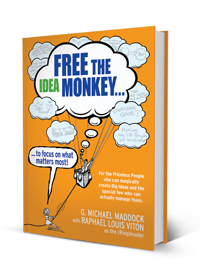
Today, I attended a Webinar sponsored by TrainingIndustry.com and presented by G. Michael Maddock.

In business, there are often synergystic pairings: Walt and Roy Disney; Wilbur and Orvil Wright.  One is the creative genius and the other is the business mastermind.  Maddock calls them the idea monkey, and the ringleader respectively.

At work, I identify with the idea monkey but I also have the focus and vision of a ringleader (I think).  I had to ask the question: can one person be both?

The answer: yes.  If the entrepreneur is in business for herself, she has to be both.  I think because of my writing, which is essentially self-employment, I’ve learned to be self directed as well as creative.

Other interesting learning bits:

Dr. Edward Hallowell, whose research influenced Maddock.  His primary area of research is ADD/ADHD and some of his research has identified similarities between highly creative or innovative people and those diagnosed with ADD/ADHD.

This was an interesting piece, especially given my recent postings on creativity and adversity in My history as a so-called author (A born storyteller … and Three blind mice).

The insight equation: I [statement of fact] because [reason] but [tension].  Example: I want to pay via credit card online because it’s convenient, but I’m afraid of fraud.  (Paypal’s insight).  The critical piece is the but + t (for tension).  So when thinking about a problem to solve with innovation, look for the sexiest butt 🙂

Expertise gets in your way.  Think outside the box?  You can’t read the label if you’re stuck inside the jar.

Finally, intelligence is painful.  You have to learn from your own mistakes.  Wisdom is better.  You get to learn from the mistakes of others.

It’s quite a bit to digest, but like most of the things I learn through my day job, it has implications not only for my work as a trainer and course designer, but also for my creative life.

What have you learned lately that seems to tie into your life in diverse and interesting ways?  Are you an idea monkey, or a ringleader?  If you’re a ringleader, do you like to monkey around?

A born storyteller …

Storyteller is just another name for liar.

In grade one, I think all my classmates (and teachers) thought of me as a silly giggler, a liar, and cat-lady-in-training.

I didn’t even know how to write properly yet, so I exercised my creativity by telling my classmates in “show and tell” about the latest stray cat that I picked up on the way home.  They’d always run away after a few days and so I could show the class a different picture from the cat book I’d checked out of the library and tell them that my latest find looked just like that.

Daydreaming was also a preoccupation.  Because my dad had epilepsy, it was thought that I might too and that my habit of totally “zoning out” was actually petit mal seizures.  Later in life, I was formally tested for epilepsy and there was absolutely no sign of it.  I’d just delve so deeply into my fantasy world that there was nothing could tear me away.

If I was born 20 years later, I’d probably have been diagnosed as ADHD and drugged into submission.  As it was, I was “spoken to” and ignored.  I was deemed enthusiastic but disruptive by different teachers for different reasons.

Can you see the mischievious? Just call me “wee devil” 🙂

Really, I was painfully shy, and the giggling was a way of deflecting uncomfortable situations, which meant pretty much everything.  To this day, I still laugh when I offer a thought or suggestion to my colleagues or manager at work.  If it’s too radical, my suggestion can always be dismissed as a joke, right?

The daydreaming-at-inappropriate-times thing stayed with me until my mid-twenties, and then I started to get clever about it.  I’d restrict my mental ramblings to my “alone time” so no one would be put off by my apparent disinterest in whatever it was they were saying.  Now I cultivate solitariness.  As I writer, I have reason to, but as a creative soul, I simply can’t do without.

As for the telling of stories, I’ve always wondered what might have happened if someone had recognized what it was I was trying to express and encouraged me to turn those imaginary powers to something else.  If I’d started writing my dreams and stories down earlier, where might I be today?

Ultimately what-ifs and might-have-beens are only intellectual exercises.  None of us have do-overs.

A few months ago, one of the writers I consider to be a mentor, Barbara Kyle, presented this TED talk (via Volconvo) to her creative network: http://www.volconvo.com/forums/content/226-do-schools-kill-creativity.html

It is 20 minutes well-spent, trust me.  Sir Ken is incredibly funny, but his message is dead serious.  Currently, it is not the business of schools to nurture creativity, but to create useful/functional members of society.  I rather agree with Sir Ken, that only by nurturing the creativity of our children will schools produce truly valuable members of the human community.

I’ve also been disturbed by the resurfacing of the ADHD debate.  Are children being over diagnosed/incorrectly diagnosed?  This debate has been around for decades and it still hasn’t been resolved.

Some food for thought:

Were you a creative child smothered by a school system that didn’t recognize what your “acting out” meant?  How did you come to understand your creativity and who helped you through that sometimes agonized and agonizing process?  Did you ever feel less valued or less intelligent because you were more creative than academic?