Saturday morning keynote: Susin Nielsen

YA novelist and Governor General’s Award-winning writer Susin Nielsen shared her journey to authorhood.

It’s an equation: 1/3 talent, 1/3 hard work, and 1/3 luck.

She showed use her first diary, and even read to us some of her early entries: “If I become famous, I may want to keep a diary.”

She aspired to be Harriet the Spy and her first diary lasted for all of 8 days.  Susin was in 7th drade.

There were always books in the house.  She was an off-beat kid.  It was a while before she realized that elaborate imaginary games were not where her classmates were at.

She didn’t have a lot of friends.

Her first book was The Smallest Snippet in Snippeton.  She showed it to us 🙂

She submitted poems to Seventeen magazine and received the response: “Nicely written, but much too depressing for us.”  Susin read us one of the poems: “Suicide.”  It was a little maudlin.

Malcolm Gladwell writes about the 10,000 hour rule.  About that time, she was about the 200 hour range.

She went to Ryerson, got a job in food services for Degrassi, wrote a spec script, which eventually became 16 episodes of the long-running Canadian series.

When Word Nerd was published in 2006, her agent was incredibly helpful.

Susin Nielsen in Lorette, Manitoba

Susin Nielsen in Lorette, Manitoba (Photo credit: Tundra Books)

The bottom line: if you’re a writer, write.  Hone your craft.

Friday evening keynote: Zsuzsi Gartner

Last year, Zsuzsi decided to conduct a radical experiment.  She went off-line, not only withdrawing from social media, but also online banking, her cell phone, texting, and even her computer.

Here’s what she shared with us.

Being a writer, social media can be addictive.  “I’ll check email just one more time” becomes a three hour odyssey down the rabbit hole.  When she realized she was enslaved to email, Zsuzsi decided to do something about it.

So, no email, no texting, no computer, no debit, no nothing.  This took a while to set up.

In the process, she found a few things that promised to help with the project.  The “suicide” app kills your online ID.  Digital Detox blocks your access.  Camp Grounded is an adult summer camp where your tech toys are confiscated upon arrival.

Zsuzsi went through withdrawal.  She started reading a lot more though.  She read Henry James’s short stories, and Portrait of a Lady.  There was clarity in the pure experience of reading.

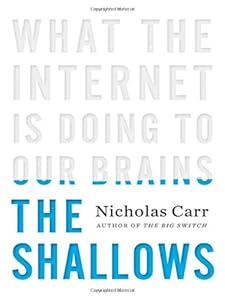
The Shallows: what the internet is doing to our brains Nicholas Carr

Cover of "The Shallows: What the Internet...

Cover via Amazon


Are we sacrificing our ability to read and think deeply?

Maryanne WolfThe Science of the Reading Brain

Is Google Making Us Stupid? (article in The Atlantic, 2008)  – Nicholas Carr.  Maybe not stupid, but lazy.

As a project, she redacted everything in her latest book that she sourced on Google.  Many pages had a quarter or more of the text blacked out.

She tried doing “real” research.  In a library.  With books, articles, and inter-library loan.  She has concerns about kids relying too heavily on Wikipedia and plagiarism in class.

English: An IBM Selectric typewriter, model 71...

English: An IBM Selectric typewriter, model 713 (Selectric I with 11″ writing line), circa 1970. (Photo credit: Wikipedia)

Zsuzsi started using an old IBM Selectric typewriter.  It forces her to think before typing. Nietzsche used a bizarre-looking typewriter and claimed it helped him write better.  “Go online and take a look at it,” she said, and of course, the irony was lost on none of us 😉  Once again ironic, the typewriter was considered the lap top of its time …

Our writing equipment informs our thoughts.  The medium has affected the prose.

Hemingway wrote description in long hand and dialogue on the typewriter.  Annie Proulx and Michael Ondaatje both write long hand.

The Russians are apparently using typewriters to create and send secret messages because there is no electronic footprint.

This experiment helped Zsuzsi engage more deeply with the world.

Behind the curtain: How mainstream publishing works

This was a fun panel with an author, an agent, and two editors.  They took us through the publication process at each stage, author, agent, and editor explaining how their part of the puzzle looks.  Then they fielded questions.

I’ve attended panels before that featured all publishers, or all editors, or all agents.  While informative, how everything dove-tailed was missing.  Occasionally, panelists might say that they couldn’t comment or speculate on what others in the process might do or experience.

‘Twas excellent.

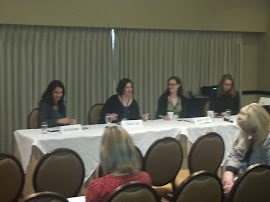
The behind the curtain panelists

The behind the curtain panelists

Panelists: Emily Ohanjanians, editor with Mira Books, the commercial fiction imprint of Harlequin; Eileen Cook, author of YA novels with Simon & Schuster and HarperCollins; Rachel Coyne, agent with Fine Print Literary; Sara Sargent, associate editor with HarperCollins’s children’s imprint, Balzer & Bray.

EC: We’ll start with the author’s search for an agent.  First you have to understand what an agent does.  Most are busy with their current authors and are not actively looking for new authors.  Do your research to find the best fit.  Newer agents will be more available.  Ultimately, it comes down to personal taste.  One agent may not like your voice or style, but another might love it.

RC: I receive 150 to 300 queries per week.  It’s impossible to respond individually.  When I started, that was my intention, but it just can’t be done.  Agents get rejected too, by editors.  There’s a certain disappointment when another agent snags an author from you, especially one that receives an award or does really well.  After I’ve agreed to take on an author, we have a one on one call to discuss next steps.  There is a two page author agreement.  It’s not a contract per se.  Standard percentage is 15% for domestic sales and 20% for foreign, TV, film, and other rights.  Most houses have one agent who is dedicated to subsidiary rights.  Once an author has signed on, the editing begins.  This could mean several rounds, back and forth.  Then the agent will submit to her first round editors.  Usually these are people the agent has an established relationship with.  Sometimes, if several editors are interested, an auction takes place.

SS: At HarperCollins, there are several meetings, one with the acquisitions team during which a profit/loss statement is generated.  The agent is advised of the proposed deal, and negotiation begins.  At the acquisition meeting, everyone sees the property.

EO: It’s the same at Mira, the meeting with the editorial director is followed by the acquisition board meeting, the agent is informed of the proposed deal, and negotiation follows.

Q: Once the book is sold, what happens?

RC: I would make recommendations to the author based on what they hope to achieve.  Usually there is a year between the deal and the publication date, so there is time to implement an author web site or blog, develop social media following, or begin on the next book.  The contract can take anywhere from two weeks to nine months to hammer out.  An advance might be $10,000.  Royalties could be 10%.  First you earn back your advance, then you begin to receive regular cheques.

Q: How does the editor work with the writer on further revisions?

EO: When the launch date is decided upon, it might be a year, or a year and a half, we work backwards, get our endorsements in place, schedule substantial, line, and copy edits, proofing, typesetting, cover art, blurbs, back cover copy, determine the meta data for online sale.

Q: So what happens when you write an editorial letter for the writer, and the writer refuses to budge?

SS: Usually I’ll read and mark up the copy, then prepare a three to ten page editorial letter for the author.  The author will usually sit with it for a few days, then I’ll meet with the author by phone and the author will indicate what they are willing to do and what they are not.  The biggest issue that comes up is characters that are not received as the author intended.  The next is the market: similar books may have tanked for specific reasons that have nothing to do with the quality of the writing.

EC: We work together to reach a solution.  e.g. I hate the character!  My character is brilliant!  How do I show it?

RC: The biggest asset a writer can have is the willingness to be edited.  I like to meet annually with my authors to find out what their plans are for the coming year.

Q: Describe your ideal author.

EO: An insecure author can become overwhelming.  20 emails a day can be draining.  An author coming out of another house might cause me to do some research.  Were there reasons for this?

EC: You have to own your neuroses as an author.  You must be open to communicate.

Q: If your author had to choose between a Canadian and American publisher, which would you recommend?

EC: Commission can be less with a Canadian publisher.  Most American publishers will include Canadian distribution.  The deal is for North American rights, not Canadian or American.  Canada is not considered a foreign market.  Really, your agent is a match-maker, trying to find the best possible home.  It used to be that agents had to be in New York, now they can be anywhere.

RC: There is a right agent and a right publisher for every author/project.

Q: What about e-rights?

SS: They are considered subsidiary rights.

Q: How often do you have to meet in person?

RC: Never if you don’t want to or can’t afford it.

Q: What is your education/experience?

SS: Placement with Disney/Hyperion, BA in English, then an MA in Journalism.

RC: Writer’s Digest Books, Donald Maass Agency, Forward Literary, then Fine Print Literary.

EO: BA in English literature/linguistics, job in finance, but I always wanted to be an editor.  I started working for magazines, then got on with Harlequin, took some courses from EAC and Ryerson in editing, and at every stage, working up through the ranks.

Q: What’s the difference for non-fiction?

EO: It’s based entirely on platform.  Not voice.  Not skill.  Who’s the audience for the book?

RC: Blog-books have been happening recently as well.  Narrative non-fiction works the same as fiction.

EC:  With a novel, you have to have the novel completed before you can query.

RC: With non-fiction, a proposal and platform is often enough.

Q: What should your word count be, and do you talk about series?

SS: Word count isn’t critical.  I’ve never rejected a book on the basis of length.  You should concentrate on one novel per query and treat it as a stand-alone.  It’s important to have a vision, though of how your writing future will look.

RC: We’re not looking so much at the concept, but the creativity of the author.

SS: With children’s literature, you have to be aware of the market.

EC: Not many YA novels are 300,000 words long, but submitting a 20,000 word novel would be too short.

Q: Can an author ever go direct to editor?

EO: If I have the time, I’ll always look.  Why not?  I could find a gem.

Q: When do you know when to stop editing and query?

EC: Write the best book you can.  No matter what you write, you can find an association (RWA, SFWA, etc.). These associations will often offer editing services, or members can serve as critique partners and beta readers.  When you do query, send out five at a time.

Q: Is a rejection a burned bridge?

RC: Not necessarily.  If you revise and resend, there’s a chance that the agent will not remember, but if they do, they are not likely to give you a second chance.  It’s better to try a new project.

Q: How long is it for an editor to respond to an agent?

RC: Between three months to a year sometimes, but the average is three to four weeks.  If there is a closing date or an auction, all interested parties are called.

Q: Do agents want to have input into the author’s platform?

RC: It’s more a matter of making suggestions, showing examples.

SS: In concert with publicity and marketing, publishers may advise.  But if you’re not comfortable on Twitter, you don’t have to use Twitter.

EC: Some agents will advise you with regard to your career in general.  Some agents will never go there.

Q: Have there been books you just couldn’t sell?

RC: Every agent has a book that they felt passionate about, but just couldn’t move.  I make every effort to sell every project, but between 60% and 90% of books signed actually sell.

EC: Hopefully you have more than one book in you.

EO: It’s often the second submission that sells.

RC: Some projects are bought on voice alone.

Q: If you’ve self-published, is it a deal-breaker?

RC: Only if it’s the self-published effort and it’s not sold well.  If it’s a different effort, no problem.

EC: They call us hybrid authors now.

Q: How about posting your work in progress on the internet?

RC: It depends on how much of your novel is out there, and at what stage.  If most of the novel is already “published,” I probably wouldn’t take it.  Do not blog your book.

Q: Can you self-publish one book and e-publish another?  Specifically, the rights on my first novel are reverting to me and I’d like to self-publish.  Meanwhile, I’m in negotiations for my second book.

EC: If your first book is erotica and your second is YA, then they’re not likely to get in each other’s way.

EO: If both books are comparable, you could offer the self-published book at a deep discount.

RC: It would be wise to check with the publisher about to put out your second novel if self-publishing your first is okay.

EO: Be up front with all interested parties.

This brings us to the end of Friday’s sessions.  I’ll have the Friday night and Saturday morning keynotes before moving on to Saturday’s sessions.  We’ll see how far I get tonight.  I’ll be travelling home tomorrow and won’t finish off whatever remains until Tuesday.

Research panel

This panel was a question and answer session.

Panelists: Anthony Dalton, Jack Whyte, Anne Perry, Diana Gabaldon, Susanna Kearsley

Q: Is it okay to use unusual names? e.g. in a historical novel set in Poland, the names are strangely spelled and not pronounced how a North American audience would be familiar with.

JW: If it’s appropriate to the historical setting, keep them.

DG: Find out how the names are treated in the time and culture you’re writing about.  e.g. Black Brian, or Mac Dubh.  Use nicknames or short forms.

AP: Are they named by profession, by an attribute?

SK: Have an outsider character learn how to pronounce the name.  Readers will remember after.

Q: How do you organize your research?

DG: I’ll have sticky tabs in the books I use for research and refer to them when necessary.

AP: I do much the same.

SK: I get documents from the archives (note: Susanna Kearsley used to be a museum curator) and organize them into binders, probably because I’m the daughter of an engineer.

AP: I find that most of the research I use in a first draft is later redacted.

JW: I recommend Scrivener (about $40).  It’s excellent for organizing your research, though it does fall down a bit in the final formatting of a manuscript.  Simply export to MS Word.

Q: How do you get translations?

SK: Try French translators, call your local university, see if they have a translation department, etc.

AD: French immersion teachers are also a good resource.

DG: Is it critical to the story?

AP: Don’t tell people what they don’t need to know.

Q: What gets questioned?

DG: Once you are immersed in the time period, you know what is likely to have happened.

AP: Research is often borne out.  In some cases, my educated guesses have later turned out to be correct.

SK: Historians can leave holes – they are bound by facts, or the lack of them.  Writers have to fill in the holes.

JW: Historians cannot speculate.

Q: Would it be okay to spell Welsh phonetically?

SK: Have an outsider character to help interpret.

DG: Language consists of three things: accent, dialect, and idiom.  For the Outlander series, they are conducting Gaelic classes.

AP: In practice, though signs might have Gaelic and English, few people actually speak Gaelic anymore.

JW: Rhythm is important.  Cadence.

AD: I researched an ocean crossing and read three accounts by three London travellers.  They were all different in spelling, etc.

Q: How do you pick out the pertinent bits?

SK: History is curated.  People save what they think is beautiful, or what has value to them.  Go back to the contemporary record, if possible.

The Daughter of TimeJosephine Tey.

Q: What if you’re dealing with several different languages?

DG: You bring in a translator.

SK: You use a dictionary, or you bring in an outsider.

JW: Tarzan of the Apes is an excellent interpretation of what it might be like to teach oneself a language.

SK: Another great example is The 13th Warrior.  There is a campfire scene where the camera pans around the Vikings and Antonio Banderas’s character catches a few words each round until suddenly, he understands what they’re saying.

Q: Who is the most interesting person you’ve researched that you haven’t written about?

AP: Torquemada.

SK: John Thomson.  He almost bankrupted Britain in the 1700s.  He told everyone a different story about what happened.

DG: Joseph Brant.

JW: William Paterson.  Founded the Bank of England and a Panamanian colony for the Scottish.  The colony was blockaded and eventually disappeared, though there is a native group who still paint themselves in tartan patterns.

Q: Whose diary would you like to fictionalize?

JW: Casca, the first man to stab Caesar.

AP: Faucher (?) He had albino genes. French Revolution.  The Butcher of Nantes.

DG: Thomas Paine.

SK: Geoffrey Plantagenet.

AD: Sir John Franklin.

Q: How do you find your research?

JW: Get to know the librarian in charge of the humanities section of your local public or university library, and ingratiate yourself shamelessly.

SK: Google Books.

Q: What are your favourite books to read?

SK: Diana Gabaldon and Nevil Shute.

JW: Roger Zelazny.  Really, it depends on how I feel when I get up in the morning.

AP: G. K. Chesterton’s poetry or crime writers like Michael Connelly.

DG: Celtic crime writers like Ian Rankin and Phil Rickman.

Friday morning keynote

Each morning, a keynote speaker addresses the conference at breakfast.

For this first day of the conference, it was Simon Clews, Australian author.  His topic was brief, but carried impact: Love, Intimacy, and Hope.

Love is important in writing.

Conditions of love – John Armstrong.

Cover of "THE CONDITIONS OF LOVE: THE PHI...

Cover via Amazon

We write for the love of it, the love of words, and the love of communicating.

We write in the hope of achieving intimacy, reaching an audience, something that has never been more possible with self-publishing and the changes in the industry.

The power is shifting in the author’s favour.

Our audience loves to read and hopes for more words to satisfy that need.

We are the future of writing and publishing.

First, a few notes

Flight from Vancouver to Toronto

Flight from Vancouver to Toronto (Photo credit: Wikipedia)

My flight was seven hours.  I had to be at the airport (a 20 minute drive) an hour ahead of time, fly to Toronto and have a brief layover before boarding my connecting flight to Vancouver.  There’s a three hour time difference between Ontario and BC.

Having arrived in Vancouver, I had to then make my way to Surrey.  I asked hour much it would be for a shuttle.  Even the flat rate was more than I was prepared to spend.

So I back-tracked, bought a train ticket, and rode the sky train for another hour and a half.

At the terminus station, I still had to catch a taxi to get to the hotel.

So, altogether, I spent about ten hours in transit and though it was only four-ish when I got here, I was done.

I checked in, got to my room, and discovered something:

I had to pay for internet access, and I could only pay for either in-room or meeting room access.  I opted for room access, hoping that my smart(-er than me) phone would have enough connectivity to tweet.

After supper and a bath, I went to bed, about eleven pm Pacific, but about two am Eastern time.

I woke up at 3 am.

Though I did my best, I only managed to send one tweet before my phone bogged down altogether.  I haven’t been able to send or receive much of anything since.

Also, Kristin Nelson was unable to attend, her flight from Colorado having been cancelled due to the weather.

I dealt with these small disappointments and have since had an absolute blast (so far).  Will be posting the day’s sessions and my notes as I go, but these will likely be at least a day late.

Sundog snippets: In the midst of chaos

I may be on a leave and relaxing may be on the agenda, but the rest of the city won’t cooperate 😦

I live on a busy street corner to begin with.

TheHicksAcross Marttila Dr. from me, my neighbours are renovating.  Their second floor is completely redone, and they’ve added a sunroom out the back.  Truthfully, it was a top to bottom gut and has been underway since June or July.

The site is quiet now, but there has been equipment and noise and all sorts of stuff happening.

Across Regent St., the city is not only resurfacing Bouchard and Southview streets, but is Bouchardalso replacing all the sewer and water on the way.  20 foot holes have been appearing and disappearing all along.  Since this is one of the routes I walk Nuala along, it’s a bit inconvenient.

Also, the supplies and equipment are stored along the side of Regent, further down, and the gravel, sand, and crusher dust they need to prepare for the resurfacing has been piled into an empty lot off Arnold St., about a block away.  Dump trucks and back-hoes are constantly moving between the lot and Bouchard.

This infrastructure improvement is scheduled to move on to Regent in the spring.  Already they’ve been upgrading the hydro and routing the power for the streetlights when they move them.

AutumnwoodSuitesCatty-corner to us is the retirement residence, The Breezes.  Well it used to be called The Breezes and was a motel at one point, but the corporation renovated.  After a few years, the corporation renovated again, building a four-storey addition that was actually bigger than the original motel.

After two years of construction, it’s now Autumnwood Suites, and they are refinishing the old motel so that it matches the new addition.  This too, is in its final stages.

OneoftwonewaptsBehind Autumnwood is an apartment complex (three of them) which is now constructing two new apartment buildings.

A block north, my old elementary school, MacLeod, is being rebuilt.MacLeod

A block south, blasting is occurring to clear the ground for another mini-mall.

I’m really feeling like I want to move.  It’s just too much chaos.

Sundog snippet

Sundog snippets: Pupdate October 2013

Sundog snippet

Yes, my friends, Nu’s health adventures do not yet seem to be at an end.

Poor pup has now contracted some kind of infection in her eye/nose.  She started sneezing a few weeks ago, and then, after a couple of days, she started shedding these honkin’ boogers from her eyes.

And yes, we figure they were, in fact, boogers because of what happened next.

In any case, we went to the vet and got some eye drops, because at this point everything seemed to be limited to her right eye.

After a couple of days of the treatment, however, I noticed that Nu’s nose was crusty (eeeewww).

A second visit resulted in antibiotics and after the full course, she’s still got a crusty nose and opti-gook.  No infection, though, which I guess is the good thing.

If the inflammation/whatever-it-is didn’t clear up, the other option that was presented to us was a foreign body.  In all likelihood, Nu snorted something up her nose hole and that is what has caused the sneezing, opti-gook, and crustiness.

She’s otherwise happy and healthy, and we hope to continue in that vein, but every once in a while, I have to wipe my dog’s nose.

Nuala in her hidey place

Nuala in her hidey place

The leave begins

I’m going to be a bit scarce, or scarcer that I have been recently.

I have my time off and I’m going to use it to catch up on a few projects/straighten out my head.

What’s up:

It’s taken much longer than I intended, but I am coming down to the final, final, FINAL revision of Initiate of Stone before I send her off to the editor who expressed interest last year and to a few select beta readers.  I’m going to be revising my pitch/query and start targeting Agents and small publishers.

I’ll be attending the Surrey International Writers’ Conference from October 25-7, and I have a pitch session booked with the wonderful Kristin Nelson (squee!)  I’m very excited, but after putting IoS to bed (for now) I will likely spend the next week prepping for SiWC.  I’m going to be reviewing my idea files for what I want to work on next.

While I wait to hear back from editors/agents/publishers about IoS, I’m going to be starting on/returning to other novel-length projects like Gerod and the Lions.

Come November, though, I’m going to be tackling another project for NaNoWriMo (!)  I only have until the 19th off, but I’m thinking it’s time to get something else up and out there.  This may be the idea file project I choose to prep for SiWC.

So that’s pretty much my writing ambitions.

I have said that I would participate in Khara House’s October Submit-o-Rama, and even participated in Kasie Whitener’s Just Write 2013 challenge for the purpose, but I’m not going to go out of my way to get a pile of short stories submitted.

If it happens, it happens.  I have some markets targeted, but I want to focus on my novels.  That’s where I need to be.

On a more personal note, I’m going to be trying to work in a little more physical activity.  I’ve gained weight just in the six weeks since I quit smoking.  It’s not good.  The clothes are tight.  And I haven’t been as faithful with implementing new habits as I was with changing the old.  I need something that will work with my life when I go back to the day-job.  This bears some thought.

I have no doubt that when I do go back, things will be as hectic as ever, so the new fitness routine has to be something that will let me get the sleep I need, get all the housework and daily chores done, and still accommodate work and writing.  And then there’s all that TV I like to watch 😛

I need to finish off my household clean-up (which stalled in September) and try to get the gardens into some kind of order before the snow falls.  I have a few projects I’d like to get to as well: 2 ceiling fans to install, my office door to strip and refinish, and one of our external doors to repaint.  I’m also looking at some storage fixes, cabinets for the bedroom and bathroom, and a new bookshelf for my office.

These last I’m not going to rush, since I think I’ll have enough with my trip to Surrey, another shortish trip to visit a friend in southern Ontario, and all the writing I want to do.

And then there’s Writerly Goodness.  I’m thinking it’s time for a face-lift, and maybe a new

English: Epic Win title card.

English: Epic Win title card. (Photo credit: Wikipedia)

name.  My domain will remain the same, but I’m thinking that a more appropriate name might be Totally Epic, or Epic Win (for my interest in epic fantasy).

I could go with something more general because I’m not just about the epic fantasy, I have urban fantasy, YA and MG, science fiction, and even some cross-over type novels in my idea file.  Plus I still write poetry and short stories, some of which are not speculative at all.

How about Improbable Possibilities (one definition of SF), or Speculations on Fiction?  There are some old suggestions: Phigment’s (Phigment is an imaginary dragon—the site would belong to her), or MelanieM/Millennium.  This last was from a friend who realized saying MelanieM sounds an awful lot like millennium.  Does something else present itself to you as clever?  I think I might just put a poll in my post this week 😉

A number of recent writer interviews have been delayed, perhaps indefinitely, so I probably won’t be posting much more than once a week (outside of SiWC, which I hope to blog and maybe even Twitter).  If I have nothing to offer by way of updates, I may not post at all in any given week.

Just to let you know.  I’m still here, but I’m going to be trying to shift my focus away from the interwebz for a bit and get back to the reason I started this whole platform-building gig in the first place—my writing.

I’ve been seeking balance for some time.  Maybe I’ll find it in the next five weeks?  Who knows?

Thanks for your patronage, and for your patience.

Lauren Carter: Deep Character Workshop, Oct. 6, 2013

I spent the afternoon with Lauren Carter, her mother, Laura (a visual artist with a good feel for story), and five other wonderful writers talking, and writing, about character.

SwarmcoverLauren is on a tour to promote her literary dystopian novel, Swarm, which was released in September by Brindle & Glass publishing.  She’s been to Orillia and Blind River (both places she used to live), and has made a stop in Sudbury for a couple of days before she heads south to continue her journey.

As part of her Sudbury leg, Lauren agreed to offer a writing workshop for the Canadian Authors Association Roving Writers program.  Tomorrow night, she will be giving a reading at the south end branch of the Greater Sudbury Public Library as part of the Luminaries reading series.

Lauren indicated that nothing she had to teach was proprietary and so I’m going to offer a bit of a run down of her workshop.

  • Lauren is a firm believer that there are no rules in writing.
  • People come to writing as artists – organically.
  • Character is important in prose, even in plot-based fiction, someone has to be at the heart of the action.
  • The reader (and therefore the writer) must know those characters intimately.
  • Each writer will have her or his approach.
  • All great art begins at a point of absolute confusion.
  • Writers make decisions about their characters.

Eric Maisel – characters are not people, they are in the novel to serve the writer.

We then reviewed two writing samples: Matadora, by Elizabeth Ruth and Anne of Green Gables by Lucy Maud Montgomery.  We looked at the clues the writers offered about their characters, their backgrounds, the techniques used to engage the reader in the character, how descriptions were used, and so forth.

Lauren passed out a character development questionnaire put together by Kathy Page.  We didn’t use it, however.  Not yet.

Then followed the first of several writing assignments.  This first focused on character description.

Next, we wrote specifically about a possession or place specific to the character, like a purse, car, or room.

Then we focused in on a specific object within the last writing assignment and worked with that.

Finally, after having gotten to know our characters a bit better, Lauren guided us back to the questionnaire and focused the next writing assignment on that.  Having written through a few iterations of describing our characters through physicality, place, and possessions, it was not easier to enter into the details of the list and discover even more.

The last writing assignment took all that we’d learned about our characters and focused on plot. This was set up by another reading from Eric Maisel about “The writer as Experimental Psychologist” taken from his book, What Would your Character Do?

Essentially, plot is a matter of answering three questions:

  1. What does the character want?
  2. Why does the character want it?
  3. How will the character achieve his or her goal (or not)?

After that, it’s a matter of the author rigorously testing the hypothesis she or he has developed until all three questions are answered satisfactorily.

So first, we explored our characters’ psychological make-up; then, we answered the first of the three questions.

Each writing assignment was a free-write and delivered with the instruction to follow the writing wherever it led.  In several cases the characters did, as they are notoriously known to do, their own things 😉

It was a good workshop, and I was happy to have been part of it.