The next chapter: April 2020 update

Here we are in the first week of May. It was an interesting and surprising month.

Pandemic life

In Canada, and Ontario, specifically, there are indications that the numbers of new cases and deaths are no longer increasing exponentially, but they are still increasing. This is likely due to the number of international travellers over March Break and returning Snow Birds as well as various waves of repatriation.

These returning travellers were all back in March, yes, but I think that because most of those travellers were not equipped to quarantine for two weeks, there was likely some scrambling to shop for supplies before self-isolating, and that unintentional transmission occurred. I’m not pointing fingers. None of us had any idea things would get so bad so quickly. People can contract covid-19 and not be symptomatic. There are reports of people in Italy and Spain being diagnosed almost a month after self-isolating. We live and we learn and we try to do better.

Because they’ve had to, the federal and provincial governments have made public their “plans” for reopening. I have to emphasize that these are plans, and plans that are dependent on widespread testing and infection tracing. Several plans do not contain hard milestones because they can’t. It’s a matter of waiting until the curve is truly planked—and confirmed—and then implementing a cautious reopening of some services and businesses and waiting to see how that affects the rates of infection and death before proceeding.

It’s true that some provinces haven’t been as affected as others and thus may be tempted to rush the reopening process, but the federal government’s message remains, “stay the course.”

And so, we are.

The month in writing

AprilProgress

I had adjusted my writing goals for Reality Bomb once again because I had almost reached my writing goals but ultimately fallen short of them in the past two months. I had lowered my overall goal to 85k words and am pleased to say that I’ve exceeded that goal this month.

Specifically, I wrote 11,378 words of my 10,264-word goal, or 111%. This put me over the 85k mark.

But … the story’s not finished yet. So, I’ve extended the project into May. Technically, I only have 4,057 words left to reach 90k, which was my original goal, but I suspect I’m going to have to overshoot that, possibly by quite a bit, to finish the story properly. Then I’m going to return to the middle section to see what needs to be cut (it is a bit of a sprawl) to bring the overall word count back down to 90k.

I once again blew away my blogging goal. I wrote 5,283 words. My goal was 3,750 words and that meant I achieved 141% of my blogging goal.

I also wrote my next Speculations column and, because it was the creation of an outline using tarot cards, it was another of my huge posts. I wrote 2,112 words of my 1,000-word goal, or 211%.

Overall, I aimed to write 15,014 words and ended up writing 18,773. That’s 125% of my goal and makes up for prior months’ shortfalls. Actually, with respect to writing goals, I achieved 111% in January, 91% in February, 99% in March, and 125% in April, for an average total of 107%. The only month I worked on revision, I achieved 96% of my goal, so that means between writing and revision, I’m running an average of 101% of my goals. I’m good with that 🙂

In addition to my writing, I finally got my poetry collection organized and submitted it to a press. We’ll see where that goes. I also entered several of my poems into a contest. The results should be out May 15, 2020. I’ll let you know if I get good news or bad news.

I heard back from the short story submission. It was rejected, but with a couple of comments. The mystery was solved too easily, which I accept and can work on. The other comment was something I’ve seen many times before, and that was that the story felt more like the basis of a longer work. Sometimes I wonder if I’ll ever effectively conquer short 🙂

I’ll definitely keep trying. In the meantime, my backlog of novel ideas continues to grow.

In non-writing-related happenings, my right eyelid became inflamed. It’s called blepharitis and was probably due to a blocked gland in the eyelid. I had the same thing two years ago. Same treatment. Warm compresses twice a day and antibiotic drops (as a preventative) every four hours for five to seven days.

And then, it appeared that my iPod classic (the kind they don’t make anymore) finally kicked the bucket. I’ve had it for a loooong time and thought that it was due. Basically, it froze (wouldn’t sync with iTunes, change menus, reset to factory settings, or anything) and none of the troubleshooting tips appeared to work. Phil and I were considering buying a new Touch, but lo and behold, I looked over at the shelf where I put the poor, gorked (or so I thought) thing, and it had miraculously reset.

I am now happily listening to my musics again 🙂

Filling the well

In April, I attended a Webinar through the Canadian Authors Association on the publishing process following the completion of a book (fiction or non-fiction). It was called, “The End” is just the beginning.

I also participated in a stress test of Zoom breakout rooms in anticipation of its use for a virtual conference. It was pretty cool. I was shunted in to two or three separate breakout rooms, hung out for a while and chatted, and then the experiment was over. We didn’t break Zoom, as far as I understood, but I think it was a valid trial of the system for the intended purpose.

This weekend (May 1-3) was to have been the Ad Astra convention, but it was, of course, cancelled.

What I’m watching and reading

Phil and I watched I Am Not Okay with This. The series was short and so were the episodes. One of the people involved in The End of the Fucking World was behind it and the series had the same aesthetic. It had a very retro vibe (the soundtrack dates it in the 80s) but the story felt contemporary.

Syd discovers she has telekinetic abilities even as she discovers her sexual identity. It’s a kind of supernatural weaponizing of a coming out story, kind of like how Ginger Snaps supernaturally weaponized female sexual maturity. The fact that Syd feels she needs to hide who she is and what she can do makes her doubly monstrous. She doesn’t want to hurt anyone, but continually ends up doing the worst possible thing in the moment. It was good, quirky, and horrific in a metaphorical and (fictionally) literal way.

There wasn’t anything new that we were interested in on the immediate horizon, so we turned to catching up on Supernatural. We’d watch up to the end of season 12 on Netflix and then they dropped the series. It moved to Amazon Prime, but we didn’t have the gap to indulge until recently. We watched season 13 and have started 14. I classify it as comfort watching. Supernatural doesn’t demand a lot of the viewer 🙂

We also watched Spiderman, Far from Home. Not as good as Into the Spiderverse, but we enjoyed it. Tom Holland is the best Spiderman yet.

In my personal viewing, I finished up the latest season of Frontier, Jason Momoa’s passion project about the genesis of the Northwest Company. They did some necessary hand waving at the travel times for story reasons (they couldn’t dedicate realistic screen time to the ocean journeys), but the story was interesting.

In terms of reading, I read the next two books in Sabaa Tahir’s series, A Torch in the Night and A Reaper at the Gates. The story is good. I liked how the three main characters each develop in their own ways. It’s the continuing relationship drama that frustrates me as a reader.

I also read Alex Bledsoe’s The Hum and the Shiver. SPOILER WARNING I quite liked the displaced Tuatha de Danann, living in seclusion in America. Good plot, humorous secondary stories, and a damaged and compelling protagonist.

Autonomous by Annalee Newitz was thought provoking. Newitz comes at the topic of slavery from multiple perspectives. The protagonist, Jack, is a slave to her past. Threezed, is a human slave. Paladin is a robot with a human (cadaver) brain that aids in facial recognition. Most bots are created indentured but can earn their autonomy through service. Med is a bot created free, educated, and with a stable career. Elias, the human antagonist and Paladin’s partner is a slave to his preconceived notions of free will, consent, and sexual identity.

Throw all of these characters into a mixing pot of big pharma, piracy, a drug that enslaves people by addicting them to their jobs, free labs that attempt to make life-saving pharmaceuticals available to everyone, and the security agency tasked to police it all and you have a SF thriller that never stops and never stops making you think.

Finally, Brandon Sanderson’s Skyward was surprising. I’ve read quite a few of Sanderson’s novels. I really liked the Mistborn series. I enjoyed the Legion novellas, Steelheart, and The Way of Kings. Warbreaker was good, too. But Skyward kept me reading in a way his other novels haven’t. I was really invested in Spensa’s journey. The theme was simple: what does it mean to be a coward or to be brave? Spensa’s father was a pilot—a great one—but in one of the greatest battles in her people’s history, he’s said to have run from the fight. Spensa grows up under the burden of that legacy, but still wishes to be a pilot despite it. Frustrated at almost every turn, Spensa has to come to terms with what her father did, her true legacy, and she has to decide who she really is.

It was fabulous.

And that was April in this writer’s life.

Until Tipsday, be well and keep safe, be kind, and stay strong. The world still needs your stories.
The Next Chapter

Tipsday: Writerly Goodness found on the interwebz, April 5-11, 2020

Another week of physical distancing has come and gone. Another week of working from home or unemployment, and increasing numbers of confirmed illness, hospitalisation, and deaths from covid-19. There is also hope that, in some areas, at least, that we’re reaching a peak, beginning to flatten or plank the curve.

Treatments are being investigated while a vaccine is in development, but this new normal may pertain until a vaccine is available. I hope that you’re finding a way to navigate the enforced isolation.

My own humble contribution is this curation of informal writerly learnings. Enjoy.

K.M. Weiland lists seven ways writing saves us when life is hard. Helping Writers Become Authors

Susan DeFreitas returns to Jane Friedman’s blog with part two of her developing a writing practice series: community. Then, Susann Cokal suggests that instead of setting a goal, try a writing dare.

Shaelin Bishop explains show, don’t tell, so you can actually understand it. Shaelin Writes

Over on Reedsy, Shaelin lists the pros and cons of past and present tense so you can choose the best one for your story.

Tamar Sloan shares what you need to know to keep the words flowing in difficult times. Writers Helping Writers

Jeanette (the Writer) Smith considers whether you can trust editing software. And here’s my latest column: five books on the tarot for writers. DIY MFA

Jenna Moreci shares her favourite man tropes 🙂

Jami Gold wants you to escape generic storytelling by asking why. Then she helps us understand the past perfect tense.

Janice Hardy helps you identify whether it’s a loss of momentum or writer’s block. Fiction University

Chris Winkle tackles Act II of Dr. Horrible’s Sing-Along Blog. Then, Oren Ashkenazi explains what Tolkien did right—and wrong—when he built Middle Earth. Mythcreants

Kristen Lamb shares the truth about introverts and why isolation is hard on us, too.

Thank you for visiting, and I hop that you’ve found something here to support your current work in progress.

Until Thursday, be well and stay safe.

Tipsday2019

Join me on DIY MFA for my latest Speculations

Hey, everyone!

On the last Speculations, I provided a brief introduction to the tarot. This time, I review five books on the tarot for writers.

FiveBooksonTarotforWriters

While you’re there, you might as well peruse the site and the great articles by my fellow columnists. Or have a look at some of the awesome resources Gabriela has put together for you.

Until next time, be well and stay safe!

The next chapter: March 2020 update

And here we are with my first monthly writing update since covid-19 was declared a pandemic. What a difference a month makes.

A month of uncertainty and change

March came in like a lamb. It would leave that way, too, as if it knew that other events would play the lion. The first reports of a novel coronavirus had come out in November (hence the 19 in the virus name) from Wuhan and the first confirmed case in Canada was on January 15. We had no idea what was coming. At worst, I thought we’d be facing another SARS and Canada had weathered that. I’d worked through similar crises before. Or so I thought.

Then, on March 10, the first case was confirmed in Sudbury and a few days later, a second. On March 11, the World Health Organization (WHO) declared covid-19 a pandemic. On March 12, the school boards declared that all schools would shut down for two weeks following March break to enforce quarantine on travellers returning after March break. Our university and colleges closed, as well.

The next week was March break and the first of my coworkers went home on special leave because she had school-aged children. More followed. I had scheduled leave the Thursday and Friday of that week. That weekend, Phil and I made the decision to stop visiting my mom, stop having her pet sit Torvi while Phil was out and about. While there have been no documented cases of covid-19 in pets, if Phil or I are asymptomatic carriers, we could transfer the virus on her fur and as Phil continues to venture out for necessaries, the potential danger is continual. The weekend and the decision were fraught with anxiety and disappointment. When I returned to work on Monday (March 23), half of the office had been sent home to telework. On Tuesday, the rest of us were told to go home. I came in on Wednesday to finish up a few things and collect my plants.

I’ve been working from home since March 26.

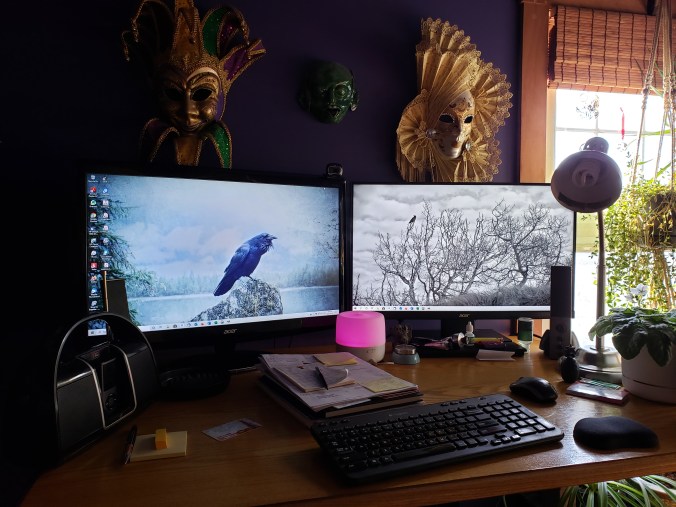
2020-03-27 18.01.12

States of emergency were declared at the national and provincial levels. Schools were closed indefinitely, and plans made to teach students virtually. Social distancing was renamed physical distancing. I don’t go out except to walk Torvi and when I do, I’m sure to stay at least two metres away from other pedestrians. Phil is our designated shopping and fetching guy, which works because he’s otherwise unemployed. He’s also performing this service for our moms.

Things haven’t changed much for me. I’m still working (a blessing) but am doing so from home. I don’t have any more time than I normally do, and so I’m not engaging in binge-watching, catching up on learning activities, or seeking distraction. I’m distracted enough by the surreality of the situation.

This is the new normal. And yet changes continue to be announced every day. The chaos has me in a state on continual, low-grade anxiety.

The month in writing

I’d planned to take weekends off and intended to compensate with extra words during the week. This went swimmingly for the first few weeks until covid-19 started to make its presence felt. Then, all bets were off.

When I came home from the office with the mandate to work from home on March 24, Phil ordered me a second monitor. My workstation at the office has two monitors and we have enough applications open that it really does make things easier. The second monitor arrived on Friday and we set it up after I finished work for the day. After that, I was toast, but I’d planned not to write Friday through Sunday every week in March, anyway, so I didn’t think I would fall too far behind. But I’d already missed Wednesday. The workday was chaotic and the more I tried to finish up and pack up and move home, the more stuff happened that prevented me from doing so.

So, I didn’t write Friday or Saturday and when I got back to it on Monday, my progress was not what I’d hoped.

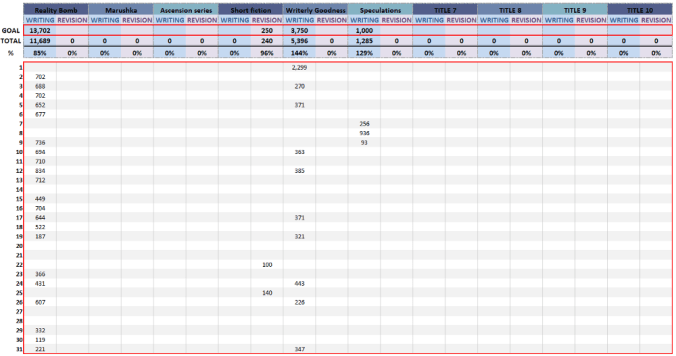
MarchProgress

All this to say that I fell short on my drafting goals for the month again. Of my 13,702-word goal, I wrote 11,689 words, or 85%.

I blew my blogging goal away with my massive review of the split worlds series last month and wrote 5,396 words, or 144% of my 3,750-word goal.

I wrote my latest Speculations column in 1,285 words, or 129% of my 1,000-word goal. It should be coming out this week, so you can look forward to that.

I also revised a short story. There wasn’t as much revision as I’d thought. There was a lot more cutting than writing. I ended up writing 240 new words and cutting close to a thousand. I set myself a 250-word goal for the revision and accomplished 96% of it. I don’t count words cut.

I submitted the revised story to an SF magazine for their open reading period. Wish my words luck.

I received some awesome news that five of my speculative poems have been accepted for publication. I’ll be able to tell you more about that when they’re actually coming out. Stay tuned.

I also finished a critique for one of my partners in the online group and found the time to wrangle all the information I needed to submit our taxes. Yay me 🙂

Interestingly, at 18,370 of my total writing goal of 18,452 words, I came in at 99%. Between writing and revision, I accomplished 98% of my goals. I’ll take it.

Overall, I’m pleased with what I was able to accomplish this month, all things considered.

Filling the well

You wouldn’t think that I’d have anything to report here. You’d be wrong 😉

I’ve recently joined a Facebook group run by Lauren Carter and she organized an online reading through Zoom. I got to read poetry along with other poets, memoirists, non-fiction writers, and other novelists from all over North America. It was lovely and supporting and just the thing I needed.

What I’ve been watching and reading

March’s viewing included Locke & Key. Phil and I enjoyed it and are glad that the series in being renewed. We classified it as horror lite because of the juvenile protagonists. Although there was a truly horrific backstory that cropped up again in later episodes, it wasn’t overwhelming. The twist wasn’t terribly twisty, though. We had it figured out before the reveal. We liked the effects of the various keys and are looking forward to what the show has in store for next season.

We also burned through Altered Carbon. Season two takes place several centuries after the first. Takeshi Kovacs and Poe have travelled all over the known universe in search of Quellchrist Falconer and Tak has worn many different sleeves. The show opens on a scene in a lounge and the singer is Tak’s latest sleeve. She’s killed and Tak’s stack is taken. A virtual meeting with his new “employer” sees Tak lured into a protection detail in return for information on Quell. The bad news? Tak is back on Harlan’s World, the hellhole he and Poe escaped at the end of season one.

When he’s resleeved in Anthony Mackie’s buff body, Tak wakes to the chaos of his new employer’s assassination, which he is promptly framed for. Poe has meanwhile degraded because he refuses to relinquish his “memories” of Lizzie from season one. He glitches dangerously and seems to have an AI version of Alzheimer’s, often forgetting what he was saying, what he was doing, and where he is. The only “cure” is to reboot, resetting him to his factory state. Poe, of course, resists this because he would not only forget Lizzie, but Tak and all the adventures they’ve shared.

I highly recommend this one.

We also watched Aquaman (finally). Eye-candy aside, it was okay. Pretty standard DCEU fare.

This month’s reading started off with Robert J. Sawyer’s Calculating God. This was an older novel, published in 2000, and centers on an alien who comes to Earth, and specifically to the Royal Ontario Museum (ROM) in search of a paleontologist because God seems to be engineering the apocalypse. Sawyer plays with the idea that civilizations only evolve to the point where they either begin to colonize other planets, or they destroy themselves. Add to this the controversial idea of intelligent design. The aliens believe in God and that everything in the universe had been planned and balanced in such a way as to to create life in multiple forms and to direct its evolution.

Two alien species have joined forces to investigate the apparent destruction or disappearance of several other civilizations. Some have, in fact, destroyed themselves. Some have taken refuge in virtual existence to avoid destroying themselves. And one travels to a remote sector of the galaxy for mysterious reasons. An impending supernova (of Betelgeuse, no less) threatens Earth and the other two alien species and the aliens want to join forces with humans to solve the mystery. Thomas Jericho struggles with the aliens’ belief in God because he has lung cancer that’s going to kill him.

A secondary plot devised by two fundamentalist Christians who want to show us Godless Canadians how wrong we are complicates matters. The bombing of a nearby abortion clinic is only a prelude to their main attraction: destroying the ROM’s collection of Precambrian fossils. The ticking clock is threefold. Will the terrorists destroy the fossils, and everyone in the vicinity; will the cancer kill Jericho and doom the interstellar mission to potential failure; or will the supernova make it all pointless?

Sawyer has often said that his stories are, at heart, about optimism. Calculating God is no exception.

Next, I read Ed Willett’s Spirit Singer. The titular character, Amarynth, begins the novel as apprentice to her grandfather. A spirit singer’s job is to sing the souls of the dead into the afterlife, but there’s something wrong. A malevolent presence haunts the between world. It stalks and kills her grandfather, stranding the souls of the people of their village, and Amarynth doesn’t yet know enough to assume his duties. She must find help.

It was a decent YA fantasy, but nothing surprising.

The Gilded Wolves by Roshani Chokshi was another story. A heist plot set in 19th Century Paris in an alternate world in which Babel Fragments endow people with magic. There’s political intrigue and manipulation and a cast of characters that I loved. Not going to say much more because y’all should read this one for yourselves.

Aliette de Bodard’s The Tea Master and the Detective is not what you might expect from the title. The tea master is a disenfranchised ship mind who’s lost her crew and is trying to make ends meet by brewing “teas,” which seem to be neurochemical enhancers. The detective is one of ship mind’s clients who solves mysteries for fun. The mystery she draws the ship mind into? That of a young woman who seems to have voluntarily exposed herself to the deep spaces.

My classical selection of the month was Moby Dick. This was basically Melville’s love letter to the American whaling industry. The story itself could have been told in a small fraction of the words, but the novel is also a palimpsest. Every event becomes a story within the story. And then there’s the chapters on the categorization of whales, the difference between whale oil and spermaceti. I didn’t hate the book, but it was entirely too long.

Finally, I read Sabaa Tahir’s An Ember in the Ashes. I remember when it was being released that someone said it would be the next Game of Thrones. Not quite, but it was an enjoyable read. The characters were engaging, but I did get a little irritated by the duelling love triangles. The world building was excellent, and I have moved on to reading the second in the series.

And that was the month in this writer’s life.

Until next time, be well and stay safe, be kind, and stay strong. The world needs your stories.

The Next Chapter

The next chapter: February 2020 update

March came in like a lamb. Still, I’m hoping for a mild month. There are always a couple of storms, but I have hope. Emerging from my cave.

The month in writing

February started off a little rough. As I mentioned last month, I was struggling with the midpoint of the novel I’m rewriting. Work didn’t resume until the ninth and, in a short month, that put me behind. Still, I managed to write 10,805 words if my 12, 180-word goal, or 89%. Accordingly, I’m rejigging my drafting goals again, but they’re still not unreasonable. I have to write 442 words per day through to the end of April to achieve my overall goal of 90k words on the draft.

The only other writing I did in the month was on this blog, and I managed 100% of my 3,500-word goal, writing 3,506 words 🙂

FebProgress

I also rallied myself to send out some poetry. I sent some speculative poetry to Polar Borealis, and some nature poetry to Canary. Will let you know how that goes. I had wanted to

Finally, I registered for Ad Astra, which has moved back to the beginning of May this year.

Filling the well

I didn’t go out anywhere, but I did take a couple of online courses through Jane Friedman and I took in another session on deep point of view from Lisa Hall-Wilson. I am a learning mutt, after all.

What I’m watching and reading

In the personal viewing department, I finished the most recent season of Dear White People. They delved into some serious topics, like the sexual assault of one of the secondary characters by one of the professors, sexual identity and exploration, the treatment of graduate students, and various characters struggled to express themselves through their various chosen media (film making, journalism). The season started out with the two characters apparently “selected” to enter into the secret society rejecting the dubious honour only to have it crop up again at the end of the season. This time Sam and Lionel are told to stay away from the secret society. It’s become corrupt.

Phil and I watched the next instalment, or part, of The Chilling Adventures of Sabrina, in which the titular character takes the throne of hell. Meanwhile, a group of pagans led by Pan are planning to destroy all of humanity and return the world to a state of nature. There’s basically a war between the coven and the pagans, which I found to be a little contrived, but in the end, the Satanic coven rediscovers their true roots as wiccans, the pagans are driven away, and Faustus releases something that looks distinctly Cthulian. The timey-wimey shenanigans Sabrina perpetrates to accomplish this end are questionable and she essentially creates a classic paradox, meeting herself. Somehow, the two iterations of Sabrina survive, one choosing to reclaim hell and the other returning to Greendale to live her “normal” life with her friends and family.

Then, we watched the first season of the October Faction. It had a fairly derivative plot. Fred and Delores Allen are monster hunters in an organization called Presidio and have twin children from whom they hide their secret lives. When it turns out that the twins birth mother, a massively powerful sorceress, wants her children back, everything hits the fan. And of course, Presidio is revealed to have nefarious plans. I had a lot of questions. At one point, it’s revealed that Fred and D, as part of a Presidio task force headed by Fred’s father, basically murder nearly all of the sorcerers. Somehow, Alice, the twins’ mother, is not shot down, but ends up trapped at the bottom of a lake to be conveniently revived by her daughter. She reveals that after escaping the massacre, she trusted the wrong people and they betrayed her. Okay? Why not just kill her? Also, after killing everyone else, Fred and D decide to spare the twins and adopt them. Would Presidio (who gets all up in the business of all their operatives) not know this? It was okay.

Reading-wise, I rounded out my tarot reading with Corrine Kenner’s Tarot for Writers. Again, as I’m going to be writing about all of the tarot books in my next Speculations column for DIY MFA, I’m going to reserve commentary here.

I also read David Gaughran’s Let’s Get Digital (finally). I’m still aiming for traditional publication, but I’m passively learning about self-publishing in the event that doesn’t pan out. It was informative.

In fiction, I finished Emma Newman’s Split Worlds series by reading All Good Things. Last year, I overdid it by reading five of Newman’s novels in quick succession, the First of the Split Worlds series and all of her Plantefall series. I had to take a break because I lost my perspective. Newman’s novels are good, but they focus on deeply flawed and often powerless protagonists who struggle with various mental health issues. This can make them challenging reading.

**SPOILER WARNING** Skip to **END SPOILERS** if you haven’t read the books and don’t want to know. I don’t give away absolutely everything, but, well, you’ve been warned.

Split Worlds was a slow burn. Things definitely happen in the first two books, but they all happen to the protagonist rather than emerging from the protagonist’s decisions and actions. Cathy was born into a fae-touched family. The fae-touched live in the Nether, one of the split worlds, and are dependant upon the fae for longevity. The Nether is stuck in a pseudo-Victorian/Regency time period with its attendant misogyny. Cathy runs away to attend university in Mundanus (our world) but is recaptured and forced to accept an arranged marriage. She also suffers from social anxiety and is blessed/cursed with three wishes from Lord Poppy, the fae lord of her family.

The second main character, Sam, is a computer programmer suffering through a disintegrating marriage who stumbles into Exilium, the realm of the fae, and thus into the Nether, encountering both Cathy and Max. Between these two stories is a third, helmed by arbiter Max, who has had his soul dislocated so that he can more effectively police the fae and the fae-touched, in the service of the heptarchy of sorcerers. The Bath chapter, of which he was a part, has been obliterated and Max’s soul is somehow transferred into a stone gargoyle. Max can’t figure out why his sorcerer, Extrand isn’t interested in uncovering the perpetrators. The plot of the first book, Between Two Thorns, involves the rescue of Cathy’s uncle, in which both Sam and Max assist, who was kidnapped as a result of fae-touched intrigue.

In the second book, Any Other Name, Cathy is drugged by her own parents and married into a rival fae-touched family against her will. Then, because she’s a feminist and not at all interested in becoming a baby factory for her husband, he gives her a love potion so that they can, at least, consummate the marriage. Sam’s wife dies and he believes it’s murder. During his investigation, Lord Iron, a member of the elemental court (as opposed to the fae court) takes Sam under his wing. Max tries to solve the mystery of the Bath chapter despite the leaden feet of Extrand and ends up helping Cathy and/or Sam more than pursuing his own goal. We find out a lot about the workings of the Nether and Exilium in book two. It’s fabulous world building.

The plot of this book involves Cathy trying to track down there whereabouts of her old tutor, who taught her about feminist history and the world outside the Nether. This leads her to an organization called the Agency, who provides all staff for the fae-touched families and has a monopoly on all the household needs (interior decorating, primarily). Cathy also discovers her husband’s secret. He has a half-sister, born of his mother’s adulterous affair, that he must keep hidden. While Cathy’s meddling marks her for an assassination, from which Sam and his growing affinity with iron save her, society schemes set her husband William on course to unseat the current duke of Londinium by duel to the death.

The third book picks up the pace a bit. In All is Fair, Cathy, having recovered from the assassination attempt, is now duchess of Londinium and, believing that she may now have the power to change the Nether for the better, decides to stay and fight the good fight. In the previous two books, her personal goal was escape, but that proved impossible in her circumstances. Having bungled/wasted the first two of her wishes, Cathy aces the third, wishing that she attain her full potential without harming her family or the ones she loves. The first thing she aims to do is to take down the Agency.

Sam begins to train under Lord Iron by learning the craft of blacksmithing. As he does so, his affinity to iron develops and Lord Iron teaches him about the elemental court, who have forgotten their role in the split worlds, that of protecting humanity from the fae. Digging deeper, Sam discovers that his wife was working to take down the company she worked for because of its environmental abuses. At the end of the book, Lord Iron commits suicide in front of Sam. For Max’s story, his investigation finally seems to be getting some traction. Extrand calls for a moot, or meeting of the heptarchy, to decide what to do, moving forward. Max also discovers that the London/Londinium branch of the arbiters is corrupt. At the end of the book, Extrand, being his unstable self, declines to attend the moot he called and the five sorcerers who do attend end up getting killed.

The plot of book three is now firmly tied into the lives and goals of the main characters.

In book four, A Little Knowledge, Cathy, empowered by her success in taking down the Agency, attempts to influence the Londinium court into accepting that women are equal to men. This makes problems for William, who is now under orders from his family’s patron and fae lord to get his unruly wife under control and produce an heir. Cathy gathers allies, mostly women who have been charmed/cursed into subservience and she starts to undermine the patriarchy. Unfortunately, she’s still under the influence of the love potion William gave her and she inadvertently gives William everything he needs to impede her every step forward.

Sam is named as Lord Iron’s heir and takes his place in the elemental court, but they have no interest in halting their environmental devastation or in resuming their responsibility of protecting humans. While Sam radically changes all of his own businesses, he tries everything he can to get the elemental court to change. Then a strange woman seeks his help.

Extrand decides that the only other living sorcerer must be responsible for the deaths of the rest of the heptarchy and starts a sorcerous war against his rival. Meanwhile, Max works to uncover the true culprit, the only female sorcerer and sister to one of the murdered sorcerers. When she unleashes a curse that kills Extrand the other sorcerer, Rupert, manages to escape, and Max decides to work for him as the last sorcerer of Albion.

Finally, in book five, All Good Things, Cathy, having learned of William’s magical manipulation of her, leaves him, taking refuge with Sam. She meets the strange woman, Beatrice, who tells her that she is a sorcerer and that she has killed all the rest because it was the sorcerers who split the worlds in the first place. She has a plan to restore the worlds to what they once were, all one, with the fae and the elemental court to balance one another. Cathy is appalled. All the evil in her life has been caused by the fae. The fae cannot be released from Exilium. Beatrice offers to teach Cathy sorcery in return for her help. Reluctantly, Cathy agrees.

Sam, meanwhile, has not made any progress with the elemental court. They have resorted to sending assassins after him. Beatrice has also explained her plan to Sam, who has the same reservations as Cathy, but he can’t single-handedly change the elemental court. Perhaps her plan is the only one that will work. Max soon learns that Rupert is no better than Extrand. All the sorcerers are mad in their own ways. Rupert asks him to kill Beatrice using a curse that will also kill Max. Max tracks Beatrice to Sam’s and Cathy talks him down from carrying out his mission.

Meanwhile, in desperation to save his family, William goes to Exilium and makes a deal with the king of the fae to take his place. That’s when the fun begins.

**END SPOILERS**

The Split Worlds is definitely a series that has to be read in order and in its entirety to be appreciated. I enjoyed it and recommend it. Newman tells a great story. It just takes a little time for all the threads to seat fully into the warp and weft 🙂

Just going to hit my other reads briefly.

S.A. Chakraborty’s The Kingdom of Copper was a great second in series, even if it kept Nahri and her afshin separated for most of the novel.

Loved N.K. Jemesin’s “The City Born Great.”

Marlon James’ Black Leopard, Red Wolf was fabulous in one respect. He goes deep into Tracker’s POV and stays there. A master class in technique. The story was good, but the framing device didn’t work for me.

Finally, Richard Wagamese’s Indian Horse was wonderful. Meaningful, poignant, and, well, just wonderful.

And that was a month in this writer’s life.

Until next time, be well, be kind, and stay strong. The world needs your stories.

The Next Chapter

Tipsday: Writerly Goodness found on the interwebz, Feb 2-8, 2020

You’ve survived Monday! Reward yourself with some informal writerly learnings.

Janice Hardy says, author, we have a problem: four plotting tips. Later in the week, Janice is poking dead scenes with a stick. Fiction University

K.M. Weiland shares six steps to create realistic and powerful scene dilemmas. Helping Writers Become Authors

Jami Gold uses an, ahem, moving metaphor to discover what matters in our stories. Then, she wonders, where do you want your story (or career) to go?

Jenna Moreci explains how to tell if you should write a series (and when you shouldn’t).

Abigail K. Perry covers James Scott Bell’s final signpost scene: transformation. As one series ends, another begins. The first of my three-part series on the tarot as a tool for mythic storytelling: an introduction to the tarot. DIY MFA

Donald Maass revisits the uncon again: world building for non-SFF writers. Cathy Yardley: your subconscious speaks a different language. ‘Cause tarot (see above)! Writer Unboxed

Meg LaTorre explains how to find critique partners and beta readers. Writers Helping Writers

Kris Spisak advises you to look at these four problem areas when revising. Jane Friedman

Joanna Penn interviews Jennie Nash: would you make a good book coach? The Creative Penn

Chris Winkle explains how storytellers use reactivity and proactivity for effect. Then, Oren Ashkenazi shares seven tricks to improve your minions. Mythcreants

Etuaptmumk: two-eyed seeing. Rebecca Thomas TEDxNSCCWaterfront

Brit Marling: I don’t want to be the strong female lead. The New York Times

Thanks for stopping by. I hope you’re taking away something to help with your current work in progress.

Until Thursday, be well, my writerly friends 🙂

Tipsday2019

Join me over on DIY MFA for my latest Speculations

This time around, I’m starting a new three-part series on using the tarot as a tool for mythic storytelling: an introduction to the tarot.

MythicStorytelling

There’s a wee bit of history and a lot of description. Next time, I’ll look at five tarot books for writers and let you know how they stack up.

While you’re visiting, check out Gabriela’s other great resources for writers, including DIY MFA 101, her flagship course.

Until next time, be well, my writerly friends 🙂

The next chapter: January 2020 update

January saw this writer still in hibernation mode.

The month in writing

Work continues on the rewrite of Reality Bomb. I changed my ambitious plan from last year, extending the remaining work through to the end of April. This meant a daily goal of 392 words. This was reasonable and very doable … until I came across a snag at the midpoint.

While the story is still science fiction, I’d classify it as soft SF because the character arc focuses on my protagonist coming to terms with her past trauma and forgiving herself for the harm she’s caused others as a result. Once the inciting event occurs, my protagonist is disembodied, which causes its own difficulties (agency), but at the midpoint, she’s in a fairly literal mirror moment as she and her alternate self—two very different personalities trapped in the same body—reach an understanding.

I stopped drafting for a few days, did some brainstorming, and moved on, but I’m still not happy with what’s on the page. I’m going to go back to my revised outline, which I’ve diverged from, as usual, do some more brainstorming, and see if I can’t wrangle the scene back into shape.

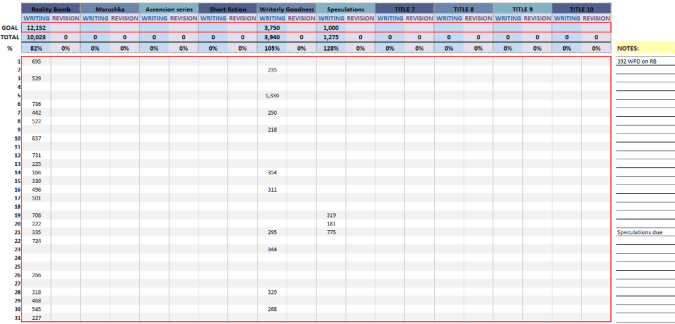
Januaryprogress

So, of my 12,152-word goal, I wrote 10,023 words, or 82%. And I’ve had to calculate a new daily writing goal, 420 words per day, to account for the shortfall.

My next Speculations column was due, and I submitted on time with a 1,275-word article, achieving 128% of my 1,000-word goal.

I also exceeded my blogging goal of 3,750 words, writing 3,940 words, or 105% of my goal.

Overall, I wrote 16,902 words of my 15,238-word goal, or 111%. Not bad.

What I’m watching and reading

Phil and I leapt into the latest season of The Expanse. We burned through it and really enjoyed it. All the characters (Bobby! Amos!) got great defining moments. The bill came due for Avansarala, Ashford broke my heart, and we have some great mysteries to solve for the next season.

Without getting spoilery, I’ll say this: The Expanse has now replaced Babylon 5 as Phil’s favourite SF of all time 🙂

Everything else is in progress.

Before I get to my reading in January, I’ve decided that I’m not going to review a book unless I can give it four or five stars. My last review last year was one I owed to the author, but … it was three stars. I liked it. But it was a first novel and while the story was good, there were other problems that made three stars the appropriate rating.

I won’t be dishonest or give a book a great rating just because I know the author. Just know that, moving forward, I’m only going to review books I genuinely love.

In non-fiction, I read three tarot-related books: Mapping the Hero’s Journey with Tarot, by Arwen Lynch, Tarot for Fiction Writers, by Haley Dzuk, and Tarot for the Fiction Writer, by Paula Chaffee Scardamalia. They were all good, but the last was, in my opinion, the best. I’m reading these for my next Speculations column, in which I will be reviewing five tarot for writers books and outlining the value for writers in each. I’ll save my opinions for the column 🙂

I finished Leigh Bardugo’s Shadow and Bone series, reading Siege and Storm, and Ruin and Rising. The series works as a series, but I don’t know that the books work as standalones.

I mentioned when I read Shadow and Bone, that I found the protagonist a bit passive, that is lacking in agency. This issue is solved in the second book, though there are several levels of conspiracy at play, all of which successfully manipulate Alina to the point where the only action she can take in the climax is to use her connection with the Darkling in a strange murder-suicide attempt, which accomplishes neither end and merely defers a final confrontation.

In book three, the best of the series, Alina actively pursues her goals. She leads her ragged band of survivors and friends on a quest to find the third amplifier, which they think is the fire bird. It’s not, and the tragic choice that faces Alina when she learns who the third amplifier is, results in a risky gambit that ultimately fails.

Then, rather than self-sacrifice, the trope both previous books ended with, Alina unwittingly pulls a Buffy (season seven). Buffy acted armed with knowledge and a viable plan to share her power with every potential slayer in the world. Alina reluctantly kills the third amplifier and is stunned when she feels emptied of power rather than filled with it, and then watches as a number of commoners turn into sun-summoners. While she manages to kill the Darkling when he’s distracted, it’s those new sun-summoners who destroy the fold and the volcra.

Alina and Mal do get their happily ever after, reopening the orphanage where they grew up, but to do this, Alina has to relinquish her power and the hope of ever being grisha again. I’m not so sure I’m happy with that ending, even if we’re told Alina and Mal are.

I also read books three and four of Emma Newman’s Split Worlds series All is Fair and A Little Knowledge. Because I’m reading book five now, I’ll save my series review for next month.

Finally, I read the first book in a YA fantasy series that Caroline Sciriha, an author from my critique group published with Castrum Press. Dawn of Purple and Gray is about Shael, who has been raised by a family of potters and has been taught to hide the white hair that would mark her as a Hyllethan. She’s told it was a gift from her mother’s mistress, a Hyllethan princess, but Shael’s family are Inlanders. After a war and political coup, the Hyllethans are their enemies.

When she comes across a wounded messenger who tells her to take his package to the queen and then dies, Shael is drawn into adventure and learns a truth she never suspected.

The story is good. The writing is good. Caroline even created a board game that plays a role in the plot on multiple levels. I found Shael skewed young, even for a YA book, however. It was an enjoyable book and I’ll read the next in series when it comes out, but it didn’t hook me like other books have. Other readers have rated the book more highly than I have, so my opinion is not in the majority.

And that was the month in this writer’s life.

Until next time, be well, be kind, and stay strong. The world needs your stories.

The Next Chapter

Tipsday: Writerly Goodness found on the interwebz, Dec 1-7, 2019

Aaaaand … I’m back with some lovely informal writerly learnings for you 😉

Jael McHenry: writing, verbs, and time. Ray Rhamey extols the fun of pantsing. Donald Maass: un-con redux—operation phoenix. Susan Spann cries, curses—foiled again! Cathy Yardley wants you to play to win. Writer Unboxed

Jenna Moreci digs deep to list her top ten dystopian tropes.

Robert Lee Brewer clears up the confusion around lose, loose, and loosen. Writer’s Digest

Emily Wenstrom offers five tips to set (and keep) an author platforming resolution. And here’s my latest Speculations: five awesome ways NASA’s all-woman spacewalk inspires us. DIY MFA

James Scott Bell answers the question, is it necessary to write EVERY day? Then, Angela Ackerman is mastering show, don’t tell. Writers Helping Writers

Writing anti-heroes with Reedsy.

Spencer Ellsworth says, outlines are for revision (say what?)—a different approach for your process. Fiction University

Ellen Brock shares a simple strategy for novel editing.

Chris Winkle shares lessons from the disingenuous writing of Maximum Ride. Then, Oren Ashkenazi considers what makes an antagonistic group problematic. Mythcreants

Thanks for stopping by and I hope you found something you need to fuel your current work in progress.

Until Thursday, be well, my friends.

It’s good to be back.

Tipsday2019

Join me over at DIY MFA for my latest Speculations

This time around we’re drawing inspiration from the real history of women in space.

AllWomanSpacewalk

While you’re there, check out the site, the other columnists, and all of Gabriela’s great resources!

Until next time, be well!