Introduction to Participant-Centered Training Delivery

Or, how I spent last week 🙂

Nothing is more fun than three ring binders.

Nothing is more fun than three ring binders. (Photo credit: Wikipedia)

So last week I was down in Toronto, the Big Smoke, Hogtown (never figured out why they call it that—oh, my friends Google and Wikipedia have discovered the answer: livestock processing was a big part of Toronto at one time) co-facilitating the Introduction to Participant-Centered Training Delivery (IPCTD) course.

Ostensibly, this is part of my attempt to become certified as a trainer through my employer.  The co-facilitation of this course was listed as a recommendation to anyone going through the process.  I didn’t think I would have this opportunity, having been told in the fall that the delivery of this and all other certification courses was being outsourced.

When the opportunity arose, I could not pass it up.

My co-facilitator and mentor for this part of the journey had just been certified in November herself and part of the purpose of our training together was so that she could give me a few pointers, watch out for those unconscious bad habits of the past.

I’ve blogged about Participant-Centered Training (PCT) before, but just to recap for those of you not interested in reading the whole post:

[In PCT, t]he trainer is merely present to elicit the desired knowledge from the learners, to encourage the appropriate behaviours, and to facilitate the process of discovery that will lead the learners to exhibit the desired performance in the workplace.  It’s no longer about [the trainer] having all the answers, but about being able to help the learners, now active participants in their own learning, find the answers for themselves.

The tag line is: Instead of the “sage on the stage,” be the “guide on the side.”

The course is two and a half days long and includes a practical demonstration by the participants, of the techniques they’ve learned.

Prior to the course, I met virtually with my co-facilitator a couple of times.  We divided up the material so that neither one of us would be leading the class for very long.  I read through the material to refresh my memory (when I took the course as a participant, it was 2009 and the course had subsequently been revised) and made copious notes.  I also brought a second copy of all the manuals, flipcharts, and PowerPoint presentations on a USB.

I travelled down on Tuesday morning and helped my co-facilitator set up the room.  That’s one thing to keep in mind with PCT: it may demand less of the facilitators in the classroom, but it requires much more preparation.  There are usually tonnes (I’m Canadian, eh?) of flip charts, visuals, learning aids, and activities to be set up in order for the session to go as planned.

The facilitators’ manual is critical as it lists times and required elements for each section of the course.  Most PCT courses are crammed full of information, the enrichment materials marked as “optional.”  Most of the time, there is no time to address much of the “optional” material, but every attempt is made to at least refer to it and ensure that the participants have access to those additional references and resources.

The course

The course was designed with a nautical theme and contained four sections: Opening and introduction; Methodologies and techniques; Communication, group building, group management techniques, and co-facilitation skills, with the practical component thrown in for good measure; and the Course closing.

The pre-course materials and assignments were to have been printed out, reviewed, completed, and brought with the participants.

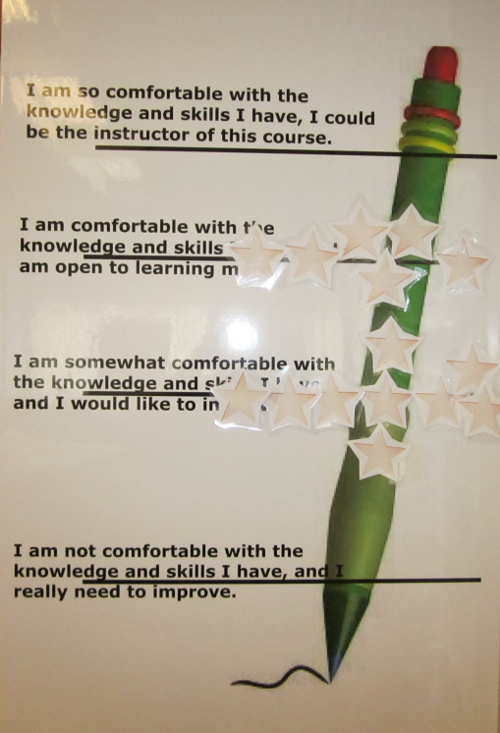
The course opening includes an activity first thing to immediately engage the participants in the topic, review of some of the pre-course materials, expectations, comfort rating, course objective, agenda, participant introductions, and an introduction to PCT.

A note on objectives: prior to getting into PCT myself, I didn’t know the criteria for a good course objective.  A course objective should include performance, process, and standard or method of evaluation.

Examples: By the end of this course, you will be able to build a bird house using the bird house building instructions so that the result will meet the criteria described in the bird house schematic.

Or: By the end of this course, you will learn how to process an application, using the application policy, such that you will be able to achieve our 80% quality assurance goal on the simulation test.

Or: By the end of this course, you will be able to use Microsoft Word, in accordance with the Microsoft Word for Dummies Tip Sheet, so that you will be able to create documents for your employer more efficiently and confidently.

And yes, the standard or method of evaluation can be the participant’s own comfort level.

The methodologies and techniques section deals with the different PCT methods of delivery and the specific techniques, or activities that can be used to effectively engage participants.

The next section is the big one.  Communication skills, group building, group management, and co-facilitation are all covered, and then the participants are divided into groups, assigned a topic, and given an hour and a half to work on a 20 minute presentation in which they will demonstrate the skills, methods, and techniques they have learned.

The closing section revisits much of the material presented in the opening to answer the following questions:  Did we meet the course objective and participant expectations?  Do the participants feel they have learned valuable tools that they will take back to their jobs?  Review and transfer strategies are also incorporated.

Throughout the course, the co-facilitators are actively demonstrating all of the skills that we teach.  That’s another difficult aspect of adopting PCT: developing your awareness.  Though PCT takes the pressure off the facilitators to be the “talking head” or subject-matter expert, they have to be aware of everything that’s happening in the class: the participants’ attitudes, changing levels of engagement, the environment, and their own behaviours.

If you’ve done any training in a traditional environment, it’s essentially lecture.  Students sit there like baby birds waiting for their meal to be shoved down their throats.  This establishes some habits that have to be consciously broken when the trainer moves to PCT.

Questioning techniques are paramount.  Relays and overheads fly and form the foundation of debriefing every activity and conducting every review.  Knowledge must be drawn out of the participants, not fed to them.

This can be demanding, especially for someone like myself.  Though I enjoy training and think that I am good at it, I am, at my core, a shy person, and more fond of information than of social interaction.  This makes delivering training an exhausting activity for me.  I’ve noticed that even in the last six months that my tolerance seems to have decreased.  The need to retreat at the end of the day is nigh on irresistible.

Despite this, my co-facilitator said that after the first day, she didn’t notice any bad habits or poor behaviours on my part.  I was a little too fond of the closed questions at the start.  We worked well together and delivered a course that was well-received by the participants.

I won’t be able to review the assessments for a while yet, but there was nothing but compliments flying about the room that last day.

So that’s the Learning Mutt’s adventure for this week.  Tomorrow, I’m heading out of town again and we’ll see if the life of a training coordinator will provide any more fodder for Writerly Goodness in the future 🙂

Next weekend, look forward to an interview with Laura Conant Howard in conjunction with her cover reveal blitz for the upcoming The Forgotten Ones, another pupdate, and, if I have the gumption, my review of the Galaxy Note II as the smart phone writers want 🙂

Goodnight everyone!

Sunday night line up: Once Upon a Time; Beauty and the Beast; and Lost Girl 🙂

Business Writing Made Easy in techno-colour

I mentioned back in the spring when I took the training-for-trainers version of the course that I would eventually be delivering Business Writing Made Easy.

The idea was that the two of us advisors from the training team would teach the course to a combination of processing staff, team leaders, and other advisors and consultants, to build capacity, so that the advisors and consultants could then turn around and help us train the entire business line.  It was to be a kind of domino effect, wherein the burden of the training would not fall to any individual or small group of specialists.

Then I was fortunate enough to get this acting gig as training coordinator, which left one advisor on the training team to do the job.  At that time, I was given dispensation to assist in the training.  There would be three sessions offered to staff in all sectors.  The training plan was developed and received approval.

Then Business Transformation (BT) kicked in and not only threw our organization into chaos, but also created new training demands and pressures.  Two of the three sessions would be cancelled.

The organization’s College which had designed and delivered the training-for-trainers for the course transformed in its own way, outsourcing its training and adopting a greater emphasis on e-learning (which I laud, btw—it was just inconvenient in this particular instance).

Part of my personal goal in delivering this training was to achieve my training certification in the process.  While the College would still administer the certification program, its delivery would be in the hands of a partner school and its trainers.  I’m still not sure how this will work out in the “real” world and what it will mean for me as a certified trainer.

Then my fellow advisor, potentially “affected” by BT, took an opportunity of her own and also left the training team.  Plans were amended.  I and two other consultants from another business line would deliver the training across both business lines.

Prep commenced, and as all of us worked in locations 4 to 8 hours’ travel apart, most of it was conducted at a distance.  2-hour conference calls, time stolen from our in-person meeting, and other opportunities were taken.

Then (yes then) my mentor accepted a position that meant that she would be less available to me for coaching.

As the time of delivery neared, I made contact with my mentor in the certification program and she arranged for someone from the college to come in and “observe” me during the training.  The point of this was to assess whether I could be ready to make my first attempt at certification with my next delivery (in February).

Nerves set in.

See, I took the first step toward certification in September 2011.  Incumbent upon me were the tasks of completing post-course assignments, 30 hours of training in a participant-centred training (PCT) style, coaching sessions, co-facilitation of the introductory PCT course, eventually leading to an in-person assessment and the hoped-for certification.

Subsequently, the training that I was to complete in Q3 and Q4 last year was cancelled.  My first opportunity to conduct any training was in May 2012, just prior to my accepting my acting position.  Though I’ve tried to implement PCT in my training, I hadn’t had the opportunity to really exercise my abilities in PCT.

Also, the restructuring of our College meant that the introductory PCT course would not be trained in-house anymore.

So I headed down Monday and had a day to help my co-facilitator set up the room.  I reviewed my sections of the training and met with the observer to schedule her visit and time for our debrief afterward.

Day one went well.  We were actually able to let the class out a little early.  Once again, I took my trainers’ guide back to the hotel to review.

I showed up early, organized our materials, our observer arrived, and we began.

At morning break, which was also about a half hour early, the observer came forward with some tips.  I felt my hopes of certification before the end of fiscal slipping out of reach.  After the break, however, my co-facilitator and I rallied.  We immediately implemented the observer’s suggestions, and even after she departed at lunch, we continued on our streak of epic win, ending the day on time and on a fairly high note.

The debrief was thankfully less painful than I expected, and a plan was settled on.  I still had a lot of work ahead and if my current mentor wouldn’t be able to continue coaching me, then our observer offered to help me out.  An opportunity to deliver the introductory course would be coming up in January.  The planned February delivery of Business Writing would be a chance for me to further hone my skills in delivering the course, and another opportunity to deliver the course to the other business line was identified.  That would be in March, and my opportunity to certify.

My co-facilitator is a people-oriented person.  Though she wasn’t in the program or seeking certification, our observer had as many tips, tricks, and kudos for my co-facilitator and she did for me.  It was pointed out, however, that my preference for facts meant that the kind of interaction that came naturally for my co-facilitator, was difficult for me to muster and maintain.  I hadn’t thought about that.  I enjoy training, but I do find it tiring.  It was an important personal realization for me.

Admittedly, the final day of training posed a few problems for us, but my co-facilitator and I, buoyed by our encouraging review, went with the flow and adapted on the fly.  Ultimately, the participants were what made the course so much fun.  We had a bunch of stars in the class.

In the end, the training was a success.  Our observer happened to be in the bathroom following the class’s dismissal, and heard some positive, off-the-cuff reactions to the course.  It’s interesting where you receive some forms of validation 🙂

The Learning Mutt is still in recovery mode.

Back into the fray on Monday!  Have a great weekend, everyone.

Adventures in professional development October 2012

In-person team meeting, Oct 16-17

My team works virtually.  We’re scattered all over Ontario and so when we can meet in person, we take the opportunity.

This year, our in person team meeting was held in Toronto and we assembled from our respective offices: Timmins, Sudbury, Scarborough, and Chatham, to meet with the three of our colleagues that lived and worked in Toronto.

The focus of the meeting was professional development, but there were a couple of specific things that we had to accomplish: review our accomplishments to date, and plan our activities for the remainder of the year.

My team is diverse with respect to skills and relative areas of expertise.  I contribute to subject matter expertise in my business line, technical, facilitation, instructional design, and other communications skills.  Others bring subject matter expertise in other business lines, project management, instructional design, presentation, and specific business communication skills.  Some have great budget management skills and a holistic knowledge of our business that I lack.

We all come together to support one another and get things done.  As the result of our accomplishments/planning session, I once more find myself entering uncharted territory and helping to put together professional learning agreement (PLA) templates for various positions my business line.  This will be interesting work.

In the professional development category, we were reintroduced to a tool called the Passport to Service Excellence (PSE), which is supposed to help us chart our career path.  Talent management is something still fairly new and very much in development at my employer.

We have several tools and platforms to help us do this.  One is, of course, the PLA, where outside our departmental mandate and goals, we list activities that we would like to engage in and what positions we’d like to move into, job shadowing or acting roles we might like to adopt.

There is a Renewal Gateway site onto which we can post our resumes and where managers from various departments are supposed to look for individuals to suit their needs.  There are also formal and informal assessment processes for various jobs occurring all the time.  There is the PSE, and I’ll be helping out with another project geared to assist employees in planning their professional development activities in the coming weeks.

It seems to me that there’s a little too much duplication in these tools.  So if I were to take a course, I would have to update my own resume, the one posted on the Gateway, then open up my PLA and list it there, go to the PSE and make the appropriate alterations there, and soon possibly also update the new tool that’s being proposed.

That’s a lot of work.  It’s almost enough to make one reconsider taking part in any professional development activity.

What would be better is to work into one of the tools the ability to export information into other forms.  So that if I complete a course, I then go into one tool, for sake of argument, the PSE, update it, and then have the tool communicate with and update the other tools (PLA, resumes, etc.)  It makes sense to me, but when I made the suggestion, it seemed something beyond what could be provided.

This kind of thing happens a lot at my employer.

The Business Expertise Forum, Oct 29-31

Along with the SMART Board training that I delivered with my colleague Monica in September, I was to deliver a workshop at the BE Forum.  It soon turned out to be three workshops offered to a portion of the attendees in rotation with two other presentations.

Monica ended up having to deliver other training and couldn’t help me, so I said for convenience’s sake that I’d deliver the workshops solo.

I thought I’d have time in October to develop the presentation, handout, and complete the work necessary to have a translated version of the handout ready in time.  Unfortunately, other priorities emerged.  My job as training coordinator is not a boring one, to be sure.

Then two days before I was off on leave to attend a writing conference, one of my team mates volunteered to co-facilitate.  At that point, I didn’t really have the presentation hammered out, but I gratefully accepted the offer and shared what I could put together in a day.

Another issue was that the training room that I was assigned and that I wanted to get in early to set up was in use the day previous.

So making the best of the chaos, I travelled down with my colleague and attended the first part of the Forum.  There were a pile of work friends from various departments and locations that I got to see again.

Our regional head delivered a welcome address and expressed interest in attending the SMART Board workshop.  <gulp!>  Fortunately, her schedule was too full to allow it, but I had a momentary wiggins 🙂

One of my training team colleagues did a presentation on creating a quality monitoring program.  She’d been called in at the last minute when the original presenter was unable to attend.

Finally, at the end of the day, I got into the training room, hooked up my computer, and tested the SMART Board out.  Joy.  Everything was working.  Linda and I started to go through the workshop and had to finish off our mini-run through the next morning, as the training rooms were being locked down for the night.

Ultimately, all went well, and I ended up having a great time.  I went out with all of my work friends and caught a couple of great presentations, on training in a multi-generational environment and on managing transitions (another course that I will be delivering at some point in the future).

Now I’m in recovery 🙂

On taking breaks and lunches

One of the other things that came out of my team’s in-person meeting was that we all need to take care of ourselves.  A former member of the team, who’d left it prior to my coming on-board in May, had passed away in the summer at the young age of 51.

So we were all encouraged to take our lunches and breaks, and to take care of ourselves.

I have to confess that I haven’t taken more than a handful of legitimate lunches or breaks since starting with the team.  I tend to take on too much.  I know this about myself, but when I have something that I’m interested in, I can’t help myself.

Unfortunately, the things I’m interested in are not the kinds of things anyone else shares a passion for.  So I end up being a niche specialist because no one else has the time or aptitude to take up the torch.

I’ll have to let you know how my quest for personal time and balance at work goes.

The Learning Mutt has a couple of weeks at home before she’s on the road again, and hopefully for the last time this year …  I can dream, and whuffle in my sleep 😉

Four learning-related resources that have come my way recently

After two weeks out of town, I have a couple days off.  So this week the learning mutt is sharing some of the interesting stuff she found on the interwebz 🙂

The first two come from my friend BrainySmurf courtesy of her blog Connecting the Dots.

Brainy’s a MOOCer, that is, she participates in massively open online courses.  Through her most recent set of them (I think 4 at last count), she’s come across Susan Cain and her site: The Power of Introverts.

Now I’m essentially an introvert, though I work in an industry that has me talking to people all the time, facilitating courses, and the like.  I dislike “putting myself out there” and “being on.”  Really, what I want to do is work independently with words (just let me design courses and give me the time to finish them properly!), and of course, write.  My true preference would be to write all the time, holed up in my wee garret, but I know that after the writing comes the promotion and I have to be super “on” for that.

Susan Cain - Quiet - The Power Of Introverts

Susan Cain – Quiet – The Power Of Introverts (Photo credit: k-ideas)

What this means is that I have to find my power as an introvert and learn how to use my innate and learned talents and skills to their best effect in an extroverted world.

Last week I mentioned Susan’s book Quiet: The Power of Introverts in a World That Can’t Stop Talking. It’s definitely on my reading list.

Last year, Brainy also mentioned Gretchen Rubin and her book The Happiness Project.  This week, I saw Gretchen on Canada AM promoting her new book Happier at Home.  Gretchen also came up during the platform-building course I’m participating in with Dan Blank of We Grow Media.  She was cited as an excellent example of platform-building, self-promotion, and book marketing.

PBS @ SXSW 2010 / Gretchen Rubin

PBS @ SXSW 2010 / Gretchen Rubin (Photo credit: PBS PressRoom)

When I first saw Brainy’s post on Gretchen, I wasn’t caught.  I was happy and didn’t really need any advice in the area, or so I thought.  Now I’m reconsidering my position.

A recent crisis in self-confidence has forced me to face the fact that I’m not currently happy.  Stress, mostly self-imposed, has me out on a limb and trying to look at myself in a mirror at the same time.  Tricky business that.

I’m thinking that I have to take another look at The Happiness Project.

Clark Quinn (the Quinnovator) noted on his blog learnets this week that Learning Design isn’t for the Wimpy.

ID isn’t easy.  We’ve been given some content, and it’s not just about being good little IDs and taking what they give us and designing instruction from it.  We could do it, but it would be a disaster (in this case, that’s what we’re working from, a too-rote too-knowledge-dump course.  And it’s too often what I’ve seen done, and it’s wrong.

Instructional design, or ID is what I aspire to do.  I write courses now, but it’s not really ID in the sense that Clark’s talking about.  There’s no consultation, there’s no conversation, there’s no back-and forth.  So far, I’ve only been writing courses on topic in which I’m considered the expert.  I can only write what I think a learner would need to know.  Being self-taught in most of these topics means that I’m writing courses for learners like myself, but I know that not everyone has the predisposition to learning that I do.

I try to work in what I think other learners will like and relate to, but it’s all through my own filters, and ultimately, that’s not good design.

Harold Jarche

Harold Jarche (Photo credit: Harold Jarche)

Which brings me to my next find: Harold Jarche.  He’s the champion of personal knowledge management, or PKM, and his latest post on Life in Perpetual Beta talks about how PKM can work to foster innovation within an organization.

In an organization where everyone is practising PKM, the chances for more connections increases. Innovation is not so much about having ideas, as making more and better connections.

PKM is something else I aspire to (hence the learning mutt), but it’s really only possible in my workplace at the advisory level or higher, and not many of us have hopped on the bandwagon so the sharing community isn’t huge.

Right now, it’s a problem without a resolution.  I have the solution, but not the internal platform to promote it.  I don’t have a lot of authority and all I can really do at this point is lead by example and talk it up every chance I get.

I set up a SharePoint site for the training team last year focused on professional development, but I was the only one using it.  I eventually stopped updating and promoting the site.  A bit of a defeat that, but perhaps someday I’ll be able to get back to it.  Not being a part of the training team anymore kind of throws a monkey wrench into those gears.

That’s it for this week.  Feel free to follow Brainy, Clark, or Harold.  They really are excellent resources in the learning and development field.

Also feel free to share any learning resources that you’ve found recently in the comments below.

Getting smart with SMART Board

Back in April, I posted about a gift I received back in May of 2010: a SMART Board.  Now I never did a dedicated post about what became of that wee gift.

English: A Smartboard

English: A Smartboard (Photo credit: Wikipedia)

In March of 2011, my then brand-new manager started an initiative.  She wanted the training team firmly in the 21st century, designing and delivering elearning.  Unfortunately, that was also about the time that my father passed away, and though I was considered the expert in  SMART Board, I only had time to complete part of the training course before I was off on leave.

My colleague completed the course for me, created a video segment for it, and delivered it, not only to our fellow trainers, but also to the regional learning governance committee, and at the business expertise forum.

The result: we received, as a team, a service excellence award for the project.

Getting even smarter with SMART Board

Fast forward a few months, and riding close on the heels of that success, it was determined that additional training should be delivered.  In person training.  Not only to our fellow advisors and consultants, but also to managers and other individuals in need of additional tools to present and conduct meetings.

Plus, there would be additional workshops to be held at this years’ business expertise forum.

Reunited for this next project, my colleague and I reworked the training, which was previously delivered as a combination of self-study and virtual delivery, into a 1-day, in class session.  The idea was that to cement the learning, hands-on application would be required, and lots of it.

Today was the first of two sessions, and though things were a little rough, we’ve received some very positive feedback.  I’m relieved.

Bumps on the road

Earlier in the summer, I was notified by the updating utility that Notebook, the software that accompanies the SMART Board, needed to be updated, so I dutifully put in my ticket with the techies, and was promptly updated to the wonderful Notebook 11 🙂

I realized that this was a major change that would necessitate the rewriting of the package.  Unfortunately, I wasn’t able to dedicate any time to the SMART Board until early August.  At that time, I booked a room, set up the SMART Board, and started playing again.  I also took scads of screen shots 🙂

The rest of August was spent re-writing the training package, given the new version of Notebook.  Dates were set, the course entered into our learning management system, invitations to participants were sent, and another ticket was submitted to the technical team to install Notebook 11 onto all the computers in the training room.

Pre-course assignments, including the participants’ guide, were sent out and submitted by the participants.

Then, last week, when I returned home after being out of town for the Managing Transitions training for trainers, I received a note that the computers were all updated … to Notebook 10.7.

Essentially, all the work that I had done on the revisions was a waste.  That was Friday, and I was on the road Monday morning to come down and set up the room prior to training.

There wouldn’t be time to work on anything.

Further, the versions of Notebook installed on the participant computers were all trial versions, and missing a few key elements.  This meant that some of the parts of the program that we were demonstrating could not be accessed by the participants at their desks.

That was a bit frustrating.

Nothing like rambling on for five minutes about this really cool feature when one of your participants pipes up and says, “where are you?  I can’t find that Icon.”  Then you realize that they’re missing something that it would really have been nice if they had.

Chameleons by any other name

So, as facilitators, we adapt on the fly, to a greater or lesser extent, and to more or less success.  Again, it seems we managed well, and that everyone got what they needed out of it.

It’s just frustrating.

I would have liked to have had more time to complete a proper facilitators’ guide.  I would have liked to have had the most up-to-date version of the software available to the participants.

As the song says, though, you can’t always get what you want 🙂

I guess all of this speaks to my perfectionism.  I’ll deal with good enough, and not stress over it (I’ve learned to let go of things at work), but I can’t help but think how much more successful the package could be.

There are so many things that I’ve done in the last couple of years that have been good enough, and that I’d love to have time to get back to and revise/update/complete.

Happy Dog

Happy Dog (Photo credit: jmckind)

How are things going in your work lives?  Are you too, plagued by persistently frustrated perfectionism?  How have you addressed the issue?  Is being able to let go enough?  Is good enough really enough?

Let me know!

The learning mutt, signing off 🙂

On the road again … or managing life’s transitions

I don’t mind traveling for work, for all that it puts a cramp in my writing life.

This week, I’m attending the training for trainers on Managing Transitions, the change management course that two of my colleagues developed for staff this year.

My employer has embarked on a business transformation strategy and a lot of our staff are being affected.  Even more are feeling the pinch of budget cuts.

Enter Managing Transitions, a course designed to offer insight into and tools to manage change in your professional life.

A colleague and myself drove to Toronto from Sudbury this morning to attend.  Today was the first half-day of class.

A couple of the critical learnings of the day:

  • change is the event; transition is the process.
  • change is often beyond our control, but our reaction to it and attitude toward it never are.
Deutsch: Viktor Frankl

Deutsch: Viktor Frankl (Photo credit: Wikipedia)

It’s the whole Viktor Frankl thing.  You know Viktor Frankl?  Author of Man’s Search for Meaning?  Essentially, he was a prisoner in a Nazi death camp during WWII.  He survived the horrors, but only by making the critical realization that the only thing he could control in his dire circumstances was himself.

Now that’s a very simplistic take on his philosophy, but if it’s piqued your interest at all, pick up his book and read more about it.  See if you agree.  Don’t take my word for it.

Now few of us these days encounter changes that are so drastic or life-changing as Frankl’s, but it can still happen.  On a day like today, I think back to 9/11, and though it’s been eleven years since the tragedy, it’s one of those defining moments in history.  Everyone remembers where they were when they first heard that dreadful bit of news.

Tribute in Light, 9/11/03

Tribute in Light, 9/11/03 (Photo credit: Brendan Loy)

Me? I was having coffee with my parents before heading off to work.  The morning show that was on the TV was pre-empted by the special news report.  I watched what they would show of it on national TV.  It was surreal.  Disturbing.  Inconceivable.

Another bit of learning from today’s session: it doesn’t matter how relatively big or small the change appears, the effect it has is directly related to how the individual experiencing the change perceives it.

So I’m here for another day and a half, then travel home again Thursday afternoon.

Will likely give you an update on this course when I deliver it at some point in the future.

In other news

Does your CEO tweet?  Does it matter?  Nick Charney calls shenanigans on ‘the 1.3 trillion price of not tweeting at work.’

What ‘open’ means to me.  New on Connecting the Dots.

Just a couple of things of interest in the virtual working world of Mel.

Thanks for stopping by!

The learning mutt needs to sleep if she’s ever going to get up in time for the course tomorrow!

Sick days and life planning

sick

sick (Photo credit: jungmoon)

Today was a sick day.  Now I’m not sick very often.  This was my first since May.  The last time I had a cold was October of 2010.  I remember it well, because it was a doosie, I was delivering training, and I couldn’t take any time off.  Usually, the only “sick” time I take is for doctor’s appointments and tests and the last time I took more than a day off was when I got hit by the car (funny story that, remind me to tell you sometime), or when I had surgery.

This, of course, got me thinking.  To work, and to do your work well, you have to be healthy.

I’m not the epitome of health.  I’m overweight.  I smoke.  I drink on the weekends.  I eat junk food more than I should, and I don’t exercise as much as I should, but I do what I can.  I walk every day.  I generally eat healthy food.  I get enough sleep (though I think I could use more), and I manage stress to the degree that I can.

Still, I have to take the odd sick day.

One of the things that I took the opportunity to do today was to read Michael Hyatt’s “Creating a Life Plan.”  Michael wrote it based on his own experience in life coaching and in cooperation with Building Champions.

Now this experience took me back a few years.  There was a time, a long time ago, that I was in “seeker” mode.  I read Stephen Covey, Anthony Robbins, Elizabeth Hay, and dozens of other books, then classified as “self-help,” in an attempt to straighten out my rather messy life.  I made a personal constitution. I worked out a weekly schedule.  I was going to FIX MY LIFE.

I learned a couple of things in the process.

1. I’m a person of habit rather than a person of plan. 
I am very habitual.  I generally do the same things every day, at the same time.  I’m organized.  I’m disciplined, but write it all down, and I’m useless.  Don’t get me wrong, I make lists of important things I need to remember, and I keep my calendar updated with events and appointments, but I can’t schedule my day to within a minute of its life.  Stuff happens and I’m a creative kind of person.  If I tie myself to a schedule, I inevitably fail to meet some of my obligations, and when it’s in writing, it becomes a permanent testament to my failure.  I’d rather set goals and achieve them, in my own time.  And usually, I get things done before their respective due dates.

2. I’m my own dog.
I think that was an old “Spuds” Mackenzie saying, but I’ve found it to be true.  I generally find my own way, and though I may try everything (at least) once, what works for everyone else doesn’t necessarily work for me.  I let experience inform my life and decision-making process.

Having said all that, there was a lot of value in Michael’s .pdf book.  It reminded me of the things that I’ve done and the progress that I’ve made on a personal level.  Most of what I’ve learned has become internalized.  Frankly, I’ve come to take it for granted.  “Creating a Life Plan” made me aware that I do have a life plan and that I need to be more conscious of it, to honour it, and to ensure that I’m still in tune with it.

It’s important to keep your priorities straight.  This is one of the first steps in creating a life plan: knowing who and what is important to you.

Personally, I prefer the idea of a pool to a hierarchical list.  I know what’s important to me, and more significantly, I know why it’s important.  But life doesn’t often allow for rigid prioritization.  I can’t always put myself ahead of my spouse.  We’re a team, on par.  When my mom needs me, she becomes the priority.  So I’ve identified who and what is important to me and we all float in a pool together.  If I notice someone’s struggling, I toss a life jacket, or at least a pair of water wings.

Once you know what’s important, then you take each item, articulate why it’s important, set a goal for future achievement, describe where you are now, and create a plan to get you to point B from point A.

Finally, you set aside time every week, quarter, and year to review your plan and ensure you’re on track.

I think this last was the most valuable piece I got from Michael’s book, and that’s to make time to review, be conscious of your plan, and to be able to make adjustments as you go.

If you can get your life plan in order, then work becomes a lot easier to manage.  You’ll find you have the flexibility you need to stay on top of your projects and ensure that everything gets done, and done well.

English: Michael S. Hyatt, Thomas Nelson, Inc.

English: Michael S. Hyatt, Thomas Nelson, Inc. (Photo credit: Wikipedia)

I do recommend “Creating a Life Plan” and Michael’s blog, Intentional Leadership.  He’s got all kinds of good stuff: videos, podcasts, free documents with subscription.  I encourage you to check it out.

In the meantime, I’m heading to bed.  Still not feeling up to snuff and I have to rest up for tomorrow.

Two lovely thinks, er, things, that fell in my lap today :)

Some say that knowledge is something sat in your lap.
Some say that knowledge is something that you never have. ~~Kate Bush, “Sat in your Lap

First

Partook of a Webinar this afternoon offered by Training Magazine Network and delivered by the inimitable Jane Bozarth on social and informal learning.  I follow her bog, the Bozarthzone, and have attended a few #lrnchat sessions on Twitter.

Jane promoted the power of social networking tools in the workplace, of curation, and the need to let learners have more control over their learning.

I’m all for this.  Unfortunately, my employer isn’t quite on the same page.  Facebook is blocked, because ours is a production environment and pressures are mounting.  Though Twitter is not blocked, our connection is so slow, in part due to the massive security measures we have in place, that it’s hardly worth the effort.

Though we have 2 internal Wikis with the capability to blog and curate, these tools are not promoted for use by our front line staff.  Again, operational requirements make it untenable.  The tools are mostly used to push information and email is still heavily relied upon as a means of communication.

We have SharePoint sites too, but again, for frontline staff, it’s used as any other Web page or site, as a means to push information, and not to engage staff in their own learning.  All of this on our sprawling Intranet, which, while it’s had a facelift, is still an unwieldy beast.

Only when staff reach the advisory or managerial level do they have the flexibility to dip their toes in those waters, and then to do so means some serious workload juggling.  Fortunately, aside from being the Learning Mutt, with a certain share of tenacity and feistiness, another of my workplace alter-egos is Shakti.  Multiple arms do tend to make the juggling easier 🙂  I could always evolve into a land-squid.

Still, informal and social learning is a wonderful dream I foster for my workplace and Jane gave me a few tools to add to my arsenal, courtesy of Diigo: http://www.diigo.com/user/jbo27712/upskilling

Second

The second gift of my day waited for me when I got home.  It arrived in the form of an email from a friend with a link: http://www.cpsrenewal.ca/2012/02/think-write-repeat.html

Think, Write, Repeat is a wonderful post.  I think I’m going to have to follow cpsrenewal 🙂  In his post, Nick Charney states that good writing and critical thinking are not only skills that can distinguish one in the workplace, but that they also support one another.

He offers a reminder: It’s a knowledge economy, stupid.  Indeed.

Charney promotes blogging as a kind of living portfolio, and one that will serve the knowledge worker well.  It’s better than a static resume that can hardly demonstrate any skill other than communication and editing.

Strong communities of practice and personal learning networks are also critical.

Once again, Writerly Goodness proves to be teh awesome (misspelling intentional) as a platform for both of my professions: writing and learning and development.

How has technology and the world of social media had an impact on your professional development?

Four things I learned about project management

1. My biggest take-away

Back in February, I spent five days in Toronto, taking Project Management training.  While this was ostensibly for my day-job, my biggest take-away is that anything can be a project: my novel, a poem, a short story, training, training design, home renovation, a conference or vacation, even going out to celebrate a birthday, all of it.  And anything that can be considered a project can be made more successful by solid project management practices.

Our instructor for the week was Paul  S. Adler of Paul S. Adler and Associates, a certified Project Management Professional through the Project Management Institute (PMI).   In a practical demonstration of participant-centered training in action, Mr. Adler guided the class through content-relevant activities, integrated lecture and video segments, and tied the whole together with practical application sessions that culminated in a presentation of our team projects on Friday morning.

2. The PMBOK and the PMBOX

PMBOK stands for the Project Management Body of Knowledge.  The PMBOK Guide is the Bible of project management and is produced by PMI.

One of the mini-projects that the class had to produce was a commercial for a product.  My group chose the PMBOX, containing everything you would need to manage your next project.  While our tagline was “With the PMBOX, your projects will manage themselves,” there is no magic solution to project management.  The toolkit is in the project manager’s head and reference library, and it will take years of practice to implement, understand, and perfect those skills.

3. The Spectre of Groupthink

While I think Mr. Adler’s video library could stand some updating, each was relevant and elucidating.  In a serendipitous bit of media tie-in, Roger Boisjoly, the central figure of the video on “Groupthink” passed away on January 6, 2012.  His passing was publicized on February 8, 2012 in newspapers across the US.  I found the video challenging and the difficulty of Roger’s position tragic.  Moreover, his story following the Challenger disaster he tried to avert was compelling. 

Groupthink is a phenomenon in which coverconfidence, looming deadlines, and pressure to conform can conspire to silence conscientious dissenters.  In Boisjoly’s case, he warned of the potential failure of the O ring that ultimately resulted in the Challenger disaster.

Groupthink in my workplace (not my team specifically – we’re pretty awesome) is a hazard, and extremely difficult to overcome.  I’m now dreading the possibility of having to confront the beast.  Thankfully, I don’t think it’s imminent, and the projects I might work on would not involve life-or-death decision, but still … it’s both haunting, and daunting.

4. Let’s Talk Again

On Wednesday evening, the day after we discussed Groupthink, I watched the CTV broadcast of Michael Landsberg’s interviews with Darryl Strawberry, Stéphane Richer, and Clara Hughes about depression.  It was significant for me in the context of the course, because Mr. Adler had spent some time discussing stress management that day.  As someone prone to depression, I do what I can to combat negative stress every day.  Walking my dog, or walking home from work, making a physical as well as mental “switch” between work and home lives, and seeking the happy are all important parts of my life and my “process.”

Kim Covert, of the Postmedia News service calls depression in the workplace the “trillion dollar elephant in the room.”   It’s an issue that has a huge impact on both our professional and personal lives and people have been silent with respect to depression for too long.

Bottom line: find your bliss; follow your joy; do whatever you can to find the happy in your life.

In the end

There was too much course to cram into a little blog post like this.  We covered at least ten important topics every day.  That’s a lot of learning!  Project Management isn’t something that can be done, or done perfectly, out of the gate.  As Mr. Adler told us, we just need to start with one thing, practice it, and build on that practice gradually.  Also, he encouraged us to use project management at home.

I’d highly recommend the course, or one like it, to everyone.

As Drew Dudley says so succinctly and so beautifully, leadership in everyday life can change the world.

Have you attended a course recently that has had an impact on you?  What was the course?  What was its impact?  Do share!

What I’d like to do, but can’t …

Now I know what you’re thinking.  Those are the words of a whiner, but I’m stating a fact and not trying to make excuses.  Honest.  There’s only one of me, and I don’t have a time-turner, like the one Dumbledore gave Hermione in The Prisoner of Azkaban.

Last week, I expressed my coulda-woulda-shouldas with respect to a piece of computer-based training.  What I’m talking about this week is part of the same training beast.  The virtually-delivered piece.

In my role as training coordinator, it’s not my task to deliver the training or to design it, and though I am training this week, it’s because I’ve no choice in the matter.  If I didn’t step in, the project would have stalled, possibly fatally.

Even as a trainer though, I’m a total n00b.  I’ve only been a trainer for three years, and though I enjoy it, and believe I’m good at it, I know I have a lot to learn and am far from perfect.  I’m even greener with respect to instructional design.  I only started doing that last year.

But if I can think of a better way to design and deliver training, then it must need improvement.

I have to step back a bit and explain a couple of things before I get to the meat of the post.

About a month ago, the task of organizing the training of all staff in Ontario on a new initiative was assigned to me.  The training products were given to the two consultants who agreed to deliver the training.  I had two weeks to get everything together, the training schedule, WebEx meetings, and invitations.  I didn’t have time to read, let alone critique or redesign the course material for virtual delivery.

So now we’re into week three of the WebEx sessions and I’ve just started my week of training.  Already, I’ve received reports back on how boring the session is.  It wasn’t designed with virtual delivery in mind.  On average, the sessions are running two hours, which is too long to sit in front of your computer, staring at a screen.

What I’d do for this course (if I could):

  • There is a policy bulletin for the new initiative and a Job Aid.  Though technically, this was all supposed to be a “pre-read,” I’d like to have had the time to turn it into a true pre-course assignment with some form of assessment, submitted to the trainers in advance, so they could have some indication of the group’s level of understanding of the new initiative prior to the course.
  • Start with an activity reviewing the four aspects of their job that this new initiative will change and conduct a proper debrief.
  • Have the exercises on a PowerPoint or Notebook presentation with answers on a reveal.  Use the annotate feature in WebEx to have participants complete the blank assignments (one “scribe” with group support) and debrief using the revealed answers.
  • Let the participants “play” with the online tool designed to help them implement the new initiative by assigning them control of the application through WebEx.  Alternately, this could be a post-course assignment to assist with skill transfer.

Now of course, all of this would make the session considerably longer and comfort breaks would have to be worked in, or the session broken up into smaller pieces (four 30 minute sessions would be my preference).

Why none of this could happen:

This is our busiest time of year, compounded by summer leave.  The timing of this new initiative couldn’t be worse.  As a result, we had to fight for the time to do the one-cheeked job we’re doing.

The initiative will be effective in August.  The training had to be completed before then.

There simply wasn’t time to roll this out differently given the tools and the resources we have.

This is why I often wish I was Shakti, one of the Hindu goddesses of multiple aspects and multiple arms 🙂  Then I might really be able to be in two places at once, doing two (or even three) jobs.  The word “shak” in Sanskrit means “to be able.”

Ah well, so much for dreaming 🙂

Timing is everything, they say.  Have you had a situation in which you’ve been “under the gun” with respect to training?  Were you able to pull a rabbit out of your hat or did you have to make do?  Is good enough really good enough?

That’s all from the Learning Mutt this week.