Anita Sarkeesian is just getting started. Bloomberg Businessweek. One of my favourite bits: “Harassment is the background radiation of my life.” And still she fights on. The definition of courage.
Veritasium. Why innovation in education is not the end of the teacher.
Reasons you should move to Finland. Buzzfeed. We have most of this stuff right here in Canada, though, especially in Sudbury, Thunder Bay, and many other northern communities where the Finnish have settled. My last name? Finnish 🙂 Yes, my mom has a sauna and makes Finn bun. Om-a-nom-a-nom-a-nom.
Last week, it was the attack on Parliament Hill that was the big news. This week, and many would say even eclipsing last week’s drama, is Jian Gomeshi. If you’ve been living under a rock somewhere, I’ll just let you catch up.
This has been a demanding month for me. I’ve been out of town training for three out of the four weeks in March.
The one week I didn’t travel was technically a week off, but I scheduled it full of appointments that I’d had to put off because of work. It didn’t feel very much like a week off.
Of the four internal postings I’ve applied for in the past several months, I learned that I’ve been screened out of all of them, even the new posting for the consultant position that I actually performed for sixteen months. I’ve requested a couple of “informal discussions” about my exclusion, and I’ve applied for another position that was posted both internally and externally. We’ll see what comes of all that.
Rejection is disheartening, though. I know I shouldn’t take it personally, but I do. Like most large organizations, my employer’s hiring process leaves many things to be desired. In some ways, I wish for the days when I didn’t think advancement was possible, when I was content in my position making my own, somewhat subversive, way in the corporate world.
Add to the day-job concerns a writing workshop, a month-long creative promotion on Google plus, and my decision to start curating on Tuesdays and Thursdays, and Mellie’s a bit tired. That seems to be the way of things, though. If you want to pursue what makes you passionate about life, you have to make sacrifices.
Fortunately, it looks like I’m going to be staying close to home, work-wise, for the foreseeable. I’ll still be training, monitoring new trainees, and overseeing a customized monitoring plan, but I’ll be working from my home office. I think I’ll be able to recover.
The sun has just set here, and though it’s been snowing and miserable forever (it seems) I have hope that the weather will improve. It’s not uncommon for us to have snow into April or even May, but this winter has been such a consistently snowy one, and freezing cold when it hasn’t been snowing, that it’s difficult to be optimistic.
Usually, we have some form of a break, a green Christmas, January thaw, or the sight of green in March, but this year it’s only been snow and cold. We haven’t had it as bad as some areas, but I think northern Ontario, heck, North America, is probably ready to say goodbye to this everwinter.
This is Writerly Goodness, shaking off the winter blahs.
First, I headed down to Mississauga (second of three trips for the day-job this month) on Monday. Since I had full travel days (Monday and Thursday) this week, I was able to travel in a more leisurely fashion.
My mission: to co-facilitate the Business Writing Made Easy course (my seventh time with that particular curriculum) with one of my colleagues.
Monday afternoon was spent preparing the room and testing our technology. There were a few tense moments. There was a TV in the room, and we attempted to hook it up as the monitor for the lap top so we could use it to show the slides for the course. It didn’t work.
So we brought the good old SMART Board into the room, and while not able to achieve full connectivity (some of the cables were missing) we were able to use it as a basic projection screen. Good enough.
My colleague was preparing for her own trainer certification. At this time, our employer’s internal college is getting out of the certification biz, however, and so she had to record a full day’s training, edit it down to four hours, and demonstrate the eighteen trainer competencies.
This would mean that I couldn’t be in the classroom, though, because to have a co-facilitator in the room would have invalidated her certification.
So what would I do? Due to another colleague’s absence, I was able to set up at her workstation, but there wouldn’t be a lot of work I could do.
The day ended, and I had to leave ends a little loose for the time being.
That evening, I tried to connect to the interwebz through my hotel’s wi-fi. It wouldn’t even let me have multiple windows open (that’s how I manage my SoMe). So that meant dependence on my smart(er than me) phone for SoMe for the week and actual productive writing time.
This was a boon in disguise. I quickly accepted it for the gift it was.
That night, I realized that my colleague and I would be co-facilitating Business Writing Made Easy again at the end of this month (my third trip of three) and that she could record her session again there. In the morning, I proposed that I observe her and give her some tips for the end of the month, then jump in on day two.
This was an agreeable plan and so we proceeded.
There was a little panic (actually ongoing) because we were uncertain whether the course at month’s end would be approved.
The video tapes (yes, it was an old camcorder) ran out before half the day’s training was finished. We weren’t sure if my colleague would have enough footage to even make up the four hours she would need to submit.
Regardless, that night we went out to celebrate and enjoyed Korean BBQ, a first for both of us. You cook your own food, right at the table, and it’s a la carte, so you just keep ordering as long as you’re hungry. It was very tasty.
The next day, a snow storm blew in. The course finished well—the grammar module is my favourite—and my colleague had figured out how to transfer her video to digital so she could edit. So she had a possibility of moving forward with her certification video even if it turned out we couldn’t co-facilitate again.
I had a quiet night, writing away, and finished editing my NaNoWriMo novel. I just have to fill the ending out a little more now. We have denoue- but need a little more -ment.
The drive home on Thursday was terrible, largely because of the previous day’s snow storm.
It took me an hour and a half to travel a distance I normally would in about fifteen minutes, even with traffic. Then I got off the highway and travelled a little more indirectly to bypass the closed lane I assumed was the reason we couldn’t travel more than 10 km/h.
Once past that bit, I was fine, but I didn’t get back into Sudbury until about 3:30 pm.
When I got home, I noticed I had received a lovely email from R. Leigh Hennig of Bastion Science Fiction Magazine. They would like one of my stories for an issue later this year. W00t!
I have to back track just a bit. I submitted my story on March 1st. There was originally a deadline of February 28, but when I went to check on the web site, I noticed the date had been removed and that Bastion was now accepting submissions on a rotating basis, with issues filling up fast.
I decided to take the extra day to polish, and I’m glad I did.
When I was in Mississauga the week before last (first trip of three), I received an email that my submission would be brought forward for discussion with the editorial team. I was cautiously optimistic. Hell, I was all alone in my hotel room doing the happy dance.
And yes, I was dancing again on Thursday night, to Phil’s delight, when I received the second email confirming Bastion’s interest.
In fact, while I’m not one to too my own horn (it makes me distinctly uncomfortable), I have to share the following: “After some careful deliberation on this piece with the rest of the staff, we’ve decided that it would be a crime not to publish this.”
Oh. My. God.
Mellie was a wiggle-puppy.
Please donate (find the link on their About page) to support this wonderful new magazine.
It was back to work on Friday, and I forgot my phone, which meant no keeping up with email or SoMe or my reading during the day.
Then it was over to my friend Kim’s for home-made chilli and much writerly talk with Kim and a new (to me) friend, Violet. There was wine. I had to drink tea to sober up before the drive home and I ended up getting home after 11 pm when I finally caught up on email and SoMe.
Connecting to like-minded, creative souls is an important part of a writer’s life. It was wonderful, even if I didn’t get to write.
Saturday morning was cranberry bread French toast with Mom, a quick clean up of the house, and then an afternoon of shopping while Nuala went for her spa day (grooming) at Petsmart. After ordering out pizza for supper, I hosted a couple of friends from out of town.
It was another night of great conversation, though accompanied by coffee and oatmeal cookies instead of wine.
Unfortunately, that meant I was unable to meet a writing deadline. I was hoping to submit to the Northwestern Ontario Writers’ Workshop (NOWW) because the judge for the speculative fiction category is none other than Robert J. Sawyer. I would have loved to get something in front of his wise eyes.
I wouldn’t have given up my time with my friends for anything though. So, I’ll have to look for other opportunities.
So it’s been a week of ups and downs, but more ups than downs. It’s been a good week. And now I’m looking forward to a week off so I can recuperate and prepare for my next business trip.
How about you? How has your week played out? Let me know in the comments below.
So, I’ve been writing this course for about the past month. All of our feedback training, in house, consists of how to give verbal feedback, in person. In our virtual workplace, where much of our feedback takes place over email or through instant messaging, a new approach was recommended.
The hope is that my course will be seen as suitable for modification and use by other business lines, and for other positions (consultants, team leaders, managers). Yes, my manager has vision 🙂
Special funding was obtained to create and pilot this course, and a second one defining our monitoring process and how it’s changed with the advent of performance management, which two of my colleagues undertook.
Last week, I had the opportunity to stand and deliver.
The target for the course was my colleagues, so facilitating held a special trepidation for me this time around. Plus, my manager was sitting in. No pressure. None at all 😉
The session started out with an introduction by my manager, who also presented me with my long-awaited trainer certification.
You may remember that I achieved my trainer certification last March. The actual, suitable-for-framing certificate was almost a year in the coming. I have it now, though. I’ll take a picture and share once I’ve had the dear thing framed.
I’m a bit of an accomplishment junkie. I frame every certificate of completion, award, or acknowledgement of completion I get. The wall at work is getting a little crowded. Like my C.V. on this site, my certificates are a concrete reminder of what I’ve done.
My manager also advised the team that we had been nominated for a service excellence award for our collective work on the recent new hire training. We’ll see what comes of that.
The course itself was designed in a participant-centered format with lots of activities.
I also tortured them with a pre-course activity, asking them to write four different types of written feedback specific to our positions.
Here’s the outline:
What do we already know about feedback (brainstorm)? Is this knowledge applicable to constructive written feedback?
Objective and agenda.
Administrivia.
Icebreaker (two truths and a lie). Rhetoric, a skill we don’t know we use every day. How to tailor our message to our reader.
The four kinds of feedback (demonstration).
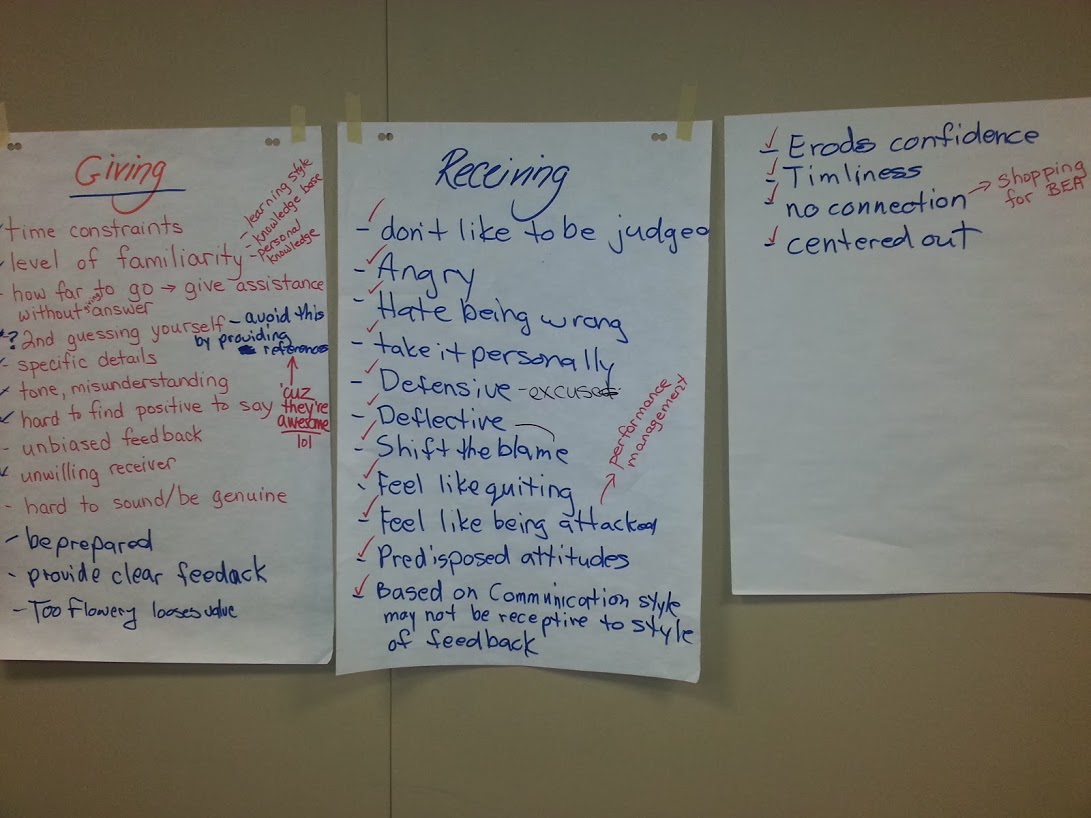
The challenges of giving and receiving feedback (marketplace).
The results of the challenges of giving and receiving feedback activity.
How perception affects our feedback.
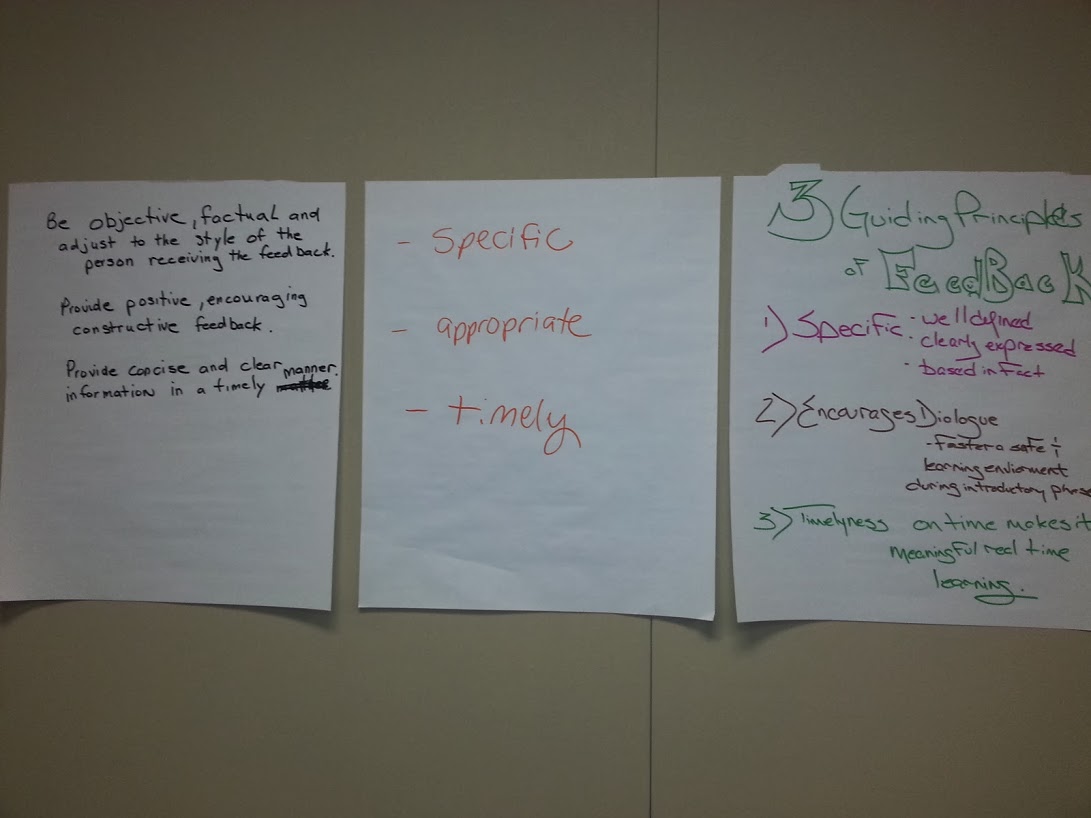
The three principles of constructive written feedback (discovery).
The results of the three priciples of constructive written feedback discovery activity.
Recurring issues and a five-step strategy to address them.
Practice in making our messages clear, concise, and readable (large group, cooperative).
Critique of the (anonymous) pre-course assignments and presentation of highlights (small group).
Sharing of best practices.
Review of objective.
Knowledge transfer – participants made a promise to themselves in the form of tasks allowing 28 days of practice to create new habits with respect to constructive written feedback.
The best part of the facilitation was eliciting the fabulous and valuable group discussions we had. My questioning techniques were certainly given a workout.
I had handouts, a PowerPoint presentation, a poster, and a facilitators’ guide, but conspicuously, no participant guide. All of the learning content arose from the class and a several points, participants were asked to capture the information generated from various activities and report back to the class.
My colleagues’ presentation on Monitoring: Beyond the Basics was informative. At our level, we haven’t had much in the way of structure or procedure. Many of us started the job by being thrown into the deep end and learning by doing.
Yes, there is a course intended to introduce us to our job duties, but that is general in nature and geared to our position across business lines and departments. Our new procedures, flow-charts, and reports will give us that much-needed job-specific structure, moving forward.
We might even be delivering the written feedback and monitoring courses to all new and acting advisors in the future, in-person or virtually.
Who knows what will result from this past month’s work? One thing for sure is this: I’ll let you know.
In between my wintery road trips and getting stuck in an elevator last week, I was actually in Toronto for work.
Last summer, while I was still an acting consultant, the opportunity to observe and/or facilitate this course arose. The initial plan was that two sessions would be held, one in January and one in February.
I would observe the course in January with an eye to facilitating it in February. Unfortunately, the second session never materialized. It may not be until next year that I’m able to try my facilitation chops out on this course.
It’s a long time to wait in the wacky world of facilitation.
Here’s what I learned:
1. The course is a very demanding one for facilitators.
One of the facilitators, who had actually delivered the course once in the past, said she didn’t want to facilitate the course again. It’s a fairly cerebral course, and a lot of material is packed in to four and a half days.
The course is intended to be an introduction to the basic duties of an advisor and as such, it covers working on a virtual team, change management, interpersonal relationships, providing advice and guidance, teaching adult learners, and workload/time management. Things are pretty tight and there’s not a lot of room to wiggle. It’s difficult to keep on track.
Because the course starts Monday morning, the facilitators and participants must travel in overtime (something management frowns on), and the facilitators can’t get into the room until the first morning of training. I prefer to prepare as much as possible in advance and to keep activities queued up and flowing well. Having an hour or an hour and a half for set up would be demanding. It also means that I’d have to come in earlier and stay later each day to stay on top of activities and exercises.
2. The course is something that every new BEA should attend
And, the sooner the better.
Many of the attendees of this course had been BEAs for years and had had the course on their performance and learning agreements for years as well.
As a result, we had a lot of great discussion about our quality control processes, technology, communications, and training. I don’t know that a class of entirely new BEAs would have been half so dynamic.
We also had a varied group of participants from different business lines. One of the big questions I had when I started out as a BEA was what other BEAs elsewhere in our organization did and how those duties compared to my own.
Even though I knew there was a BEA course, it was being redesigned when I started as a BEA and was only piloted to select groups of participants in the next couple of years.
In the positions I’d held previously, there was training, weeks of it. Plus post-training monitoring. I learned the role of advisor by doing it, which is fine because it works with my learning gestalt, but I’m sure for others it was a bit of a culture shock.
After the BEA level, most of the training is piecemeal and you have to actively pursue those courses if you want to take them. Task or competency-based training is not mandatory once you’re out of production.
3. The BEAs in attendance thought the course had value for them
This was a concern, because, after one of my colleagues attended a pilot of the course years ago, she did not have many positive things to say about it.
The BEA Curriculum is a course where you derive benefit proportional to the time and effort you invest.
It’s also one in which the participant should have clearly defined goals and expectations of the training. When the modules of the course that hold the most value for them come up, participants are more likely to play a more active role in their learning.
I presented a short exercise about performance management. I prefaced it with Cathy Moore’s flowchart: Is training really the answer?
Once the advisor has determined that neither training nor monitoring is the answer, what do they do? They perform a needs analysis to identify learning gaps and see if they can devise a plan, working with management, to bring the employee’s behaviour into line with the employer’s expectations.
I asked them to come up with some scenarios from their own experience, and once we had a few, divided them up by business line to review a tool in the training package and see if it would help them in those performance management situations.
Several of the participants told me they thought both the flowchart and the checklist were great resources.
So while the BEA Curriculum was not an unmitigated success (I forgot one of the groups in a breakout room and they didn’t return until after everyone else had left—bad Mellie!) I think it was a good course and one that I’ll enjoy facilitating in the future. If I can remember all the tips and trick I learned this time around!
Do you have any facilitation stories to share? New courses learned or delivered? Lessons learned in the delivery?




 Always Looking Up