Tipsday: Writerly Goodness found on the interwebz, April 17-23, 2016

Dialling back on the writerly goodness this week, but there’s still a shit-tonne to share 🙂

Sudbury IS Reading Town Canada. April 30 to May 8, 2016.

K.M. Weiland shares everything you need to know about writing third person point of view (POV). Helping writers become authors.

Dave King writes about writing class accurately in an historical context for Writer Unboxed.

Elsa S. Henry guest posts on Terribleminds about writing blind characters realistically.

K.M. Weiland points out the one major pitfall of writing strong characters. Helping writers become authors.

Becca Puglisi discusses friends as enemies for Writers Helping Writers.

Diverse fantasy is better fantasy. Fantasy Faction.

Oren Ashkenazi lists five signs that your story is racist. Mythcreants.

Ricardo Fayet lists twelve common writing mistakes even bestselling authors make. BookBub.

What’s your potential? Dan Blank on Writer Unboxed.

Jamie Raintree shares her thoughts on the real reason we want to be published. Writers in the Storm.

Awesome process alert! Kameron Hurley discusses why she writes non-chronologically. I can’t. One thing needs to lead to the next for me. But try it out. If it works for you, why not do it? Process is an evolutionary thing.

Janice Hardy explores how to balance writing and working without losing your mind. Fiction University.

Kameron Hurley writes about the slog on the mountain and the calm before the storm.

Related: Lauren Carter writes about climbing gear.

Jim C. Hines considers shield theory as a way of explaining spoon theory to his son.

Publishing news: proposed settlement reached in Harlequin class action suit.

SFWA contracts committee alert.

Nina Munteanu examines the moving target of indie publishing. What every writer and editor needs to know.

I read Janet Reid’s blog religiously. Here’s an excellent post on author/agency agreements.

Carly Watters interviews Kurestan Armada concerning her first year as an agent for the Things I wish I knew series.

Agent Chip MacGregor defines success. MacGregor Literary.

Chris Winkle analyses the fantastic writing of Andy Weir’s The Martian. Mythcreants.

Charlie Jane Anders lists eighteen short stories that pack more of a punch than most novels. Gizmodo.

Michael Peck explores the literature of cyborgs, robots, and other automata. Literary Hub.

Leah Schnelbach wonders why we’re still white-washing Asian characters. Tor.com

These are all kinds of beautiful: Studio Ghibli’s greatest works drawn in Art Nouveau. Go Boiano.

Colm Tóibín on writing. Sentences as rhythm. Sentences as brush strokes. Yummy. Louisiana Channel.

Jeanette Winterson examines Shakespeare’s take on love: bed tricks and broken women. A friend took exception to the dim view of Anne the piece presents, but y’all know not to believe everything you read, right? The Guardian.

The manuscripts of the first two English women writers are now on display. Alison Flood for The Guardian.

Thoughty Thursday is full of videos. See you then.

Tipsday

Tipsday: Writerly Goodness found on the interwebz, April 10-16, 2016

I can’t believe how much writerly goodness I have for you this week. WTF’s going on here, anyway?

Angela Ackerman wonders, why do characters resist change? Writers helping writers.

David Corbett argues that conflict isn’t the engine of story. Writer Unboxed.

Lisa Cron explains what ‘let it go’ really means. Writer Unboxed.

Sarah Callender helps us create delightful, messy characters with the humble ampersand. Writer Unboxed.

Lance Schaubert talks talecraft on Writer Unboxed.

Jami Gold explores paragraph breaks and voice in her building blocks of writing series.

Janice Hardy helps you get what’s in your head onto the page. Fiction University.

Margie Lawson shows us how to make strong writing stellar. Writers in the Storm.

Chris Winkle shares some tips on narrating layout and position. Mythcreants.

Kelly Simmons explains how your personality type wreaks havoc on your writing and offers ten things you can do about it. Writers in the Storm.

In times of doubt, Chuck Wendig advises you to write what you love. Terribleminds.

Leanne Sowul offers some tips to keep writing when times are tough. DIYMFA.

K.M. Weiland shares twelve ways to rock your novel research. Helping writers become authors. Later in the week, she explained how to moderate reader reactions to character sins.

I’m curating the curators, now 😉 Elissa Field shares a number of quirky research sources for writers on her Friday links for writers.

Jamie Raintree offers the three most common query mistakes and advice on how to fix them.

Roz Morris shares a discussion on the benefits of editors from Author Fringe 16.

Nina Munteanu writes part two of her ecology, women, and science fiction post: praxis. Great discussion with some of Canada’s best women SF writers and editors.

Kim Fahner shares some of her lessons learned from her week in Banff with Lawrence Hill (and meeting with Alice Major). Upon her return, she struggled with decompressing and managing her creative energy.

The first of three posts by Jim C. Hines on trigger warning shenanigans inspired by Stephen Fry’s poorly thought out comments: Trigger warnings are censorship, and other nonsense. He returned the next day with Trigger warnings as an impediment to healing and mental health. Here’s the third instalment: when trigger warnings attack!

John Grisham and Donna Tartt headline the author protest of Mississippi’s anti-LGTBQ law. Electric Lit.

Doctors and psychiatrists may soon prescribe fiction to help youth with mental illness. <This is me, cheering like Kermit—yaaaaaaaaaaay!> The Guardian.

Rod McDonald, Canadian designer of the typeface Classic Grotesque, heads for Manhattan launch party. The Toronto Star.

An interview with transplanted Sudburian, Matthew Murphy. Quebec reads.

Sian Cain covers Sir Terry Pratchett’s memorial for The Guardian.

Hedgehogs are the keepers of order and knowledge in Slavic fairy tales. Tiny Donkey.

Ten facetious book dedications that actually got published. Books rock my world.

Orna Ross shares a Celtic creation story.

This is awe-inspiring: The librarian who saved Timbuktu’s cultural treasures from al Qaeda. The Wall Street Journal.

Film dialogue from 2000 screenplays, broken down by gender and age, shows how sexist movies are. Polygraph.

No trailer for this yet, but Story of Your Life looks like it might be a good SF film to check out. Movies.com

Cheryl Eddy previews another fairy talish movie due out this year: A Monster Calls. i09

We have to wait until November (no way I’m wishing is here any sooner—love spring, summer, and fall!). Fantastic Beasts and where to find them.


But this weekend! Eeeeeee! Game of Thrones, season six. I really hope they make up for last year.


And that is Tipsday for this week.

Hope you are all well and writing wicked stuff 🙂

Tipsday

The next chapter: March 2016 update

In my 2015 year-end update, I said that 2016 would be the year of revision. To this point, I’d only ever revised the one novel, Initiate of Stone. I revised IoS eight times and I recently got a few ideas on how to improve it further as a result of my first run through of Apprentice of Wind.

In the first few days of March, I finished that first review of AoW. I’m going to return to it again, but this time, as I mentioned last month, I’m going to apply what I hope to be improvements to IoS and then move on to AoW.

My idea is to reinforce my voice over the two novels, which is quite different to the other novels I’ve drafted so far. Most of those are in a modern setting. Urban fantasy of various stripes. Though I’ve worked with IoS for so long, when it came to reviewing AoW, because I’d drafted the five other novels in between, I found I’d lost touch with the voice of the series and its characters.

We’ll see how that turns out, later in the year (I hope).

YTDProgress

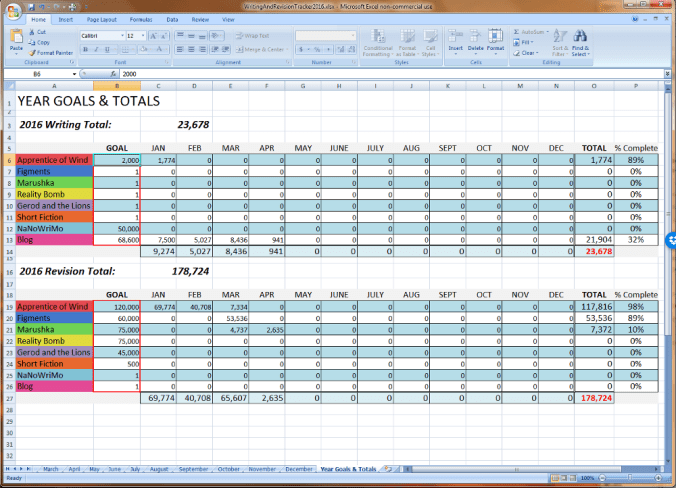
Year Goals and Totals page

The current draft of AoW stands at 119,590 words. So 120K, which is reasonable for an epic fantasy.

I then moved onto Figments, my YA urban fantasy. It’s considerably shorter, nineteen chapters, and 53,536 words. I know I’ll have to punch that up a bit, but I have a number of ideas to make that happen.

Both of these novels were drafted, let to sit, printed out, read through, mapped, let to sit again, read through again, and then reviewed. I just changed some of the major things, POV, character deletion, consistency over the novels (in the case of AoW), and notes for future revision.

I don’t think I’ll need as many drafts of either AoW or Figments as I needed with IoS to finish them to my satisfaction.

I’m trying something different with Marushka, which I moved on to in the last few days of March.

My revision plan so far has been to review a chapter a day, which was challenging for AoW and Figments, because a number of the chapters of both were several thousand words long. I often found myself up until midnight on a weekday trying to get my work finished before I went to bed.

Marushka was the first novel I drafted using Scrivener and it really changed the way I drafted. The chapters are comparatively tiny (1000 to 1500 words so far) but there are a lot more of them (54).

I didn’t print Marushka out. I didn’t read it through or map it. As I review each chapter, I’m reading it through for the first time and mapping it as I go.

We’ll see if this is more or less productive than printing the draft out, and reading and mapping it out prior to my first run through.

I’m approaching this year of revision as an opportunity to experiment. My process is in continual evolution and, as I learn, from both success and failure, I’m seeing improvement in my process and in my writing overall.

I’m not looking for short cuts as much as efficiencies. I’m not doing any less work, I’m just doing it differently.

Again, we’ll see how it goes.

So here’s how the month breaks down.

MarchProgress

MarchProgress1

Want your own Writing and Revision Tracker? Visit http://jamieraintree.com/writing-revision-tracker

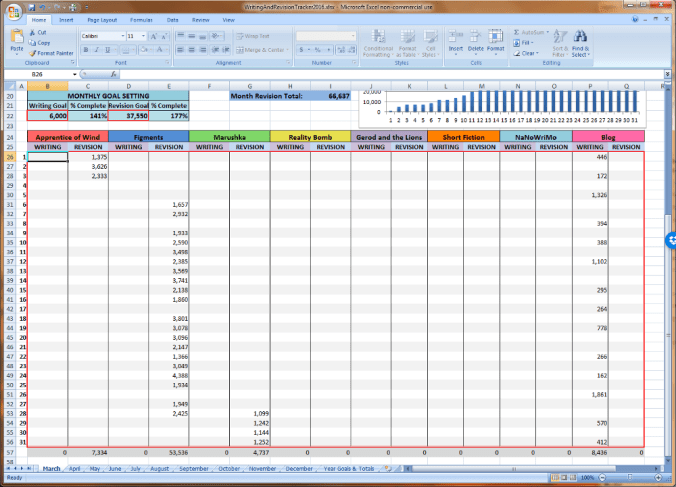
  • AoW – 7,334 words revised
  • Figments – 53,536 words revised
  • Marushka – 4,737 words revised
  • Blog – 8,436 words written.

I achieved 141% of my writing goal and 177% of my revision goal.

At this rate, I’ll finish the first run through on Marushka part way through May and move onto Reality Bomb and finally, Gerod and the Lions. Once I’ve got everything reviewed once, I’m going to take a break (which I tend to need in the summer months) and work on my outline for Mistress of Waves, the third book in my Ascension series and NaNo 2016 project 🙂

Then I’ll get back to deeper revisions until November arrives. I may not be able to conquer more than IoS/AoW. Maybe I make it as far as Figments.

Querying continues. I’ve not devoted much time to short fiction recently, though.

As far as conferences and conventions, I’m hitting Ad Astra (April 29-May 1), The Canadian Writers’ Summit (June 15-19, though I’ll only be attending June 17-19), and WorldCon, AKA MidAmericon II (August 17-21). I have paid my fees and reserved accommodation, but it’s all pending leave approval.

I’m holding my breath until I know it’s approved. Once it is, I’ll be able to book my flight to Kansas City.

My employer asks us to apply for leave every six months. We apply in March for the first half of the fiscal year, April to September, and in September for October through March. Approval is subject to seniority and operational demands (peak seasons).

I should know whether this first round of leave requests has been approved by the end of April.

My plans for fall and winter will have to wait on the approval of the second round of leave in October.

I’ll save those potential plans for a later update.

For the remainder of this month, I’ll be offering some Series discoveries posts (fall season, part two, mid-season follies, and anime) and at least one book review (Jane Ann McLachlan’s second Kia novel, The Salarian Desert Game).

As of Ad Astra, the convention reportage will resume.

So there’s lots of Writerly Goodness to look forward to, and of course, Tipsday and Thoughty Thursday curations will continue through the week.

In the meantime, break a bunch of pencils, you wonderful, creative people.

The Next Chapter

Tipsday: Writerly Goodness found on the interwebz, March 20-26, 2016

Holy shemoley! Lookit all the Writerly Goodness!

Ok. This is big news around here. Sudbury has a new poet laureate, and its first woman in the role, my awesome soul sister, Kim Fahner! The Northern Life. And here’s the interview she did with Markus Schwabe of the CBC’s Morning North. She had a cold, but it’s still a fabulous interview 🙂 She’s on her way to Banff right now to work with the wonderful Mr. Lawrence Hill!

Jane Friedman points out the pros and cons of maintaining a personal profile versus a professional page on Facebook.

Susan Spann advises us when a book is considered out of print. Writer Unboxed.

Jed Herne guest posts on The Better Novel Project with The Half-Blood Prince guide to question arcs.

Michelle Hoover writes an excellent guest post for Writer Unboxed on the duplicity of a character’s desire.

John J. Kelley explores the art of the plausible for Writer Unboxed.

Barbara O’Neal discusses the matter of talent. Writer Unboxed.

C.S. Lakin offers three ways to keep readers reading past page one. Live, write, thrive.

Tiffany Lawson Inman explains how to build dramatic momentum in fiction. Writers in the Storm.

Janice Hardy explores the ebb and flow of plotting a novel. Fiction University.

K.M. Weiland’s back with five more ways to trim your novel’s word count. Helping writers become authors. Later in the week, she helps us choose the right protagonist.

Kate Elliott gives us the tools to write women characters into epic fantasy without quotas. Tor.com

Awesome: How do we write about diversity when the word has lost its meaning? With Daniel José Older, Ashley Cassandra Ford, and Tanwi Nandini Islam. Elle. (Really? Yuh-huh.)

Steve Kettmann: On knowing what to leave out. Medium.

Victoria Mixon shares her super-easy formula for creating a blurb.

Ruthanne Reid points out the two most important words for writers: don’t quit. The Write Practice.

Kerry Lonsdale writes an open letter to writers at every stage of publishing. Books by Women.

Kameron Hurley ponders her sales.

J.K. Rowling shares rejection letters on Twitter to help beginning authors. The Guardian.

Jamie Raintree explores how to decompartmentalize your art.

Anna Lovind bares herself in this post on the process of creative transformation.

Dan Blank shares what he’s learned from 30 days of vlogging.


Thinking about a writers’ retreat? Sarah Selecky gives you a place to start looking.

Madeleine Dore offers 50 ways to take care of yourself in the arts. Performing Arts Hub.

Robert J. Sawyer shares his creative process with Inverse’s Lauren Sarner.

Where five Canadian authors read. The Globe and Mail.

Buzzfeed lists 21 German words we should be using in English.

Victorian doctors thought reading novels made women incurably insane. History Buff.

On the other hand, art is proven to have mental health benefits. The Butler Collegian.

National Geographic lists its top ten book stores in the world.

Daniel José Older: Notes on love and revolution. Guernica Magazine.

Brainpickings shares Charlotte Brontë’s love letters.

The Telegraph lists ten novels with titles from Shakespeare.

Shakespeare’s skull stolen from grave. BBC.

15 Welsh myths and legends. Wales Online.

Michael Boyle and Daniel A. Kaufman wish Babylon 5 a happy birthday. This is one of my all time favourite series. The Electric Agora.

I don’t know about you, but I’m exhausted!

See you Thursday 🙂

Tipsday

The next chapter: February 2016 update

February is always a struggle for me, even in this year, when we didn’t have snow until after Christmas. By the time February rolls around, the dimness of winter has resulted in some degree of seasonal affective disorder (SAD). I’m tired of being cold. I’m tired of slogging through the snow. I’m just tired.

Just a note here: We’ve had more snow in January and February that we had by this time last year, and last year, the snow started in the last week of October. That’s global warming for you.

Add to that Phil’s health issues (which are steadily showing improvement, so we’re good on that score), my illness, and my subsequent discovery that I’m anaemic, and we have a perfect storm of personal stress.

I suspect that I’ve been anaemic for some time. Persistent exhaustion and difficulty sleeping (among numerous other symptoms) have supported this hypothesis. Heck, in the days when I used to donate blood, I remember being turned away on several occasions because of low iron.

Then there’s work. The problems there are mostly political in nature and not anything I have either control or influence over. It’s frustrating and disappointing more than anything else, but that’s contributed to my desire to leap-month over February and get on with things.

Creatively, I’ve still managed to exceed my revision goal, but was unable to meet my writing goal in February. I’m not going to go into the reasons for that because it doesn’t have an impact on you, gentle readers, nor would there be any nugget of wisdom to be pulled from those events.

My challenge in February was in trying to continue my coursework in Story Genius while proceeding with my writing and revision goals, which were set prior to the course, and (for me) take precedence. I also committed to another, shorter course from Jamie Raintree, and though I enjoyed it, I think I simply took on far too much. Far. Too. Much.

I had a rough week during which I felt stupid because I couldn’t effectively implement the Story Genius lesson. It blocked me. I couldn’t even revise for a number of days because I could see my failures too clearly in front of me. I could see all the ways in which my existing work sucked ass (sorry, but that was the exact thought in my head at the time).

There are several reasons for this:

  1. I’m a keener and I have been learning my entire life. I’m a perfectionist. I’m used to doing well. I’m so much harder on myself than anyone else can be. My confidence is easily shaken. Usually, I can write through the malaise, but this time, I balked.
  2. I chose to work on a finished draft rather than a new story idea. Worse, I chose the second book in a series. I set myself up for failure because the focus of the course is to develop an idea from, “oh, this is cool,” to a realized story map given the specifics of the Story Genius methodology. It would have been much easier if I had chosen to do this. I was stubborn and thought I could both revise Apprentice of Wind and use it as the basis for my work in the course. Silly rabbit.
  3. This was an opportunity I couldn’t pass up, but I had neither budgeted for the expense of the course, nor, because of my day job, could I budget sufficient time to do a good job.
  4. Illness played a role, both mine and Phil’s. My personal circumstances have made me less able to cope with what would otherwise be a minor disappointment.

Ultimately, I’ve stepped back. I have the lessons, transcripts, examples, etc., and I’m going to take the time to do the learning, and incorporate it into my creative process. In my own time. Benefits will be reaped, just not tomorrow.

There’s one week left and I’m not going to ignore it or dog it. I’m going to do the best I’m currently capable of and be content that, with practice, the true learning will occur.

My difficulties have been completely of my own making and I could have prevented them from happening by waiting for the next time the course was offered, or the time after that. If I’m able to prepare properly, I can meet (and sometimes exceed) my own, admittedly high, expectations.

Learning nugget for y’all: If we fail to plan, we plan to fail. Thank you, Benjamin Franklin.

Mel’s version: If you’re keen on something that’s popped up unexpectedly, sit back and really assess the situation. What will happen if you don’t do it this very minute? Are there future opportunities you could take advantage of? Do you really have the resources (time, money, focus) you need to invest? If not, is there a way you can shift things around to make those resources appear? Look at the long game. What part in your career does this opportunity have? Will things look any different in five years (or ten, or twenty) if you don’t “do all the things” now?

Above all, be kind to yourself.

Having said that, Story Genius is a mind blowing course and I value the opportunity to learn from Lisa Cron and Jennie Nash, both incredible experts in writing and editing. My assigned editor is also a fabulous guy and he’s been very supportive. It’s well worth the investment in time and money.

I’ll reiterate what I wrote above: my problems are of my own making and should not in any way reflect on Jennie and Lisa’s amazeballs course.

So. What did I get done in February?

I have finished the first run-through of Apprentice of Wind. There is at least one more structural edit I have to do, in which I will make use of the Story Genius method, but I’m going to let the work relax for a bit before I dive back in. In fact, I’ve seen some further areas for improvement in Initiate of Stone, as well. I might start at the beginning and work straight through both novels on the next round. It will keep me in the Ascension series headspace and voice, too, something I feel is lacking in AoW.

In the meantime, I’ve moved on to Figments. Reading through it, it’s a lot better than I remember, which has been comforting. I’m going to apply Story Genius to that, too. Before I get to the actual revision, so I’m not mucking up one process (planning) with the other (revision).

I think that repeated practice will be the key to successful implementation. Eventually, it will become second nature. Then, I will actually be able to say that I’m a story genius 😉

I resumed querying, and I submitted more short stories.

I also received more rejections. Some of them were positive (this story isn’t suitable, but please send something else), but it still results in no further publications.

This hits home in tax season, during which one becomes acutely aware of how little income one has made from one’s creative efforts.

It doesn’t help, either, that nominations for various awards have opened. Even though I really don’t have a chance in hell of getting on a ballot, it would be nice to be able to put my name beside the title of a story I wrote (and was paid for), and then stand back and say, like a proud five year old, “I made this.” 😀

FebruaryProgress

Here’s how the numbers break down.

I achieved 108% of my revision goal with 40,708 words revised.

I achieved 90% of my writing goal with 5027 words, all written on this blog.

I sent out five queries and one package for a publisher’s open call.

I submitted short stories to one anthology call, and one magazine.

And that was my month in review.

This month, as I mentioned, I’m moving on to revising Figments, and will be submitting more queries and short stories.

And I’m going to give myself a break. I’m making progress. It’s enough. So am I. I just have to remind myself what would happen if publishing was taken out of the equation.

That’s right. I’d still be writing.

If you don’t love what you’re doing, why the hell are you doing it?

Have a good week, everyone.

Hugs all around.

You’re awesomesauce, each and every one of you.
The Next Chapter

Tipsday: Writerly Goodness found on the interwebz, Feb 21-27, 2016

A yummy week of Writerly Goodness for you:

Roz Morris shares three diagrams that you can use to check your novel’s pacing. Nail your novel.

Becca Puglisi also tackles novel pacing for Writers Helping Writers.

K.M. Weiland offers four tweaks that will help you write original stories and characters. Helping writers become authors.

C.S. Lakin looks at scenes as capsules of time. Live, write thrive. She added establishing your setting to her Scene Structure series later tin the week.

Jami Gold helps us find the right balance in story description.

C.S. Plocher shows us what we can learn from J.K. Rowling’s series grid. The Better Novel Project.

Janice Hardy explores how to build internal and external core conflicts. Fiction University.

Chris Winkle shares some tips about narrating dreams and visions. Mythcreants.

The 49th Shelf shares a round-table discussion about world building.

Oren Ashkenazi offers some tips for writing a diverse story. Mythcreants.

Marcy Kennedy writes about valuing yourself and your work. Remember that thing from last week? Yeah. More of that.

Jim C. Hines discusses the importance on not only having anti-harassment policies at cons, but also of enforcing them.

Heather Webb explores how a writer lives with yearning on Writer Unboxed.

Dan Blank advises us to create every day. Life is chaotic. There is no time but now. Writer Unboxed.

And here’s another Dan Blank video. Invest in relationships, not blueprints.


Jessie Burton writes about her journey, as a creative, through depression and anxiety.

Kirsten Oliphant guest posts on Jane Friedman’s blog on how authors can use Pinterest best.

Then Jane posted on Writer Unboxed about a common misunderstanding authors have about web sites.

Brent Underwood goes behind the scam to discover what it takes to become a “bestselling” author on Amazon. The Observer. The answer? $3 and five minutes.

Jamie Raintree helps you design your writing career from the top, down. Writers in the Storm.

Mark Medley profiles Jennifer Robson, the most successful Canadian author you’ve never heard of. The Globe and Mail.

The Epic of Gilgamesh, read in the original Akkadian. Open Culture.

Just a quick reminder about the importance of the Oxford comma. The Poke.

Electric Lit shares an infographic analyzing the 15 most populated novels. Guess what? A Song of Fire and Ice isn’t the worst offender 😉

An accented tour of the British Isles:


How to be a person. Shane Koyczan.


A first look at five new character portraits for season two of Outlander. It’s getting closer! Yahoo!

And that’s it until Thursday!

Tipsday

Tipsday: Writerly Goodness found on the interwebz, Feb 7-13, 2016

Load up your plates my friends, I have lots of nommable readables here 🙂

K.M. Weiland shares her insights into being a person with obsessive-compulsive disorder and a writer. She also offers some tips on how to remain healthy even if you live at a desk.

C.S. Lakin explains how writers can benefit from outlining their scenes. Her scene structure series continues with the opening hook.

Janice Hardy shares five common problems with novel beginnings and how to solve them.

Jamie Raintree shows how the power of consistency builds writing careers.

Lisa Cron shared an older post with our Story Genius class: Three misunderstood pieces of writing advice that can derail your novel. Writer Unboxed. And here’s her most recent post for WU: Where real drama comes from.

Anne R. Allen lists five reasons writers need to use Google+ even though the new Google+ is awful. I must admit, I’ve fallen out of love with G+ these days. I still post there, but if I’m in a time crunch, it’s the first SoMe to be sacrificed.

Kameron Hurley admits her fallibility: We all drop the ball. Another excellence post on the importance of self-care and forgiveness in times of stress.

Related: Allie Larkin writes about the myth of balance for Writer Unboxed.

Jim C. Hines explores the pros and cons of antidepressants.

Chris Winkle gleans lessons from the cinematic writing of I Am Number Four. Mythcreants.

Local author and writerly friend, Paulette Dahl, publishes Love Letters. The Northern Life.

Ken Pisani says, finding an agent is the worst this ever. Publishers Weekly.

You should read this chat on diversity in publishing from The Toast.

The Kenyon v. Clare court case has been all over the feeds this week. Here’s where I heard about it first. Courthouse News Service.

J.K. Rowling will be publishing the script of Harry Potter and the Cursed Child. Publishers Weekly.

This is cool. Mental Floss lists eight things invented by famous authors.

Mental Floss also lists eleven authors who hated the movie adaptations of their books.

Bitch Media presents, Anya to Zombies, an alphabet of graphic novels by women.

This video is sad and beautiful and all kinds of wonderful: The Life of Death. Great storytelling.

Fantasy Fiction Focus features Tim Reynolds.


Historical novelist Tracy Chevalier calls Charlotte Brontë her hero. The Guardian.

William Gibson shares his experience writing Neuromancer. The Guardian.

The secrecy and speculation around the Doctor’s new companion (or not). Radio Times.

A Discovery of Witches series is in development. Deadline Hollywood.

I can hardly wait! Outlander, season two, begins April 9! And here’s the official trailer in case you need a little something something to get excited about 😉

Now, to settle down with some tea and let all this awesome digest!

I’ll be back with some thoughty for you on Thursday 🙂

Tipsday

The next chapter: January 2016 update

First, a note about the non-writing parts of my life

Well, the new year has gotten off to a bit of a shaky start, not with respect to my writing and revision goals, but with respect to other stuff.

In the last week of December, Phil got sick enough he had to go see a doctor. He hadn’t been in a very long time and in the process of diagnosing the illness he went to see the doctor for in the first place, the doctor diagnosed him with two other, fairly serious, illnesses. Three for the price of one. Yay?

I won’t go into the details, because it’s not my story to tell, but he’s on several medications, we’ve had to change our diet (not significantly, but still), and we’ll have to commit to several more lifestyle changes in the coming months. It’s going to be a good thing, ultimately, but I’m a creature of habit. Change is stressful.

Phil’s been told not to tackle everything at once, and so we’re dealing with things one issue, and one day, at a time.

I’ve gotten a cold for the first time in about three years. Since I don’t get them often, I tend to get doozies. I’m also in the process of seeing whether I’m anaemic or not, and my gall bladder is acting up.

I guess this is my reaction to the stress of everything else.

Which includes learning that I’ve been screened out of the consultant process at work. We’ve had a general information session, because many of the over three hundred people who applied were screened out, but I’m still getting an informal discussion of the specific reasons I was screened out. That happens Tuesday.

I’ve really been trying not to get upset. Work is work and I’ve tried to prioritize my creative work over the day job, but having been successful in the last three processes and had four acting assignments in as many years, I can’t help but feel that I’ve been kicked in the teeth. They still have testing and interviews to go, and if the eventual pool ends up being as small at I suspect it will be, there will be another process in the future. I have to question the point of putting myself through the wringer again, though.

My current acting assignment ends next Friday and at that point, so far as I know, I’m heading back to the training and advice & guidance team, but everyone keeps saying that I’m not going back and even managers aren’t including me in the training plan and no one is telling me anything. I’m kind of suffering from mushroom syndrome.

I’m trying to be Zen, but I’m not very good at that, in all honesty. I am a lot more laid back than some people, but I internalize a lot. Hence, the illen.

Now, onto the Writerly Goodness 🙂

I took some time over the holidays to plan out my writing year. Using Jamie Raintree’s amazing new Writing and Revision Tracker, I set writing and revision goals for the year, and for each month.

As I mentioned in my last Next chapter update, 2016 will be the year of revision. As I return to the querying process with Initiate of Stone, I realize I want to have some of my other five finished novels revised and edited and ready to go so that I can keep working toward my dream of a traditional deal.

What I did was to add up the current word totals of all my drafts and divided them up according to what I figure will be my productive months. I also estimated what my blogging totals would be per month and add in my NaNo 2016 writing goals.

What that worked out to was 37,550 words of revision each month (except November and December), between five and seven thousand words of blogging each month (except November), and 50k words drafted in November and December (NaNo this year will be book three of the Ascension series I figure it will take me two months to complete the draft).

So this is what January looked like.

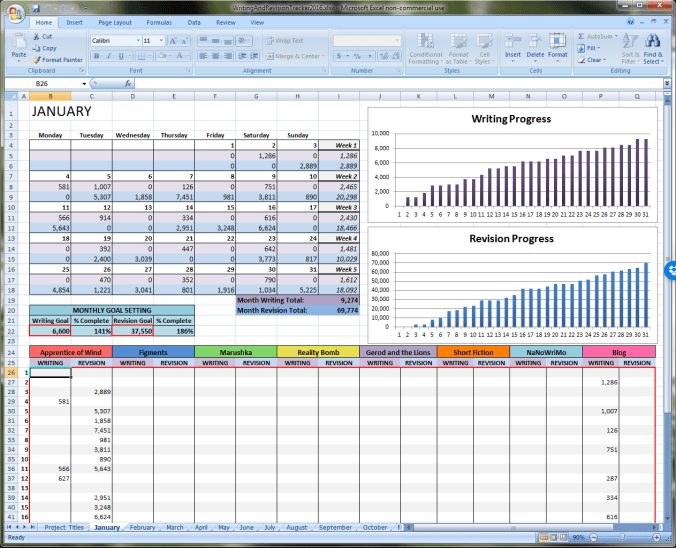
JanuaryProgress

And I even took a few days off (!)

The month started with a couple of days devoted to reading through my draft of Apprentice of Wind, and then I set to. I’ll probably have the first run through done within the next couple of weeks, and then I’m probably going to go through it at least one more time.

So at 9,274 words, I wrote 141% of my writing goal and at 69,774 words, I almost doubled my revision goal (186%).

I also revised and sent out two short stories, and heard that another short story is still under consideration from a submission last year. So that’s awesome.

I also sent out IoS packages to open submission periods for a couple of publishers. As of the end of last year, the three Canadian small publishers I’d pitched last fall had either declined or failed to respond.

We’ll see where all of that gets me.

Other excitement

I’ve attended a few events this past month. The first was Last Stop at the Sudbury Theatre Centre, in which a couple of writer friends had their plays in progress workshopped in front of a live audience (us). It was awesome.

Then, I attended a Skype workshop with Barbara Kyle through the Sudbury Writers’ Guild on adding magic and verve to your first thirty pages. Barbara is an excellent presenter and so knowledgeable about her craft. It’s a pleasure to learn from her.

Finally, I attended a lecture by singer/songwriter Steven Page at Laurentian University on ending the stigma around mental illness. He sang a couple of songs from his new album and discussed his struggles with mental illness.

I’m also currently enrolled in two online courses.

First, I couldn’t resist signing up for Story Genius with Lisa Cron and Jennie Nash. It’s based on Lisa’s new book (of the same name) and is eight weeks long. I’m working on my week four submission this weekend. It’s hard (like, it hurts my poor, tender head hard), especially negotiating the day job and health issues Phil and I are facing right now, but I can see how it’s going to improve my ability to write a novel that will hook readers and keep them reading.

Second, I signed up for Jamie Raintree’s Design a writing career you love workshop. I’m trying to keep one foot in the business side of things. Jamie’s an excellent instructor and I always enjoy her courses.

I’ve booked my hotel for both Ad Astra in April and WorldCon in August and am still waiting for the registration information for The Canadian Writers’ Summit to emerge.

So, I guess it’s no wonder I’m under the weather at the moment.

By and large, though, I love my life. The creative part of it anyway 😉

Next week, the CanCon 2015 reportage continues.

Hope your creative endeavours are moving full steam ahead and that you’re all well on your ways to meeting your goals. Feel free to share your trials and triumphs in the comments below.

The Next Chapter

Tipsday: Writerly Goodness found on the interwebz, Dec 20-26, 2015

Here’s a little Writerly Goodness for you 🙂 Looks like I really did take a holiday last week. Yay me!

K.M. Weiland talks about coincidences in your fiction and what mistake in means you might be making.

C.S. Lakin calls these stylistic devices. I call them rhetorical figures. I lurves me some rhetoric. I blame the politicians for rhetoric’s pejorative connotation 😦 However you choose to look at them, they’re a lot of fun and can add something special to your writing.

Dan Blank says that creative work is performance. Writer Unboxed.

Why writers need human connection. Jamie Raintree guests on Writers in the Storm.

Chris Winkle shares lessons learned from the awkward writing of The Sword of Truth. Mythcreants.

George R.R. Martin uses it. So does Robert J. Sawyer. Find out why Wordstar is the preferred word processor for these authors.

And speaking of nifty writer tech, here’s Jamie Raintree’s new writing and revision tracker*. This is the spreadsheet that revolutionized my attitude toward my writing. I hope it will do the same for you 🙂

*This year, Jamie’s made the spreadsheet fairly foolproof. You can only enter data into certain cells. So much easier. I’ll still do a little post on how to set it up, but it won’t be as extensive as I thought based on past years.

Before you launch a Patreon for your writing, read this. Nicole Dieker for The Write Life.

Madeleine Monson-Rosen recounts the twelve happy accidents that helped save science fiction. i09.

Now this is my idea of a happy Christmas: Jolabokaflod. NPR.

Hope you had a wondrous holiday.

See you Thursday!

Tipsday

Wordsmith Studio homecoming blog hop number three

WSS Homecoming 2015It’s been three years since I joined a bunch of fellow platform builders in what became Wordsmith Studio.

Today: blog hop, part the third.

1) What are you currently working on?

The final (for now) revisions of Initiate of Stone, drafting Marushka, my 2014 NaNoWriMo novel, and revising one long short story that may actually be a novel in disguise 🙂 Plus, I blog.

2) For past work, what was your greatest joy or greatest challenge?

Finishing my first draft of IoS and getting my two short stories, “The Broken Places” and “Downtime” published would all have to tie for greatest joys.

My greatest challenge to date has been the first chapter of IoS. Oh, and trying to keep things balanced. Actually, the balance thing wins out in the toughest challenge category. I suck at balance.

3) For current work, what challenge are you working through now?

As mentioned above, my first chapter. For some reason, this particular opening is kicking my buttocks. I’ve tried starting the story earlier, later, a prologue (very bad), and rewriting the first chapter from scratch about four times. I’ve tried Surry Idol at the Surrey International Writer’s Conference, Ray Rhamey’s Flogging the Quill, beta readers, and advice from writing mentors.

4) For work you are just planning or starting, what challenges or growth are you expecting or hoping to encounter?

Every novel I draft, revise, or edit improves my craft. The next work I’ll be starting from scratch will be this year’s NaNoWriMo. It’s a new adult science fiction thriller. Oh yeah. That won’t be hard to sell at all 😛

5) What have successes or challenges in your work (recently) taught you?

I write a lot more than I thought I did. Others see value in my work. Tracking your writing progress is a great motivation. I generally rise to any challenge I set myself.

6) What obstacles or challenges have you not been able to overcome, or still frustrate you?

The aforementioned beginnings, though I think a breakthrough is due. Overdue, frankly.

7) How would you describe a great writing day (or week)?

A great writing day is any day that I write. Period. If I achieve my goals, that’s a lovely cherry on top of the sundae. In a way, every word is a victory 🙂

8) What specific tools or strategies help you succeed? 

Jamie Raintree’s writing spreadsheet is a fabulous tool and motivation. K.M. Weiland’s Helping Writers Become Authors blog and her books are some of the best craft advice out there. Awesome. Similarly, Roz Morris’s Nail Your Novel series and blog are teh best. And she’s so generous with her time and advice. Finally, attending conferences and conventions have been a big help. I learn metric tonnes at each one 🙂 The networking isn’t half bad either.

And there you have it.

See you on Tuesday for my Tipsday writing curation.

Powered by Linky Tools

Click here to enter your link and view this Linky Tools list…

Muse-inks