The leave begins

I’m going to be a bit scarce, or scarcer that I have been recently.

I have my time off and I’m going to use it to catch up on a few projects/straighten out my head.

What’s up:

It’s taken much longer than I intended, but I am coming down to the final, final, FINAL revision of Initiate of Stone before I send her off to the editor who expressed interest last year and to a few select beta readers.  I’m going to be revising my pitch/query and start targeting Agents and small publishers.

I’ll be attending the Surrey International Writers’ Conference from October 25-7, and I have a pitch session booked with the wonderful Kristin Nelson (squee!)  I’m very excited, but after putting IoS to bed (for now) I will likely spend the next week prepping for SiWC.  I’m going to be reviewing my idea files for what I want to work on next.

While I wait to hear back from editors/agents/publishers about IoS, I’m going to be starting on/returning to other novel-length projects like Gerod and the Lions.

Come November, though, I’m going to be tackling another project for NaNoWriMo (!)  I only have until the 19th off, but I’m thinking it’s time to get something else up and out there.  This may be the idea file project I choose to prep for SiWC.

So that’s pretty much my writing ambitions.

I have said that I would participate in Khara House’s October Submit-o-Rama, and even participated in Kasie Whitener’s Just Write 2013 challenge for the purpose, but I’m not going to go out of my way to get a pile of short stories submitted.

If it happens, it happens.  I have some markets targeted, but I want to focus on my novels.  That’s where I need to be.

On a more personal note, I’m going to be trying to work in a little more physical activity.  I’ve gained weight just in the six weeks since I quit smoking.  It’s not good.  The clothes are tight.  And I haven’t been as faithful with implementing new habits as I was with changing the old.  I need something that will work with my life when I go back to the day-job.  This bears some thought.

I have no doubt that when I do go back, things will be as hectic as ever, so the new fitness routine has to be something that will let me get the sleep I need, get all the housework and daily chores done, and still accommodate work and writing.  And then there’s all that TV I like to watch 😛

I need to finish off my household clean-up (which stalled in September) and try to get the gardens into some kind of order before the snow falls.  I have a few projects I’d like to get to as well: 2 ceiling fans to install, my office door to strip and refinish, and one of our external doors to repaint.  I’m also looking at some storage fixes, cabinets for the bedroom and bathroom, and a new bookshelf for my office.

These last I’m not going to rush, since I think I’ll have enough with my trip to Surrey, another shortish trip to visit a friend in southern Ontario, and all the writing I want to do.

And then there’s Writerly Goodness.  I’m thinking it’s time for a face-lift, and maybe a new

English: Epic Win title card.

English: Epic Win title card. (Photo credit: Wikipedia)

name.  My domain will remain the same, but I’m thinking that a more appropriate name might be Totally Epic, or Epic Win (for my interest in epic fantasy).

I could go with something more general because I’m not just about the epic fantasy, I have urban fantasy, YA and MG, science fiction, and even some cross-over type novels in my idea file.  Plus I still write poetry and short stories, some of which are not speculative at all.

How about Improbable Possibilities (one definition of SF), or Speculations on Fiction?  There are some old suggestions: Phigment’s (Phigment is an imaginary dragon—the site would belong to her), or MelanieM/Millennium.  This last was from a friend who realized saying MelanieM sounds an awful lot like millennium.  Does something else present itself to you as clever?  I think I might just put a poll in my post this week 😉

A number of recent writer interviews have been delayed, perhaps indefinitely, so I probably won’t be posting much more than once a week (outside of SiWC, which I hope to blog and maybe even Twitter).  If I have nothing to offer by way of updates, I may not post at all in any given week.

Just to let you know.  I’m still here, but I’m going to be trying to shift my focus away from the interwebz for a bit and get back to the reason I started this whole platform-building gig in the first place—my writing.

I’ve been seeking balance for some time.  Maybe I’ll find it in the next five weeks?  Who knows?

Thanks for your patronage, and for your patience.
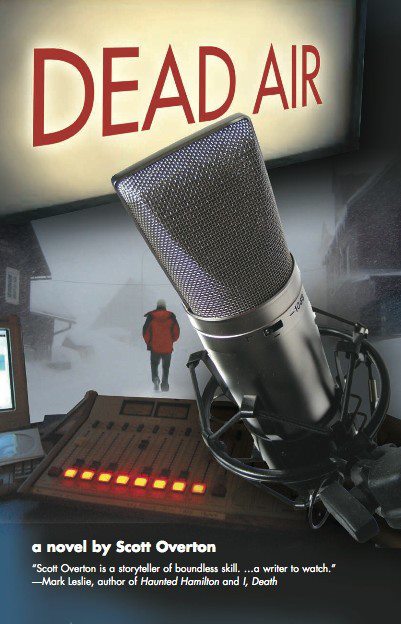
Review of Scott Overton’s Dead Air

This review is considerably overdue.  My apologies, Scott.

The Amazon blurb:

dead airWhen radio morning host Lee Garrett finds a death threat on his control console, he shrugs it off as a prank—until a series of minor harassments turns into a set of undeniable attempts on his life. The suspects are many—he’s made enemies—and the police are strangely uncooperative. The radio career he loved has turned sour, leaving behind a dwindling audience and the wreckage of his marriage. Then the friendship of a newly blind boy and the boy’s attentive (and attractive) teacher offer unexpected hope. Maybe he can make a fresh start. Maybe he can admit that he’s the source of a lot of his own problems. But when the deadliest assault yet claims an innocent victim, Garrett knows he has no choice—he has to find his persecutors and force a confrontation. The extraordinary outcome will test the limits of an ordinary man. In Dead Air career broadcaster Scott Overton creates the disturbing scenario of an ordinary man whose life is threatened by an unknown enemy.

My thoughts:

I wasn’t in love with the character of Lee Garrett. In fact, I didn’t like him much at all, but that’s exactly the way it had to be for Dead Air to be a successful thriller.

Lee Garrett has made enemies over the years, enough to fill a room with the usual suspects, and his wife left him, taking their two children.  She’s making a new life for herself while Garrett’s disillusioned and jaded and not a bit depressed.  He’s a bit of a schmuck, steeped in a good dose of self-sorrow.  Not an attractive package.

Garrett has his redeeming qualities, though.  The reasons he’s made all those enemies is because he generally tried to do the right thing and exposed their varied douchebaggery in the process.  He’s still in love with his wife, and the friends he has are the dependable kind that come through when the going gets tough.

Then he makes friends with Paul, a boy who recently lost his sight, and Candace, his CNIB counsellor.  As the relationship develops, Garrett learns a lot about himself, and how he is the author of his own misery.

He also makes a staunch ally by virtue of an act of kindness.  He even wins over the detective assigned to his case despite having been black-listed for ruining another officer’s career.

By the time Garrett exposes that act that haunts his life and underpins many of his poor decisions, I realized I liked Garrett, despite his not inconsiderable flaws.  I could even think of him as Lee 🙂

Dead Air is a novel about hard-won redemption and a fascinating character study as well as being a thriller with enough twists and turns to keep the reader guessing until the end.

My rating:

4.5 stars out of 5

About the Author:Scott Overton colour high res

Scott Overton hosts a radio morning show on Rewind 103.9 in Sudbury, Ontario. As a broadcaster for more than thirty years (twenty-four of them as a morning man), he knows the world he writes about in Dead Air.

To most readers, morning radio is as much a part of their breakfast routine as a hot cup of coffee. On the air, Scott has become a friend to thousands as he entertains and informs. He brings those same instincts to his writing, with clear prose and honest feelings.

His short fiction has been published in On Spec, Neo-opsis, and anthologies such as Tesseracts Sixteen, Canadian Tales of the Fantastic, and In Poe’s Shadow. He’s also a regular contributor of theatre reviews for a local newspaper.

His other passions include scuba diving and a couple of classic cars.

May submit-o-rama was a bust :(

I got side-tracked, in a marvellous way, but still side-tracked, by courses.

May Submit-o-rama ChoiceI know myself and my limits.  Further, I’m focusing on fiction at this time versus verse, so I opted for the Choose your own Challenge category, and set my goal, as I had back in October, at one submission per week.

At the time, I was working on two short stories for submission May 31, 2013, and so I thought maybe a couple of flash fiction pieces, or something equally non-angst-inducing and I’d be able to make it.  If necessary, I could polish up some of my older, unpublished poems and see what I could do, but then the learning opportunities came knocking, and I knew I wouldn’t have time to do more than the two stories.

Last week, the deadline on one of the submissions I had planned was extended, and frankly, I was glad. Being out of town for training derailed my writing plans.  So in the end, I submitted one short story in the entire month of May.

It was an original, though, so at least it counted toward Kasie Whitener’s Just Write short story challenge (13 original stories in 2013).  Unfortunately, it was April’s original 😛

I participated, but I don’t think that it could be considered a success.

I’m remarkably okay with that though.  I’ve got my fingers into so much right now, that something had to give.

Other perceived failures

I’d submitted a guest post that was to have gone live sometime in April but my colleague’s even more hectic schedule intervened.  There was some hope that the post might have been rescheduled in May, but the month has passed and it looks like it won’t see the light of day any time soon.  It’s only the second guest post I’ve submitted.  It’s also the second that didn’t pan out.

An interview that I arranged recently also seems to have fallen through.

Why it’s all good

There’s a saying that if you aren’t failing, that you aren’t doing enough to stretch yourself.

I agree with that, so long as the individual who perceives their actions as failure can put the attempt in a positive frame.  Otherwise, it can weigh on the soul.

My perspective: so long as you’ve tried your level best, you’ve upheld your part of the bargain.

I put my best effort into everything that I do, or try.  I can feel satisfied with that and I learn something important every time.  At the end of the day, it is enough.  I am enough.

Are you failing upward?  Have you had some perceived failures recently that have left you questioning yourself?  How have you overcome the negative and turned it into a positive?

Do share.  I’d love to hear what y’all have been up to 🙂

The next chapter: update February 17, 2013

Just a brief catch-up here on what’s been happening.  Brief, because what’s been happening = not much 😛

This week, I put my second original short story of the year, “Beneath the Foundations” in the can and submitted to the Sword and Mythos anthology.  I’m not optimistic because the story that bubbled up was not along the lines that the editor said she was looking for.

The editor was looking for aboriginal (not just NA, but Australian, etc.) northern Africa, Arab, Indian, or Asian settings, female protagonists, and in general, a new spin on the old Cthulian genre.

BtF is medieval European, specifically England during the time that King Alfred was ousted

English: Statue of King Alfred in Wantage, England

English: Statue of King Alfred in Wantage, England (Photo credit: Wikipedia)

by the Danes and was gathering his forces to retake Wessex and Mersea.  Adric, the protagonist, is male, though he is a little person, and by that I don’t mean that he was a pixie, but short of stature.

He’s bought by a Danish lord, Ofded, as a sapper along with several other boys from St. Jerome’s. Proper miners supervise the expendable boys in the endeavour.  Alfred’s supposedly harbouring in Castle Sark,  and Ofded wants to get the credit for his capture.

The story is about what Adric finds beneath the foundations and the horror that ensues.

So I’ll have to wait and see.  Typically, I don’t think much about my stories after I send them off.  I list them in my submissions table and mark off the result when it eventually comes in, or not, as the case may be.

Next up, I’ll be revising a couple of stories for submission to Tesseracts 17.  I haven’t quite decided which one I want to send in yet.  The deadline for that is February 28, for those of you who would like to submit.  Check out the guidelines.

I haven’t had a lot of time to work on Gerod and the Lions, and haven’t gotten back to Initiate of Stone yet.  I have a busy time coming up for the day job, and I have to pick and choose.

This week coming, I’m out of town for a training gig, and then again, after one week at home, I’ll be travelling again for more training delivery and my attempt at certification.  I don’t think it will be reasonable for me to return to IoS until after the next few weeks.

In March, when I dive back into my project, revising for beta-reader feedback (and yes, I will be asking a broad cross section of friends RL and online for their assistance) I will also be working on revising another, fairly long, short story for the next Writers of the Future (April 1) and a new short story (idea hasn’t cropped up yet) for In Places Between (April 4).

I’ve submitted to WotF before, and was pleased to receive an honourable mention certificate, but it’s hard to know how one would do in such a popular arena.  Again, I’ll encourage those of you who are working on your own stories to submit.

Also this week, I submitted some work to my critique group and am largely caught up.

Next weekend, when I return from training, I’m going to be attending a poetry workshop and I actually have some poetry to take with me.  My poet friend, Kim Fahner, graciously offered to have a look and I hope to have the few revisions she suggested ready.

I hope to submit some of my poetry to various journals, but I’m not so much into the poetry these days, so if anything this may be something that has to go by the wayside for now.  I definitely want to submit a poem to the League of Canadian Poets National Poetry Month Blog, and have a few options for online submissions that might suit.

Upcoming for the blog, I’m going to try my hand at submitting a post to Wordsmith Studio, another pupdate (Nu had her check up this past week, but I won’t have the time to commit it to the blog this weekend), I’m going to continue my new series, A life sentence, with mortal punctuation, I hope to have an interview with my friend, Brian Braden, about his new book, Black Sea Gods, and will likely blog about the training, the poetry workshop, and anything else my life offers up for sacrifice 🙂  Writerly Goodness

That’s it for now.

Good words at y’all!  Writerly Goodness, signing off.

A life sentence with mortal punctuation: part 1

First: A note about memory, frame, and fiction

I have my memories, but as I get older, I don’t know that the biological hard drive that is my brain hasn’t been corrupted, that the memories reflect the reality that was, or reality as I want it to be.

My memories have also been informed by family stories and sometimes the latter influence the former, so again, I can never be certain of their veracity.

Thinking about this, I remember the academic and theoretical concept of “frames” from my undergraduate studies, now also more than 20 years in my past.  Everyone has their own frame of reference, influenced by their experiences and education, family and individuated world view.

Even if one attempts to be completely truthful, one’s truth can run counter to reality.

The writer cannot express anything but through the filter of their frame.  In this sense, all written work, whether scientific, academic, journalistic, historical, or honestly fictive, has in it the element of fiction.  It cannot help but be influenced by the frame of the writer.

Mathematics may be the only purely objective writing, but even there, unknowns and chaos creep in and beg interpretation.

This is just my opinion, but I wanted to get it out there as a way of saying that even though I write from memory and experience, I am writing a story.  It is my story, but not having time travel at my disposal, I cannot say that this story, based on real life events, is any more “real” than a movie based on the true story of X.

How it all began (yes, I’m really going there)

So, it’s October, 1969, and my mother, nine months pregnant, walks to her regular doctor’s appointment.  Her doctor’s office was at the top of Regent Street hill, and for those of you who don’t live in Sudbury, that’s a really big hill, of San Fransiscan dimensions, even.

The doctor enters the exam room and says, “I didn’t expect to see you.  I thought you’d have your baby by now.”  My mom shrugs and says that everything’s going fine, “but,” she says, “I’ve been having these really strange cramps all day.”

After a brief assessment, the doctor tells her to call her husband and get over to the hospital post-hasty: “You’re in labour, woman!”

My mom’s never been the kind to thrust the agony of my birthing at me.  I don’t know how long she was in labour or how painful it was.  I just know that it was the first, and only, occasion when my maternal grandmother, sober her entire life with that notable exception, got stinking drunk 🙂

Early memories

The only things I remember from my infancy are images.  Moments.  The colourful, plastic Fischer-Price mobile that hung above my crib; a tin, battery-operated locomotive; and this memory, which became a poem:

infant crawls

mother says she was crawling by six months and walking
by eighteen. situate her chronologically as you wish
any month and day in 1970.
reaches linoleum and drags
legs forward.  pivots onto buttocks.
suddenly sees black shoes and white tights,
spill of turquoise dress over thighs.
a contemporary picture reveals the dress in question.
shirred bodice, empire waist, short sleeves poofed and gently
cinched around chubby arms.  her hair is short and blonde, lovingly
held in place by two plastic pink barrettes in the shape of bows.  her baby
teeth are coming in.
fridge holds her attention for a moment.  then something moves
—brown shoes—ma ma.
though she was beginning to speak, her words were
carefully articulated.  not mama, but ma ma; syllables
spat out, exhaled along with breath.
low like this, ma ma is brown shoes and white-pink
calves.  ma ma is also round-white-pink, brown curly, and
long-white-pink ticklers, but they are all ma ma.  they all smell
of comfort.
the brown shoes were around for years, with large, square,
brass-toned buckles.  nylon-sheathed legs above them truncated by
fall of blue dress: straight, simple, homemade, with short sleeves.
horn-rimmed glasses frame hazel eyes and permed, dyed hair.  mother’s
smile was shy and kind.
chubby arms lift hands to grasp.  frustratingly ma ma seems to be between
wriggling grabbers, but cannot be touched.  “ma,” she says, and “ma.”  two
world-shaking clomps later, the long-white-pink lifters bring her up to the
round-white-pink ma ma and pudgy fingers tangle in curly brown.
this is my memory.  i do not ask my mother if she
shares it.

©2012 Melanie Marttila

infant crawls era Mel

‘Dis be me 🙂

Something I don’t remember

My maternal grandmother had a massive heart attack that required a multiple by-pass (not sure how many, just that they had to take the vessels from her leg).  In the wake of the ordeal, she was in a kind of fugue state, conscious, but not talking, not interacting.

My mom was allowed to bring me in to the intensive care unit.  Normally, a baby wouldn’t be permitted, but it was thought that either it was time to say final goodbyes, or that I might somehow remind my grandmother that she had a reason to live.

Fortunately, the latter happened.  My name was the first word she uttered in days.  I have no idea how old I was when that happened.  It’s funny sometimes the affect we have on others, whether we know it or not.

My grandmother was given a dim prognosis: months perhaps.  She lived to see me graduate high school and did not pass away until I was in university.  More on that in a later post in this series.

Grandpa

My first encounter with the spectre of death was the passing of my paternal grandfather.  When I was three, my grandfather was up on his carport roof, shovelling snow, and had a massive heart attack.  I was carefully sheltered from the event.

That year, the local television station broadcast “The Santa Show” which read children’s letters to Santa on the air.  The big Christmas news Santa reported that year was that Rudolph was sick and might not make his annual flight.  In trying to explain the situation to me, Mom told me that Grandpa was in the hospital.

“With Rudolph?” I asked.  Yes, with Rudolph, she said.

Only days later (I think), I was set to play in the snow while my father climbed up to clear that same carport roof.  The job had to be completed.  As he descended, the ladder slipped on the ice, and he fell, calling to my toddler self for help.

Understandably, I thought Daddy was being silly.  Patiently, through his pain, he convinced me, who’d never gone anywhere alone in my brief life, to go to the next-door neighbour for help.  I was frightened out of my wee gourd and Dad had to keep encouraging me to keep going.

Neither of us knew, entangled in our own drama, that Grandpa had died.

I only know this because my mother told me: Grandpa was a man of few words.  He loved to garden, and grew straw flowers so he could engage in dried flower arranging in the winters.  When he watched me, he sat in his chair, often reading the paper, and let me play quietly with his Salada tea figurines.  I still have the wolf.  It sits on my bookshelf along with other memorabilia.

I hardly had the opportunity to get to know him and he was gone.  Dad ended up with a fractured pelvis and was in the hospital over the holidays.

Truthfully, neither event had much of an impact on me, though I always thought that I’d let Dad down when he fell, not that I could have done more than I did, being three and all.  I got used to not having Grandpa around, and life went on.

I think that when you’re very young, death can’t be understood.  It’s therefore far easier to accept.  Absence becomes the new normal.  There’s no introspection or grief, and the grief of others is equally beyond understanding.

Perhaps these early experiences do have a lasting effect.  Maybe the trauma lies dormant, only to surface at a later date and hijack our lives.  For all the time I’ve spent examining my life, I can’t say.  I don’t feel any connection between these early experiences and the person I became.

What about the stories of your lives?  Do you have a memory of a death from your early years?  How did you react, or not?  Can you connect the experience to some trait or tendency that you embody today?  Have any of your early memories inspired your creative work?

Next week:  My first near-death experience and what came of it.

Until then, writerly peeps.  In the meantime, mine your memories for creative gold 🙂

The next chapter

Have desk, will write

Have desk, will write (Photo credit: Bright Meadow)

Today, I’m going to share some of what’s happening next with my work in progress (WIP).

Early in the life of Writerly Goodness, I blogged regularly about my WIP, from its origins, through various drafts, to the lessons the whole process taught me.  I also blogged my character sketches and world-building fairly extensively.  I’ve been a little quiet on the subject in recent months however.

The reason for this is that I have been focusing on the revision of my latest draft, and in keeping with my reasonable and malleable goals for the new year, I have now finished that work (to the degree I am currently able) and have sent my manuscript for a content edit.

This is scary.

Why?  Because it means that I’m taking this whole process seriously.  I’m getting closer to perfecting Initiate of Stone for submission and/or publication.

Given the responses I’ve gotten from various writerly authority figures in my early life, my internal editor is very well-versed in the whole “what the hell do you think you’re doing/you can’t write/your ideas are crap/your writing is puerile/you’ll never make it” brand of advice.  I’ve had to tame that beast and try to get over it.

But … there’s still this voice in my head that says: “but what if this investment (the content edit) backfires?”  What if the result is the confirmation of all my worst fears and neuroses?

I can’t think about that.  So, while I wait to hear back from the editor, I’m moving on.

What’s up, buttercup?

First, I’m going to make a few submissions of short stories.

I’m revising one for submission to an SF magazine, which I will have to do this weekend.

I’m going to participate in a few flash fiction challenges.

I’m also going to aim for a couple of anthology submissions:

  • Sword and Mythos – January 15-February 15, 2013
  • Tesseracts 17 – February 28, 2013
  • Plus, I’m going to keep my eye out for the open reading period for Fearful Symmetries.  I don’t know if I’ll have anything appropriate for the publication, but I’ll certainly give it a try.

Second, I’m going to move on to a new novel.  As of my last writing on the subject, I hadn’t decided what.  The logical next step would be the second novel in the Ascension series, Apprentice of Wind.  I’m thinking that something completely different might be in order though.

So just to give me a complete break from Ferathainn for a while, I’m going to tackle Gerod and the Lions.  I’m just going to leave you with the title for now and I’ll let you know how it goes 🙂

Finally, I’m getting back to work on my critiquing.  I’ve been inactive on this front for a while, again because I’ve been focusing on my novel, but I’m waaaaaay overdue in this department and I have to get back into it.

This will have to wait one more week, in the event, because I’m traveling for the day-job again.  My apologies to my peers.  Zombie Mel will return from the land of the critiquing dead, just not quite yet.

Set yourself up for success

The deal here is that if you are progressing on one project, but not actively working on it,

St. Augustine writing, revising, and re-writin...

St. Augustine writing, revising, and re-writing: Sandro Botticelli’s St. Augustine in His Cell (Photo credit: Wikipedia)

you may need to pick something else up.  Take on a new challenge.  Keep honing your craft.  Get over your bad self.

Now this is not something you might just choose to do while waiting to hear back from your beta-readers or an editor.  You could be querying, or trying to get your self-publishing ducks in a row.  Keep in touch with your creativity.  A writer writes above all else.

Some people may think that juggling projects is a bad idea.  They want to see one project through from beginning to end and believe that they can’t divide their attention with another novel.

There are going to be those fallow times though, and I’m not just talking about those times when you have to “get distance” from your novel between drafts, when you might want to do something non-writing related (I’ve done home reno projects, or some other form of artistic expression for this, drawing, pottery, or taking part in a play).

I’m not talking about keeping your creative reserves replenished with reading and movies and creative dates either.

I’m talking about those times when you’re waiting.  Fill up those fallow times with new creative projects so you don’t stall out entirely.  Don’t let your muse get lazy.  Keep him, her, or it, active and healthy.

This is just my opinion.  In no way am I suggesting that this approach is the only one.  It’s just the strategy that I’m using, and that I’ve seen other successful authors use.

How do you fill up your fallow times?  How do you manage your writing projects?  Do you work multiple ones at the same time, or focus on a single project until it’s completed?  Do share 🙂

The Next Big Thing – Initiate of Stone

My friend, Kim Fahner tagged me in this project in which the writer answers questions about their work and then tags other authors to blog their “next big thing” in turn.

So I’m going to victimize tag Scott Overton, who though he’s just published Dead Air, I know has more irons in the fire, Brian Braden, who has a fabulous WIP to share, Tim Reynolds, who’s always working on something fabulous, and Sandra Stewart, who likewise keeps her irons hot (in more ways than one!) 🙂

Onto the Questions:

  • What is the working title of your book?

Initiate of Stone  Bonus: Series title:Ascension, book 1

  • Where did the idea come from for the book?

This is one of the few ideas I’ve had that did not come from a dream.  I just started with an idea of a young woman, forged by elemental forces, who survives war to become the hero the world needs. Everything grew out of that seed of a character and story.

  • What genre does your book fall under?

Epic fantasy.

  • Which actors would you choose to play your characters in a movie rendition?

Actually, I’ve blogged this before, so I’ll take the lazy-a$$ route and simply link the previous character sketches, all of which include my casting suggestions:

Ferathainn

Eoghan

Dairragh

Supporting characters

Villains (muwahahahahaha)

  • What is the one-sentence synopsis of your book?

An uninitiated mage must uncover the secrets her family have kept from her in order to defeat the man who ripped her family, her hope for initiation, and her innocence from her.

  • How long did it take you to write the first draft of your manuscript?

About a year, writing in the evenings and weekends, working full time in the day.

  • Who or what inspired you to write this book?

I’ve always wanted to write novels.  I have lots of ideas.  This just happens to be the first one I chose to work on.

  • What else about your book might pique the reader’s interest?

IoS features a strong female character that doesn’t necessarily find fulfilment with a guy.  There are romantic elements, but Fer’s issues can’t be resolved in the course of this novel.  Thematically, I address the painful legacy of secrets, even those kept in care or kindness; the sometimes twisted relationship between parents and children; the difference between institutionalized religion and spiritual practice (how the one can damage and the other promise healing); and the struggle to realize one’s true potential, whatever it is.

So I hope your interest has been piqued 🙂

Thanks for the opportunity Kim, and if anyone is interested, I’ve blogged about my WIP Writerly Goodnesspretty extensively.  If you’d like, just pick my “Work in progress” category and read away.  I haven’t blogged the novel itself, just the character sketches and world-building behind it.

It’s back to the day job for me tomorrow, so I probably won’t post again until the weekend.  Have a good end-of-the week all!

Writerly Goodness, signing off.

My first SciFi Saturday: Killing with Kindness

Hi there.

Trying something different today.  A new acquaintance, Melanie Fountain, has her own publishing company: Fountain Blue Publishing.  In conjunction, FBP has a blog.  You should have a look and see what you think.

The blog encourages guest bloggage and has several opportunities to keep your writerly chops in shape.  One is SciFi Saturday.

So I’m giving it a try.

____________________________________________________________________________

Killing with Kindness

The boots don’t fit.  Far from being small, I’ve had to wrap my feet in strips of cloth to keep them on at all, but the wrappings have come loose and bunched up around my ankles and the arches of my feet, possibly the most uncomfortable places they could be.  Every fold and wrinkle has become the occasion for a blister, or a pressure sore.

The persistent rains have made it worse, turned the inner surface of the leather into sandpaper.  Every inch of skin on my body has pruned.  Much longer, and we’ll all have to start worrying about fungus and infection.  Not that we don’t already have worse to contend with.

We can’t stop though.  There’s no shelter out here on the wide plains that would hold twenty people.  We haven’t come across a town with standing buildings in days.

Besides, if we stop, the Radios—the radioactive people—will catch up.  As slow as we’re moving, their mutations slow the Radios even more.  As long as we keep moving, we’ll be okay.  If we stop, we’ll all die.

It’s not that the Radios want us dead.  I think they’re just looking for friends, family, mates, but their long exposure and adaptation to the radioactivity that’s killed just about everything else on the planet has changed them, and not just physically.  I don’t think they understand that the very thing that saved them will kill the rest of us.

When the shelter doors opened a month ago, the curious Radios flooded in, and though we were preparing to leave, and more than a little horrified by their melted and tumour-riddled appearance, we were curious ourselves as to what had become of the human race on the surface.

The constant pain they lived in had made them kind and amiable sorts, willing to help and learn in exchange for food and warmth.  The shelter’s reserves were almost used up, though.  That’s why the doors opened.  Though there could be no certainty, the scientists had given us as much time as they could to wait out the worst of the fallout and nuclear winter.  For better or worse, we would have to see if we could survive on the surface.

The Radios set up housekeeping though, and at first, we didn’t have the heart to leave them.

Within days of the Radios’ arrival, the children and the elderly became ill, over half our scant population.  Too late we realized that the people from the surface were still strongly radioactive.  How they survived to reproduce, we could only speculate, but now the entire shelter was contaminated and we didn’t have enough anti-radiation medication to save everyone who already showed signs of sickness.

Half of those who remained healthy eschewed the drugs, chose to stay and die with their loved ones.  The rest of us took the medication and fled.

If the Radios would only give up, but here on the prairies, we can still see them on the horizon, following like a bunch of forelorn puppydogs, just trying to bring their friends back home.

Now we’re all getting sick from mutated viruses and exposure that the anti-rad drugs are no proof against.

One way or the other, it’s going to end soon.

I don’t know where we’re going, but we’re almost there.

_____________________________________________________________________________

This was actually something I wrote for the Canadian Authors Association Virtual Branch Given Line flash fiction contest.  I’m trying to break the epic novel-writer’s mojo and see if I can get a proper short story written one of these days.  A friend suggested flash fiction as the fix.

We’ll see how this goes.

Let me know what you think.


World-building: Where do you start?

This is a sample constructed-world as seen fro...

Confession time

I’m a pantser.  I write through first, and restructure later, but I do extensive mapping using my trusty bulletin board, and as I’m getting to know the inner workings of Microsoft Word better, I’m learning to use headings to organize my chapters and sections, making outline view a useful tool too.  I have Office 2007 right now, so that’s the best I can do.  When I have blocked some time to learn more about it, I intend to use a master document to further organize my novel.  I’ll probably start using OneNote to organize a lot of my research, world-building, character sketches, and other resources.  More on that in the future.

Process, process, process

Where to start, indeed?  Really, this all depends on how you write and what your process is.  If you’ve been reading Writerly Goodness, you know my process is organic and holistic.  Some writers might see that as a cop-out, an excuse for a sloppy and ill-defined (dare I say undisciplined?) process.  Really, it’s process as a way of life.

Life = process

That demands a lot of dedication, organization, awareness, and the ability to think, not only on your feet, but sitting, laying down, at work, watching TV, eating …  In short, it means thinking all the time.

Plot leads to setting

If you’re a plot-based writer, that is, if you start with the story, then that will be your jumping off point for your world-building.

Example:

Hard-boiled detective?  Then you’ll have to create that milieu, and that means research.  Add Hammett and Chandler to your reading list, watch the classics of the movie genre, and then once you’ve got the flavour, go for the meat.  What time will you set your story in?  Just because the genre evolved in the 1920’s and 30’s doesn’t mean you have to restrict yourself.  As long as you can evoke the feeling of the hard-boiled detective, you can play.  William Gibson plays elements of the hard-boiled into some of his science fiction.

Once you have your setting, then you have direction.  Research the heck out of it.  Dream about it.  Start mining your life.  Have you ever done or seen anything that is distinctively “hard-boiled”?  Chances are, if you’re attracted to the genre, there’s a reason.  Dig.  You can find it.

But that’s where you’d start, in the Writerly Goodness universe 🙂

Character leads to plot/setting/theme (sometimes simultaneously)

If you’re a character-based writer though, it’s a little tougher.  You write the character, or characters, first, and the story emerges from them.  Sometimes, you don’t even know where or when the story will be set when you start out.

That’s the way it is for me.

If the story is the plot-based writer’s place to start, then character is the character-based writer’s place to start.

Do character sketches, written ones, and maybe actual sketches, if you’re so talented.  If not, find pictures of actors that might fit the bill.  Have them fully developed as people: their back-stories, their personal quirks, their convictions and beliefs.  Invite your writers’ group, or just some writer friends over for coffee, and have them quiz you on your characters, quick-fire style (it’s in the post, about half-way through).  And, of course, keep writing in the meantime.  Only once your characters are real people to you will their stories start to emerge and direct your plot.  Only once you have a developed plot, will your setting and themes become apparent.  Only then will you be able to truly start developing your world.

You may have some ideas when you begin to write, and by all means, start your research as soon as possible.  If you’re going for a contemporary setting, or a historical one, immerse yourself in the time or place.  It might inform your writing as you go and help you develop your setting with crystalline clarity.  If you’re trying to create a truly original fantasy or science fiction milieu, however, those details might have to wait for you to discover them through writing.  The best you may be able to do at the outset is read in your chosen genre.  If nothing else, do that.

Other options

Ultimately, how you write will determine where and when you start to build your world.  Plot- and character-based writers aren’t the only kinds either.  They’re the only kinds I can provide any guidance for, however.  If you’re another kind of writer, then go with your strengths.  Does your theme emerge first?  Or maybe you can’t write in a world that you don’t know and start off with the world first.  It’s all good.  The point is that no matter what you write, you have to put your characters and their stories in a time and a place and you have to know that world as intimately as you know your characters and plot.  It’s the only way to roll 🙂

Coming up

In the next weeks, I propose to post some of my character sketches and the plot lines that developed from them, along with pictures (though I have started to draw some of them, I’m not finished and they wouldn’t come through in a scan well … also, they’re not very good).

In the future, I’ll move on to other aspects of world-building, including a number of print resources on the subject.

Are you a pantser, or a plotter?  Are you a plot-based, or a character-based writer?  Are you something else entirely?  Where do you start in your world building?  Please, comment, like, share!