CanWrite! 2013: Day 2 agents’ panel

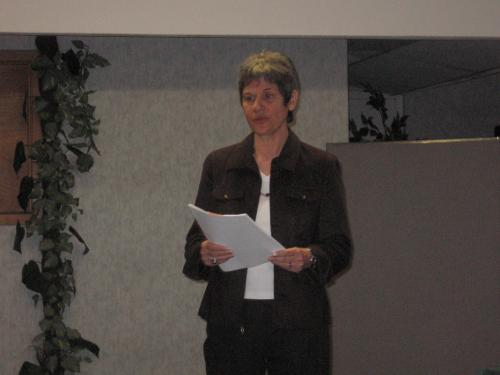
After another morning of creative writing and lunch, conference-goers again gathered in the academic building for the 1 pm Agents’ Panel Discussion.

James Dewar acted as moderator for the panel, which consisted of: Sam Hiyate, president of The Rights Factory and Carly Watters, agent at the P.S. Literary Agency.

JD: What are you looking for right now?

CW: Picture books; contemporary YA (thriller/mystery, romance); women’s fiction; upmarket; non-fiction; and multi-media.

SH: New agents are looking for new clients. I’m full up myself, right now, but occasionally I do sign the odd author.  For non-fiction, a platform is essential. Most non-fiction sells on proposal alone.

JD: What can a fiction writer do to obtain representation?

CW: Write an amazing novel.  Platform does not matter.

SH: Debut novelists—sometimes even established ones—can fail to sell.  I like a strong voice, someone who can perform acrobatics with a sentence.

CW: I have a more commercial taste, a Book Club book would appeal to me.

JD: How do you move an “almost there” author to “there”?

SH: I’m a different beast than most agents and will work with the writer to edit the work.  Most agents won’t.  Others will set the writer up with a freelance editor.

CW: I’ll write an edit letter to the writer if the good stuff is REALLY GOOD.  Some books are edited seven times before they are sent to a publisher.  If the writer has the ability to turn their MS around quickly, the chances are better.

SH: My best advice is to find an agent who “gets you.”

JD: What should authors NOT do?

SH: Don’t send your MS in too early.

CW: In a pitch session, do not go through your whole synopsis.

SH: Sometimes the pitch or query can be better than the book.

JD: We’ll open the floor to audience questions (AQ) now.

AQ: Do I need an agent first, or can I approach a publisher directly?

CW: Agent first.  Most larger publishers won’t accept unsolicited manuscripts.

SH: An agent can say “no,” however.  An editor will refer the author to an agent anyway.  Send it and see what happens.

AQ: What does an agent do?

SH: Our job is to create a competitive situation around your book.

AQ: Can you have more than one agent?

SH: We contract exclusively, much like a real estate agent would.  Your book is the property we’re selling.  Our commission is 15% on domestic and 20% on foreign sales.

AQ: In the context of the “Literary Apocalypse” of self- and ebook publishing, do writers even need publishers anymore?

CW: Some agencies have publishing arms, but it gets complicated.

SH: Self-publishing is a new way for agents to discover talent.  Eventually, all the good material gets scooped up by the publishers.  Cases in point: Amanda Hocking, E.L. James, and Hugh Howey.

CW: These are exceptions to the rule.  Agents can’t turn $10k ebook sales into a traditional deal, but if you sell $200k+, that’s different.

SH: In the future, writers will have more control.

AQ: If an author has published a book but is not happy with the rights (terms) is there anything that can be done?

SH: No, if the rights have already been contracted out, that’s it.  Most agents won’t negotiate a bad contract for you, though.  Publishing houses and agencies start out with really talented, committed, and enthusiastic people who are grossly underpaid, for like ten years.  In that time, the ones who can’t maintain their passion leave for greener pastures.  The ones who can, become successful.

The agents’ panel was great, and both Sam and Carly were professional and up front with their insiders’ looks into the publishing world.

Tomorrow: I’ll cover Day 1 and Day 2 evening events, and Day 2 and 3 afternoons with Andrew Pyper and Cordelia Strube.  That will leave the Awards Gala and wrap-up posts.  So three more days, and it’s all over!

Don’t despair, there will be lots more Writerly Goodness coming your way this summer.  Book reviews and hopefully some more author interviews, pupdates (yes, there’s at least one more coming), and updates regarding the backyard office (interesting things afoot there).  I’ll also have some updates on my work in progress and any other conferences or events that I get to.

I will be returning to my weekends-only posting schedule after this week, though.  Blogging every day, though fun for a short period, takes up a lot of writing time (!)  My goal is to have my current revision done before the summer’s out.

Until tomorrow!

CanWrite! 2013: Day 1 publicity and marketing sessions

As promised yesterday, I’m going to talk about the good, bad, and downright ugly.

To start with …

The Good

I’ll start with Vikki Vansickle’s Mapping your Market presentation.

Vikki was enthusiastic, energetic, and clearly loves what she does, on both sides of the board.  Vikki is an author and a marketer, recently moving to Penguin Books (congratulations!).

Vikki has published four middle-grade (MG) novels since 2010.

  • So what do you do when you get published?
  • Celebrate!  Tell EVERYONE.  You never know who your champion will be.  Word of mouth is still king.
  • Do some research (yes, it’s important in marketing too).  How do you find the books you like?  Work outward: How does someone like you in Houston, Whitehorse, or Harrison Hot Springs find the books she likes to read?  That’s where you want to go, to get in front of the wave.
  • Who wants to read your book?  Who needs to read your book?
  • Comparative novels (comps) are critical.  It doesn’t even need to be a novel, as long as it’s in popular culture.  “If you like X, you’ll love XXX!”  “It’s Dirty Dancing without the dirty :)”  “It’s Looking at the Moon meets The Summer I Turned Pretty.”
  • Who is your ideal reader?  Define her in every detail.  Who are your potential readers (again work outward)?
  • Your elevator pitch should be about the length of a Tweet.  You have to tell people what your novel is about in pithy, taut, engaging sentences.
  • Be prepared to wear different hats.
  • Instagram is big with kids.  Facebook’s where their parents are (ew!).
  • Goodreads is great for more mature readers.
  • Writers Cafe (dot) org can help you with critique, beta readers, contests, conferences, etc.
  • Find your niche and identify specialized groups that will help you reach your readers.
  • The Ontario Blog Squad will set up blog tours.  6 blogs.  You create the content.
  • Twitter giveaways.  People love free stuff!  Specify Canada only.  Make sure they enter using a Retweet (RT) and including a hashtag specific to you, your book, or blog.  This helps to spread the word to all of your participant’s followers (and so on, and so on).

The Bad

I won’t tell you the guy’s name, or who he works for, but he’s a publicist.  I thought a publicist would be better spoken, honestly.

His session had some good information, but he was almost too relaxed, too casual.  At times I thought he was bored with the topic.  At times he went off on tangents or mumbled.  He decided to wing it.  He didn’t have a plan.

  • Print ads are not an effective use of funds.
  • Look for web magazines that have “up fronts” (= previews) especially if they have a print tie in.
  • A platform is not essential for fiction writers, but is absolutely key for non-fiction.
  • In fiction, the publisher may work with the writer to build the platform.
  • Build your relationship with your publisher.
  • A P/L or profit /loss sheet may determine what will be expected.  Analysis determines what the most appropriate action or angle may be.
  • Do you have a business or profession related to your book?
  • Books = cultural entertainment product.
  • You have to engage your readership on social media (SoMe).
  • Some publishers spend more $$ on authors than others.  This will be different in the States.
  • If a publicist is assigned, it’s usually for 3 months.  On-shelf promotion (during the initial sales period of the book).
  • Marketing is different for every book.
  • Book trailers are too expensive to be effective.
  • Applications (apps) are even more inefficient and more expensive.

The Downright Ugly

One thing that emerged early on in the session and coloured the remainder of it was that this publicist works for a small imprint of a larger publisher and in non-fiction (politics, sports, world events).  His clients are men and of the imprints authors only a third were women.

He made an off-hand remark about the ladies liking their beach reads.  Fatal mistake when speaking to an audience of 90% women.

To be fair, I have to say that I don’t think the young man realized that he’d just insulted his audience unforgivably.  Even after several women from the audience spoke up and made some very salient points, I’m not sure our publicist got it, or if he did, he was so scared, he didn’t know how to save himself with any grace.

I think it has to do with the publishing environment he works in every day, his mentors, his colleagues.  I think the sexism is so ingrained, so rampant in his sector of the industry, that he wasn’t fully conscious of the prejudices he promoted.

For the remainder of the conference, our publicist was the topic of conversation, and not in a good way.

It immediately brought to mind Chuck Wendig’s posts on sexism and misogyny in publishing.

It’s not a problem that has an easy answer.

Tomorrow: I’ll be moving onto the Day 2 panel and session.

CanWrite! 2013: Day 1 Publishing Panel

For the most part, for the panels and sessions, I’m just going to be transcribing my notes, as written.  I’ll attempt to offer some context, however.

After the morning writing circle and some networking time at lunch, it was onto the Publishing Panel.  On the panel were Halli Villegas, publisher of Tightrope Books, Christie Harkin, children’s book publisher and editor at Fitzhenry & Whiteside, and Anita Chong, senior editor at McClelland & Stewart.

In later panels, I noted the speakers, but for this first one, I didn’t have the presence of mind to think of it.  My apologies to the publishers.

The panel was called Changes in the Publishing Landscape.

  • Larger publishers are finding that their biggest book-buyers are going to non-traditional (not brick and mortar bookstores) sellers to get their books (Costco, Walmart). Books are now competing with groceries (!)
  • Smaller presses are going back to events, launches, readings, etc.
  • Fewer stand-alone poetry books being published.
  • LGBT is gaining in popularity.  More mindful of the community they write for and have to market to.
  • Everyone feels like they have to dance to Amazon’s tune, though that may not be accurate.
  • Chapters/Indigo has a very short return policy now.  Books are being returned before they have a chance to get any traction.
  • Inventory control is important to the big booksellers.
  • Chapters/Indigo may buy 5000 copies of a book for all their chains.  Most come back (about 2/3).
  • Some publishers have to increase a print run, or go into a second printing to meet these orders.  This puts them further behind the eight ball.  They’ve suffered a loss before they’ve even got their books in stores.
  • All the indies order books too, increasing the pressure for a large print run.  Smaller publishers are suffering.
  • There is increasing specialization in publishing.  No more generalists.
  • What authors need to know most: DO YOUR RESEARCH!  All the information you need is on the websites of the publishers.
  • Go to the bookstore. Who’s publishing books like yours?  Look at the acknowledgements of these books: agents and editors are often among those thanked.
  • Don’t follow the trends. Erotic zombies?  (LOL)  Stick to your guns.  It’s not either/or but how far are you willing to go and how much are you willing to do?
  • Children’s books are not marketed to children, but to those who buy books for their children: parents, teachers, etc.
  • Print on demand (POD) doesn’t work in most cases.  There are restrictions.  Minimum print runs may still be required to break even.  POD kiosks offer poor quality product.  POD is not viable even at larger publishers.
  • Still on POD.  Short run = 250.  Medium run = 250-1000.  Watch how POD affects your contracts.  It has an impact on what’s considered to be in print.  If your rights don’t revert to you until after the book is out of print and POD technically means that the book never truly goes out of print, you may not get your rights back (!)
  • Electronic publishing is better, regardless of the venue chosen.
  • Publishers generally give 50% of their profits to distributors, booksellers, etc.  Publishing is not as lucrative as you think.  Ebooks lose only 30% (or less).
  • Publishers are looking for new talent all the time.
  • Unsolicited submissions can result in publication, but rarely.  Same with the slush pile.  DO. YOUR. RESEARCH.
  • Writers Reserve from the Ontario Arts Council.  $$ for writers.  Publishers apply for it and use the $$ to pay their authors.
  • Ask agents and publishers what they are looking for.  Write to order (if you can).

It was great to see three fabulous and articulate women take the stage.

Tomorrow: Publicity and marketing sessions: Good, bad, and downright ugly.

CanWrite! 2013: The arrival

Though events and sessions weren’t scheduled to get under way until June 13, strictly speaking, I’m pretty keen to show up and get ready.  I need a little time to rev up and get in the social way of things.  Any conference is pretty much a social marathon for however many days it lasts.  I have to work up to it.

My home for the week

My home for the week

Orillia is a little over three hours away from Sudbury.  I took the full day off on the 12th and relaxed for the morning, picked up my rental car, packed, and got underway just shy of 2 pm.

CanWrite! was hosted this year, as last, by the Orillia campus of Lakehead University.  It is a small campus, but it is a fairly recent construction.  I checked in, unpacked, and collapsed for a few minutes before heading out to my fend-for-yourself supper, returning in time to attend the welcome reception.

At the reception, I reconnected with some old acquaintances and made some new ones.  Among the old were Jake Hogeterp, who heads the virtual branch, Matt Bin, the prez, poet-on-demand, Jean Kay, Lamont Mackay of The Cooking Ladies, and Anita Purcell, our tireless Jacqueline-of-all-trades.  Among the new, Jennie Chabon and Kathleen Schmitt from BC and John McDonell from Nova Scotia.

Though I thought I was heading back to my room early, it was after ten by the time I made it up, and nearly midnight by the time I’d checked my precious social media (SoMe) and powered down for the evening.

The creative writing circles

Each morning of the first three days started off after breakfast with writing circles.  Either poetry or creative writing could be chosen.  Of course, I went for the creative writing.

The first morning, Ruth Walker led the session.  The second and third days were led by Sue Reynolds.

I’m not going to go into detail about these sessions, as the writing done is always intensely personal, but great material was produced all three days by all the participants.

I got some work done on some missing pieces of Initiate of Stone while I was there and that, along with some bits that might produce good stories, made the circles worthwhile for me.

Ruth was new to me, but I’d met Sue before.  I went to the University of Guelph with her sister, Sandy, and then I met her and her partner James last year at the Algonkian conference.

Other bits and pieces

Initially, I was a little concerned.  I could find no information on the Lakehead U site that would tell me what kind of internet would be available.  I’d hoped to try Tweeting some of the sessions.

When I checked in, I was advised that wifi was limited to the common areas of the residence building and required a password, but that I would be able to “plug in” up in my room.

In my room, I looked for a network cable, but couldn’t find one.  It took the kindness of Jean Kay to reveal the secret: the cable was coiled up and tucked into the base of the telephone.

So one problem solved, but the next day, when I attended the first panel discussion, I discovered that there was no signal in the academic building at all.  Bummer.

The food proved very good and was one of the consistent positives of the conference.

The rooms were nice, but the beds were a little harder than was comfortable.  Such is residence life.

Tomorrow, I’ll begin to document the panels and sessions for you.

Until then *waves*

Sundog snippets: quick update

First, happy Fathers’ Day!

Second, I’ve been away at the Canadian Authors Association CanWrite! conference 2013.  There was much writerly goodness to be shared, but no signal in the lecture hall, so I couldn’t Tweet the sessions as I’d hoped to.

I will be blogging them, however, even if after the fact, and just so I don’t get completely out of step, I’m going to be doing something I haven’t done in a very long time: I’m going to blog daily until I’ve got it all transcribed!

Also, there are big things happening with the CAA, and I’ll save that for the wrap post.

Michael Reaves’s Blood Kiss has been funded through Kickstarter at over $88,000.  The movie is a go, but there’s still much work to be done.  I’ll pass along updates as I receive them for those who were partial.

Though the Margie Lawson course is now over, I’m not going to blog it.  Unfortunately, after about the half-way mark in the month, I fell behind and have not finished the course.  The information was great and I would definitely recommend Margie, but I think the best way to experience her courses is to participate in one of her in-person intensives.  I think that’s a critical piece of the puzzle that I missed out on.

Also, I would suggest starting out with the EDITS system course.  It is the foundation of the other courses Margie teaches, and though you can purchase and download the course materials, I don’t think that it can be a substitution for the live Margie experience.

I received my contract from On Spec this week.  This was the happy-dancing news I received back in April.  They wish to purchase one of my stories for the publication (over the moon).  On Spec is one of the most respected and longest running speculative fiction magazines in Canada.  It is a true pleasure to be honoured with their acceptance.

I manages a couple of submissions so far this month.  Things are definitely looking up 🙂

I’ll be posting an interview with Anthony Armstrong shortly.

Back in a few.  True Blood starts shortly and I have to book to make that deadline 🙂

Sundog snippet

The Next Chapter: Overwhelmed or underwhelmed?

You may have noticed that I have been a little quiet here on Writerly Goodness lately.  What’s the deal? you ask. Fair question.

One piece of the puzzle is that I am a little overwhelmed right now.  I’ve taken on a submission challenge that I probably won’t meet, and several courses, that while excellent, have also eaten up a good chunk of my creative time.

I’m trying to prepare two short stories for submission at the end of the week, and one of them has yet to be finished.  I know.  I’m stressed. 😦

I’m also working through the next revision of my work in progress and this coming week, I’m on the road for work again.  I rarely finish the things I need to get done while I’m travelling.

The other piece is that I haven’t been taking advantage of all the interesting creative things coming my way.  I haven’t been motivated.  The time issue may be part of it, but I suspect that the overwhelm and stress has left me a bit down in the last bit.

This is about to change.  I’m going to make contact with a few people this weekend to see if I can arrange for some interviews, and in a couple of weeks, my creative event schedule is getting underway, starting with Sudbury Wordstock, June 7 and 8, 2013.

Then I’m off to the Canadian Authors Association CanWrite! Conference in Orillia, June

English: Waterfront of Orillia, Ontario, Canada

English: Waterfront of Orillia, Ontario, Canada (Photo credit: Wikipedia)

12-16.  I’d like to catch a Chi Series reading on the 12th as well, because one of my all-time favourite writers, Guy Gavriel Kay, will be reading that night.  I just don’t know if I can do both in such a short turn-around.

Other writerly goodness on deck: an interview with Barbara Kyle (which I’m very pleased about), and possibly something of a departure that I don’t want to spill the beans about in case it doesn’t pan out.  I’ll also be blogging my experience in Margie Lawson’s course, and, on the learning mutt side of things, my first training for trainers experience (where I’m headed this week).

When I get my outdoor office set up, I’ll probably show that off too, with the new view sans birches.

Later in the summer, I’m hoping to head to When Worlds Collide in Calgary (might be

Chinook arch over the city of Calgary, Alberta...

Chinook arch over the city of Calgary, Alberta, Canada (Photo credit: Wikipedia)

hooking up with an editor/writer friend for this and meeting a couple of other writerly friends on site), and in the fall, I’ll be taking off to the Surrey International Writers’ Conference where a whole pile of authors, agents, and editors I follow will be.

Having put off the migration to WordPress.org and a self-hosted site, I’ve turned my attention to adding video or podcast elements to my blog.  Not sure how soon that might happen.  I have to put my techie hat on for that.  And the site revamp is still lurking.  Once again, I just need the time to spend a day or two and dedicate myself to the changes.

There’s a lot of exciting stuff happening, I’ve just yet to get excited about it 😉  It’s kind of creeping up on me, though.  I just wish I had more time off to get everything done (!)

So I’m not really underwhelmed, I’m just under-invested at the moment.

Summer will be here before I know it!

One Sundog Snippet yet to come this week.  See y’all soon!

The Next Chapter: Progress by inches (and bounds)

It’s been a while since I’ve posted about my progress, or lack thereof, on my writing.

Initiate of Stone

I’ve been struggling to rewrite my first chapter.  I’ve now made progress, after writing, and rewriting it several times.  I really had to go back and decide what it was necessary to accomplish in my opening chapter.

A short list:

  • Introduce my protagonist – Ferathainn, or Fer, is fifteen, and her coming of age is in two moons, at the next goddess festival, Sestaya.  She wants to become an Agrothe mage, and will be the first girl to do so in a very long time, but she chafes under the tutelage of her master, Aeldred.  Fer has been studying from the moment she wakes to the moment she sleeps (except festival days) with Master Aeldred for 12 turnings of the sun through the seasons, but it’s all been mundane. He’s forbidden her from using her innate talent, to speak with the spirits, or souls, of animals, plants, elements, and perhaps even people, like he controls who the spirits speak to …  Fer desperately wants to be initiated so she can start using her talent and learning “real” magick.  She knows she’s capable of more than what Master Aeldred permits her to do.  The process is long and demanding, though, and she will have to make sacrifices.  She loves Leaf, the eleph finiris, or song master, and will marry him on Sestaya as well.  She sees her astara, or soul-lights, in his eyes, something that only the eleph are supposed to see.  She’s not so sure about children, though they seem to be the natural consequence of marriage.  She’s just been so long separated from other girls her age by her studies that she wants something that everyone else takes for granted.  Fer worries that love, marriage, and family will be the sacrifices that she will have to make to become a mage.  She’s determined to have at least love in addition to the solitary life of a mage.
  • The “normal” world – Hartsgrove, Fer’s village, is a “free town” and the eleph and people of Tellurin live side-by-side in relative peace.  It’s an agrarian village that sends tributes to the surrounding, larger, towns and cities to show fealty and secure support in times of need.  The predominant religion is worship of the Goddess Auraya, creatrix of Tellurin.  Every year the season of Vedranya brings deadly storms to besiege the land.  This has been the way of things since the Cataclysm, two centuries before, changed the face of Tellurin and reduced much of Tellurin civilization to rubble.  Fer lives in a small, but sturdy cottage, with her mother and father, Selene and Devlin, a seer and a bard respectively, and her younger half-sister, Aislinn.  She has never left Hartsgrove.
  • Hook the reader – What’s the root cause of Fer’s resentment of her master, the man who could grant her wish to become a mage?  Why does he want to keep her from using her talent?
  • Ask a question (that needs to be answered by the end of the novel) – What is the secret Master Aeldred feared so much he magickally bound Fer’s friends and family to silence?
  • Foreshadow the inciting event – An earth elemental, or nomi, tells Fer the secret is a potentially deadly one though it cannot more than hint at the nature of the secret; she must be strong to face the trials to come.

So I’m slowly working my way through the list without dumping too much backstory or world building on the reader.  Beginnings, why are you so hard?

Some links about beginnings:

On a whim, I’ve signed up for Margie Lawson’s course, A Deep Editing Guide to Making Your Openings Pop, starting May 6, 2013.  She focuses on psycho-linguistic and rhetorical techniques to improve your writing.  My undergrad was focused on rhetoric and I love psychology, linguistics, and brain science, so this looks like it’s right up my alley.  Will let you know how it goes.

I might do the crazy and send my beginning (when I’m more or less happy with it) to Ray Rhamey’s Flogging the Quill to see if it passes his test.  Stay tuned.

Short Stories and poetry

Well, so far, I’ve kept up with Kasie Whitener’s Just Write short story challenge.  I’ve written a completely new short story for each of January, February, and March.  I’m a little behind in April, and may opt for flash fiction to make up the short fall.

The short story that I revised and sent to On Spec in January has been accepted (!)  I am very (like !!!!!!!!!!!!!!!!!!!!!!!!!!!!!!!!!!!!!!!!!!!!) excited about this, even though I know that it won’t be in print until sometime next year.  I’m looking forward to working with their editorial team to whip “Downtime” into shape.

“Beneath the Foundations (original story #2),” my attempt at medieval Cthulian for Sword and Mythos was rejected.

“A Terrible Thing” was rejected by the editors of Tesseracts 17.

It’s too early to have heard back from either Writers of the Future, to whom I sent “The Gabriel,” or In Places Between, to which I submitted “Molly Finder (original short story #3).”

There wasn’t room for my poem “peregrine” on the League of Canadian Poets National Poetry Month blog, but I have subsequently submitted that poem plus two more, “contain you” and “infant crawls,” to Sulphur.

From last year’s submissions, I learned that my submission to Mark Leslie’s Spooky Sudbury will be included in the publication, and my poem, “north of thule” was included in the fabulous Sopphey Vance’s Enhance no. 11.  It’s been a good month (and a bit) for happy dancing!

I’m going to work on something flashy this week to round out April’s short story quota, and set to work on another original for May in hopes of garnering some attention in the Rannu Fund competition.May Submit-o-rama Choice

I’ve joined Khara House’s May submit-o-rama and have committed to 1 submission per week in the Choose Your Own Challenge category.  Rannu will make up only one of those, so I’ll have to get my arse moving on identifying other submission opportunities (!)

Critiquing

Actually finished the BIG critique for my online group and am working on a review of the first 100 pages of another online critique buddy.

Have only three people left to critique for the Sudbury Writers’ Guild before I’m caught up with them.  We’re trying to get our stories and poetry together for an anthology.  I put forward “A Terrible Thing” and “Old Crow,” another short story of mine that was rejected by Tyche Books last year (Masked Mosaic anthology).  It looks like “Old Crow” might be salvageable as a short story, but that “A Terrible Thing,” as editors have said—and I’ve thought—in the past, is really a novel in the making.

Conferences

A local effort, Wordstock, will be happening June 7 and 8 at the Sudbury Theatre Centre.  This is the first year for the event, and the organizers are hoping to build on what they hope to be this year’s success.  The SWG has a block of time for readings.

I’ve registered for the Canadian Authors Association CanWrite! conference in Orillia, June 12-16, and booked my room in the Orillia campus of Lakehead University.

I’m still waffling about When Worlds Collide August 9-11.  The registration fee is reasonable in the extreme, but I still have to bear the cost of the flight and accommodation.

One reason I’m waffling is because I want to go to the Surrey International Writers’ Conference this year (Oct 25-27).  Domestic flights are sooooo expensive.  Right now, a return to either Calgary or Vancouver for the conference dates is showing as over $1000.  It may be an either/or kind of thing for me.  Or I might just cash in my Avion or Aeroplan points for one or the other flight.  That’s an idea!  Thanks for letting me suss that one out online 😛

I think that’s all the conferencing I can take for this year.  Next year, I hope to add some fancons like Ad Astra.  We’ll see how the financial situation sits.  And my various air rewards plan balances 🙂

Other stuff

Taxes done and refund received 🙂

Am still putting off the decision to move to WordPress.org.  I think I just need some dedicated time to devote to research and reflection.

Hope all is well with you and your writing lives.

I’d love to hear from you about your latest literary adventures!

Tonight’s viewing line-up: Doctor Who and Orphan Black!

Tomorrow, I’ll share my thoughts on happiness and how my experiences have influenced my writing in the final instalment of a life sentence with mortal punctuation.

Caturday Quickies: Other Writerly Goodness to share

In other writerly news

A couple of weeks ago, Mark Leslie contacted me about my submission to his Spooky Sudbury project which will be published through Dundurn Press later this year.  He’s going to include the piece I submitted 🙂

Last week, Sopphey Vance, editor of Enhance Magazine, advised that she was interested in one of my poems.

These were both submissions I had made last fall, while participating in Khara House’s October Submit-O-Rama challenge.  It’s wonderful to know that my efforts are bearing fruit.

On a slight downer, my submission to the League of Canadian Poets’ National Poetry Month Blog has not been accepted.  This is my fault.  I delayed in sending my poem in and they had too many submissions to post everything.  It’s a ‘live and learn’ moment.

Certified and certifiable

I found out the Monday following my return from Chatham, that I passed my certification (yippee!).  I am now a certified trainer through my employer.  This could open up several opportunities for me in coming months.

Also on the work front, my acting position as training coordinator has been extended through to August 31, 2013.  Given the chaos that is my portfolio right now, I’m not so certain that this was a wise move on the part of the powers that be (PTB), but I was happy to accept.

Monday, I’m heading down to Toronto again for a course in writing briefing notes.  This one I’m not facilitating.  Professional development rocks 😉

Platform impasse

WordPress

WordPress (Photo credit: Adriano Gasparri)

I’ve reached the anniversary date of my blog this month and with that have come some challenges that I hope very soon to turn into opportunities.

I have now passed my WordPress follower goal of 100.  I’m currently at 111 and am faced with the challenge of setting up a quarterly newsletter.  I’ve been dragging my heels on this, though, because …

I’m seriously considering migrating to WordPress.org from WordPress.com.  I can’t very well set up a newsletter on my current site and then leave it.

I’ve been reading up on the process of migration/blog set up through WPBeginner and Michael Hyatt.  I’m pretty certain I can make the leap, but I want to parse my posts first.  I need to ensure that my pictures are either my own, or provided courtesy of a commons license.  I want to edit some of my posts too, so that I can make sure that my best foot is put forward.  I know that few if any people will peruse the archives, but I want to be ready of they do.  This is going to take some time.

With the move, I’m also considering a change in theme/appearance.  This also deserves some careful consideration.

Do you have any suggestions for a new theme?  Any and all welcome in the comments below.

Alas, Google Reader, I knew him well

Only days after the announcement that Google Reader would be decommissioned in July, the option disappeared from my more + tab.  Not interested in spending the time trying to find a buried link, I decided to try Feedly.

Feedly Logo and iPhone App Design

Feedly Logo and iPhone App Design (Photo credit: imjustcreative)

So far, so good.  I’d definitely recommend giving it a try.

What I’m working on now

So … I’ve been mentioning for ever that I’m going to submit some more poetry.  I’m now thinking Sulphur will be one of those.  Maybe they’ll like the poem that the League passed on 😉

I’ve been trying to get back into the swing of Initiate of Stone, but since the beginning requires significant rewriting, this has not been easy.  The progress is painfully slow.

I’m having better luck with the short stories and hope to have them completed/revised in advance of their respective dues dates.

Just as a reminder: Writers of the Future closes April 1 and In Places Between April 4.

Recently, I became aware of the Rannu Fund prize.  Bonus: Cory Doctorow is one of the tie-breaking judges.

Conferences

Was looking at the CanWrite! conference this year and it looks quite good.  So good, I’ve just registered 🙂

My other goal is to attend the Surrey International Writers Conference.  Registration isn’t open yet, but I’ll keep watching.  Also, their annual writing contest opens April 1.

So there’s lots of Writerly Goodness going on.

What’s happening in your writerly life?

Caturday Quickies

Do you dress for success?

If you’ve been reading Writerly Goodness for any length of time, then you’ll know that I’m fascinated by process, my own and others’.  I love to find out how other creative people do what they do, their sets of rules and their arcane rituals.  On Facebook, I often share the tips and tricks I find on my blogly ramblings, and secretly, I take a certain perverse pleasure in how many of those rules I break, and how many guidelines I defy.

Writerly Goodness aspires to the transgressive, but only rarely does she manage the faithful leap such actions require.

In May of 2011, I attended the Canadian Authors Association’s CanWrite! Conference.  Workshop host Barbara Kyle offered many writing tips, but the one that stays in my mind is this: dress for success.

Why?  I suppose it’s because I don’t, but more on that in a bit.

Barbara stated that when she got up in the morning, she was always careful to dress appropriately, as if for work: business casual.  She said that this practice honoured her work and her as its creator.  Dressing for work meant that she was serious about her writing, that she wasn’t taking anything for granted, and that she wasn’t going to waste anyone’s time, not hers, not her readers’, and certainly not her agent’s, editor’s, or publisher’s.

I agree that one should dress appropriately for one’s work, but to me, that depends entirely on what your work and life is like.  Let me ‘splain …

Writing is Barbara’s second career, after a successful first career as an actress.  She stopped acting to become an author and made the decision to write full time.  The temptation for someone in that position would be to become part of the pyjama patrol, roll out of bed, and stumble to the computer.  Barbara worked hard at her first career and knew the value of discipline, however; she knew that the slovenly writer’s life was not for her.

I don’t have that luxury.  I have to work and I have to dress appropriately for work.  When I get home of an evening, it’s actually part of my ritual to dress down for my writing.  Phil and I call this transforming into ‘comfort woman’ 🙂

I need to shed one professional self to become another, and my professional writer wants to be comfortable.

Right now, I’m in my shortie penguin pj’s, and damn, do I feel good!  You might have the urge to equate me to Michael Douglas’s character in Wonder Boys who wore the same bedraggled housecoat to write in every day … and discovered he was hideously blocked!  That would be a mistake.

I have a reason to dress as I do when I write.  That in no way means that I am any less diligent or devoted to my craft.  It simply means that my definition of appropriate dress is different.  So I’m comfortable saying that I still dress for success.

Process is different for every writer.  That’s why I find it so fascinating.

What about you?  How do you dress for success?  What does that mean for you?

CanWrite! The Canadian Authors Association 2011 Conference

May 2-6, 2011.

Yes, I finally did it.  I managed to do something entirely nourishing to my writer’s soul.

I’d determined that I wanted to go to at least one conference week-long workshop last year and when the announcement went out in November 2010, I signed up right away.  Barbara Kyle, one of the workshop presenters, was also offering 20-page critiques for a nominal fee.  Again, I was in.

My next challenge was how to pay for the venture.  I applied for a Northern Arts Grant for professional development from the Ontario Arts Council, but was not accepted.  So, credit it was.  As far as conferences go, the CAA conference wasn’t expensive.  Even with my day job, I don’t make enough money to drop a thou and not feel it.  Still, it was time and long past that I made a substantial investment in my creative self.

Throughout February, March, and April the CAA conference organizers held little writing contests to get participants in the creative frame of mind.  I submitted to two of the three and though I didn’t even manage an honourable mention, they were interesting exercises and did serve to build a lovely feeling of anticipation.

I made my leave request at work as soon as I could, but operational requirements made it seems unlikely that it would be approved.  As the date of the conference approached, I began to worry that I’d have to withdraw.

Then my father passed away, April 9, 2011 and thoughts of the conference vanished.  For the week previous, Mom, a family friend, and I took turns watching vigil.  Dad had originally gone into the hospital March 18, 2010, and though he never recovered sufficiently to come home, his final illness and his ensuing struggle were completely unexpected.  Needless to say, Mom and I were devastated.

To paraphrase Forrest Gump: that’s all I have to say about that.

In the dizzying days following, my leave was miraculously approved.  Now the conference had a second purpose: I needed to get away and do something that did not involve Dad, his funeral arrangements, or my mom’s uncertain financial situation, all of which were consuming my life in large, ragged mouthfuls.

The drive to Grand Bend from Sudbury, though long, was relaxing.  There’s some beautiful country in Bruce and Gray counties, and now, there are lovely windmills and solar panels dotting the landscape.  I don’t understand the public resistance to wind and solar.  They’re some of the cleanest, greenest sources of energy around, and I didn’t find them ugly at all.  I rather thought them graceful, alien guardians, standing sentinel over the people and the land.  In any case, I arrived at the Pinedale Motor Inn in time for the evening meet and greet, and welcome barbeque.

I discovered that that year’s conference was a departure from previous years.  It was set up as a writers’ retreat with workshops and events, but with the afternoons off to enjoy the town and to write.  No maddened dash to attend competing workshops, this.  Never having attended any conference before, I didn’t have anything to compare it to, but it seemed like exactly what I needed.

I won a bottle of wine in a raffle.  We were off to a good start

The first workshop presenter was Sandy Plewis.  Her session was highly interactive with lots of writing exercises, but she depended heavily on secondary sources in her lectures.  She seemed pleasantly surprised at the willingness of the conference attendees to dig deep and write.  There was not a still pen in the house when it came time to complete an exercise.

Then came time for my critique with Barbara Kyle.

Globally, she was complementary.  My characters were interesting, their conflicts dynamic and immediate, but then, as the critique commenced, the shortcomings emerged: the pacing was too fast, my scenes lacked a sense of place, and I didn’t go deep enough into my characters’ hearts and minds.  And I was too subtle.  While I got a lot of good advice from Barbara, by the end of it, I was dizzy, hardly able to breathe.  I think it was a panic attack.  I wasn’t able to think about things clearly until much later in the day.

Barbara’s workshops, one based on The Writer’s Journey by Christopher Vogler, and the other on her own experiences as a first draft survivor, were illuminating.  Though not heavy on the writing, they were professional, and informative.  I had a revelation.

I’d read Vogler’s book, and its inspiration, Joseph Campbell’s The Hero’s Journey.  The guardian at the gates has been a repeated part of my development as a writer, and my past experiences with those guardians informed my inner critic, the biggest, baddest guardian of them all.  That’s what happened in the critique session.  Though intellectually, I knew that Barbara was giving me exactly what I needed to head into the next revision of my novel, to make it stronger, and better, emotionally, every negative that emerged seemed a confirmation of my worthlessness.

So … I confessed.  Spastically and awkwardly–which is the only way I can confess the deeply embarrassing–I told everyone about my struggle.

That afternoon, Lightning Strikes, a series of mini-workshops, took place, and in the evening, at the Mock Awards Ceremony, I received the “Best Attempt to Make Us Cry” award.

Even the annual general meeting was interesting.  As a professional member, I had a vote.

Overall, the CAA conference was a very rewarding experience, and one I hope to repeat.

Conferences can be fertile experiences.  Have you made a breakthrough at one?  New friends?  Networked connections?