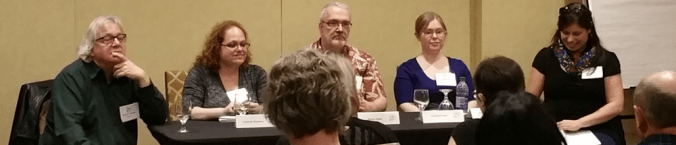
CanCon2015 day 2: The history of science fiction

Presenter: Dr. David G. Hartwell (and, his site).

DavidHartwell

Sorry for the poor pic. It was the best of the bunch I took 😦

Frankenstein (1818) was actually a collaboration between Mary and Percy Bysshe Shelley. The Bodleian library holds the original manuscripts. They reveal four distinct hands. That it’s the first science fiction written by a woman is therefore debatable.

Aphra Behn, Margaret Cavendish, and Jane Louden could be contenders.

Many of the manuscripts from the early 20th century are now being re-examined.

Facsimile reprints only lasted 15 to 18 years for the research set. Now we have Google Books, Project Gutenberg, and the like.

There have been no organized, concerted efforts dedicated to science fiction. It’s something fun for academic researchers. The early works, in particular, don’t get a lot of attention.

After Shelley, we have Jules Verne (1828 – 1905) and Edgar Allen Poe (1809 – 1849).

Poe was, arguably, not a great writer, but he more or less created genre fiction, specifically mystery, science fiction, and horror.

Kafka (1883 – 1924) and Edward Bulwer Lytton (1803 – 1873) published speculative works as well.

There was a growth in modern nationalism and military invention at the end of the 1800s. The machine gun, the tank, and the air plane. It was largely considered the end of war the way it had always been fought. Governments other than monarchy developed.

More’s Utopia and Plato’s speculations were considered thought experiments. They were never realized.

By the 1890s, there was a large body of work that could be read and mimicked.

George Orwell was considered to have wrote scientific romances.

Currently, it is thought that the ‘important’ science fiction is written in one language, but there are French, German, Polish, and Italian writers in the genre.

Q: What is proto-science fiction?

Science fiction is a conscious effort. If it’s accidental, it’s proto-SF. The second consideration is that there has to have been an audience for the work.

Q: What about other literatures?

There are Arabic texts describing aliens that date back to Medieval times.

Q: Is Tom Swift considered science fiction?

Not really. It’s more adventure.

All imaginative literature got scrunched together and separated from ‘proper’ literature. The fantastic exists in literature since Gilgamesh. That doesn’t mean it was what we consider fantasy.

Q: What’s the difference between a techno-thriller and science fiction?

In the techno-thriller, the changes are temporary. The world reverts to normal. Science fiction tends to change the world permanently.

J.G. Ballard’s work usually involves a disaster of some variety and humanity must live with the results. It’s not the optimistic attitude of most science fiction.

Between 1920 and 1940, the literary establishment had to start excluding written material to maintain their elitism. The typical modernist text of the time was normal life with psychological insight.

John Updike wrote about The World Treasury of Science Fiction. He said it couldn’t be first rate literature.

The attitude of the literary establishment toward science fiction is not acceptable.

Q: Could you comment on Orwell? What about Huxley and Burgess?

Burgess liked reading science fiction, but his only analogue is A Clockwork Orange. Orwell wrote in the tradition of H.G. Wells. He would have been appalled if anyone called him a science fiction author.

Science fiction and fantasy are marketing categories.

Genre is an interaction between the author, the text, and the reader. There’s direct feedback. The traditional genres (literature, drama, poetry) don’t necessarily have that.

There was a fair amount that I didn’t get written down with this particular presentation, but it was still a great source of information. It filled in a few gaps for me from my previous studies. I have a feeling that Dr. Hartwell could have kept going 🙂

That’s it for this week.

I’m off to Bedfordshire (as in bed).

TTFN!

CanCon 2015 day 2: Asteroids

I can’t believe it. I actually had the time between Boxing Day shopping and family dinner this evening to put my post up. I love it when a plan comes together 😉

Happy Boxing Day, everyone!

Panellists: Andrew Barton, Eric Choi, Wolfram Lunscher

AsteroidsPanel

AB: Let me just say this: Armageddon is not a documentary.

WL: Asteroids pass Earth all the time. There’s an asteroid that will pass us on the far side of the moon, about 15,000 miles. The Hallowe’en asteroid. Mining asteroids is feasible, but we’d need rockets bigger than the Saturn 5. Space-X is developing the Falcon Heavy, which could be used for the purpose. Our planetary resource needs could be met by mining four asteroids. There is a parallel between the exploration of space and the exploration of the new world. Spice used to be as expensive as gold until the Spice Islands were discovered. It will be expensive to mine asteroids until we have sufficient access to the resources we need to make it reasonable.

Q: Can a solar mirror be used to melt asteroids?

WL: For resource processing in situ, a solar mirror could be used to smelt minerals. If we can figure out a cost-effective way to mine asteroids, we could become a true space-faring species.

EC: Terrestrial mining is a huge part of the Canadian economy. Can we transfer these skills to the mining of asteroids?

WL: The short answer is, yes. There’s a lot of enthusiasm within the industry for making the leap. Deep mining drills are taking place in Sudbury and a paper is being prepared, a feasibility study.

EC: Back to you Andrew. You said before that Armageddon was science fiction.

AB: I’m not the expert. I’m just and author who likes to write about asteroids. My research tells me that asteroid settlement is possible. James S.A. Corey (actually two co-authors) writes about the Belters, who make a living mining the asteroid belt for water to supply settlements on Mars and Jupiter’s moons. Asteroids are actually spinning rubble piles.

Q: Diverting asteroids away from Earth is supposed to be more effective than trying to blow the up. Are there any practical experiments or is this all fiction?

AB: We could use a kind of gravity tractor to divert asteroids. There’s not a lot of drama in the process, though, so people don’t write about that.

WL: If the asteroid impact is immanent, we would have to try blowing it up. If we can spot the asteroid at least ten years out, we would have the time to mount a mission to divert it.

EC: The budgets for the films Armageddon and Deep Impact were both orders of magnitude greater than the budget astronomers have for asteroid detection.

AB: There’s a probe that has been sent to the inner solar system, to Venus and closer to the sun. It’s intended to detect asteroids orbiting in the inner solar system. There’s danger from that direction, too.

Q: What complications does the spinning of the asteroid pose to landing on it?

AB: It’s problematic because there are voids in the asteroid a probe or landing vehicle could be lost.

And that was time.

Next weekend, I’m going to take a break from CanCon do write my year-end Next Chapter update, and, if I have time, I want to put together a post on how to set up Jamie Raintree’s new writing and revision tracking spreadsheet. I was asked to do this back in the spring by some writer friends who aren’t Excel-savvy, but realized that doing it when the spreadsheet is fresh off the presses would be better. Sorry for the delay, ladies!

We’ll see how it goes 🙂

In the meantime, I hope everyone is safe and cozy with their loved ones and if anyone dared Boxing Day madness, that they’re all home and none the worse for wear (if a little poorer in their bank accounts).

CanCon 2015 day 1: How to pitch

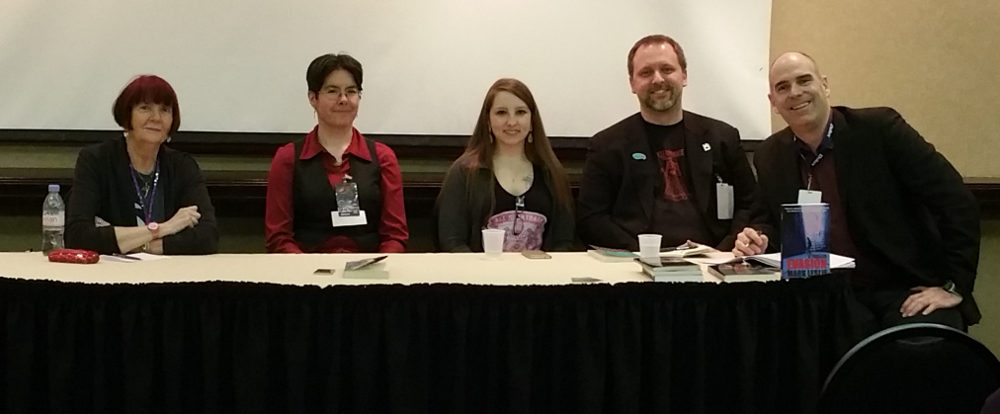
Panellists: Hayden Trenholm, Gabrielle Harbowy, Robert Runte, Elizabeth Hirst, Marie Bilodeau

PitchPanel

Q: What do you want to see/hear in a pitch?

EH: Enthusiasm. If the author loves their book and believes in it, that’s a good sign. Make sure the book you pitch is finished.

HT: Don’t lie. If the book isn’t finished, be up front about it. If the finished book comes in nine months later, that ship has sailed, though.

GH: First impressions count. Don’t ignore the guidelines. One guy wiped his nose before he shook my hand. It didn’t matter what he did after that.

EH: Presentation is key.

HT: I have to know I can send you to a high-end book store. Publishers don’t buy books. We buy authors.

RR: Different editors look for different things. You want to get rejected as quickly as possible. If you’re not a fit for the editor, you have to feel good about that and move on. You’ll find the editor who’s as passionate about your work as you are. I polled my SF Canada colleagues and asked them, ‘what’s the longest you’ve waited for a response?’ Eight years was the longest. That’s a huge chunk of your life.

HT: Pitching is like a job interview. Treat it like that.

EH: I wish the authors well. If it’s not for me, I might suggest someone else.

GH: Don’t argue. All decisions are final.

HT: Some people try to tell me why I’m wrong. It’s like asking for a second date after a failed first one.

EH: You should ask as many questions as they ask you.

HT: You have to make sure it’s the right fit.

EH: I might recommend self-publishing to some pitchers.

GH: But I can’t take a book that’s already been published.

RR: You have to make sure you match your capabilities. Don’t promise anything you can’t deliver.

HT: We don’t know everything. We all do what we can. Self-published books are a tough sell. 55% of Americans won’t read an ebook. Think about what you want. Your expectations should be clear. A bestseller in Canada is about 5000 books. When you choose a small publisher, you have a personal relationship. Our goal is to make the best book we can. If that’s what you want, pitch to a small press.

GH: Bigger presses look at Dragon Moon’s catalogue. We’re happy to send authors on to bigger and better things.

RR: If you’re asked for a synopsis, it’s a blow by blow of everything that happens in the novel, including the end. I need to know the ending. You have to tell me what your book is about.

EH: The ending is not as important to me as the main conflict. What’s interesting about the book? What’s the intrigue? That’s the reason people read.

GH: Premise and plot are not the same thing, though.

HT: People think the book has to be perfect. No. The book has to be interesting. If the book is a shambles in terms of spelling and grammar, we can fix it.

RR: I have to love your book to put the four- to five hundred comments on it that I do on most books. I’ve been giving these talks forever, but I finished my first book and went to pitch it . . . and blew it.

HT: The last person who knows what the book is about is the author.

Q&A ensued.

And that’s the end of day 1. Between Nina’s workshop and this panel, the opening ceremonies took place and after this panel, I went to the Bundoran Press book launch and SF Canada party, where I got to hear GoH Ed Willett read from his latest novel and network with my writerly peeps.

So that was all I did on Friday.

Next week: Asteroids.

Note: I’m not sure if I’ll be able to post on Saturday or if it will have to be pushed to Sunday. Family shenanigans. You know the holiday drill 🙂

Ad Astra 2015, day 3: The hero’s journey and the story promise

I lied. Last week I’d said that I’d be reporting on fairy tales this week. Turns out that my notes from that panel were less than a page (!) I was enjoying rather than making notes, again (bad Mellie). So I’m fast-forwarding to the last session I attended at Ad Astra this year.

Panellists: Catherine Fitzsimmons, Cathy Hird, Kelley Armstrong, Nina Munteanu

the hero's journey panel

KA: The first stop on the hero’s journey is the ordinary world. Science fiction and fantasy authors can struggle with this because of the urge to info-dump. We want to share all the details of our intricate world building. You can’t jump straight to the call to adventure, though. You have to set the stage.

NM: The call to adventure is often refused and may require the appearance of a mentor figure.

CH: Refusal is an interesting moment, though. It’s great conflict.

NM: Threshold guardians are another great source of conflict. In most cases, your hero will need help to defeat or circumvent them. Mentors or allies. The descent and return must be accomplished by your hero alone, however. Your hero must transform.

KA: That’s the return with the elixir. Sometimes, though, the hero does not refuse. Sometimes, it’s awesome. I’m in! Hella yeah! And sometimes the threshold guardian just doesn’t want the hero to get hurt. It’s still conflict. It’s just not so overt.

NM: It’s the belief in the quest that carries the hero over the threshold. The mentor believes in the hero. The threshold guardians do not.

CH: In Tanya Huff’s The Enchantment Emporium, the quest is hidden.

NM: The story promise requires the hero to progress on the journey to its ultimate fulfillment.

CF: There has to be a hint, even when the quest is hidden.

KA: Even romance novels follow the hero’s journey.

CF: Literary fiction can be more metaphorical.

CH: Two people may want to achieve the same goal, but in different ways or for different reasons. In some of the epic stories, things fall apart. Every King Arthur has his Mordred.

Q: Is the hero’s journey a western convention?

NM: The template aspect is western, but Campbell studied cultures all over the world to identify the pattern. The basis of the hero’s journey is universal.

CH: The hero’s journey doesn’t fit with some of the eastern stories, though. They can be more cyclic in nature. The Shiva trilogy by Amish Tripathi is an example.

CF: It’s a matter of interpretation.

KA: If you want a simplified version of the three act structure: chase your character up a tree; throw rocks at them; have them climb back down.

NM: In the third act resolution, the hero’s resolve must be tested.

And that was time.

Next week: The Ad Astra 2015 wrap post with my usual picture of my bookish purchases.

Have a great weekend, everyone.

Ad Astra 2015 day 3: Making a living isn’t just for the cream of the crop anymore

Here we are, finally, on day 3!

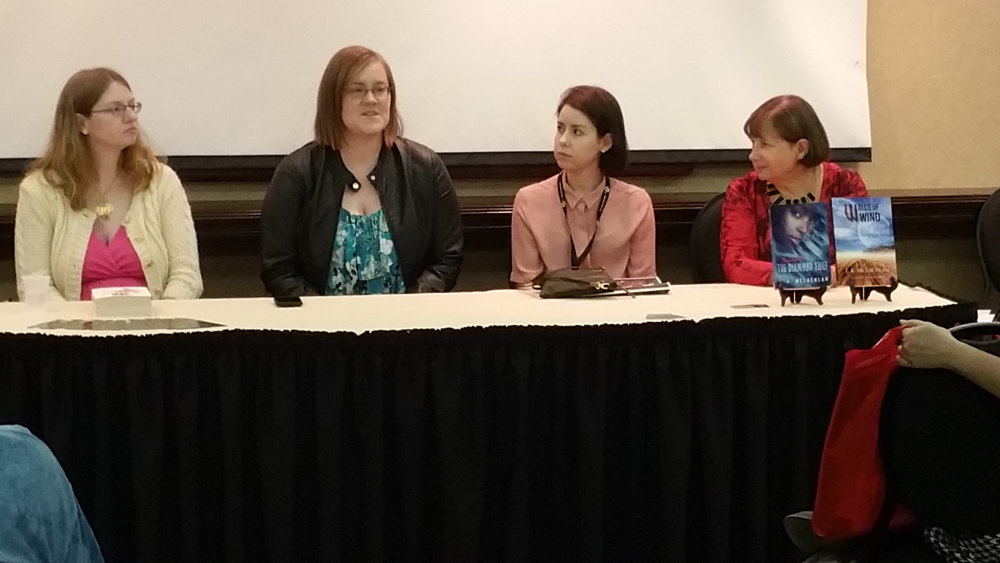
Saturday evening, I attended the Edge book launch event for Jane Ann McLachlan and Aviva Bel’Harold and then on Sunday morning, I got to sit between Charles de Lint (eeeee!) and then president of SF Canada, Peter Halasz at the Guest of Honour Brunch.

EDGE Launch

Jane Ann McLachlan and Aviva Bel’Howard at the EDGE Science Fiction and Fantasy launch event

All that to say that there are only three sessions left to report on (including today’s). So we are almost at the end of Ad Astra 2015.

Also, as we’ve hit a new day, I thought it might be handy to reiterate my disclaimer:

These posts are composed of my notes. Often, because of the scheduling, I enter sessions after they’re already in progress. I write by hand, so as I’m writing what I believe to be a salient point, I may miss the next one. I do my best to catch as much as I can, but things will be missed. Also, if, in my haste I recorded something incorrectly, please don’t be shy about coming forward and letting me know. I will correct all errors post-hasty once informed of them.

Panellists: Gail Z. Martin and Mary MacVoy

GZM: Publishers pay twice per year. You have no idea what your royalties might be. When sales trickle off, multiple streams of income is a wise approach.

MM: Multiple streams on income could include traditional publishing, epublishing or self-publishing, Wattpad, crowd funding, Patreon, etc. You have to educate yourself on how each potential stream works.

GZM: Athena’s Daughters was the most successful literary Kickstarter at the time. Be aware, though, that 75% of all literary Kickstarters fail.

Q: How do you grow your following?

GZM: Your current discoverability/sales for your current work will be based on how successful your last novel was. Crowd funding is a way to identify your audience/readers before you have a project out. Kickstarter will not allow charities anymore. Indie-gogo will, however. Go fund me and Patreon might be options, too.

MM: Crowd funding is just one element of building your audience.

GZM: Do you have a newsletter? Do you have YouTube videos? Do you podcast? Can you teach a class? Building an audience is largely about what you can offer.

Q: What advice do you have about working with small or indie publishers?

MM: It’s an option to explore. Some small publishers have excellent marketing and PR packages. Confidence is key when approaching a small publisher.

GZM: Different streams will compensate for each other.

MM: People are looking for an experience. Make sure your audience leaves with a piece of you. Check out the rules of your various social media periodically. They change and you don’t want to run afoul.

GZM: Facebook and Twitter are essentials. Talk about what you’re doing. Build relationships. Don’t spam.

And we got the nod that it was time to clear out for the next panel.

Next week: Fairy tales!

Have an awesome weekend and we’ll catch up with you on Tipsday.

Ad Astra 2015 day 2: Cutting contracts and shaking hands

The business basics of writing

Panellists: Greg Wilson, Monica Pacheco, Gail Z. Martin, Leah Bobet

Cutting Contracts Panel

Q: Do I need an agent?

LB: First, you have to ask yourself what you want. What will your career look like?

MP: If you want a Big 5 publishing deal, film rights, foreign rights, etc., you need an agent.

GZM: Can you do your own taxes or do you have an accountant? An agent has specialized knowledge that’s critical in the publishing industry. Their 15% commission is well worth it.

LB: I have to clarify my response: if you want to self-publish, no, you don’t need an agent. If you focus on short fiction, you don’t need an agent.

MP: Short fiction is excluded in publishing contracts.

GW: The stuff that used to be done by acquisition editors in the publishing houses has shifted to agents. There are many ways to achieve the same result. Having an agent can free up more time to write.

GZM: I don’t need an agent for short fiction, but if I notice something hinky with the contract, I can run it by my agent. He gets paid if I get paid, so he’s invested in my success.

LB: Agents aren’t interchangeable. It’s like a marriage. Fortunately, break-ups are rarely acrimonious.

MP: Your agent is also a buffer between you and the editor, you and marketing, etc.

GZM: My agent can play the bad cop.

MP: There’s an imbalance of power.

GW: A bad agent can be worse than no agent at all. You have to believe in what you do. Get the right agent for you.

GZM: I recommend the Guide to Literary Agents.

LB: Don’t take the boiler plate! [Mel’s note: a boiler plate is a standardized contract that frequently offers the worst possible terms for the author.] When it comes to long form contracts, it depends on the publisher, the genre, and the specific rights asked for.

MP: An agent will get a different boiler plate as a starting point for negotiation. Sub-rights depend on whether the agency has a strong film/foreign rights department.

GW: Also look out for audio rights and gaming rights.

GZM: Ebook rights are now a part of the non-negotiable rights a publisher can ask for. It will differ by house. A lot of authors are doing more hybrid work as their careers progress. Your contract determines what you can do (e.g. when rights revert to the author).

LB: Non-compete clauses are something to examine carefully. Looking at the big picture, publishing houses are figuring out how to proceed in the world of epublishing and publishing on demand (POD).

GW: Distribution wars can have an affect on your novel. When Amazon and Hachette were fighting it out, some authors lost out because their books were getting into the stores.

GZM: The sales of your current book will determine how many copies of your next book stores will order.

GW: Titans fight and the peons pay. I self-published and then I got a traditional deal. Publishing and writers are both more flexible. Hybrid will become the norm. You have to have more awareness of the “shape” of the industry.

MP: We used to search WattPad to find the next author. Now, established authors are publishing on WattPad.

LB: I’m interested to see if WattPad will be monetized.

GZM: How does free translate to readers (which translates to income)? Some people read a book a day. They can’t afford their book habit, but if they read and review, they become influencers.

GW: We now have multiple avenues to get our work out there. You can leverage multiple fan bases. The more each author is successful, the more all authors are successful. The rising tide floats all boats.

LB: YA rules are a little different. It’s flush with money. It’s a gold rush. I’m aware of my limits as a writer, though. 18 hour days on an ongoing basis would kill me. Publishing is built on interns. Books are great, but they’re not everything. You have a life outside of books. Your career is your choice.

GZM: Precarious is in the eye of the beholder. I have a life and I do work long days.

GW: Being a college professor is precarious. You have to learn how to work smarter, not harder.

LB: No one knows what the magic button is.

And that was time.

Next week: We move on to DAY 3 (!) and making a living as a writer.

Ad Astra 2015 day 2: Canadian young adult literature

Panellists: Amanda Sun, E.K. Johnston, Monica Pacheco, Jane Ann McLachlan

Canadian YA panel

MP: What makes a YA novel Canadian?

JAM: Weather. We have a unique obsession with seasons, weather, and winter.

MP: Setting. American cities are the default for most YA authors.

EKJ: The Story of Owen is set in my home town. When I go to read at local schools, the kids are always excited: “Hey! That’s my street!”

MP: There’s a trend for setting becoming a character in its own right.

AS: Can lit is starting to embrace the speculative.

EKJ: We have horror to thank for that.

MP: For me, it always comes down to the writing and the voice.

JAM: There’s a difference in dystopian, too. Americans don’t trust their government as much as we do. It’s a central theme. Canadians are different. Our dystopias are often ecological disasters.

EKJ: One review of The Story of Owen said, “This is a poorly written dystopia.” It’s not a dystopia!

JAM: Even people on the right are left-leaning in Canada. How do we sell to American readers?

EKJ: I actively don’t care. Readers are looking for interesting and different books.

AS: My editor is American. He’s the gatekeeper. What’s March Break? What’s icing sugar (it’s powdered sugar in the States)? You wrote “in hospital.” Did you mean in THE hospital? Are you done work, or done working?

EKJ: I reclaimed Canadian spelling in subsequent printings of my book. It was a victory.

AS: I write in Canadian English.

JAM: I edit to American spelling but I’m afraid we’re going to lose Canadian spelling if all our young people are reading American English. I feel like I’m contributing to the delinquency of our youth.

Q: What’s your opinion of the renaming of Harry Potter and the Philosopher’s Stone to Sorcerer’s Stone in the States?

[There was a brief discussion of how Scholastic made the decision to rename the book in America and how this translated into the movies. Was it a “dumbing down”? No, just a matter of wording, like icing sugar vs. powdered sugar.]

MP: Both authors and editors expect advocacy. There’s more acceptance of diversity now.

EKJ: Maureen Johnston is an American author, but she wrote an amazing book that is British in every way: setting, weather, politics, and language.

JAM: That’s another thing that distinguishes Canadian YA: our sense of humour and multiculturalism. Canada is a mosaic and America is a melting pot.

EKJ: I have friends in the leadership of the We Need Diverse Books movement. It’s a slow burn.

AS: We don’t understand how divisive race is in America (or other countries).

Q: What about the “white washing” of diverse characters (the character is one of colour, but the cover image shows a white character)?

EKJ: It happened to Beth Revis. In Across the Universe, the male love interest is black. The actor in the movie is white.

AS: I wanted my novel’s Asian love interest on the cover and was nervous, but the publisher agreed. Julie Kagawa’s Clockwork Prince features an Asian on the cover. The cover for Nalo Hopkinson’s Brown Girl in the Ring is culturally appropriate.

EKJ: YS Lee’s Agency series is another example.

MP: I have noticed some of this, but I’ve seen more graphic covers that don’t feature a person at all. I don’t know if I’m reading too much into it, though.

JAM: What about the humour aspect? Canadian humour is self-deprecating.

And that was time.

Next week: We’ll be cutting contracts 🙂

On deck (today): The next chapter June update and a Caturday quickie pupdate.

Ad Astra 2015 day 2: High quality self-publishing

Panellists: Beverly Bambury, Caro Soles, Catherine Fitzsimmons, Samantha M. Beiko, Stephen Kotowych, Mark Leslie

Self-publishing panel

ML: When you self-publish, do you use your own name?

CS: It’s not professional.

BB: If it’s a small publisher that no one has ever heard of, why not use your own name?

SMB: It doesn’t really matter. The book will speak for itself.

SK: Using your professional name adds credibility.

ML: I run Kobo Writing Life for small publishers and independent authors. The top 15 to 20 best selling Kobo books are independently published.

BB: Does Kobo offer supports?

ML: We’re looking into how to best connect authors and services. There are a lot of predators out there. We should be bringing out something later this year.

BB: Supports vary. Authors have to do more regardless.

SMB: An author will finish writing and editing a book and say, “Well, that was a nightmare.” Fasten your seatbelts, people: it gets worse.

ML: What’s your best advice to the author considering self-publication?

CS: Join writers’ organizations. You find out what’s going on in publishing. Hire a copyeditor.

SMB: Come out to events like this one. Everyone really wants to help everyone else.

SK: Don’t spam people. Offer something of value.

CF: Don’t skimp on the cover, but be smart. Shop around.

CS: I do my own covers. You just have to learn how.

BB: Someone with a graphic design background could be better than an artist. Invest in an editor.

CS: A beautifully written story, if poorly copy edited, will lose competitions for awards and other opportunities.

ML: A good cover catches attention. A good back cover copy reels readers in. Write your next book. Nothing sells you last book like your next book.

CS: An ebook cover has to look good in thumbnail form.

CF: Check out Kindle cover disasters on Tumblr.

Q: You mentioned two different kinds of editors. Could you elaborate?

SMB: There are substantive editors. They look at the big picture, structural stuff. They can cost a lot. A copyeditor or line editor looks at sentence structure, grammar, and syntax. Is this the best way to convey your intent? A proof reader looks at spelling and punctuation.

ML: Who’s looking at the revised copy? If you have beta readers, ask them, “Where did you fall out of the story?”

CF: With beta readers, the more the better.

ML: Beware the hype of the Kindle gold rush. Don’t look at self-publishing as your ticket. It’s a long term game, not a quick buck.

BB: As a publicist, I have people coming to me with unrealistic expectations.

Q: What are your thoughts on giving away your work for free?

CF: You shouldn’t start that way. If you have a complete series, then offer the first for free. If readers like it, they’ll buy the rest of the series.

ML: Kobo uses free in different ways. It works best when the call to action is to buy the author’s next book (series or otherwise).

SMB: If you have a novella, don’t give it away for free. It’s considered an exclusive item. Give it a limited run.

ML: Let’s run the numbers. Say you offer a book for free and 10,000 people download it. Of those 10,000, maybe 2,000 will open the book. Of those, only 350 will finish it. Of those, only 175 will buy the next book.

Q: How do you balance everything?

CS: That’s up to you.

SK: Schools can be a goldmine.

And that’s all we had time for.

Next week: Ad Astra gets punked 😉

And sorry folks, you’ll have to wait until next weekend for my report on Madeleine Callway’s workshop and Wordstock. I’m bushed.

Six questions with M. H. Callway

Madelaine Harris-Callway

Madeleine Harris-Callway is a traditionally published crime writer. Her debut novel, Windigo Fire, which has a northern Ontario setting, was published by Seraphim Editions in October 2014. It was warmly received by reviewers, including Margaret Cannon of The Globe and Mail. The Huffington Post Canada put it on their list of Books for Book Clubs. On April 23rd, she was thrilled to learn that Windigo Fire is a finalist for this year’s Arthur Ellis Award for Best First Crime Novel.

Prior to writing Windigo Fire, Madeleine was a successful crime short story writer. Her stories have appeared in several anthologies and magazines and have also won awards.

She has moderated and participated on numerous panels at writing conferences. Most recently, she moderated a panel at Left Coast Crime on plot twists. Her favourite topic is “How to Get Published” and she regularly gives talks at public libraries on this subject.

In 2013, Madeleine founded The Mesdames of Mayhem, a collective of 16 Canadian women crime writers.

_______________________________________________________________________

I was introduced to Madeleine through a mutual friend, author Dorothy McIntosh (D.J. McIntosh), last year. She mentioned that she would be interested in coming up to Sudbury to promote Windigo Fire, and we started a correspondence that culminated with the organization of a writing workshop and her participation in this year’s Wordstock literary festival.

I’m so pleased to welcome Madeleine to Writerly Goodness 🙂

WG: When did you first come to writing, and, as it’s always seemed to be your thing, what drew you to crime writing specifically?

MHC: I have been writing since I was a child. I co-opted my mother’s portable electric typewriter and banged out plays for my friends to perform with mixed results! I forgot my dream to be a writer between studying science and business at university, earning a living and raising a family though I returned to it from time to time. In 2002, I decided it was now or never and committed to writing full time.

While I worked at the Ministry of Health, I was assigned to work on the scientific investigation of the mysterious deaths at Sick Children’s Hospital in Toronto. The study, in parallel with the police investigation, was headed up by the Centers for Disease Control, Atlanta. The report concluded that deaths were indeed homicide.

It was a deeply disturbing experience that affected every one of us who worked on the study. My boss at the time ended up leaving the government and becoming a forensic psychiatrist! He and I would have many long discussions puzzling over the motivation of the person responsible. I began to read accounts of true crimes, trying to gain insight into the criminal mind and I continue to read such books to this day though I’ve come to believe that the reasons, at least to me, remain unknowable.

I turned instead to crime fiction, where the criminals, for the most part, are caught, punished and moral order is restored!

WG: You’re an avid cyclist, runner, and downhill skier. Does your physical activity play a role in your creative pursuits?

MHC: Physical activity and writing are intertwined my personal life. Windigo Fire is an outdoor survivalist thriller. I drew on my personal experiences with dehydration and fatigue to lend authenticity to the hardships my hero, Danny Bluestone, goes through. During long training runs and bicycle rides, I have the freedom to think up stories and to resolve plot problems. And on the way I always spot odd and fascinating people, buildings or incidents that give me ideas.

WG: What led you to found the Mesdames of Mayhem?

MHC: Sadly women crime writers still face an uphill battle to get equal recognition. Though we represent at least half of published crime writers, we aren’t reviewed as often as men and we don’t win as many awards. My friends and I feel we have greater power by banding together and supporting each other at our new book launches and through social media. Through the Mesdames of Mayhem website and Facebook page, we reach far more readers than we can as individuals. We’ve had great fun doing readings at libraries and other venues. It’s much easier for emerging and mid-list authors to get exposure when we approach libraries and literary events as a team.

WG: What was the idea that became Windigo Fire, and how did it evolve?

MHC: The first crime novel I wrote became my “learner novel”. Though it had interest from a few publishers and a New York agent, it never quite made it and it now lives in my filing cabinet. Windigo Fire was to be the second novel in the series, but Danny came to life and took over.

The story of Pasha, the tame bear at Logan’s zoo, was inspired by a bear we saw performing at Clark’s Trading Post, a roadside attraction in New Hampshire. I was inspired to write Windigo Fire after reading about Ted Nugent’s obsessive advocacy of hunting. At the same time, I ran across a sad story about canned bear hunts or fake hunts where the poor animal is chained down and shot by “hunters” who pay a fortune for this. Fortunately these occurrences are rare. Naturally, I asked what if the hunters become the hunted . . .

I spent a lot of time in Northern Ontario early on in my working career: my first job was with Lac Minerals, a gold mining company and later on, I ran health studies for the Ontario government. I heard many wild stories from my workmates, some of which, like the wild bear encounter, are true. The event “karaoke strip night” is an exaggeration, of course, though not by much!

WG: Windigo Fire is set in northern Ontario and features a native protagonist. What kinds of research did you conduct in the process of writing the novel?

MHC: I relied on a friend and fellow writer who was Native Canadian. She explained aspects of culture, such as sweat lodge ceremony and shared her life on and off the reserve. Sadly she passed away so she never knew that Windigo Fire was published.

I also did research at the Spadina Road Branch of the Toronto Public Library, which has a great collection of Native Canadian literature. Studying Cree legends, I ran across the story of the windigo, which proved to be the perfect theme for my novel. The windigo is the symbol of evil, a cannibal with a heart of ice that can only be destroyed by fire. I believe Native Canadians used this legendary character to explain the existence of psychopaths.

At a deeper level, my novel represents the struggle of the main characters against evil. Do they rise and become strong enough to fight it? Or do they succumb to it and let their hearts turn to ice?

For information about surviving in the north, I used the book, How to Survive in the Woods, and for details on uranium mining, I used the internet.

WG: Can you give us a hint about what’s coming up in the future for M.H. Callway, author?

MHC: Absolutely! I am hard at work on Danny’s next adventure, the second book in the series, called Windigo Ice. Danny survived forest fire season, but now he’s forced to battle the frigid northern winter and a rogue priest bent on bio-warfare.

In follow up to our successful first anthology, Thirteen, my group, the Mesdames of Mayhem, will be releasing a second anthology, Thirteen O’Clock. It contains twisted tales of time and crime and will be available on Amazon this fall on Kindle and in printed form.

Thank you for an insightful interview, Madeleine. It was a pleasure! Break a pencil in your creative pursuits 🙂

Many thanks, Mel. It was a pleasure to be interviewed!

________________________________________________________________________

Danny Bluestone, a young Native Canadian, settles for a job at a children’s camp in his Northern Ontario hometown of Red Dog Lake. Local entrepreneur, Meredith Easter, offers Danny some easy money: play the role of native scout for his wealthy hunting buddies. Danny knows that Easter’s roadside attraction, Santa’s Fish Camp, is the front for the local grow-op, and probably more, but the money is his way out of Red Dog Lake. Danny flies the hunters to an island lodge deep in the wilderness. Once there, he learns that he’s part of an illegal bear hunt and is powerless to stop the men from shooting the helpless animal. The following morning, he awakes to find all the hunters but Ricky brutally murdered. Even though each of them believes the other is the killer, Danny and Ricky must team up to escape the forest fire started by the hunters. While his friends in Red Dog Lake struggle to rescue him, Danny falls back on the teachings of his shaman grandmother to survive the bush and the Windigo, the evil spirit that pursues him and Ricky.

Windigo Fire

Ad Astra 2015 day 1: Science fiction for a young adult audience

Panelists: E.K. Johnston, Charlene Challenger, Leah Bobet, Jane Ann McLachlan

YA SF panel

Having just been in a session, Leah was a tad late . . .

JAM: Has fantasy done a better job reaching the YA audience? Who is the audience for YA SF?

LB: There’s the problem right there. Is YA about and geared to young adult readers, or do readers just find their ways to it? Adult authors will write YA SF to “convert” younger readers. That’s a bad reason to write YA SF.

EKJ: Girls are starting to look for science fiction in the YA section.

LB: It’s really YA novels that are paranormal at the core. Authors are starting to cater to YA readers bored with standard paranormal.

JAM: Who are the readers of YA? There are a lot of adults who are looking for, perhaps, a simpler plot or a more youthful protagonist.

LB: I wouldn’t trash readers.

Mel’s note: There was a bit of awkweird at that point. Leah confessed to a lack of sleep but continued to make her point. For the record, Jane Ann’s remark wasn’t intended as a slight to readers of YA of any age, nor was it intended as a slight to the authors of YA, of whom she is one.

EKJ: One of the things that YA does well is include something for readers of all ages.

CC: I remembered being intimidated by SF as a kid. Star Trek: The Next Generation made is accessible. [SF] elevates the human condition.

EKJ: It asks the important questions.

LB: SF is no longer about showing your geek pass card. It’s rooted in outsider culture.

JAM: Are there more female protagonists in YA SF? What does this say about the authors? The readers?

LB: Traditionally, SF has had a massive issue with sexism and misogyny.

Q: Would genre crossing novels find readers in YA?

EKJ: Maybe. That’s the charm of YA. It encompasses all genres. It would probably be an easier environment to break through with a cross-genre book.

Q: What makes for a good YA novel?

EKJ: The pacing is faster, length is a little shorter than the average novel in the adult category. The story doesn’t make them feel bad for being a teenager.

LB: In 2014, the biggest trend was adult readers, particularly women readers, reading YA. As a result, the YA market became huge. Advances were five times the advances in other categories. Publishers had the budget dollars for editing and promotion.

EKJ: Check out Midwinterblood by Marcus Sedgwick.

JAM: Most YA share common themes: leaving home, dystopia, romance, authentication. Most are written in first person, present tense.

EKJ: Second person is rare, but it can be mind-blowing when done well. Fan fiction is a great way to learn the conventions and break them at the same time.

LB: Understand the conversation you’re entering.

JAM: What’s the difference between YA and adult fiction?

EKJ: Flexibility is the key. The main differences are the age of the protagonist and the age of the reader.

CC: The YA journey is outward. The adult journey is inward.

LB: It’s the reading culture. Adult SF is the classic authors like Asimov and Heinlein. It’s not accessible to new readers.

LAM: There is accessible adult SF. The Time Traveller’s Wife is an example, but is it really SF? Young adult is distinguished, in my opinion, by the intensity of emotion and its sense of optimism.

And our time was up.


I’m going to have to defer my next chapter post until tomorrow. I’ve had a couple of evenings out, I have full-tum syndrome (sleepy) and it’s late.

Until tomorrow, be well.