Ad Astra 2016, day 2: Common mistakes from an editor’s perspective

Disclaimer: I am not perfect and neither are my notes. If you notice anything that needs correction or clarification, please email me at melanie (dot) marttila (at) gmail (dot) com

Panellists: Dominik Parisien, Linda Poitevin, Nina Munteanu

MostCommonMistakes

With this session, I chose a different approach. There was a lot of discussion and insight, with examples from various editing projects, none of which I was able to capture effectively on the page. The editors focused on the three parts of a story, the beginning, middle, and end, and, interestingly enough, they discussed three main problems with each part of a story.

As a result, this is a very point-form summary of the main points of the panel.

So here’s the description of the panel from the program:

Whether it’s easy-to-correct grammatical errors or awkward sentence structure, or more complex issues related to characterization, plot, or research, in this panel you’ll hear real editors share the most common mistakes that they see new or inexperienced writers make and tips on how to avoid them. They’ll tell you the things they encounter that have a simple fix, but also the things they encounter that are warning signs of larger problems.

Problems with beginnings

  • Not starting in the right place. Too early (prologues/backstory) or too late (character in danger immediately/no reader investment).
  • Not hooking the reader. If the reader puts the book down, you’re done before you’ve even gotten started.
  • Not having a distinctive, crisp voice.

Mel’s note: Most of these problems can only be solved by experience, either the author’s own, gained through practice, or by leveraging the experience of others, with the help of good critique partners/beta readers/freelance editor.

Problems with middles

  • Solving the character’s problem too early in the narrative. The story ends when the character achieves their goal.
  • Not knowing the story you’re telling/theme.
  • Presenting event after event to get the character from point A (the beginning) to point B (the end).

Mel’s note: Points two and three are related. If you don’t have a handle on your story and its theme, you’re most often going to end up with a series of unrelated events. My recommendation: read Steven Pressfield’s blog and books, and read to Shawn Coyne’s (Steven’s editor) Story Grid book and blog (and now podcast with Tim Grahl—excellent).

Problems with endings

  • Not ending (!).
  • Setting up for a series when the novel is a standalone, or failing to set up for another book when it’s a series.
  • No payoff for the reader/unsatisfactory ending.

Mel’s note: Begin with the ending in mind, even if you’re a die-hard pantser. Endings are torture if you’ve given them no thought until you get there and you’ll likely finish your draft with a hefty case of post-partum depression. Also, one of your editing exercises should be to ‘reverse engineer’ your story from the ending back to the beginning. You can see where important bits of foreshadowing need to be.

And that is my final entry in Ad Astra 2016 reportage. There were readings and launches and the Guest of Honour Brunch, but I wanted to enjoy those rather than record notes on them 😉

See you on Tipsday!

Ad Astra 2016, day 2: A guide to submitting your short stories

Disclaimer: I am not perfect and neither are my notes. If you notice anything that needs correction or clarification, please email me at melanie (dot) marttila (at) gmail (dot) com

Panellists: Bob Boyczuk, Gregory A. Wilson, Nicole Levigne, Kate Heartfield

NL: Read the submissions guidelines of the publications. Read the publication to get a feel for the kind of story they publish.

GAW: Don’t undersell or oversell your story. Don’t lie. What’s really important is the excellence of the work. Would you overlook stories just because they haven’t followed guidelines?

NL: We read everything. We give feedback, even if it’s just one sentence. One query that got to me used parenthetical snark. After noting that he’d conformed to the guidelines, he went on, in parentheses, to say that he didn’t understand why his story had to formatted in any particular way given today’s technology.

GAW: Someone who goes on and on about their experience may be an asshat. If you receive any feedback, it’s a win. You don’t have to follow the advice unless you see a pattern forming, though.

NL: Rejection often speaks more to fit versus quality of the story or the writing.

GAW: Don’t argue with the editor.

KH: You don’t have to respond to the rejection, even if it’s a nice one.

BB: You can use it if you meet in person, though. “You gave me some encouraging advice. Thank you.”

KH: If you talk to other writers, you learn that rejection is the default. Fantasy and Science Fiction (F&SF) gets over 1,000 submissions a month.

GAW: Don’t overlook anthology calls. Most of my publications have been in anthologies. The idea that anthologies don’t make a lot of money isn’t accurate. It depends on how it’s launched and the audience.

NL: For Second Contacts, the theme was 50 years after first contact. That’s not a theme you’d see in a magazine.

GAW: Athena’s Daughters was an all-female effort. Authors and editors were all women. Apollo’s Daughters was pro-feminist and had women editors, but the writers were men.

Q: How do you find anthologies?

GAW: Duotrope, Ralan, and Submission Grinder are your main resources.

NL: Duotrope is a for-pay service, but they tweet, so follow them on Twitter.

Q: Do you always get a response?

KH: Yes.

NL: If they don’t, it will be stated in the guidelines.

KH: Some editors will let you know you’ve made it to a second round. This is awesome news.

NL: For magazines and anthologies that use Submittable, you can track your submissions, which is useful. If you submit to Lightspeed, just watch your email. They respond at light speed, too.

GAW: It depends on the magazine’s internal process.

NL: Simultaneous submissions are fine for most publications. Read the guidelines, though. They may specify otherwise. Never send multiple submissions (that’s more than one story at once to one publication). Don’t resubmit, or submit another story unless you are asked to do so.

GAW: If you get a request to revise and resend, take advantage of it.

NL: There’s no guarantee they’ll accept it, even if you do, though.

KH: We should talk a bit about contracts, at least in the high level sense. A contract follows acceptance. They’ll usually ask for first North American rights for print or online, whatever format the publication is in. There will be a reversion clause to specify when rights will revert to the author. Payment conditions will also be specified. Check to see how long the publication has exclusivity.

NL: Have a writer friend read it over.

GAW: Check out the Writer Beware web site for fraudulent publishers.

And that was time.

There’s only one more Ad Astra session for me to report on and then I’m moving on to sessions from the Canadian Writer’s Summit 🙂

See y’all on Tipsday!

Have a fabulous weekend!

Ad Astra 2016, day 2: How to get an agent

Disclaimer: I am not perfect and neither are my notes. If you notice anything that requires correction or clarification, please email me at melanie (dot) marttila (at) gmail (dot) com.

Panellists: Amanda Sun, Mary Fan, Gerald Brandt, Matt Bin

HowToGetAnAgentPanel

AS: Online resources that can help you get an agent: #MSWL, Miss Snark, Query Shark, Guide to Literary Agents blog.

MB: #MSWL is critical these days.

GB: You have to do the research.

MF: There are writers who get an agent and their first novel fails to sell, their second novel fails to sell, but then their third sells big.

MB: The agent has to love your book.

GB: If your query doesn’t match their submission guidelines, it will be rejected.

AS: I used to be an acquiring editor for Room. If a submission didn’t meet the submission requirements, I’d never see it. It would go straight to the spam folder.

Q: How formal does your query have to be? I write YA.

GB: You have to be professional up front. Your second paragraph, where you’re pitching the novel has to have the flavour of your book, but it’s a sales pitch.

MB: The agent wants to understand how your book works and why it will appeal to readers.

MF: 250 words is a good goal length for your query.

Q: At what point do you look for an agent?

GB: As soon as you have a book that’s finished and ready to go out into the world.

MB: Query agents first. If you submit to publishers, agents will have their sales channels limited. Remember, it’s your agent’s job to sell your book to publishers.

GB: Take advantage of pitch sessions at conferences and conventions.

AS: And work on your next book.

GB: The agent is in it with you for the life of your career.

Q: So querying an agent first is better? Is that because editor A might love you book and editor B might hate it?

GB: At Penguin Random House, if one editor rejects the book, all of them do.

MF: That can happen at agencies, too. Agents can move around, too.

Q: What happens when your agent leaves the agency?

GB: In my experience, I was given the option to follow the agent or stay with the agency.

MB: When agents send your novel to publishers, they do so with a different perspective.

MF: I know a writer whose agent is all business. Some agents will want to help edit or develop the work prior to submission to publishers.

MB: Look at the agent’s reputation before you sign with them. You have to be able to work with them.

GB: When an agent is interested in your work, the tables turn.

MF: When you get an offer, don’t be afraid to ask for references.

AS: Don’t be too eager. You don’t have to back down 100% of the time. It’s a partnership.

MF: There are some Schmagents who aren’t legitimate. There should be no reading fee.

GB: The money should flow to the author. Check out Writer Beware and Preditors and Editors.

MB: Querying is the traditional road. Networking at conferences and conventions can help.

GB: But don’t be stalkery. Have your elevator pitch ready, just in case.

AS: Don’t burn your bridges. Publishing is a surprisingly small world.

MF: Maybe we should talk about the structure of a query? It’s three paragraphs. Introduce yourself and your book. The second paragraph is your pitch. Then the third paragraph is about you and your qualifications.

GB: List publication credits if you have any, memberships in any writing organizations. Make sure you look serious.

AS: Your introductory paragraph should focus on the reasons you’re querying this particular agent. Have you met at a con? Do you write books in the same genre as other authors they represent?

Q: Do you use Canadian, or US spelling?

GB: Everything should be in US spelling.

MF: Your comps (comparative novels) should be published in the last three years.

AS: X meets Y is a popular formula to use. Agents can use it to pitch to publishers.

MB: We should also mention online pitch contests like #PitMad. Look them up. Most of them are on Twitter and you have a limited time to pitch directly to agents. Use the hashtag. If an agent likes your 140 character pitch, they’ll respond to you. The rules are all online.

Q: How long should my book be?

MF: It really depends on your genre and category. There are a lot of resources for this online.

Q: Should you query to an agent if you mostly write short fiction?

AS: You can do that without an agent and, in fact, most agents won’t represent short fiction, even for authors they represent for novels.

GB: Collections of short stories are a hard sell.

And that was time.

Next weekend, it will once more be time for a next chapter update (already?).

Be good and write well!

Review of DIYMFA by Gabriela Pereira: What it should have been but never was

What Amazon says:

DIYMFACoverGet the Knowledge Without the College!

You are a writer. You dream of sharing your words with the world, and you’re willing to put in the hard work to achieve success. You may have even considered earning your MFA, but for whatever reason–tuition costs, the time commitment, or other responsibilities–you’ve never been able to do it. Or maybe you’ve been looking for a self-guided approach so you don’t have to go back to school.

This book is for you.

DIY MFA is the do-it-yourself alternative to a Master of Fine Arts in creative writing. By combining the three main components of a traditional MFA–writing, reading, and community–it teaches you how to craft compelling stories, engage your readers, and publish your work.

Inside you’ll learn how to:

  • Set customized goals for writing and learning.
  • Generate ideas on demand.
  • Outline your book from beginning to end.
  • Breathe life into your characters.
  • Master point of view, voice, dialogue, and more.
  • Read with a “writer’s eye” to emulate the techniques of others.
  • Network like a pro, get the most out of writing workshops, and submit your work successfully.

Writing belongs to everyone–not only those who earn a degree. With DIY MFA, you can take charge of your writing, produce high-quality work, get published, and build a writing career.

My thoughts:

Gabriela Pereira was compelled to create DIYMFA, the website, community, course, podcast, and now book, after her disappointing experience with her Master of Fine Arts (MFA) program.

Like Gabriela, I went the route of the Master’s degree, believing that I needed the validation. It was the lie I believed, and it almost ended my writing career before it began.

DIYMFA is what the MFA program should be (or should aspire to be) but never was.

Most MFA programs centre on critique—without teaching the students what it takes to offer and receive constructive feedback—and coaching/mentorship by someone who may or may not even understand their own creative process, let alone be able to articulate it, or guide their mentee to their process and best mode of creative expression without imposing some ideal of “how things should be done.”

Admittedly, MFA programs have matured and improved, but rather than focus what should be a review of an amazing guide to the writing life on an indictment of the graduate institution, I’m going to, in grand rhetorical style, return to the matter at hand (see? Academia has ruined me—ruined!).

Gabriela divides her guide into three sections: write with focus; read with purpose; and build your community.

In the first, she offers a brief, but engaging, examination of all the essential points of craft that writers must master. There is no one way to reach the destination, but a multitude of paths from which writers can choose based on their personal goals and aptitudes. Self-knowledge and self-confidence are the foundations upon which craft is built.

While the reading with purpose section is shorter than the other two, it is no less important. Gabriela emphasizes a balanced approach throughout DIYMFA. All three aspects, writing, reading, and community, are essential to creative development.

Learning to read and analyze the text, not like an academic, but like a writer, is what this second section is all about. We have to learn about craft first and begin to apply it before we can learn to recognize it in the writing of others and extract lessons from that purposeful reading that we can take back to the page.

Finally, in this brave new world of social media, how do we tackle the task of finding our audiences, reaching out to them, and building a community of writerly friends, readers, and fans?

In all aspects of DIYMFA, Gabriela has studied and learned from the best in the industry, and she unpacks these lessons in an accessible and engaging way.

One of the things I enjoyed most about DIYMFA is that Gabriela draws on her statistics background and mathematical bent to offer charts, matrices, and unique visualizations that will help readers and learners find a way into the material she presents.

And, as a self-confessed word nerd, she exercises her talent for acronyms and initialisms, creating fun mnemonics to encapsulate concepts and principles for her writerly audience.

Having sung the praises of DIYMFA as an alternative to a traditional MFA program, I must point out that Gabriela never disparages academia, in fact, traditional programs are pointed out as viable options for the aspiring writer.

What if that writer has economic, domestic, or temporal limitations, though? It is for those writers-in-progress that DIYMFA has been crafted.

DIYMFA earns my highest recommendation.

My rating:

FIVE STARS!

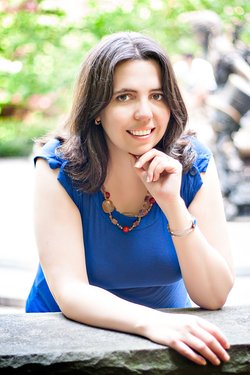
About the author:GabrielaPereira

Gabriela Pereira is the Instigator of DIYMFA.com, the do-it-yourself alternative to a Masters degree in writing. While undercover as an MFA student, she invented a slew of writing tools of her own and developed a new, more effective way for writers to learn their craft. She dubbed it DIY MFA and now her mission is to share it with the world. Teaching at conferences and online, Gabriela has helped hundreds of writers get the MFA experience without going to school. She also hosts DIY MFA Radio, where she recreates the MFA speaker series in podcast form.

Before becoming a writer, Gabriela has done lots of wild and nerdy things like: playing violin at Carnegie Hall, singing madrigals in full Renaissance garb, designing toys for kids ages toddler to tween, and taking applied topology and number theory “just for kicks.” Despite her varied interests, Gabriela’s main passions have always been teaching and design. Now at DIY MFA she can bring these two elements together. Her favorite thing to do is come up with new dastardly plans and innovative resources for writers.

When she’s not teaching or developing new courses, Gabriela loves to write middle grade and teen fiction, with short stories for “grown-ups” thrown in for good measure. A New Yorker born and raised, she lives in NYC with Lawyer-Hubby, Little Man, Lady Bug, and Office Cat.

Ad Astra 2016, day 1: Do’s and don’ts of writing erotica

Disclaimer: My notes are not perfect and neither am I. If you see something that needs correction or clarification, please email me at melanie (dot) marttila (at) gmail (dot) com and I’ll fix it post-hasty.

Panellists: Sèphera Girón, J.M. Frey, Matt Bin

JMF: How did you get into writing erotica?

MB: I just wanted to try it out because a friend said that I could make some money writing erotica while I got my other work into shape. I posted short stories on Amazon. I didn’t do any promotion, but I got some sales.

SG: I wanted to send a story to Penthouse letters about giving my boyfriend a blow job, but I didn’t go through with it at my boyfriend’s insistence. Laurie Perkins, an agent and publisher, was asked to bid on a Kama Sutra project. I did not get the contract for that. They wanted to make it into Kama Sutra flash cards, though. I was brought in to help pose the models because the publisher wouldn’t. They were afraid to make a mistake/be accused of harassment. I got a flat rate for that even though the book has been printed in two editions and the cards sell consistently.

JMF: I entered into erotica through fan fiction (1991-1995). I was always interested in the sexuality of characters. I was called by the editor of an anthology—we don’t have enough good porn. My story ended up headlining the anthology. I got another call—I have this gap in my anthology. I don’t have any  . . . alien porn. So I write the story to fill the gap. J.M. Frey can’t be writing erotica, though. I have a YA steam punk novel coming out. So I write erotica under Peggy Barnet. Now the rights for most of those stories have returned to me and I’m putting together an anthology. I’ve also written an erotica novel. Kindle is the place to sell erotica. Exclusive (through KDP Select) makes sense for erotica.

Q: How much should you reveal? How explicit should you get?

JMF: It depends on the character and the story. My alien erotica isn’t explicit. I have a medieval fantasy erotica and the euphemisms are appropriate to the genre. Even in erotica, you have to think about why you’re writing the scene. Are you furthering the plot or revealing character?

SG: I have an astrology-based series. Readers complain that there’s too little sex, and other readers complain that there’s too much. You can’t please everybody.

MB: I’m working in a different arena. I short pieces, two thirds of the story is set up and one third is hard core sex. Do you use penis/vagina or purple helmet/blooming flower? There are only so many ways you can refer to genitalia. Approach the sex from a sensual or emotional perspective. Get into the sensations. How are the characters feeling?

JMF: That’s how you write good erotica. You engage the reader. In The Order of the Phoenix, who didn’t weep when Sirius Black died?

Q: What’s selling the best?

SG: I’ll answer the question I thought you were asking. Before ebooks, it used to be really hard to be an erotica writer in Canada.

JMF: Harlequin has gay and lesbian lines. Fanfic feeds into erotica. People write to fill a void. I’m not interested in writing vanilla boning.

MB: It tends to be the edge fetishes that sell the best. Vampires used to be big. Then, using the word Billionaire in the title was big. Every once in a while Amazon wipes out what it thinks is too taboo.

JMF: It’s hard to make a kink that’s not yours attractive to the reader, though.

MB: Military-based homosexual erotica (army, navy, etc.) and sports homosexual erotica are really hot now.

JMF: If a reader is into something, they’ll buy all of it. You have to remember this with your marketing. My tagline for Peggy Barnet is: tickles your nethers without leaving your brain behind. I write think pieces that are smexy.

MB: Reader in the genre. See what’s out there.

JMF: Ask yourself why you want to write in the genre?

Q: What’s the limit for sex in non-erotica?

JMF: It’s whatever your publisher will tolerate.

SG: I got a Vivid Video contract. I was told to write anything I wanted. I wrote erotic horror. I asked the president of Vivid if anything was off the table and she said, anything but black guys. Savannah doesn’t touch black guys. I was like, there are rules?

JMF: With respect to Diana Gabaldon’s Outlander series. I loved the first three novels. Now, the sex feels self-indulgent. Yes, everybody loves Jamie. Go as far as you want to. If you’re comfortable with your drunk uncle reading it to your grandmother at a family gathering, go for it. My parents have a brag shelf and all my erotica is on it.

Q: Do you get sex writer’s block?

SG: Yes. Sometimes it gets boring.

JMF: I go to the deepest, darkest parts of the internet.

MB: Burnout is a real thing. The motivation of the character is what engages the reader. The trouble is forcing it.

And that was time.

Hope everyone has a fabulous weekend.

See you Tipsday!

Ad Astra 2016, day 1: The influence of Shakespeare on science fiction and fantasy

Disclaimer: I am not perfect and neither are my notes. If you notice anything that needs correction or clarification, please let me know: melanie (dot) marttila (at) gmail (dot) com and I fix things post-hasty.

Panellists: Kate Heartfield, Arlene F. Marks, Kate Story

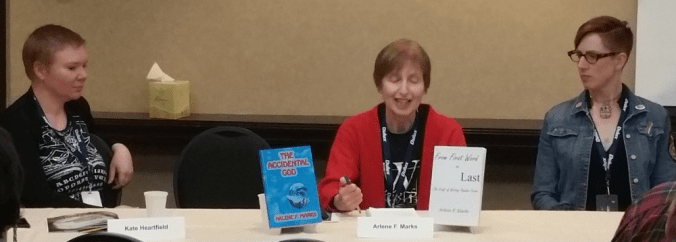
ShakespearePanel

AFM: Shakespeare’s plays were, in his time, entertainment and education. They’re lessons in history, then and now. They also were some of the earliest examples of genre. Hamlet is, in part, a ghost story. MacBeth can be seen as urban legend. A Midsummer’s Night’s Dream is fantasy.

KS: Shakespeare needed to make a living. That’s why he wrote. He was a great enabler of public discourse.

KH: You don’t have to go far to find gender queer characters in Shakespeare.

AFM: The Hogarth Shakespeare series from Penguin Random House is asking well-known authors, like Margaret Atwood, to re-imagine his plays. That’s the brilliance of Shakespeare. You can put any one of his plays into any era or milleu.

KH: A lot of adaptations of his work are coming out because it’s the 400th anniversary of his death.

KS: My father was a scholar in Newfoundland. We had a cultural renaissance in the 60’s and 70’s and we started to make some connections. Maybe we have something to offer to the tradition. I think the spirit of Shakespeare’s time was close to Newfoundland’s now. Shakespeare has always been there and has always been an influence. Shakespeare’s women were far more realistic than the women characters of many modern playwrights.

[Kate then performed the monologue from her story in Carbide Tipped Pens, edited by Ben Bova and Eric Choi. It was a variation of Romeo and Juliet, set in space. She’s currently working on the stage play. I just sat back and enjoyed 🙂 ]

Ian McKellan said in an interview, “Where in the modern world would it be so wrong for two people to fall in love?” It resulted in a 70’s production of Romeo and Juliet set in Belfast.

AFM: In Shakespearean times, it was forbidden for women to go in stage. All women’s roles were played by men, or, more often, boys. The audience was very demanding. If they didn’t like a play, or the actors, they brought rotten vegetables to throw.

KS: He was asking the audience to be clever, to know it’s a man playing a women, pretending to be a man. It engaged the audience, drew them in.

AFM: It’s the fiction of the people. The only publisher that approaches this today is Harlequin, who would hold regular “reader appreciation” luncheons to meet their most popular authors. In Shakespeare’s day, there would be nobles and prostitutes in the same audience. It was whoever had the money to pay.

KS: It was nuts for the theatre. A sixth of the population of London would attend the performances.

KH: The culture of fandom/fanfic has a lot in common with the culture of Shakespeare. There’s nothing more Shakespearean than fanfic. Most of Shakespeare’s plays were drawn from earlier works. He borrowed liberally from Ovid.

Q: Shakespeare’s plays address universal themes. The more popular ones get done. Some might say overdone, but the historical plays are ignored.

KS: My theatre did a gender-swapped Taming of the Shrew.

KH: The film industry has done a better job. My Own Private Idaho, The Hollow Ground series, Looking for Richard.

AFM: A Thousand Acres was the story of King Lear. Shakespeare was brilliant of using every member of the company. There were often comic actors. Characters like Falstaff were written for them. If there were acrobats, he’d give them something to do. They had to be very practical in terms of costuming for these reasons.

KH: Titus Andronicus and Troilus and Cressida were essentially horror. Shakespeare was a great worldbuilder. He was consistent in terms of how fairies, spirits, and witches behaved. His idea of Titania was dark, but comic. Fairies had an alien sense of good and evil.

AFM: He built on the motivations of all his characters.

And that was time.

Next week: The do’s and don’ts of writing erotica (oh, my!).

Ad Astra 2016, day 1: The relationship between self-publishers and editors

Disclaimer: I am not perfect and neither are my notes. If you notice anything that needs correction or clarification, please let me know and I’ll fix it post-hasty.

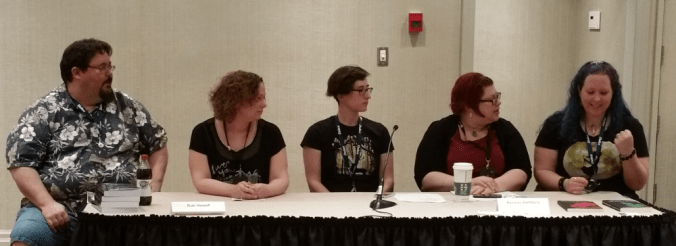
Panellists: Rob Howell, Jennifer Jaquith, Charlotte Ashley, Beverly Bambury (moderator), Vanessa Ricci-Thode
SelfPubAndEditorsPanel

VRT: There are three types of editing: the substantive edit, line editing, and copy editing. The substantive edit is also called a comprehensive edit, or a structural edit. It’s big picture stuff. Does the story make sense, is it compelling, are characters distinct, are story events consistent, are there too many or too few characters? Line editing looks at the story on a paragraph/sentence level. Given your style/voice, is each sentence written well, does each paragraph make sense, do your transitions flow? Copy editing is the nitty, gritty stuff: spelling, punctuation, and so on. There are places where the various editing tasks might overlap. In doing a line edit, some spelling and punctuation might be addressed.

RH: My editor works with me in stages. She’ll address global concerns first, then move on to more detailed editing. My mom’s a professional copy editor, so I have that covered.

BB: I don’t work with a self-publisher who hasn’t had at least one professional edit done on their book. What are the common issues editors see?

JJ: I have a list of hit words. Seems, felt, just, started to, etc.

CA: People who come to me at the wrong stage are a challenge. I love writers who come to be expecting the cost and work involved. Writing is a process of drafting and resting, but some people are on deadlines and they can’t do that.

NRT: Writers make the same mistakes over and over. Mixing tenses, head-hopping, showing versus telling. If you enter into a relationship with your editor, we get to know your particular weaknesses and look out for them.

BB: I look for the crutch words . . . actually, as I see it. Filler words that don’t really add anything to the work.

RH: I am guilty of overusing the shrug. I use it a lot. My editor points it out so I can fix it. You need an editor who can see your faults.

BB: How did your relationship with your editor evolve?

RH: When I was writing academically, I had my ego knocked out through editing. We’d debate the amount of white space on the page.

BB: Editors, how is it from your perspective?

VRT: I use beta readers for structural editing, but otherwise, I depend on my editor.

CA: I write short stories. You don’t get edited until the story is accepted for publication.

JJ: I’m a possessive writer. In technical writing, you hand everything over to the editor. I don’t argue and nine times out of ten, I’ll make the requested changes. Sometimes I don’t know how to improve the piece.

BB: I wrote a piece for Dirge. A friend of mine turned out to be a sexual predator. It was very internal. The editors helped me turn it into a personal essay. You have to trust the process.

CA: I write a lot of non-fiction as well. I once wrote a book review and the editors cut it up. I didn’t know until I saw it in print and at the time, I thought they hadn’t liked it. It turns out it was a matter of the space they had to devote to the review.

RH: If you’re a writer, the most terrifying moment is when you have to send your work off. I know I have someone on my side. It’s still terrifying, but it’s better.

BB: Do you have a success story you’d like to share? What constitutes a successful relationship?

RH: I’m the driver of the race car, the jockey on the horse, what have you. We all do our parts, everything comes together, I read the manuscript one last time, and if I think “I like this,” it’s a job well done.

JJ: You have to understand that the editor wants to like your work. They want to make it better. You have to be open to questions and discussions. You have to make a connection.

CA: A successful client is one who comes back to me. Some don’t come back, or they come back years later and say “you were right.”

VRT: Authors who come back, who are happy with the results, who are willing to do the work.

BB: The editor is rooting for the writer. Everyone needs an editor.

Q: How much time does a substantive edit take?

VRT: It varies, but I can review an 80 to 100 thousand word manuscript in 30 to 40 hours. Sometimes I might recommend a manuscript evaluation. It’s focused on overall strengths and weaknesses.

RH: Scheduling is important. I create a schedule so I can produce consistently. I try to write three books a year. My business model works because I produce. I have 2016 all planned out.

BB: That’s a good point. How far in advance should a writer make contact with the editor?

AC: I like two months lead time.

Q: What’s better proofreading or beta readers? And if you have betas, do you still need a developmental editor?

CA: An editor will be able to tell if your work needs a developmental edit.

VRT: A good editor will be honest.

RH: I chose my beta readers for specific reasons. I have a friend in martial arts who looks specifically at my fight scenes. I have a horse person who looks at logistics and whether I’m treating my fictional horses right or not.

Q: When you’re doing a developmental edit and you hate the story, what do you say?

VRT: I can tell the author that I’m not the right editor for this piece. I’m a member of the Editors’ Association of Canada (EAC) and we make referrals to one another.

CA: When someone says to me they’ve sent the manuscript to 500 agents and 1000 publishers and nobody wants to take it on, I know I have to be cruel to be kind. An editor can’t sell your novel for you.

JJ: I can’t edit horror. I can’t sleep.

CA: There are some issues I can’t handle in a manuscript. Racism or sexism is a definite “no” for me.

BB: As a publicist, I see some things that bother me. People of colour who are stereotypes, pedophilia.

Q: How do you generate a client list?

VRT: I work through the EAC and referrals mostly, but I get some clients through social media and networking.

RH: I have an embarrassing story for you. My editor Kelly and I have known each other forever through the Society for Creative Anachronism (SCA). The first two editors fell through and only after I was working with the third and had my first book out did I find out that Kelly was an editor.

CA: I get most of my clients through word of mouth.

Q: How much should I expect to spend?

CA: A substantive edit usually runs about $2000. Proofreading can be $300. Expect to spend between $500 and $1000 on average.

And that was time.

Next week, one of my favourite sessions from this year’s Ad Astra: The influence of Shakespeare on  science fiction and fantasy.

Review of Jane Ann McLachlan’s The Salarian Desert Game

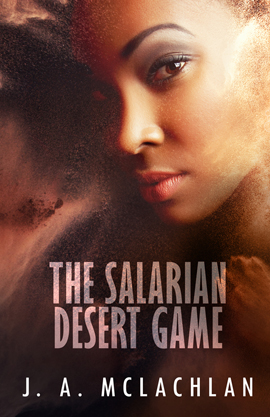
SalarianDesertGame

What Amazon says:

What if someone you love gambled on her life?

Games are serious business on Salaria, and the stakes are high. When Kia’s older sister, in a desperate bid to erase their family debt, loses the game and forfeits her freedom, Kia is determined to rescue her.

Disguised as a Salarian, Kia becomes Idaro in order to move freely in this dangerous new culture. When she arrives on Salaria, she learns it’s a world where a few key players control the board, and the pawns are ready to revolt. Kia joins the conflict, risking everything to save her sister. As if she doesn’t already have enough to handle, Agatha, the maddeningly calm and unpredictable Select who lives life both by-the-book and off-the-cuff shows up to help, along with handsome Norio, a strong-willed desert girl with her own agenda, and a group of Salarian teens earning their rite of passage in the treacherous desert game.

What can an interpreter and former thief possibly do in the midst of all this to keep the people she loves alive?

Edge’s video intro, by Jane Ann McLachlan:


My thoughts:

In my review of Jane Ann’s first Kia and Agatha novel, The Occasional Diamond Thief, I said that Kia learns the truth about herself by learning the truth about others.

This trend continues in The Salarian Desert Game.

Kia, not long returned from her adventures on Malem, is translating at The Salarian Night Games, a form of high stakes gambling, in which losers agree to indentured servitude in the Salarian crystal mines until their debt is paid.

Her sister plays, and loses, and Kia, though prevented by doing anything in the moment but protesting because of her role as translator, determines to travel to Salaria and free her sister.

As she is preparing to depart, she is summoned by the OUB, the interplanetary religious authority. Yes, she must go to Salaria, but as translator for the Select Agatha, and she is forbidden from attempting to save her sister. The mission is all. It was foreseen in a vision and cannot be denied or abandoned.

Worse, Kia will not only have to travel in disguise, but the OUB asks her to surgically erase her identity and assume that of Idaro, a half-Salarian girl who died years earlier.

When Agatha and Kia, sorry Idaro, arrive on Salaria, they are separated and everything falls apart. Alone, Idaro visits her estranged grandmother, Matriarch Ryo, and tries to figure out what she can do to find and help Agatha and get back on her mission to save her sister.

To maintain her cover, though, Idaro must join the Salarian Desert Games, a coming of age ceremony which pits fifteen year old girls against the desert of Salaria and its poisonous denizens. It’s survival of the fittest, and Idaro must survive more than the desert’s snakes and scorpions and the distrust and schemes of her fellow candidates.

The scope of this novel is on a grand societal scale, addressing racism, slavery, misandrogy (Salaria is a Matriarchy), terrorism, and the other consequences these institutionalized practices.

In discovering this alien world, Kia, and the reader, must reflect on the evils of our societies, reflected in the mirror of the novel.

When she first emerges from the surgery that will change her into Idaro, Kia hardly recognizes herself. By the end of the novel, she’s not only learned who Idaro is, but who Kia is, and how far she’s willing to go to save those she loves.

Once again, Jane Ann has written an amazing novel.

My highest recommendation.

My rating:

Five out of five stars!

About the Author:Jane Ann McLachlan

J.A. McLachlan was born in Toronto, Canada. She is the author of a short story collection, CONNECTIONS, published by Pandora Press and two College textbooks on Professional Ethics, published by Pearson-Prentice Hall. But science fiction is her first love, a genre she has been reading all her life, and Walls of Wind is her first published Science Fiction novel. Her new science fiction novel is The Occasional Diamond Thief. She is represented by Carrie Pestritto at Prospect Agency.

Robert J. Sawyer reviewed The Walls of Wind and had this to say:
“Look out, C. J. Cherryh! Step aside, Hal Clement! There’s a new master of truly alien SF, and her name is J. A. McLachlan. THE WALLS OF WIND is doubtless THE debut novel of the year.”
— Robert J. Sawyer, Hugo Award-winning science fiction author

You can learn more about J. A. McLachlan and her books on her website at: http://www.janeannmclachlan.com

Connect with Jane Ann on Facebook: https://www.facebook.com/janeann.mclachlan

What others are saying about her:

“In ways SF readers can favorably compare with icons of the genre, such as Ursula K. Le Guin, James Tiptree Jr. and Robert J. Sawyer, WALLS OF WIND boldly weaves anthropology, psychology, drama, future history, even meteorology, into a tapestry of viewpoints and epiphanies that propel McLachlan’s characters toward a necessary and illuminating change in their collective relationship. … If you read no other “alien” authors this year, don’t miss WALLS OF WIND.”
– Bookreporter

Read the full review:
http://www.bookreporter.com/reviews/walls-of-wind-a-science-fiction-novel

“I loved it from the first page and couldn’t put it down!!”
Domenico Maniscalco

“The writing is excellent and never gets in the way of the story (which is very important to me); The characters are well drawn and believable.”
Peter Barron

“I loved the writing style of the author; her characters are diverse and very real.” Steve

CanCon 2015, day 2: Getting noticed (in a good way) in the novel and short story slush pile

Yesterday ran away with me, so I’m a bit late.

Panellists: Mike Rimar (co-owner Bundoran Press), Gabrielle Harbowy (managing editor, Dragon Moon Press), and Elizabeth Hirst (editor, Pop Seagull)

SlushPile

MR: What do you want to see?

GH: Electronic submissions simplify the process. You want to submit your absolute best work. Follow the submission guidelines.

EH: When something works well in the submission, it stands out.

MR: When it comes to a query, I need to see three things: word count, genre, pitch.

EH: I like a little personality.

Q: Do you always reply?

GH: When submissions are open, yes. When they’re not, all bets are off.

MR: Usually, we reply within three months. If someone has taken the time to query, we will reply. Nothing’s worse than being left hanging.

GH: Wait 1.5 times what the submission guidelines say, just to give everyone a buffer. I will always respond when we have an open submission period.

MR: Asimov’s can be up to six months.

GH: Lightspeed will reject you before you can hit send. It might be a cliché, but eleven lines is all an editor needs to tell if the submission is for them.

EH: I think that’s true, but I keep readings until I know for sure whether it’s a pass or a request for full.

MR: For the Second Contact anthology, I gave people more of a chance to impress me. Two to three pages.

GH: If I’m suitably impressed, I might check out chapter two.

Q: Can you share some statistics?

EH: We had 70 submissions for the Robotica anthology. We took 18. I found more that I liked, but we couldn’t take them. Love, Time, Sex, Magic was different.

MR: It’s sad when you read a really good story that doesn’t fit.

Q: Will you respond with a ‘please send something else’?

MR: No. If I reject a story, I don’t want to invite further interaction.

GH: I’ll respond with a request for further material if I like what I’ve read.

MR: If we meet face to face, I’ll tell you directly.

Q: Do you respond if someone submits repeatedly?

MR: It hasn’t happened yet.

GH: It’s happened to me. They’re probably not paying attention. I keep a maybe file. It’s about 10% of submissions. 2% receive further consideration and 1% might get published.

MR: What are the technical no-no’s you watch out for?

GH: Not fitting with the publication, not following the submission guidelines. Stupid, nervous mistakes are forgivable.

MR: Keep your queries polite and to the point.

GH: In fiction, it has to be complete. Make sure you include your contact information.

MR: Are you as forgiving with paper submissions?

GH: It’s been ten years and I’ve never received one.

MR: Tricks just make me mad.

Q: Is theft a problem?

MR: Not at all.

GH: If I like it, I’ll buy it.

MR: People can have similar ideas. It’s not copyright infringement.

GH: I choose the one that executes the best.

More great advice from professional editors. I’ll be back on track next week, when we’ll be moving on to day three and speculating sex and sexuality.

CanCon 2015 day 2: Blood spatter pattern analysis

Presenter: Detective Constable Garneau of the Ottawa Police

Note: The Constable introduced himself, explained what his job entails, and the education he needed to do his job. He told us that he hadn’t presented to writers before and that he’s brought along the material that he’d present to an introductory forensics class. Then he told us that he spoke to a writer about what would be important for a writer to know. He was advised to focus on the physical evidence and on the interpretation of that evidence through case studies. We wouldn’t need to know the history of forensic science or much about the physics.

So, he asked us if we would mind terribly if he focused on that material. He also warned us, even though it was in the program, that he would be presenting some graphic material. He was so polite.

BlooSpatterPatternAnalysis

Blood spatter pattern analysis tells the examiner:

  • The direction the blood droplet was travelling;
  • The angle of impact;
  • The mechanism(s) that contributed to the creation of the pattern;
  • The area of origin;
  • The minimum number of impacts for any source of blood;
  • The relative positions of person(s) or object(s) involved;
  • The sequence of event(s); and
  • The identity of the perpetrator.

The most useful evidence is the outliers.

I confirm theories using science. I don’t work for the Crown, or the defence. I work for the court.

Blood behaves according to the principles of physics. It will behave differently, and look differently, on different surfaces.

In lab simulations, I use sheep’s blood, but then I would also have to explain how sheep’s blood behaves similarly to human blood when I present the evidence in court. If I don’t have to use a lot of blood for the simulation, I’ll use my own.

There are three kinds of blood spatter patterns:

  1. Passive;
  2. Spatter; and
  3. Transfers.

Passive blood spatter patterns are affected by gravity and include: drip stain patterns, drip trail patterns, drip patterns, splash patterns, pool patterns, saturation, and flow patterns.

Spatters are caused by a physical action and include: mist patterns, expiration patterns, cast-off patterns, cessation cast-off patterns, projected (e.g. arterial spray) patterns, and impact patterns. Impact patterns are the fun ones. I have to use physics and math to explain them.

Transfers occur when a blood-covered object touches another object, leaving a pattern behind. Transfer patterns include: the transfer stain, the swipe pattern, and the wipe pattern.

Many of us develop morbid senses of humour. It’s a way to protect ourselves from the impact of all the horrible things we see every day.

For impact patterns, we now have software which will map everything out based on our measurements. I could use strings, and in some cases, I have to, but it’s very time-consuming. Dexter does it wrong, by the way. You can be very precise.

I use trigonometry to determine the area of origin/impact.

The rest of the presentation was specific case studies and how the Constable’s blood spatter pattern analysis resulted in a resolution to the crime. In some cases, it was a positive outcome. In some, it was not. Most of the crimes presented were perpetrated by men against women, often their girlfriends, or spouses.

It was gruesome, but fascinating.

Next week: Getting noticed (in a good way) 🙂

Be with the one you love, tomorrow.

Phil and I will be heading to an afternoon movie (Deadpool!) and dinner.