Wordstock 2024 post-festival wrap-up

My first official literary festival appearance and all the other goodies.

Day 1 – November 1, 2024

Poetry Primer – The Bistro 5:30 to 6:30 pm

I showed up a bit early and was seen to the hospitality suite and given my lanyard and swag bag. I got to meet Kelsey Borgford and Alex Tétreault in advance and settle in. We’d exchanged a few emails leading up to the session to let us know how the event would proceed.

It was absolutely lovely. Kelsey wore her beautiful ribbon dress, and we had a smooth and interactive session. People asked questions. We even answered them!

Picture of the Poetry Primer session with Melanie Marttila, Kelsey Borgford, and Alex Tétreault.

And afterward, Kelsey and I signed several books each.

It was awesome.

Festival Opening and Youthwords Announcement – The Bistro 7 to 7:30 pm

Heather Campbell welcomed everyone formally. MP Viviane Lapointe, MPP Jamie West, and the deputy mayor all commented on the importance of Sudbury’s arts community and Wordstock as a part of it. The Youthwords contest winners were announced and were invited to read their pieces.

And Then She Fell: Alicia Elliot in conversation with Shana Calixte Pitawanakwat – Studio Desjardins 7:30 to 8:30 pm

Alicia Elliot was funny and irreverent in her discussion of her latest novel, the writing life, and motherhood.

Amazing.

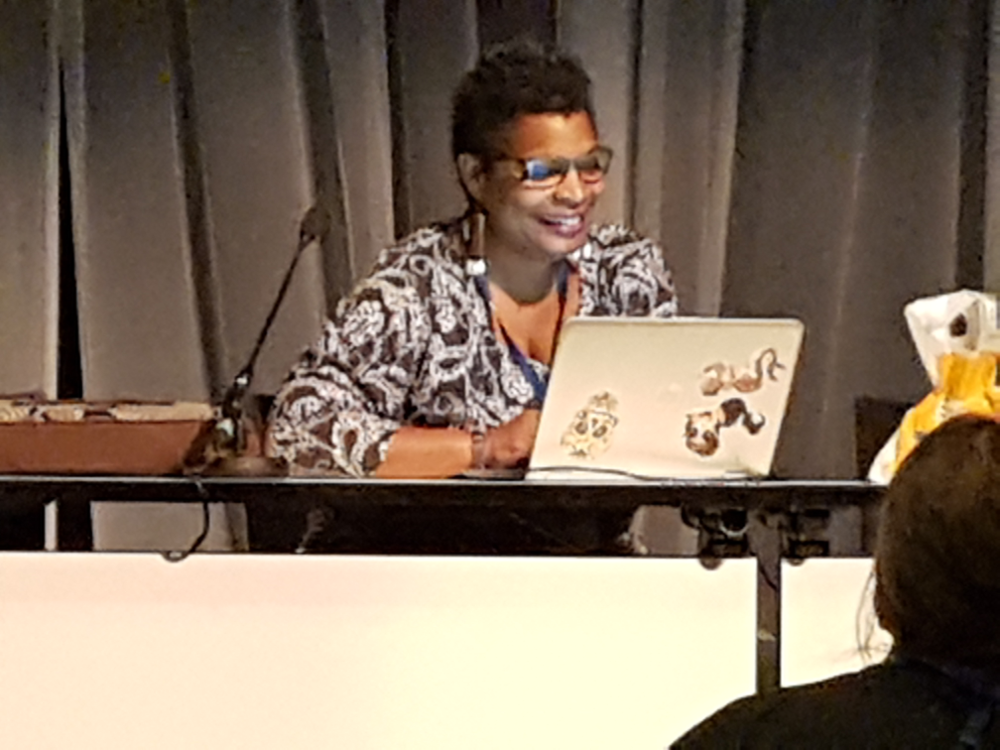
And Then She Fell: Alicia Elliot in conversation with Shana Calixte Pitawanakwat.

Day 2 – November 2, 2024

Masterclass – Immersive Writing Foray – out and about – 9 to 10:30 am

Ariel Gordon and Yvonne Blomer, after a gathering and brief reading in the Bistro, took us for an urban walk with several stops to pause and write.

I wrote three short pieces and explored a part of the downtown greenspace I hadn’t visited in years. No pictures, because too busy walking or writing.

Writing and Publishing Today – Studio Desjardins – 11 am to 12 pm

Alicia Elliot, John Degen, and Hollay Ghadery discussed writing and publishing in Canada today. A lot of insights from both sides of the industry. Moderated by Randall Perry.

Writing and Publishing Today with Alicia Elliot, John Degen, and Hollay Ghadery. Moderated by Randall Perry.

The Inner World of Women – Studio Desjardins – 1:45 to 2:45 pm

Kim Fahner, Heidi Reimer, and Louise Ells discussed their novels and how their characters explore their inner worlds. Moderated by Liisa Kovala.

The Inner World of Women with Kim Fahner, Heidi Reimer, and Louise Ells. Moderated by Liisa Kovala.

Queer Reflections – Studio Desjardins – 3 to 4 pm

Emily Austin and Kate Cayley discussed their respective bodies of work and how they reflect gender and identity.

Queer Reflections with Emily Austin and Kate Cayley.

Echoes of the Earth – Studio Desjardins – 4:15 to 5:15 pm

Ariel Gordon, Yvonne Blomer, and Sophie Anne Edwards discussed their recent publications and how they explore the environment and climate change from different perspectives.

Echoes of the Earth with Ariel Gordon, Yvonne Blomer, and Sophie Anne Edwards. Introduced by Heather Campbell.

Day 3 – November 3, 2024

Ode to Brunch – The Bistro – 11:30 am to 1 pm

Hollay Ghadery, Fereh Malik, and Emily Austin provided a poetic accompaniment to Brunch, reading from their new and published work and discussing the role of poetry in Canadian publishing today. Moderated by Kim Fahner.

Ode to Brunch with Hollay Ghadery, Fereh Malik, and Emily Austin. Moderated by Kim Fahner.

Big and Important Feelings – Studio Desjardins – 1:15 to 2:15 pm

Danielle Daniel, Kern Carter, and Emily De Angelis discuss their middle grade and young adult novels and the emotional journeys their characters travel. Moderated by Jonathan Pinto.

Big and Important Feelings with Danielle Daniel, Kern Carter, and Emily De Angelis. Moderated by Jonathan Pinto. Introduced by Heather Campbell.

It was an amazing weekend. I learned a lot, met many authors I’d only interacted with online, and, of course, bought a lot of books.

All the books I bought.

This was the festival’s 11th edition. I’ve been to every one so far, and I’ll be returning next year.

The Stillwater Writing Retreat

June 7-9, 2024

This event required its own post.

While I attended the Writing Excuses Retreat (WXR) in 2017, that was on a cruise ship and involved a lot of people.

The Stillwater Writing Retreat, on the other hand, organized by Lauren Carter and Anita Allen-Rudzitis of Wild Ground Writing was the first “traditional” writers retreat I’ve attended. The focus of the weekend was to learn strategies to address writerly anxiety and self regulate while still being productive.

I went with Kim Fahner and Laura Young and we had a lovely, writerly road trip on the way down and back from the Loretto Maryholme Retreat Centre in Roches Point, Ontario, on Lake Simcoe. Lots of good conversation, or crack, as Kim would say 🙂

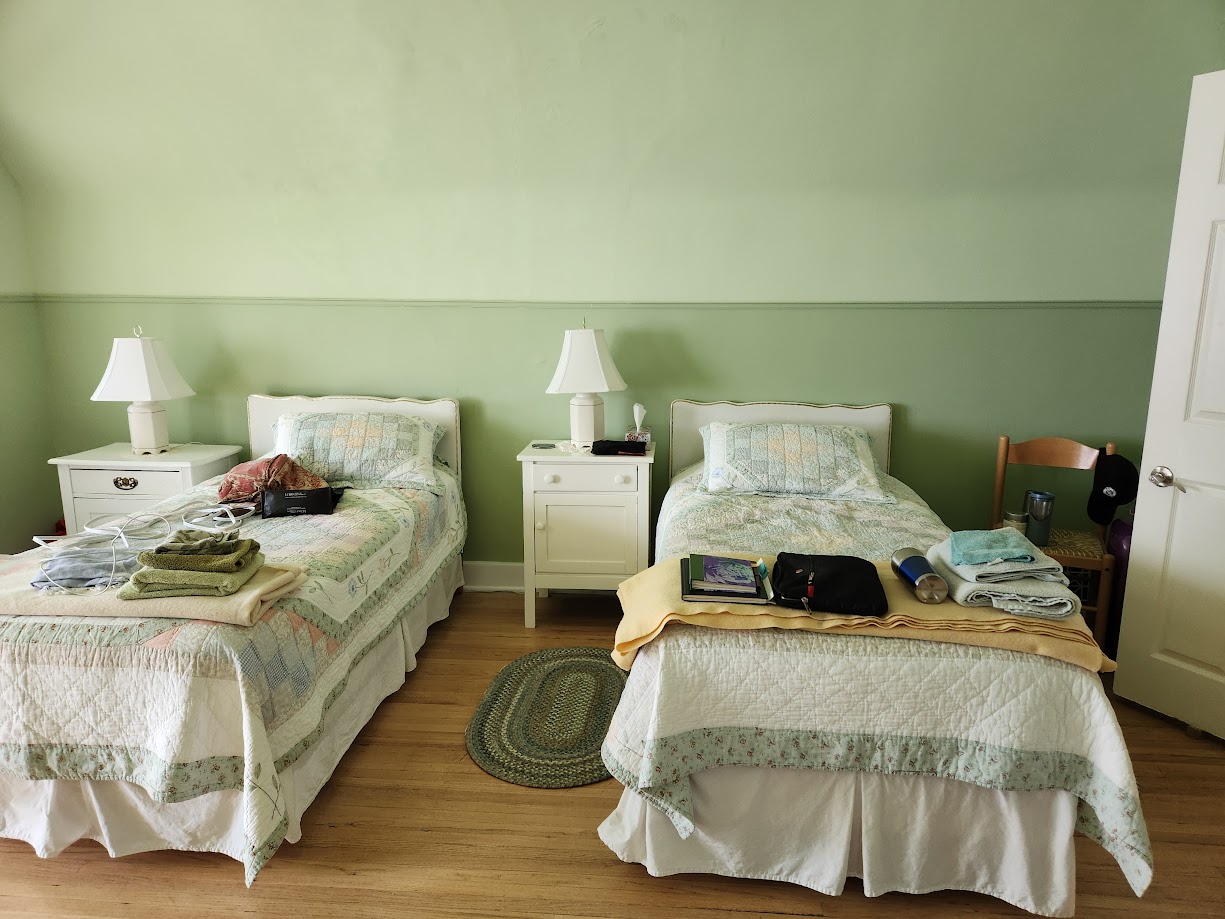
We arrived just after 3 pm, were seen to our rooms (Kim and I shared “The Green Room”), settled in, and I took the opportunity to tour the grounds before supper.

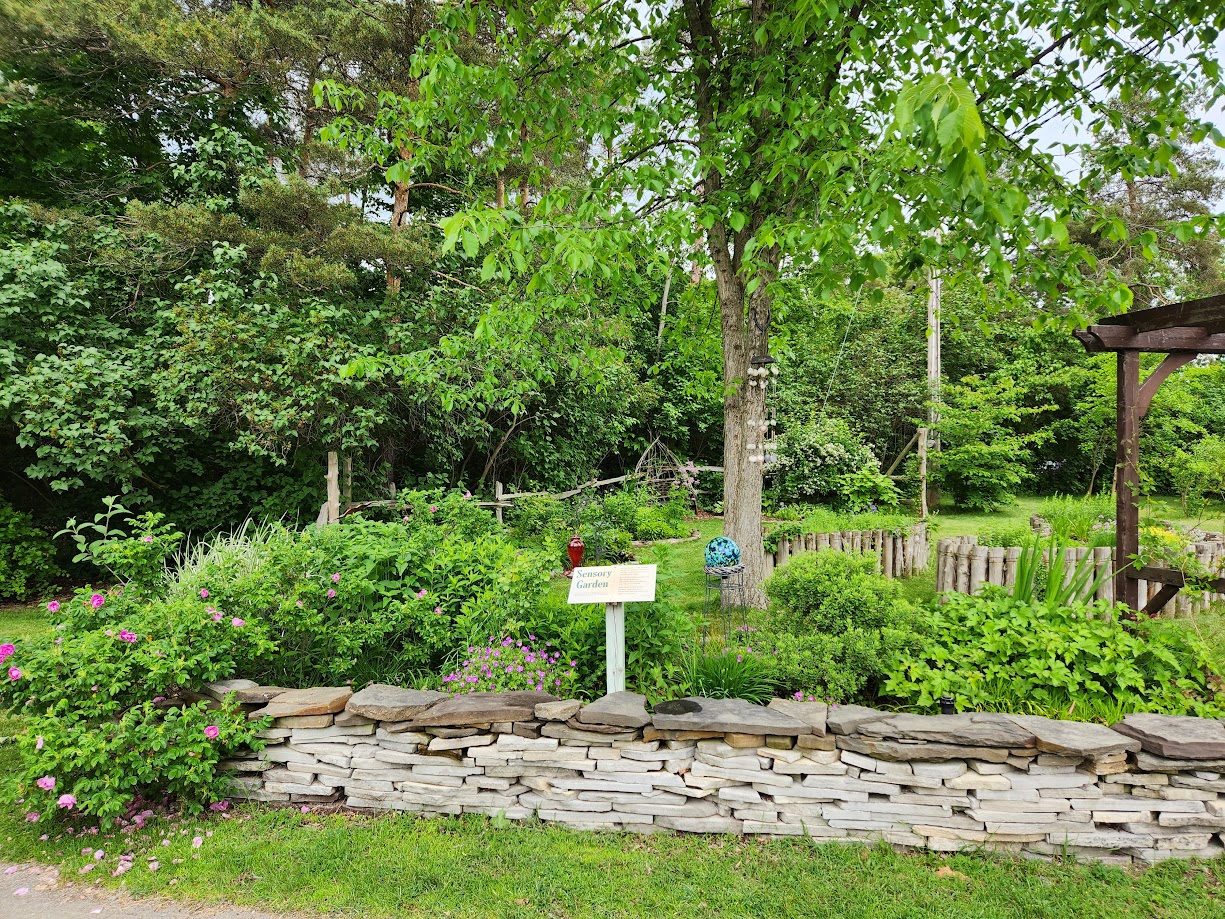
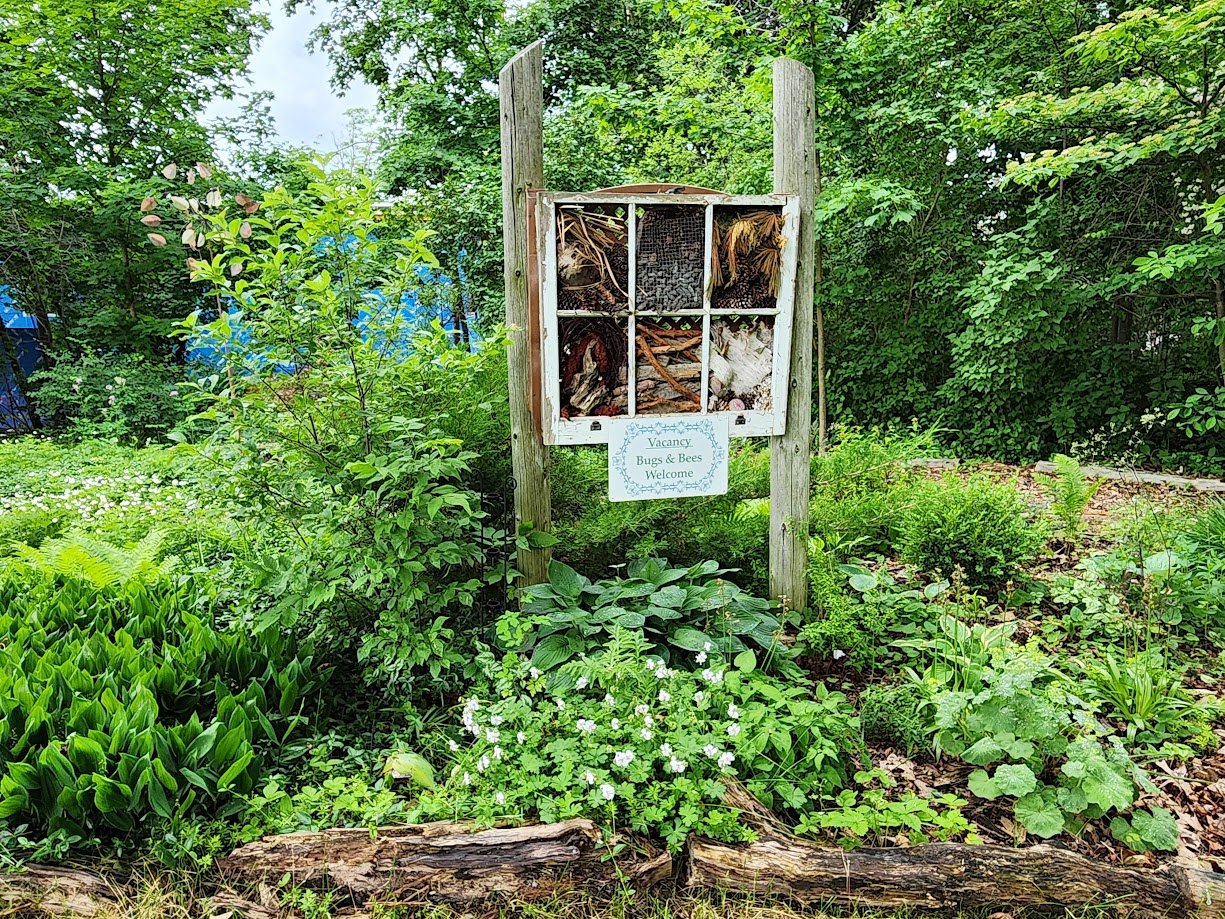
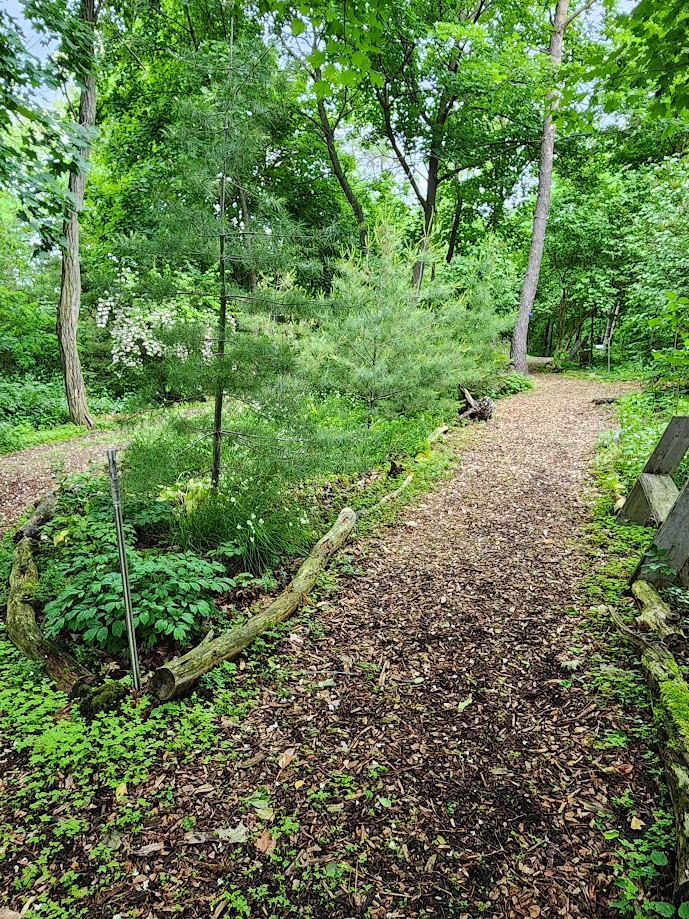
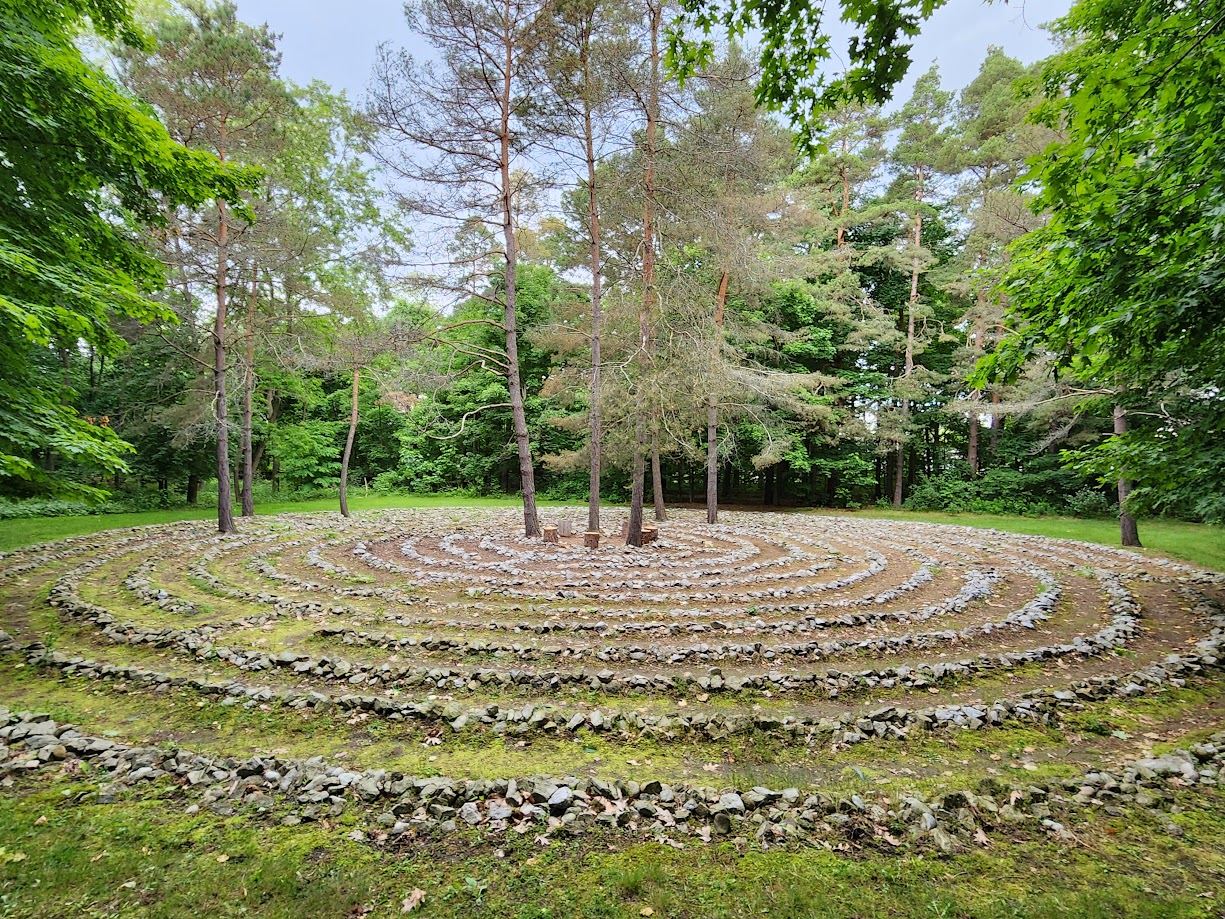
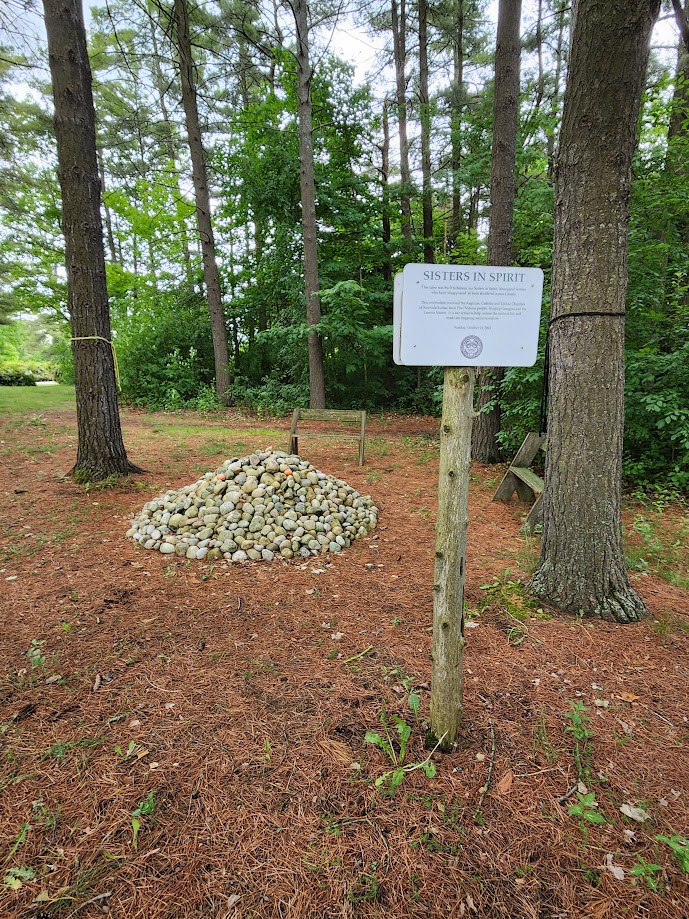
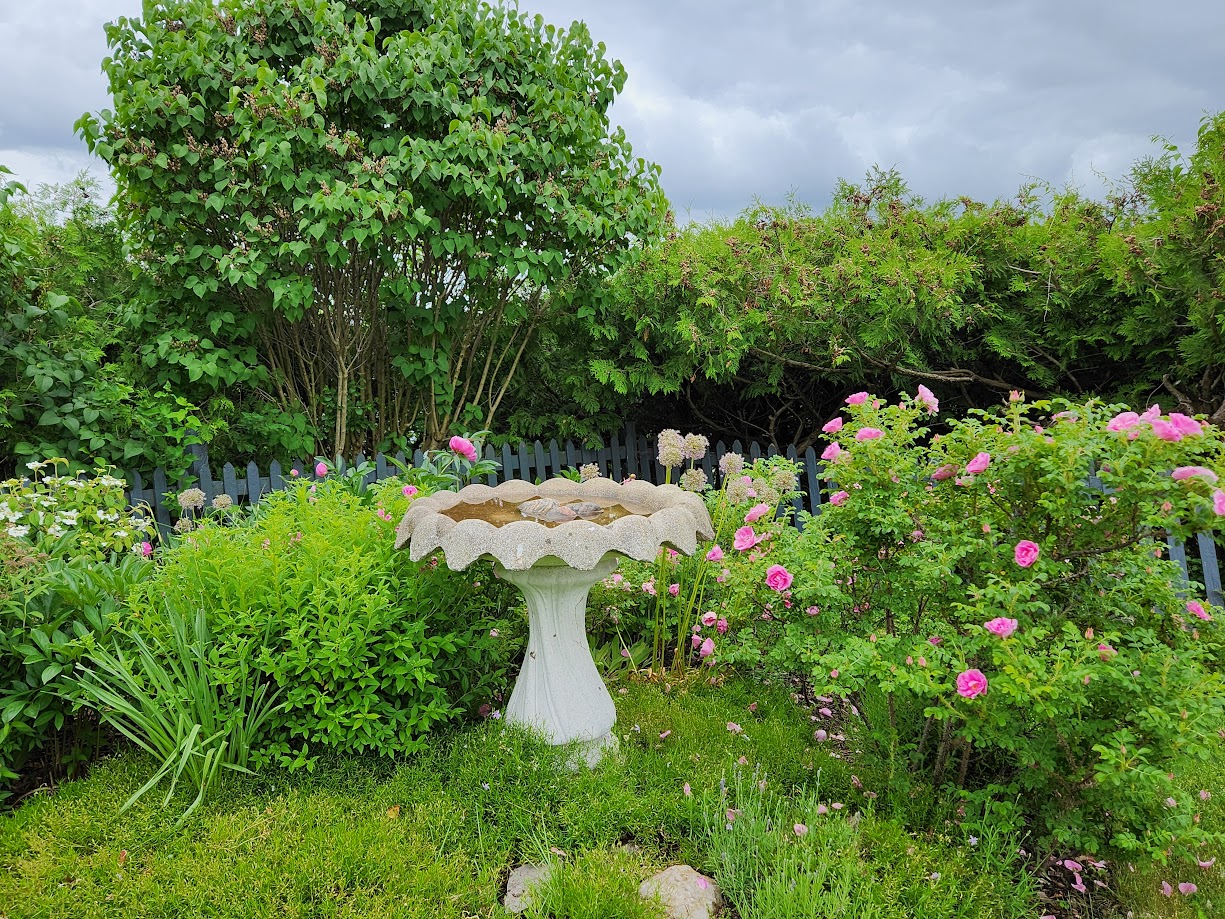
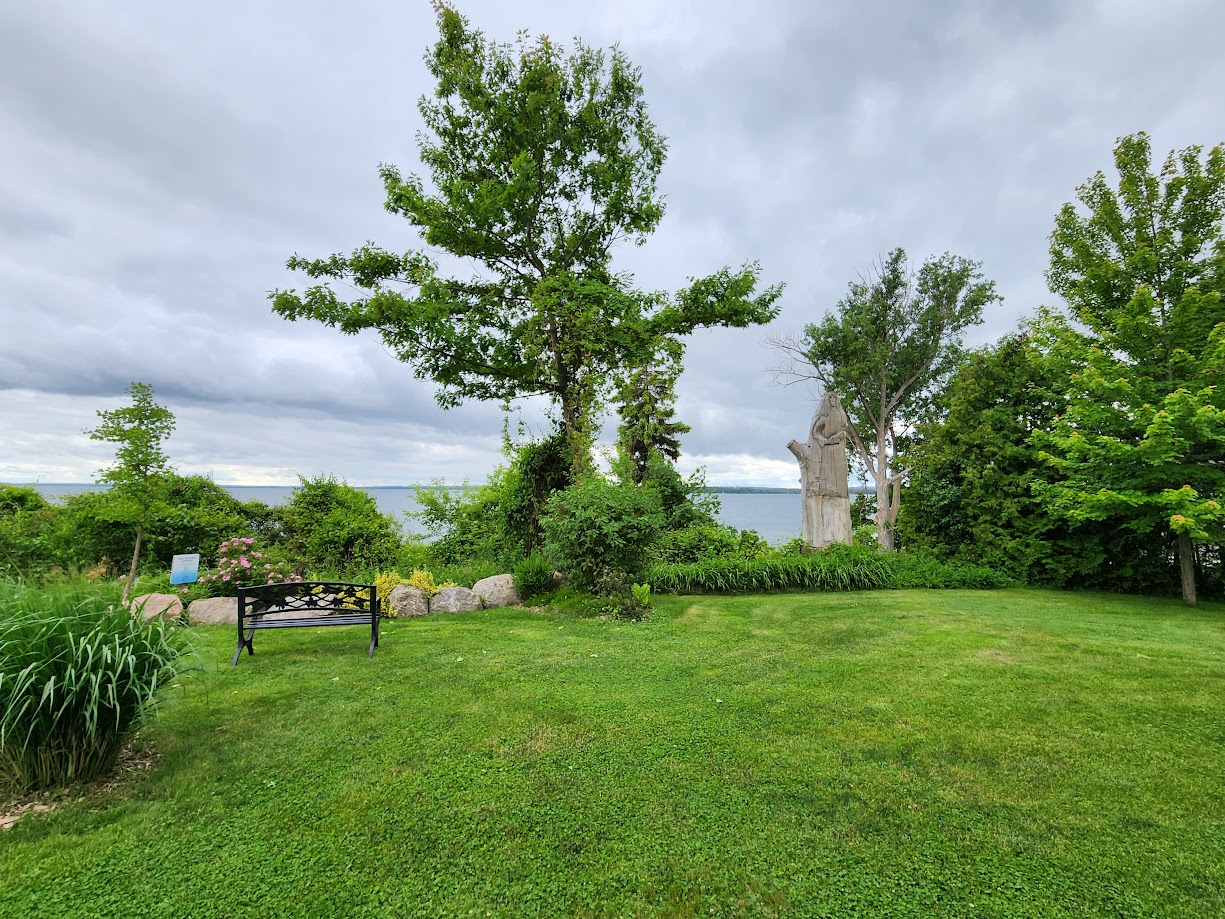
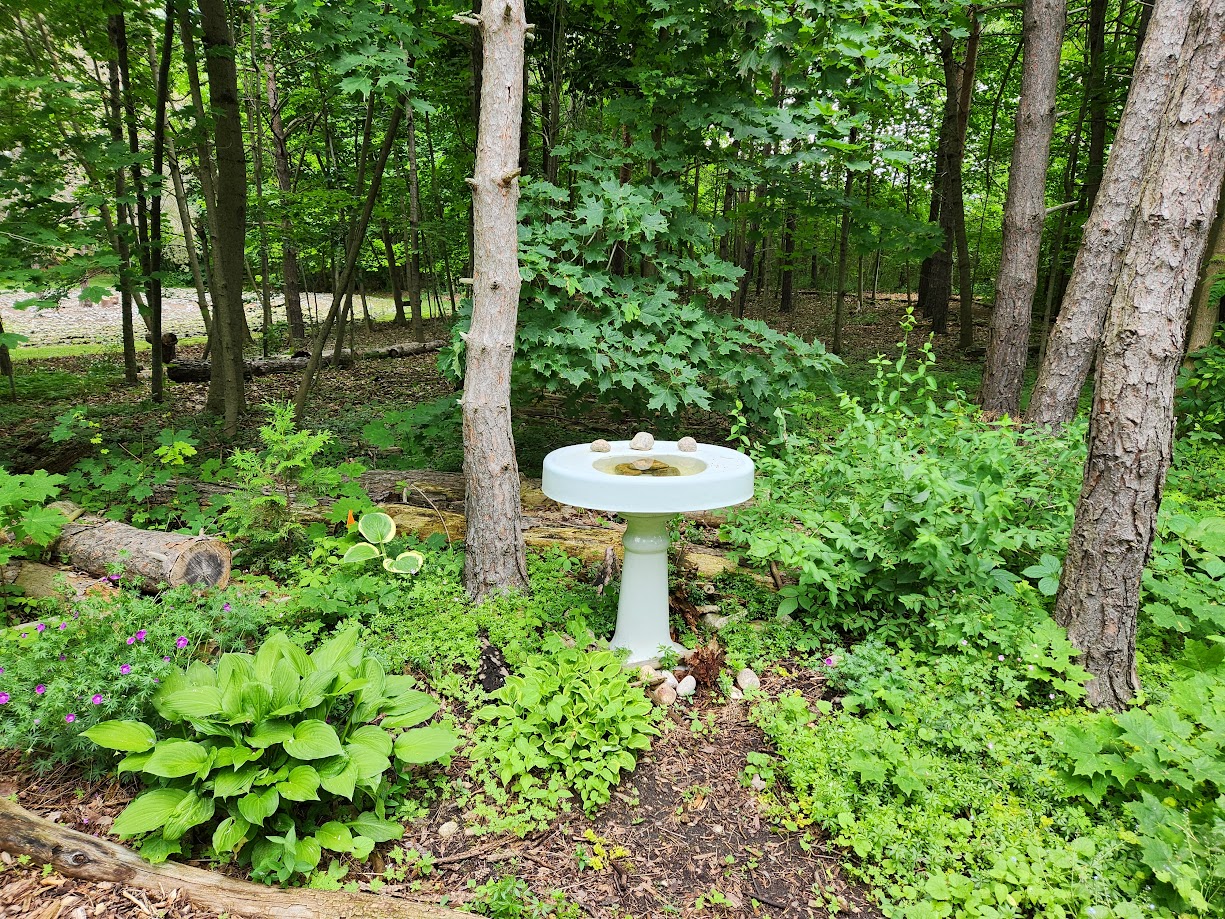
Among the features: a sensory garden, an insect garden, maintained trails, a labyrinth, a memorial cairn for missing and murdered Indigenous girls and women, a medicine wheel garden, a cosmic walking tour, and a “stations of the light” walking tour. Note: I did not take pictures of everything.

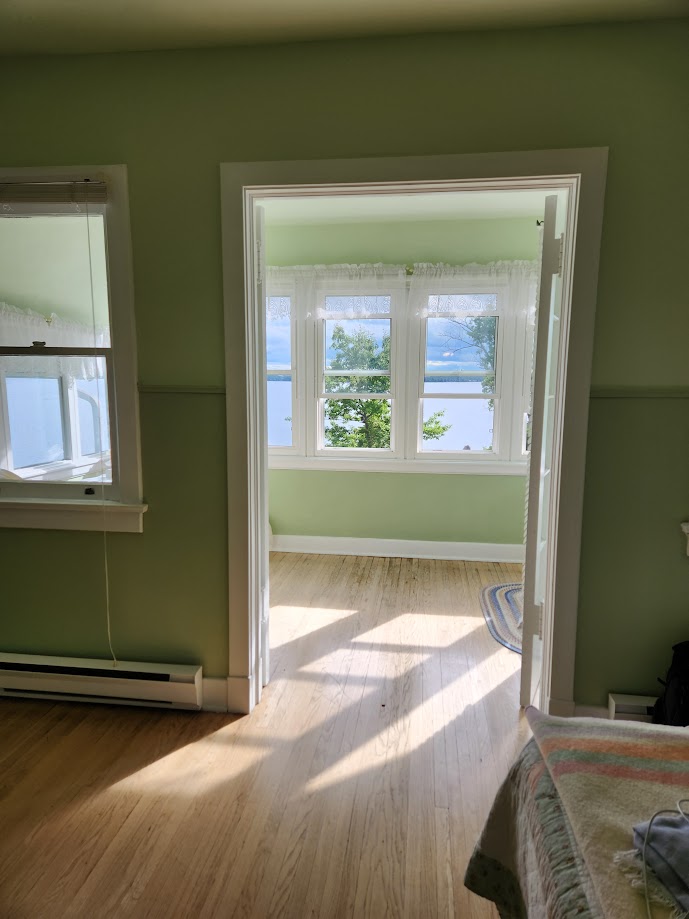
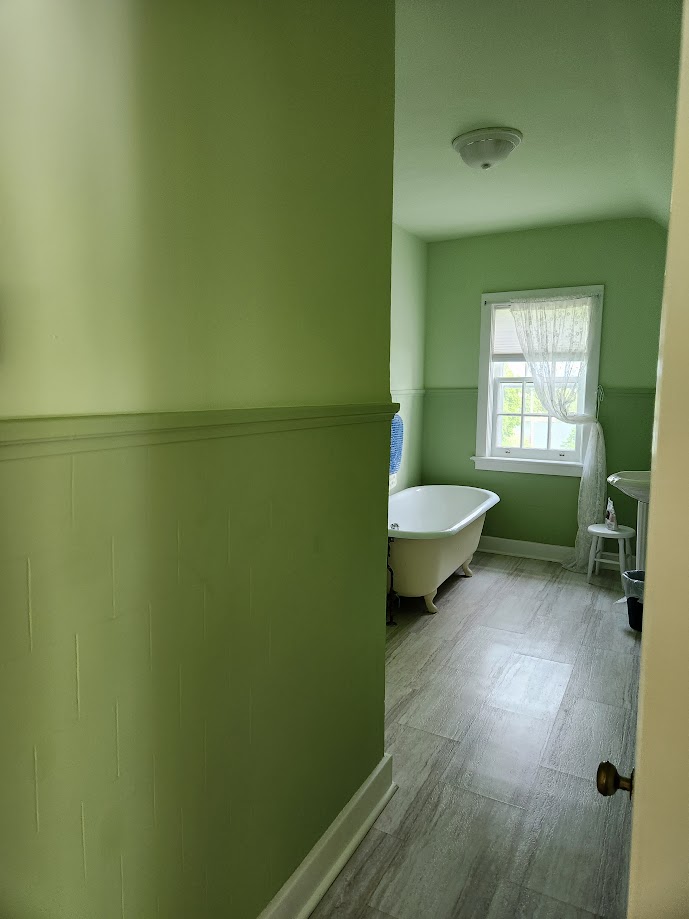
Aside from Edgar House and the nearby Fensom Cottage, there are three other cottages to rent, and all look like wonderful places to stay. The Green Room was huge and had an ensuite with clawfoot tub and a sunroom overlooking the lake. The fresh cut peonies smelled divine.

The sessions were well-balanced with independent writing time, and it was great to be in the company of creative women and to walk together on our creative paths for a while.

Friday night, after a group session, we all retired early (travel days are tough!). I was up before six on Saturday and, though it was overcast, donned my swimsuit and made my way to one of the centre’s two docks. The wind made the water choppy, and I wasn’t able to swim (I tried, but no dice), but I took a (refreshing!) dip and sat to dry off before heading back up to Edgar House for breakfast.

While I was there, I explored most of the gardens and trails. I walked the labyrinth. They have three bee boxes and a visiting beekeeper (!). I saw the resident foxes a couple of times, as well as cardinals, red-wing black birds, blue jays, red, grey, and black squirrels, and chipmunks. I had to watch where I stepped because there were tonnes of garden snails.

Calming and peaceful, the Stillwater Retreat was a needed reset during my time off.

If they do it again next year (there was talk) I’m going again.

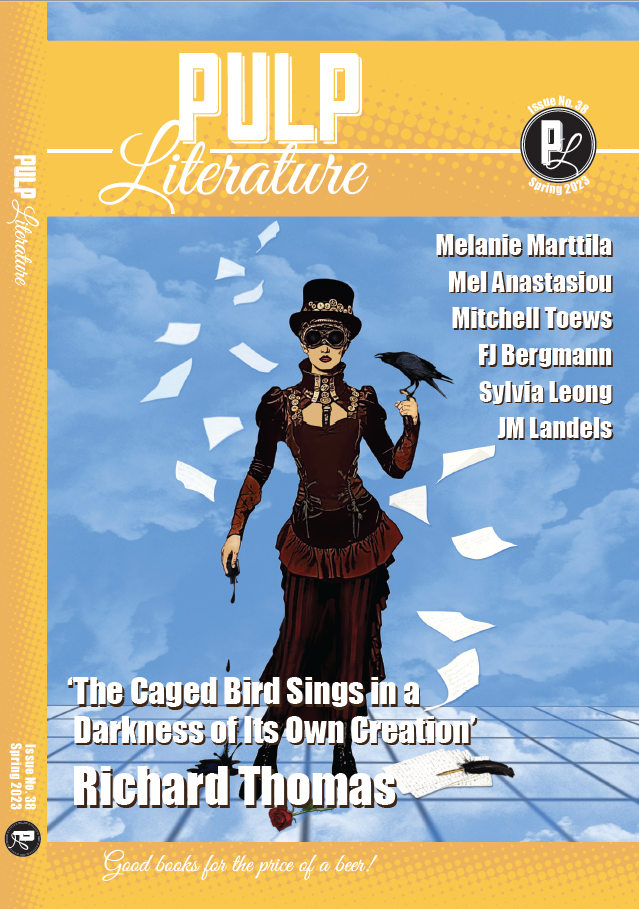
Pulp Literature Issue 38 Launch

I’m just dropping by to remind everyone that Pulp Literature issue 38 is launching tomorrow at the Port Coquitlam Readers & Writers Festival!

If you’re in the area, I encourage you to visit the Book Fair & Market Hall at 1 pm. Authors Sylvia Leong, JJ Lee, Rhea Rose, Renée Sarojini Saklikar, Jude Neale, Leslie Wibberley, and JM Landels will be on hand and reading their fabulous work.

And if you’re not in the area, consider ordering a copy.

Show the good people at Pulp Literature some love!

Until next time, be safe and stay well; be kind and stay strong. The world needs your stories!

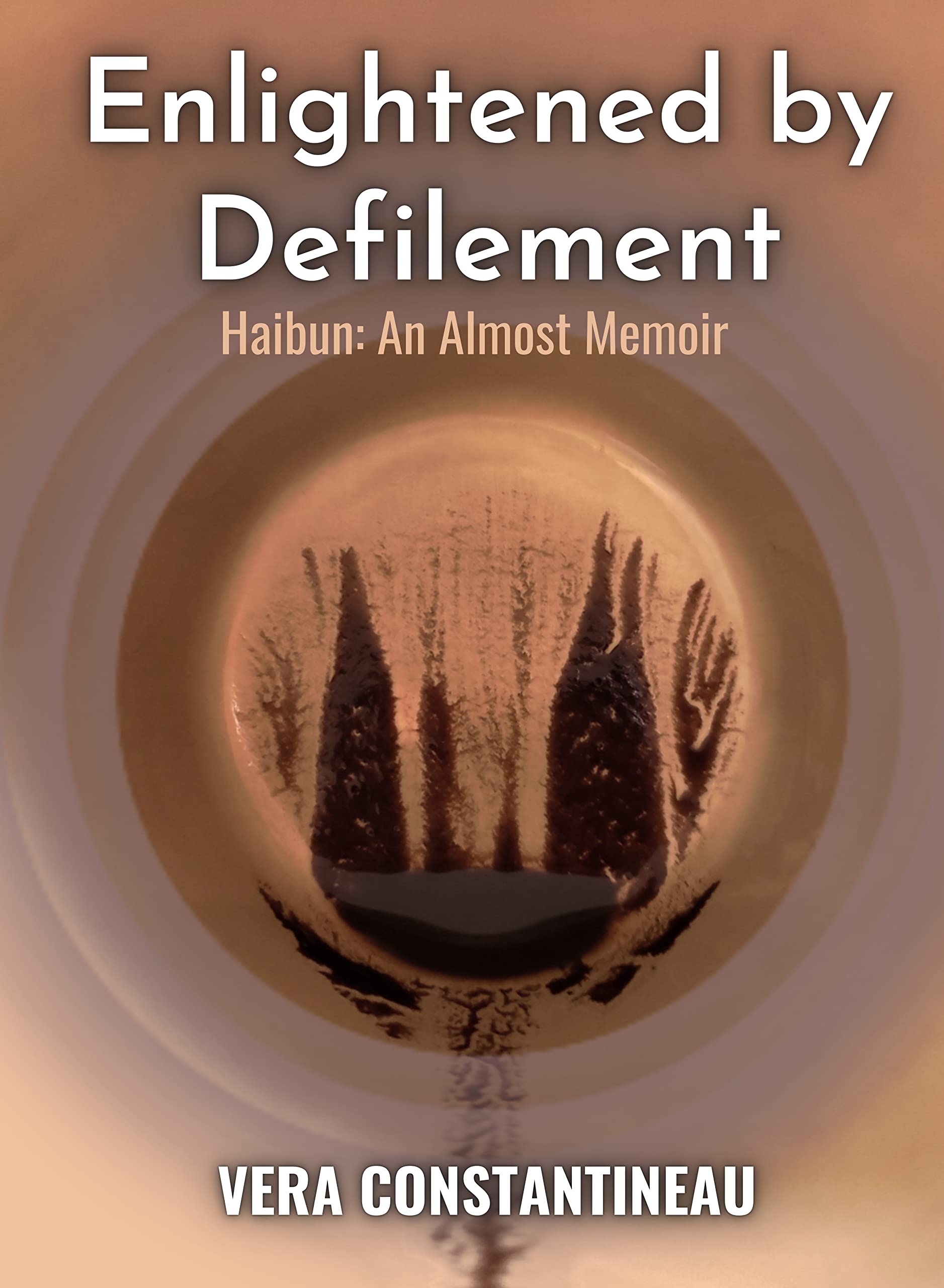
Book Launch: Enlightened by Defilement by Vera Constantineau

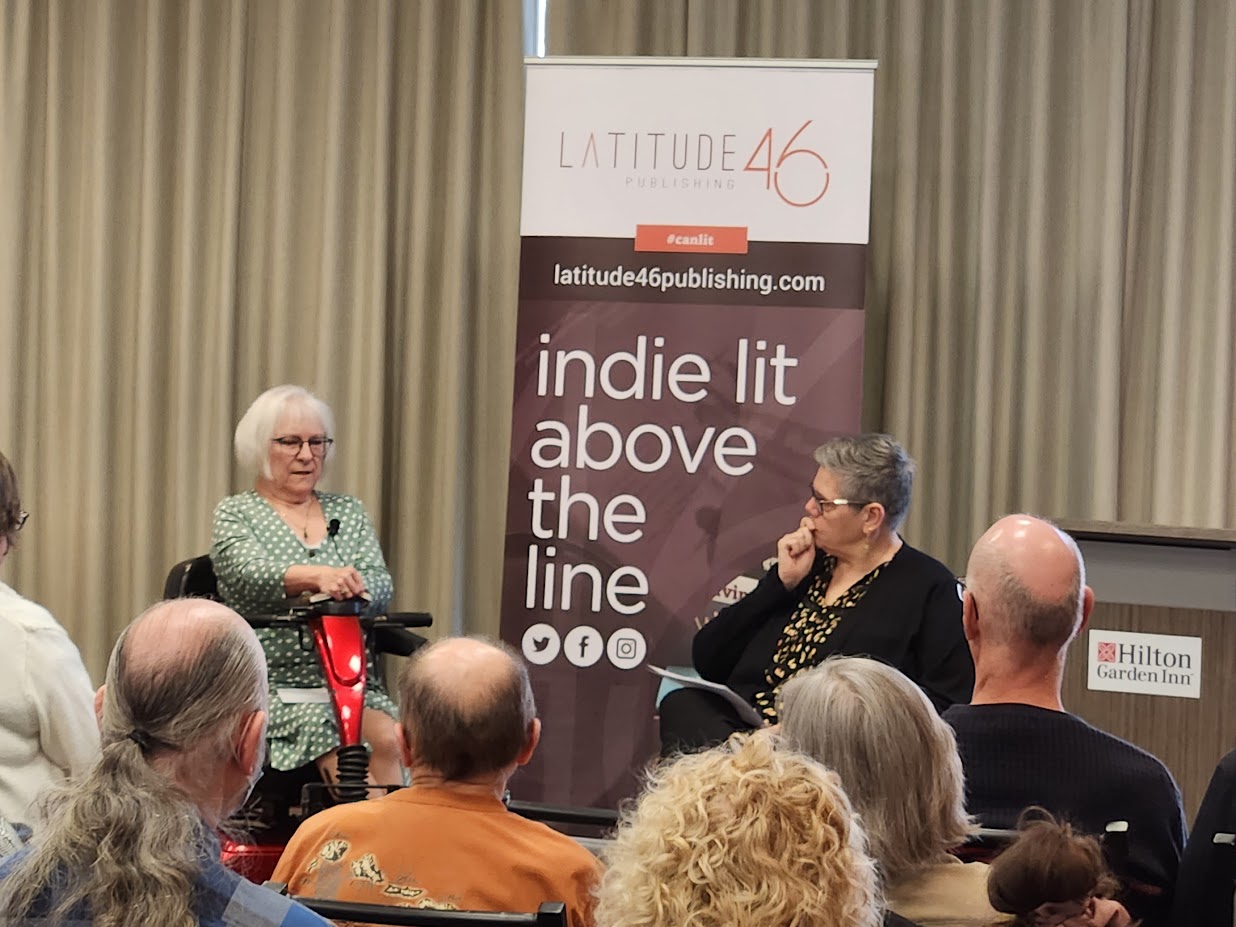
Yesterday, On Saturday, April 15, 2023, I attended the launch of Vera’s collection of haibun, Enlightened by Defilement, at the Hilton Garden Inn, in Sudbury.

It was a lovely afternoon and I saw many members of the Sudbury Writers’ Guild, who came out to support our former Poet Laureate. Heather Campbell, the publisher behind Latitude 46 was also there, and I reconnected with an old friend (hi, Linda!—waves frantically).

Emily DeAngelis conducted an interview with Vera and asked her to read a few poems. It was a different format, and I appreciated it. The Sudbury Star interviewed Vera, as well.

The event was catered with sushi, spring rolls, fruit, cheese, meats, and crackers. Very good!

There was something for everyone.

I’ll encourage everyone to support Vera and Latitude 46 by purchasing a copy, either directly from the publisher’s page, or through Amazon.ca.

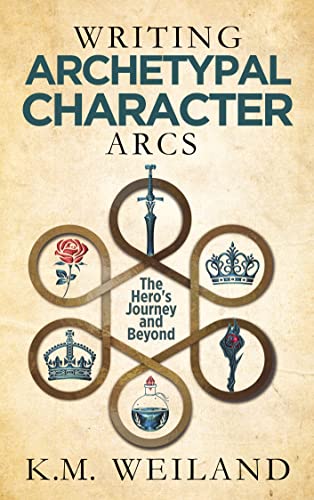
Book review: K.M. Weiland’s Writing Archetypal Character Arcs

What Amazon says:

The Six Transformational Character Arcs of the Human Life

Ready to take your story’s character arcs and themes to the next level? This latest book from veteran writing teacher and story theorist K.M. Weiland ventures far beyond the popular and pervasive Hero’s Journey to explore six important archetypal character arcs, representing key moments of initiation in the human experience:

  • The Maiden
  • The Hero
  • The Queen
  • The King
  • The Crone
  • The Mage

Found in every genre from fantasy to drama to romance to adventure, these transformational stories are the secret of powerhouse fiction—as shown through a wide variety of real-story examples throughout the book.

Writing Archetypal Character Arcs will teach you:

  • The archetypal beats for each of the six journeys
  • Which archetypes are right for your particular story
  • The best way to use archetypes in a series
  • How to choose the right archetypes for supporting characters
  • How to use archetypes to identify your story’s theme

You will also learn how to deepen your stories by implementing shadow archetypes (the negative sides of each positive archetype), resting or “flat” archetypes (the fixed stage between each of the main arcs), and archetypal antagonists (the epic antagonistic forces that oppose each of the positive archetypes in their journeys). The Hero’s Journey is just the beginning.

Learning about archetypal character arcs will change the way you view stories—and life—forever.

My thoughts:

K.M. Weiland has a passion for story structure (Structuring Your Novel) and character arc (Creating Character Arcs). Now, she adds to her writing craft oeuvre with Writing Archetypal Character Arcs.

Her journey began with Joseph Campbell’s Monomyth (The Hero’s Journey) and his discussion of Jungian archetypes in his seminal work, The Hero with a Thousand Faces. But Campbell’s work has always lacked the feminine dimension and anything leading up to or following the Monomyth/Hero’s Journey.

To fill this gap, Weiland has read not only the works of Maureen Murdock, Kim Hudson, and Gail Carriger and their interpretations of the heroine’s journey, but she’s also delved deeply into archetypes at all stages of life’s journey through the works of numerous authors. One look at her list of references at the end of Writing Archetypal Character Arcs will make the craft writing book junkie or academic in you drool.

Though I intend to add a number of these books to my reading list (‘cause I’m a geek), you don’t have to. Weiland has studied and skillfully distilled these works into her book and lays them out for writers in an accessible way.

This is a writing craft book that you will want to buy in print and keep at your desk as a reference. It’s that good.

My Rating:

FIVE STARS!!!!!

Go buy it now, peoples.

You’re welcome.

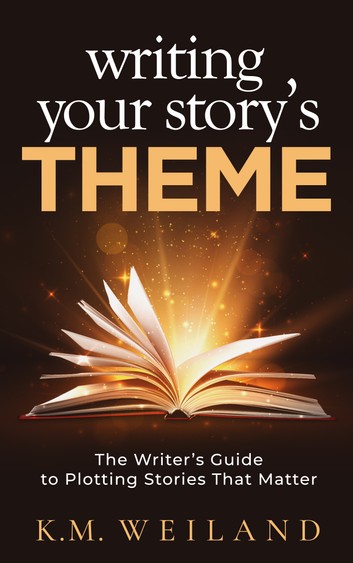
Book review: Writing Your Story’s Theme, by K.M. Weiland

K.M. Weiland has helped you to outline your novel, structure your novel, and create your character arcs. Now, she completes the “holy trinity” of craft with Writing Your Story’s Theme.

What is theme and how can you identify it in your story? How does theme relate to story structure (plot) and character arc? Why should every character and subplot reflect or enhance your theme? How can theme help you to outline your novel? How is theme related to but distinct from message and how can you keep your theme from reading as too preachy or on-the-nose?

As with all of Weiland’s craft books, Writing Your Story’s Theme is meticulously researched and full of insights the author gained through her own writing practice. There are additional resources to help you dig deeper into the topic in the appendices at the end.

If you’re a fan of Weiland’s craft books, you need to pick this one up. If this is your first of Weiland’s writing books, it will leave you wanting to complete your library (and you should—they’re that good). Weiland’s writing advice is accessible and consistent with her blog, podcast, and other craft books. If the pattern holds, Weiland will likely have a workbook coming in the next year.

I always have “lightbulb” moments when I read one of Weiland’s craft books and Writing Your Story’s Theme was no exception.

My highest recommendation.

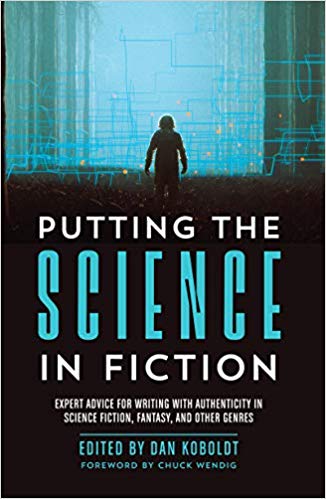
Book review of Putting the Science in Fiction

Another overdue review.

What Amazon says:

Science and technology have starring roles in a wide range of genres–science fiction, fantasy, thriller, mystery, and more. Unfortunately, many depictions of technical subjects in literature, film, and television are pure fiction. A basic understanding of biology, physics, engineering, and medicine will help you create more realistic stories that satisfy discerning readers.

This book brings together scientists, physicians, engineers, and other experts to help you:

  • Understand the basic principles of science, technology, and medicine that are frequently featured in fiction.
  • Avoid common pitfalls and misconceptions to ensure technical accuracy.
  • Write realistic and compelling scientific elements that will captivate readers.
  • Brainstorm and develop new science- and technology-based story ideas.

Whether writing about mutant monsters, rogue viruses, giant spaceships, or even murders and espionage, Putting the Science in Fiction will have something to help every writer craft better fiction.

Putting the Science in Fiction collects articles from “Science in Sci-fi, Fact in Fantasy,” Dan Koboldt’s popular blog series for authors and fans of speculative fiction (http://dankoboldt.com/science-in-scifi/). Each article discusses an element of sci-fi or fantasy with an expert in that field. Scientists, engineers, medical professionals, and others share their insights in order to debunk the myths, correct the misconceptions, and offer advice on getting the details right.

PuttingTheScienceInFiction

My thoughts:

I subscribe to Dan Koboldt’s newsletter and refer to his site as a resource for research. When I learned that he was putting some of the essays from his site into a book, I had to buy it. Now I have a great reference on my shelf which is a starting point for research.

The book is divided into sections that cover biomedical topics, including death, genetics (Koboldt’s specialization), neuroscience, wildlife biology, artificial intelligence and other computer-based technology, Earth and the planets of our solar system, astronomy and space flight, and, finally, the future of space travel and exoplanets.

Chuck Wendig writes the foreword, on the advice to write what you know and what it really means (do your research). In his signature playful tone, Wendig clarifies the advice and demonstrates how he’s applied it in his own writing life, finishing by calling Putting the Science in Fiction a great launching pad for essential research.

The contributors themselves write with humour—find out why, as a woman working in a lab, you should never wear thong underwear—and draw on their personal expertise for an enjoyable read. In the chapters addressing space travel, they reveal their geek roots, honouring the books, television shows, and movies that inspired them while at the same time pointing out the technical misconceptions such media promote.

Putting the Science in Fiction is a great reference for any writer’s shelf.

My rating:

Four stars out of five.

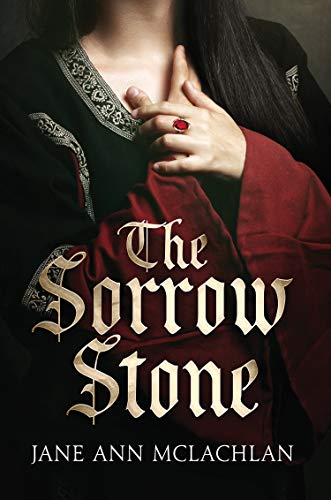
Review of The Sorrow Stone by J.A. McLachlan

I’ve been a fan of Jane Ann’s for some time and when I saw that she was launching her latest historical fiction novel at 2018’s Ad Astra, I had to pick up a copy. Jane Ann is an excellent storyteller and The Sorrow Stone did not disappoint. I have been lax in my commitment to write reviews for my author friends. I read The Sorrow Stone some time ago and I’m only now rectifying my tardiness in writing my review.

TheSorrowStone

What Amazon says:

Winner of the Royal Palm Literary Award for Historical Fiction.

What if you could pay someone to take away your sorrow?
In the middle ages people believed a mother mourning her child could “sell her sorrow” by selling a nail from her child’s coffin to a traveling peddler.

Lady Celeste is overwhelmed with grief when her son dies. Desperate for relief, she begs a passing peddler to buy her sorrow. Jean, the cynical peddler she meets, is nobody’s fool; he insists she include her ruby ring along with the nail in return for his coin.

A strange but welcome forgetfulness comes over Celeste when the transaction is completed – until she learns that without her wedding ring her husband may set her aside, leaving her ruined. She embarks on an urgent journey to retrieve it. But how will she find the peddler and convince him to give up the precious ruby ring?

Pretending to be on pilgrimage, Lady Celeste secretly hunts for the peddler. In dreams and brief flashes her memory begins to return, slowly revealing a dangerous secret buried in her past. Will she learn what she needs to know in time to save herself, or will the knowledge destroy her?

If you like realistic, well-researched historical fiction with evocative prose, complex characters and a unique story, you’ll love The Sorrow Stone. Travel to 12th Century France with this compelling story based on an actual medieval superstition.

“J. A. McLachlan is a terrific writer — wry and witty, with a keen eye for detail.”
~ Hugo award-winning author Robert J. Sawyer
“Strong, character-driven fiction — McLachlan makes you both care and think. You can’t ask for more.”
~ Aurora award-winning author Tanya Huff

My thoughts:

While this novel is somewhat of a departure from her adult and young adult science fiction publications, the inspiration for the story is a superstition and fantastic elements infuse the novel.

In the wake of the transaction that forms the inciting incident, Celeste is not only forgetful, but she’s also lost her capacity to feel compassion in any form, making her alien to her lady’s maid, the nuns of the convent she’s been sent to for her recovery, and the clergy and pilgrims she meets on her journey.

The only thing she’s certain of, at first, is that something terrible happened that sent her to the convent and, because she can no longer feel the love she once did for her dead child or her husband, while she knows the something terrible involves her infant’s death, she can only assume that her life had been one of cruelty and pain to have resulted in her current state of health. Celeste uses her mind and sense of logic, skewed because of her lack of feeling, to try to unravel the mystery.

She’s afraid of revealing her compromised state to anyone and engages is some radical behaviour to achieve this end. She travels with only her maid as a companion, she seeks the means to become independent, and she tries to track down the merchant to whom she traded her sorrow and her wedding ring with the intent of reclaiming only the ring and not her emotion, now viewing it as a weakness. Her actions in pursuit of these goals verge on cruel.

For his part, the pragmatic merchant Jean finds his life plagued by unwanted compassion. He wants to rid himself of Celeste’s ring and the sorrow attached to it, but his every attempt to do so ends in failure or worse. After he recovers from a robbery and assault that nearly results in his death, Jean returns home to find his bad luck extends to his family. His daughter is seriously ill and may die if he doesn’t find the means to set things right.

The outcome of these intertwined journeys involves a mystery, betrayal, and greed on multiple levels. As Celeste’s husband pursues her, thriller elements come into play. Can Celeste reclaim her ring before her husband catches up to her and finds out what she’s done?

The Sorrow Stone is a complex story about how important it is to achieve a balance between logic and emotion, the destruction that greed engenders, and the revelatory and healing powers of love.

My rating:

Four out of five stars.

I really liked it 🙂

I’m going to try to catch up on my review obligations over the next weeks, so you can look forward to more reviews on writerly goodness.


WorldCon 75 summary post

It seems we’ve exchanged hurricanes and mass shootings for wildfires and floods. Wherever you are, whatever has come your way, please find safety.


Welcome back to the ongoing tale of my European adventure 🙂

This instalment will be the penultimate one. Next week, I’ll cover my takeaways from the trip.

Since I’d made the decision earlier in the year to stop blogging my session notes … I didn’t take any during the whole of WorldCon (!) It was very freeing. I relaxed and enjoyed.

Something I forgot to mention in my last post is that I also enjoyed the hotel’s Sauna on Tuesday night. I had a nice, naked conversation with some Finnish ladies who were curious about all the Americans in town … but it was helpful for the cruise crud.

Wednesday, August 9, was the first day of WorldCon, and at breakfast that morning, I met up again with the Tracy’s, Heather and Bill, and their mom, Becky, who’d been my roommate on the WXR cruise. Bill was also attending WorldCon, while Heather and Becky did the tourist thing in Helsinki.

After breakfast, I strolled down the pedestrian underpass to the train station, bought my ticket at the kiosk, and caught the train to Pasila.

I want to take a moment here to express just how fabulous the Helsinki trains were. Clean, spacious, and efficient. My registration for the con included a train pass for the week, because they knew most of us would be staying in the downtown area. There are a couple of hotels in Pasila, but they were booked quickly, and blocks of rooms were reserved for those who needed accommodation (or so I understand).

The only other city train I’ve been on that comes close is Vancouver’s, but at the time I travelled on it, the number of passengers made the journey (with luggage) uncomfortable. In Helsinki, there were two main lines, the K and the I (though there were more) that ran north and between the two, one left every ten minutes.

The first day of WorldCon was a bit disappointing, to be honest, because I think the organizers underestimated the interest of casual attendance (day passes). Except for the academic stream session I attended, nearly every room was full and they were very strict about the numbers because fire regulations. I don’t blame the organizers, but it was a frustrating first day.

The convention centre did have a great food court, however, and I ended up meeting a couple of friends of fellow Sudbury Writers’ Guild member Andy Taylor at the cafe. Tim Boerger and Nina Niskanen had both attended Viable Paradise with Andy and he wanted me to connect with them. I’d actually seen Nina at WorldCon last year, but I didn’t know who she was until after her steampunk panel was over 😦

While there, I also met Lara Elena Donnelly, author of Amberlough 🙂

I also saw a number of WXR cruise mates, and fellow member of SF Canada, Su Sokol.

That evening, I met up with a group of Canadian SF fans and writers, including Su, Eric Choi, and Jane Ann McLachlan, to have dinner at Zetor.

Thursday was a more productive day. I attended sessions on the Kalevala (which I was geeky enough to be reading at the time), Nalo Hopkinson’s Guest of Honour interview (I kind of stalked her sessions throughout—I’m a fan), a presentation on the sauna, the live taping of the Coode Street podcast with Kelly Robson and Walter Jon Williams, a panel on secrets in SF that Jane Ann McLachlan was on, how to start a podcast with Howard Tayler, and the live Ditch Diggers taping.

nalohopkinson

That night was a meet up with Writing the Other alumni and K. Tempest Bradford. We went to a Nepalese buffet that was only a block or so from the convention centre called Mero-Himal. A number of alumni had also been on the cruise, and so it was a very enjoyable evening.

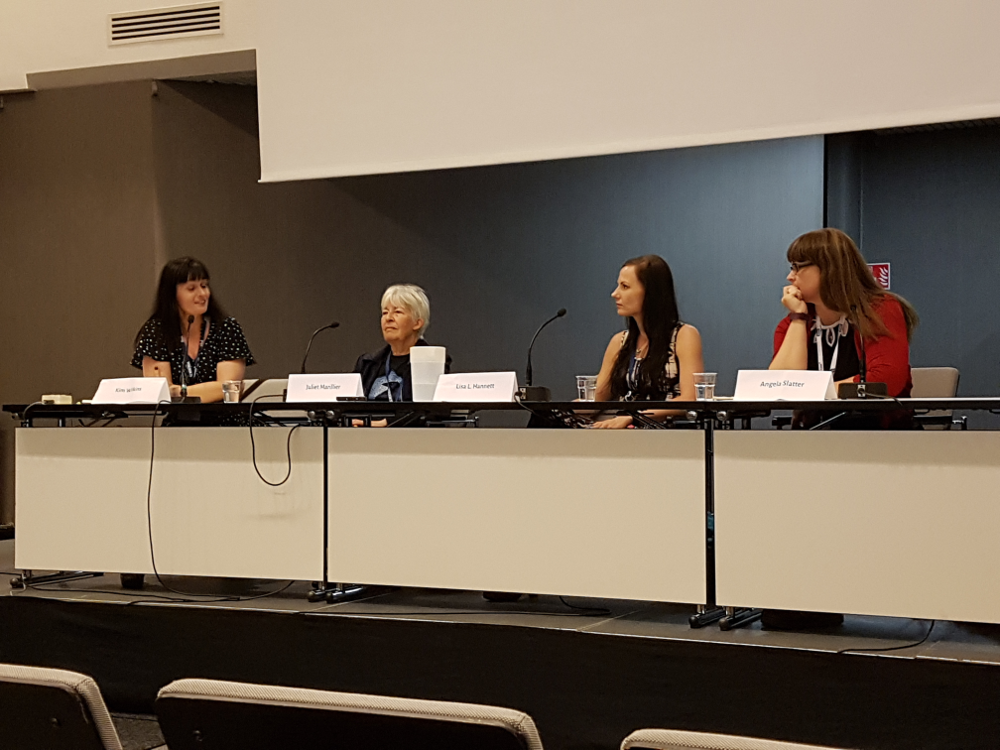
Friday’s WorldCon line up included a panel on artificial intelligence, one called Building Resistance, on which where Nina Niskanen and Kameron Hurley, one on female friendship in fiction with Navah Wolfe and Amal El-Motar, another Nalo Hopkinson GoH presentation, a panel on Austalian fantasy with Juliet Marillier, more Nalo Hopkinson (I said I was stalking her), a panel on how science really happens with Eric Choi, one on weird fiction with Helen Marshal, and one on alien language in SF with David J. Peterson, creator of the languages for the Game of Thrones series.

australianfantasy

Friday night was the night of the Hugo Awards Ceremonies and, still suffering from cruise crud (it didn’t completely clear until I was back home), I thought I’d catch the ceremonies on YouTube from the comfort of my hotel room. They were supposed to be webcast.

As I headed out on the train, the skies grew ominously dark and by the time the train arrived back in Helsinki, it was a full-on torrential downpour. The forecast had said that the weather would hold until evening … and so I’d left my umbrella in my hotel room.

While I waited some time at the station for the rain to stop, I eventually had to make it back to the hotel and got completely soaked. I got in and changed clothes, waited until the weather cleared a bit, and then strolled around the block—with my umbrella—to a little sushi restaurant for supper.

When it was time for the Hugos webcast … I was unable to connect. When I hopped on social media to see what I could find out, it turned out that there were technical difficulties and the webcast was a no go. I watched the Twitter feed for a while and ended up calling it an early night.

Saturday began with a science panel on planets beyond the Goldilocks zone, a panel on worldbuilding without ableism with Fran Wilde and Nalo Hopkinson (yes, I know), one on maintaining your scientist character’s credibility with Karen Lord, a panel on Octavia Butler (with you-know-who), I checked out the author signings where Mary Robinette Kowal and Margaret Dunlap were at side-by-side tables, a panel on fairy tale retellings with Navah Wolfe and Karen Lord, one on bad-ass female leads in young adult, and one on crafting a fantasy tale from mythology with Juliet Marillier.

I decided to call it an early night because I’d be heading for the airport in the morning for my flight home. I had supper at a sports bar, packed, and got a good night’s sleep.

secondmorningskyiceland

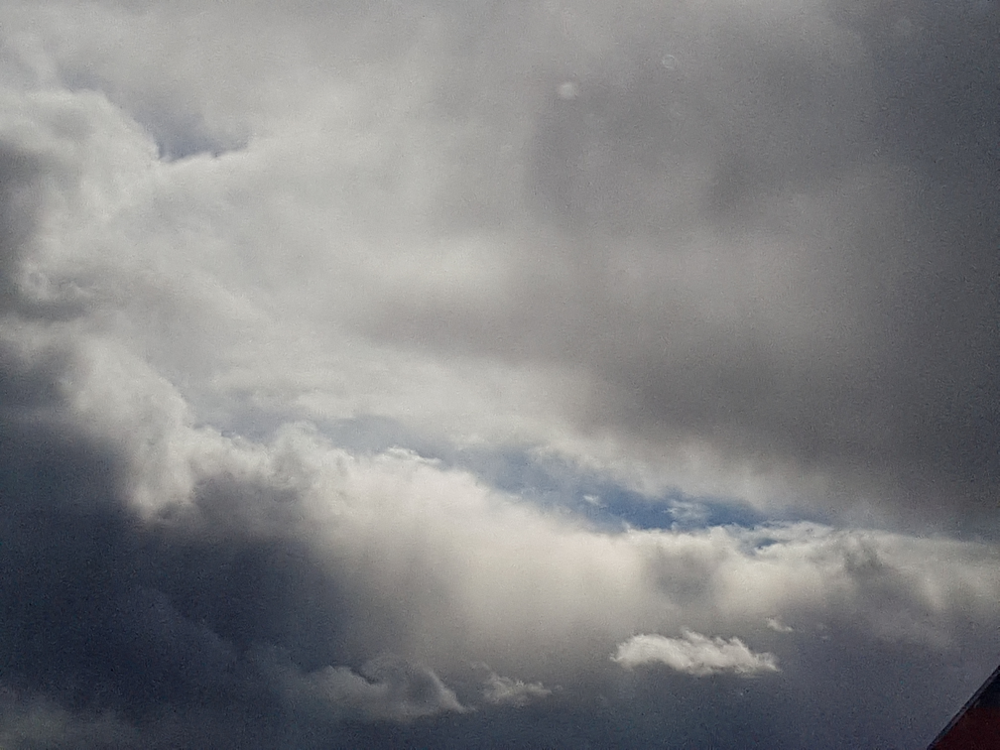
My flight left just after 8 am. I watched the sun rise on the train (at—bleargh—5:30 am) and, after a three hour flight to Iceland, watched the sun rise again 😉 Because I was travelling back through time zones, another five and a half hour fight brought me to Toronto before noon (!)

I hung out in Toronto for five more hours as my flight home was delayed, but I was home in time to watch that night’s Game of Thrones episode and then crawl into my own lovely bed.

I spent the next day resting and catching up on the television I’d missed during the trip. I could have used the rest of the week off to resent my internal clock and fully recover from the cruise crud, but it was back to the grind on Tuesday.

And that was how my European adventure ended.

Thanks for hanging with me on this journey!

As I mentioned off the top, next week will be my lessons learned/takeaway post but, because next Saturday is the launch of Kim Fahner’s latest poetry collection, Some Other Sky, I may not get the post up until Sunday. The next week, I’ll probably dedicate some time to writerly events (including the launch) and other happenings in this writer’s life, and then I’ll be on my annual blogging hiatus for NaNoWriMo!

Holy cow! This year is disappearing!

In the meantime, dear friends, be well, be kind, and stay strong. The world needs your stories.

The Writing Excuses Retreat, part 4

Part four of the Writing Excuses Retreat (WXR) begins on the morning of Thursday, August 4, 2017, day six of the cruise.

This was our day in St. Petersburg, Russia, and our third port day in a row. In every other port, the tours ranged from three to five hours and there was always the option to take a taxi and wander around on our own if we wished. In St. Petersburg, the tour was all day. In fact, it was two tours with a brief break in between.

The rules were fairly strict in Russia. Our passports would be checked on the way out and on the way in. We would be issued visitor’s visas for the day. We were not, under any circumstances, to leave the tours, as our visas only covered us for the cruise-related excursions. There would be no wandering around St. Petersburg.

It was also an early-rising day. We’d have to get up, get ready, and eat in time to report for our 8 am (ish) departure.

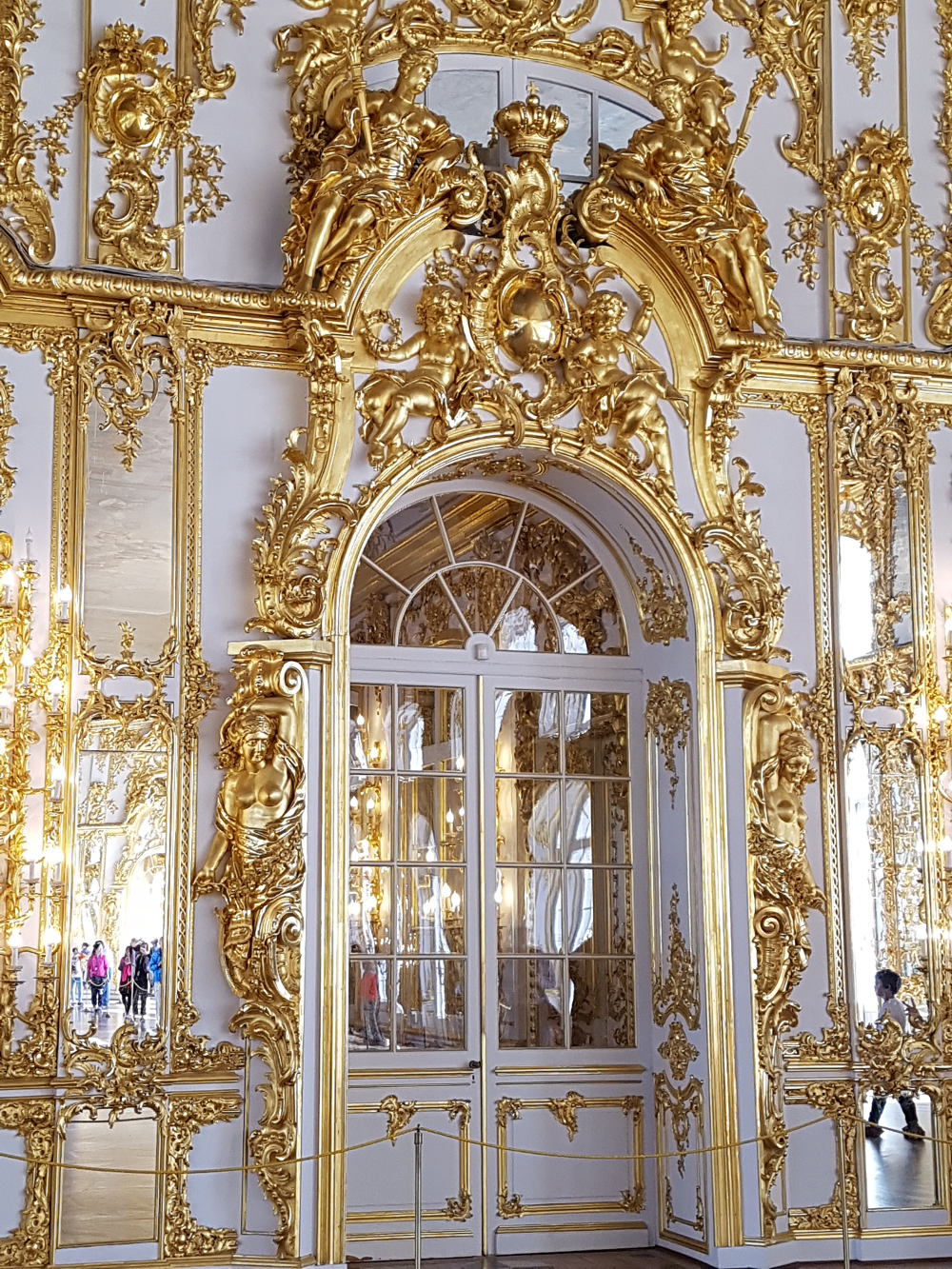
The morning would be spent at Catherine’s Palace. Sweet lord that place is huge, and we only got to see a relatively small part of it. The sprawling courtyard is bounded on all sides by buildings or iron gates. And all that yellow-painted detail? It will eventually be gilded, like the domes.


Catherine’s Palace is part of a city-wide restoration. Scaffolding was erected around several sections of the palace grounds as buildings were repaired and painted, only awaiting the gold leaf.

Inside, it was the same. Every entryway glittered. There were 14 different kinds of wood, imported from all over the world, inlaid in intricate patterns on the floors. And, of course, we had to don booties again to protect the site from plebeian tourist feet.
TheGildening

Just as in the royal reception hall in Copenhagen, each room was designed based on the style in one of the European capitals. There was the Versailles room in red, games rooms, dining rooms, bedrooms, studies, art galleries, and lots of cabinets, painted in toile designs.

And there was the legendary Amber Room, which we were forbidden from photographing (though our tour guide did encourage us to take surreptitious photos at the doors, to and from the room—the babushkas were quick to discipline those who tried, though, so I refrained). Amber is one of Russia’s special resources and it’s considered an extravagance to cover an entire room in the petrified resin.

The Amber Room itself is considered a national treasure and that’s one of the reasons we weren’t to take pictures of it. They don’t want cheap replicas of the room appearing elsewhere.
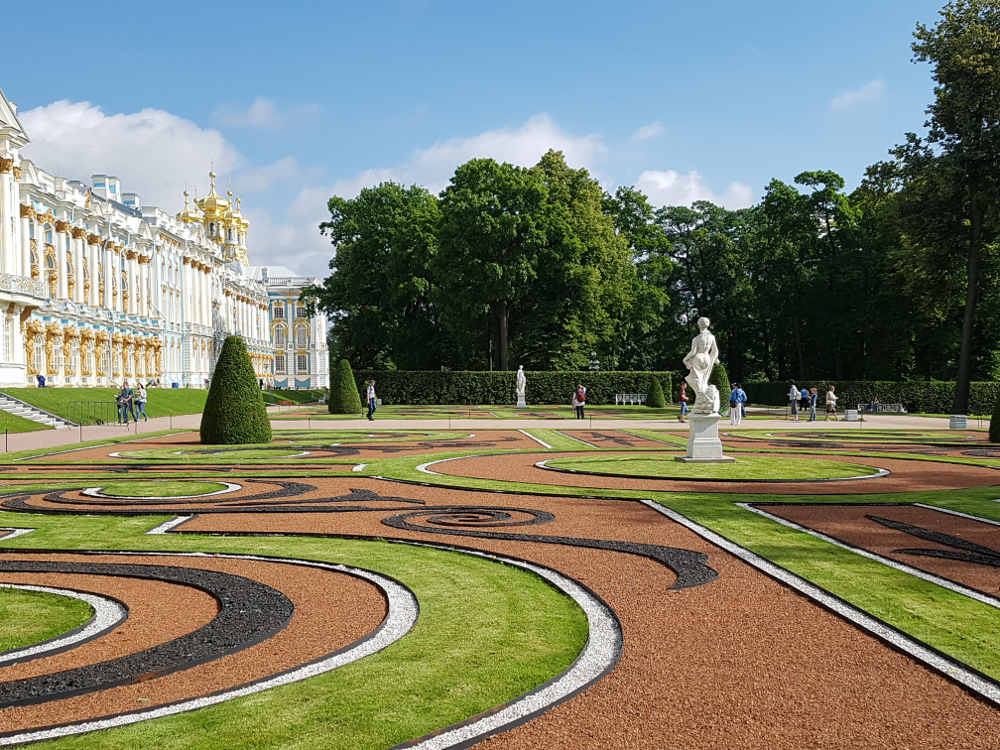
TheGrounds

After the tour, we were taken out into the palace grounds and took the long way back to the tour bus past what looked like a Roman aqueduct, through the gardens and forested grounds, and one of Catherine’s personal outdoor retreats, or bowers.

On the way back to the pier, we stopped for shopping. The cruise crud I’d contracted had (literally) reached a fever pitch, and I availed myself of whatever over-the-counter remedies I could find. Of course, I bought souvenirs and gifts, as well, but coughing until my chest and gut were sore was getting tiring. Immediate comfort was my chief concern.
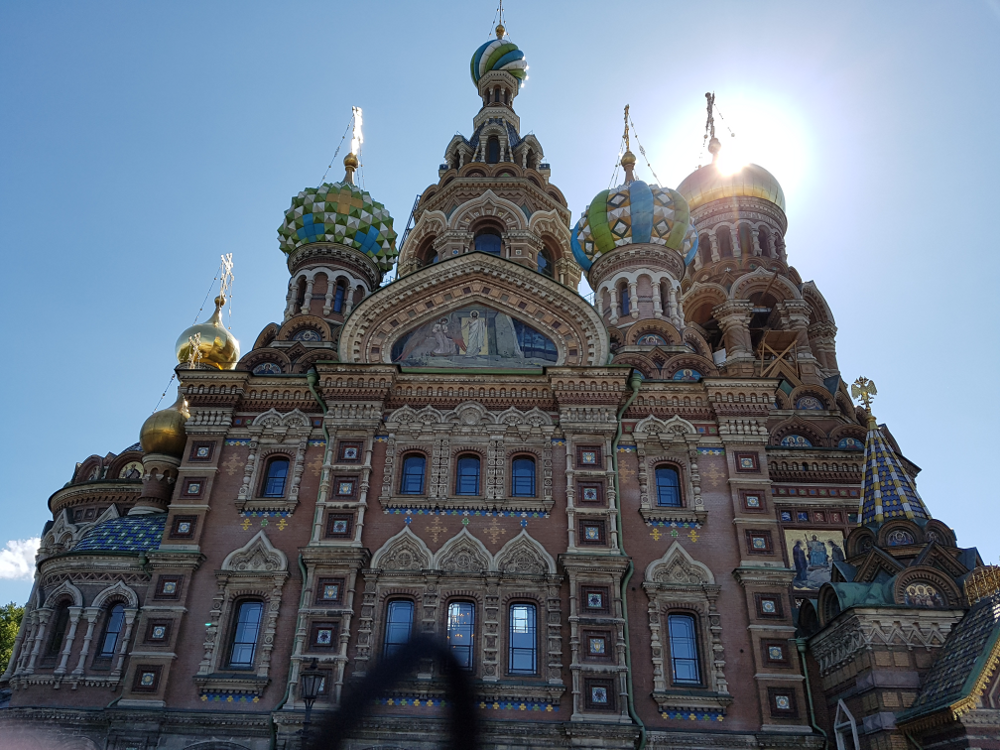
SpilledBlood

Forgive the intruding phone strap at the bottom. I’m a terrible photographer.

The afternoon tour took us into St. Petersburg and to the Spilled Blood Cathedral. The cathedral was built on the site of the murder of Emperor Alexander II as a monument to his greatness, by his son, Emperor Alexander III. It took 24 years to build, which, once you see the mosaics inside, is absolutely mind-boggling.

Every inch of the walls, arches, and domes is covered in mosaics. These few pictures will just give you a taste of its magnificence. Really, there are no words.
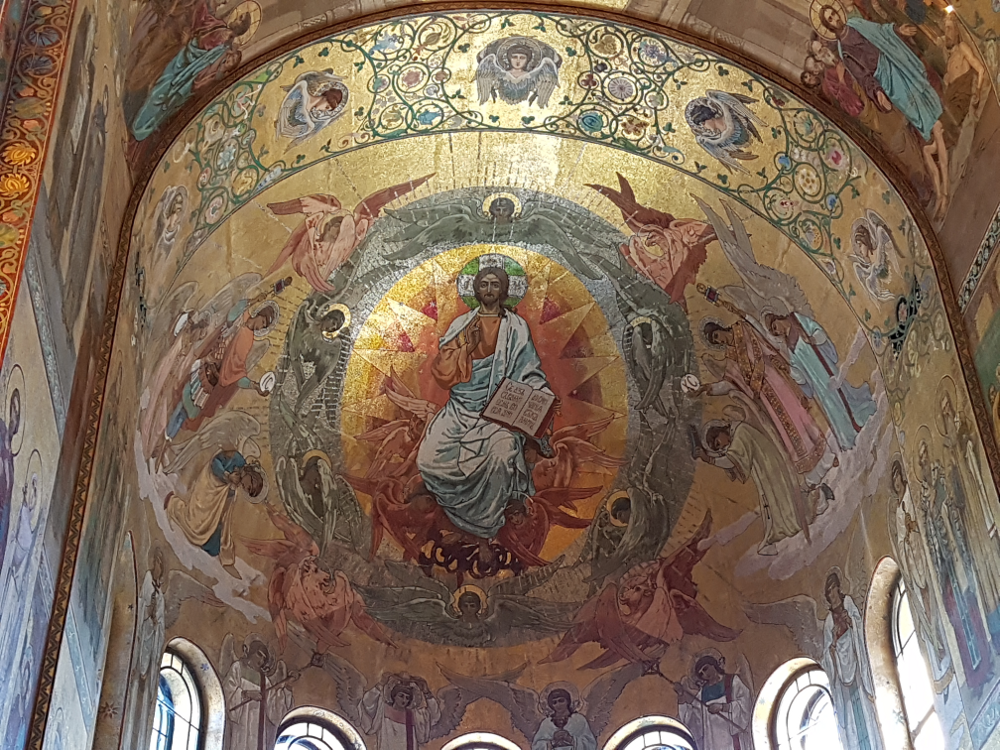
mosaics3

After the cathedral, we did a walking tour of St. Petersburg, during which we saw Senate Square and the Winter Palace.

Peter the Great wanted to build Russia a capital like Venice, a canal city on the Baltic. Really, Russia needed a naval port, and St. Petersburg served that purpose too, but its true purpose was to be the jewel of the Baltic.

canal

Though there are canals, St. Petersburg never achieved its architect’s dream of becoming a canal city. Every street is lined with grand houses, palaces, though, because all of the Russian nobility moved in and set up house, each family trying to outdo the others in terms of grandeur.

And there was a second shopping stop 🙂

I had time upon my return to devote some time to revision, and then take a cruise crud induced nap.
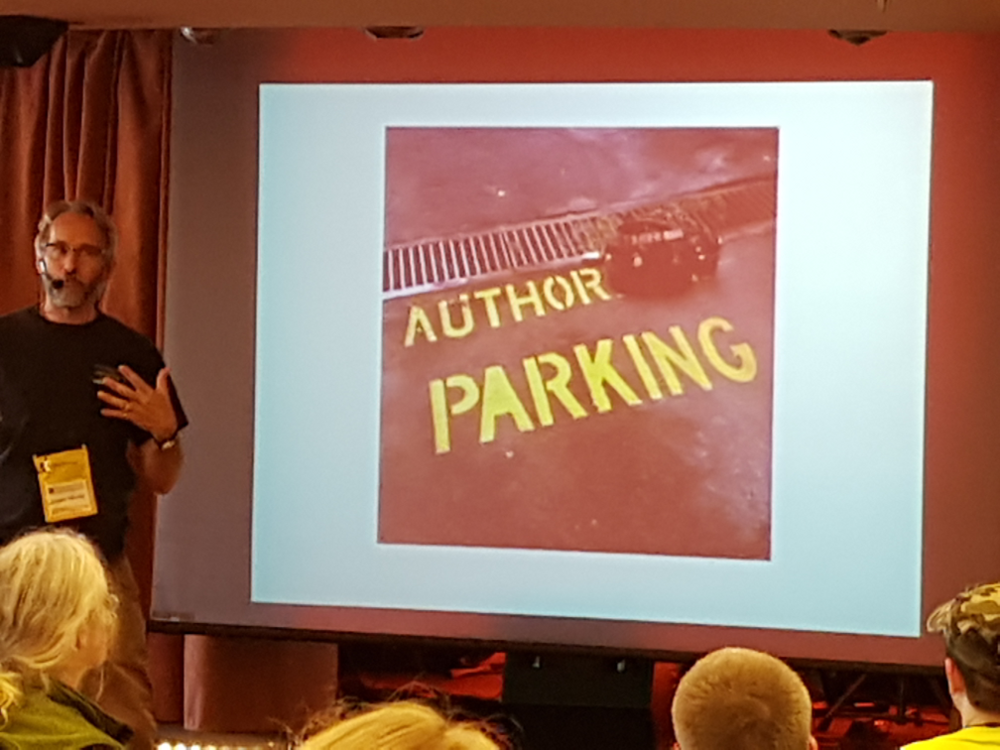
JasperFforde

That evening, Jasper Fforde delivered his talk on the last 5%, that ineffable quality that most writers lack: magic fairy dust. He promoted a lifestyle of creativity and joie de vivre so that, when we wrote, we couldn’t help but infuse that little something extra into our work. And he was hilarious.

At supper, I sat at Piper and Matthew Drake’s table. They are such an adorable couple, I couldn’t help but do an internal squee. They also had fascinating stories to tell.

Friday was our second day at sea as we sailed at top speed back to Kiel, Germany. The wind became progressively fierce throughout the day, eventually causing the water park and on-deck bar to close. All the deck chairs were stowed and the tables and chairs were crammed up against the rail and Plexiglas wall because the wind was blowing them around the deck. It was our only stormy day and even then, I barely felt the roll of the ship.

At the giant Q&A session, I sought out Thomas Olde Heuvelt, as I’d missed the early part of his presentation, and Emma Newman, because I wanted to get some help with my interminable burnout. Both were extremely helpful.
WXRecords

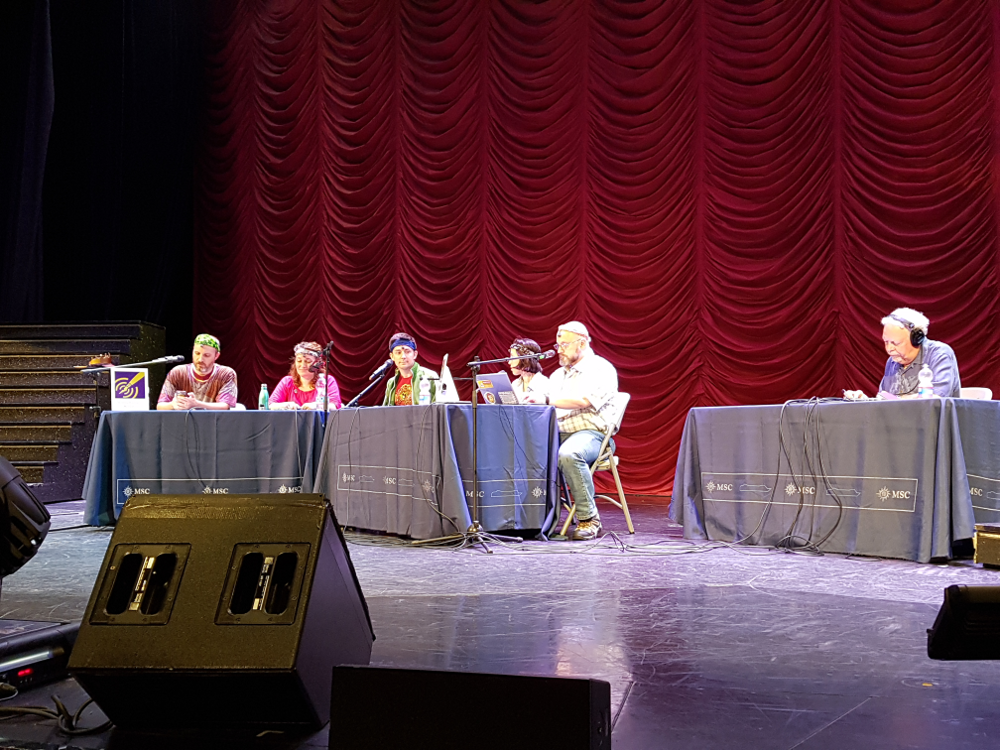
After lunch, we attended the on-board recording of the Writing Excuses podcasts. The first one featured one of my new friends, Mike Stop Continues.

Then, after another stint of revision, I had to crash. Cruise crud was getting the better of me.

At supper on this final night of the cruise, though I was not scheduled to sit with any of the instructors, there were enough absences, perhaps due to the cruise crud, that I got to sit at Emma and Peter Newman’s table. I think it was my second most enjoyable night (next to dining with the two Sarahs and the two Laurens).

The Newmans gave equal time to everyone at the table and it was the meal at which I learned the most about some of my fellow WXR participants.

Saturday was debarkation day, and so … yes, there was more queuing 😉

Fortunately, the process was handled as efficiently as embarkation and we were back at the Atlantic Hotel in Kiel by noon. Not all the rooms were ready for occupancy, however, and so a group of us gathered out front and His Majesty Dan Wells led us to a local laundromat.

Once everyone got their wash on, we strolled two doors down to a döner restaurant for lunch—yum! The owner had to call in extra staff to help with the crowd (!) Afterward, while we waited for our clothes to dry, Mary and Dan recorded Patreon special episode of the WR podcast. Then, we trouped back to the hotel.
Kiel

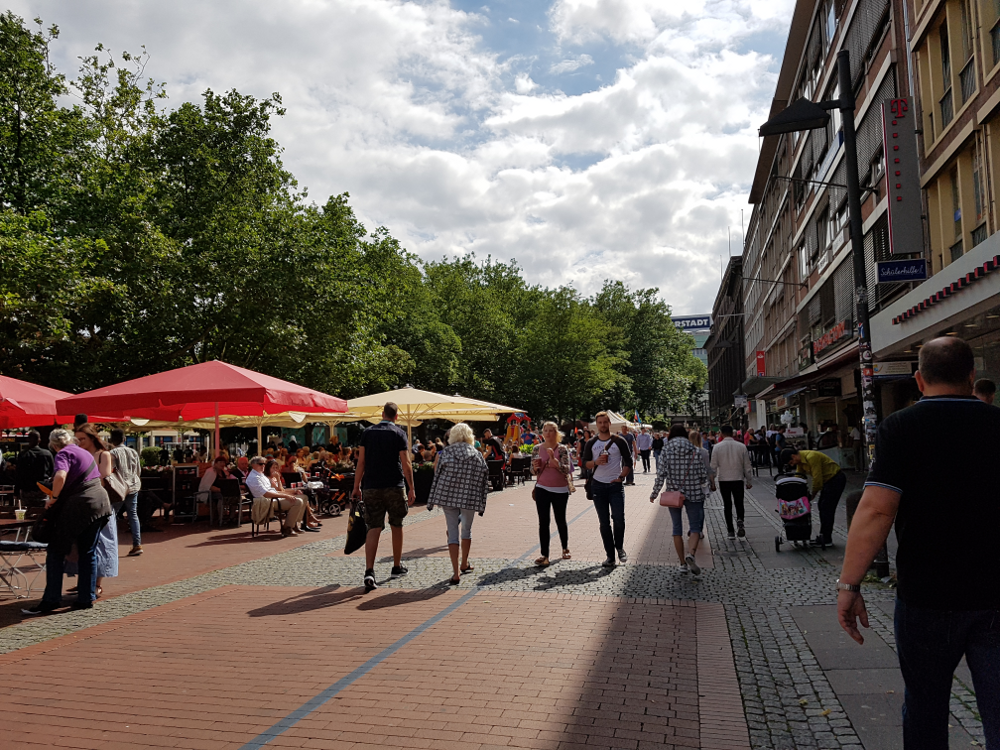
After checking in, I spent the afternoon wandering around Kiel’s mall and open market, meeting up with some of my fellow cruisers to head to supper. There was some disagreement over where to go, and we ended up splitting, some choosing a German restaurant, and my group opting for Mexican.

I must say, the German version of Mexican is … interesting.

And that is where my WXR adventure ends.

Next week, my journey to Helsinki, and how I spent my time until WorldCon began.

Until Tipsday, be kind, be well, and stay strong. The world needs your stories!