Geeking out and gearing up

Last week, I wrote about my accomplishments in 2013.

Now I’m going to write a bit about what I want to accomplish in 2014.

First, I have to tell you about a few things I picked up.

One of the rewards from my NaNoWriMo win was a 50% discount on Scrivener. So I finally bought the software after being on the fence about it for a couple of years. Jack Whyte’s commendation of the program for research purposes was one of the things that tipped the scales in the favour of purchase. The discount didn’t hurt either.

I’m still working my way through the tutorial and sorting out exactly which project(s) I’m going to use it for, but rest assured, I’ll tell everyone about my experiences when I do start using it.  I know I won’t have anything to add to the conversation considering the cajillions who already use Scrivener, but I’ll put in a few words.

A few months ago, Jenny Hansen discussed how she uses OneNote to support her writing. I’m running a Microsoft box, much to my husband’s discontent, and I have the program, so I figured, why not use it? At first blush, it seems that several of the features of Scrivener and OneNote overlap, but we’ll see how they work together, and if they behave themselves.

I have Evernote too, but I find I’m using the webclipper a lot more then anything else. Again, we’ll see how the various programs work together. Or not.

Writing progress worksheet, ready to go

Writing progress worksheet, ready to go

I nabbed Jamie Raintree’s Writing Progress Template. I spent some time customizing it to my projects, and we’ll see how it goes.

I loved the ‘ding’ moment I had when I finished NaNo. I’ve also been following Dean Wesley Smith’s Writing in Public challenge. I think that I write quite a bit and it would be nice to see that progress reflected in concrete form.

I’ve been having fun with the technology. Yes. That’s the geek part.

Finally, I just purchased the Writer’s Digest Guide to Literary Agents 2014. Guess what I’m going to do with that?

Now for the goals

I took a bit of a break after November’s triumph. I didn’t stop writing altogether, but I focused on getting my last original short story of the year completed and submitted. Oh! And while we’re on the subject – I managed to write or revise and submit 13 stories (3 of them on Dec 31, but I did it) thus meeting Kasie Whitener’s Just Write Challenge! W00t!

I also kept up with my blogging.

This weekend I’m spending time getting things organized and as of Monday, I’ll be back in the writing swing of things.

  1. Initiate of Stone. I’m beginning to hear back from some of my beta readers and so I will be revising the old girl once again based on the feedback I receive. That’s going to be a while in coming back from some readers, so I’ll focus on other projects until I’ve heard from everyone. I’ve decided to hold off serious querying until I get the next revision done. I don’t want to ruin IoS’s chances with too many agents by submitting a manuscript that’s less than ready.
  2. Apprentice of Wind. I’m going to start working on book two. It’s mostly drafted, but I have to assemble a few chunks I cut out of IoS, move them into AoW, and stitch everything together with an eye to structure. Revisions for IoS may further inform the work on AoW.
  3. Figments. This is the YA Urban Fantasy I drafted during NaNo. I worked from an outline I had written a few years ago. Beginning, ending and overall structure need some work before I redraft.
  4. Gerod and the Lions. This is the MG medieval I was working on while I waited for my content editor to get back to me last year. I only have a few chapters, but I have an outline to write to.
  5. Short stories. I still want to write a few short stories and attempt to have them published some time this year. I know I can’t always have as banner a year as I’ve had last year, but I can’t win unless I continue to play.
  6. Blog. I still want to revise/revamp, but my efforts from my first week of leave did not continue. I had other writing on my mind. I still have to update posts and pictures (to use my own or something in the public domain) and may actually be looking at a move to self-hosted WordPress, but I’m not going to put a timeframe on the project. The blog seems to be the first writing to get set aside and I hate making promises I can’t keep. I’m going to try to get back on the review and interview track as well.

This is going to be the first year that I’ve worked on so many things at once. It’s going to be a challenge, but I think I’m up to it. I’ve always been pretty good at switching focus between priorities, and I hope that moving between projects will keep the work, and my perspective on it, fresh.

All of the bits and pieces I’ve purchased or obtained (above) will help me on my way.

I think that being so devoted to one project for so long has been a bit of a detriment. I need to diversify.

I’ll let you know how it all goes.

The next chapter: 2013 in review

I think it’s important to recognize all the good things one accomplishes.  With regard to my writing, 2013 has been a banner year.  I haven’t seen its like in … well a very long time.

You may remember way back at the beginning of the year what I wrote about resolutions, how I’m not fond of them, and how I prefer to make reasonable goals so I can have a chance to reach them.

It worked a charm for me.

I wrote four (soon to be five) new short stories this year and revised six others for submission. This has resulted in three fiction publications (one paid), and another three poetry publications.

While the goal of Kasie Whitener’s Just Write Challenge was to write thirteen stories in 2013, I think that eleven was pretty darn good, considering the other things that I’ve accomplished.

I sent Initiate of Stone for a content edit in January and revised the whole thing twice. I’ve now sent the manuscript to select beta-readers and have sent it off to one agent and will ship it to one editor shortly.

In the mean time, I started on a middle grade fantasy, Gerod and the Lions, and drafted Figments, a YA fantasy, during NaNoWriMo.

Since the end of November, I’ve given myself a bit of a break. I’ve written a crap-load this year (because in addition to the 11 short stories, poetry, revisions, and the 50k+ draft, I’ve also tried to keep things rolling with my blog) and felt the distinct need for a rest before diving back into things in 2014.

Though I was not able to meet my goal of revising my blog (reader response seemed to indicate it wasn’t a priority) or moving to self-hosted WordPress, those goals remain on the list.  This time last year, I managed to accrue 100 followers on my blog. Now I’m over 222. While I’m still considering a newsletter, I continue to hold off. Until I have a novel out, I’m not certain a newsletter will have much value.

This year I also attended the Canadian Authors Association’s (CAA’s) CanWrite! Conference (June) and the Surrey International Writers’ Conference (October). Both were amazing experiences, and I learned a huge amount from the sessions at both conferences.

Currently, though my services haven’t been much requested of recent months, I’m sitting on the CAA’s Program Committee, and so putting some of my efforts into not only the CanWrite! Conference, but also, the Literary Awards, the Roving Writers Program, and other events.

As a reward for all my hard work, I’m going to be investing in Scrivener, thanks to the NaNo

Scrivener (software)

Scrivener (software) (Photo credit: Wikipedia)

reward discount, and purchasing the 2014 Guide to Literary Agents.

As far as what I’m aiming for in the New Year, stay tuned. I’ll have a post on more reasonable goals coming up next week.

books for sale!

books for sale! (Photo credit: bookgrl)

In the meantime, please share your accomplishments. It really helps to put them down in writing. I think when you see everything you’ve managed over the last year in print, you’ll be amazed. I was.

Then celebrate! You were fantastic! And you know what? So was I 😉

Sorry, couldn’t help the Doctor Who reference. Geek girls rule!

LEGO Doctor Who (Collection)

LEGO Doctor Who (Collection) (Photo credit: ChocolateFrogs)

Solstice and other things that happen around this time of year

Today was, in case you didn’t notice (you could be forgiven for missing it), the shortest day of the year, the winter solstice. It’s also the first day of winter, though you wouldn’t know it up here in the Sudz. It’s been snowing and cold since mid-November. It usually is, this time of year, but that doesn’t mean I can’t complain about it.

Now we face the longest night, but you know what? Things get better from here on out.

You’ll notice that the days start getting longer again and we start that long stretch to spring.

Christmas is coming, and with it the latest Doctor Who special 🙂

New Year’s is coming, with all its promise for another fresh start.

We actually have a chance to appreciate the people we’ve taken for granted all year, or the activities we’ve cut back on so that we could work/get the promotion/pursue various important things.

We can put things in perspective.

We just went out to celebrate my mom’s birthday. It was yesterday, but we celebrated tonight because everyone’s off. I was a terrible kid and forgot to wish Mom happy birthday yesterday. I took her shopping this afternoon. I don’t think it really made up for the lapse.

The 20th of December was also the day, twenty years ago, that Phil asked me to marry him.

We were getting ready to take my mom out, and I’d just gotten off work. I was a life guard back then, and I was rushing to get changed. I noticed that every time I turned around, Phil was there, but I whirling-dervished around him until I turned and nearly tripped over him.

Phil was kneeling. I was stunned until I realized what was going on. Then, I was all *amazeface*! He asked my parents’ permission and everything.

I’m always rushing at this time of year, and I have to remember to slow down and appreciate the people in my life.

Slow. Down. Appreciate. People.

Don’t be a dervish douche. Don’t forget your mom’s birthday. Trust me. It sucks.

Other reasons I like the solstice

It’s scientific.

Winter solstice

Winter solstice (Photo credit: Wikipedia)

Because of the tilt of the earth’s axis and the way we orbit the sun, we have seasons. The solstices and equinoxes delineate the divisions of the year.

It is a fact that the winter solstice is the occasion of the shortest day of the year and the longest night. In the northern hemisphere, anyway.

It’s pagan.

Well, neo-pagan, at least.

Seemingly on the opposite side of the spectrum, the solstices and equinoxes form some of the pagan holy days. In case you haven’t been following me for that long, my spiritual inclination is agnostic with pagan leanings.

Agnosticism, according to Richard Dawkins, is the worst form of self-delusion in that we aspire to atheism, but can’t quite commit because of the niggling doubt that maybe there is a God …

Well, Phil is atheist, and we’ve discussed religion at length. I think that the atheist position is very sensible. I also acknowledge that there is a lot that science hasn’t made clear for us yet, and while I think that the existence or non-existence of God is not one of the questions that science can answer for us, I think that there is enough mystery left in the universe that the answers science will provide us will be surprising.

I like to keep an open mind.

Besides which, I’m a fiction writer. A fantasy fiction writer at that. Gods, goddesses and magic are kind of what I’m all about.

I’ve studied shamanism in some depth (though not, I would say, comprehensively) and I’m fascinated by the ancient sites and their purported use in astronomy and astrology, time-keeping, the precession of the stars, and the observation of the sun.

I could geek out on ancient cosmology all day and all night.

English: Highworth cemetery at the winter sols...

English: Highworth cemetery at the winter solstice The shortest day of the year in the northern hemisphere falls between the 20th and 23rd December depending on the year. In 2007 the solstice occurred on the 22nd with the period between sunrise and sunset being 7 hours 49 minutes and 40 seconds. The sun set in London at 15.54 today, 22 minutes after this picture was taken. (Photo credit: Wikipedia)

It’s quiet.

Because a lot of people travel to visit relatives at this time of year, the city (small, yes, but a city nonetheless) grows quiet. In the morning when I’m walking the dog, I can feel the increased stillness, the anticipation of a world holding its breath for the next sunrise.

It’s about light.

This is why we have so many festivals of lights at this time of year. We’re fighting back the darkness, recalling the light, celebrating with our wee candles in the night, shielded against the wind.

I prefer strings of LED lights on the stair rails outside my house, though. I plug ‘em in the night before solstice and don’t unplug ‘em until New Year’s Day.

I’d just like to wish everyone, regardless of your religious or spiritual convictions or devotions, the happiest of holiday (holy day) seasons.

And ‘cause I was raised Christian and still celebrate with my nearest and dearest: Merry Christmas!

Behind the curtain: How mainstream publishing works

This was a fun panel with an author, an agent, and two editors.  They took us through the publication process at each stage, author, agent, and editor explaining how their part of the puzzle looks.  Then they fielded questions.

I’ve attended panels before that featured all publishers, or all editors, or all agents.  While informative, how everything dove-tailed was missing.  Occasionally, panelists might say that they couldn’t comment or speculate on what others in the process might do or experience.

‘Twas excellent.

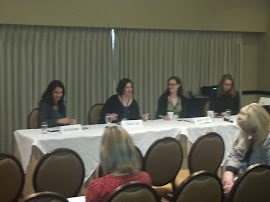
The behind the curtain panelists

The behind the curtain panelists

Panelists: Emily Ohanjanians, editor with Mira Books, the commercial fiction imprint of Harlequin; Eileen Cook, author of YA novels with Simon & Schuster and HarperCollins; Rachel Coyne, agent with Fine Print Literary; Sara Sargent, associate editor with HarperCollins’s children’s imprint, Balzer & Bray.

EC: We’ll start with the author’s search for an agent.  First you have to understand what an agent does.  Most are busy with their current authors and are not actively looking for new authors.  Do your research to find the best fit.  Newer agents will be more available.  Ultimately, it comes down to personal taste.  One agent may not like your voice or style, but another might love it.

RC: I receive 150 to 300 queries per week.  It’s impossible to respond individually.  When I started, that was my intention, but it just can’t be done.  Agents get rejected too, by editors.  There’s a certain disappointment when another agent snags an author from you, especially one that receives an award or does really well.  After I’ve agreed to take on an author, we have a one on one call to discuss next steps.  There is a two page author agreement.  It’s not a contract per se.  Standard percentage is 15% for domestic sales and 20% for foreign, TV, film, and other rights.  Most houses have one agent who is dedicated to subsidiary rights.  Once an author has signed on, the editing begins.  This could mean several rounds, back and forth.  Then the agent will submit to her first round editors.  Usually these are people the agent has an established relationship with.  Sometimes, if several editors are interested, an auction takes place.

SS: At HarperCollins, there are several meetings, one with the acquisitions team during which a profit/loss statement is generated.  The agent is advised of the proposed deal, and negotiation begins.  At the acquisition meeting, everyone sees the property.

EO: It’s the same at Mira, the meeting with the editorial director is followed by the acquisition board meeting, the agent is informed of the proposed deal, and negotiation follows.

Q: Once the book is sold, what happens?

RC: I would make recommendations to the author based on what they hope to achieve.  Usually there is a year between the deal and the publication date, so there is time to implement an author web site or blog, develop social media following, or begin on the next book.  The contract can take anywhere from two weeks to nine months to hammer out.  An advance might be $10,000.  Royalties could be 10%.  First you earn back your advance, then you begin to receive regular cheques.

Q: How does the editor work with the writer on further revisions?

EO: When the launch date is decided upon, it might be a year, or a year and a half, we work backwards, get our endorsements in place, schedule substantial, line, and copy edits, proofing, typesetting, cover art, blurbs, back cover copy, determine the meta data for online sale.

Q: So what happens when you write an editorial letter for the writer, and the writer refuses to budge?

SS: Usually I’ll read and mark up the copy, then prepare a three to ten page editorial letter for the author.  The author will usually sit with it for a few days, then I’ll meet with the author by phone and the author will indicate what they are willing to do and what they are not.  The biggest issue that comes up is characters that are not received as the author intended.  The next is the market: similar books may have tanked for specific reasons that have nothing to do with the quality of the writing.

EC: We work together to reach a solution.  e.g. I hate the character!  My character is brilliant!  How do I show it?

RC: The biggest asset a writer can have is the willingness to be edited.  I like to meet annually with my authors to find out what their plans are for the coming year.

Q: Describe your ideal author.

EO: An insecure author can become overwhelming.  20 emails a day can be draining.  An author coming out of another house might cause me to do some research.  Were there reasons for this?

EC: You have to own your neuroses as an author.  You must be open to communicate.

Q: If your author had to choose between a Canadian and American publisher, which would you recommend?

EC: Commission can be less with a Canadian publisher.  Most American publishers will include Canadian distribution.  The deal is for North American rights, not Canadian or American.  Canada is not considered a foreign market.  Really, your agent is a match-maker, trying to find the best possible home.  It used to be that agents had to be in New York, now they can be anywhere.

RC: There is a right agent and a right publisher for every author/project.

Q: What about e-rights?

SS: They are considered subsidiary rights.

Q: How often do you have to meet in person?

RC: Never if you don’t want to or can’t afford it.

Q: What is your education/experience?

SS: Placement with Disney/Hyperion, BA in English, then an MA in Journalism.

RC: Writer’s Digest Books, Donald Maass Agency, Forward Literary, then Fine Print Literary.

EO: BA in English literature/linguistics, job in finance, but I always wanted to be an editor.  I started working for magazines, then got on with Harlequin, took some courses from EAC and Ryerson in editing, and at every stage, working up through the ranks.

Q: What’s the difference for non-fiction?

EO: It’s based entirely on platform.  Not voice.  Not skill.  Who’s the audience for the book?

RC: Blog-books have been happening recently as well.  Narrative non-fiction works the same as fiction.

EC:  With a novel, you have to have the novel completed before you can query.

RC: With non-fiction, a proposal and platform is often enough.

Q: What should your word count be, and do you talk about series?

SS: Word count isn’t critical.  I’ve never rejected a book on the basis of length.  You should concentrate on one novel per query and treat it as a stand-alone.  It’s important to have a vision, though of how your writing future will look.

RC: We’re not looking so much at the concept, but the creativity of the author.

SS: With children’s literature, you have to be aware of the market.

EC: Not many YA novels are 300,000 words long, but submitting a 20,000 word novel would be too short.

Q: Can an author ever go direct to editor?

EO: If I have the time, I’ll always look.  Why not?  I could find a gem.

Q: When do you know when to stop editing and query?

EC: Write the best book you can.  No matter what you write, you can find an association (RWA, SFWA, etc.). These associations will often offer editing services, or members can serve as critique partners and beta readers.  When you do query, send out five at a time.

Q: Is a rejection a burned bridge?

RC: Not necessarily.  If you revise and resend, there’s a chance that the agent will not remember, but if they do, they are not likely to give you a second chance.  It’s better to try a new project.

Q: How long is it for an editor to respond to an agent?

RC: Between three months to a year sometimes, but the average is three to four weeks.  If there is a closing date or an auction, all interested parties are called.

Q: Do agents want to have input into the author’s platform?

RC: It’s more a matter of making suggestions, showing examples.

SS: In concert with publicity and marketing, publishers may advise.  But if you’re not comfortable on Twitter, you don’t have to use Twitter.

EC: Some agents will advise you with regard to your career in general.  Some agents will never go there.

Q: Have there been books you just couldn’t sell?

RC: Every agent has a book that they felt passionate about, but just couldn’t move.  I make every effort to sell every project, but between 60% and 90% of books signed actually sell.

EC: Hopefully you have more than one book in you.

EO: It’s often the second submission that sells.

RC: Some projects are bought on voice alone.

Q: If you’ve self-published, is it a deal-breaker?

RC: Only if it’s the self-published effort and it’s not sold well.  If it’s a different effort, no problem.

EC: They call us hybrid authors now.

Q: How about posting your work in progress on the internet?

RC: It depends on how much of your novel is out there, and at what stage.  If most of the novel is already “published,” I probably wouldn’t take it.  Do not blog your book.

Q: Can you self-publish one book and e-publish another?  Specifically, the rights on my first novel are reverting to me and I’d like to self-publish.  Meanwhile, I’m in negotiations for my second book.

EC: If your first book is erotica and your second is YA, then they’re not likely to get in each other’s way.

EO: If both books are comparable, you could offer the self-published book at a deep discount.

RC: It would be wise to check with the publisher about to put out your second novel if self-publishing your first is okay.

EO: Be up front with all interested parties.

This brings us to the end of Friday’s sessions.  I’ll have the Friday night and Saturday morning keynotes before moving on to Saturday’s sessions.  We’ll see how far I get tonight.  I’ll be travelling home tomorrow and won’t finish off whatever remains until Tuesday.

The leave begins

I’m going to be a bit scarce, or scarcer that I have been recently.

I have my time off and I’m going to use it to catch up on a few projects/straighten out my head.

What’s up:

It’s taken much longer than I intended, but I am coming down to the final, final, FINAL revision of Initiate of Stone before I send her off to the editor who expressed interest last year and to a few select beta readers.  I’m going to be revising my pitch/query and start targeting Agents and small publishers.

I’ll be attending the Surrey International Writers’ Conference from October 25-7, and I have a pitch session booked with the wonderful Kristin Nelson (squee!)  I’m very excited, but after putting IoS to bed (for now) I will likely spend the next week prepping for SiWC.  I’m going to be reviewing my idea files for what I want to work on next.

While I wait to hear back from editors/agents/publishers about IoS, I’m going to be starting on/returning to other novel-length projects like Gerod and the Lions.

Come November, though, I’m going to be tackling another project for NaNoWriMo (!)  I only have until the 19th off, but I’m thinking it’s time to get something else up and out there.  This may be the idea file project I choose to prep for SiWC.

So that’s pretty much my writing ambitions.

I have said that I would participate in Khara House’s October Submit-o-Rama, and even participated in Kasie Whitener’s Just Write 2013 challenge for the purpose, but I’m not going to go out of my way to get a pile of short stories submitted.

If it happens, it happens.  I have some markets targeted, but I want to focus on my novels.  That’s where I need to be.

On a more personal note, I’m going to be trying to work in a little more physical activity.  I’ve gained weight just in the six weeks since I quit smoking.  It’s not good.  The clothes are tight.  And I haven’t been as faithful with implementing new habits as I was with changing the old.  I need something that will work with my life when I go back to the day-job.  This bears some thought.

I have no doubt that when I do go back, things will be as hectic as ever, so the new fitness routine has to be something that will let me get the sleep I need, get all the housework and daily chores done, and still accommodate work and writing.  And then there’s all that TV I like to watch 😛

I need to finish off my household clean-up (which stalled in September) and try to get the gardens into some kind of order before the snow falls.  I have a few projects I’d like to get to as well: 2 ceiling fans to install, my office door to strip and refinish, and one of our external doors to repaint.  I’m also looking at some storage fixes, cabinets for the bedroom and bathroom, and a new bookshelf for my office.

These last I’m not going to rush, since I think I’ll have enough with my trip to Surrey, another shortish trip to visit a friend in southern Ontario, and all the writing I want to do.

And then there’s Writerly Goodness.  I’m thinking it’s time for a face-lift, and maybe a new

English: Epic Win title card.

English: Epic Win title card. (Photo credit: Wikipedia)

name.  My domain will remain the same, but I’m thinking that a more appropriate name might be Totally Epic, or Epic Win (for my interest in epic fantasy).

I could go with something more general because I’m not just about the epic fantasy, I have urban fantasy, YA and MG, science fiction, and even some cross-over type novels in my idea file.  Plus I still write poetry and short stories, some of which are not speculative at all.

How about Improbable Possibilities (one definition of SF), or Speculations on Fiction?  There are some old suggestions: Phigment’s (Phigment is an imaginary dragon—the site would belong to her), or MelanieM/Millennium.  This last was from a friend who realized saying MelanieM sounds an awful lot like millennium.  Does something else present itself to you as clever?  I think I might just put a poll in my post this week 😉

A number of recent writer interviews have been delayed, perhaps indefinitely, so I probably won’t be posting much more than once a week (outside of SiWC, which I hope to blog and maybe even Twitter).  If I have nothing to offer by way of updates, I may not post at all in any given week.

Just to let you know.  I’m still here, but I’m going to be trying to shift my focus away from the interwebz for a bit and get back to the reason I started this whole platform-building gig in the first place—my writing.

I’ve been seeking balance for some time.  Maybe I’ll find it in the next five weeks?  Who knows?

Thanks for your patronage, and for your patience.

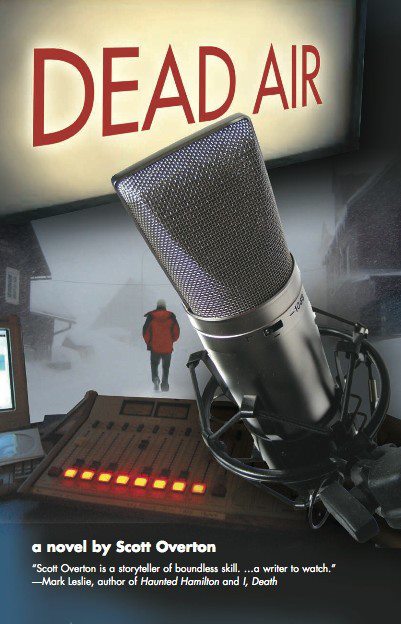
Review of Scott Overton’s Dead Air

This review is considerably overdue.  My apologies, Scott.

The Amazon blurb:

dead airWhen radio morning host Lee Garrett finds a death threat on his control console, he shrugs it off as a prank—until a series of minor harassments turns into a set of undeniable attempts on his life. The suspects are many—he’s made enemies—and the police are strangely uncooperative. The radio career he loved has turned sour, leaving behind a dwindling audience and the wreckage of his marriage. Then the friendship of a newly blind boy and the boy’s attentive (and attractive) teacher offer unexpected hope. Maybe he can make a fresh start. Maybe he can admit that he’s the source of a lot of his own problems. But when the deadliest assault yet claims an innocent victim, Garrett knows he has no choice—he has to find his persecutors and force a confrontation. The extraordinary outcome will test the limits of an ordinary man. In Dead Air career broadcaster Scott Overton creates the disturbing scenario of an ordinary man whose life is threatened by an unknown enemy.

My thoughts:

I wasn’t in love with the character of Lee Garrett. In fact, I didn’t like him much at all, but that’s exactly the way it had to be for Dead Air to be a successful thriller.

Lee Garrett has made enemies over the years, enough to fill a room with the usual suspects, and his wife left him, taking their two children.  She’s making a new life for herself while Garrett’s disillusioned and jaded and not a bit depressed.  He’s a bit of a schmuck, steeped in a good dose of self-sorrow.  Not an attractive package.

Garrett has his redeeming qualities, though.  The reasons he’s made all those enemies is because he generally tried to do the right thing and exposed their varied douchebaggery in the process.  He’s still in love with his wife, and the friends he has are the dependable kind that come through when the going gets tough.

Then he makes friends with Paul, a boy who recently lost his sight, and Candace, his CNIB counsellor.  As the relationship develops, Garrett learns a lot about himself, and how he is the author of his own misery.

He also makes a staunch ally by virtue of an act of kindness.  He even wins over the detective assigned to his case despite having been black-listed for ruining another officer’s career.

By the time Garrett exposes that act that haunts his life and underpins many of his poor decisions, I realized I liked Garrett, despite his not inconsiderable flaws.  I could even think of him as Lee 🙂

Dead Air is a novel about hard-won redemption and a fascinating character study as well as being a thriller with enough twists and turns to keep the reader guessing until the end.

My rating:

4.5 stars out of 5

About the Author:Scott Overton colour high res

Scott Overton hosts a radio morning show on Rewind 103.9 in Sudbury, Ontario. As a broadcaster for more than thirty years (twenty-four of them as a morning man), he knows the world he writes about in Dead Air.

To most readers, morning radio is as much a part of their breakfast routine as a hot cup of coffee. On the air, Scott has become a friend to thousands as he entertains and informs. He brings those same instincts to his writing, with clear prose and honest feelings.

His short fiction has been published in On Spec, Neo-opsis, and anthologies such as Tesseracts Sixteen, Canadian Tales of the Fantastic, and In Poe’s Shadow. He’s also a regular contributor of theatre reviews for a local newspaper.

His other passions include scuba diving and a couple of classic cars.

Review of K.M. Weiland’s Dreamlander

I’d been meaning to get K.M. Weiland’s Dreamlander and read it for a while now.  Well, not long ago, Katie posted on Wordplay about Story Cartel, where readers can get free books in exchange for an honest interview.

I missed the deadline for her challenge, which might have won me an Amazon gift certificate (moar books!), but since I always intended to write the review up anyway, I figured I’d just carry on and post when I actually finished the book.

I don’t read as fast as I used to.  I blame it on the day job, but I have a feeling that even if I wasn’t working I wouldn’t be consuming a book a day like I used to. Besides, I wanted to savour Dreamlander.  If that doesn’t give away the nature of my review, I don’t know what will 😉

One of the reasons I was so keen was the concept: a man goes to sleep in this world and wakes up in a parallel world.

Any of you who have followed my blog for any length of time will know about my tonsillectomy trauma and the dream that I had upon my return from my second visit to the hospital.

For those of you who haven’t seen the post and don’t want to take the time to read it, here’s the short version: I had a near-death experience, and as a result, I dreamed that I had, in fact, died.  I fell asleep in one world and woke up a new person in another world.

So you can see how Dreamlander kind of fed into my life-long fascination with dreams and dreaming.

DreamlanderThe Amazon blurb:

What if it were possible to live two very different lives in two separate worlds?

What if the dreams you awaken from are the fading memories of that second life?

What if one day you woke up in the wrong world?

Only one person in a generation may cross the barrier of dreams to reach the other world—a world of war-scarred countries and fallen faiths. When a Chicago-born journalist finds himself on the far side of his dreams, he must hurl himself into battle to save a princess from her own people, two worlds from annihilation, and himself from a dream come way too true.

My thoughts:

I loved Dreamlander (did you see that one coming?).  Weiland has created a flawed protagonist in Chris Redston who wins our hearts over as he attempts to undo the damage caused by the mistakes he’s made.

Having lost his mother and one sister in a car accident he survived, and having subsequently lost his father to alcoholism, Chris is done with alternately lending his father money and bailing him out of jail.  He can’t find his focus though.  Once a talented writer, Chris finds himself blocked and unable to support himself.  Then there are these bizarre dreams he keeps having…

Chris turns out to be The Gifted, a rare man who can cross over into the land of his dreams, a very real world where he lives an alternate life.

Allara Katadin, princess of Lael and Searcher, is equally damaged.  The last Gifted who crossed over sent her world spiralling into chaos and she feels it was her fault.  She can’t trust Chris not to be the man his predecessor was, and when he initially proves her right, she shuts Chris out, not understanding that life is about taking chances and about giving second ones when it matters most.

Dreamlander is true epic fantasy, with not just one, but two worlds in jeopardy.  Chris and Allara must work together and sacrifice everything to do the right thing, even as Allara’s own people cry for her blood and that of the Gifted.

The denouement was both heart wrenching and satisfying, Weiland proving that the writer must be cruel to her characters to be kind to her readers.

My highest recommendation.

My rating:

5 out of 5 stars.

About the author:

K.M. Weiland grew up chasing Billy the Kid and Jesse James on horseback through the hills of western Nebraska, where she still lives. A lifelong fan of history and the power of the written word, she enjoys sharing both through her novels and short stories. She blogs at Wordplay: Helping Writers Become Authors, where she mentors other authors and shares the ups and downs of the writing life.

Now I’m off to post my review to Story Cartel, Amazon, and Goodreads 🙂

Later, ‘taters!

The next chapter: July 2013 update

Just a few words here about my writing life of late.

I am continuing to revise Initiate of Stone, but at least once a week, I can’t seem to get to it after all my other responsibilities.  Then sometimes I make a choice.  This past Tuesday, for example, I chose to go to North Bay rather than taming my daily dose of the intewebz or write.  Though it was well worth it, I still felt odd not writing.

It’s an addiction now.  Healthy, but an addiction nonetheless 😉

Acceptances

Since my last update, I’ve received some good news.  The Atomy picked up two of my poems, Enhance will be accepting one of my photographs (wow!), and most recently, Sulphur will be accepting three of my poems for its next issue.

I received my contract from On Spec and am waiting to hear from their content editor on next steps (still so excited about this!).

I’ve submitted a couple of flash fiction pieces, but they’re both fairly recent stories and may need to mature (read, to be edited) before they find a home.

Writers of the Future wasn’t fond of “The Gabriel” but I have yet to recieve my personalized response.

Still waiting to hear about a few short story submissions from April, May, and June.

Oh, and I almost forgot.  I submitted the first bit of a story to Erin Brady too, and I’m curious to find out what will come of that 🙂

Just as I was linking those publications, above, I noticed that Enhance has a call out for that flashy fiction stuff!  Go see!

Conferences

This year’s CanWrite! was a success.  I certainly hope everyone got a lot of good information out of my CanWrite! blog posts.

Since I’m now a member of the program committee, which includes responsibility for the conference and the CAA literary awards, I’ll probably have some news forthcoming about next year’s conference in the future.  Watch this space 🙂

I’ve had to make a decision about When Worlds Collide in Calgary.  Though I would love to go and the line up looks great (Patricia Briggs, Robert J. Sawyer, and Angela Ackerman will be among the guests), I just can’t afford it.

The conference fee is reasonable in the extreme, but it’s the air fare and accommodation that make the event costly.  Domestic flights are quite expensive. I had my eye set on Surrey this year, so I think I’m going to stick with that conference and go to WWC next year.  I only have enough Avion points to take 2 trips anyway and one is already spoken for (a friend’s pre-wedding party) so there you have it 🙂

There’s a writing contest associated with Surrey too, so I’ll probably aim to submit something for that as well.

It’s good to keep the creative opportunities lined up and ready to rock.

Writerly Goodness

What’s everyone working on these days?  I’d love to hear from you about your creative projects!

CanWrite! 2013: Gala and wrap post

Before I begin, I’ll apologize for the apparently drunken photo-taking.  I’m still getting used to the camera in my Galaxy Note II 😛

On Saturday evening (June 15), conference attendees were shuttled out to the Best Western conference centre for out Gala event and announcing of the winners of the CAA literary awards.

Gathering for the Gala

Gathering for the Gala

Our master of ceremonies for the evening was Bruce Pirrie, Second City alumnus and writer for the Red Green Show.

The evening’s events picked up after dinner with an introductory monologue from Bruce about the dubious joys of being a comedy writer.

Then Charles Foran took the podium with an impassioned plea from PEN Canada.  While the organization is best known for its work overseas on behalf of writers and free speech (a current campaign focuses on the events in Turkey), PEN Canada has noticed a disturbing trend here in Canada with the censorship of Canadian scientists and the digital freedom controversy.

Charles Foran

Charles Foran

PEN needs writers everywhere to stand up for the right to free speech and fight the oppression of censorship.  To this end, they are conducting a membership drive until the end of June.  Please consider joining this worthy organization.

Andrew Westoll

Andrew Westoll

Matt Bin

Matt Bin

Next was Andrew Westoll, Author of The Chimps of Fauna Sanctuary.  Andrew presented the stories of three of the Fauna chimps, their individual struggles, and the rewards their caregivers reap.  It was an amazingly touching presentation.

Then, President Matthew Bin introduced the CAA literary awards.  Originally started in 1937, the awards were the “for authors, by authors” recognition of excellence in Canadian literature.  They became the Governor General’s Awards and administration of them assumed by the Canada Council for the Arts.  More recently, in 1975, the Canadian Authors Association has once again started their awards program.

Here is the list of the winners.

It was a fabulous evening and I was inspired by having been a part of it.

_______________________________________________________________________

The rest of the story

I have been a professional member of the CAA since I joined a few years ago.  As such, I have voting privileges at the annual general meeting.  Two years ago, I expressed interest in taking part in the program committee.

This year, I was invited to join it.

The program committee has a fairly sweeping mandate, including the CAA literary awards and the annual conference.  Also on the list of responsibilities are professional development programs (where my greatest interest is), the roving writers program, editor-in-residence program, members’ book catalogue, and contests.  I’m a little daunted but I have great fellow committee members and a great chair to work with.  Our role is primarily to set policy and make key decisions.  We won’t be doing the leg work, but I can see some of that happening.

There are exciting times ahead for the CAA as it also embarks of a “twig” program and membership drive.

The web site is also undergoing a long-overdue revamp and should be far more oriented to service to the CAA’s membership.

I’ve made some writerly connections: Sharif Khan, author of The Psychology of the Hero Soul, John McDonell, and Vikki Vansickle.  I reconnected with some old friends too: Sandra Stewart attended for the weekend only, as did Betty Guenette, another member of the Sudbury Writers’ Guild.  I reconnected with Sue Reynolds and James Dewar (one of my fellow program committee members), who I’d last seen at the Algonkian conference in the fall.  I met a lot of authors, and bought a lot of books (!)

It was a wonderful experience.  I just wish items like Hermione Granger’s Time Turner actually existed, so I could see and experience everything 😉

Coming up: I’ll be returning to my weekends-only schedule, starting with some long-overdue book reviews.

CanWrite! 2013: Open mic, Andrew Pyper, and Cordelia Strube

I already mentioned the welcome reception and the morning creative writing circles, but have since launched into panels and sessions without mentioning what happened the evenings of June 13 and 14.

Back-pedalling now …

Open mic and shortlist readings

On June 13, interested parties were encouraged to sign up for the open mic.  I did and intended to read the revised opening of my novel as I had at Wordstock, then at supper I heard that the readings would be restricted to five minutes.  This was reduced to three by the time I arrived due to the number of last minute sign-ups.

Not having brought my poetry with me that night, I read as much of my opening as I could.  It was well-received.

Other readers offered their poetry and stories (one humorous one was about discovering one was having a heart attack while on the toilet – shades of Elvis) the organizers sticking strictly to the three-minute limit.

June 14 was to have been readings from the authors short listed for the CAA Literary Awards, but again, a last-minute change opened the floor to additional readers.  I signed up and brought my poetry, a much more appropriate genre for the three-minute limit.

I got to hear the end of the Elvis story and some more great poetry, fiction, and non-fiction.

I enjoyed the readings from the short listed works.  With one exception, none of them could show up in person.  The man who did was Michael S. Cross, author of A Biography of Robert Baldwin: The Morning-Star of Memory (Oxford University Press).

Michael’s reading was wonderful.  I didn’t know Robert Baldwin was such a fascinating character.

Another fascinating author was Jane Doe. She read from her book The Story of Jane Doe.  She is an advocate and activist and her story is a compelling one.  I encourage everyone who has an interest in women’s issues, advocacy, or the attitudes of the legal system to victims of rape and violent crime to pick up this book.

Andrew Pyper

Andrew Pyper

Andrew Pyper

Andrew Pyper is the author of six novels, most recently, The Demonologist.

Andrew’s session was on the afternoon of June 14, and it was as much workshop as presentation.

The session, Getting organized, getting started, focused on the essential elements required before an author begins to write a novel.

  1. An Idea;
  2. A Premise;
  3. A Protagonist;
  4. A Hook;
  5. A Structure; and
  6. An Outline.

He also offered six tips for overcoming roadblocks.

One of the most interesting pieces of his presentation was about ideas.  Yes, one must have at least one good idea to propel one’s plot, but the author shouldn’t stop there.

Traditional thought and misconception would imply that one idea must be made big enough to become the basis for a novel.  Andrew suggested that rather than one idea expanding to fit a novel, that a multitude of ideas should funnel down and feed into a single novel.

This made a lot of sense to me, and when I think about it, that’s how I write fiction.  I never write about one thing.

The premise is distinguished from the main idea of the novel because of its scope.  Andrew’s explanation reminded me of Larry Brooks’s.

He offered the following example:

Idea: A modern-day Frankenstein.

Premise: Archaeologists extract DNA from mosquitoes trapped in pre-historic amber and use it to clone dinosaurs. A philanthropist establishes a theme park around the beasts and invites a select group of scientists and family to witness his triumph; then the beasts escape (Jurassic Park).

The key to a premise is “high concept,” a concept that can be evasive.  This is why Larry Brooks is forever explaining the difference between idea, concept, and premise on his site 😉

Andrew had us write our premises for the Rob Ford story.  As expected, we all had different takes on the well-publicized scandal.

I won’t give away the whole of Andrew’s session, but I will say that it was informative and fun.

Cordelia Strube

Cordelia Strube’s session, on the afternoon of June 15, was mostly workshop.  She’d actually had workshops on both afternoons (14th and 15th) and anticipated that conference-goers would attend both, but a miscommunication occurred and the message was never conveyed to attendees.

Cordelia has published eight funny, powerful, sparse, cathartic and critically acclaimed novels, among them Alex & Zee, Teaching Pigs to Sing, The Barking Dog, Blind Night, and Lemon. Her ninth, Milosz was published last year.

Her plan was to have participants from the first session return and revise the work they had started the day before.  Those of us who only came on the second day would have to start from scratch.

Cordelia gave us a framework and some strategies for getting into our focused writing.  She then distributed horoscopes and a number of other prompts: postcards, small items, all of which were to inform our writing project for the afternoon.

After we were sent off to write however and wherever we wished, the class was asked to share the results of their writing.

It was an excellent session.

________________________________________________________________________

I should take a moment to mention that there were a number of sessions happening concurrently on Friday and Saturday afternoons.  I can only report on the ones that I attended.

Specialty sessions, at a nominal additional cost, also took place during the mornings.

There were also agent pitch sessions occurring Thursday, Friday, and Saturday mornings.  Though I did not opt into these, they were very popular and booked solid.

I like the way in which they were conducted.  Each author was to submit their query letter and first five pages of their novel in advance of the pitch session.  I think that this is a much better way to conduct pitches than to do them blindly.  It’s better for the agents because they have a sense of the author’s work.  It’s better for the writer because they don’t only have their two to five minutes to convey the meat of their novel.

A professional photographer was also on site to take author shots for the attendees.  I happily paid the (again, nominal) fee for this.  I should have the results next week and I hope they will be better than my efforts to date.

Tomorrow: The final panel, Traditional vs. Self-publishing.

G’night y’all 🙂