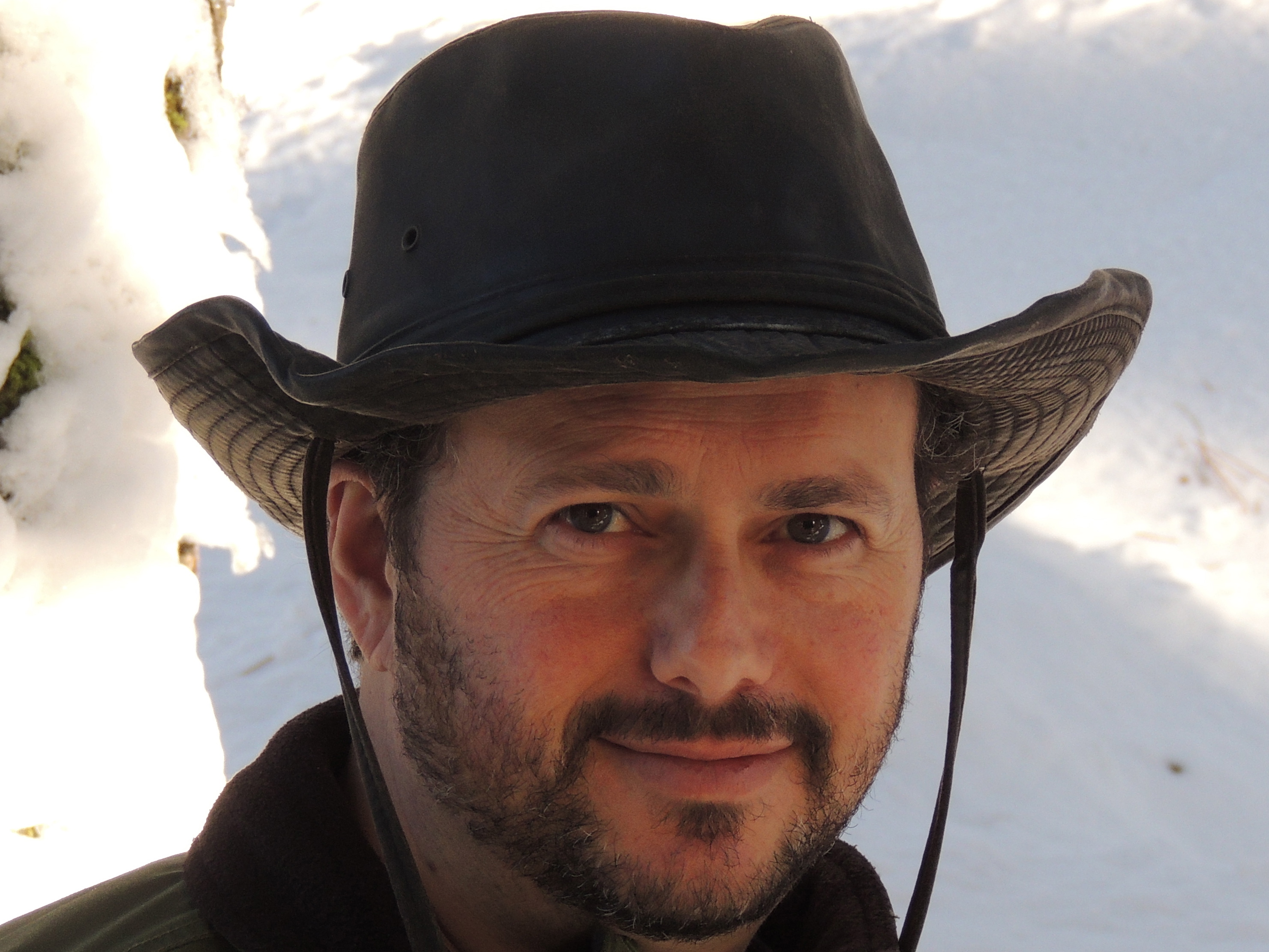
Six questions with Alon Shalev

Alon ShalevAlon Shalev writes social justice-themed novels and YA epic fantasy. He swears there is a connection. His latest books include: Unwanted Heroes, At The Walls Of Galbrieth, and The First Decree. Alon tweets as@alonshalevsf and @elfwriter.

_________________________________________________________

Welcome to Writerly Goodness, Alon!  Thank you for taking the time to answer a few questions for my readers.  I must say that I’ve been following you with great interest since we “met” through Author Salon and I became aware of your progress through last year’s Amazon Breakthrough Novel Award (ABNA).

WG: I know you’ve probably written a lot about this, but I must ask about your experience with the ABNA.  Some of my friends have expressed interest in the competition (or entered) and I’m sure they would love to know about the process of getting to the quarterfinals and how it contributed to your success with At the Walls of Galbrieth.

AS: I think ABNA is an amazing opportunity even if you do not win. It pushes you to finish and polish a manuscript, and prepare what is essentially your media kit. I have reached the quarterfinals with three different books and enjoyed the tension around it (I had my acceptance speech all worked out!). When you reach the quarterfinals, experienced people in the industry critique your novel. It can be tough, but you do learn a lot. Finally, there are many agents trolling the competition, so it is an effective way to avoid the depressing slush piles.

WG: Now The First Decree, the second novel in your Wycaan Master series has been published.  How was writing the second novel in your series different from the first and what did it teach you about yourself as a writer?

AS: The most significant difference is allowing for a story arc that gives a satisfying climax, but also extends tendrils into the next book. In fact, there is a similarity at the beginning, because you want to bring the reader who has not read your first book (or read it a while ago) up to speed without imparting a huge information dump or giving away too much from the first book. I found this very challenging and had a number of friends critique this aspect in order to find the right balance.

What I love most about writing a series is that I can really develop my characters. They have time to grow up and mature. Outside of writing, I am a devoted father (which is what got me writing epic fantasy in the first place) and work with college students. So I realize that I am imbuing this love for seeing young people grow and develop into my writing and, I think, only a series can allow for this.

WG: How did Seanchai’s story begin for you and how did it evolve? 

AS: Every summer, my family goes camping for two weeks in Northern California. After we had set up camp, my sons (then 11 and 7) went off to explore the campground and I whipped out my laptop. They soon returned and objected to me writing during family time and this was the compromise we reached. During the two subsequent years, I wrote The First Decree and Ashbar, and read a couple of chapters each night either around the fire or snuggled in my tent.

I realized that many aspects of Seanchai are a mix of both sons, and perhaps how I would like them to turn out.  My fears that I will not be there for them one day plays out as Seanchai is denied a parent or mentor so many times. But there is also the desire to cultivate deep friendships, which I believe is central to the values that both boys have, as well as dealing with teenage romance and pressure.

All my characters are now part of my family. When I killed one off, I cried. When I edited that chapter several times, I cried…several times! I often imagine conversations with them, counselling and encouraging them, as I strive to do for my sons.

WG: I’m a big process geek.  Would you share something about your writing process? 

AS: I am not a good person to ask. I plunge in and trust the creative juices. I usually finish a 100,000-word manuscript (a rough draft full of mistakes) in three months, writing an hour a day and more on weekends. I keep a contents page for myself to track chapters and a characters page where I add physical traits or history. I also have ongoing plot notes that are threads between chapters and stories. This is written at the bottom of the chapter I am writing and I cut and paste on from word doc to word doc and erase an idea after it is included.

In terms of workspace, my desk is in the kitchen and I can write on the train, bus, anywhere. Once the idea is there, everything flows. It is a truly exhilarating experience. My family would probably tell you that I am a bit crazy when in the creative process. If I do not have the time to write I can become somewhat cranky and have a propensity to talk about little else. I am constantly worrying about my characters and the danger or emotional turmoil that I put them in.

WG: I’ve been told by industry experts that traditional fantasy is a hard sell in today’s market.  Did you find this to be true and what are your thoughts on the genre’s continuing potential? 

AS: My marketing guru is John Locke (the author) and I am fastidiously following his business model. He says it is better to have a smaller, clearly defined target audience, than a larger, less identifiable one. I have more problems placing my social justice-themed novels than fantasy.

Fantasy readers are passionate, fun, social and happy to share opinions. They are on line and engaging their peers all the time. In addition, every movie – Lord of the Rings, Eragon, Hobbit, Harry Potter, Oz, Jack and the Giant Slayer – brings waves of new and eager readers. Parents, who want to encourage their children to read, will buy them the books that reflect these movies. As long as these movies are being produced, as long as there are great authors writing quality stories, I think the future is bright and I am thrilled to be a part of it.

WG: What’s coming up for you and The First Decree?

AS: Following John Locke’s model, I am very focused on writing and publishing. Ashbar – the third book in the series is scheduled to come out in the fall. I will finish writing Book 4 during the summer and then spend the rest of the year editing it before turning it over to my editors.

The new marketing reality is that we are in an age of instant gratification. You finish Book 1 and if you enjoy it you want the next and you want it now! How smart were Amazon with their 1-Click? There is so much social media that to keep your readers waiting a year for a book is dangerous if your name doesn’t end in Brooks, Salvatore etc.  The First Decree

Meanwhile, I continue to build my online platform through my weekly blog (www.elfwriter.com) and twitter (@elfwriter – 22,000+ followers). I spend a fair amount of time here and on Facebook (and just getting into Goodreads), and I truly love the interaction with fellow writers, readers and fantasy fans.

Thanks for sharing your time and expertise, Alon.  All the best for your future writing endeavours!

Thank you, Mel, for this opportunity.
Ch-ch-ch-ch-changes! Rethinking my online strategy

I’ve been through a fair amount on this platform-building journey, from my first hesitant steps, through my experience of being hacked, and my triumphant return to the blogosphere.  I think it’s time that I took a little more control of my online life rather than letting it control me.

To this end, I’ve retooled my blogging schedule.  I’ll only be posting twice weekly now, Tuesdays and Thursdays.  Tuesdays (starting next week) for my learning and development category, and Thursdays for all things Writerly Goodness (it’s a grab bag folks!).  Fridays will be set aside for any guest blogs and other special events.

The truth is that I really have to get back to my novel.  If I don’t have a product, what’s the point of all this platform development?

Back in April I partook of Robert Lee Brewer’s Platform Challenge.  I’ve learned a lot from the experience and made a lot of online friends through the continually evolving Wordsmith Studio community.

Recently, I also volunteered to help develop Author Salon’s social media campaign.  With working, critiquing, curating, blogging, and hopefully writing, my schedule’s full enough.  I’m learning and growing though, as a writer and in social media.  As Christina Katz wrote, if it’s not painful, you’re not growing.

Actually, what she wrote was:

If you are frustrated to the point of tears or total exasperation, then wow, you must really be taking risks and stretching yourself. Good for you!

Think I’m getting there 😛

For the next six weeks, I’m participating in We Grow Media’s How to Build Your Author Platform course delivered by Dan Blank.  I’m hoping to learn how to make more efficient use of online tools to recapture some of my precious writing time.

Today, however, I want to share some pearls of online wisdom I’ve learned over the course of the past few months:

From Nathan Bransford:

  • When you post something to Facebook or G+, the link that you copy into your status will be embedded.  Once the post shows up, you can delete the pesky link and use the space to say something more apropos of your witty authorial persona.
  • Render unto Twitter that which is Twitter’s.  In short, if you tweet a lot, don’t link your Twitter feed to Facebook.  I experienced the negative side of this earlier this year, when a friend joined Twitter and I saw his half of every Twitter conversation he had.  It was excruciating clutter, but because he was a friend, I didn’t say anything.  He isn’t the “hey, you’ve got a booger in your nose” or a “that dress makes you look like a hoochie mama” kind of friend.  Sorry Dan.

From Kristin Lamb:

  • Don’t spam your friends.  Though tools like Hootsuite make it very convenient to post to multiple social media at multiple times, don’t do it unless you’re there to engage anyone who might respond.  Twitter is about having a conversation, forming a community.  If you’re automating you posts and someone replies to you or retweets saying that they liked it, you have no way to engage them if you’re not actually on line to respond.  Prove you’re not a robot?  Only post/tweet/share when you’re on line.  Got a day-job?  Tough.

Other points of etiquette:

  • Got published?  Yippee!  But I don’t need to see the same post every five minutes.  If I’m interested, I’ll check it out, but I find that half my Twitter feed consists of people trying to promote their books.  It becomes a visual kind of white noise and I tend to ignore those tweets after a while.  Pace your promo posts, and again, try to do it when you’re online to respond to any enquiries.
  • In the same vein: be professional.  In the early stages of any platform building effort, it can seem like you’re not getting anywhere.  It takes time.  Sometimes years.  Be patient.  If every time you post to Facebook, Twitter, LinkedIn, G+, or any of the other social media sites, you’re practically begging people to “share, please share” it smacks of desperation.  It’s off-putting.  If you write honestly and put out quality material, people will share of their own accord.  Again, it takes time to build a solid following.
  • If you’re interested in proposing a guest blog for someone and they’ve posted guidelines, treat them as seriously and professionally as you would submission guidelines to a magazine or journal.  Read the guidelines and follow them.  Respect the blogger you want to guest post for.
  • The other side of that coin is that if you’ve entered into an agreement, informal as it may be, to host a guest blog, or to interview someone, treat it with as much respect as a written contract.  If you can’t, for whatever reason, hold up your end of the deal, be up front and address the issues with your guest or interviewee.  If you have to decline after receiving the interview transcript or post, then do so in a timely manner.  Pretend you’re a publisher, because that’s what you’re doing when you host guests or conduct interviews, and treat your guest or interviewee as you would like to be treated if your positions were reversed.

It’s the golden rule.  Be polite.  Be professional.  Show respect.  You’ll be amazed how those three simple phrases will transform your online life and how much more quickly your platform will grow as a result.

Ok.  Kicking the soap box off to the side now 🙂

There might be some additional changes coming in the future as the result of Dan Blank’s course.  I’ve been considering a thematic revamp of the blog, but I want to hold off until I have some feedback.

On that note, if you have any of that for me (feedback) please feel free to comment.

How are your platform development efforts going?  Have there been bumps, or ruts in the road?  What have to done to work through these issues?  Do you have a plan moving forward?  Do tell 🙂

Writerly Goodness, signing off.

The endless, stuttering, intermittent draft

As promised, I’m taking a break from worldbuilding, itself a fairly endless task, to talk about my most recent draft.

Officially, this is number six (oh gawd, will I ever be finished?) but I’ve actually been through the MS once, and now I’m editing in fits and starts between critiquing and platform-building, and working.

I’m so tired, I feel like I’m sleepwalking.  With my somnabulant history, maybe I am …

I started honing number six in January when I joined my critique group on Author Salon.  The focus, at first, was my profile, which only featured about six pages of my writing, plus a short synopsis, hook line, conflict statement, protagonist, antagonist, and other character sketches, unique world, climax and denouement.

I still haven’t got the hang of it.

In February, AS announced their first Showcase, and I submitted my bits and pieces, only to be advised that my novel was far too long to be considered.  This happened at the same time that my original blog, labbydog, was hacked.

Faced with two fairly substantial pieces of bad news, I was initially paralyzed.  As I cobbled together my online life, I tried to figure out how I was going to compress a 250,000 word novel into 110,000 words (the AS upper limit).  I sat in a stunned boggle for days trying to think of what I could cut without sacrificing the story.

When my mind stopped spinning long enough to have a coherent thought, I realized the solution was simple, and had been staring me in the face the whole time: cut the bloody thing in half, revise, and edit down from there.  It was a far less daunting task that the one I was considering, and eminently doable.

So I cut, and went through the whole thing, tweaking as I went.  My mid-point was actually a little more than half-way through the original MS and even after that first review, I was still at 150,000 words.

In March, I also posted my first 50 pages to the AS critique group.  Well it was supposed to be the first 50 pages, but mine was close to 90.  The feedback I got was great, but meant that I would have to rewrite a fair chunk of my first act.  I started thinking about how I was going to do that.

Then life got a bit crazy.  March 14 would have been my dad’s 71st birthday, followed in quick succession by the anniversary of his death and funeral in April.  I wanted the world to stop at that point, but the crazy continued with some unexpected kudos at work and a new position in May.

At that point, I was just struggling to keep up, treading water and taking big gulps of air while the waves washed over me.  I know I was overwhelmed.  I knew it even then, I just didn’t have the time to feel it.  I didn’t work on my novel for the entire month of May.

Since then, I’ve conquered the rewrite, revised 30 pages out of the first part of Initiate of Stone, and just recently returned to the critiquing world.

So I haven’t finished this strange draft yet.  I have to work through the three remaining parts of the novel and cut the words/pages to the point where IoS is a streamlined machine, within the AS word limits, and hopefully suitable for a future AS Showcase.

I also have to revise my profile (again) to try and reflect the unique angle my novel presents.  This is a challenge, because IoS is a straight up, traditional fantasy.

What this process has taught me so far:

  • Life continues to happen while you’re making other plans.  It doesn’t stop because you want or even need it to.  The good and the bad crop up at the most inconvenient times and you just have to deal, take care of yourself, and stop worrying about what everyone else thinks.
  • Balance is the thing.  Time and project management skills come to the fore when you’re under stress.  Do what you can and don’t feel guilty.  It is enough.  You are enough.  All will be well.
  • Don’t stop writing.  Even though I wasn’t working on my novel, I was still writing, critiquing, and blogging.  Return to the words every day, and they will reward you every time.
  • Have a plan, or, if the plan you have isn’t working, change it up.  You can be the most meticulously organized person in the world, and something will always happen that sets everything awry.  It’s not a failure unless you quit.  Sometimes you just have to angle into the wind a bit more to keep sailing in a straight line 🙂
  • Write what you want to write, but then you have to find a way to make the concept of your novel interesting to an agent or publisher.  I’m still working on this one.

Will let you know how it goes.

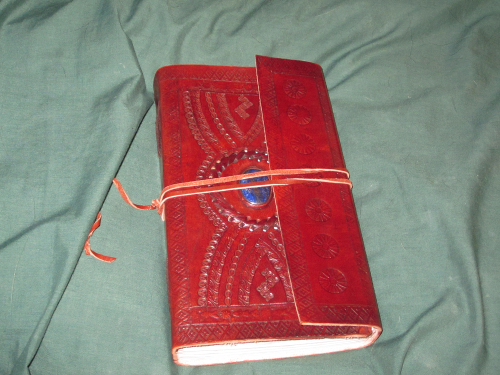
A wee side note here: I’ve started using the super-cool journal my friend Margaret gave me for Christmas.  Embossed leather cover with a nifty semi-precious stone embedded in the leather, home-made, recycled paper laced into the cover.  I even have a refill that I can lace in when I’ve used up all of these pages.

Isn’t it just the coolest writer-gift ever?  I think so.

How is your creative project going?

A virtual tour of Mel’s office

I was inspired to blog this after seeing two similar posts from people in my writers’ learning network (hey professionally I can have a personal learning network, or PLN; why can’t I have a WLN?) Brian Braden, one of my critique partners from Author Salon, and Diana Gabaldon, one of my favourite authors.

I’d intended to do this as a vlog, or video blog, but I haven’t figured out my new tablet sufficiently to do a creditable job.

I’m going to do this a little differently than my compatriots though.  As with everything I blog, there’s a little story to go with this virtual tour.

Starting with the street on which I live.

My intent was to go out and take a picture of the street sign, but someone crashed into the post on which the sign used to hang last year, and while the post has been replaced, the street sign hasn’t.  So Googlemaps is the best I can do.  You can go there yourself and get the street view, but it’s from a few years ago.

But … did you notice anything about the street name?  That’s right!  It’s my last name.  It provides endless entertainment for just about everyone, and then I have to explain: yes, my grandfather bought the property that became Marttila Dr and then subsequently sold the lots to the city, who named the wee street after him.

And it is a wee street.  Please don’t go assuming I’m rich or something.  I don’t “own” the street, nor does anyone in my family.  I own the little house on the corner with the chunk of pre-cambrian shield in the unfinished basement and my mom owns the house next door.  Poor financial decisions on the part of a number of our family (myself included) mean that the house is all I have.

Sure, I’m gainfully employed and so is my husband, but all we have to show for our collective life’s work is a 2 bedroom bungalow on one of the busiest street corners in town.

We’ve made the best of her though, slowly renovating, inside and out.

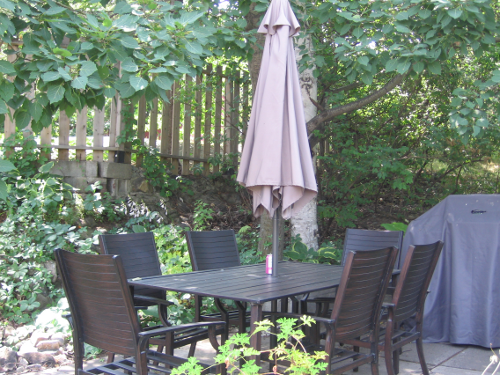
Before we head inside, I’d like to point out my summer office.

When it’s not insanely hot (like it’s been this year), I’m outside most weekends, days off, and even evenings with my lap top.  If you’ve ever heard that relocating for revision is a effective way of shifting your creative mind out of writing mode and into editor mode, I’m here to tell you it’s abso-frickin’-lutely true.  Works a charm for me at any rate 🙂

Now let’s move into the office itself.

The first thing that every office needs is a door.  Right now, my office door is one of the originals that came with the house and is painted white … over blue … over white … over ?  When I have a significant period of time off, I want to strip the door and polish up the brass handle like I did last year with the door to our bedroom.  So this is what it eventually will look like when I get it done 😀

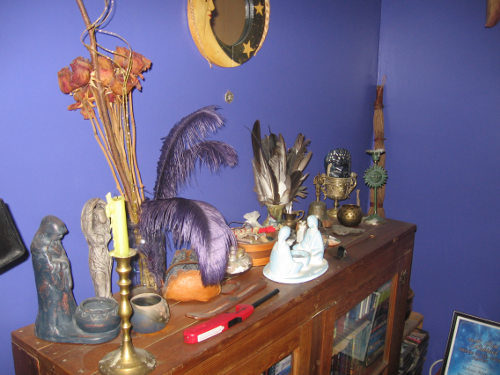
The first thing you see upon entering my office is this. Yes, it’s an altar.  I have distinctively pagan-ish, shamanic leanings.  What you may notice if you look down is that it’s also a bookshelf.  Another one of my stripping and refinishing projects, this cabinet used to hang on the wall of my mother’s  sewing room.  Originally, it was from the local school board.  My grandfather used to work there, and when they dismantled one of the schools, he nabbed this cupboard.  It’s crammed, top to bottom, with paperbacks.

Also, in the lower right corner of the picture, you’ll see my honourable mention from Ron L. Hubbard’s Writers of the Future contest.  Having just refinished the room (down to the studs and rebuilt from there) I’m still reluctant to poke holes in the walls, even for cool stuff like degrees and awards.

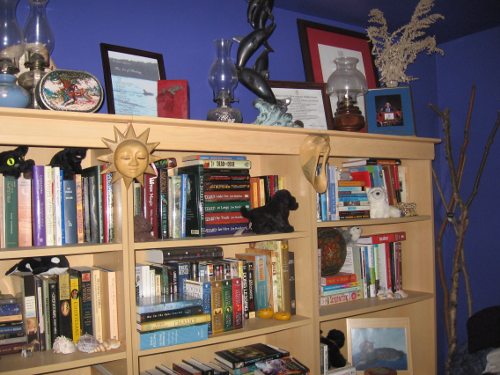
On the far wall are my three additional bookshelves, purchased to harmonize with the massive desk (in a moment, hold your horses …) I inherited from my mother-in-law when she moved about ten years ago.

The first shelf from the left houses historical and spiritual research books.  The bottom row is devoted to books on gardening and herbalism.  The middle shelf is overflowing with fiction I don’t want to store away, or haven’t read yet.  Like the paperback bookshelf, it runs the gamut from fantasy and SF, YA, classics, UF, to mysteries and literary fiction, etc.

The final shelf is populated with a number of my books on the craft.  Interspersed on the shelves are a number of objects I value: artefacts from family and friends, old tins, kerosene lamps, masks, my degrees, my picture from the alumni address I gave a Laurentian University a few years ago, and a couple of framed poems, “Fire and Ice” which was featured in the ekphrastic art project Fusion, and “The Art of Floating,” the poem I wrote for my dad.

The rest of my books are stored in approximately twelve Rubbermaid tubs in the basement.  Yup.  I’m a book addict, and happily so.

In the corner, you will notice three staves.  Actually, it’s one poplar staff, and one birch and one maple stang. All generously donated by the trees in my back yard (resulting from lightning strikes and wind storms).  Another project for the future: stripping the bark from these lovlies and waxing them to preserve.

Now comes the organized chaos I call my desk.

The first picture shows a collection of journals (the ones I write in and the ones I have subscriptions to), a few key reference books including the Guide to Literary Agents and Novel and Short Story Writer’s Market, research DVDs, binders containing three earlier versions of my novel, my BIG binder of AS critique material, my Brother inkjet printer, and various pens, pencils, highlighters, clips, push-pins, and other tools that I make use of at my desk.

The keen observer may notice the ashtray and the wine glass.   Yup.  You caught me.  I’m a vile smoker and I drink wine on occasion.  Once again, unapologetic about it.

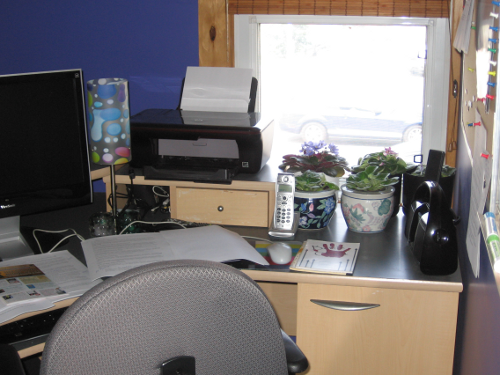
The second picture doesn’t look quite so chaotic, but shows the rest of what’s on my desk.  My computer, whatever project I’m currently working on (in this case, Rachel Walsh’s The Last Scribe) underneath which hides my laptop, my colour printer/scanner/copier (currently on the fritz), a couple of my poetry books, my African violets (green things essential), and my i-pod (in the corner, also essential).

Behind my desk, on the wall, are my cork board and white board.  On my first and second revisions (after the draft has been completed) I use these extensively to map out my story and make notes.  As each piece of paper is addressed, it comes down for shredding and as each note is incorporated into the novel, it’s erased.

Right now, the board it just reminding me of outstanding submissions I haven’t heard back about yet, my blogging schedule, and calendar.

And that’s it.  I didn’t clean up on purpose, because I thought I’d let everyone see what I really work like.

So I hope you enjoyed this little tour.  Take comfort in the chaos!  My office is as much a part of my process as a writer as anything else.

What does your office/writing space look like?  How does it reflect your process?

Work-Life-Creative balance … and resources!

I was inspired to write a little about work-life balance because of something my manager sent out to the team last week.

It was his newsletter from David Irvine, titled Quantity or quality of life, what really matters?

In the article, David recommends the following:

  • Relax, stop entering data in the computer, and take a deep breath;
  • S-l-o-w d-o-w-n long enough to actually look into the eyes of a person you care about and experience the love between you;
  • Smile at a stranger;
  • Stop and let the beauty and magnificence of a plant in your office be a part of your awareness;
  • Offer a word of acknowledgement and encouragement to a colleague;
  • Do something that leaves you nourished: have a hot bath; go for a walk in a part of nature that you enjoy; spend time with a good friend;
  • Let a child make you laugh;
  • Stop and watch the sun go down behind the hill and experience, with awe and gratitude, the beauty and wonder that surrounds you.

Today, Julie Czerneda sent this wonderful video my way:

It got me thinking …

When I lived in Windsor, the starlings that lived in the Ambassador Bridge were, quite frankly, a nuisance.  When I saw how they flew in murmurations though, I was touched and inspired to write a poem about it.

Sometimes all you need is a moment of beauty to give you pause, and help reprioritize your life.

Last week, Phil and I lost our internet service.  No email, blogging, or other social media for an entire week.  My initial reaction was panic, but then I recognized the crisis for the gift it was and took an unplanned, but very welcome SoMe fast.

Years ago, I just worked, and worked part time at that.  I fit my writing in when I could (which wasn’t often, because I wasn’t a writer then, I just thought I was).  Then the day came when I had the epiphany, and I worked the day job, then came home and wrote.  Where did I find the time?  I realized what was important to me and found the time for it.  I reprioritized.

When I became a trainer, not much changed, until another epiphany, this time at work, led me to the world of informal learning and social learning.  It was another kind of reordering in my life.  I found the time at work not only to do my job, but to feed my ravenous appetite for knowledge.  It’s paid great dividends for me: Service Excellence Award and an acting position as a Training Coordinator among other, less formal forms of recognition for my hard work.

Last fall, when I first started blogging and building my platform, then joined Author Salon and started critiquing my butt off, I started to falter.  I was doing too much again.  The three to four hours a night I used to devote purely to my writing was suddenly spent curating content, blogging, critiquing, and doing anything but working on my novel.

In the month of May, I hardly spent any time writing at all.  Broke my heart in all kinds of ways.

Last week, when we lost service, I wrote.  I reconnected with my work in a way that I hadn’t been able to for months.  I realized where my priorities should be.

So now I’m back working seven and a half hour days, building the platform at night, and yes, writing.  It’s not perfect yet.  Two hours of tonight’s allotment has already disappeared, but now I see where the fulcrum is.  Now I can learn how to find my balance again.

All I needed was a good “claque western” as the Northern Ontario French say 🙂

How do you keep your work-life balance?  Do you?  What challenges have you faced and have you found a workaround or kluge?

Now for the resources:

I’m a big fan of Cammy Bean of Kineo too, and gleaned a handful of wonderful resources courtesy of her blog (which I subscribe to):

Until next week, the Learning Mutt is signing off 🙂

Challenges become opportunities: The Author Salon Experience

Back in December, I joined Author Salon on the advice of one of the people I consider to be my writing mentors, Barbara Kyle.

Initially, I had no clue what I was getting myself into.

My first mistake was not reading anything before I signed up, so when I was presented with a profile to fill out, I dove right in.  Little did I know that there was an art to this …  I did read the AS step-by-step guide, belatedly, but I still had no clue what I was doing.

I set up my profile to the best of my ability, sounded off in the Shout Out Forum, and then posted a call for peers in the In Production I Forum group that seemed to suit me best: Fantasy, Urban Fantasy, Horror, and Speculative Fiction.

The initial group that formed was small, but dedicated.  We started off by critiquing each other’s profiles.

Now, this may not seem particularly important work, but part of the AS process is that professional editors and agents peruse the site from time to time.  Ultimately, the author’s profile will be a marketing tool to those same agents and editors, so it is a critical piece of the AS puzzle.

It’s as important as perfecting your “pitch” or logline, as important as writing a knock-their-socks-off query letter, in short, the AS profile is as important as it gets.

I’ve been at a bit of a disadvantage because I’ve not yet attended a conference where I’ve had the opportunity to “pitch” my concept to agents.  I haven’t started shopping my novel yet, and so I really don’t have any experience crafting a query or synopsis.  I really don’t have an idea about what a hook line should be and how it differs from a conflict statement.  But I’m learning …  and I have to learn fast.

I thought I knew at least one thing going in: even if you have a series planned, the novel must function as a stand-alone, but it seems that everyone else in my critique group is using the fact that they have a series planned as a selling point.  So now I’m fairly convinced that I know nothing, and am approaching the whole process tabula rasa.

One question posed to me was, “why mention your day-job?”  The point was that the information should only be included in the event that it lends to the topic you write about, like a retired police officer writing mysteries/police procedurals.  I’d like to address that here.

As a learning and development professional, I write courses.  Certainly, it’s a completely different beast than a novel, but writing is writing and any practice reinforces skill.  It develops my rhetorical skills to direct my writing to a particular audience with a particular purpose in mind.

Also, as a corporate trainer, I have presentation skills.  It’s a good marketing point and while it may not be on the top of every agent’s list of skills an author must have, it may be an asset that tips the scales in my favour.

I’m more likely to be comfortable in an interview situation, doing public readings, and participating in workshops or conferences on a panel.  I’m tech-friendly, if not tech-savvy, as the result of my work.  I could easily put out YouTube videos or podcasts regarding craft, or reading of my work (in fact, it’s something on my list of things to do for my platform).  I could even parlay my skills into delivering Webinars or tutorials.

Finally, it was my learning and development day-job that got me back into learning-as-lifestyle.  Mutant learning, social learning, independent research, call it what you want, it’s what I need to ramp up my profile and my writing as presented on AS and attract the attention of agents and editors.  I started developing my online platform as a writer thanks to my work in L&D.

What I learned about Initiate of Stone in the first go-round:

  • It was too long;
  • It was too complex:
  • I’m too wordy; and
  • I’m not very good at seeing the redundancies in my own work.

Then, in January, all of my critique partners left In Production I and were promoted to Editor Suite.  Most of them had attended an Algonkian Conference which acted as their respective invitations to AS.  They all received personal notification to move along.  I thought I was left behind.

So I started over with a new call for peers and waited.  Eventually the administrators realized that there was some kind of miscommunication and offered a clarification.  I was promoted to Editor Suite after all!  My relief was immense.

My new critique group in Editor Suite included all of my old friends, plus a couple new ones.

The first order of business was to start over with the profile critiques, and when that was done, we moved onto critique our first acts.  AS calls them the first 50 pages, but I prefer to call it the first act because it’s actually the first 50 -100 pp, depending on where your first major plot point falls.

What I’ve learned from the critique of the first act:

  • My first major plot point takes too long to arrive;
  • The story line for my protagonist needs to be seriously amped up;
  • I still suck at the profile stuff (that’s part of what I’m working on next);
  • I may be wordy, but given my chosen genre, epic fantasy, it works, overall.

Along the way, there was this thing called the Showcase.  AS reps would be showing a foreshortened version of our profile to industry experts and seeing if they could get any interest.  The call went out about the time that the former version of this blog was hacked and there was a little confusion while I reordered my electronic life.  The server on which my blog was hosted at the time was also my email server …

Got that mess sorted, but even though the Showcase went on until May, IoS did not get a single nod.  Almost everyone else in my critique group, however, got at least one, and many received multiple expressions of interest.  I’m very happy for my peers, but really disappointed in/for myself.  This just speaks, once again, to the importance of the AS profile in the overall process.

What I’ve done or am doing as a result of all this:

  1. Cut my novel in half.  The former mid-way point is now the climax and I still have to cut about 40k words.  I don’t know how this will turn out, but I’m willing to work at it until it’s fabulous 🙂 ;
  2. Rewriting Ferathainn’s story/plot line;
  3. Revamping my profile;
  4. I’ve applied for, was accepted to, and have registered for Algonkian’s New York Comes to Niagara conference in October.  If nothing else, I’ll learn how to get my profile together there.

So we’ll see where this all takes me.  The AS journey has been fraught and fun and incredibly hard work so far.

That’s it for this week bubbies!  Gotta get working on my WIP!

For my science fiction writer friends, I want to post links to Robert Sawyer’s two-part January interview with William Gibson:

Also check out Robert’s TedXManitoba lecture:

Are you part of an online critique group?  What have you learned from the process?  How is it changing your creative life?

Two approaches to novel structure I recommend you check out!

I’m no expert with regard to writing a novel.  Admittedly, I’m still revising my first one, and while I’ve had some modest success with my poetry and short stories, I’m a complete n00b when it comes to the mechanics of the novel.  I’m learning as I go and I’ll share these bumbling lessons in my Work in Progress category, but for this week’s Alchemy Ink, I thought I’d do a little curating.

In the past couple of weeks, I’ve come across two of approaches that attracted me and that I intend to follow through to their blogging conclusions.

Why did I gravitate to these two writing bloggers?

The short answer is that I’m floundering.  I’m working with a peer group in Author Salon and part of that entails the presentation of my project in a formatted profile.  I’ve never queried an agent before, never participated in a pitch slam, or in a workshop that focuses on developing a pitch, hook, synopsis, or any of the other components of the profile.

In recent weeks, both the critiques of my peers and the advice of AS staff have brought several things to my attention:

  • My synopsis misses the mark.  The synopsis we’re asked to produce for the AS profile must be between 200 and 300 words and so is what’s been described to me as the short synopsis.  This is something that might fit into a query letter and could be analogous to the blurb on the back of a book.  The specific form still escapes me at the moment.
  • My hook line doesn’t ‘hook.’
  • My conflict statement isn’t well-defined.  My plot is very complicated and I can’t seem to distil everything into a concise, yet clear statement that addresses internal, interpersonal, and plot level conflicts.
  • I didn’t have a series title, and the title of the novel didn’t resonate with most of my readers.  This is still in flux.  I’ve chosen a series title and changed the working title of the novel, but there were reasons that I chose the original.  I won’t go into those here, but at least one peer thinks the original was better.
  • My original novel was far too long.  I’ve had to cut it in half and that’s changed a whole whack of things.  When initially confronted with this, I was defensive, and unwilling to move, but after my initial panic, I recognized that I didn’t have to take the scorched earth policy and destroy what was a 295,000 word opus.  So I’ve chosen to break the novel up, using the mid-point as the new climax and am editing down from there to a neat 110,000 words.
  • My climax and denouement are not well defined.  This owes to the above re-envisioning of my novel.  Reworking a mid-point to a climax has brought with it its own challenges.

Other issues have become apparent to me in the process:

  • My protagonist’s story arc is not dynamic in its early stages.  There’s a lot of internal conflict, and some interpersonal, but not much that relates overtly to the plot.  It all relates to the larger story arc, but that doesn’t become apparent until later on in the novel.
  • There’s a lot of disembodiment going on.  This is a tough one.  I can fix the POV issues that contribute to some of this, but dream/out of body experiences and shamanic journeying are central to the story.  I’ll have to let this incubate for a while and write through some of the possibilities.

I’m going to need some help working through all of this.

So what are the two approaches already?

Karen Woodward and the Starburst method

I caught on to Woodward with Part 3 and backtracked through her blog posts from there.  There are ten parts/steps to the process, so I’m going to be following Woodward through them from here on out.

Part 1 entails creating a one sentence description of your story.  This equates to what, in screenwriting circles, is called a log line, or what AS is calling the hook line.  That alone made my Writerly Goodness ears perk up (Didn’t know my authorial alter ego was a dog?  Take a look at the site mascot 😛 ).

Part 2 takes that one sentence and creates from it a five sentence paragraph.  This might make a zippy short synopsis.  Woodward discusses the three act structure here as well, another takeaway from the screenwriting world that has been successfully applied to novel writing.

Part 3 expands each sentence into its own paragraph.  By now, I think I have a decent idea of where the Starburst method is heading, but I’m still curious enough to follow through with it and see where it leads me.

K.M. Weiland and the Secrets of Story Structure

Late to the party with Weiland as well, I didn’t pick up on her series until part three, and was reminded of it this week when Porter Anderson reposted a link to part five in this week’s edition of Jane Friedman’s Writing on the Ether.

Why I like Weiland’s approach

What struck me immediately was that Weiland’s secrets are both organic in nature, having emerged from her own process and experience, and very clear.  Ideas and insight started to pop as soon as I read her first post.

Part 1 answers the question: Why should authors care?  It made complete sense to me.

Part 2 deals with the hook in its story structure form as opposed to the hook line that AS wants.   Still, the way Weiland describes the hook offers insight into what (perhaps) should and shouldn’t be present in a hook line.  It’s the question that the protagonist, and therefore the reader, needs to answer.  For the writer, it propels the plot; for the protagonist, it sets her feet on the hero’s journey; and for the reader, it keeps him or her reading until the question is answered.

Part 3 covers the first act.  How do you introduce your characters, the setting, and the plot stakes?

Part 4 defines and illustrates the first plot point.  What is the first major plot point and how does it differ from the inciting incident and the key event?

Part 5 goes into more detail with regard to the inciting incident and the key event.  At each stage, Weiland uses the same set of examples to illustrate what she’s talking about and solidifies the takeaways in point form at the end of her posts.  Excellent blogging form 🙂

These last three together are important factors to consider in writing the first part of your novel, what AS calls your “First 50 Pages,” but admits could be as many as 100 pages.  This is also part of what’s critiqued  in the AS process and something I may have to rewrite substantially.

I’ll summarize by reiterating my invitation to check out both of these blogs.

Have you come across any excellent online resources regarding novel or story structure?  Please share!