Tipsday: Writerly Goodness found on the Interwebz March 9-15, 2014

TipsdayThough I had all of one respondent to my poll at the end of last month, I’m going ahead and curating for you.

Part 5 of K.M. Weiland’s Creating Stunning Character Arcs series. You can follow from the beginning, Katie is always good about posting the links to all that has gone before.

http://www.helpingwritersbecomeauthors.com/2014/03/character-arcs-5.html

How commenting on blog posts can help build your platform. Anne R. Allen’s blog (with Ruth Harris).

http://annerallen.blogspot.ca/2014/03/are-you-ignoring-this-simple-platform.html

How knowing your audience and identifying your category is critical to querying, placement of, and marketing your book. Roz Morris.

http://nailyournovel.wordpress.com/2014/03/09/is-my-book-paranormal-or-literary-and-which-age-group-is-it-for-how-to-categorise-your-novel/

Why you should pitch at conferences even if you don’t think you’ll succeed. The importance of Networking by agent Carly Watters.

http://carlywatters.com/2014/03/10/why-the-chances-of-you-meeting-your-future-agent-at-a-conference-are-slim-but-you-should-try-anyway/

The many roles of the editor.

http://www.theguardian.com/books/booksblog/2014/mar/12/writers-editors-eleanor-catton-booker-winner

Rejection letters that will give you hope 🙂

http://distractify.com/people/famous-people-rejection-letters/

You’ll see some regulars here from week to week. I read a lot more bloggage than I’ve shared here and I’ve even gotten some good material out of a lot of it, but I’m only gathering up the material that spoke to me enough to share on the interwebz.

Hope you enjoy these as much as I did.

Feeling old

March will be a busy month for me. I was out of town this past week for training, and will be heading out again tomorrow and for the last week of March.

Though I was happy to have the opportunity to pilot the training I worked on for most of February, I noticed something while I was away last week.

I was exhausted.

I didn’t have the energy to write in the evenings. I didn’t sleep well.

I know a lot of trainers who travel frequently, and many of them take sleeping pills. I can’t. I tried at one point, but couldn’t take the side effects. I’m not fond of the side effects of most medications, but that’s another story.

I used to really enjoy the opportunity to travel for training. I’d get my work done during the day, go out with class members or co-facilitators in the evenings, and still manage a decent day’s writing.

Over the past couple of years, I’ve noticed that I just can’t do it anymore. I can only pack so much into a day. Or an evening.

Last night, my mother-in-law commented how the circles under my eyes look so much more pronounced than usual.

Feeling old, with the grey hair, wrinkles, and dark circles to prove it :P

Feeling old, with the grey hair, wrinkles, and dark circles to prove it 😛

It’s a family trait, but I do look more bruised when I’m tired.

I’ve never been one to have those traumatic, age-related realizations that others have.

  • At 20: I’m not a kid anymore.
  • At 25: I’m a quarter century old!
  • At 30: My baby-making days are numbered (for women only).
  • At 40: I’ve lived half my life at this point, and what have I to show for it?

I’ve not hit the big five oh yet, so I can’t go any further than that, but I’ve never felt any of that age angst that friends have reported. And mostly, it is women. At least, I rarely hear of a man complaining about his age.

Aches and pains, yes. Age angst, no.

I’ve always felt young, relatively speaking. I may have felt fat, or prematurely winded because of smoking, but neither of those are age-specific complaints.

This past year, however, I have been feeling increasingly old. O.L.D.

It’s interesting more than distressing, but it’s also inconvenient. I need to write. It’s not an option anymore, and when I can’t write, I feel legitimately crappy. If I can’t write because I’m feeling crappy to begin with, that only makes me feel worse.

This can result in a negative spiral that leads to burn out and depression. I know those two feelings. I need to manage them carefully.

I just have to remind myself that I am enough, that I’ve done enough this day, and that it’s been a good day, because in most cases, it’s true.

We can only do what we can do. We can get back on the horse the next day and rock it.

How about you, my writerly friends? It doesn’t have to be age, but life has this habit of happening while we’re making other plans. Are there things over which you have no control that complicate your life? How do you cope?

Please share.

Series discoveries

I haven’t posted about my television viewing since the fall. At that time, I wrote of my disappointments with various television series in the past.

I had some fairly high hopes for some of the new series. That’s what I’m going to spend a little time on today.

First, I’ll remind you that I do watch television and movies with a writer’s eye. That is, I look at the plot lines and the story overall, the character development, and I try to analyze why I like watching it, and not simply accept that I do and blank out on the couch for an hour.

I’m a critical thinker. What can I say?

So the new shows I’ve watched and liked this season are:

Almost Human

When I saw this one listed and read the preview, I thought that it would be a take on I, Robot, the novel by Asimov, not the Will Smith interpretation, which I must say was entertaining, but had as much to do with the text upon which it was based as Blade Runner had with Dick’s Do Androids Dream of Electric Sheep?

Plus, there was the added attraction of Karl Urban. Hey, I don’t always have to be deep and thought-y, do I?

I’m enjoying AH, though it has been basically police procedural with a small twist for the most part. I’m waiting for the pay off of the Detective Kennex’s inciting incident: the failed assault which resulted in the deaths of his squad, the loss of his leg, and a 17 month coma.

Kennex bears the responsibility for the failure of the assault and the loss of his squad. He is teamed with a DRN android whose line has a history for going crazy. So two pariahs in arms. A buddy drama.

Bitten

This one is a mid-season offering from Space based on the Kelly Armstrong novel of the same name. It’s about werewolves, in the broad sense.

I’ve only seen a few episodes so far, and while the main plot continues through each episode, the cast is still in the character development stage. After establishing the crisis (murders of humans by renegade werewolves, or mutts), the series has gone into backstory mode.

The jury’s out on this one.

Dracula

I’m enjoying Dracula far less than I thought I would.

I appreciate the reengineering of the story and the tie in with Tesla (Greyson, Dracula’s American Industrialist cover is developing a new energy source that threatens the oil and coal interests of the wealthy in Britain). I like the strong(ish) women characters.

It’s too easy to dislike Harker, though, and the highlight of the show (for me) is Renfield, the voice of reason in a howling vortex of loose plot threads.

It’s hard to admit I like Renfield better than Jonathan Rhys-Meyers’s Dracula.

The concept isn’t strong enough to breathe life into the undead. Eye-candy aside, if I miss a week, I find I don’t really mind.

Intelligence

This is another mid-season offering and I like the premise, but I’m not certain about it yet.

An agent named Gabriel, with a special genetic affinity, has a computer chip installed in his brain. He can access the internet anytime he wants. The project is called “Clockwork.”

He’s not only a kick-ass spy, but he is also an asset, and so must be protected. They bring in a secret service operative to do this, and though Riley does prove herself, I was left wondering at the choice.

There seems to be a lot of potential in the series, but there is also a lot of potential for bad science and plot holes.

In the first episode, another person has the chip implanted. This, of course, becomes Gabriel’s nemesis. His wife ends up being a terrorist and she kills herself in a suicide bombing. Almost immediately, sparks seem to be flying between Gabriel and Riley, and I was disappointed in how they handled the whole situation. Gabriel was initially so devastated by his wife’s defection and death that he tried to hide in a bottle.

In any case. We’ll have to wait and see on this one, too.

Once upon a time in Wonderland

Like its parent show, Once Upon a Time, OUaTiW turns the Disney standard on its head and does a bizarre bit of a mash-up with the main character.

In this version, Alice is a young woman, having survived both her adventures in Wonderland, and the battle in the “real” world against those who believe her to be insane, including her family.

The mash-up comes from her love interest, a genie named Cyrus, and the two antagonists battling for control of him, the Queen of Hearts, and Jafar (from Aladdin).

Alice is helped by the Knave of Hearts (the Queen’s former love), and the unreliable White Rabbit, voiced by John Lithgow.

I haven’t seen any cross-over action yet, and don’t anticipate it, given the disparate settings (Victorian England vs. modern day North America).

While I enjoy the quirkiness of the story and the visual oddities of Wonderland, I’m wondering where the plot will go. As of the last episode, the Knave, having helped Alice and Cyrus reunite, is now the new genie in the bottle.

It’s a bit of a ramble, but I’m willing to indulge the writers a while yet. Sometimes an interesting concept will trump a good plot (for a while).

Sleepy Hollow

Another reboot, this time of the Washington Irving story. It’s a favourite of mine, so on the strength of that alone, I’m willing to indulge the series for a while.

In this incarnation, Ichabod Crane is not a school teacher, but an Oxford professor who enlisted in the British Army against his father’s wishes. Fighting against the Americans in the War of Independence, Crane defects and ends up serving as an agent for General Washington himself.

In his final battle, he faces a soldier known only as “The Hessian” and decapitates his foe even as he is dealt a killing blow. The two die and their blood mingles. Crane’s wife Katrina, a witch, casts a spell which will awaken Crane if ever the Hessian comes back from the dead.

In modern times, Crane wakes, and has to adjust to life in the 21st century while trying to defeat the Hessian, who, it is revealed, is Death of the Four Horsemen of the Apocalypse.

With him are Detective Abbie Mills, her sister Jenny, and Chief of Police Irving, played by Orlando Jones.

The writing for SH has been a lot tighter than for some of the other series and the plot is far more intricate.

Death, it is revealed, is Crane’s old friend, turned competitor for the woman they both love, Katrina.

In the last episode I saw, War is a man Crane and Mills thought of as a friend, but who is, in fact, Crane’s son and in a jaw-dropping final scene, Death rides off with Katrina, recently released from limbo.

Crane is devastated.

There’s a lot more to the story than what I’ve written here. Every character has a stake in the plot beyond the obvious (save the world). So far, I find it very well done.

Then again, I like intricate plots that engage my brain.

A note on reboots/mash-ups

Phil has lamented the state of television (and movies) for some time now, declaring that Hollywood doesn’t have an original thought in its collective head.

I tend to agree, but I also find that if I can set aside the obvious complaint (could they not have written an original story with these elements and have done equally well, or better?), I can enjoy the story and series.

He also dislikes the tendency of North American studios to copy British or French shows of better quality. The British version of Being Human is far superior to the North American, in my opinion. And both are shown, sometimes on the same network. Why show up one series as a shoddy copy of the other?

Bonus: Homeland

I’ve watched season one of Homeland on Netflix and am now catching up on season two courtesy of Bravo.

This is an original series, and I really like it. It’s clever, and gives its characters a lot to deal with.

Carrie Mathison is manic depressive, a disease she’s hidden from her employer and coworkers. She’s an intelligence analyst for the CIA and she is obsessed with the terrorist Abu Nasir. She discovers that Nasir has “turned” an American soldier, though she doesn’t know who.

When US marine Nick Brody is rescued after eight years as a prisoner of al-Qaeda, Carrie immediately suspects him.

It’s very well-written, and extremely well-acted. I love Clair Danes, Damian Lewis, and Mandy Patinkin.

The plot is so complex, with so many unexpected turns, I can’t even attempt to give you a summary that will do it justice, and the characters are so well-drawn that their actions are always logical in context.

I know that they’re already into the fourth season, but we don’t receive Showtime here, so I have to wait for Netflix, or put out for the DVDs.

So that’s what I’m watching these days.

Series discoveries

How about you? Have you seen a new series that gives you the frissons (shivers)? One that makes you sigh and give up hope for originality or quality programming? Have you learned anything from these series that you could apply to your writing?

It’s all good.

Caturday Quickies: On inspiration

Place as inspiration

As I mentioned in the first of today’s (not-so) quickies, I was in Chatham this week.

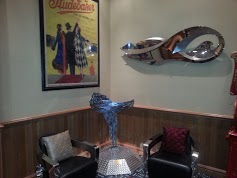
The place I stayed in was an amazing hotel called the Retro Suites.  If you’re ever in Chatham, I’d recommend it, just for the fabulous quirk factor.

The owner restored classic cars for years and you can see a lot of that material  has made its way into the hotel.  Fenders turned into benches, tools turned into sculpture and art.

retro7

A “school” of vice-grips 🙂

retro6

An assemblage of dispirate art and antiques

The owner is a massive collector as well.  Throughout the suites, framed classic movie posters, old microphones (including one from Elvis and one from the Voice of America) and radios, vintage furniture, tables made out of the tail-pieces of WWII bombs, authentic Turkish samovars, and paintings by one of the owners’ family members grace the walls.  He even has a couple of the FAO Schwartz tin soldiers in there.  You can spend hours just wandering around the joint.

A pair of FAO Schwartz tin soldiers with automotive-part furniture

A pair of FAO Schwartz tin soldiers with automotive-part furniture

Each suite is decorated in theme.  My suite was the “Chrom-e-delic.”  I’m sure you can see the mod 70s influence 🙂  Go to the site (linked above) and see some of the other suites for yourselves.

retro8retro9

The hotel is actually a block of converted and renovated buildings.  It’s a wonderful maze in there and inspired an idea for my third (of thirteen) original short stories for Kasie Whitener’s Just Write: 2013 Short Story Challenge.

Books as inspiration

I started reading Catherynne M. Valente’s Palimpsest this past week.  Just previous, I finished Deborah Harkness’s A Discovery of Witches, which features as its MacGuffin, a palimpsest, or book within a book.  Picking up Valente’s book next just seemed the logical extension in my mind 🙂

I was struck by Valente’s lyrical style of writing.  It reminded me of a couple of other books I’ve read: Kathryn Davis’s The Thin Place, and Richard Grant’s Views from the Oldest House.  I’m not sure why I associate them, but I think that, once again, it has to be the quirk factor.

This too, is feeding into my new story 🙂

Dreams as inspiration

I’ve often mentioned that I, like many other authors, draw inspiration from my dreams.  I’ve had a couple this week that I’m going to keep in the idea file.

One, though I think I’m going to play with the particulars a bit, is about a family of vampires (hence the playing, I don’t think another book about vampires could be published any time in the next few decades), who hire a human investigator to discover why their fellow creatures want to kill them.

The dream was more detailed, of course, but this is just to give you the basics.

The second dream is a little more bizarre.  A group of refugees (what they’re running from was not clear in the dream) take refuge in what looks like the ruins of a castle, but turns out to be sentient.  Not only that, but as they explore the castle, they come across indications that at least one of them has travelled to the past, and left messages for them to find around the castle.

Definition of inspiration (courtesy of the Miriam-Webster Online Dictionary)

1
a : a divine influence or action on a person believed to qualify him or her to receive and communicate sacred revelation
b : the action or power of moving the intellect or emotions
c : the act of influencing or suggesting opinions

2
: the act of drawing in; specifically : the drawing of air into the lungs

3
a : the quality or state of being inspired
b : something that is inspired <a scheme that was pure inspiration>

4
: an inspiring agent or influence

in·spi·ra·tion·al adjective

in·spi·ra·tion·al·ly adverb

What inspires you?

Writer-tech: Asus Transformer and Samsung Galaxy Note II

I’ve always been a bit of a technophile.  I think it comes from the fact that Phil is computer-dude supreme, a genius even, or, as one of our friends once called him, an ass in jeans 🙂  I like to joke that I learn things from him through osmosis.  I’m fairly certain that if it weren’t for Phil, that I’d still be tech-clueless and likely in a lot sorrier shape than I am now.

I’m still tentative about some things though, and learning something new in the technical realm that I’m not particularly motivated to learn can still stress me out.

Once upon a time …

In another life (that’s how long ago it was), I had an interest in creating Web pages, and with Phil’s help, I learned how to do basic HTML scripting, you know, the kind that you had to type out in Wordpad, tags and all?  I’d do my own graphics too, real basic stuff, that I’d put together in a freeware imaging editor that I no longer remember the name of.  I use The Gimp now 🙂

I did a few Web pages for some of my employers at the time: Huntington University, The Art Gallery of Sudbury, and ACCUTE (the association of Canadian college and university teachers of English).  Eventually, I graduated to Microsoft FrontPage, but I couldn’t compete with the new Web page design companies that were plentiful even in a place like Sudbury.

I maintained listservs too, and brought at least one employer into the world of Yahoo! Groups, then the only game in town, so to speak.

Enough of my techie history though.  I just wanted to give you some perspective, and to set the stage for my next revelation.

Let’s do the Time Warp!

Fast forward a few years and here I am happily writing away with a desktop, laptop, and USB keys to affect file transfers.  I was a confirmed bibliophile too, lived the smell and the feel of books, and didn’t want to enter the world of ereaders even after Phil bought one (a Kobo, by the way).  As Rupert Giles said to Jenny, knowledge should be … smelly.

I’d started my blog, been hacked, restarted my blog and was on a dedicated mission to build my platform.  I didn’t even understand what that was to begin with; I just know that I should have one.

My phone was what I affectionately called a “dumb” phone.  It was the dumbest I could find when my contract came up.  Called the Doro phone, it was marketed at seniors 😛 with a big number pad and no camera on board.  I had a digital camera.  I didn’t think I’d ever have need for anything else.  I just wanted to be able to make a phone call, and to receive one, maybe text a friend every once in a while.

Then things changed

I got tired of the dumb phone and its limitations, of paying more than half of what my friends were for their I-phones and Blackberries.  As my shelves were quickly filled with paper books, I began to see the benefits of an ereader.

Phil had given his Kobo to his mom and purchased an ASUS Transformer.  He began to use it every night, reading books off Project Gutenberg, comics, and even watching Netflix in bed.  I began to see the attraction.

So, I bought my own ASUS Transformer, and I love it!Transformer1

First, it was super easy to set up and learn how to use.  I was downloading apps from the first day.  There’s more than enough space on the dear little thing to keep me happy for a long time.

Second, it has a suppementary keyboard attachment which extends the battery life, memory, and data ports, as well as helping to protect your investment.

I have access to internet, email, all of my social media, WordPress, and just about anything else I’d want.  The only down side is that it’s not so easy taking my writing on the road.  Polaris Office doesn’t do a bad job, but there are some features that I’ve just gotten used to in Microsoft Word that Polaris doesn’t understand or offer.

Dropbox has the potential to replace my USB though 🙂

transformer2I also have, with the tablet, not only Kobo’s, but Amazon’s app too, so now I can read whatever I want wherever I want 🙂  I also have news, comics, and other readers, so I’m pretty much loaded for bear.

Plus, it has a camera/video recorder with voice recording too!  Can my dreams of podcasting and vlogging be far off?

The Transformer’s all but made my laptop (and my camera) obsolete.  Who knew that an upgrade could actually lead to an overall reduction in the amount of tech I own/use?

plus ça change, plus c’est la même chose

(The more things change, the more they stay the same.)

Around my birthday last year, I had done a lot of word-of-mouth research, asking friends and coworkers about the kinds of smart phones they had, about their service providers, and contracts.  How much were they paying a month and what were they getting for the price?

I’d had my eye on the Galaxy Note since Guy Kawasaki reviewed his purchase of one.  I looked up every review and the worst anyone had to say about it was that it was a little big.  Big whoop, I thought, I’ve got decent-sized hands.

As serendipity would have it, my service provider sent an upgrade offer to my email.

Phil, who used to have his own cell phone, then tired of it, had been forced back into a contract by his employer.  Then, as a cost-saving measure, his employer introduced a cost-sharing program, whereby Phil could get his own phone again, and his employer refund him for part of the monthly cost by way of compensation for using the service for work purposes.

So when I mentioned the upgrade offer, and that I was seriously considering the Galaxy Note II, it was perfect-tech-storm time 🙂

Galaxy1We went out and got ourselves a couple of Galaxy Note II’s that weekend.

Phil now uses his note to read/watch movies in bed 🙂  It’s lighter than the Transformer, even without the keyboard.  We have a wireless network at home and Phil has one at work, so we’re going to downgrade his data plan.  He almost never has to use LTE at all.

I’ve found it a boon because I can keep track of my email and SoMe notifications at work and better manage the time I spend online in the evenings.  I haven’t yet graduated to using it to create blog posts at lunch or anything, but I can see that happening in the future.

It’s essentially a tablet with a phone and text capability.  Because it’s an Android, like my tablet, I can have all the apps I have on my tablet on my phone too.  Many of them will even sync up.

I love the stylus feature though.  Included in the Galaxy Note II’s applications is a note suite galaxy2which has everything from basic notes, to meeting minutes, mind-mapping tools, financial planning notes, greeting card creation notes, drawing apps, etc.  I haven’t explored these thoroughly yet, but I have used it for shopping lists, to do lists, and reminders.

galaxy3You can simply write on your note, or use the text conversion feature to change your handwriting to text.  It works great for me.  It’s only messed up once, when I was demonstrating the feature to a friend.  I can definitely see this replacing my journal some day, but I still have about 10 or so paper journals to write through first.

I’m not an early adopter

For some things, I’m the first person to take an interest and conquer the new tech.  This happens most often in my day-job.  In general, I’m not the first person to pick up the latest technology.  I like to wait until the manufacturer has worked out the bugs and someone else has tested the product first, often Phil.

I haven’t been very quick on the uptake with respect to all the writerly apps I can make use of on my tablet and phone either.  I’ve barely scratched the surface, so I’ll leave you with a few sites I found that were very helpful to me in selecting the best apps for my droid.

I hope this post will be useful to those of you considering a tablet or smart phone.

Tomorrow, there will be a brief pupdate.  Come on back now, ya hear 😉

Mel’s movie madness

Beware! Here be spoilers!

Cloud Atlas

Cover of "Cloud Atlas"

Cover of Cloud Atlas

Last Sunday, I attended the film with my mother, mother-in-law, and sister-in-law.  I was blown away.  Loved it.  Like any good meal, fine beverage, or other work of art, it wants savouring.  It takes time to digest.  And so, here I am, a week later, blogging about it.

First, a word about music.

In a previous life (only about 25 years ago), I was a music major.  Total miscast, that one 🙂  But I learned a few things that have stood me in good stead as a writer.

In my first year, I was introduced to the structure of symphonies.  Like most other art forms, symphonies tell stories.  They’re told in several movements and bound together thematically by the leitmotif.

Think of Bethoven’s Fifth.  The opening bars provide the listener with the motif.  The motif appears throughout the work in its rhythm and interval, but it transforms through key and tonality.

Another example is Berlioz’s Symphonie fantastique.  The leitmotif appears first as a lilting flute line, reflecting the main character’s beloved.  Through the movements, the motif transforms into a parodic witch’s dance on the main character’s grave and ultimately to the main character’s redemption.

Classical music is a wonderful exercise in structure.  Get into a music appreciation/analysis class sometime and you’ll see.

All kinds of good to be taken away to the writer’s desk.

So back now to Cloud Atlas.

Based on David Mitchell’s novel of the same name, the movie is a masterful symphonic composition.

Six stories play out simultaneously, weaving back and forth between one another and bookended by a seventh.

The movie begins with an old man telling a story around a camp fire under a starry sky.  His face bears markings reminiscent of Maori, or other aboriginal cultures, and he speaks in a form of pidgin English.

Though the movie moves back and forth between the stories constantly, I’ll lay them out in a more or less chronological fashion.

In 1849, lawyer Adam Ewing travels to the Chatham Islands to conclude a business contract for his father in law, Haskell Moore, a man famous for his tracts on the moral rectitude of slavery.  While on the islands, Ewing is horrified by the manner in which the slaves are treated.  He meets Dr. Henry Goose as he digs for evidence of cannibals and subsequently contracts some form of parasite, which Goose promises to treat for him.  One of the slaves stows away on Ewing’s ship and convinces Ewing first to hide him, then advocate for him.  Goose is actually poisoning Ewing in an attempt to steal his gold, and the slave saves Ewing’s life.

In 1936, gay composer Robert Frobisher leaves his lover in Cambridge and becomes amanuensis to famed composer Vyvyan Ayres in Edinburgh.  His goal is to complete his own work and while under the thumb of Ayres, he becomes embroiled in the drama of Ayres’s “Jewess” wife (remember this is pre-WWII), and seeks solace in the travel journal of one Adam Ewing.  He writes letters to his lover, Rufus Sixsmith.  Ayres hears Frobisher’s composition, The Cloud Atlas Sextet, and attempts to take credit for it.  Frobisher shoots Ayres and flees, completes his masterpiece living under the assumed identity of Adam Ewing, and ultimately commits suicide, leaving his work to Sixsmith.

We leap to San Francisco (coincidentally the home of Adam Ewing) 1973, where journalist Luisa Rey bumps into a much older Sixsmith, who is now a nuclear physicist.  Sixsmith wants to disclose something to Rey, but before he can, he is murdered.  As she follows the clues, Luisa discovers Frobisher’s letters to Sixsmith and falls in love with their story.  This leads her to a second hand record store where the proprietor plays The Cloud Atlas Sextet for her.  She determines to solve the mystery of Sixsmith’s murder.  At the reactor where Sixsmith worked, Rey meets Isaac Sachs, who gives her incriminating evidence against the plant’s owner who is purposefully looking to engineer a failure to feed Big Oil interests.  Though Rey becomes a target of the assassin, a war buddy of her father’s helps her out and she survives to write her expose.

In 2012, publisher Timothy Cavanaugh watches one of his authors throw a critic off a balcony in front of a room full of witnesses.  The spendthrift wastes the ensuing windfall and when the author’s criminal family come to claim their share of the profits, Cavanaugh flees to his long suffering brother, who institutionalizes him in a nursing home reminiscent of One Flew Over the Cuckoo’s Nest.  Eventually, in a series of comedic misadventures, Cavanaugh escapes and pens a screenplay of his story which becomes a major motion picture.  He also writes of Alexander Solzhenitsyn in his screenplay.  I believe Rey is one of his other authors.

In dystopian Neo Seoul of 2144, Sonmi-451, a fabricant waitress, comes to the awareness that she is a member of a slave race.  Freed by Hae-Joo Chang, a member of the resistance, she studies Solzhenitsyn and Cavanaugh’s movie as she is inducted into the underground.  Fabricants, told that they are going to ascend, are in fact slaughtered and recycled into the food that feeds them.  As the final battle between Neo Seoul military forces and the rebellion plays out before her and she watches Chang die, Sonmi-451 broadcasts her message of hope and freedom.  When she later tells her tale prior to being executed, she influences the man who interviews her.  He now believes as she does.

Finally, the post-apocalyptic Hawaiian Islands (approximately 2321) form the setting of the final story.  Zachry, a devotee of the goddess Sonmi, is plagued by visions of “Old Georgie,” his tribe’s version of the devil, after failing to save his brother-in-law Adam from the cannibalistic Kona.  A Prescient (the remnants of technological society after “the fall”) named Meronym visits from the mainland.  She is on a mission to save humanity by activating a distress beacon located on the island.  The beacon will send a call to humans who have settled off-world.  Radiation will kill everyone on Earth if they can’t evacuate.  In the process Zachry and Meronym find the recording of Sonmi-451’s broadcast.

We return to the even later, where the old storyteller, Zachry, finishes his epic tale.  His audience is composed of his many grandchildren.  At the end of the tale, Zachry shows one of the children where Earth winks in the sky, then ushers them inside where Meronym waits to embrace him.

While it may seem that I’ve spelled everything out here, I haven’t.  The story, or stories, are much more complex than that.

On Theme

When I first emerged from the movie, in a bit of a daze I must admit, my first thought on its theme was: The truth shall set you free.

While I still think this holds true, there are many themes in Cloud Altlas, just as there are many stories that intertwine throughout the movie.  Slavery appears overtly in Ewing’s story as well as in Sonmi-451’s, but prejudice and the abuse of power go hand in hand with it.

Homophobia and anti-Semitism appear in Frobisher’s story and the abuse of the elderly in Cavanaugh’s story.  Zachry’s tribe lives in ignorance and is victimized by the Kona.  Cannibalism features in Ewing’s tale as well as Sonmi-451’s and Zachry’s.

The abuse of power shows up in all the stories one way or another, from Haskell’s assertion that slavery benefits the enslaved, through Ayres’s attempted appropriation of Frobisher’s work, corporate espionage in Rey’s story, Cavanaugh’s commitment, and the “right” of the Neo Seoul hierarchy to create a slave race to serve society, to the Kona’s slaughter of Zachry’s people and the abuse of secrets withheld from them by the Prescients.

Knowledge is power could also be a theme as well as the enduring power of the creative work.

With regard to the leitmotif, the endurance and influence of the creative work is one.  Each story connects in some way to the next through the creative medium.  Ewing’s travel journal, Frobisher’s letters to Sixsmith and The Cloud Atlas Sextet, Rey’s expose and resulting career as a mystery novelist, Cavanaugh’s screenplay, and Sonmi’s broadcast.

The actors form another set of leitmotif, as most appear in every story.  The make-up and effects are stunning.

If I was still in school, I’d be writing a thesis on this movie 🙂  It is that good.

Best movie I’ve seen this year. It’s the true-true.

Writerly goodness, signing off.

The launch of Dead Air, Pontypool, and other Writerly Goodness

Last night was the official launch of my writer friend Scott Overton’s first novel, Dead Air.  I bought my official copy, Scott signed it, officially, I hung out with the other members of the Sudbury Writers’ Guild who came out to support Scott (his official fan club?), and he even got the official CTV interview 🙂

Before I get to particulars, I wanted to share a few more views of the Living with Lakes Centre at Laurentian University where the launch was held.  Yes, that’s the same place that Scott read with John Forrest and Mark Leslie last week for the LUminaries reading series.

I won’t say that I arrived early, but it looked like I had some time to walk around the grounds and I took a couple of pictures of the centre from a different angle, and then another looking out over Lake Ramsey from the centre’s dock.

Upon entering, I immediately gravitated to the huddle of SWG members.  We chatted and caught up a bit before the flurry of purchasing and signing got underway.

There were beverages, but word soon spread that the caterer hadn’t shown up yet.  Ever the consummate showman, Laurence Steven of Your Scrivener Press gathered the crowd and ushered us into the room for the reading.

One of the SWG members had thoughtfully brought cookies and just as Laurie apologized for the lack of provisions, the caterer arrived, the result of an understandable miscommunication.

With that sorted, Laurie made a brief but gracious introduction of Scott and brought him to the podium.

Scott first introduced his wife, Terry-Lynne, to whom his book is dedicated, his co-host for his morning radio show, and then he read three selections from his novel.  Afterward, he opened the floor to questions.

Scott spoke of his inspiration, the process of writing the novel, and the interesting things he learned on the way.  He also spoke about the editing process and how he and Laurie had negotiated that.

Overall, it was a very entertaining evening.

But I got this cold, see?  So when I got home, I crawled into bed like the little illen-filled chicklet I am and settled in for the evening.  In cruising the channels, I came across Pontypool.

In the movie, adapted from Tony Burgess’s novel of the same name, a morning radio host (sound familiar, Scott?) is trapped in his radio station while people in the town around him succumb to a strange virus.

Far from the scads of zombie-related virus movies, Pontypool takes a left turn.  The virus is spread in the form of words, and the infected begin to babble and fixate on a particular word or sound.  Through the timely visit of a doctor to the studio, the protagonist learns that it is the understanding of a word that seems to trigger the infection and that speaking in another language is an effective means of evading the illness.

As everyone around them succumbs, the protagonist and his producer are hiding from the hordes and she (the producer) begins to babble, “kill, kill, kill …”  The morning man, twigged by the words of the visiting doctor, begins to try to break his producer’s loop, telling her that kill isn’t kill, that it’s sun, dress, flower, and finally he settles on kiss.  Kill is kiss.

He knows he’s been successful when she says, “kill me.”

I just found the premise fascinating.  A semiotic virus.

You may have noticed me dropping that academic bomb from time to time on my blog, and the reason for it is that I love semiotics.  It’s the study of meaning, to put it simply.  Ultimately all language is invented and arbitrary.  Language is a series of signs or symbols that we chose to mean things so that we can communicate with others and think about them.

We accept that the letters D O G spell dog and that means a certain class of canine quadrupeds that many of us choose to coexist with, but why is it dog and not cap or tree of bazooka?  Who came up with the word and why did everyone accept that this wee beastie should be called dog (and not tomato)?

Two things: have you ever repeated a word to yourself over and over again until the word loses all meaning and just becomes a sound?  Have you ever written or typed a word that you’ve written or typed thousands (perhaps millions) of times before only to think immediately that the word is somehow wrong?  Have you been so convinced of this illusion that you look the bloody word up in the dictionary just to make sure you’ve not gone insane?

That’s semiotic confusion, or uncertainty and may just lead to the thought that it’s not the experience that’s the illusion, but all language and meaning lumped together.

That’s the kind of mind-blowing awesome of a movie like Pontypool.  Not to mention the eerie serendipity of coming from the launch of my morning radio show host friend Scott, whose novel is about a morning show host who receives what turns out to be a very serious threat and finding a movie about a morning radio show host in the middle of a semiotic virus breakout.

Gave me dreams, man …

One last thing, well two really, but they’re related.

I’ve been so busy guest blogging, hosting guests, blogging events, and interviewing that I forgot to mention that Brian Braden of Underground Book Reviews interviewed me last week!  And this week, as the result of the number of comments and likes, he’s posted an excerpt from Initiate of Stone, my work in progress.  Sure, he may have misspelled my name, but everyone does 🙂  Hazard of being me.

So if you want to find out what my WIP is made of, go read for yourself!

Need to curl up with my dog and some wicked cold meds.

Fairy tales, Snow White and the Huntsman, and Mirror, Mirror

Once more, I find myself a day late and a dollar short, but for good reason.  Last night, I attended the Sudbury Writers’ Guild meeting and caught up with my fellow writers in arms 🙂

A lot is happening up here in the north.  Matthew Del Papa published Green Eyes through Capreol, a collection of short stories based on life in the railway town.  Scott Overton had one of his short stories accepted into the recently published Tesseracts 16, will have his first book, Dead Air, launched October 11, 2012, and next week, he will take part in the LUminaries reading series at Laurentian University along with Mark Leslie and John Forrest presenting on the topic “The Power of Popular Fiction.”

Several members are nearing completion of their various works in progress (yay!) and the Guild is moving forward on an anthology of northern writers.

Exciting creative times in Sudz!

____________________________________________________

Last week, I was a little out of sorts.  My response to stress seems to be to heap more of the deadly stuff on until my overwrought brain insists on a break.  Thanks to the kind comments of my writer friends, I embarked on a dedicated weekend of relaxation, and as part of that, I watched a couple of movies: Snow White and the Huntsman, and Mirror, Mirror.

In the beginning

Both movies are based on the fairy tale of Snow White.  Now the original story is much the same as the one most of us have become familiar with through Disney.  With a few subtle differences.

A young queen, desperate to have a child, sits spinning at her wheel.  She looks out through the ebon-wood frame of the window, onto a snowy field.  So distracted, she pricks her finger and three drops of her blood fall.  In that moment she wishes for a child black as ebony, white as snow, red as blood.

She has the child, but dies in childbirth.  The king remarries a vain woman who owns a magic mirror.  As the child grows in beauty, the new queen grows jealous and orders her huntsman to murder the girl.  The huntsman, touched by her beauty, cannot kill her, and she runs into the woods.

The huntsman figures the girl will be killed by wild animals in any case and shoots a deer with his bow, taking its innards (not just heart) to present the queen.  In the meantime, Snow finds her way to the home of the dwarfs and they allow her to stay if she will cook and clean for them.

The queen learns from her mirror that Snow still lives, and the artefact is so kind as to tell her where.  So she disguises herself and visits the dwarfs’ home while they are away working.  First, she gives snow a lace collar that once tied around the girl’s throat, chokes her.  The dwarfs return and remove the collar, restoring Snow.

They warn the girl not to receive strangers but the naive thing does so twice more, once to be poisoned by a comb placed in her hair, which the dwarfs also remove, and then to be poisoned by an apple, a mouthful of which lodges in her throat.

The dwarfs cannot revive her this last time, and determine to encase her body in a glass coffin.  As they transport the coffin to a mountain top, a traveling prince literally runs into them, upsetting the coffin, and dislodging the poisoned apple.

The prince announces he will marry Snow and invites everyone in the land.  The queen, preparing to attend the great feast and not knowing the identity of the bride, checks once more in her magic mirror, and is told once again that Snow White and not she is the fairest in the land.  The mirror neglects to tell her where Snow is this time, however, and she goes to the wedding still ignorant.

At the feast, the queen and her treachery are exposed and she is presented with a pair of iron shoes that have been heated in the fire.  She must dance until she dies.

Clarissa Pinkola Estes, in her anthology of the Tales of the Brothers Grimm, writes:

A tale invites the psyches to dream upon something that seems familiar, yet often finds its origins in a far away time.  In entertaining the tales, listeners are re-envisioning the meanings of them, “reading with the heart” these important metaphoric guidances about the life of the soul.

As my recent foray into Fairy tale blogging madness will attest, fairy tales have an enduring fascination.  Snow White has been given homage in many novels and movies as a result.

Snow White and the Huntsman

This movie is quite faithful to the original fairy tale at the outset, but then takes a radical departure.

**Warning: Spoiler alert!**

Snow White & the Huntsman

Snow White & the Huntsman (Photo credit: Ludie Cochrane)

The queen, a fearsome sorceress who drinks the life force of beautiful maidens to remain young and beautiful, murders the king and keeps Snow White a prisoner for ten years while the country grows desolate around them.

When Snow White escapes into the dark forest, where she has no power, the queen recruits a huntsman and binds him with the promise that she will resurrect his dead wife if he will kill Snow White.

In the forest, Snow meets the dwarfs, who have fallen on hard times.  The huntsman finds Snow White, but Snow convinces him that the queen has deceived him and that they will both die if he takes her back to the queen.

They flee with the dwarfs, through various adventures, and joined by Snow’s childhood playmate, the son of a neighbouring duke, they defeat the queen’s brother and his men.  The queen, however disguises herself as the duke’s son and offers Snow the fateful apple.

When she is revived, Snow convinces the Duke to go to war against the queen and in a final confrontation, a Snow that appears more like Joan of Arc than a fairy tale princess, kills the queen.

What I liked about it:

  • The queen.  She was a brilliant villain, made more complex by a back story of abuse and tragedy, and more creepy by implications of incest with her brother.
  • The dwarfs.  They were a mystical, gruff bunch.  Bob Hoskins was fantastic 🙂
  • The lord of the forest.  At one point, the group enter fairy lands, and the lord of the forest blesses Snow.  It was a scene reminiscent of Princess Mononoke, with the lord of the forest appearing as a giant white stag with gloriously branching antlers, though I much preferred Myazaki’s Puff ‘n’ Fresh-like head rattlers to Huntsman’s eerie fairies that crawled out of the bodies of animals.
  • The scarred women.  To protect themselves from the queen’s predations, the widowed and orphaned women of the land scar their faces.
  • The awakening kiss.  Though it is the duke’s son who loves Snow, his kiss does not awaken her.  It is the huntsman’s kiss that proves to be the kiss of true love, but not because he loves Snow.  It is a kiss born of his sorrow for failing Snow as he failed his wife before.  I liked that a lot.
  • The ending.  Snow White, having defeated the queen and reclaimed her kingdom, sits on the throne, no man by her side, not the duke’s son, and not the huntsman.
  • The song.  Breath of life by Florence + the Machine is awesome!

What I didn’t like:

  • Some of the plot points were too convenient.

Why keep Snow White a prisoner?  The queen could have just killed her, or better still, take the girl’s life force to maintain her beauty.  It’s only when the mirror reveals to her (ten years on) that Snow’s heart will keep her forever young that she thinks to do anything with her rival.  Why did the mirror wait so long to tell her?
The queen has no power in the dark forest, so she recruits the huntsman, but she still sends her brother in after Snow.  Why didn’t she just send her brother in the first place?
The duke’s son gets himself recruited to the queen’s brother’s hunting party, but when they find Snow, he’s more concerned about maintaining his cover than in helping her.

  • The fairies creeped me out.
  • Snow is innocent and pure.  It’s that purity that allows her to defeat the queen, but for the final battle, she’s done up in plate mail.  It promises bad-assery that Snow fails to fulfill.  The queen tosses her around like a rag doll and she only succeeds in killing the queen because she’s lucky.

Mirror, Mirror

Mirror, Mirror, from the outset, seemed a movie that didn’t know what it was trying to accomplish.  It starts with the queen, narrating her own story in a British accent, which she doesn’t maintain.

There are moments in it that are potentially dark, but they are overwhelmed by the silly.

In this revision of the fairy tale, Snow is merely locked away while the queen fritters away her money on parties and trying to look young.  She is advised by a maid to go out and have a look at the kingdom herself.  Snow is horrified by the poverty she sees.

When the prince comes on the scene, the queen settles on him as a means to continue her wastrel ways.

The prince, however, has fallen in love with Snow (who rescued him after the bandit dwarfs left him hanging), so the queen decides to get rid of her, sending her chief boot-licker out to do the job.  That part is faithful to the fairy tale.  The boot-licker is unable to kill Snow, but leaves her to the beast that lives in the forest and shows the queen some organ meats that were left in the kitchen.

The dwarfs are highwaymen in this version.  They rob the prince twice, and in keeping with the fairy tale, permit Snow to stay with them if she cooks and cleans for them.

As the queen tries to seduce the prince, Snow becomes a highwayman herself, insisting that the dwarfs return the money they steal to the townspeople to whom it truly belongs.

The queen eventually sends “the beast” out after Snow and the beast turns out to be her father.  Snow breaks the enchantment, marries the prince, and when the queen sneaks into the wedding feast and offers Snow the gift of an apple, Snow sees her for what she is, and refuses to be fooled.

What I liked:

  • The mirror.  In this version, the mirror is a kind of portal to another place where the queen communes with the mirror, which is herself.  Kinda nifty.
  • Snow as a highwayman.  She delivers on the kick-ass, though not terribly convincingly.
  • The beast/the king.  It was Sean Bean!  He got to live, for once!

What I didn’t like:

  • The queen.  Shallow and careless.
  • The prince.  He’s depicted as a doofus from the beginning and totally unworthy of Snow.
  • The dwarfs.  Though they’re thieves, they run around on stilts and do circus stunts.
  • The potion.  In the queen’s attempt to seduce the prince she gives him a potion without first examining what it is.  It turns out to be puppy love.  More doofus action for the prince.
  • The puppets.  The queen sends marionettes after Snow and the dwarfs.  Lame foes and once Snow sees their strings, she easily cuts them and saves everyone.
  • The Bollywood production at the end.  Totally misplaced.
  • The soundtrack.  Very traditional orchestral stuff.  Probably very good, but easily ignored given the ridiculousness of the movie.

Takeaways

  1. Villains that have a reason to be villainous and who do truly terrible things as a result are always better than purely selfish divas.
  2. In the same vein, flawed heroes are better than the goody-two-shoes, but …
  3. Heroes need to be heroes.  No doofaci (the plural of doofus, don’t ya know?) need apply.
  4. Convenient plot points will always be noticed and called out by the faithful reader.
  5. Go for the subtle twist.  The kiss of true love doesn’t necessarily mean what you think it means.
  6. The trails that your characters go through have to be dangerous, dire, challenging.  If no one is truly in danger, the reader won’t care.
  7. Even minor characters can be awesome: the scarred women.
  8. If in doubt, borrow from Anime before going to Bollywood for inspiration 😉
  9. Similarly, go for the quirky new artist rather than the traditional soundtrack for inspiration.
  10. Your story doesn’t have to end with a kiss, or even a relationship beyond mutual respect.

Have you seen any movies lately that got you thinking?  Do you watch movies for plot?  Learn anything about your craft in the process?

Writerly Goodness must hit the hay.  Reading at the 100 thousand poets for change event in North Bay tomorrow!  And you know I’m going to blog about that 🙂

The peregrine and all that followed

A.K.A inspiration, happiness, desire, Buddhist philosophy, and semiotic journeys

The peregrine

This morning, as I walked my dog, we neared a series of well-manicured cedars … and something flew out of them.  It looked about pigeon-sized, but it didn’t fly like a pigeon.  I like watching birds, okay?  I know what pigeon-flight looks like.  I know what it sounds like too, the rhythmic pumping of the wings that seems to push a little sigh with each down-thrust.

Pigeons don’t “kree” either.

This happened fast and I noticed most of it peripherally, but my interest was piqued, and the motion drew my eye to a nearby rooftop where a peregrine falcon was just landing. I saw the markings on its tail feathers and wing tips, and when it turned, I saw the pale breast, its feathery “pants.”

I mock you with my feathery pants.

It was beautiful, perfect even.

The words were out before I even knew I’d spoken: thank you.  The world shifted around me slightly.  My day was made.  Gratitude can do that to you.

I let Nuala sniff about for a bit.  She hadn’t noticed the peregrine, so I was able to watch.  It bobbed its head, assessing the threat.  I figured we must have disturbed its breakfast, that it downed something tasty and was having at in between the cedars.

So we moved on and let the peregrine get back to business.

I know we have peregrines in Sudbury.  In the past, they’ve nested at the University and of some of the buildings down town, but it’s not often I get to see one, and rare that I see one so intimately.

It got me thinking of several things.  In no particular order, they are:

There’s a poem in this

In my Thursday poetry posts, I often write a few words about the inspiration for the poem.  When I see something like the peregrine, and it touches me, usually there’s a poem in the moment.

If the moment is fleeting, I have to get it down, and quick, but if it has some staying power, the moment has to rattle around in my head for a few days, maybe a few weeks, gathering images and words like a mental tumbleweed until it gets so weighed down it can’t move anymore.  Then it’s time to write.

That’s what’s happening now.  Wee little tumbleweed, rolling around in my skull … 🙂

Happiness

The thing that made the world shift around me, that made me utter thanks, it feels like a “ping.”  It makes me take notice.

Moments of happiness and gratitude are all around you.  You experience them all the time, every day.  Pay attention.  It really does make the rest of the madness of life easier to put into perspective.

I don’t want to sound all hokey, but there’s sacred in those pings.

Desire

Which got me thinking about want.  A writer-friend posted to Facebook last week that she’d enjoy writing so much more if she wasn’t so invested in the whole publication thing.

I didn’t want to preach, so I didn’t comment, but what I wanted to write was: then stop worrying about publishing.  Write.  Act with purpose.  Continue submitting, by all means, but don’t hang your hopes on publication.  Persistence and practice pay off.  If you’re not enjoying it anymore, then you shouldn’t be doing it.  Take a break.  Give yourself a chance to remember why you love writing, why you really don’t want to do anything else.  Find your passion again and just write.  When passion fuels your efforts, you will write amazing things.  Shop those amazing things around and someone will accept them.  But stop wanting.  Just be a writer.  Write.

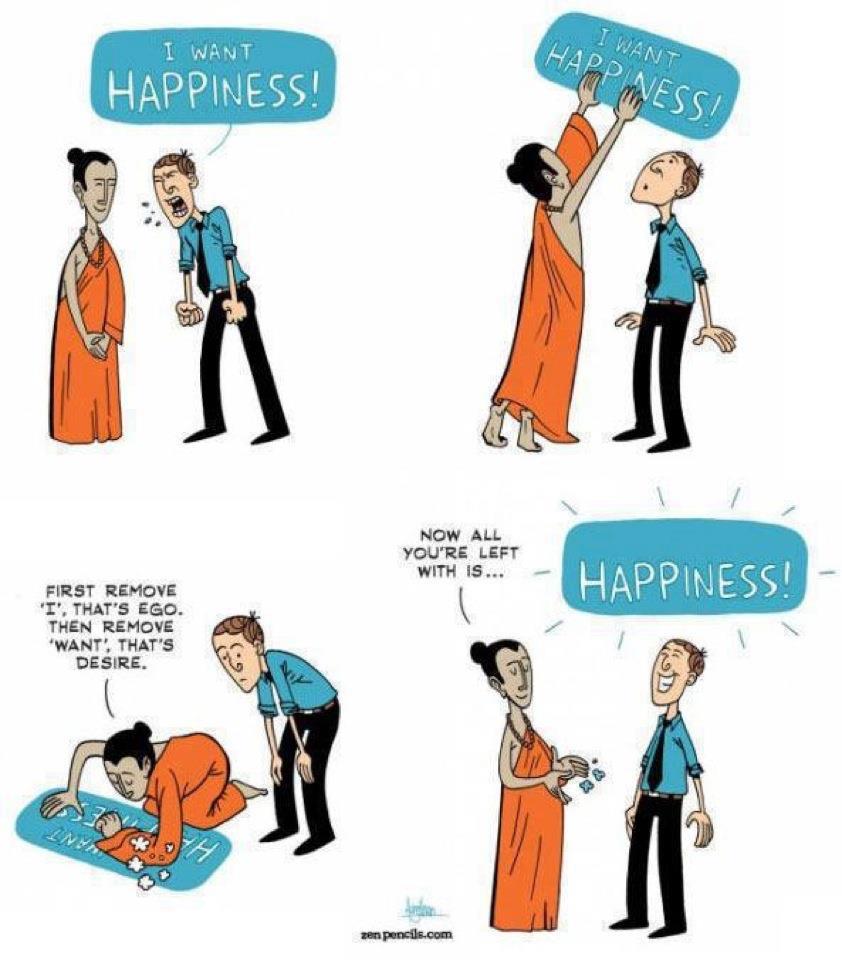
Another writer-friend posted this on Facebook today:

Take the “I want” out of anything, and you’ll find the happy.  It doesn’t come easily all the time, but if you can manage it even occasionally, you’ll be a happier person.  It’s this whole wibbley-wobbley, timey-wimey thing … No, that’s Doctor Who.  Sorry, obsession of mine 🙂

Really, it’s Buddhist philosophy

I read the Bhagavad-Gita not long ago, and that’s the central message of the text: stop wanting.  Stop desiring.  Be in the moment.  Act with conviction.

See the beauty, the power, and the terror (or the Krishna, if you’re a Buddhist) in everything.  It’s all connected.

Which brings me back to the peregrine.  Isn’t it a lovely little circle?

Oh, and something else

Peregrination.  Isn’t’ that a lovely word?  It means to take a journey, a pilgrimage.  Isn’t that what all of us writers do?

It’s all a wonderful semiotic mess 🙂

More insight into the mind of Mel.  Terrified yet?  Where has your mind been going lately?  Has it been going there without you?  How do your mental peregrinations influence your creativity, your art?  Do tell.

The things you learn when you look into your family tree

Or … the duty of a bard

This week, I thought I’d write a little bit about genealogy.  I’m not going to post any of my family trees (I have three, though they’re incomplete and slightly out of date) … I’m just going to write about the wonderful things you can learn when you do a bit of digging.

The first is this: genealogy is one of the duties of the bard.

Whether you think of a bard as a bard, or filidh, or ollamh, a bard wasn’t just a collector of tales, a memorizer of songs and poems, but they also held the responsibility to guard the family history and bloodlines.  They were scholars, doctors, law-givers, and just darned cool, and as a writer, I feel that I have some connection to that tradition, and some responsibility for the history of my family.

I’m a Celtophile, and unabashedly so (hence the interest in filidh and ollamhs), but the family I can trace is Finnish.  Yes, Marttila is a Finnish name.  You can generally tell because of the three consonants together.  That, or the double vowels (e.g. Saarinen) are pretty clear give-aways.

The larger family name in my genealogy is Wiirtanen.  There is a large Finnish community in the Sudbury area, many of them coming from the Long Lake area of town and the Pennala subdivision there.  That’s where the Wiirtanens settled.

One of my Wiirtanen relatives still lives out at Beaver Lake, a bit of a drive out of town.  He’s a trapper and owns a farm.  Other Finnish families moved into town around Lake Nepawin (Maki Avenue was named after one of them) and there have been a few books published on the Finnish roots of Sudbury.

A number of years ago, a genealogist visited me out of the blue.  I sat with him for a few hours in an afternoon and he taught me a few things about my family, which happened to be part of his family tree, which is why he looked me up.

In Finland, at the beginning of the last century (give or take a few years) families gave up their names, and took on the names of the farms or cities where they worked.

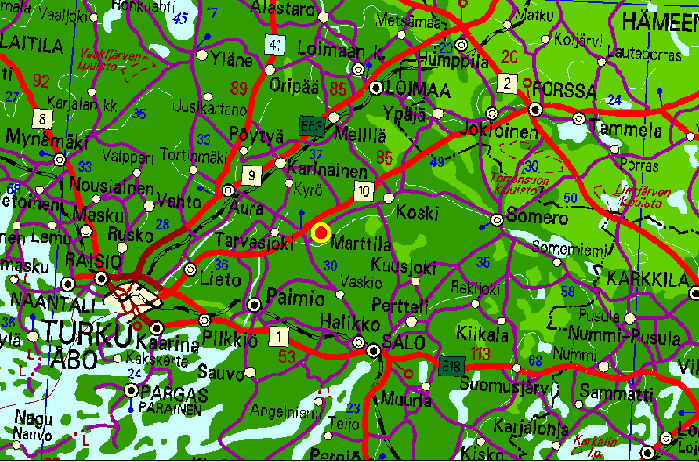
There’s a city in Finland called Marttila.  My uncle Walter and aunt Margaret visited it years ago.  Here’s a wee map and the city’s crest from their Web site:

Notice the image on the crest: It’s St. Martin of Tours cutting his cloak in half to give to a beggar.  So Marttila roughly translates to St. Martin, not a particularly Finnish icon, but at least I know where my family name comes from.

So I started keeping a few files on my family tree.

Something else I did was to look into the kalevala, the national epic poem of Finland.  It’s a creation myth, set of legends, and features magicians and the mystical sampo, which could be, among other things, an analogy for an instrument that could track the precession of the stars.

It’s no wonder I’m into the fantasy 🙂

My mother was adopted and has no interest in looking into her family, so I’m kind of stumped there, though she tells me that she was Irish, something my grandfather liked to tease her with.  So maybe there’s a reason, I’m so enamoured of all things gaelic.

Have you delved into your genealogy?  What did you discover?