Caturday Quickie: Calgary, I am in you

I’ve been waiting to say that for a long time. I’m such a nerd.

To be brief:

Thursday afternoon, Phil and I went to see Guardians of the Galaxy. I may have to post a Mel’s Movie Madness about it. For the future. I enjoyed it thoroughly, however.

Yesterday (Friday), I got up at the ungodly hour of 4 am so I could get out to the airport by 5-ish and catch my 5:55 am flight.

All went well, caught my connection, watched the second Hunger Games en route, and arrived at 10:18 am, on the dot, in Calgary.

My friend, Sharon, offered to pick me up and we went out to lunch before I checked in at the Carriage House Inn and started my marathon of sessions.

I attended 5 of those yesterday, plus the keynote speakers in the evening. I also met, in person, several people I’d only known to this point virtually: Angela Ackerman, Diane Walton, Tim Reynolds, and I reconnected with some fellow writers and publishers: Mark Leslie, Ron Hore, Swati Chavda, and Avery Olive.

I had dinner and lovely conversation with Nina Munteanu, and met a few other writers and editors hanging around outside the hotel. I also saw the wonderful Jack Whyte again, and met Brandon Sanderson in the flesh. Brandon was my fangirl moment of When Words Collide so far.

I’ll be in sessions from 10 am to 6 pm today, and then there is the mass autograph session this evening.

It has been a jam-packed conference so far, but I’m having a blast. Prepare for much bloggage coming out of this 🙂

Also got to see the 2014 In Places Between anthology chapbook. The readings and judging take place tomorrow morning. Will let you know (of course) how “On the Ferry” fares.

I think this may be my only post this weekend, just because WWC is proving to be a very fast-paced event.

In the meantime, I shall wish much you all much Writerly Goodness.

Caturday Quickies

Thoughty Thursday: Things that made me go hmmmm on the interwebz, July 27-Aug 2, 2014

Science abounds this week.

Astronomers detect a signal 240 Million light years from Earth. IFLS.

More IFLS: Scientists have solved the mystery of the hole at the world’s end. Remember that article I posted a few weeks ago? Well, here’s the explanation.

ASAP science asks, how much sleep do you need?


NASA records ambient space music. That’s what ima call it anyway. I think it’s lovely.


Neil deGrasse Tyson refutes GMO fear mongering. Mr. Science says the same. Smart guy, my man 😉


Wired’s absurd creature of the week is the Satanic Leaf-Tailed Gecko. Personally, I think he’s beautiful.

Kathryn Schulz says a good life is not so much about regretting nothing, but about forgiving yourself for whatever it is you regret. TED.

Another TED talk, this time by Suzanne Talhouk. The Arabic language is in danger. Cultures around the world are trying to preserve their languages. Suzanne hopes to inspire the Middle East to do the same.

Vivek Wadwha predicts that automation will replace human workers more quickly than we’re prepared to handle. How will the world address this trend and what will we do?

Heading off to When Words Collide very early tomorrow morning. I’m still going to try to blog Saturday and Sunday, but you may have to forgive me if I get caught up in the panels, sessions, and workshops.

In other words, I’ll see you when I see you.

Hang tight, my writerly peeps 🙂

Thoughty Thursday

Tipsday: Writerly Goodness found on the interwebz July 27-Aug 2, 2014

Sorry for the late-ish post. Had to go to Yin practice tonight. Yoga was beginning to think I abandoned her 😉

Roz Morris started her Masterclass for The Guardian. This is the first post in her daily reporting on the queries arising from hre students. Catch all of her snapshots. She’s got a clever bunch there.

Part 3 of K.M. Weiland’s negative character arc series: The negative character arc in the third act. Surprise, surprise!

And here’s more Katie, guest-posting on Angela Ackerman and Becca Puglisi’s Writers Helping Writers. Five important ways to use symbolism in your story is part of Katie’s ongoing blog tour in honour of her new book: Jane Eyre: Writer’s Digest Annotated Classics. It’s the last day to enter her giveaway! Go get ‘em writing tigers 🙂

And . . . Katie’s Wednesday vlogs return with foreshadowing’s number one job in your story. Welcome back, vlogs! We missed you!

Writer Unboxed is experiencing some technical difficulties so The Tyranny of Motive and The Many Dreams of Writing will have to wait until next week.

Shennandoah Diaz writes about three ways to save your backstory from the cutting room floor on the There are No Rules blog at Writer’s Digest.

Laura Drake shares her tale of tragedy and triumph on Writers in the Storm.

Edits, Editors, Editing. Ruth Harris explores the secret weapon of every successful writer on Anne R. Allen’s blog.

Elif Shafak’s TED talk on the politics of story.

Quentin Cooper asks the question, why is science fiction so hard to define, on the BBC’s Future blog.

Crawford Killian looks at three SF&F writers who break the mould in The Tyee.

21 books that changed science fiction and fantasy forever from io9.

Electric Lit shares a lovely list of supernatural collective nouns. Anyone for a fondle of unicorns (I thought that was a blessing)?

CNN Travel features the world’s coolest bookstores. Ok . . . gotta sop up the drool here.

Enjoy the Writerly Goodness, my peeps. See y’all Thursday.

Tipsday

CanWrite! 2014 wrap post

It’s been a month and a bit of me posting on the weekends, but here we are, at last, at the end of the CanWrite! run.

The CAA Literary Awards Gala

This was held the night of Saturday, June 21st.

The night previous, we’d heard several of the nominees read from their works. All were excellent.

Here’s a post about the award winners.

Mariatu Kamara and Susan McClellandThe highlight of the evening was Keynote speaker, Mariatu Kamara, who, along with Susan McClelland, wrote her harrowing story of survival, resilience, and hope.

Of course, I picked up a copy of the book, The Bite of the Mango, and got it signed by the authors.

It was a night of wonderful stories shared and writerly camaraderie.

Other stuff that happened

The CanWrite! conferences are set up with all sorts of interesting activities.

On Thursday, Friday, and Saturday mornings, there were meditation sessions (which I did not attend), yoga sessions (which I did), and writers’ circles in fiction, poetry, and non-fiction (which I attended last year, but not this), pitch sessions (which I did not participate in), photo sessions (which I participated in last year, but not this), and walking tours (which I opted out of).

In the evenings on Thursday and Friday, there were readings with open mic segments. I read at both, but since the reading time was capped at three minutes, I did not read much 😉

There were workshops on Wednesday, one on fiction, one on poetry, and one on non-fiction. I had initially signed up for the fiction one, but the facilitator had to cancel.

On Wednesday night, there was a wine and cheese reception.

There were also two to four other sessions or workshops held each of Thursday, Friday, and Saturday afternoons which I could not attend without benefit of a time turner 🙂

Finally, there was the book fair. You know what I did there, don’t you?

CanWrite! book purchases

It’s an addiction

Thoughts on conferences and conventions

This brings me to preparing to attend a conference.

First, as with everything else that has to do with writing, you have to do your research.

What kind of conference or convention is it? I’ve attended three CanWrite! Conferences, an Algonkian Pitch conference, the Surrey International Writers’ Conference, an Ad Astra convention, and will be attending When Words Collide next weekend. All of them have been different.

Some conferences are set up as a kind of writers’ retreat with swaths of time for independent writing, group work (by genre – and here I’m talking poetry, fiction, non-fiction, and plays/screenplays), individual assessment (usually by the group facilitator), and social/networking opportunities (dinners, readings, etc.).

Pitch conferences focus almost exclusively on the pitch sessions, with all other workshops serving to prepare the pitchers and their pitches for their sessions.

Most conferences are set up with one-hour or two-hour sessions throughout the day and evening with short breaks in between to address biological imperatives like bathroom visitations and snack purchases. Each time slot will have multiple options for the attendee and reviewing the program ahead of time is of paramount importance. These conferences will also have pitch sessions (for an extra cost), blue pencil sessions (for an extra cost), photo sessions (extra cost), readings, and other social events. There will often be some kind of buffet, or gala dinner. Keynote speakers will be featured after meals, and there will be book launches/signings, after-hours parties, book fairs, and so forth. These are the writerly smorgasbords/marathons that you will have to navigate carefully to avoid utter exhaustion.

Conventions take the conference model and add even more geekery to the mix with LEGO salons, costume balls/masquerades, anime theatres, arts lounges, vendors, astronomy sessions, readings, and karaoke. The convention sessions are primarily panels, however, and not focused workshops, though workshops may be offered for an extra cost. The big reception or gala/keynote dinner will often also be an extra cost.

Conferences are usually expensive, with a fee in the hundreds of dollars. Conventions are nominally priced, but all the extras are on a pay per participate basis. Accommodation and transportation are always additional costs.

Mel’s tips for travel and accommodation: use hotel and travel rewards programs to lessen these expenses, where possible.

So, do your research, decide what you want to do, and go prepared. Most conferences and conventions will have their programs online months in advance, so you can plan what to attend and budget for the experience.

So, CanWrite! is a wrap, just in time for WWC 🙂

Today’s second post will have to be deferred until next weekend. I’m heading out to my sister-in-law’s shortly for a family BBQ.

Have a fabulous weekend, everyone!

The next chapter: July 2014 update

July was much the same as June for me.

I worked primarily on Gerod and the Lions, am still slowly mapping out Figments, and though I did some work on a short story (it’s almost 10K, so not really short, per se) it was revising, and the word count was negative.

July's progress

Total for the month: 17,516 (not quite as high as last month, but still a w00t! in my book)

Total on GatL: 4,821 (again, a little less than last month, but I’m still on track to finish the first draft by year’s end)

Total on blog: 12,695

Thought it might be time for a review of the year to date:

Month Total Blog Initiate of Stone Apprentice of Wind Figments Gerod and the Lions Short Stories
January 11,532 7,114 0 2,781 207 821 609
February 9,789 6,303 0 47 308 1,296 1,835
March 10,781 8,193 0 333 1,488 312 455
April 11,612 10,930 0 0 381 0 301
May 7,503 7,503 0 0 0 0 0
June 18,471 13,425 0 0 0 5,046 0
July 17,516 12,695 0 0 0 4,821 0
YTD Total 87,204 66,163 0 3,161 2,384 12,296 3,200

I must say, I’ve impressed myself. This ain’t bad for a writer with a day job.

It’s a comfort to know that I could convert some or all of those words spent on the blog into other writing projects, even while continuing in my day job. That could be two books a year, and that’s awesome.

Why don’t you do that now, you ask (and well you might). Right now, I’m happy to blog away for the benefit of my readers and writerly friends. Though a platform isn’t required for a publishing deal, it doesn’t hurt. Plus, sharing my struggles, progress, and process, curating and conference/convention reportage is gratifying to me. It seems that I’m sharing material that benefits my network.

It warms my wee heart when people like, comment, reblog, or otherwise share my posts.

The fact that I’m making progress also makes me happy. I don’t want to rush into querying or publication and regret it later.

I have to work the day job at least until Phil and I have our remaining debts paid off. There’s a lot of uncertainty in our lives right now (of which I’ll write tomorrow). Call me a chicken, but I can’t take the risk of quitting at the moment.

If I’m fortunate enough to get a deal of some description before we’re debtless, I’ll also have a choice. I could potentially devote all my time to writing, and produce three or four novels in a year. That could translate into a replacement income . . . eventually.

Due to the uncertainty in our lives and in the rapidly-shifting publishing industry at the moment, I’m not prepared to take that chance now, but I know I can do it if I have to.

I write because I enjoy it and I want to keep it that way.

What’s on for this month?

I’m going to continue to plug away at GatL and Figments, and that 10k story I mentioned, I’m going to submit it after revision. I don’t want to talk too much about it, because a story of this length is a huge risk. I’ve also submitted it to other anthologies and magazines in the past to a resounding “no.” Let’s see if I can’t do better this time.

This coming Friday, I’m off to When Words Collide in Calgary, and I’ll learn on Sunday morning whether my top ten story “On the Ferry” was considered a winner in the In Places Between contest. Though I’m really excited about the possibility, I’m just pleased as punch to be in the chapbook anthology.

So, of course, there will be more conference reportage coming your way 🙂

And that’s about it.

Tomorrow, I’ll be posting my CanWrite! Conference wrap and writing about the unsettled nature of things, not necessarily in that order.

Have a happy Civic Holiday long weekend, my Canadian friends 🙂

The Next Chapter

Caturday Quickies: “L” is for love

Here is a picture of Nuala snoozing from overhead. She’s taken to this style of rest since her ACL repair.

"L" shaped pup

Notice the distinct “L” shape.

L is for love.

That is all.

Caturday Quickies

Thoughty Thursday: things that made me go hmmmm on the interwebz, July 20-26, 2014

I guess this is the week for controversial stuff. PEN Canada, and other charitable organizations who engage in “political” activism are now under investigation by the Canada Revenue Agency.

Here’s a post by Charity Village on the same subject.

The Winnipeg Free Press offers a list of the organizations under investigation.

It’s just disturbing to me that all of these organizations are being audited. It continues the trend of cutbacks, suppression, and outright antagonism toward the sciences, and environmental and arts organizations in this country.

That’s all I’m saying about that.

Carmine Gallo explores the science behind TED’s 18 minute presentation rule. My trainer geek emerged. This is the 90-20-10 rule. People can listen with attention for 90 minutes (think about the timing of your breaks and lunch at work). They can listen and understand for about 20 minutes. The trainer or presenter (in-person) should change things up every 10 minutes. Virtual is a whole different ball game 😉

And speaking of TED, here’s Ze Frank’s very brief, Are You Human?


Frances Caballo offers a concise, yet comprehensive guide to Twitter for writers. The Book Designer.

Elizabeth J. Griffin, MD discloses her struggle with depression and what most people don’t understand.

The relationship between creativity and mental illness, on Brainpickings.

One tree has been grafted to bear 40 different kinds of fruit. IFLS. One of my friends commented: It’s experiments like this that lead to Triffids – LOL!

National Geographic explores what animals do in wildfires.

The 100 best sci-fi movies, as chosen by critics and experts. They’re presented in alphabetical groupings and each delivers their top ten. It’s a fair amount of wading, but there are some interesting choices . . .

Balloon art. Seriously. And I can’t even make a poodle. Maybe a snake 😛

And that be it for the thoughty and fun this week.

I’ll check in again on Saturday 🙂

Thoughty Thursday

Tipsday: Writerly Goodness found on the interwebz, July 20-26, 2014

Angela Ackerman details her encounter with copyright infringement on Writers Helping Writers. This is serious stuff.

I’ve had other writerly friends who’ve noticed their books have been pirated and if you’ve been following Angela on FB, you probably know that she’s encountered that too.

There’s a mode of thought on the interwebz that says pirating is not your enemy. If people like your book so much they steal it, then it will likely convert to more readers.

I think that argument is fundamentally flawed. Chuck Wendig spoke to this quite eloquently a few months ago, here, here, and here.

What if people are stealing your work and trying to make money off it illegally by selling it and pocketing the profits? For a self-published author, the book is her livelihood. Even for the traditionally published, what money he might have seen from a legitimate sale, disappears. It’s wrong.

And the readers who buy these pirated copies may not even know that their money is not going to the author. That’s doubly wrong. Theft, deceit, and fraud? That’s jail time people.

But as Chuck said, it’s not just about the money. An author (or authors) slaved over that book for months, if not years. It’s their intellectual property (IP). It’s their blood, sweat, and tears.

Don’t pirate books. Don’t do it.

<end rant>

Onward, to more light-hearted material.

M.M. Finck posts on Women Writers, Women’s Books about the querying process and why it’s not just about the query. Thanks to Jamie Raintree (see below) for bringing this to my attention.

Anthony Metivier guest-blogged about how to mine your dreams for story gold on Writers Helping Writers.

Bringing a strong vision to your fiction, by Laura K. Cowan, for Writer Unboxed.

Jamie Raintree asks, how far do we follow our dreams? Since we’ve become acquainted, Jamie’s acquired an agent and is now working on a second novel. I love watching her journey unfold.

Here’s Janice Hardy’s guest post for Anne R. Allen’s blog about how not to start a novel.

Veronica Sicoe follows up last week’s post on how she structures her novels with this one on how she brainstorms an idea into a working concept.

K.M. Weiland continues her negative character arc series with part 2: The negative character arc in the second act.

Whether you’re considering hiring a ghost writer, or becoming one, this post by Roz Morris will answer your questions.

Four reasons to use dramatic irony from Writers Write.

Chuck Wendig gets a mention again for sharing this i09 post about Snowpiercer and its fascinating influence. Yes, it’s a South Korean movie based on a French graphic novel, but it’s still great storytelling.

Xia Jia shares her thoughts on what makes Chinese science fiction, Chinese on Tor.com. Translated by Ken Liu. It’s interesting socio-political stuff.

And if your to-be-read (TBR) pile isn’t big enough yet, here is some recommended reading from TED.

Flavorwire presents the 35 writers who run the literary internet.

As a follow-up to my last week’s posting of the CanLit song, here’s every Canadian novel ever. It’s kind of true. And funny. The Toast.

And that’s it for this week, folks.

Thanks for following, sharing, and all the good stuff you do.

Tipsday

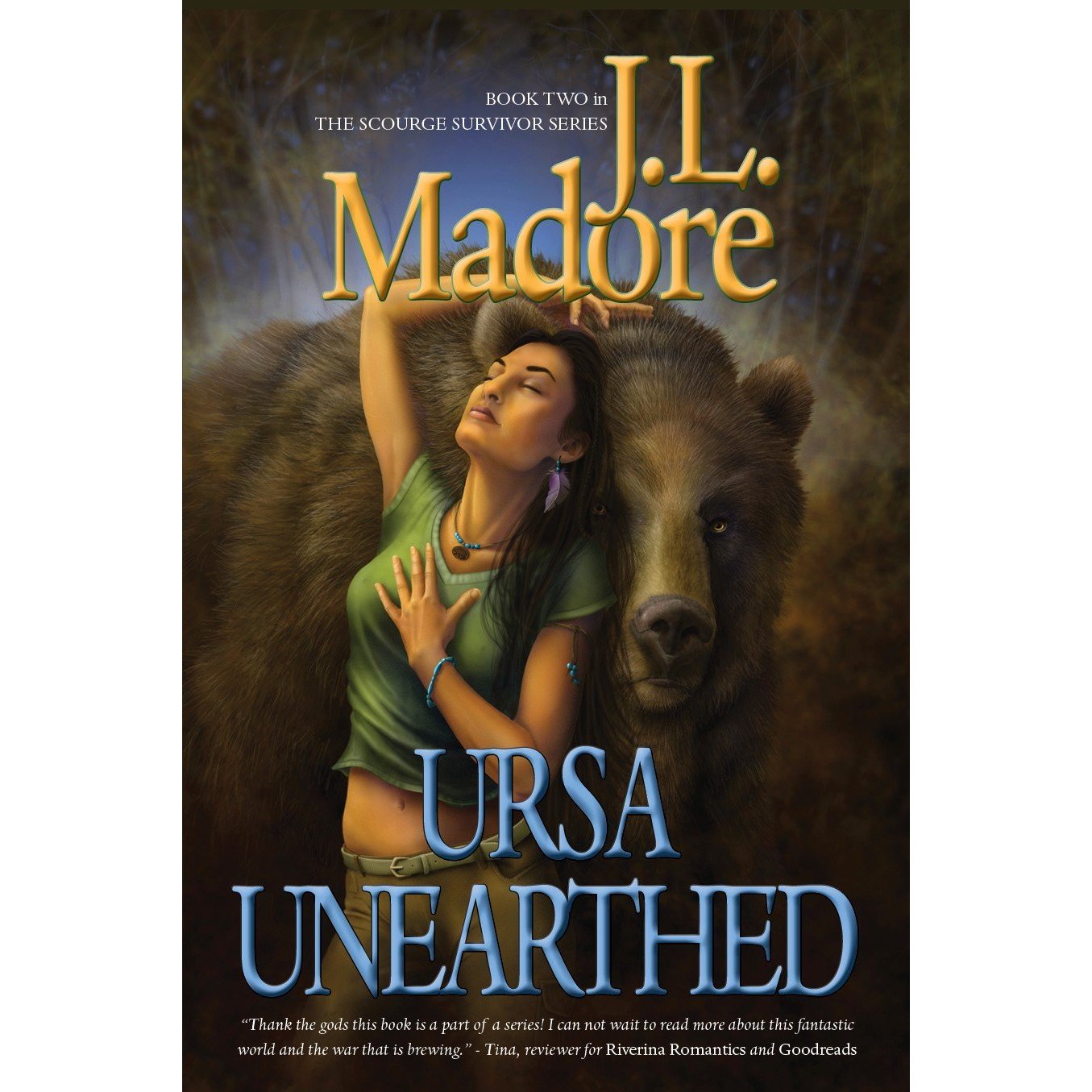
Review of Ursa Unearthed by JL Madore

Ursa Unearthed

What Amazon says:

Mika’s life has never been normal, but it’s hers.
After being told by the Great Spirit that her destiny is to stand up for the Earth Mother’s children and “save the great species from extinction,” she buries herself in an investigative journalism career hunting down poachers and exposing illegal trade in wildlife exotics. A survivor by nature, she would rather fight injustice than maneuver the hassles and heartache of relationships.
When danger suddenly finds her unprepared, Mika’s perception of her life is shattered and she’s hurled into a realm of magic and murder she does not understand. Seduced by Bruin, the powerful warrior who saves her life, Mika is catapulted into a world where Were-creatures and Scourge assassins threaten not only her life but her heart as well.
With the boundary between worlds crumbling, Mika realizes that committing to save the great species of Weres will draw her deeper into a reality more terrifying to her than anything she’s faced before.
Trusting in love.


My thoughts:

I read and reviewed Blaze Ignites a year or so ago, because Jenny and I had worked together in a critique group and I was itching to find out what the finished product was like. When Jenny offered me a review copy of Ursa Unearthed, the second novel in her Scourge Survivor Series, I again jumped at the chance.

I love to see my writer friends grow and mature in their craft.

I’m happy to say I lurved Ursa Unearthed.

Jenny writes in a bare (dare I say, naked) style. Not a word is wasted. Action and hot sex propel the reader through the book. I actually finished reading it the week before last. At my reading rate, I burned through it.

My critical eye caught a few, very minor, editing gaffes, but by and large, my only critical comment on the story itself is that Mika’s “lie,” the thing that prevents her from committing to Bruin until things become so dire she has no choice, is not well developed at the outset. I occasionally found myself irritated with Jenny’s protagonist for her failure to get over her bad self, spank that inner moppet, put on her big girl panties, and deal.

Developing her trauma would have given this reader something to hang that irritation on. There would be a reason beyond being transported into a world of magic and danger to prevent her from accepting her altered circumstances.

Given that Mika is Native North American, has a spiritual connection with the Earth Mother, which grants her supernatural insights, and her main support, her grandfather, accompanies her to Haven, Mika shouldn’t have been so resistant.

Having said that, I think Ursa Unearthed is a fabulous book. The characters are otherwise well-drawn and Jenny has a knack for making you care about them.

And yes, you read that correctly earlier, there is lots of hot sex in the novel and Jenny writes this well, too. You’ll tingle in all the wrong naughty right places 😉

The story is standalone, but readers of Blaze Ignites will recognize many familiar faces in the cast. They don’t detract from Mika and Bruin’s character arcs, though. The spotlight remains where it should, on Mika and her bear.

My rating:

Four out of five stars.


About the author:JL Madore

JL Madore didn’t find writing so much as it found her. Waking each morning with a vivid cast of characters tangled in chaos in her head, it seemed essential to capture them on the page. With Blaze Ignites and Ursa Unearthed published and receiving rave reviews, she’s turning her attention to Watcher Untethered, an unpublished paranormal/erotic romance manuscript which just won 4th place in the Toronto Romance Writers – The Catherine. Aside from spinning tales of elves, weres, demons and fallen angels, she’s also Vice President of the Writers’ Community of Durham Region, a 300 member writing organization just outside of Toronto. http://www.jlmadore.ca/

CanWrite! 2014: How to get published with Halli Villegas, June 21

There was no panel discussion on Saturday and at breakfast, one of the organizers asked me if I’d host Halli’s workshop in the afternoon. I said sure, but I was a bit nervous. I even asked Halli how she wanted her name pronounced, and then promptly messed it up anyway. Sorry about that, Halli.

Halli VillegasFor your information, it’s Vee-yay-ges 🙂

Please note: This is a transcript of my hand-written notes. Halli, or anyone else who may have been present, if I’ve gotten any of the details wrong, please feel free to correct me. I will fix it post-hasty.

To the workshop (allons-y).


The title of this workshop might be misleading. I’m not going to publish you. We could have called it The Business of Writing. Now there’s a sexy title.

We’re going to talk about what happens when you get published. I can give you my perspective on that, but I’m looking more toward a sharing of expertise. I don’t have a grounded knowledge in self-publishing, or publishing with a micropress, or with a major publisher, but some of you may, so I’m looking forward to bringing out the knowledge in this room.

<We then went around the room and introduced ourselves and shared a little bit about our experience, or lack thereof, with publishing.>

Tightrope Books is a small, or indie press. We’re also called a boutique publisher, because we cater to a specific writer and reader. We tend to the literary, but we’re not publishing so much poetry as we used to. We now have an annual anthology of the year’s best poetry, with guest editors.

You don’t want to compete with yourself.

I worked for five years with Guernica and when it came time to think about starting my own press, my idea was to make it author-centric. That core idea had to evolve, though. It had to become a business.

Always read and follow the submission guidelines. What does the press publish? Does your work fit?

Be professional. Fill out your writing C.V.

Some publishers will have set reading periods. Some have particular niches. ChiZine Publications, for example, focuses on horror and dark fiction.

There’s also the Writers’ Reserve. It’s a fund that provides money to publishers to publish professional writers offered by the Ontario Arts Council (OAC). That reading period is from September to February. Tightrope will receive maybe three hundred submissions under the Writers’ Reserve. We might look more seriously at twenty manuscripts. How many of those we publish varies from year to year.

<Halli discussed the Writers’ Reserve in more detail in the Tightrope Books context. Here’s the link for the Writers’ Reserve if you’d like more information.>

Do your research. Is there a house style guide? If not, the Chicago Manual of Style is the default reference.

Poets generally aren’t agented.

Networking is a great way to make contacts. Conferences like CanWrite! and events like Word on the Street (WotS). WotS used to have a festival atmosphere. Now it’s more commercial. Small press fairs are much the same. All are great places to make connections.

Determination plus persistence equals success.

What happens once your submission is accepted?

You will go through what’s called a substantive edit with an editor. This takes at least two months and is a process of shaping that manuscript.

Next is the line edit. This phase of editing focuses on details and continuity in the manuscript. That leads to the copy edit, which delves into spelling and grammar.

Once your book is accepted, it’s usually about two years to publication.

The fall season is the big publishing season. Spring is a second big season, but you’ll see more beach reading and other, lighter fare.

Typesetting is an art. It’s not as simple as it looks. It’s really about capturing the spirit of the book in a tangible form.

Similarly, your cover design, and therefore your cover designer, is important.

Even the back cover copy is tailored to the book.

Most publishers dictate typesetting, cover, and back cover copy.

Simultaneous submissions are frowned upon.

Response times run anywhere from three months to a year. It depends on the volume of submissions. Responses often can’t be personalized. There’s no time.

The launch is your champagne moment. Make sure you have review copies and copies set aside for contests, major media, etc.

With respect to marketing, print ads aren’t worth it. Budgets have decreased across the board. Grants are disappearing. Sometimes we have to go begging for reviews. There’s no money to send the writer on a book tour. We can’t pay for flights.

Initial sales can be between six weeks and six months. It depends on the profile and popularity of the book. This is the main sales drive.

In a cooperative arrangement, the publisher pays for preferential placement of your books. Even if the publisher pays, however, you should check.

Engage in guerrilla marketing. Go into the bookstore and rearrange the books on the shelf to better display your books.

A bestseller in Canada is about 5,000 copies. A poetry bestseller is between 200 and 300 copies. In the American market, you have to sell at least 35,000 copies to even crack the lists.

I’ve given you in your package a copy of the Tightrope Books contract. It was based on the Writers’ Union of Canada (WUC) contract. Let’s have a look . . .


Since I’m not going to share Halli’s contract, I’m going to end here.

I will offer you the link to the Writers’ Union of Canada’s contract information page. If you’re not a member, you may have to pay a nominal fee, but their resources are well worth the cost.

Halli gave us a load of handouts that was very informative. 10 pointers to help you get published; a list of resources for writers; a list of Canadian literary magazines; The Tightrope Books house style guide; and a copy of her contract.

Next weekend: The CAA Literary Awards Gala and wrap post.