Ad Astra 2015 day 1: The beldam, the hag, and the hedgewitch: Witches in popular culture

Panelists: Derek Newman-Stille, Kate Story, Karen Dales, and Gail Z. Martin

GZM: How has the trope of the witch been used in the past?

KS: In the European tradition, witches were evil. We have a countercultural fascination with them.

GZM: That might depend on your point of view.

KD: The roots of the word witch are from the Anglo Saxon wicce/wicca. It means wise. The vilification of witches came about as a result of the Inquisition and the malleum malificarum (the witches hammer). Disney’s portrayals of witches have cemented the pejorative image witches have.

GZM: Every village had a hedgewitch. Someone wise, who knew about herbs, could deliver a baby, and so forth.

KD: Hereditary witches are still around today.

DNS: In Greek and Roman times, the practitioners were mostly men. They used curse tablets and imported Egyptian and Jewish words.

KS: Nnedi Okorafor writes about witches in her young adult novels. In Nigeria, there are actual witch camps.

GZM: Voodoun and Hoodoo, though they started in similar ways, are very different traditions. Santeria, too, started with the mystification of Catholic saints and ritual.

KS: One of the lenses we’re looking through is the appeal of the witch to young people. It’s the attraction of the unseen, ghosts, supernatural abilities; it’s the longing to see and work with these things.

KD: Llewellyn publications has seen a massive uptake in sales of their informational magic books. In Toronto, we have four occult shops. Young women are attracted to wiccan practice thanks to shows like Charmed and Buffy the Vampire Slayer (Willow). The attraction is the ability to have a personal relationship with the divine without an intermediary.

GZM: The young protagonist may not even know what’s happening to them.

DNS: There’s actually an organization called the Harry Potter Alliance and they are activists. They do good for a lot of different people in a lot of different situations.

GZM: In Bewitched, the curses the witches made were all to Hecate. The Kathryn Kurtz novel Lammas Night was based on true events.

KD: Sir Terry Pratchett went to the Pan-European Convention to conduct research for his novels.

GZM: Butcher’s Dresden was not an evil character, but, because he was taught by an unscrupulous master, he suffered repercussions for decades afterward.

DNS: We love delving into the darker aspects of the witch. Look at “Dark Willow” from Buffy, and Stephen King’s Carrie.

GZM: A character can find an ouija board and an old book and suddenly there are unforeseen consequences.

DNS: It plays into political conservatism. If you experiment, bad things will happen to you. Essentially, it’s fear of knowledge.

GZM: You have to take responsibility for your actions.

KD: In The Mummy, the characters are told not to read the book. She reads it anyway and releases the mummy.

KS: A little knowledge is a dangerous thing.

Q: Do you find in fictional depictions that it’s the girls who are called to the dark side? Boys seem to get away with anything.

KD: Maybe the guys can handle it and the girls can’t? I’d argue that’s societal bias and not necessarily accurate.

GZM: Our culture is still struggling with women who have power. In reality, there are just as many foolish boys as there are foolish girls.

DNS: Knowledge is still forbidden to women in many ways. In fiction, it’s often a traumatic event that triggers the emergence of power. It reflects institutionalized abuse.

GZM: In Norse culture, it’s okay for women to have power.

KD: In Celtic legends the king could only assume power—and keep it—by virtue of having ritualized sex with the goddess, or her representative.

KS: There’s a South African contemporary dancer who has recently revealed that he is from a long line of shaman. That’s how he channels his dance.

DNS: The curse tablets I mentioned earlier were meant to harness Cthonic powers (under the earth). England is a particularly rich source because they used lead tablets which were then rolled. These have lasted much longer that their stone equivalents. They were stabbed with nails to enact the curse.


And that was my short hand for what was a lively discussion of witches in various popular media 🙂

Thoughty Thursday: Things that made me go hmmmm on the interwebz, April 26-May 2, 2015

Finally! Pakistan jails 10 of Malala Yousafzai’s attackers. BBC News.

Jon Krakauer: If you’re not a feminist, then you’re a problem. Penguin Random House’s Medium.

Teachers in the secondary school board are striking right now. Here’s a couple of posts that deal with the issues they’d like to see addressed.

11 ways Finland’s education system shows us that less is more. Filling my Map.

Schools should teach kids to think, not memorize. The documentary Most Likely to Succeed. Gotta watch this. The Huffington Post.

Ok. So, Sudbury was nominated the happiest city in Canada. Here’s 17 things you should know about us 😉 Buzzfeed. (Yes, we made Buzzfeed!)

Studies link social anxiety to empathic ability, high IQ, and sentinel intelligence. Spirit Science and Metaphysics.

The secret weapon that prevents anxiety and depression? It’s not what you think. The Creativity Post.
“When we attempt to divorce ourselves from pain, we end up feeling nothing pleasurable or meaningful at all. When we better understand, tolerate, and harness distressing thoughts and feelings, and become aware of the situations when they are helpful, we become empowered. We gain vitality. We become whole.”

Depression can alter your DNA (!) IFLS.

Veritasium: just knowing about learned helplessness can help you free yourself from its clutches. (Plus a bonus Sudbury tie-in with a mention of the Neutrino Observatory 🙂 )

LifeHack lists 20 signs that you’re succeeding, even if you don’t feel like you are.

Scientists turn pancreatic cancer cells into normal cells. Now . . . how close are they to releasing this treatment? IFLS.

Why are some people left-handed? (I like to say that we’re the only people in our right minds – LOL). IFLS.

Audi makes diesel fuel from water and carbon dioxide. IFLS.

i09 presents seven lesser-known but fascinating Victorian inventors.

A man knocked down a wall in his basement and discovered a hidden underground city. SlipTalk.

Here are the winners of the 2014 Smithsonian photography contest. Amazing and beautiful photos. The Atlantic.

And that’s your thoughty for the week.

Be well.

Thoughty Thursday

Tipsday: Writerly Goodness found on the interwebz, April 26-May 2, 2015

Your prologue could be destroying your story’s subtext. K.M. Weiland – Helping writers become authors.

Are you misusing cliffhangers? Find out in Katie’s Wednesday vlog.

Christine Frazier of the Better Novel Project presents an infographic that will show you how to deconstruct a scene like Katie 🙂

Ruth Harris discusses the magic of novel rehab on Anne R. Allen’s blog. Never give up!

Gwendolyn Womack writes about the story iceberg on Writer Unboxed.

Jordan Rosenfeld guest posts on Writer Unboxed: the seven secrets of highly persistent writers.

Janice Hardy explains how mini arcs create more story depth.

Jane Friedman compiles links to all the relevant resources on her site for this post: How to find a literary agent. Heading into querying (most likely June), so I needed this 🙂

Books & Such agent, Wendy Lawson, discusses the issue of “Playing around the Edges.”

Writer tech awesome: Veronica Sicoe shows us how to format our novel for Smashwords in one day. Note: requires a #gallonofcoffee 🙂 Step by step with screenshots. Extremely helpful.

Klexos from the Dictionary of Obscure Sorrows:

The case for physical books. The National Post.

Grammarly presents the dark side of nursery rhymes.

Publisher’s Weekly lists their top ten most difficult books. How many of them have you read (or tried to read)?

Here’s Buzzfeed’s list of 26 books from around the world that we should read before we die.

How Shakespeare’s heroines evolved from one-dimensional to feminist. Flavorwire.

Last week’s Outlander episode featured full frontal male nudity and laughed in the face of rape. Salon.

Thanks for making Writerly Goodness part of your blog-reading pleasure 🙂

See you Thursday!

Tipsday

Wordsmith Studio homecoming blog hop number three

WSS Homecoming 2015It’s been three years since I joined a bunch of fellow platform builders in what became Wordsmith Studio.

Today: blog hop, part the third.

1) What are you currently working on?

The final (for now) revisions of Initiate of Stone, drafting Marushka, my 2014 NaNoWriMo novel, and revising one long short story that may actually be a novel in disguise 🙂 Plus, I blog.

2) For past work, what was your greatest joy or greatest challenge?

Finishing my first draft of IoS and getting my two short stories, “The Broken Places” and “Downtime” published would all have to tie for greatest joys.

My greatest challenge to date has been the first chapter of IoS. Oh, and trying to keep things balanced. Actually, the balance thing wins out in the toughest challenge category. I suck at balance.

3) For current work, what challenge are you working through now?

As mentioned above, my first chapter. For some reason, this particular opening is kicking my buttocks. I’ve tried starting the story earlier, later, a prologue (very bad), and rewriting the first chapter from scratch about four times. I’ve tried Surry Idol at the Surrey International Writer’s Conference, Ray Rhamey’s Flogging the Quill, beta readers, and advice from writing mentors.

4) For work you are just planning or starting, what challenges or growth are you expecting or hoping to encounter?

Every novel I draft, revise, or edit improves my craft. The next work I’ll be starting from scratch will be this year’s NaNoWriMo. It’s a new adult science fiction thriller. Oh yeah. That won’t be hard to sell at all 😛

5) What have successes or challenges in your work (recently) taught you?

I write a lot more than I thought I did. Others see value in my work. Tracking your writing progress is a great motivation. I generally rise to any challenge I set myself.

6) What obstacles or challenges have you not been able to overcome, or still frustrate you?

The aforementioned beginnings, though I think a breakthrough is due. Overdue, frankly.

7) How would you describe a great writing day (or week)?

A great writing day is any day that I write. Period. If I achieve my goals, that’s a lovely cherry on top of the sundae. In a way, every word is a victory 🙂

8) What specific tools or strategies help you succeed? 

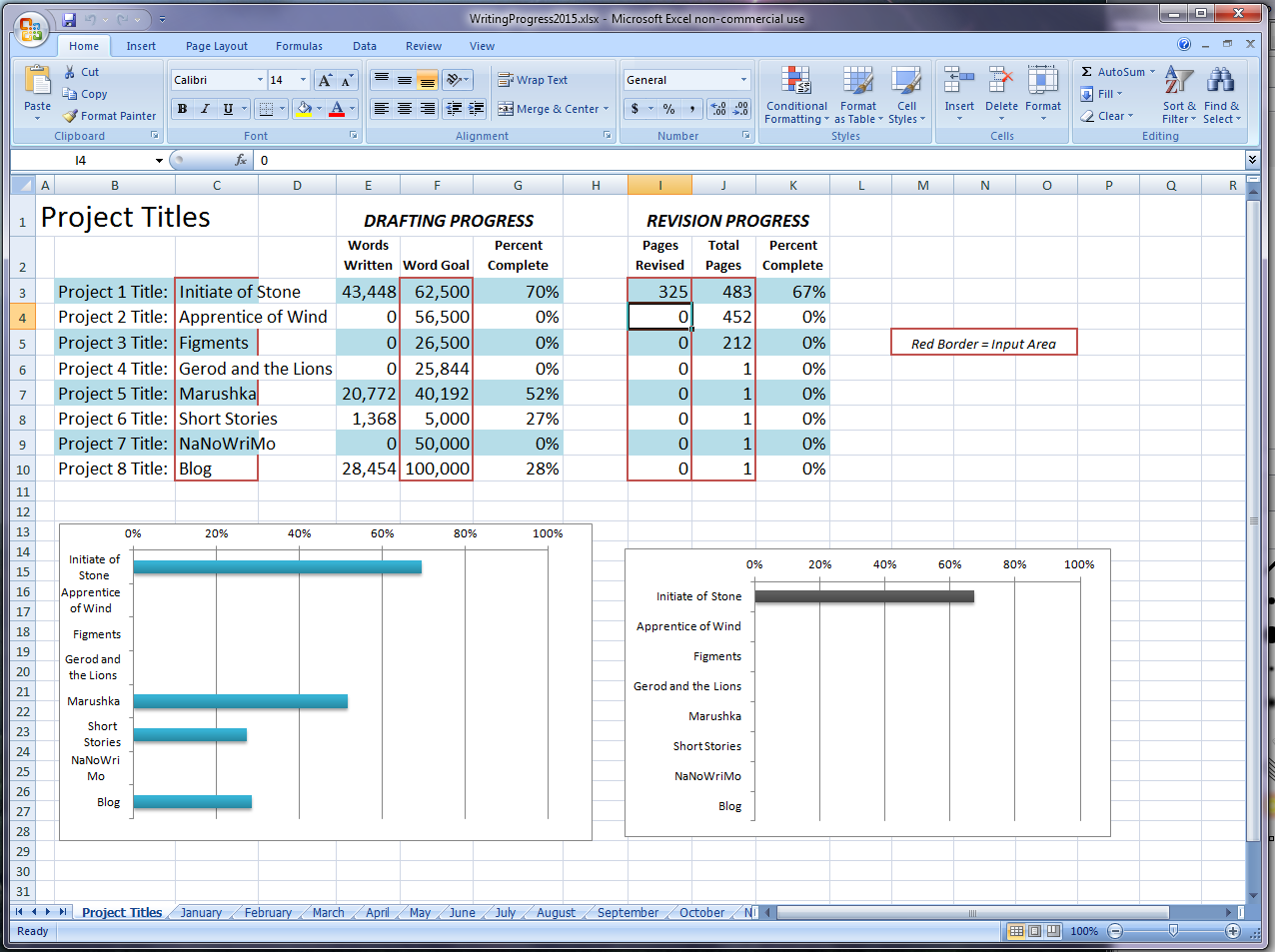
Jamie Raintree’s writing spreadsheet is a fabulous tool and motivation. K.M. Weiland’s Helping Writers Become Authors blog and her books are some of the best craft advice out there. Awesome. Similarly, Roz Morris’s Nail Your Novel series and blog are teh best. And she’s so generous with her time and advice. Finally, attending conferences and conventions have been a big help. I learn metric tonnes at each one 🙂 The networking isn’t half bad either.

And there you have it.

See you on Tuesday for my Tipsday writing curation.

Powered by Linky Tools

Click here to enter your link and view this Linky Tools list…

Muse-inks

The next chapter: April 2015 update

Where I’ve been

I don’t know how to say this, but April kind of sucked.

Due to the situation at work, I decided to give myself a true break for the Easter long weekend. So, no writing there.

The next weekend was Ad Astra and I knew better than to even promise a blog post. No writing that weekend either.

After having left things for so long, it took a while to get restarted.

I didn’t get either of the two stories written that I had wanted to, and only revised one story, but incompletely.

You won’t be surprised by my progress, or lack thereof.

April 2015 progress

11,907 revised words on Initiate of Stone. I’m about 70% finished.

5,541 words written on the blog.

2,931 words written on Marushka. This is so far below what I’d hoped for in progress that it makes me weep a little. According to my original goal, I’m just over 50% of the way to finishing the draft. I’m closer than that, but I don’t know how much more.

38 words is all I managed on my short story.

20,417 was my total for the month.

April 2015 summary

I submitted my story “The Broken Places” for consideration to the Aurora Awards and several people were kind enough to nominate me.

I’ve also sent it to Sandra Kasturi for consideration in the next Imaginarium anthology.

Will be sure to let you know what happens.

Where I’m heading

Friday was my last day as a consultant. It’s truly a relief to be back at my old position with the training team. I’ve realized that I appreciate my position so much more now because I actually get to see the results of my work.

Even if I’m frustrated because my learners tend to hear what they want rather than what I’m actually teaching them, I maintain relationships with many of them and can see how they’re doing.

I’m burnt. I’ve actually been so tired I’ve felt sick, but when I’ve tried to nap, I don’t actually sleep. I close my eyes and my mind won’t settle down. It happens at night, too. I just need a break.

I have only two weeks at work and then I’m off for five.

Since I need the rest, I’m not going to be slaving away over my break, but I do intend to get some work done and finish a few small projects around the house.

I aim to have my revisions on IoS and my drafting of Marushka all, or mostly, done by the time I start my leave.

Then, I’m writing my query and synopsis, researching agents, and I’m going to send IoS into the world to see how she does.

I’m trying to arrange a bit of a promotional visit for a new author friend, Madeleine Callway, some time in June as well.

Because of that, I’m not aiming high for the next couple of months, though I do intend to pick up with drafting Gerod and the Lions once I’m finished Marushka, and trying to pull together Apprentice of Wind, the second book in the Ascension series.

Since I’ve been working toward the goal of querying, I’ve taken a load of courses, including Jane Friedman’s MBA for Writers and I’ve picked up Jeff Goins’s The Art of Work.

I’ve had Julie Czerneda and another author friend review my opening (‘cause openings still kick my arse).

I’ve ordered the 2015 Guide to Literary Agents and signed up for Publisher’s Weekly, ShelfAwareness, and Publisher’s Lunch free newsletters.

I’m getting serious about this writing gig in a whole different way.

Of course, I’ll let you know how all of this pans out.

One more post today and then I think I’m done.

See you in a few!

The Next Chapter

Ad Astra 2015 day 1: Science fiction for a young adult audience

Panelists: E.K. Johnston, Charlene Challenger, Leah Bobet, Jane Ann McLachlan

YA SF panel

Having just been in a session, Leah was a tad late . . .

JAM: Has fantasy done a better job reaching the YA audience? Who is the audience for YA SF?

LB: There’s the problem right there. Is YA about and geared to young adult readers, or do readers just find their ways to it? Adult authors will write YA SF to “convert” younger readers. That’s a bad reason to write YA SF.

EKJ: Girls are starting to look for science fiction in the YA section.

LB: It’s really YA novels that are paranormal at the core. Authors are starting to cater to YA readers bored with standard paranormal.

JAM: Who are the readers of YA? There are a lot of adults who are looking for, perhaps, a simpler plot or a more youthful protagonist.

LB: I wouldn’t trash readers.

Mel’s note: There was a bit of awkweird at that point. Leah confessed to a lack of sleep but continued to make her point. For the record, Jane Ann’s remark wasn’t intended as a slight to readers of YA of any age, nor was it intended as a slight to the authors of YA, of whom she is one.

EKJ: One of the things that YA does well is include something for readers of all ages.

CC: I remembered being intimidated by SF as a kid. Star Trek: The Next Generation made is accessible. [SF] elevates the human condition.

EKJ: It asks the important questions.

LB: SF is no longer about showing your geek pass card. It’s rooted in outsider culture.

JAM: Are there more female protagonists in YA SF? What does this say about the authors? The readers?

LB: Traditionally, SF has had a massive issue with sexism and misogyny.

Q: Would genre crossing novels find readers in YA?

EKJ: Maybe. That’s the charm of YA. It encompasses all genres. It would probably be an easier environment to break through with a cross-genre book.

Q: What makes for a good YA novel?

EKJ: The pacing is faster, length is a little shorter than the average novel in the adult category. The story doesn’t make them feel bad for being a teenager.

LB: In 2014, the biggest trend was adult readers, particularly women readers, reading YA. As a result, the YA market became huge. Advances were five times the advances in other categories. Publishers had the budget dollars for editing and promotion.

EKJ: Check out Midwinterblood by Marcus Sedgwick.

JAM: Most YA share common themes: leaving home, dystopia, romance, authentication. Most are written in first person, present tense.

EKJ: Second person is rare, but it can be mind-blowing when done well. Fan fiction is a great way to learn the conventions and break them at the same time.

LB: Understand the conversation you’re entering.

JAM: What’s the difference between YA and adult fiction?

EKJ: Flexibility is the key. The main differences are the age of the protagonist and the age of the reader.

CC: The YA journey is outward. The adult journey is inward.

LB: It’s the reading culture. Adult SF is the classic authors like Asimov and Heinlein. It’s not accessible to new readers.

LAM: There is accessible adult SF. The Time Traveller’s Wife is an example, but is it really SF? Young adult is distinguished, in my opinion, by the intensity of emotion and its sense of optimism.

And our time was up.


I’m going to have to defer my next chapter post until tomorrow. I’ve had a couple of evenings out, I have full-tum syndrome (sleepy) and it’s late.

Until tomorrow, be well.

Thoughty Thursday: Things that made me go hmmmm on the interwebz, April 19-25, 2015

Not an overwhelming amount of thoughty this Thursday, but quality is the thing.


The tragic news of the week is the earthquake in Tibet. Zee News.

Before and after images of the devastation from Think Progress.

My thoughts and prayers, such as they are.


Last week I shared an article about how there are not enough psychiatrists and too many in need. This week: why Doctors don’t have clients . . . Psychiatric Times.

Your passion isn’t your bliss; nor is it your bitch. Justine Musk.

Sir Ken Robinson on how creative schools can transform education. CBS News.

Cancer research in Sudbury is making progress. Here’s the news article and the interview from Morning North. CBC.

Neil deGrasse Tyson’s ambition is to make science hip. LA Times.

Shedding light on dark matter and dark energy with Patricia Burchat. TED Talk.

Life in the deep ocean, a TED Talk by David Gallo.

North Brother Island: the last unknown place in New York city. Brainpickings.

More abandoned places. This time: Creepy brothels. Scribol.

When cancer in dogs isn’t just a matter of bad luck. Vet Street.

If I fits, I sits! Why cats (of all sizes) love boxes. IFLS.

Watch an octopus catch and eat a crab. Wicked! Geekologie.

Diving giraffes and bouncing elephants. Awesome animation on i09.

I’ll catch up with you next on Satuday. Break a pencil until then.

Thoughty Thursday

Tipsday: Writerly Goodness found on the interwebz, April 19-25, 2015

Some of the best writing posts and podcasts came out last week. Seriously. Awesome.

Here’s part 2 of K.M. Weiland’s Scrivener series: How she uses Scrivener to draft her novels.

How symbolism and subtext improve action beats in your dialogue. Katie’s Wednesday vlog.

Roz Morris’s video chat with Christine Nolfi and David Penny from #indierecon15: How to keep writing when time is scarce.

Then Roz joined Joanna Penn on The Creative Penn podcast to talk about plot.

Jami Gold has some excellent advice on . . . advice 🙂

Dan Blank wrote my favourite post of the week on Writer Unboxed: Shame and your writing career.

Christine Frazier of The Better Novel Project interviews Jeff Goins on the importance of fairy tales.

Jordan Rosenfeld guests on Jane Friedman’s blog on the topic of balanced productivity. Here’s another book for my “to read” pile . . .

Amazon pays this self-published writer $450,000 a year (!) I couldn’t do what Mark Dawson did. Kudos to him for making it. Forbes.

MPR News presents the top ten most challenged books of the year.

TED-Ed on Shakespearean insults:

Enrich your vocabulary with some 1920’s slang:

How Tatiana Maslany is transformed into a cast of clones by Orphan Black makeup artists. Vanity Fair.

See you on thoughty Thursday!

Tipsday

Ad Astra 2015 day 1: Deconstructing tropes

First, a disclaimer

These posts are composed of my notes. Often, because of the scheduling, I enter sessions after they’re already in progress. I write by hand, so as I’m writing what I believe to be a salient point, I may miss the next one. I do my best to catch as much as I can, but things will be missed. Also, if, in my haste I recorded something incorrectly, please don’t be shy about coming forward and letting me know. I will correct all errors post-hasty once informed of them.

We good?

Alrightie, then!

Panelists: Gail Z. Martin, Leah Bobet, Charlotte Ashley, K.W. Ramsey

KWR: What if you love genre, but hate tropes?

LB: Tropes are clichés. They’re mass produced. They’re widgets. Genre is more than just the tropes that are common to it. Genre is an assumed set of knowledge. This can include tropes, but it’s more enjoyable for most readers if the writer alludes to tropes rather than spelling them out in the same ways as other writers before them.

GZM: We have archetypes, the Hero’s Journey. That’s structure. To use a construction metaphor, not every house will be built the same way, even if the builders start out with exactly the same materials.

KWR: You have to understand the tropes to use them properly. When you understand what an FTL [faster than light] drive is, and the scientific problems attendant upon creating one, then you can use it well.

GZM: Butcher does that with Harry Dresden. He’s a wizard, and powerful, but he lives without any of the benefits you would think go with that power.

CA: Dresden is basically an import into urban fantasy of the hardboiled detective trope.

KWR: And there are writers who do this well. Firefly mixed science fiction and the tropes of the western. Defiance tried to do something similar, but they didn’t understand the tropes they were trying to use in enough depth to use them well. The writers behind Firefly were conscious of what they were doing and wrote around their tropes intentionally.

GZM: After the Civil War, people went west, not seeking adventure, but because they’d been on the losing side.

KWR: Defiance trots out their tropes too obviously: here’s the stagecoach episode, etc.

LB: A photocopy of a photocopy eventually fades to nothing. If we see the same tropes used similarly in story after story, they lose meaning.

GZM: If the writer wants to be successful, she has to bring something new to inform the trope and give it fresh life.

LB: We all read books for different reasons. Some readers want comfort and familiarity. For these readers, tropes are fine. Some readers want their minds blown.

CA: In that sense, Firefly does not subvert its tropes.

GZM: It’s not just the tropes, though. Characters can bring something fresh as well. Tropes alone will only get you so far.

CA: Comfort reading is like decor. Mind-blowing reading is deeper.

LB: The stories that meant something to us as children need to be reinvented for a modern audience.

GZM: Myth is bigger than the telling.

CA: Look at Diana Wynn Jones’s retelling of Tam Lin.

LB: The books that point out that “this is messed up” further the conversation. We need these conversations.

KWR: Literature is cyclical. It responds to what has gone before but also invites the next voice to the conversation. The pendulum is always swinging.

GZM: In the 50’s and the 60’s, the cold war was a huge trope in science fiction. Recent authors have brought that tropes forward successfully.

LB: There’s a genre fallacy that there should only be one conversation going on, though. For example, post-colonialism is not part of the SF conversation.

CA: A Stranger in the Laundry speaks to that.

[There was a short side-track into the Hugo’s controversy that I chose not to record.]

CA: Is Star Wars not a post-colonial narrative?

KWR: The Jedis are basically samurai. It all goes back to the Tokugawa gun law.

GZM: What about Carpe Demon? The protagonist is an everyday person. She has to get the kids to school, work, manage her household, and still fight demons.

LB: That’s just good writing. Rounded characters are the result of good writing. Kate Elliott is an underrated writer. Karen Addison’s The Goblin King is fabulous also.

And we were out of time.

Next week: You get a double shot. Science Fiction in YA from Ad Astra 2015 and my next chapter April update.

Thoughty Thursday: Things that made me go hmmmm on the interwebz, April 12-18, 2015

#BringBackOurGirls a year later. NBC News.

It hasn’t always been a man’s world. Amy Logan’s TED X talk from Sacramento:

The reason you’re not happy and how to fix it. The Next Web.

There are too few psychiatrists and too many patients. The Psychiatric Times.

Why you should spend your money on experiences rather than on things. Fast Company.

How to be emotionally intelligent. The New York Times.

Peak creative moments. 99u.

The greatest work of your life will require a compass, not a map. The Creativity Post.

Could oral contraceptives be changing your brain structure? IFLS.

BBC Two presents super powered owls.

Why we melt when we see puppy dog eyes. The LA Times.

Remembering the dogs of the Titanic. Dogington Post.

Neil deGrasse Tyson on Pluto, science groupies, and killing insects. Esquire.

Now we know why the earth hums. IFLS.

Fabulous picture of the Grand Canyon.

The eeriness of the English countryside. The Guardian.

Horrible crimes took place in this lovely house in New Orleans. i09 True Crime.

She sheds: the answer to the man cave. The lighter side of real estate.

These three young girls rock Metallica’s “Enter Sandman.” ReMezcla.

And I’ll leave you on that rockin’ note (LOLZ) until Saturday 🙂

Thoughty Thursday