Canadian Writers’ Summit 2016: Writing hard truths

Disclaimer: I’m not perfect, and neither are my notes. If you see anything that needs correction or clarification, please email me at melanie (dot) marttila (at) gmail (dot) com and I will action it post hasty.

HardTruths

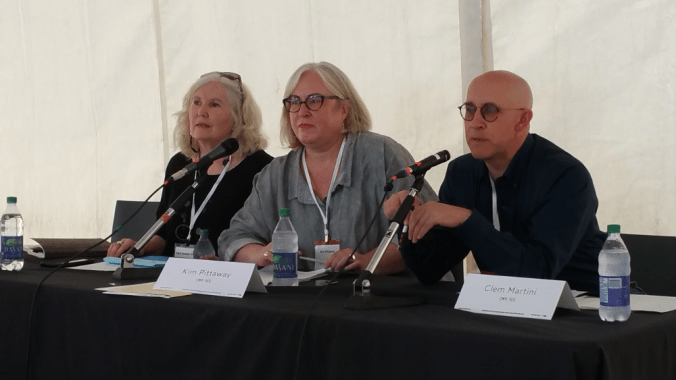
Panellists: Lorri Neilsen Glenn (moderator), Kim Pittaway, Clem Martini

LNG: So many people are struggling with how to approach difficult topics and hard truths in their writing. Each presenter will have the opportunity to frame their work, each will give a reading, and then we’ll open the floor to Q&A.

CM: In 2010, I wrote Bitter Medicine, which is about my family’s struggle with mental illness. It ends on a positive note, but the story itself is difficult in that it documents our journey with my brother’s schizophrenia and my mother’s developing dementia. When I recognized the first signs of my mother’s dementia, the support structure we’d had in place for my brother collapsed. They were living together, and had been able to take care of each other, with my support, until then. I’m now working on the continuing story, the working title of which is The Book of Lies. Caregiving is a verb. Ideally, it’s perfect, like a spider web, a delicate network of mutual and community support. In reality, it’s more like a spider web that’s been woven by a spider on LSD. It’s full of flaws. My problem now, because I’m writing our story as I’m living it, is to decide what’s safe to write about. What do I include? How far do I go? Those are cogent questions for all writers facing true stories with demanding subject matter.

KP: My current manuscript is about families and unforgiveness. The concept of difficult knowledge versus lovely knowledge is used in curation. Deborah Britzman defines lovely knowledge as easily assimilatable. It confirms what we know, or think we know, about the world. Difficult knowledge does not confirm, or conform with, our reality. How do we curate suffering? Are we showing it?  Are we turning suffering into something productive? How is truth-telling gratuitous? How is it harmful? This is intriguing to me as a writer because most memoirs are full of lovely knowledge. There’s nothing wrong with sweetness and nostalgia, but we have to be aware that everything contains within it, its opposite. Do you face it head on, or obliquely? We have to question our tools, our strategies, and our craft.

LNG: I was reading Martha Nussbaum. She states that the heart cannot change without story. I found myself thinking about readers and readers’ responses. My students ask me why I don’t have any happy stories or poems. It’s a valid question, but it made me think. Writing hard truths forces us to confront our shadow selves as writers and as readers. Despite what you think you’re writing about, the tough stuff is already there. Do we really need those details, though? There is a hunger for stories that get close to the bone. Take a look at the stories that have come out as a result of the Truth and Reconciliation Commission for residential school survivors. Those are terrible stories, but they’re also healing stories. Stories about difficult truths invite us to remove our masks. They can be, and often are, gendered.

Readings ensued, with the attendant and courteous trigger warnings, followed by Q&A.

Remember: I’ll be on blog-vacation, so there won’t be a post next weekend, though this week’s curation posts will be scheduled and should be posted on their regular days. No curation on the 23rd and 25th, though. I’ll be back on August 27th with my notes from Robert Sawyer’s presentation on diversifying your income and regularly scheduled blogging will proceed from there until November.

Thoughty Thursday: Things that made me go hmmmm on the interwebz, July 31-Aug 6, 2016

Lots of thoughty to get that mental corn a-poppin’.

Someone asks for advice on how to deal with grief. This response nails it. That Eric Alper.

Michelle Steinke reports on stifled grief and how the west has it wrong. The Huffington Post.

Minda Zetlin: here’s why you must make a happiness list right now. Inc.

Elisha Goldstein shares five ways to increase happiness in daily life. Mindful

Eric Barker examines how to find happiness. Time

Angelina Zimmerman presents eight ways to make a positive impact every day. Inc.

How to get rid of a stiff neck in 90 seconds. Real Farmacy

Nicolas Cole lists twenty brutal truths all twenty-somethings need to hear. Frankly, everyone could stand to be reminded . . . Inc.

Abigail Haworth reports on the Tanzanian wives: why these straight women are marrying each other. Marie Claire.

Actresses over 60 are the new box office powerhouses. Mark Harris for The Vulture.

Rejected Princesses features Jeanne de Clisson (1300-1359).

The Bright Side lists eleven of the most breathtaking buildings humanity is building right now.

I’ve shared this before, but it’s just that awesome. Kale in the arctic: an igloo greenhouse that could inspire fresh food production in the north. CBC

Chinese Canadian and First Nations artists created huge prints in Chinatown. The Georgia Straight.

The CBC invites you to meet the five commissioners leading the missing and murdered Indigenous women inquiry.

Angelique Eaglewoman explains why the inquiry into missing and murdered Indigenous women must engage all Canadians. The Globe and Mail

Female genital mutilation has been banned in Nigeria. A triumph. Kimberley Richards for A Plus.

Ijeoma Oluo explains what those feel-good cop videos are really all about. The Establishment.

Jonna Ivan knows why Trump supporters chant his name. The Establishment.

A neuroscientist explains what’s wrong with Trump supporters’ brains. Bobby Azarian for Raw Story.

Foz Meadows makes a note on mansplaining. We all do it, if we’re honest.

Melissa Dahl discovers why reading makes you carsick: your brain thinks it’s being poisoned. Yup. Still gives me the queaze. Science of Us.

The science of emojis. ASAP Thought.


Open Culture presents an infographic of the tree of languages.

The Decolonial Atlas names the Great Lakes in Ojibway.

A dark ages has been discovered in Cornwall. David Keys for The Independent.

UpWorthy asks you to try not to jiggle as you watch these new, bladeless wind turbines.

Super cool: check out this prototype for China’s new elevated buses. Bored Panda

Jonathon Ramsey reports on how UC Irvine accidentally invented a battery that lasts forever. The Drive

Scientists discover light could exist in a previously unknown form. Phys.org

The Perseid meteor shower will peak on Aug 11 and 12. And wouldn’t you know it? It’s cloudy tonight 😦 Phil Plait for Slate.

The so-called alien megastructure just got even more mysterious. Maddie Stone for Gizmodo.

Every year, the Curiosity rover sings happy birthday. It’s kind of sad, actually. Curiosity

The Declaration of Arbroath has been awarded UNESCO status. BBC

Feeling wicked? Here are nine spooky spells from an Icelandic book of sorcery. HMB

The power of smudging: the different types of blessing herbs and their healing properties. Spirit Science.

Why Sudbury needs a busy hub for creators. The Sudbury Star.

See you Saturday!

Thoughty Thursday

Tipsday: Writerly Goodness found on the interwebz, July 31-Aug 6, 2016

K.M. Weiland: how to get the most out of your scene sequels. Helping writers become authors

Margie Lawson shares her writing rule number 16: add subtext with dialogue cues. Writers in the storm

Marcy Kennedy explains how to use layers to create rich character emotions.

Jessica Strawser offers five ways to keep writing when life intervenes on Jane Friedman’s blog. Later in the week, Angela Ackerman guest posts: how to find and reach influencers to help you promote your book.

Donald Maass guides writers to the secrets of wonder for Writer Unboxed.

Your senses can come to your rescue. Juliet Marillier for Writer Unboxed.

Vaughn Roycroft shares his amazing writing journey. Writer Unboxed

Jo Eberhardt examines the problem with female protagonists. Writer Unboxed

Jami Gold teaches us how to tell whether a shocking scene is necessary, or just gratuitous.

Kristen Lamb considers when it’s time to give up. Warrior Writers

Self care and productivity for authors with Ellen Bard. The Creative Penn podcast.


Oren Ashkenazi lists five times stories broke promises to audiences. Mythcreants

Kameron Hurley offers her usual pithy and practical wisdom: you don’t owe anyone your time.

Lisa Cline interviews Orly Konig for CultureSpot MC.

Gabriela Pereira interviews Joanna Penn for DIYMFA Radio: how to be an author-entrepreneur.

K.M. Weiland shows you how use Scrivener to edit your novels. Helping writers become authors.

Publishing news: Suzanne Brandreth and Ron Eckel acquire Cooke International. Quill & Quire

Stacy Conradt shares ten facts about Lois Duncan. Mental Floss

Adrienne LaFrance lists the 200 happiest words in literature. The Atlantic

Alex Weiss compiles 24 quotes from Mr. Penumbra’s 24 Hour Bookstore that will make you fall in love with books all over again. Bustle

The conjuring: writing as spell. Megan Abbott for Catapult.

Troy L. Wiggins presents nine diverse fantasy novels that will challenge your idea of fantasy fiction. BookRiot

Cheryl Eddy lists fifteen must-read science fiction and fantasy books being published this month. i09

Dangerous Minds presents images from the 1973 masterpiece, Fantastic Planet. I remember seeing this when I was a kid. It disturbed me.

The biggest flaw of Stranger Things is its treatment of women. Genevieve Valentine for VOX.

How a 16th century Chinese legend transformed into the movie, League of Gods. Cheryl Eddy for i09.

Deadpool 2 will take aim at superhero sequels. Beth Elderkin for i09.

And this is how we get our informal writerly learnings.

See you Thursday.

Tipsday

The next chapter: July 2016 update

So, here we are again at a monthly update. August. Where has the year gone?

One of the great things about tracking your production (and this applies to all things, not just writing) is that you can look back and see the evidence of your work. It’s very comforting.

In addition to wrapping up my work in July this time, I’m going to review the year to date.

July

JulyProgress

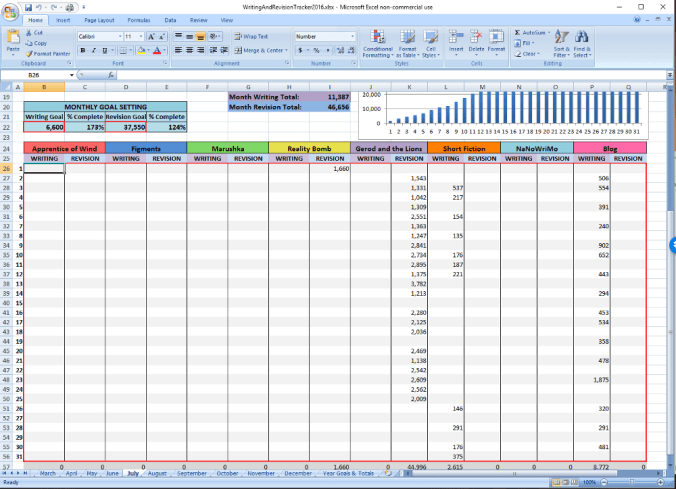
This month, I finished my first review of Gerod and the Lions. As with the last couple of novels, I wasn’t twitching as I reread, reacquainted myself with the story, and worked on some of the flow issues I saw. One reason for the flow issues was that GatL was written in chunks, separated by work done on other projects.

Sometimes the gaps were months long, and it shows. I had to get my head back into Gerod’s world and each time I returned to it, it took a few days to recapture the feeling.

The draft comes in at 44,996 words, which is decent for a middle grade book and 124% of my revision goal for the month.

I also continued work on the short story, which I’ll be submitting for consideration soon. 2,615 words written on that.

And, of course, there was the blog, and since I continued to participate in the weekly challenges presented by Gabriela Pereira to her DIYMFA Street Team, I far outblogged my goal.

Between the short story and the blog, I wrote 173% of my goal for July.

I also had the pleasure of guest blogging a couple of times in July, once on Mel’s Madness, and later, on DIYMFA (holy cow!). I have another guest blog due out this month on Kristene Perron’s Warp World blog.

I continued querying.

Year-to-date

Please keep in mind that revision is a very different animal than writing. I’m not writing all these words from scratch. I’m rearranging words, rewriting sentences or paragraphs for flow, inserting or removing punctuation, and making notes for future revisions.

Writing equates to original words.

Month Revision Writing Projects
January 69,774 words 186% of goal 9,274 words 141% of goal Apprentice of Wind, blog
February 40,708 words 108% of goal 5,027 words 90% of goal Apprentice of Wind, blog
March 66,637 words 177% of goal 8,436 words 141% of goal AoW, Figments, Marushka, blog
April 37,478 words 100% of goal 10,498 words 187% of goal Marushka, blog
May 50,882 words 136% of goal 10,474 words 181% of goal Marushka, Reality Bomb, blog
June 48,009 words 128% of goal 12,013 words 207% of goal Reality Bomb, blog
July 46,656 words 124% of goal 11,387 words 173% of goal RB, Gerod and the Lions, short fiction, blog

 Now and the rest of the year

With GatL, I’ve finished reviewing all of my drafted novels. Many of them are still grossly underwritten, but at least I have a better idea now of where I’m going with each.

For August, I just finished up my short story, which I will now revise, and otherwise, the only writing I’m doing is on the blog.

I’ve taken some time off to consider the remainder of the year and what I want to do.

Under consideration are:

  • Assembling a poetry collection (going to submit to a local small press) – August
  • Organizing a collection of my non-SFF short fiction (again, targeted at the small publisher) – August
  • Outlining the third book in my epic fantasy series. I’ve already taken a shot at it, but I know I have to rework it. I’ll do this anyway, because it’s this year’s NaNoWriMo project, but it’s on the list. – concurrent with other projects through to the end of October
  • Returning to Initiate of Stone and AoW, to recapture the voice of the series and bring everything into line in light of the outlining and NaNo for the third book. I want to get to November steeped in the world and its characters. – September and October

Because the third in series is of the epic nature, I expect to be continuing the drafting well into December.

I’m also taking a bit of time to think out how I want to structure my writing year from here on out. Previous to 2016, my focus was on getting the words down. Great, but then I had six novels drafted, only one of which was ready for querying.

This year, I’m focusing on the revision of all those drafts. They won’t be completely ready to go, but I’ll be in a place where I can alternate writing and revision in the coming years.

I want to draft new work twice a year, and then work on revision in between. I don’t know exactly what form that’s going to take (except for NaNo), but I think it’s something I can do.

Other stuff

I’m heading out to WorldCon/MidAmeriCon II on the 17th. It will be my first big con, so I’m super excited. This will be my last convention or conference for the year, though. I’ve blown my budget.

As a result, though, I’m going on a blogging vacay. I’ll schedule my Thoughty Thursday curation for the 18th before I leave, but you won’t hear from me again until I’m back and recovered and ready to resume bloggage on the 27th. Sacrifices have to be made.

I’ve done the crazy and applied for Brenda Drake’s #PitchWars. I’ll find out how that goes on the 25th. Not saying more about it for now.

I’m investigating partnerships with an editor. I want something long term, a professional editor who can help me get my drafts into publishable states.

I signed up for a first five pages workshop with NLA. Again, I’ll leave the deets for later.

And that’s this writer’s life.

Next weekend, I’ll be continuing with my CWS 2016 reportage with my notes from the Writing Hard Truths panel.

The Next Chapter

Thoughty Thursday: Things that made me go hmmmm on the interwebz, July 24-30, 2016

And here we are in August . . . where has the year gone (so far)?

Jim C. Hines hosts a couple of special guests for this post on policing in problematic times.

Onto the good news . . .

Sudbury will get a new rooftop mural for this year’s Up Here Festival. CBC

Jennifer Wolkin recommends mindful eating for a healthier brain-gut connection. Mindful.

The discovery of the heart. Paul Kennedy’s Ideas, on CBC.

The Scottish Refugee Council: Courage.


Parmigiani Fleurier restores a 200 year old double barrel pistol and its animated songbird.


Nicole Prause: what women (don’t)  need. Nova’s secret life of scientists and engineers.


Bored Panda presents pictures of modern women wearing traditional Ukrainian crowns.

The Vintage News reports on crinolinemania, the dangerous Victorian fashion garment that killed nearly 3,000 women (!)

April Holloway reports: DNA testing on the 2,000 year old Paracas skulls may change anthropology. Ancient Origins.

It turns out you only need one hour of moderate activity to make up for a day’s sitting. Exactly what I didn’t need to hear (Mellie = sluggie). Jennifer Ouelette for Gizmodo.

Bill Gates, Warren Buffett, and Oprah Winfrey all use the five hour rule. Inc.

Dying is hard. Death Doulas want to help make it easier. Ellen McCarthy for The Washington Post.

Rosetta’s final resting place has been chosen. Phil Plait for Slate. Later in the week: A white dwarf zaps its red dwarf companion with a death ray.

Kevin Kelly wonders if we’re heading toward a Minority Report style future. Tech Insider.

Monarch butterfly population triples over last year. Terry Turner for Good News Network.

When a crow dies, other crows investigate. Katherine Ellen Foley for Quartz.

Watch the Chincoteague ponies complete their 91st annual swim. Jason Daley for the Smithsonian Magazine.

Humpback whales protect other sea animals from killer whale attacks, but no one knows why. IFLS.

Tony Wu captures amazing sperm whale rituals. bioGraphic

Happy Friday!

See you Saturday for July’s next chapter update 🙂

Thoughty Thursday

Tipsday: Writerly Goodness found on the interwebz, July 24-30, 2016

Yummy, soul-feeding stuff this week.

The first post of the week for K.M. Weiland was intensely personal. It was also inspirational. It was exactly what I needed to read as the world around me seems to be falling to pieces (though that’s more apparent in my Thoughty Thursday curation posts, of late). Read it, my writerly friends, and take heart. This is why we write: five reasons why writing is important to the world. Later in the week she cautions us: don’t make this mistake with story structure.

Bonnie Randall guest posts on Janice Hardy’s Fiction University. Once more with feeling: writing emotionally strong characters.

Chris Winkle offers five ways to restore tension in your novel. Mythcreants.

Two of my favourite writerly women: Joanna Penn interviews Roz Morris for the Creative Penn podcast. Finding your author voice.

Katharine Britton guest posts on Writer Unboxed. On the road to a first draft: when you don’t know where you’re going, any road will do.

Marcy Kennedy is back with part four of her reading as a writer series.

Kelly Harms: writing a book takes how long, now? Writers in the Storm.

Jami Gold shares more lessons learned from her recent RWA conference. Do you belong, or are you a fraud?

Shawn Coyne wonders if good enough is good enough . . . This post was a bit controversial for a friend. Yes, we need mentors; we need editors. I personally don’t think there’s anything wrong with learning through experimentation, practice, and study, however. The idea that writers aren’t good enough, that they can’t be good enough without the intervention of others can result in sensitive creatives believing that they are inherently worthless. Or, it can result in the following problems, which can be just as bad . . . Just sayin’.

Karen Woodward encourages us to let go of perfectionism.

Kristen Lamb explores stress and burnout . . . and how to get your writerly mojo back.

Heather Webb has some advice on what to do when you feel like you’re treading water. Writer Unboxed.

Kameron Hurley: the wisdom of the grind.

Jane Friedman offers a definition of author platform.

Constance Renfrow writes about the do’s and don’ts of query letters. DIYMFA. AND . . . I had the opportunity to guest post on DIYMFA thanks to my participation in Gabriela’s Street Team! Five things I’ve learned from being on the DIYMFA Street Team.

Camille DeAngelis says that having her book go out of print was a pretty great thing, after all. Publishers Weekly.

Lynn Neary: can serialized fiction turn binge watchers into binge readers? NPR.

Sudburian Matthew Heiti wins the Carter v. Cooper competition! The Northern Life.

Working girls: the Bröntes. Elizabeth Hardwick for The New York Review of Books.

Alex Kulaev for BookBaby: The Jungle Book is a beautiful film with flawed storytelling.

Orange is the New Black’s Samira Wiley joins the cast of Hulu’s adaptation of Margaret Atwood’s The Handmaid’s Tale. Amy McNeill for The National Post.

Katherine Trendacosta thinks Christophe Gans’ La Belle et La Bête (Beauty and the Beast) is the most beautiful thing she’s seen in ages. i09

We are not things: shining examples of women’s autonomy in science fiction. Delia Harrington for The MarySue.

Babylon 5’s Jerry Doyle dies at the age of 60. Sadness 😦 James Whitbrook for i09.

And that was your informal writerly learnings for the week.

See you Thursday!

Tipsday

Review of D.G. Valdron’s The Mermaid’s Tale

About the book:

themermaidstaleIn a city of majesty and brutality, of warring races and fragile alliances, a sacred mermaid has been brutally murdered. An abomination, a soulless Arukh is summoned to hunt the killer. As the world around the Arukh drifts into war and madness, her search for justice leads her on a journey to discover redemption and even beauty in the midst of chaos.

Published by Five Rivers Publishing.

My thoughts:

The Mermaid’s Tale is a fable of personhood wrapped in a murder mystery framed by a fantasy setting, peopled by familiar races that are presented in subtly original ways.

Valdron’s protagonist has no name. Most Arukh (orcs) don’t. The few that have been so graced have earned their names by distinguishing themselves from their mad and murderous brethren. Each race has its own name for the Arukh, but all of them translate to either abomination, or abortion.

The Arukh are the sterile offspring of vampires and goblins and considered to be soulless. They are housed in lodges and governed by trolls, dwarves, or vampires and are largely used as expendable troops in warfare, which the various races engage in frequently with one another.

Something horrible has happened, though. A mermaid, one of a race considered sacred, has been brutally murdered. The selk call upon the Arukh to investigate and find the killer. It is implied that this particular Arukh is known for her skill in this area, but not why.

As she investigates, the trail of the killer leads the Arukh to each of the races in turn and the world is eventually fleshed out very cleverly in the form of told tales and legends. The mystery is what first draws readers in, but the world and its stories are what compel readers to continue turning pages.

Valdron’s world is a young one of unmitigated violence and the Arukh’s life is one of degradation. She fails repeatedly in her quest and makes many wrong assumptions, but for all that, the story itself is one of hope and redemption and the climax and denouement are both satisfying and bittersweet.

Readers will be left wanting more (moar!) of Valdron’s world and more of his surprisingly complex protagonist.

I lurved The Mermaid’s Tale.

My rating:

Five out of five stars. I did say lurve, didn’t I?

About the author:DGValdron

Den Valdron, is a reclusive writer, originally from New Brunswick, currently living in Winnipeg, Manitoba. Over the years, he has published in print and online a variety of short stories of speculative fiction, and articles on obscure pop culture topics.

Like many writers, his previous occupations have included mechanic, carpenter, schoolteacher, journalist and ditch-digger. He is currently an aboriginal rights lawyer.

He loves B-movies and tries to be nice to people. The Mermaid’s Tale is his first published novel.

You can connect with Den on Facebook.

Thoughty Thursday: Things that made me go hmmmm on the interwebz, July 17-23, 2016

Less angsty this week, as promised, but there’s still some serious.

Germany finally apologizes for its other genocide—more than a century later. Lynsey Chutel for Quartz.

Physician groups representing 426,000 doctors demand a stop to gun violence. American Psychiatric Association.

How Americans came together after Orlando. Conor Friedersdorf for The Atlantic.

Jim C. Hines considers another pointless police shooting.

Ok. New direction.

Twelve female activists who are changing the world. Joe McCarthy for Global Citizen.

Got privilege? What Lori Lakin Hutcherson told a white friend asked her opinion about white privilege. Good Black News.

Why I’m a racist. Not what you think. Just read it. Beyond the Glass Wall.

Dr. Nadine Caron is Canada’s first female First Nations surgeon. CBC’s the Current.

Canadian doctors have successfully reversed the effect of MS in a patient using stem cells. Notable.ca

Chris Hadfield: Questions for a Star Man. Nova’s secret life of scientists and engineers.


Hubble takes a long look into the heart of the crab nebula. Phil Plait for Slate. Later, he shares a year of Earth’s days in time lapse.

A walk in the woods: how walks are improving mental health. S.A. Mathieson for The Guardian.

Jen Granneman lists twelve things every highly sensitive person needs. Introvert, dear.

Another brief dip, but it’s important.

Lauren McKeon breaks fifteen years of silence. Toronto Life.

The real reason women love witches. Anne Theriault for The Establishment.

Buzzfeed presents seventeen maps that will change the way you view the world.

An orca rescue on Newsiosity.

The Oregon Supreme Court rules that dogs are sentient beings and not merely property. Bark Post.

And on that positive note, I bid thee adieu.

Until the weekend.

Thoughty Thursday

Tipsday: Writerly Goodness found on the interwebz, July 17-23, 2016

I am pleased to present your informal writerly learnings for the week.

K.M. Weiland: four ways to verify if your story concept is strong enough. Helping writers become authors. Also: four places to find the best story conflict.

You know what your novel means, but does your reader? Roz Morris advises that you approch the problem with two mindsets. Nail your novel.

Liz Lazzara guest posts on Writer Unboxed. Storytelling: an exercise in empathy.

Jeanne Kisacky: the synergy of the first draft, whether you trim or embellish. Writer Unboxed.

Dan Blank presents a hobbit’s guide to launching your book. Writer Unboxed.

Pamela Hodges lists fourteen books that should be on every writer’s shelf. The Write Practice.

Jennifer Louden guest posts on Jane Friedman’s blog: five ways to develop your writer’s voice.

Karen Woodward: never give up your dreams.

Chris Winkle offers seven common causes of reader confusion. Mythcreants.

Gail Carriger lends her expertise to Janice Hardy’s Fiction University. How to write (and how not to write) an author bio.

Derek Newman-Stille interviews Kate Story for Through the Twisted Woods.

The Writer’s Block features Matt Murphy.

Victoria (V.E.) Schwab writes about the slow pursuit of overnight success.

Writing as resistance. Chris Hedges for Truth Dig.

Keeping up with the Wangs. (SF related.) The Economist.

Grant Munroe interviews Margaret Atwood for Literary Hub.

Gabrielle Bellot explains why Calvin and Hobbes is great literature. Literary Hub.

This live-action Futurama fan film is both incredibly impressive and creepy. Bryan Menegus for i09.

Coldplay and Michael J. Fox play a tribute to Back to the Future. The Hollywood Reporter.

The Vulture lists every major film reference in Stranger Things. This series is full of homage. Lurve.

John Squires shares what Stephen King thinks about Stranger Things. iHorror.

Germain Lussier presents the first Wonder Woman trailer. Yum! i09

Come back Thursday ya’ll and get ya’s some thoughty 🙂

Tipsday

The Canadian Writers’ Summit 2016: Achieving your dream: the shadow side

Disclaimer: I am not perfect and neither are my notes. If you notice anything that needs correction or clarification, please email me at melanie (dot) marttila (at) gmail (dot) com

Panellists: Suzanne Alyssa Andrew, Carrie Snyder, Maria Meindl, Heidi Reimer, Sarah Henstra (Moderator)

theshadowside

SH: Everyone talks about the struggle that precedes publication, but what about what happens afterward?

[Panellists introduced.]

What’s been your experience with the shadow side?

HR: I’ve been thinking about this because I achieved my creative goals and felt things nobody I knew had ever mentioned. I finished my novel and I felt depressed rather than elated. My spouse is an actor and he’s experienced in the art of letting go. In his world, it’s a recognized thing that all actors experience. It’s not in mine. When I won the Chatelaine contest, I was elated, and then terrified. I looked up their distribution and readership on line. That amount of exposure made me feel vulnerable. I physically recoiled. Something intensely private was about to become public. I talked to friends about my distress.

MM: I feel like I’ve confronted the connection between success and darkness in my life. My grandmother was Mona Gould. By the time I was a child in the 60’s, her poem, “This was My Brother at Dieppe” was everywhere. When her success faded, she turned to alcohol and became bitter. What I learned from that experience is that success is harmful. It can destroy you. When she died, I received boxes of her materials. It took me five years to sort through it. She started promoting her work at the age of eleven. Her poem was sponsored by an arms manufacturer, but she was a pacifist. She didn’t feel she could object. Now I understand that it’s not success that’s destructive, but the lack of a forum and the means to use it.

CS: I always wanted to be a writer. As I was driving in from Waterloo, I tried to figure out what that seven-year-old girl’s impulse was. I focused everything on becoming an author. I published by first book at the age of twenty-nine. It was written when I was twenty-six. It was another eight years before I published my second novel. In 2012, The Juliet Stories came out and was nominated for a Governor General’s Award. It was a huge moment for me. I embraced the high and I rode it. I wasn’t prepared for not winning, though. I mean, I knew I wasn’t going to but knowing it and experiencing it are two different things. They informed us ahead of the public announcement and I sat with the secret for a week. I felt ashamed. I was afraid of disappointing my kids and everyone else who’d been so supportive of me and my book. I didn’t know how to cope with it. I am so grateful for my blog because I was able to get my experience out there. I almost changed careers. I had my acceptance to McMaster’s midwifery program in one hand and the offer for The Girl Runner in the other. I thought I’d made a mistake in pursuing my dream. Now I’m making a living as a writer. It’s wonderful and it’s amazingly difficult at the same time. It’s hard to be here and to be vulnerable in front of you.

SAA: Everything you’ve all said resonates. I’ve just published my first novel and I, too, have always wanted to be a writer. I went on a book tour and it was the first time my family had heard me read my work. I play bass in a band. It’s a group, a community. We share. In literary circles, I find there’s a lack of transparency, especially about publishing in Canada. I think the reality’s worse than any of us realize. There’s a lot of pressure to market your own book. I invested in promotion. I’m a freelance writer. I don’t regret making that investment. At the time I figured, I’ll worry about it later. Well, it’s later and I’m feeling the financial impact. I have second book paralysis, knowing how hard it was promoting my first. Musicians are open and honest about the challenges. They offer each other advice and strategies. Authors in Canada don’t talk about these issues. We’re worried about seeming ungrateful. It’s very isolating. We need to be more vocal as a community.

SH: Can any of you comment further on shame and vulnerability?

CS: You’re novel is something you’ve worked on for years. It will be judged. There will be reviews. I’m a private person. I work through things in writing. It doesn’t feel right to be so exposed. To create anything of value, you have to go there, though. I was terrified of being changed by success. I can deal with rejection, but I have no experience in dealing with success.

SAA: It’s about being a creative person in the public sphere. You can get so involved in the persona you adopt for the media that you can start to feel schizophrenic. We don’t express our real feelings on social media. Everyone else seems more successful, happier. You compare yourself to others and find yourself wanting. There’s another reality to the one presented on Facebook.

HR: When I was published for the first time (I wrote an essay about the experience) I suffered anxiety and panic attacks. If it’s not discussed openely, everyone thinks it’s only them. I have a novel on submission. I received a rejection and felt relief. I know what to do with rejection. A ‘yes’ involves a whole other world. I was happy to stay in my identity as a rejected writer. You have to redefine yourself in light of success.

SH: Is this a question of gender? We’re all women on this panel.

MM: There’s a line between the inner and outer worlds of the author. There’s a free-floating shame still attached to being a woman and a woman writer in particular. Hélène Cixous once asked, “write? With what right?” We’ve internalized this social message. It’s about taking charge of the narrative. Take hold of the narrative. Be heard. It’s a gendered issue.

CS: Are there any men authors in the audience?

Aud: Yes. When the questions was asked, all the women were nodding and the men were shaking their heads. We don’t talk about the shadow side.

MM: The word authorship, etymologically, it means leadership, mastery. As a woman, I didn’t feel welcomed into that world.

SH: Many authors speak of their novels as their ‘book babies.’ There’s a stigma to post-partum depression. You’re not allowed to feel down after having a human baby. Have you found anything that helps?

SAA: Being someone who had this dream, I had high expectations. Being in a band dialled those expectations back. Check your expectations. Talk about it with other authors. What does success mean to you?

CS: Create a safe, private space in which to create. Don’t get down on yourself if you can’t create while you’re doing publicity. It’s not what I thought the job was. I have to remember why I write. I have to turn off all of my expectations. I’m still a writer, even if I never get published again. I wanted to make a living as a writer. I have. But there are worse things than not making a living as a writer.

HR: I did a releasing ritual. I needed to get all of that stuff out. Society says you should be happy. I felt loss. I had to write it out. I had to acknowledge the feelings and affirm what I wanted.

SH: How do you not miss the moment because you’re rushing on to the next fifty things you have to do? You have to celebrate your successes. Ania Szado says you also have to honour your losses.

MM: When my book came out, my Rabbi did a blessing over the book. It was a wonderful thing, on the Sabbath, so, no selling, no pressure. We were just honouring a life event.

SH: Do you want to say something about your definition of success?

MM: The more I thought about it, the more I realized how much others define success for us. We also internalize those definitions and move the bar.

CS: My ‘word of the year’ was success. It terrified me. To everyone else, it looks like success. To me, it doesn’t feel like success. It has a lot to do with what we expect.

SAA: Amy Winehouse’s definition of success was to sing. That’s it. When she got big, she imploded.

Q: What issues turn you on to writing?

CS: I write because I have something to say. Later, the issues grow out of what I’ve written.

SAA: Despite all the challenges of writing, we all have something to say. The joy of writing is in expressing something, of speaking to your readers.

Q: How do you relate to your readers and how is that relationship affected by the shadow side?

MM: I used to be more involved in small press publication. A man bought my book for a dollar and then returned later to tell me that he was moved. It was a wonderful feeling.

SAA: I started out on fire about online marketing. Eventually, I felt like I was speaking into the void. It wasn’t until I went on tour that I felt it was real. I could talk to people. Writers are rarefied outside Toronto.

CS: I was at a writers’ festival in BC and a woman gave me an envelope. In her letter she asked me how I had known her so intimately? She felt like I had written for her, to her. It was humbling.

SH: When I launched Mad Miss Mimic last year, a girl bought the book, sat down, and didn’t stop reading all night. My favourite thing is when parents send me pictures of their kids reading the books. It’s old school. One reader can change your world.

Q: What kind of support do you look for?

SAA: I get the best support from other writers. I have a wonderful agent, Samantha Haywood, and she held my hand through the process.

Q: What strategy do you use to deal with criticism?

CS: I bounce back really quickly now. I’m as polite as possible in person. Privately, I allow myself 24 hours of bleakness, and then I get over it.

SAA: A lot of critique says more about the critic than the writer.

Q: Do you get requests for information from aspiring writers?

CS: Yes. I have advice on my blog. I’ll respond to individual requests for advice from friends.

HR: Take me out for lunch and I’ll tell you whatever you want to know.

Q: How do you deal with family stuff?

HR: I write what I write and when it goes out into the world, I panic. The Chatelaine article reveals some personal information about my relationship with my dad. I had to tell him when I heard that it would be published. I was worried, but it was good. It’s best to deal with it directly.

And that was time.

Next week, I’m going to post another book review.  It’s a five-star so you can look forward to that 🙂

Be well until next I post, my friends.