Why did I call this category Alchemy Ink?

I thought it was about time I answered this question.

I was reminded that I hadn’t addressed the issue yet when I read Martina Boone’s guest post on DIYMFA yesterday.  Martina writes:

Writing fiction is alchemy. We can have all the ingredients for a great story and still miss that wow factor that makes it all come together, makes our work transform from words on a page to a living, breathing entity with the possibility to burrow into someone else’s consciousness.

I’ve always thought of writing as a kind of alchemy, a kind of magic.  This might be

My only souvenir of Siobhan’s art is this book cover.

because I write epic fantasy.  Or it might be because when I started reading for pleasure, I started with C.S. Lewis, Lloyd Alexander, and Madeline L’Engle.  It could even be my inspiration for writing: the wonderful artwork of Siobhan Riddell.  When I was in grade three, she and her grade five classmates wrote and illustrated their own storybooks.  Siobhan’s was of a knight fighting a dragon.  Classic fairy tale.

And I was hooked.

I wanted to write something, even then, that made people feel the way Siobhan’s storybook made me feel.  That was the kind of magic I wanted.

Much later, I tried out a few of writers’ groups.  One was composed of friends from university: Kim Fahner, Steven Lendt, and Dan McCormick.  I actually proposed the name “Alchemy Ink” to them.  No one seemed particularly keen.

The next was a group of women brought together around the fabulous Si Tranksen.  That group published Battle Chant in 1999 and included Paulette Dahl, Violet Brenner, Louise Lane, Carole Trepanier, and, though she departed before the book project came together, Sonny B.

After that, another group of women writers, including the fae folkstress Dolores Dagenais, Gypsy, and fellow Sudbury Writers’ Guild members, Irene Golas, Margaret Lavoie, and Sue Scherzinger met irregularly to engage in creative stuff.  We didn’t only share our writing, but did cool things like playing with clay.

When the chemistry is right, a writers’ group can be magical.  I’m going to use some of my dreadful learning lingo here, but synergies can develop between the writers, and the creative energy so generated tends to fuel the creative self in wild ways.  Some of my best writing/most productive periods were inspired while I was in writing groups.

This is why I’ve called this category Alchemy Ink.  It’s a kind of substitute for the old writing groups.  Magical things can happen when you share …

But getting back to the writing of fiction, transforming what is in my head and heart onto writing on the page is pure alchemy.  I struggle to create gold, but what I might have is a means to immortality, the other goal of alchemy.  My words, if they’re good enough, will have a life outside of mine.  With luck and diligence, they may outlast me 🙂

Martina goes on to write that she is not a pantser (like me).  For her, the magic happens between the characters, in the backstory, in the execution.  She uses plotting and structure to “make room” for the more magical aspects of her art.

The last word belongs to Martina:

Chances are, that’s the part of storytelling we fell in love with in the first place.

Why did you fall in love with the alchemy of storytelling?  Where does the magic happen for you?

The cosmology and divine history of Tellurin, part 2

Last time on Work in progress: Yllel got his narsty on and killed his father!

With the death of Auremon, Yllel fled.  Almost at once, Auremon’s school, and indeed the entire island of Aurensart crumbled. Many of the initiates, apprentices, and magi died in the collapse.  What was left of Auremon’s school was a single spire of rock that rose from the water to the full height of the island.

Kaaria, an air elemental from Elphindar, and her sister Naia, rescued what was left of Auremon’s spirit and bound him into the spire that was all that remained of Auremsart. Without his god-share of power, though, Auremon was effectively trapped within the stone. He could communicate with no one but Kaaria and Naia.

Yllel returned to his preying on sourcerors and now magi as well.  He held the magi in particular contempt for his father’s sake.

Auraya, saddened enough at her mate’s sacrifice of his power, was now left bitter and bereft by his death.  She withdrew in earnest from the world, allowing Tryella to serve Tellurin in her stead.

The Kas’Khoudum, or book of light, that was started when Auraya, Auremon, and Tryella mingled freely with the people of Tellurin, was revised and added to.  Many of the feats described in its pages were Tryella’s but the goddess was more than happy to let her grieving mother take the credit for her good deeds.

In response, and out of a twisted need to outdo his mother, Yllel began to inspire the creation of his own holy book, the Rada’Khoudum, or book of darkness.  In its pages he put hideous secrets in the guise of rituals and ceremonies that seemed as if they honoured Auraya.  In truth, the spells he wove into those rituals would drain his mother of her power and bind her will to do terrible things.

When finished, Yllel was careful to see the precious book into the hands of the greatest spiritual leaders of the time.  The Kas’Khoudum, which Yllel encouraged to be seen as a pleasant book of fables, was supplanted by his liturgical masterpiece.  Unfortunately, neither Auraya nor Tryella were very interested in reading and neither of them discovered what deviousness Yllel had been up to.

Tryella investigated Auremon’s murder intensively, but none of the magi who survived the collapse of Auremon’s school could remember anything useful.  The only thing either Tryella or her mother knew for certain was that Auremon’s murderer had been one of his students.

Yllel had visited each of them briefly to offer his condolences, but did not join Tryella in her search.  Auraya retreated to the moon, but Tryella, something piqued by her brother’s behaviour, began to suspect Yllel of his treachery.

She had no proof, but it would only be a matter of time before she found it.

While Tryella didn’t find exactly what she sought, she soon learned how her brother spent his leisure time: hunting and killing the very magi their father helped to train.  She confronted him and Yllel told her that he was merely exacting revenge.  One of these was surely the creature who had killed a god.  Why should he not hunt and kill, even torture them?

Tryella went straight to Azuresahki, the blue realm of her mother.  Auraya listened with uncertainty to what Tryella told her and together they continued to observe Yllel from near and afar.

There was nothing in his choice of victim to indicate that he suspected any of these poor users of magick of Auremon’s murder.  Rather it seemed that he chose them for how much power they had.  Some managed to escape him through clever tricks they called binding, but though their power and soul might have been safe within an amulet or object, that often wasn’t enough to prevent Yllel from killing them for spite and trapping them within the object they had bound themselves to.

He didn’t attempt to break or destroy the artefact, but ensured that the object would remain lost to Tellurin forever, thus relegating the magi within to isolation, and eventual insanity.

This wanton killing and cruelty was enough to inspire Auraya to action.  Tryella still hadn’t shared her suspicions about Auremon’s murder yet, fearing her mother’s response, but held the secret as a trump card until a critical moment, or until she had proof.

Auraya first tried something like an intervention in the hope that Yllel was not lost to her entirely.  Her efforts were rebuffed. She tried again with the same results but was reluctant to give up hope.  Auraya couldn’t bear, after losing Auremon and the akhis before him, to lose another member of her family.

Eventually though, even she realized that tough love was more likely to get results.  Unfortunately, administering a godly spanking was more difficult than she could have imagined.  Tryella at her side, Auraya tried yet again to deliver her son a smack down that would put him in his place.

For his part, Yllel soon grew tired of his mother’s attempts to discipline him.  At first they might have been amusing, but now they were simply tedious.  Soon he no longer cared to hide his true feelings and motivations from them.  Soon he would have enough source that it wouldn’t matter.

Auraya had eventually to concede that Yllel was evil.  He killed for the joy of it as much as any other purpose.  He tortured her with her inability to discover Auremon’s murderer.  His attacks on Tryella were growing positively barbaric.

She had to face the fact that Yllel wanted to kill his sister, and that was something she could not allow.  Reluctant as she was to lose a child, even an evil one, Auraya began to up the stakes, pulling out all the tricks she had learned in her exceedingly long life.  Still every confrontation ended in defeat.  Yllel gloated, but though he seemed eager for the kill, he held back from it, as though he were testing them.  Or perhaps himself.

Something else would have to be done.

She got the idea from Auremon’s ill-advised release of power into the world.  In the process she knew he had torn open a Way Between the Worlds.  Auraya sought that place out and investigated it as a possible means to be rid of Yllel without having to kill her own child.

That Way would not be suitable, however.  There were still a great many people living in the world on the other side.  As Tryella continued her investigations and Yllel continued to test his newfound strength against her, Auraya sought out all the Ways Between the Worlds that existed in Tellurin.  One after another, they proved unsuitable. Until she found the one on the plains.

In the middle of the lush, grassy plains of eastern Tellurin. Auraya found a Way that seemed to lead nowhere at all.  There was literally nothing on the other side, no light, no sound, no air, and certainly no innocent people or creatures for Yllel to torture.  Now that Auraya had found her cage, she would have to figure out how to get the Way open wide enough to admit her son without sucking half of Tellurin in with it, and she would have to figure out how to close the Way afterward and make it impassable to Yllel.

She hadn’t thought so deeply about anything in a very long time.  Rarely had she had to think about how to accomplish something she desired at all.  Usually her desires simply manifested themselves.  This was something different.  Auraya was trying to change the very nature of something, a place, a void, into the ideal prison for her son.

Think of the void as a black hole … sort of.

Despite its apparent suitability, the void was its own place with its own purpose.  It did not want to be changed.  It had its own power and its own desire to use it.  In the end though, Auraya had more power and more desire, and a son she desperately did not want to kill.

When the void was subjugated and prepared, Auraya and Tryella found Yllel, engaged him in battle and lured him to the Way that led to the void.  The battle lasted sunspans in Tellurin time.

Great earthquakes shook the land.  The entire western coast of the world sheered off.  The mountains grew.  Volcanoes long dormant erupted into life.  The plains upon which the three gods fought became a desert.  The jungle became infested with random power, investing its creatures with strange abilities.  Vedranya changed from a season where few wished to travel to one in which shelter was an inescapable necessity.

This was the Tellurin Cataclysm.

In a few short suns, much of Tellurin civilization fell.  Many creatures died before they learned how to survive the newly changed Vedranya.

Finally, on the verge of exhaustion, Tryella and Auraya brought Yllel to the opening of the Way, but now Auraya had to focus her attention in opening the Way without tearing it so that it could be sealed again once Yllel was within.  That meant that the task of forcing Yllel into the void fell to Tryella alone.

She was unequal to it.  Yllel taunted her, as much as confessed to the murder of Auremon while his mother was otherwise occupied.  He was too confident by half and Tryella managed to make him stumble until he was caught in the well of the Way.

He realized his fight against the pull of the void was not going to be successful and relented, but not before reaching inside his sister and tearing her source and immortality from her, in one swift motion, killing her instantly.

Auraya wailed in despair.  First she lost the ahkis, then Auremon, now both children at once.  As she sealed the way to the void, Auraya heard Yllel say one final thing. “Don’t you want to know what I did to—”

And then he was shut away … Auraya thought forever.

Auraya was so depleted from her long battle and so wounded from her losses that she retreated again at once to the moon for solace.  Taking stock, she realized that she was now slowly dying, fading away.  She had poured out so much of her power during the battle with Yllel that the world had gotten hold of it and was slowly siphoning it away.  She could not stem the flow or find a way to reverse the process.  It would take centuries yet, perhaps even millennia for her to die completely, but it was a certainty now.

Kaaria and Naia, as they had with Auremon before, now resurected Tryella in the same manner.  The only vessel that could hold the former goddess was that of a giant sea eagle, or yrne.

From within his prison, Yllel discovered that while he could not escape, his thoughts could, and a god’s thoughts are powerful. He found someone willing to help him escape, a sourceror named Kane.  Over the next two centuries, Yllel plotted, used his favrard soul-slaves to trick some of the other people of Tellurin, the okante, krean, blinsies, grunden, and bakath into binding their collective souls to him as the favrard had done.

Tryella and Auremon, meanwhile found themselves in a predicament. Due to the nature of their respective deaths and resurrections by Kaaria and Naia, they were invisible to all but each other and their saviours. They couldn’t even tell Auraya they were still alive.

The only talent that Tryella retained was that of prescience. That talent alerted her to Yllel’s scheming and she tried to find some way of stopping him. Even with Kaaria’s help, however, her efforts proved futile, until her visions revealed to her the face of a young girl. She could be the means of defeating Yllel. Together, Tryella and Kaaria set out in search of her.

Auraya, meanwhile, while still hidden on Azuresakhi, nonetheless felt the effects of Yllel’s machinations in the world.  She determined to raise a champion of her own, a man who would become the Kas’Hadden, or hammer of light, and her avatar on Tellurin. He would protect the world and end Yllel’s predations once and for all.

Like his sister, Yllel began to be haunted by dreams of a girl. She had power, a mere splinter of a god’s but more than most Tellurin could ever hope for. He knew that she could prove a complication to his plans.  She could kill Kane before the sourceror could free Yllel from the void.

She was such a tasty prize, though, that Yllel determined to enslave her to his will instead.  Only if that plan failed would he concede and kill her.

He also became aware of what his mother was trying to do to end his hopes of escape.  Even as he commanded Kane to set sail for Tellurin and begin the war that would eventually result in his freedom, Yllel began to manipulate his mother’s followers, the Faithful.  He’d make sure that the Kas’Hadden would never be made.

And this is the point at which the novel opens.

Next week: We’ll start on the earthly history of Tellurin.

Challenges become opportunities: The Author Salon Experience

Back in December, I joined Author Salon on the advice of one of the people I consider to be my writing mentors, Barbara Kyle.

Initially, I had no clue what I was getting myself into.

My first mistake was not reading anything before I signed up, so when I was presented with a profile to fill out, I dove right in.  Little did I know that there was an art to this …  I did read the AS step-by-step guide, belatedly, but I still had no clue what I was doing.

I set up my profile to the best of my ability, sounded off in the Shout Out Forum, and then posted a call for peers in the In Production I Forum group that seemed to suit me best: Fantasy, Urban Fantasy, Horror, and Speculative Fiction.

The initial group that formed was small, but dedicated.  We started off by critiquing each other’s profiles.

Now, this may not seem particularly important work, but part of the AS process is that professional editors and agents peruse the site from time to time.  Ultimately, the author’s profile will be a marketing tool to those same agents and editors, so it is a critical piece of the AS puzzle.

It’s as important as perfecting your “pitch” or logline, as important as writing a knock-their-socks-off query letter, in short, the AS profile is as important as it gets.

I’ve been at a bit of a disadvantage because I’ve not yet attended a conference where I’ve had the opportunity to “pitch” my concept to agents.  I haven’t started shopping my novel yet, and so I really don’t have any experience crafting a query or synopsis.  I really don’t have an idea about what a hook line should be and how it differs from a conflict statement.  But I’m learning …  and I have to learn fast.

I thought I knew at least one thing going in: even if you have a series planned, the novel must function as a stand-alone, but it seems that everyone else in my critique group is using the fact that they have a series planned as a selling point.  So now I’m fairly convinced that I know nothing, and am approaching the whole process tabula rasa.

One question posed to me was, “why mention your day-job?”  The point was that the information should only be included in the event that it lends to the topic you write about, like a retired police officer writing mysteries/police procedurals.  I’d like to address that here.

As a learning and development professional, I write courses.  Certainly, it’s a completely different beast than a novel, but writing is writing and any practice reinforces skill.  It develops my rhetorical skills to direct my writing to a particular audience with a particular purpose in mind.

Also, as a corporate trainer, I have presentation skills.  It’s a good marketing point and while it may not be on the top of every agent’s list of skills an author must have, it may be an asset that tips the scales in my favour.

I’m more likely to be comfortable in an interview situation, doing public readings, and participating in workshops or conferences on a panel.  I’m tech-friendly, if not tech-savvy, as the result of my work.  I could easily put out YouTube videos or podcasts regarding craft, or reading of my work (in fact, it’s something on my list of things to do for my platform).  I could even parlay my skills into delivering Webinars or tutorials.

Finally, it was my learning and development day-job that got me back into learning-as-lifestyle.  Mutant learning, social learning, independent research, call it what you want, it’s what I need to ramp up my profile and my writing as presented on AS and attract the attention of agents and editors.  I started developing my online platform as a writer thanks to my work in L&D.

What I learned about Initiate of Stone in the first go-round:

  • It was too long;
  • It was too complex:
  • I’m too wordy; and
  • I’m not very good at seeing the redundancies in my own work.

Then, in January, all of my critique partners left In Production I and were promoted to Editor Suite.  Most of them had attended an Algonkian Conference which acted as their respective invitations to AS.  They all received personal notification to move along.  I thought I was left behind.

So I started over with a new call for peers and waited.  Eventually the administrators realized that there was some kind of miscommunication and offered a clarification.  I was promoted to Editor Suite after all!  My relief was immense.

My new critique group in Editor Suite included all of my old friends, plus a couple new ones.

The first order of business was to start over with the profile critiques, and when that was done, we moved onto critique our first acts.  AS calls them the first 50 pages, but I prefer to call it the first act because it’s actually the first 50 -100 pp, depending on where your first major plot point falls.

What I’ve learned from the critique of the first act:

  • My first major plot point takes too long to arrive;
  • The story line for my protagonist needs to be seriously amped up;
  • I still suck at the profile stuff (that’s part of what I’m working on next);
  • I may be wordy, but given my chosen genre, epic fantasy, it works, overall.

Along the way, there was this thing called the Showcase.  AS reps would be showing a foreshortened version of our profile to industry experts and seeing if they could get any interest.  The call went out about the time that the former version of this blog was hacked and there was a little confusion while I reordered my electronic life.  The server on which my blog was hosted at the time was also my email server …

Got that mess sorted, but even though the Showcase went on until May, IoS did not get a single nod.  Almost everyone else in my critique group, however, got at least one, and many received multiple expressions of interest.  I’m very happy for my peers, but really disappointed in/for myself.  This just speaks, once again, to the importance of the AS profile in the overall process.

What I’ve done or am doing as a result of all this:

  1. Cut my novel in half.  The former mid-way point is now the climax and I still have to cut about 40k words.  I don’t know how this will turn out, but I’m willing to work at it until it’s fabulous 🙂 ;
  2. Rewriting Ferathainn’s story/plot line;
  3. Revamping my profile;
  4. I’ve applied for, was accepted to, and have registered for Algonkian’s New York Comes to Niagara conference in October.  If nothing else, I’ll learn how to get my profile together there.

So we’ll see where this all takes me.  The AS journey has been fraught and fun and incredibly hard work so far.

That’s it for this week bubbies!  Gotta get working on my WIP!

For my science fiction writer friends, I want to post links to Robert Sawyer’s two-part January interview with William Gibson:

Also check out Robert’s TedXManitoba lecture:

Are you part of an online critique group?  What have you learned from the process?  How is it changing your creative life?

The cosmology and divine history of Tellurin, part 1

Last time on Work in progress: The supporting cast was introduced.

Once I had all my characters, I needed to think about the world they inhabited.  I went back to the beginning.  The very beginning of everything …

In the beginning, there was the One.  It was everything and everything was in it. The One simply was, and was in perfect harmony, until something within it recognized its independence, and in that moment, the One ceased to be and everything else came into existence (including time, hence the moment, the first).

Modern science would call this the big bang.

The-thing-that-recognized-its-independence wandered the universe, searching for something like itself.  Really, it was searching for the harmony of the One again, but it had destroyed the One, a crime of which it was ignorant, thus authoring its own loneliness and misery.

Having explored about three quarters of everything that existed, it was about to give up, when it finally found something else that felt like “home.”  It had discovered the disc of debris of a planet accreting itself into existence.

The two kindred spirits found names for each other: The-thing-that-recognized-its-independence became Auraya, and the planet, Tellurin.

Tellurin is the name of the world and its spirit, but it is also the name for the main continent of the world.  Originally, it was nothing but a large landmass, one of five on the planet.  Life was limited to plants, protozoa, bacteria, and insects.  The world was one rich in power, but it was latent and undirected.  When Auraya first chose the planet for her home, she explored it thoroughly.

Eventually, the mere exposure of the world to a sentient and powerful being like the goddess encouraged the development of innate intelligences.  The world responded to Auraya’s loneliness and became her first family.

One of the continents took on sentience and personality as brothers: Zaidesahki, Tahesahki, and Nuresahki.  The four remaining continents did not fully emerge into sentience, although the achieved consciousness.  They are called the watchers, because they did not speak or interact with anyone.  They simply bore witness to all that happened.  Similarly, the planet’s single blue, moon became conscious, though never sentient.  She was nonetheless given a name: Azuresahki and became a haven for Auraya.

The air and the water were their sisters: Freyesahki and Augesahki.  The deep fiery core of the earth was another brother, but more distant and less social than the others.  He was also more volatile and less kind that the others.  His name was Dwergesahki.

When Auraya left them to explore the rest of the universe, they felt abandoned.  The first life forms above the level of insect were the elementals.  Each of the sentient elements made its own creature, rich in source and of high intelligence: sylphs (air), undine (water), nomi (earth), and efts (fire).  Then came the animals, birds, and fish.

These arose due to the combined efforts of Zaidesahki with Freyesahki and Augesahki.

Tahesahki and Nuresahki became jealous and wanted to create something better.  Beastly races like blinsies, okante, krean, grunden, bakath, and the like arose from those efforts.

Without jealousy, but merely wishing to make companions for the creations of his brothers, Zaidesahki brought forth humans (Tellurin), and favrard.  Dwergesahki, less interested in all this wasteful creating than the others, asked for Zaidesahki’s assistance in creating the dwergen and dwergini.  Along the same lines as the subterranean folk, and for purely selfish reasons (much like Auraya), Zaidesahki and Augesahki joined forces again and created the anogeni, the hidden people, as special and secret companions for themselves.

Eventually, Tahesahki and Nuresahki became increasingly jealous of their brother, who seemed so contented with what he’d done.  Tahesahki lured the favrard away from Zaidesahki to his deserts.  Surprisingly, Zaidesahki let them go and made Tahesahki welcome as the favrard were much more suited to Tahesahki’s deserts than Zaidesahki’s lush forests and mountains.

The bitter brothers ignored and mistreated their own creations, creating miserable children.  In the end, they rose up against Zaidesahki, shattering him into seven pieces and killing him.  In the process, they sundered the great landmass that had once been their collective “body,” giving themselves wounds as mortal as their brother’s.

Augesahki, devastated by the death of her brother and lover, collected the seven shattered
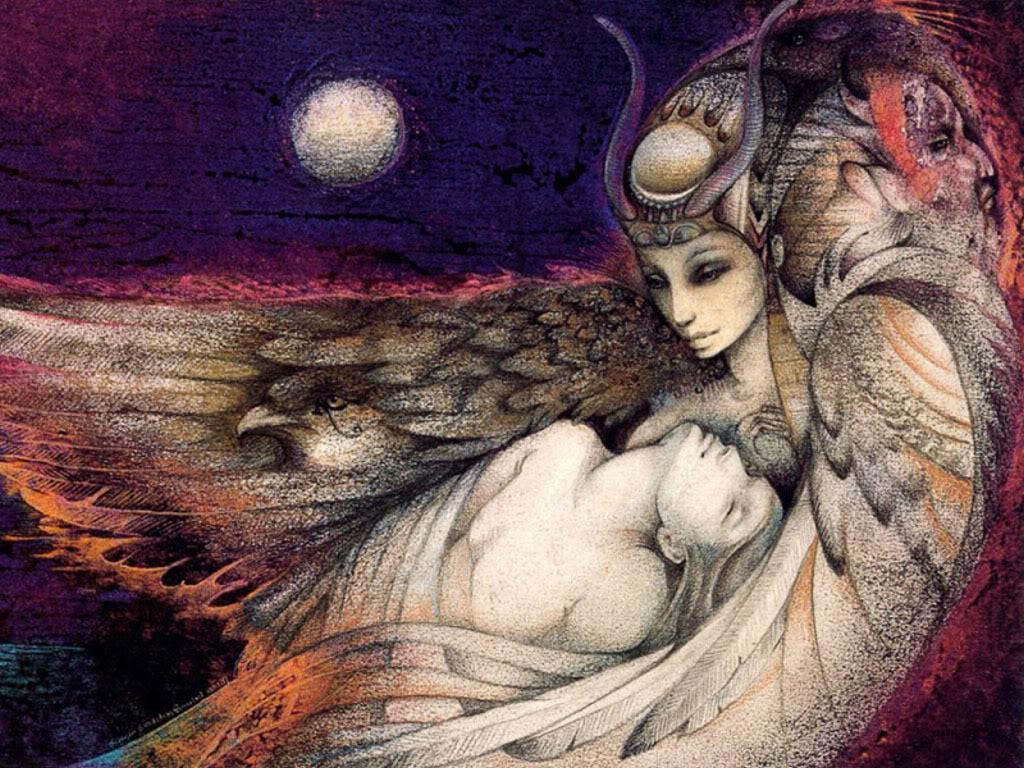
Susan Boulet’s Isis and Osiris

pieces of Zaidesahki’s soul and encased them in the body of a Tellurin who willingly sacrificed himself for the purpose.  She sealed Zaidesahki in a stone sarcophagus at the bottom of a lake in the middle of the continent.  She withdrew to the sea and became silent. (Based in part on the myth of Isis and Osiris, and in part on Arthurian Legend.)

Freyesahki and Dwergesahki remained what they always were, flighty and stoic respectively, and nothing more was heard of any of the akhis.

Auraya returned to Tellurin to show off Auremon.  Having failed to find anyone else like herself in the entire universe, she clove herself in two, creating Auremon her other half and spouse/consort. (Derived from a tale of how the Celtic goddess Aine fell in love with her reflection in a magic mirror that showed her the masculine part of her, or animus, and subsequently brought him to life.)

She was greeted with the desolation of her first “children” and the chaos of a million different life forms all clamouring for help and guidance.  The watchers, as ever, were silent.

Auraya vowed never to leave her beloved Tellurin again.

Auraya and Auremon began immediately to help the denizens of Tellurin, Auraya from her new home in the blue moon and Auremon by walking among the people in their guise.  Soon it became a titanic task for even the two celestial beings.

They determined to create two of their own children, helpers in their task.  Tryella was much like her father, adventurous, playful, and interested in getting her hands dirty.  She too, like Auremon, walked among the people of Tellurin and helped them in the disguise of one of their own.

Yllel was more introverted.  He resented the time and attention that the denizens of Tellurin exacted from his family.  Attention he thought more befittingly belonged to him.  He only helped the people of Tellurin when forced to and while neither Auraya nor Auremon chastised him for his lack, the praise they lavished on Tryella for her efforts made Yllel feel all the more jealous.

He began to sabotage their efforts in subtle ways, but bored of that quickly.  His attention was then captured by the sourcerors.  These people had recognised in themselves the ability to access and manipulate the innate power in all things.  They called it the source and themselves sourcerors.  Yllel realized that these sourcerors had much to teach him.  After all, what was he but source?  How did the gods manipulate the world around them but through the use of source?

When they began to kill one another and steal each others’ source, Yllel learned the art.  When they developed binding as a way to protect themselves from one another, Yllel paid careful attention.  Soon the god willingly masqueraded as a Tellurin to kill sourcerors and take their source.  Then a truly devious idea occurred to him.  Soul and source could be bound to other objects and even people.  What would happen if he tricked someone, or several someones into binding their source to him while they still lived …  And so Yllel created the first and greatest of his soul contracts, that with the favrard.

The favrard still lived on Tahesahki in isolation from the main continent.  They were in the midst of a battle against the other denizens of Tahesahki: the krean.  The lower race, as even the krean fancied themselves, were numerous in the extreme.  Though short-lived, the krean possessed the ability to regenerate, or heal themselves (essentially trolls, but sea-faring as well as desert-dwelling). Sheer numbers were taking their toll on the valiant favrard and they faced extermination.  In their darkest hour, Yllel came to them, putting on his most beatific form and manner.  He easily tricked the favrard into signing over their source and souls to him while they still lived, to be his slaves in perpetuity.

Binding the living to him taught Yllel much.  He did not get to claim the favrard souls and source wholesale until they died, at his hands or at each other’s, but he could use their source to feed himself even while they lived, and their connection allowed him to possess them from time to time at his whim.  It was as though a piece of him resided in each of them.  He could eavesdrop on any of them, or all of them, at will.

He experimented freely, and sometimes fatally with the first.  He learned just how far he could push them, exactly what he could make them do.  He wasn’t satisfied though.  They were still frail and mortal.  To make them immortal, Yllel would have to sacrifice too much of himself in the process.  His intent was to gather source, not expend it.  So he used his connection with the favrard to alter them.  He made them tougher, stronger, and imbued each of them with the incredible healing ability of their enemies, the krean, so that they could heal from all but the most drastic of injuries.  They would never grow old or ill, but they could be killed.

Yllel continued to make his study of the sourcerors.  One in particular was different.  His name was Halthyon, and he wasn’t a Tellurin, dwergen, dwergini, or any other people that walked on or under the earth.  Halthyon refused to give up his secrets, however.

It wasn’t long before Auremon, also seeing the sourcerors and what they did, but not understanding it in the same way that Yllel did, sought to bring even more source into the world for the people to benefit from.  He believed that if there was more power, more people could learn to use it.  Or more people would be born with the innate ability to access and manipulate the power, and he hoped that it would give them the ability to protect themselves from the worst of the sourcerors who only lived to kill each other and subjugate those of lesser talent.  So he determined to forfeit his godhood and release his power into the world.

Noble sentiments, but things don’t always go as planned.

When he released his power into the world, Auremon inadvertently tore open a doorway he hadn’t even known existed.  Speckled throughout Tellurin, and every world for that matter, are Ways Between the Worlds.  Yllel’s mystery sourceror, Halthyon came through one of these from the world of Elphindar.

Now Auremon tore that Way wide open, pulling a good half of the population of eleph, and many of the other animals, elementals, and other denizens of the world in a cataclysmic maelstrom.  Many of those so pulled died in transit, but those who survived found themselves stranded in a strange place and inexplicably unable to cross back through the Way to Elphindar.

They established their own settlements and learned of Auremon’s terrible mistake when in the aftermath of the Rending, he came to them and tried to make amends.  Their collective fear and anger and shame caused the eleph to reject Auramon’s overtures as well as those of the Tellurin, dwergen, or anyone else who came to trade or make alliances.  They became solitary, wounded people, and for a long time, there was no hope in them.

The cataclysm was a blessing in disguise, however, though one they would not understand for many sunspans to come.  Elphindar was already a dying world.  Auremon’s mistake ushered it on its way more swiftly, but the ultimate decline of Elephinar was inevitable.

Auremon’s mistake did not yield the results he had hoped for either.  No more people than before were able to sense and manipulate power.  He wanted to discover the reason why, but without his own, he was little more than a Tellurin himself.

He researched for a while, found like-minded sourcerors who thought the cannibalistic ways of their fellows and their experiments a form of heresy.  Together these sourcerors, guided by Auremon, devised a new way of viewing the manipulation of power.

By changing the names of all things sourcerous, they hoped to divorce ensuing generations of magi (as they now called themselves) from much of what was evil in their practice.  Source became magick and those who manipulated it were called magi.  A structured apprenticeship bound in ceremony and ritual and true research grounded the craft and made it “safe.”

A young mage was initiated by one of his elders when his talent was detected.  After thirteen sunspans of continuous study, the mage would be made apprentice and his abilities “unlocked.”  In truth the ability was never locked to begin with, but the young mage would be so occupied with his training that he wouldn’t have time to realize that small lie.

Auremon set up a school on a small but mountainous island off the coast of the main continent and magi from all over Tellurin would report for training.  Yllel, in the meantime, had been working hard to fortify his store of source and became contemptuous of his father’s attempts to “dumb down” the art of sourcery.

There were still sourcerors in the world and more recognized their abilities all the time, but Auremon turned a blind eye to them, hoping, quite naively that if he just ignored them, they would go away.

Yllel disguised himself as a Tellurin again and approached his father’s school as an initiate.  He soon became a favoured student, completing all of his tasks competently and without complaint, but Yllel soon began to ask questions about sourcery and the sourcerous arts.

He was trying to expose the dullards his father was producing to the true art of which Agrothe magery was a pale imitation.  Eventually, Auremon invited Yllel to a private meeting.  As he was trying to enlighten what he thought was a simple student, Yllel took advantage of their seclusion and murdered his father.  There was no source left to take, and this left Yllel frustrated and empty.

To be continued …
Do you dress for success?

If you’ve been reading Writerly Goodness for any length of time, then you’ll know that I’m fascinated by process, my own and others’.  I love to find out how other creative people do what they do, their sets of rules and their arcane rituals.  On Facebook, I often share the tips and tricks I find on my blogly ramblings, and secretly, I take a certain perverse pleasure in how many of those rules I break, and how many guidelines I defy.

Writerly Goodness aspires to the transgressive, but only rarely does she manage the faithful leap such actions require.

In May of 2011, I attended the Canadian Authors Association’s CanWrite! Conference.  Workshop host Barbara Kyle offered many writing tips, but the one that stays in my mind is this: dress for success.

Why?  I suppose it’s because I don’t, but more on that in a bit.

Barbara stated that when she got up in the morning, she was always careful to dress appropriately, as if for work: business casual.  She said that this practice honoured her work and her as its creator.  Dressing for work meant that she was serious about her writing, that she wasn’t taking anything for granted, and that she wasn’t going to waste anyone’s time, not hers, not her readers’, and certainly not her agent’s, editor’s, or publisher’s.

I agree that one should dress appropriately for one’s work, but to me, that depends entirely on what your work and life is like.  Let me ‘splain …

Writing is Barbara’s second career, after a successful first career as an actress.  She stopped acting to become an author and made the decision to write full time.  The temptation for someone in that position would be to become part of the pyjama patrol, roll out of bed, and stumble to the computer.  Barbara worked hard at her first career and knew the value of discipline, however; she knew that the slovenly writer’s life was not for her.

I don’t have that luxury.  I have to work and I have to dress appropriately for work.  When I get home of an evening, it’s actually part of my ritual to dress down for my writing.  Phil and I call this transforming into ‘comfort woman’ 🙂

I need to shed one professional self to become another, and my professional writer wants to be comfortable.

Right now, I’m in my shortie penguin pj’s, and damn, do I feel good!  You might have the urge to equate me to Michael Douglas’s character in Wonder Boys who wore the same bedraggled housecoat to write in every day … and discovered he was hideously blocked!  That would be a mistake.

I have a reason to dress as I do when I write.  That in no way means that I am any less diligent or devoted to my craft.  It simply means that my definition of appropriate dress is different.  So I’m comfortable saying that I still dress for success.

Process is different for every writer.  That’s why I find it so fascinating.

What about you?  How do you dress for success?  What does that mean for you?

The cadre … or should that be the cabal?

Whatever 🙂  The supporting cast.

Last week on Work in progress: I sketched out the baddies in my novel.

This week, I want to look at some of the supporting characters on the heroic side of things.  I haven’t done detailed written sketches of any of them, so this might be short and sweet!

We’ll start with Ferathainn’s family.

Selene and Devlin

Selene looks like Selma Blair … or vice versa

Selene was a child when her family and the people they were traveling with were attacked.  Only Selene survived, though injured, and was found wandering in the woods by Leaf and Oak, eleph brothers, who promptly took her back to their home in Hartsgrove.  The child could not remember anything, not even her own name.

Willow, sister of Oak and Leaf, named Selene after performing the ritual of shir’authe, the eleph way of foretelling the future of a child.  Willow knew that the girl would be a seer, a talent associated with the moon.  Selene seemed appropriate.

Years later, a young bard came to Hartsgrove.  He recited his poetry and sang his songs.

And John Butler would make an awesome Devlin

Devlin also collected stories though, and was particularly enamoured of the eleph.  Leaf was finiris, or a song master, and like a bard, finiris practiced not one, but as many of the arts as they could learn.

Though he moved on, Devlin returned often, using Leaf as his excuse, but spending more and more of his time with Selene.

Eventually, they married, but soon learned that they could not have children.  When a pregnant noble woman appeared, then ran away, shortly after giving birth, Selene and Devlin decided that they would adopt the child as their own, but they’ve never told Ferathainn that she is not theirs.

In Tellurin society, it doesn’t matter if a child is adopted or not.  The people who raise you are your parents, and fostering is a common practice.  It wouldn’t be a shameful thing if Selene and Devlin did tell Ferathainn, but they don’t.

Master Aeldred

Walt Whitman reminds me of Aeldred

The old mage was a wanderer.  He’d had his degree from the King’s university, but loved research and unearthing lore.  It was coincidence that he was in Hartsgrove the Sestaya that Ferathainn was born, but as a mage, he had the right to take part in the infant’s shir’authe.  He was simply pleased to take part in an eleph ritual.

The eleph could see nothing of the baby’s future though, except Leaf, who saw his astara in the baby’s eyes.  Selene immediately took exception to this, since Leaf was already over a hundred suns old.  It seemed perverse, and no matter what assurances Leaf offered, Selene could not be appeased.

When Aeldred finally took the baby in his arms, he could sense the power in her.  It was like nothing he’d ever felt before.  To those assembled, he merely said that the child had promise and that he might be induced to stay and take her on as a student when she was older, if she wished.

Aeldred is afraid of Ferathainn, though.  Afraid of what she might become and of his inability to control her.  This he never spoke of either, not even to his colleagues back in Drychtensart, who all wondered that he’s taking on a girl as a student.  Aeldred did what he thought was best for the girl, though, and taught her in the Agrothe tradition.  He does not gawk or wonder at her talents, though inwardly he quakes.  If she does not think she is special, if she submits to the disciplines of the Agrothe, then it is likely that she will not become the monster he fears she will …

Aislinn

Devlin loves Selene, but he always wanted a child of his own, and when Willow proposed a liaison, he was definitely interested.  Willow made it clear that she had no love for him.  Lust, yes, but that was a passing thing.  If she could get the idea out of her mind, she’d never have reason to pursue the bard afterward.

In an unusual move, Devlin and Willow approached Selene.  Devlin would only proceed with her approval.  Even more strangely, Selene gave her consent.

Willow hadn’t suspected that an eleph and a Tellurin could have children together, but was pleased to discover her pregnancy.  Devlin doted on his child and unofficially adopted her into his family.

Emma Stone as Aislinn

As she grew older, though, Aislinn never exhibited an interest in his music the way Ferathainn had.  She didn’t dance and she couldn’t carry a tune in a basket.  She was what we might call a girly-girl.  She loved sewing and making her own clothes, doing her hair up in fancy styles, and giggling and gossiping.

Unfortunately, her eleph features marked her as strange.  Parents didn’t take kindly to their children fraternizing with the half-breed.  She had nothing in common with either Devlin or Leaf, did not take an interest in Oak’s scouting and hunting, or in the kishida (eleph martial arts), and she didn’t like getting dirty like her mother, Willow, who spent her time either tending her fruit, or brewing, fermenting, and distilling it into alcohol.

Aislinn’s shir’authe revealed that she could be a bridge between the eleph and the Tellurin.

Leaf, Oak, and Willow

Brad Pitt with silver hair could be Leaf

These three eleph are shuriah, or outcast from their people.  Eleph society is very rigid and those that do not abide by the rules are ostracized.  In Elphindar, where the eleph originated, there were no other people.  Being shuriah meant death in all but a very few cases.

Tellurin is full of people, though.  It’s crawling with Tellurin (named for their land), but is also populated by other races: the okante, grunden, blinsies, and favrard.  The dwergen and dwergini live beneath the mountains.

Olivia Wilde as Willow

In the west, government is sparse and centralized in a few of the larger cities.  In between, people live largely as they choose.  So it was that Ashandrel (Willow), Duriel (Oak), and Faliel (Leaf) found a small community where they could live peacefully with their neighbours so long as they contributed to the sowing and harvesting at the area farms, and contributed to the livelihood of the village.

Leaf saw his astara, or soul lights, in Ferathainn’s eyes.

Orlando Bloom could be Oak

Only eleph are supposed to see them, and only in the eyes of other eleph.  Still, destiny cannot be denied.  He is even more mystified when Ferathainn sees her astara in his eyes, but he is grateful.  He would never have disclosed his feelings for Ferathainn had she not returned them.

Shia and the anogeni

Once, the anogeni were the hands of the mountains, the fingers of the seas, but eventually, they became their own distinct people.

They resemble pygmies in stature, but have large, child-like heads.  Their eyes are large and they do not have hair, but their ebony skin is covered in a kind of down.

The anogeni way is one of love.  Everything has a spirit, and they respect the spirit of every thing.  This is how they work what others might consider magick: they ask nicely, and usually the spirit is willing to help.  They shape stone and wood, and the core of their spiritual practice centres on twelve sacred plants, or askhiwine.  These particular plant spirits are very wise, and teach lessons.

Essentially, they are shaman.  The anoashki, or great mystery, is their grandfather, the living spirit of the world.

The anogeni find Dairragh after the fall of Gryphonskeep.  He is dead, but these remarkable people bring him back to life and try to teach him the anogeni way.

The anogeni are born with all of the memories of their predecessors.  Between that and the lessons of the ashkiwine, they have a great many prophecies, and Dairragh figures into a few of them.  So they determine to save him, and try to make him a champion.

Ella and Kaaria

Really, I should reserve discussion of these two figures until I talk about the deities of Tellurin, but they are part of the cabal that help my heroes, so I’ll say a few words here.

Ella is all that is left of the goddess Tryella after her brother tried to murder her.  Kaaria, an air elemental, and her sister Naia, a water elemental, rescue Tryella, after a fashion, but the best they can do for the wounded god is to put her into the body of an yrne, or giant sea eagle.

While she can still speak, nobody but Kaaria, Naia, and their other rescue, Auremon, can understand her.  She has a little prescience, and is very long-lived, but beyond that, she is mortal.  A Tellurin with a bow and good aim could kill her.

She’s been desperately trying to find some way to prevent her brother from escaping his prison.  If he gets out, everyone is going to suffer.  No matter what she tries, however, it does not seem to change the outcome.  Even Auraya’s attempts to raise the Kas’Hadden, she fears, will not be sufficient to defeat Yllel.

She does see the face of a girl, though.  Ella’s not sure whether the girl will play a role in her brother’s defeat, or if she’s not a greater danger altogether, but she figures that she will need all the help she can get.

Kaaria is helping her track down the girl, but when they do, it’s almost too late.  In desperation, Ella diverts Eoghan from his destination at the Well of Souls, to save the girl, and she and Kaaria try to prepare both Eoghan and Ferathainn for what is to come.

Kaaria and her sister aren’t native to Tellurin.  When Auremon tore the Way Between the Worlds between Tellurin and Elphindar apart, they were two of the beings pulled through it into Tellurin.  Elphindar was a dying world, and they were grateful to have a new home.

The living spirit of the planet spoke to them and has recruited them to help him bring back his original children, the akhis.  Ferathainn and Dairragh have a role to play in that drama too.

And that’s it for this week 🙂

I’ll be moving on to more legitimate world-building activities after this, I promise!

Have a great weekend.

What happened afterward

Last time on My history as a so-called writer: NEOVerse opened new possibilities 🙂

About the same time that I started working for ACCUTE, my sister-in-law told me to apply for a job with her employer.  I did and before the year was out, I was once again working two jobs at the same time, up to sixty hours a week.

Exhausted, I left ACCUTE and stuck with the better career opportunity.  It was in a call centre, not something I’d generally choose for myself, but in Sudbury at the time, it was a very good job (considering pay, benefits, and pension) and I needed that.

It felt like selling out, though.  Plus, I wasn’t suited to it.  Every negative call stayed with me.  Every anguished personal tale made me feel guilty that I couldn’t do anything to help.  I tried working full-time, but couldn’t hack it long-term and returned to a part-time schedule after six months.

It was at this time that my depression, which I’d been trying to deny since I was seventeen, reared its ugly head in earnest and I had to deal. Medication and therapy provided a short-term solution, but eventually, I weaned myself off the meds and tried to manage my illness through diet, exercise, meditation, and persistent awareness of what my body, heart, and mind were telling me.

They were screaming at me to get out, but I didn’t have any other options.

Term employment led to permanent, a mortgage (negotiated to consolidate our debt including our sizable school loans), and a car loan.

I was an adult now, with an adult job, adult debts, and adult responsibilities.  I was a home-owner.  All creativity seemed to vanish.  Though I was still certain that I wanted to write, I was unable to muster the necessary dedication.  Writing was now something reserved for vacation.

This went on for years.  I tried to wedge my butt in my desk chair, but it never stayed for long.  I did pull out my old project from time to time, but couldn’t focus. I joined the Sudbury Writers’ Guild and attended a fall workshop with Rosemary Aubert.  To be honest, I’d never heard of her before, but the workshop was great and I was inspired.

When my grandfather passed away, part of my small inheritance went toward a lap top computer.  That helped a little too.  I wasn’t chained indoors in the middle of summer anymore.  I wrote more that year.

I was successful in an internal competition at work.  Better pay and a better job.  It was a good thing.  Just before I started, the Sudbury Writers’ Guild scored another coup: Nino Ricci.  That was when my writing life changed.

In the wake of that workshop, I started writing every day.

That was the real beginning of my life as a writer.

Took me long enough, didn’t it?

Gratuitous links regarding the butt in chair phenomenon:

____________________________________________________________________________

This is my last post in My history as a so-called writer for the foreseeable.  Other tales of Writerly Goodness can be found under my categories: Work in progress and Authorial name dropping.  Next week, my blogging schedule will change, so stay tuned.

I will continue to post in Select poetry, Alchemy Ink, Work in progress, and Breaking open the mind, my learning category.

The Initiate of Stone rogues gallery

Previously on Work in progress:  Character sketches part 1: Ferathainn Devlin; Character sketches part 2: Eoghan MacDubghall; Character sketches part 3: Dairragh McKillian.

So the deal is this: as I started to write, all three of the above emerged as protagonists to one degree or another.  Ferathainn remained my primary protagonist, because it was her story that everything else emerged from, and I intend to adhere to that.

Eoghan and Dairragh were strong supporting characters, though, and I felt I had to provide them with antagonists (antagoni?) of their own.

Originally …

The character that became Khaleal was Ferathainn’s main antagonist.  He was the servant of Kane, who is known as The Black King, but Khaleal was only a servant, and acted wilfully and maliciously in Kane’s service.

The initial origins of the favrard people (they can have viable offspring with Tellurin and are therefore not a separate race/species from my perspective) were that they were created, from time immemorial, to be predatory.  Their genetics are dominant, but they needed a non-favrard to mate with, someone who possesses power, and similar physical traits, to reproduce.

Originally, this was the impetus for his rape of Ferathainn, because she was a suitable subject for the continuance of his people.  It was a biological imperative, and eventually, this seemed to me to be too contrived.

Kane was the mastermind behind the war that Khaleal is a perpetrator of, and he experimented on people.  Initially, this was a purely scientific experimentation: how much weight could a healthy specimen hold before his or her strength gave way and she or he was crushed?  How far could various joints be bent before they broke?  Things like that.  Kane was just plain cruel.

Yllel was originally called Greymon, or known to the peoples of Tellurin as “The Grey Man.”  He was the traditional devil figure and tricked people into selling their souls for various dispensations.  He was always imprisoned to prevent him from harming people/destroying the world, but initially his passion for destruction was mindless.  It just was.  There was no reason for his need to bring the world to ruin.

Eventually, I conceived of a way to bring these three villains together when I thought about the deities of Tellurin and its magick system (yes, they’re both coming in future world-building posts).

For Eoghan, Kane and Yllel (as Greymon) were the people he was assigned to defeat because as the Kas’Hadden, it was his duty to protect the world and fight the people who posed a threat to it.  Khaleal would be an obvious antagonist because of Eoghan’s love for Ferathainn.  He wants to protect her.

When I developed Tellurin’s religious system (also coming in a future post), I realized that organized religion would also be an antagonist for Eoghan.

I gave it form in the personages of Archbishop Hermann Manse and High Inquisitor Alphonse de Naude (which I will not be offering sketches of here).  Later, I also instituted a rival religion for the Faithful, the adherents of the Holy Mother Church, of whom Queen Amalthea became the main antagonistic figure.  She does not appear until the next novel in my series though.

The Fathithful could be equated to Christianity in general.  They share the most in common with High Anglican practice, but there are points of divergence.  The Faithful do not really believe in the existence of the gods, but perpetuate belief for the better governance of the people.

The HMC is more of a political body.  They believe in the gods in the clock-maker sense.  The gods set everything in motion, but the Tellurin are the ones who rule the world on their behalf.  Magick and its practitioners are blasphemous.  The Faithful are blasphemous.  Any people not purely Tellurin are blasphemous.  They are looking to foment holy war.

In thinking about Dairragh and his potential conflicts, I decided to make Halthyon into his primary antagonist.  They have a long and strange association.  As I mentioned in Dairragh’s sketch last week, Halthyon enters Dairragh’s life when he is very young.  The sourceror seduces Aline, Killian’s wife, impregnates her, and then leaves.

Not having any knowledge of where her lover went, Aline eventually runs away when Killian realizes that her baby is not his.  Halthyon returns years later and Aline willingly runs away with him, but he is not interested in her, only the child she bore.  Aline refuses to disclose where she left her baby, and dies at Halthyon’s hand.

Halthyon leaves her body for Killian and Dairragh to discover and disappears again.  When Halthyon returns to Gryphonskeep a third time, it is as the captain of a regiment.  Dairragh recognizes him, and tries to kill the author of his life’s tragedies, but only succeeds in setting off the attack, destroying everything he knows and loves.

Dairragh is also at odds with Killian, who, after his betrayal by Aline and Halthyon, becomes abusive and cruel.

When I decided to make Ferathainn and Dairragh half-brother and sister, I knew Halthyon had to be her father.  That got me thinking about how he could also play the antagonist role for Ferathainn …

Raven Margrove is Dairragh’s cousin (born Nicholas de Corvus), and a minion of Kane’s.  He is the one responsible for the destruction of Aurayene, and he leads the largest company of the Black King’s army.  It is his goal to kill King Romnir Raethe and assume the throne of Tellurin.  Eventually he and Dairragh come into direct conflict, but not in the first novel of the series.

The sketches

Name:  Khaleal bin Nasir

  • Birth date/place: 30 suns ago

    Think Oded Fehr, but with auburn hair.

  • Character role:  Secondary antagonist
  • Age:  30
  • Race:  favrard
  • Eye colour:  Green
  • Hair colour/style:  Red, long and wild.
  • Build:  Athletic, 6’ 2” 200 lbs
  • Skin tone:  dark, sun-weathered
  • Style of dress: armour, articulated plate and chain
  • Personality traits:  Khaleal is insane.  The dark god Yllel has insinuated himself into his mind as he has done with all favrard since the race sold their collective souls to him.  Khaleal is an honourable man and tries to be true to himself whenever he can, but the near-constant pressure the god can exert on him has unbalanced Khaleal to the point where he no longer has control over his own actions.
  • Background:  Khaleal was raised by his amah, Illiden, in seclusion and had what would be considered a normal childhood until he came of age.
  • At the age of 12, Khaleal felt the first stirrings of Yllel in his mind.  Over the course of the next months, Khaleal was twisted by the dark god until he was driven to seek out and kill his own mother.
  • After that, Khaleal was Yllel’s slave.
  • He harbours the secret wish to free his people from Yllel’s slavery.
  • Internal conflicts:  Insanity/Yllel.  Tortured by the things Yllel forces him to do.  His rape of Fer is what starts to send him over the edge.
  • When he sees Fer, he feels that she will be instrumental in the defeat of Kane, or Yllel, or both.  Why else would Yllel want to subvert her to his purpose?  He determines to use Fer to achieve his goal (the freedom of his people) if he can.
  • External conflicts: The Black King seeks possession of Yllel’s soul contracts and thus control of Khaleal and all his people.  Khaleal sees this as an opportunity.  Kane will certainly be easier to kill than Yllel, and then his people can be free.
  • Ferathainn wants revenge for the slaughter of Hartsgrove and her rape.
  • Eoghan and Dairragh want to kill him for Fer’s sake.
  • Yllel possesses and tortures his slaves frequently.

Name: Kane

  • Nickname: The Black King

    I picture Kane as Marlon Brando/Kurtz from heart of darkness. Just give him black eyes and pale skin, and that’s pretty much Kane.

  • Birth date/place: Thousands of suns ago
  • Character role: Secondary antagonist
  • Age: Kane’s not even certain
  • Race: Once Tellurin, but years of magick abuse and experimentation have turned him into something else.
  • Eye colour: black
  • Hair: None
  • Build: obese, 265 lbs, 5’8”
  • Skin Tone: White, so pale, it’s almost translucent
  • Style of dress: Immaculate, reflective of his self-endowed title: King.
  • Characteristics/mannerisms:  Perpetually nervous, paranoid, physical tics throughout his body.
  • Personality Traits: Methodical, cruel, patient.  Megalomaniac.  Aristocratic.  In modern psychological terms, he’s a psychopath.  Power and its exercise over others is his sole goal and the only thing that can give him any pleasure.  War and physical violence are beneath him, but he will resort to such methods if required.
  • Background: Kane was once Tellurin, became a sourceror, studied hard and learned all that he could, and then became to experiment with the source, extending his life, becoming something that was no longer Tellurin.  He developed the technique of binding to the point of perfection.  Then he began to cultivate an interest in mechanics.  But to what end to use all of his knowledge?  Kane began to quest for something worthy of his new skills.  The domination of Tellurin seemed to be the logical next step.
  • He battled and slew his fellow sourcerors, gathering source enough to sustain himself and his experiments.  Kane spent the next years experimenting on people, creating living weapons from them that were utterly subservient to his will.  He calls them grotesques.  Everyone else calls them abominations.  He made various artefacts and mechanical weapons by enslaving the souls of other sourcerors within them.
  • Eventually, Yllel found the sourceror.  Kane learned of the god’s incarceration, resources, and desire for revenge.  Kane offered to free the dark god in exchange for a piece of the world remaining after Yllel was done with it.
  • Kane’s true ambition is to free Yllel from the void only to trap him in an even more impenetrable prison: the Machine.  The instant that Yllel made his deal, the idea of the Machine rose into Kane’s consciousness.  He knew already from his earlier experiments that machines naturally dampened the flow of the source.  A maze-like Machine that was carefully sealed to control whatever source it contained could effectively imprison Yllel forever.  Or at least as long as the Machine could be maintained and repaired.
  • He fabricated the Machine from his brother’s beloved, Laleina.  He lusted after her, but prefers her ghost in his machine to any physical form of intercourse.
  • He began to create his “army” of misshapen creatures, once Tellurin, eleph, okante, or whatever other basic material came to hand.
  • All he needs now is control of Yllel’s soul contracts.
  • He plans to take control of the soul contracts, then Yllel himself.  He will not just have a small piece of the playground.  Kane will own the entire thing.
  • Internal conflicts: Fear of discovery by Yllel.  As powerful as he is, the god could still kill him.
  • External conflicts: Yllel doesn’t trust him and can kill him if Kane doesn’t watch himself.
  • Ferathainn, Eoghan, and Dairragh all want to stop the war and prevent Kane from freeing Yllel.
  • Once Kane holds the soul contracts, Khaleal will have to kill him to free his people.  Halthyon wishes to kill Kane because he is an aberration.  Halthyon also sees Kane as one of the impediments to his own goals.

Name: Yllel

  • Appearance: currently formless, but he can appear in any form
  • Background: Created by Auraya and Auremon along with Tryella his sister, Yllel is actually a piece of Auraya.  Inadvertently, the goddess instilled in her son all of her worst qualities.  He too, is psychotic.
  • Auraya, Auremon, and Tryella devoted themselves to Tellurin and its people.  Yllel had no such interest and saw their absence as abandonment, then a betrayal.  He killed his father after Auremon relinquished his godhood and became mortal; he killed his sister, Tryella, when Auraya trapped him in the void.  He’s been plotting his escape ever since.
  • Thought is the only way he can affect Tellurin now, but a god’s thoughts carry a great deal of power.  The Way Between the Worlds that leads to his prison must be opened from the outside and for that, he has recruited Kane.  He uses his enslaved peoples to work his will in the world.
  • Yllel’s goal is to escape the void and destroy Tellurin while his mother watches.  This alone might kill her, but he hopes that she survives so that he can do the deed with his own hands.  He hasn’t given much thought to what he will do afterward, but will likely recreate the world in his own twisted image.
  • Lately, he’s been plagued by visions of a girl.  She has power.  Not a god’s power, but more than most Tellurin will ever have.  He wants to possess her, and failing that, he will destroy her.
  • There is no image for Yllel, because he can look like anyone he wants to …

Name: Halthyon Morrhynd

  • Birth date/place: Thousands of suns ago/Elphindar

    I think of Halthyon as a cross between Luke Goss as Nuada in Hellboy 2 and …

  • Character role: Secondary antagonist
  • Age: unknown
  • Race: eleph
  • Eye colour: Ice Blue
  • Hair: Beautiful, luxurious, white hair.  Long and flowing.
  • Build: 6” 160 lbs.  Tall, slim, but very strong, though he rarely uses his physical strength.
  • Skin tone:  Lovely ivory skin protected from the sun.  Perfect complexion.
  • Style of dress: Flowing robes, traditional, elaborate sourceror’s garb.
  • Characteristics/mannerisms:  A flair for the dramatic.  He likes to think he is the director of the lives of others.  He’s taken a particular interest in Dairragh.
  • Personality traits:  Confident, quiet, necessarily cruel.  Halthyon takes some

    Harry Lloyd’s Viserys from Game of Thrones.

    pleasure in the work that he does but not from meaningless cruelty.  He also takes care with everything he does.  Meticulous planner.

  • Background:  Much like Kane, Halthyon is a self-made man.  As a child and bearing a name he has since discarded, he suffered heinous abuse at the hands of his father, Galag, who he suspected also killed his mother.  When Halthyon came into his power, he killed his father and determined that no one would ever be able to abuse him again.  His quest for power was driven by this need.  His history draws him to Dairragh, who has also been abused by his father (though not to the same degree, so there is contempt too).
  • Exiled from Elphindar (after a failed coup attempt), he wandered until he found one of the fabled Ways Between the Worlds.  He used it to travel to Tellurin where he found himself a kaidin, or eleph sourceror, in a world rich in the kaides esse (powers that be), and among a people who had great talent to manipulate those powers.  The Tellurin had already discovered and learned to tap the source.  He studied long and diligently and learned everything he could about sourcery in his new home.  Interestingly, as he taught the Tellurin, the Tellurin taught him.  He too, learned about the battle of the gods and Yllel’s incarceration, but from arcane sources (Halthyon is also a bit of an archaeologist).  He, too, was able to prolong his life sourcerously.  Eleph are already long-lived.  He didn’t have far to go to achieve immortality.  The source of other sourcerors and magi is his primary sustenance.
  • Halthyon was present when Auremon sacrificed his godhood and released his source into the world, permanently rupturing the Ways Between the Worlds.  He watched his people spill over into Tellurin in terror.  He watched them battle with the Tellurin and withdraw into the Deep Forest.  Halthyon watched as Auremon became a great teacher among mankind.  Halthyon watched as Yllel approached his divine father, disguised as a student, and murdered Auremon.  He watched as Yllel slowly gathered his power and then struck out at his grieving mother and sister.
  • Halthyon observed as each act of godly creation or destruction diminished the gods.  He began to study the ancient philosophers, some of whom posited that the Gods would eventually become as mortals, and as mortals became more powerful, they would eventually become gods.
  • Halthyon believes that he is destined to become one of these new gods.
  • He will be rid of Kane, the aberration, take Yllel’s power for himself by using Kane’s Machine to siphon off the dark god’s power, and then he will ascend.
  • Halthyon also suspects that Ferathainn, as his daughter, could become a new god and he wishes to have her by his side.
  • Internal conflicts: Conceited, a bit of a megalomaniac.  Thinks entirely too much of himself.
  • He has to be careful to maintain his deception.  He has to appear a willing and devoted servant of Kane and Yllel.
  • Childhood molestation by his father resulted in Halthyon committing patricide and permanently messed him up.
  • External conflicts:  Dairragh wants revenge.
  • Everyone else believes he is working for Kane to help conquer Tellurin and free Yllel.  When the truth is revealed, however, even Kane and those who see him as an ally will be his enemies.

Name: Raven Margrove (Nicholas de Corvus)

  • Date/Place of birth: 35 suns ago in Aurayene.
  • Appearance: Black hair, brown eyes, otherwise, he and Dairragh could be brothers
  • Background: Raised in a family that was devoutly Faithful (a de Corvus was the first Kas’Hadden to be called), but possessed of magickal talent, Nicholas was torn.  His father and uncle were both magi, but deemed his talent insufficient to develop (truthfully, they found his personality unsuitable—Nicholas would use his power to hurt others).  His mother wanted him to become a priest, but Nicholas wasn’t interested in a life of sacrifice and self-deprivation.  He wanted to be a mage.
  • To fulfil what he believed was his destiny, Nicholas left home and went in search of a master who would be willing to train him.  There were no takers on the continent.  Eventually, he took to the sea and found his way to a barren and desolate island.  There, in the midst of horrible creatures and marvellous inventions, Nicholas found Kane, who promptly agreed to train him to the degree his talent allowed.
  • In return, Nicholas chose a new name, Raven Margrove, and pledged himself to serve the only man who saw fit to grant his fondest wish.
  • In Kane’s service, Raven learned first the necessity of cruelty, and then the love of it.  Kane has made him general of his largest company, and field marshal of the army.  He’s promised Raven the crown in return for his service, and Raven intends to have it.

For the visual, please refer back to my post on Dairragh last week.  They could be brothers.

Next week: The cadre of secondary/supporting characters.

TTFN!  Have a great Victoria Day Weekend everyone!

And now for something completely different … the Versatile Blogger Award

JLynn Sheridan at Writing on the Sun nominated Writerly Goodness for the Versatile Blogger Award!

Thank you JLynn!

For more information, please visit the Versatile Blogger Award site.

Here are the rules:

If you are nominated, you’ve been awarded the Versatile Blogger award.

  •  Thank the person who gave you this award. That’s common courtesy.
  •  Include a link to their blog. That’s also common courtesy — if you can figure out how to do it.
  •  Next, select 15 blogs/bloggers that you’ve recently discovered or follow regularly. ( I would add, pick blogs or bloggers that are excellent!)
  •  Nominate those 15 bloggers for the Versatile Blogger Award — you might include a link to this site.
  •  Finally, tell the person who nominated you 7 things about yourself.

My fifteen nominees:

  1. Monique C. Liddle: Bends in the Road
  2. Rebecca Barray: Becca’s Blog
  3. Linda Hatton: The Whatnot Shop
  4. Richard Hacker: Richard Hacker’s Blog
  5. Khara House: Our Lost Jungle
  6. Mel Jones: Mel’s Madness
  7. E.B. Pike: Writerlious
  8. Paul Ellis: It was a Dark & Stormy Night …
  9. Gerry Wilson: The Writerly Life
  10. Muddy Kinzer: Muddying the Waters
  11. Karen Woodward
  12. Writers in the Storm Blog
  13. Stephen A. Watkins: The Undiscovered Author
  14. Gabriela Pereira: DIY MFA
  15. K.M. Weiland: Wordplay

Seven things about me:

  1. Favourite foods: sushi, onion rings, sauteed mushrooms
  2. Favourite colour: purple
  3. Favourite place: home
  4. Favourite pet: every single one, even the rats
  5. Favourite authors: Guy Gavriel Kay and O. R. Melling
  6. Favourite words: serendipity and synergy
  7. Favourite thing in the whole world: writing 🙂

NEOVerse

One of the contests I entered while I was struggling through grad school was for the League of Canadian Poets.  Through that competition, one of my poems was selected for publication in the 1997 (W)rites of Spring.

I read at their gala (with Valerie Senyk, Roger Nash, Sonja Dunn, Katerina Fretwell, and others) and subsequently submitted my poetry to Dr. Laurence Steven, who was now the proud owner of Your Scrivener Press.  He accepted my work and along with the work of two other northeastern Ontario poets, Monique Chenier and Natalie Wilson, he published NeoVerse (1999).

It stood for northeastern Ontario verse, but in a way, it was the beginning of a whole new life for me creatively.

I traveled all over the north giving readings that year: North Bay, Timmins, Sault Ste. Marie, and Parry Sound.  Due in part to my reading activity, I was invited to participate in an event in Caledon called Word Harvest, where several other poets were performing.

Thanks to the publication of my poetry in chapbook form, I was able to become an associate member of the League of Canadian Poets.

Also around that time, I was writing articles for the Sudbury Arts Council (SAC) in the Sudbury Star, after having served on the newspaper’s readers board for a term; I wrote interviews for the Laurentian University Alumni Magazine, and articles for Georgian Bay Today.  GBT didn’t last long.  The way I was to be paid was to sell advertising to local retailers.  I was not then, nor am I now, a salesperson, by any stretch of the imagination.

I put together a few workshops for elementary and high schools, and even one for the Manitoulin Writers’ retreat.

I was also putting together Web pages for the Huntington University Library and for the Art Gallery of Sudbury.  This was the old-fashioned (ha!), type-your-tags-out-in-Wordpad, HTML Web pages.  Eventually I adopted Microsoft FrontPage.

I started to write reviews for the Canadian Book Review Annual, took another short-term contract at the Cambrian College Library, and then two of my Laurentian professors contacted me with an offer of employment.  It would only be a part-time contract, but I could be the executive assistant for an organization called ACCUTE, the association of Canadian college and university teachers of English.

There, I developed another Web site, published the quarterly newsletter, and helped to coordinate their annual conference.

My first year with ACCUTE I did the crazy and auditioned for Theatre Cambrian’s production of Hair.  It was hard work.  Dancing, singing, and acting.  It was also one of the most fun, most amazing experiences of my life.

How about you?  Was there a time in your life when you became creatively fecund? What happened?  If you’re blogging about it, link through in your comments.  I’d love to see what you’ve been up to 🙂

Like, comment, share, subscribe! (The social media equivalent of think-do-create-BE!)