Caturday quickies: The Conspiracy of Three reading series in North Bay

I went on a bit of a road trip on Tuesday evening with Kim Fahner and her friend Brenda—a poetic road trip!  Kim and our mutual friend Roger Nash had been invited to the Conspiracy of Three reading series in North Bay.

A word about the Conspiracy

Kim and I have both read at the Conspiracy before…like nearly twenty years ago (!) and on Tuesday, I learned that the series is close to twenty-five years old.  The reading series that preceded it (and out of which it emerged) ran for an even longer time.  So the Conspiracy has a long tradition in North Bay.

To the reading

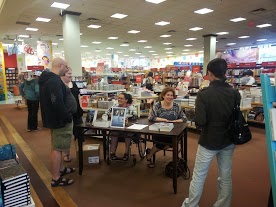
The reading was hosted in the new location of the White Water Gallery and by Doyali Islam, who I met last year at the 100,000 poets for change event.

Also in attendance were Tim Robertson and his wife, Karin, Kevin Smith, and Natalie Wilson.

There was a brief discussion about upcoming events and the group’s concerns about Gulliver’s, a local book store that they’re trying to form a co-op for.  Otherwise, this independent book store might just disappear.

Kim and Roger were the featured readers.

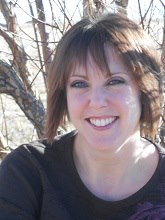
KimSmilesTooKim was great, as usual, and managed to dig out a North Bay poem for the crowd.

Roger read from his recently published book of shYesRogerSmilesort stories, The Cobra and the Camera, and a few of his poems.

Afterward, the final set was for open mic participants.

I’m terrible with names, but aside from the curator of the gallery, there was a man who worked as a plumber whose poetic observations were witty and hilarious.  A young poet, Mary, I believe, was also quite good, but in the way of someone new to the reading experience, she needed to project her voice just a bit more.

It was a lovely night and the worst of the shadflies were over.  It started raining just as we arrived and stopped by the time we left.  While this mostly served to bring out the fishy smell of the shadflies, it was lovely and cool for the ride back to Sudbury.

Caturday quickies: The super sweet blogging award

Caturday Quickies

So here I am, almost a month later, and I’m finally getting around to taking care of this sweet little bit of business.

I got another blogging award!

So here are the rules:

  1. I must thank the person who nominated me.
  2. I must answer five Super Sweet questions.
  3. I must include the Super Sweet Blogging Award pic in my blog post.
  4. I must nominate a baker’s dozen of deserving bloggers.
  5. I must notify my nominees on their blogs.

The thanks

Super Sweet thanks to Lord David Prosser of the Barsetshire Diaries!

The questions:

Cookies or cake?

Will I be considered an anarchist if I say pie?  Pie is, as Phil likes to say, the perfect dessert. Cherry, banana cream, and apple and cranberry praline are my faves.

Chocolate or vanilla?

Vanilla.  Love vanilla beans.  Cut one open and pop it into your sugar.  The flavour will infuse.  Awesome for all kinds of things.  My fave ice cream is the vanilla with the flecks of vanilla bean in it.  It’s also a fab accompaniment to the above-mentioned pie 🙂

Favourite sweet treat?

I’m not really a sweet tooth (believe it or not).  Most nights we don’t have any dessert around here, or maybe I’ll just grab a piece of fruit.

I have a weakness for pie crust though (sensing a pie theme here?).  I once made an all-crust pie with some friends 🙂  In recent years, though, I find plain crust isn’t enough, so I’ll have to go for pettes de soeur, or nun’s farts.

French-Canadians must also be fans of crust.  When they make a pie, instead of tossing all those little scraps of dough, they collect them, roll them out, slather with butter, and sprinkle with cinnamon and sugar.  The pastry dough is then rolled, sliced into disks, and baked like cookies.

Can I just say—nom!

When do you crave sweet things the most?

Um, I’m a woman in her early forties already getting pre-menopausal symptoms.  When do you think I crave the sweet stuff?  I’m at the mercy of my hormones, people!

Super sweet nickname?

I don’t really have any nicknames.  There’s Smelly, of course, but I don’t think that’s very sweet.  Phil calls me Mellie, and sometimes adds on a –boo or –belly, so I think I’ll have to go with that.

The Award Pic

the Super Sweet blogging award

The ma-nominations (do-doo, da-do-do!)

Not sure if I’m going to be able to list 13 people who don’t already have it (!)

Here we go:

Kim Fahner;

Elissa Field;

Jenny Hansen;

Gemma Hawdon;

Rebecca Barray;

Bolton Carley;

Heather Button;

Lara Schiffbauer;

Hally Willmott;

Laura Howard;

Swati Chavda;

Claudette Young and Meena Rose; and

Amanda Socci.

I’ll notify them all, but it might be through email, FB, or G+ rather than their blogs per se.

Now to add the award to my awards page 🙂

Next up: The Conspiracy of Three reading series I attended in North Bay last week 🙂

Review of Blaze Ignites by JL Madore

As I mentioned in our interview, I’d worked with Jenny in an online critique group.  I was so pleased to hear that she moved ahead with her novel and was eager to read the results.

The Amazon blurb:

BLAZE IGNITES blends strong, clever women and tough, sexy men in a fast paced, Blaze full page covervolatile cocktail of action, seduction, and wicked humour.

“Destiny my ass.” Jade Glaster refuses to believe the Fates rule her life. Orphaned after an attack by Scourge soldiers, a young Jade vows never to be powerless again. Once grown and strong, wielding the affinities of fire and healing, Jade protects innocents as an enforcer for her world’s elite policing agency—The Talon.

When an emissary mission to reinstate a race of exiled Elves brings Galan into her life, Jade finds herself overwhelmed by new passions, some welcome, some not. Although Galan’s antiquated views on women offend her to her heated core, when the Scourge attack his family, she helps him navigate the outside worlds he knows nothing about—the magical Realm of the Fair and, stranger still…the modern streets of Toronto.

Through their sensually charged pursuit of justice, Jade discovers that when dealing with the Fates—destiny is never random.

______________________________________________________________________

My thoughts:

Jade Glaster doesn’t think much of fate.  Her life has been a literal shit storm to this point (in fact, the series was originally called the Shit Storm Survivors, which I now note has been tactfully changed to Scourge Survivors) and if this was fate’s doing, Jade wants none of it.

Her Talon code name is Blaze because of her red hair and fiery temper, which often results in the unleashing of a literal blaze of power.

One of Jade’s laments at the outset of the novel (aside from the Scourge murdering her parents), is her apparent frigidity. When her duties for Castain, chief of the Fae gods, bring her face to face (and crotch to crotch—had to be said) with Galen, however, Jade’s problem ceases to be one of not reacting to men, but of her overwhelming reaction to Galen.

This is not what she needs right now. She has a mission to complete.

The writing is taut and gives the reader Jade’s attitude with both barrels. I like the ‘tude and the sexy bits, which are well-done. I only have a few issues with Blaze Ignites, and most of those are matters of personal taste (word choice, creative decisions) which other readers will likely not cavil at.

Events begin with a bar fight involving an Otterkie that is never mentioned again. Readers often expect details like this to have a pay off somewhere later in the novel. It’s a loose thread that should be woven in.

Though conflict, physical and otherwise, abounds, the novel takes a while to pick up the pace. When things swing into high gear, the author keeps them at a high pitch with few exceptions.

I have to point out, for a supposedly “kick-ass” heroine, Jade gets her ass kicked more often than not.  This I did have a bit of a problem with, especially given the denouement of the novel (which I will not give away).

It just seemed to me that Jade shouldn’t have had her ass handed her or to be in need of rescue as often as she did. Yes, Galen needs a maiden in distress, but there might have been another way around this.

Blaze Ignites is a solid contender in the paranormal romance and urban fantasy sub-genres and suitable for fans of Laurel K. Hamilton and Sherrilyn Kenyon. Readers of Charles de Lint will find Madore’s work enjoyable as well.

A good first novel in a new series that I’m sure we’ll see more of in the future.

My rating: four out of five stars.

______________________________________________________________________

About the author:

JL MadoreJL Madore, lover of family, animals and chocolate, spends her days writing fantasy romance and paranormal erotica. Strangely enough, she hadn’t considered being a writer until her writing muse found her lying in a hammock in a Panamanian rainforest.Blaze Ignites, the first installment in the five novel Scourge Survivor Series, was born out of that tropical haven. Though she didn’t actually see any Elves or Weres running through the trees or swimming in the waterfall grottos their voices came to her there and had a story to tell.

To learn more, you can follow her at:
http://www.jlmadore.ca
http://www.twitter.com/jlmadore

Sundog snippets: Pupdate, July 2013

So here’s a quick pupdate for you.

First, the story so far:

In January, Nuala had an ACL repair. On the heels of that, she contracted a UTI. We administered antibiotics. She somehow scratched herself an aural haematoma. Rather than having it drained, the vet recommended letting her body metabolize the blood. We agreed.

The follow up urine sample, however showed extra protein, which is usually a sign of a problem with the kidneys. Blood tests showed that Nu’s kidney enzymes were in perfect balance. An x-ray revealed no stones in either kidney or bladder, but an enlarged liver and spleen.

The vet recommended an ultrasound. This would require a journey of several hours for which Nuala would have to be sedated (she doesn’t travel well) and several days off work for Phil and me. The ultrasound may or may not have found anything and may or may not have resulted in a laparoscopic biopsy, which may or may not have proven clinically definitive. We declined.

We changed her food to a kindey health diet, and started her on a regimen of ACE inhibitors. Nuala subsequently redeveloped a UTI and this time we have the urine sample cultured. It turned out to be a massive e-coli infection. Uber-doses of antibiotics later, she was once again clear of infection, but the high protein in her urine remains a concern.

Where we are now

The vet is again encouraging us to consider the ultrasound. We’ve discussed things at length and here are the ultimate reasons Phil and I are not going to follow through with it:

  1. Nuala is behaving well, she’s feeling better than she has in a long time. Her residual limp from the ACL surgery is almost unnoticeable. By all accounts, she’s happy.
  2. What will the ultrasound reveal? The existence (or the lack of existence) of a growth of some sort.
  3. If the growth is benign, will it be removed? No (unless its negative impact on Nu’s health is severe).
  4. If the growth is malignant, what can we do? Not much. Cancer in dogs is notoriously fast-growing and often has metastasized before an operation can remove it. Though they do have canine chemo and radiation, the course of treatment would again involve travel and its effectiveness is not as good as human therapies.

While it may result in a better diagnosis and possible prognosis, we may not be able to act on it quickly enough to make a difference.

So we’ve decided to stay the course with her current medication and see how things go.  If Nuala’s health worsens, we may have to revisit and reconsider our decisions, but I honestly don’t think this will happen.

Our last dog, Zoe, had cancer, and we did what we could, but the cancer was aggressive and ultimately fatal. The operation to remove the cancer wasn’t effective, was very hard on her, and it may have bought her two weeks, but they weren’t a good two weeks. Her death broke our hearts and it was two years before we thought about adopting another dog.

Whatcha got there?

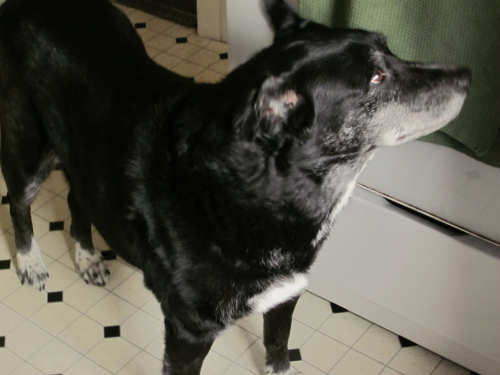
Nuala hoping to scam noms from Phil 🙂

You may disagree with our decision, but I hope you can respect it.

Here ends what I hope to be the last pupdate for some time. Nuala really is doing well and until we can see a reason to, we’re not going to put her through further procedures.  She’s been through enough this year already.


Sundog snippet

Caturday quickies: What’s going on in the garden?

Just a little note to give you an update on how things are going, or not, with the back yard.

The trees are gone and the hostas and ferns are beginning to recover.  Phil wanted to construct a roofed gazebo on our patio, but realized it would be fairly expensive.  Solution: a purchased gazebo.  He chose one that has a solid roof and intended to bolt it to the patio with tap-con screws.

recoveringhostasrecoveringhostas2

Sadly, it’s bigger than the patio.  Solution: Phil is going to dig post-holes and sink some sono-tubes in the ground and pour proper footings for the gazebo.

Unfortunately, it’s been too hot to do a lot of work on the weekends.

So we wait.

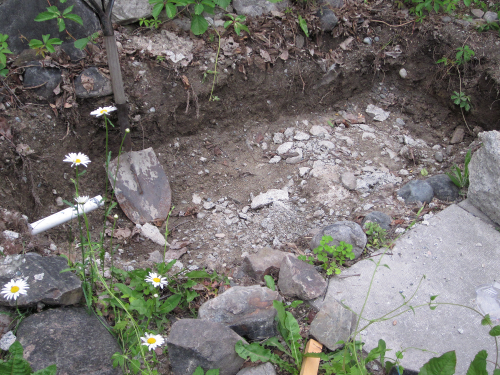
Second problem, we had this small pond beside the patio.  It’s never been what either of us envisioned, so it came out this year.  The ground has been levelled but there are still all the stones around the edge.

This was the old pond

This was the old pond

then we dug it out

then we dug it out

now it looks like this (plus rubble)

now it looks like this (plus rubble)

Phil wants to replace them with retaining wall bricks or landscaping ties, but not until next year when he builds the deck overtop the patio and knocks down the brick retaining wall he build several years ago, and a whole bunch of other stuff that I think is a little too ambitious.

We’ll see what can be done.

In the meantime, it’s no outdoor office for Mellie.

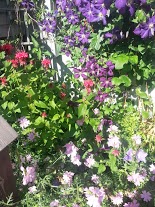
As far as the gardens go, I’ve decided to let them grow wild.  I keep up with the weeding as I can, but I’m not moving plants from one area to another, thinning, or any other typical gardening duties.

The result is wonderfully chaotic.

chaostheory2chaostheory3

itty bitty vine, HUGE flower

itty bitty vine, HUGE flower

Note how this clematis has grown up under my window (!)

Note how this clematis has grown up under my window (!)

And the Hedge Rose

And the Hedge Rose

Strawberry harvest is done.  Had about a week’s worth of berries on my morning cereal.  Perfect.

And my hedge rose has gone crazy this year!  I’m not complaining 🙂

Inside

My mom is helping a friend prepare for a move down south to be near family.  As a result, I’ve nabbed a couple of things.

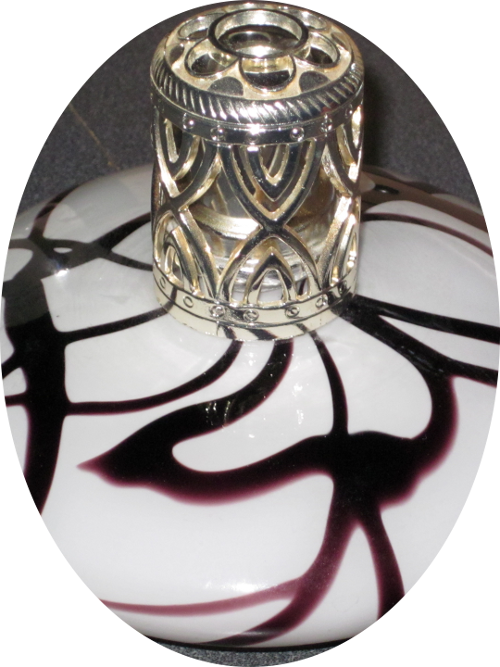
A lampe Berger.

lampeberger

And another dolphin for the office collection.

dolphin

Tomorrow: An ever so brief pupdate (the last, I hope) and another book review.  I’m thinking Blaze Ignites.

See ya then!

Caturday Quickies

Book review of Alon Shalev’s At the Walls of Galbrieth

I’ve fallen behind in my reviewing duties, so I’m going to be catching up over the next few weekends.

At the Walls of Galbrieth

At the Walls of Galbrieth

What Amazon says: The young elf desired only to follow in his mother’s footsteps and become a healer, but when the Emperor’s army attacks his village to punish traitors and conscript youth, Seanchai flees to the mountains, seeking safe harbor with an uncle he has never met. He is shocked as many people sacrifice their lives to ensure he reaches a Wycaan Master, an enigmatic woman named Mhari, who can teach him to wield a powerful death-and-life magic that might just free the races of Odessiya. In a world defined by strict racial boundaries, where humans rule, dwarves hide deep underground, and elves are a slave nation, Seanchai must find a way to create friendships and trust, unheard of since the fall of the Wycaan Masters, and reunite the races into an alliance that will bring freedom to all. Sometimes one must choose between his companions and his destiny. Seanchai abhors his ability to kill and, in the friendships he forges, discovers something potentially more powerful than his magic. Friendship, however, can be a double-edged sword.

My rating 4 out of 5 stars.

The book starts off at a fairly quick pace, with Seanchai fleeing his home in the middle of the night to escape the predations of the Emperor’s troops.

While events continue to move quickly throughout the book, Seanchai is not always at the heart of the action, as he trains with his master to unlock his powers.  Alon took a bit of a risk here letting Seanchai’s companions take centre stage for the middle third of the book.

Some readers might be tempted to skim the sections of training if not for a few key transformations that make what might otherwise be monotonous passages startling.

Then Seanchai takes the reins firmly in hand leading up to the climax on the novel and the payoff is satisfying.

I liked the play on Irish tradition (a seanchai is a traditional Irish historian and storyteller, akin to a bard) and pagan practice (wycaan is a variation of the word wiccan, the modern tradition of witchcraft).  His training with his master is distinctively pagan and I appreciated his angle on magic.

For a first YA epic fantasy, AtWoG is a good read.  The novel is well-paced and written in straight-forward language.  Alon has room to learn and grow as an author, and I look forward to the next two books in his series.

Strictly speaking, Alon doesn’t need my help.  At the Walls of Galbrieth was Alon Shaleva quarter finalist in the 2012 Amazon Breakthough Novel Award competition, which led to his getting the novel published that same year.  Alon now has two more books in his series published.  This year, AtWoG won the YA category and was a grand prize finalist in the 2013 Eric Hoffer Book Award.

Alon, who blogs as the Elf Writer, is a staunch supporter of epic fantasy as a viable genre despite what some argue as overused tropes (Tolkien-esque writing, elves, dwarves, etc.).  I also happen to believe in the enduring power of epic or high fantasy and am very pleased that AtWoG has done so well.

Until tomorrow, my writerly friends 🙂

CanWrite! 2013: Gala and wrap post

Before I begin, I’ll apologize for the apparently drunken photo-taking.  I’m still getting used to the camera in my Galaxy Note II 😛

On Saturday evening (June 15), conference attendees were shuttled out to the Best Western conference centre for out Gala event and announcing of the winners of the CAA literary awards.

Gathering for the Gala

Gathering for the Gala

Our master of ceremonies for the evening was Bruce Pirrie, Second City alumnus and writer for the Red Green Show.

The evening’s events picked up after dinner with an introductory monologue from Bruce about the dubious joys of being a comedy writer.

Then Charles Foran took the podium with an impassioned plea from PEN Canada.  While the organization is best known for its work overseas on behalf of writers and free speech (a current campaign focuses on the events in Turkey), PEN Canada has noticed a disturbing trend here in Canada with the censorship of Canadian scientists and the digital freedom controversy.

Charles Foran

Charles Foran

PEN needs writers everywhere to stand up for the right to free speech and fight the oppression of censorship.  To this end, they are conducting a membership drive until the end of June.  Please consider joining this worthy organization.

Andrew Westoll

Andrew Westoll

Matt Bin

Matt Bin

Next was Andrew Westoll, Author of The Chimps of Fauna Sanctuary.  Andrew presented the stories of three of the Fauna chimps, their individual struggles, and the rewards their caregivers reap.  It was an amazingly touching presentation.

Then, President Matthew Bin introduced the CAA literary awards.  Originally started in 1937, the awards were the “for authors, by authors” recognition of excellence in Canadian literature.  They became the Governor General’s Awards and administration of them assumed by the Canada Council for the Arts.  More recently, in 1975, the Canadian Authors Association has once again started their awards program.

Here is the list of the winners.

It was a fabulous evening and I was inspired by having been a part of it.

_______________________________________________________________________

The rest of the story

I have been a professional member of the CAA since I joined a few years ago.  As such, I have voting privileges at the annual general meeting.  Two years ago, I expressed interest in taking part in the program committee.

This year, I was invited to join it.

The program committee has a fairly sweeping mandate, including the CAA literary awards and the annual conference.  Also on the list of responsibilities are professional development programs (where my greatest interest is), the roving writers program, editor-in-residence program, members’ book catalogue, and contests.  I’m a little daunted but I have great fellow committee members and a great chair to work with.  Our role is primarily to set policy and make key decisions.  We won’t be doing the leg work, but I can see some of that happening.

There are exciting times ahead for the CAA as it also embarks of a “twig” program and membership drive.

The web site is also undergoing a long-overdue revamp and should be far more oriented to service to the CAA’s membership.

I’ve made some writerly connections: Sharif Khan, author of The Psychology of the Hero Soul, John McDonell, and Vikki Vansickle.  I reconnected with some old friends too: Sandra Stewart attended for the weekend only, as did Betty Guenette, another member of the Sudbury Writers’ Guild.  I reconnected with Sue Reynolds and James Dewar (one of my fellow program committee members), who I’d last seen at the Algonkian conference in the fall.  I met a lot of authors, and bought a lot of books (!)

It was a wonderful experience.  I just wish items like Hermione Granger’s Time Turner actually existed, so I could see and experience everything 😉

Coming up: I’ll be returning to my weekends-only schedule, starting with some long-overdue book reviews.

CanWrite! 2013: Day 3 Traditional vs. self-publishing panel

The day 3 (June 15) panel, featured Halli Villegas of Tightrope Books, Sheila Mahoney, Certified Copyeditor and Editors’ Association of Canada Director of Professional Standards, and Tom Taylor, self-published author of Brock’s Agent, Brock’s Railroad, and Brock’s Traitor.

Once again, James Dewar acted as moderator.

JD: Should an author go for a traditional deal, or self-publish?

TT: There are many ways to skin this cat.  I have a publisher in the UK, but did the Canadian editions myself.  All the big marketing budgets have gone by the wayside in any case (Penguin, ECW). You have to invest money in your own promotion regardless.

SM: Know what you’re willing to do.  If you know you can invest the time and money, then do it.  It cost one client $25000, but mistakes were made.  What’s an acceptable risk?

HV: It’s not either/or but how and when?  Speaking tours can be difficult to arrange depending on your genre.  Publishers do have a lot of resources that can help in some situations.  It’s a matter of choice.  For example for academic clients and libraries, there’s Coutts.  They’ll order a set number of copies for distribution to their clients.  Also, there’s BowkerLINK, which offers sales and marketing information.  Publishers can get the proper ISBN barcodes for the cover.  Your books can be featured in catalogues for booksellers and distributors.

TT: It’s business and you have to approach it like that.  Where will your books sell?  Blue Heron Books in Uxbridge is a rare bookstore, very entrepreneurial.  There’s a bakery in the Niagara region where I’ve sold more books (about 300) than at most bookstores.  The owner will talk the books up to customers, many of whom are tourists.  You have to know how to market wisely.

Here’s what I invested and how I recovered the costs:

  • Line edit: $1500
  • Substantive edit: $1500
  • Layout (internal and cover design): $3000
  • Printing: $4000 (2000 copies at $2 each)
  • Total: $10000

To break even, I had to sell 1000 copies of the book at $10 a piece.  Everything else was profit.

SM: Certified editors are best but they don’t come cheap.  Independent editors, some are good and some are bad.  Design is important.  You should make your book a pleasure to read.

TT: I don’t necessarily want everyone to spend $10000 only to fail.  Your comfort level must be considered.  Editing is paramount.  The package is the product (like the media is the message—Marshall McLuhan).

SM: The people who love you are not going to be honest with you.   There’s a difference between line editing and copy editing and substantive editing.  Know what you need and what you’re paying for.

JD: Agents can take over part of the substantive.

TT: Maybe self-publishing is not for you, but if you’ve done the work up front, if you have a fully edited manuscript and a beautiful layout and a lovely cover ready to go, how much more interested will a potential publisher be?  Media coverage is important as well.  Get the word out however you can.  Chapters will take books on consignment too.  Check with your local store.

Ultimately, there were no real answers in this presentation as to whether traditional or self-publishing is better.  It’s an individual decision for every author.  There was a lot of good information that could come in handy regardless of whether you go for a traditional deal or self-publish.

Tomorrow: The Gala and wrap-up post.

See you then!

CanWrite! 2013: Open mic, Andrew Pyper, and Cordelia Strube

I already mentioned the welcome reception and the morning creative writing circles, but have since launched into panels and sessions without mentioning what happened the evenings of June 13 and 14.

Back-pedalling now …

Open mic and shortlist readings

On June 13, interested parties were encouraged to sign up for the open mic.  I did and intended to read the revised opening of my novel as I had at Wordstock, then at supper I heard that the readings would be restricted to five minutes.  This was reduced to three by the time I arrived due to the number of last minute sign-ups.

Not having brought my poetry with me that night, I read as much of my opening as I could.  It was well-received.

Other readers offered their poetry and stories (one humorous one was about discovering one was having a heart attack while on the toilet – shades of Elvis) the organizers sticking strictly to the three-minute limit.

June 14 was to have been readings from the authors short listed for the CAA Literary Awards, but again, a last-minute change opened the floor to additional readers.  I signed up and brought my poetry, a much more appropriate genre for the three-minute limit.

I got to hear the end of the Elvis story and some more great poetry, fiction, and non-fiction.

I enjoyed the readings from the short listed works.  With one exception, none of them could show up in person.  The man who did was Michael S. Cross, author of A Biography of Robert Baldwin: The Morning-Star of Memory (Oxford University Press).

Michael’s reading was wonderful.  I didn’t know Robert Baldwin was such a fascinating character.

Another fascinating author was Jane Doe. She read from her book The Story of Jane Doe.  She is an advocate and activist and her story is a compelling one.  I encourage everyone who has an interest in women’s issues, advocacy, or the attitudes of the legal system to victims of rape and violent crime to pick up this book.

Andrew Pyper

Andrew Pyper

Andrew Pyper

Andrew Pyper is the author of six novels, most recently, The Demonologist.

Andrew’s session was on the afternoon of June 14, and it was as much workshop as presentation.

The session, Getting organized, getting started, focused on the essential elements required before an author begins to write a novel.

  1. An Idea;
  2. A Premise;
  3. A Protagonist;
  4. A Hook;
  5. A Structure; and
  6. An Outline.

He also offered six tips for overcoming roadblocks.

One of the most interesting pieces of his presentation was about ideas.  Yes, one must have at least one good idea to propel one’s plot, but the author shouldn’t stop there.

Traditional thought and misconception would imply that one idea must be made big enough to become the basis for a novel.  Andrew suggested that rather than one idea expanding to fit a novel, that a multitude of ideas should funnel down and feed into a single novel.

This made a lot of sense to me, and when I think about it, that’s how I write fiction.  I never write about one thing.

The premise is distinguished from the main idea of the novel because of its scope.  Andrew’s explanation reminded me of Larry Brooks’s.

He offered the following example:

Idea: A modern-day Frankenstein.

Premise: Archaeologists extract DNA from mosquitoes trapped in pre-historic amber and use it to clone dinosaurs. A philanthropist establishes a theme park around the beasts and invites a select group of scientists and family to witness his triumph; then the beasts escape (Jurassic Park).

The key to a premise is “high concept,” a concept that can be evasive.  This is why Larry Brooks is forever explaining the difference between idea, concept, and premise on his site 😉

Andrew had us write our premises for the Rob Ford story.  As expected, we all had different takes on the well-publicized scandal.

I won’t give away the whole of Andrew’s session, but I will say that it was informative and fun.

Cordelia Strube

Cordelia Strube’s session, on the afternoon of June 15, was mostly workshop.  She’d actually had workshops on both afternoons (14th and 15th) and anticipated that conference-goers would attend both, but a miscommunication occurred and the message was never conveyed to attendees.

Cordelia has published eight funny, powerful, sparse, cathartic and critically acclaimed novels, among them Alex & Zee, Teaching Pigs to Sing, The Barking Dog, Blind Night, and Lemon. Her ninth, Milosz was published last year.

Her plan was to have participants from the first session return and revise the work they had started the day before.  Those of us who only came on the second day would have to start from scratch.

Cordelia gave us a framework and some strategies for getting into our focused writing.  She then distributed horoscopes and a number of other prompts: postcards, small items, all of which were to inform our writing project for the afternoon.

After we were sent off to write however and wherever we wished, the class was asked to share the results of their writing.

It was an excellent session.

________________________________________________________________________

I should take a moment to mention that there were a number of sessions happening concurrently on Friday and Saturday afternoons.  I can only report on the ones that I attended.

Specialty sessions, at a nominal additional cost, also took place during the mornings.

There were also agent pitch sessions occurring Thursday, Friday, and Saturday mornings.  Though I did not opt into these, they were very popular and booked solid.

I like the way in which they were conducted.  Each author was to submit their query letter and first five pages of their novel in advance of the pitch session.  I think that this is a much better way to conduct pitches than to do them blindly.  It’s better for the agents because they have a sense of the author’s work.  It’s better for the writer because they don’t only have their two to five minutes to convey the meat of their novel.

A professional photographer was also on site to take author shots for the attendees.  I happily paid the (again, nominal) fee for this.  I should have the results next week and I hope they will be better than my efforts to date.

Tomorrow: The final panel, Traditional vs. Self-publishing.

G’night y’all 🙂

CanWrite! 2013: Day 2 agents’ panel

After another morning of creative writing and lunch, conference-goers again gathered in the academic building for the 1 pm Agents’ Panel Discussion.

James Dewar acted as moderator for the panel, which consisted of: Sam Hiyate, president of The Rights Factory and Carly Watters, agent at the P.S. Literary Agency.

JD: What are you looking for right now?

CW: Picture books; contemporary YA (thriller/mystery, romance); women’s fiction; upmarket; non-fiction; and multi-media.

SH: New agents are looking for new clients. I’m full up myself, right now, but occasionally I do sign the odd author.  For non-fiction, a platform is essential. Most non-fiction sells on proposal alone.

JD: What can a fiction writer do to obtain representation?

CW: Write an amazing novel.  Platform does not matter.

SH: Debut novelists—sometimes even established ones—can fail to sell.  I like a strong voice, someone who can perform acrobatics with a sentence.

CW: I have a more commercial taste, a Book Club book would appeal to me.

JD: How do you move an “almost there” author to “there”?

SH: I’m a different beast than most agents and will work with the writer to edit the work.  Most agents won’t.  Others will set the writer up with a freelance editor.

CW: I’ll write an edit letter to the writer if the good stuff is REALLY GOOD.  Some books are edited seven times before they are sent to a publisher.  If the writer has the ability to turn their MS around quickly, the chances are better.

SH: My best advice is to find an agent who “gets you.”

JD: What should authors NOT do?

SH: Don’t send your MS in too early.

CW: In a pitch session, do not go through your whole synopsis.

SH: Sometimes the pitch or query can be better than the book.

JD: We’ll open the floor to audience questions (AQ) now.

AQ: Do I need an agent first, or can I approach a publisher directly?

CW: Agent first.  Most larger publishers won’t accept unsolicited manuscripts.

SH: An agent can say “no,” however.  An editor will refer the author to an agent anyway.  Send it and see what happens.

AQ: What does an agent do?

SH: Our job is to create a competitive situation around your book.

AQ: Can you have more than one agent?

SH: We contract exclusively, much like a real estate agent would.  Your book is the property we’re selling.  Our commission is 15% on domestic and 20% on foreign sales.

AQ: In the context of the “Literary Apocalypse” of self- and ebook publishing, do writers even need publishers anymore?

CW: Some agencies have publishing arms, but it gets complicated.

SH: Self-publishing is a new way for agents to discover talent.  Eventually, all the good material gets scooped up by the publishers.  Cases in point: Amanda Hocking, E.L. James, and Hugh Howey.

CW: These are exceptions to the rule.  Agents can’t turn $10k ebook sales into a traditional deal, but if you sell $200k+, that’s different.

SH: In the future, writers will have more control.

AQ: If an author has published a book but is not happy with the rights (terms) is there anything that can be done?

SH: No, if the rights have already been contracted out, that’s it.  Most agents won’t negotiate a bad contract for you, though.  Publishing houses and agencies start out with really talented, committed, and enthusiastic people who are grossly underpaid, for like ten years.  In that time, the ones who can’t maintain their passion leave for greener pastures.  The ones who can, become successful.

The agents’ panel was great, and both Sam and Carly were professional and up front with their insiders’ looks into the publishing world.

Tomorrow: I’ll cover Day 1 and Day 2 evening events, and Day 2 and 3 afternoons with Andrew Pyper and Cordelia Strube.  That will leave the Awards Gala and wrap-up posts.  So three more days, and it’s all over!

Don’t despair, there will be lots more Writerly Goodness coming your way this summer.  Book reviews and hopefully some more author interviews, pupdates (yes, there’s at least one more coming), and updates regarding the backyard office (interesting things afoot there).  I’ll also have some updates on my work in progress and any other conferences or events that I get to.

I will be returning to my weekends-only posting schedule after this week, though.  Blogging every day, though fun for a short period, takes up a lot of writing time (!)  My goal is to have my current revision done before the summer’s out.

Until tomorrow!