Solstice and other things that happen around this time of year

Today was, in case you didn’t notice (you could be forgiven for missing it), the shortest day of the year, the winter solstice. It’s also the first day of winter, though you wouldn’t know it up here in the Sudz. It’s been snowing and cold since mid-November. It usually is, this time of year, but that doesn’t mean I can’t complain about it.

Now we face the longest night, but you know what? Things get better from here on out.

You’ll notice that the days start getting longer again and we start that long stretch to spring.

Christmas is coming, and with it the latest Doctor Who special 🙂

New Year’s is coming, with all its promise for another fresh start.

We actually have a chance to appreciate the people we’ve taken for granted all year, or the activities we’ve cut back on so that we could work/get the promotion/pursue various important things.

We can put things in perspective.

We just went out to celebrate my mom’s birthday. It was yesterday, but we celebrated tonight because everyone’s off. I was a terrible kid and forgot to wish Mom happy birthday yesterday. I took her shopping this afternoon. I don’t think it really made up for the lapse.

The 20th of December was also the day, twenty years ago, that Phil asked me to marry him.

We were getting ready to take my mom out, and I’d just gotten off work. I was a life guard back then, and I was rushing to get changed. I noticed that every time I turned around, Phil was there, but I whirling-dervished around him until I turned and nearly tripped over him.

Phil was kneeling. I was stunned until I realized what was going on. Then, I was all *amazeface*! He asked my parents’ permission and everything.

I’m always rushing at this time of year, and I have to remember to slow down and appreciate the people in my life.

Slow. Down. Appreciate. People.

Don’t be a dervish douche. Don’t forget your mom’s birthday. Trust me. It sucks.

Other reasons I like the solstice

It’s scientific.

Winter solstice

Winter solstice (Photo credit: Wikipedia)

Because of the tilt of the earth’s axis and the way we orbit the sun, we have seasons. The solstices and equinoxes delineate the divisions of the year.

It is a fact that the winter solstice is the occasion of the shortest day of the year and the longest night. In the northern hemisphere, anyway.

It’s pagan.

Well, neo-pagan, at least.

Seemingly on the opposite side of the spectrum, the solstices and equinoxes form some of the pagan holy days. In case you haven’t been following me for that long, my spiritual inclination is agnostic with pagan leanings.

Agnosticism, according to Richard Dawkins, is the worst form of self-delusion in that we aspire to atheism, but can’t quite commit because of the niggling doubt that maybe there is a God …

Well, Phil is atheist, and we’ve discussed religion at length. I think that the atheist position is very sensible. I also acknowledge that there is a lot that science hasn’t made clear for us yet, and while I think that the existence or non-existence of God is not one of the questions that science can answer for us, I think that there is enough mystery left in the universe that the answers science will provide us will be surprising.

I like to keep an open mind.

Besides which, I’m a fiction writer. A fantasy fiction writer at that. Gods, goddesses and magic are kind of what I’m all about.

I’ve studied shamanism in some depth (though not, I would say, comprehensively) and I’m fascinated by the ancient sites and their purported use in astronomy and astrology, time-keeping, the precession of the stars, and the observation of the sun.

I could geek out on ancient cosmology all day and all night.

English: Highworth cemetery at the winter sols...

English: Highworth cemetery at the winter solstice The shortest day of the year in the northern hemisphere falls between the 20th and 23rd December depending on the year. In 2007 the solstice occurred on the 22nd with the period between sunrise and sunset being 7 hours 49 minutes and 40 seconds. The sun set in London at 15.54 today, 22 minutes after this picture was taken. (Photo credit: Wikipedia)

It’s quiet.

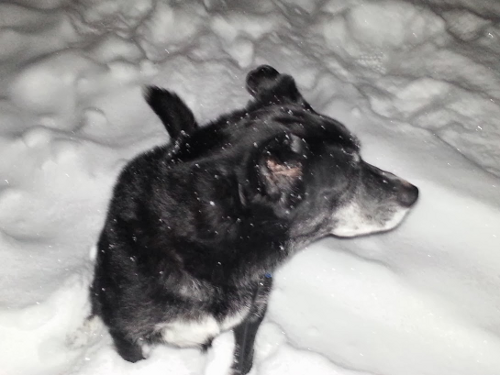
Because a lot of people travel to visit relatives at this time of year, the city (small, yes, but a city nonetheless) grows quiet. In the morning when I’m walking the dog, I can feel the increased stillness, the anticipation of a world holding its breath for the next sunrise.

It’s about light.

This is why we have so many festivals of lights at this time of year. We’re fighting back the darkness, recalling the light, celebrating with our wee candles in the night, shielded against the wind.

I prefer strings of LED lights on the stair rails outside my house, though. I plug ‘em in the night before solstice and don’t unplug ‘em until New Year’s Day.

I’d just like to wish everyone, regardless of your religious or spiritual convictions or devotions, the happiest of holiday (holy day) seasons.

And ‘cause I was raised Christian and still celebrate with my nearest and dearest: Merry Christmas!

Six questions with Sarah Lashbrook

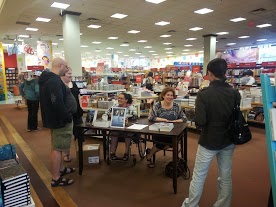
I met Sarah back in the summer at a book signing in the local Chapters. I immediately approached her about doing an interview, and of course, I bought her book!

The book signing at Chapters (Sarah’s on the left, chatting up some friends)

Without further ado:

Sarah Lashbrook has been writing since the early age of 12, when she wrote her first letter to the star of Days of Our Lives, inquiring about a writing career on the popular Soap Opera. Inspired by television, Sarah continued to pursue a life of writing, gaining her first recognition when she graduated high school with top English marks and won a National scholarship worth $15,000, from Global Television. Sarah chose the Journalism Program at Humber College, and after the three year course ended she furthered her education with a post-grad course in Writing, Directing, and Producing, for Television.

WG: You state that you started writing at the age of 12 with a letter to Days of Our Lives. Writing for television was clearly your inspiration, but what was it about television that drew you to writing?

SL: Hmmm good question. The idea of entertaining people always appealed to me. The thought that with a simple twist here and there to the English language – you could cause a reaction in someone that is very deep and personal. Whether it be laughter, tears, anger, or total joy…the appeal of causing the reaction was always one I wanted to be able to provoke. Back as a child, I had more access to television than books, so that is probably why my love started with that medium.

WG: What was your first published/aired piece and what did you learn from the experience?

SL: My first published piece – well I had two in one paper – the first was a newspaper profile article on Margaret Atwood, and the Second was an interview with Bobby Hull on fighting in the NHL. Both were in our school newspaper. My first aired piece was with CTV – I had written, filmed, and edited 6 family stories for the Easter Seals Telethon. Both times thrilled me to bits. I must admit – I still get quite giddy when I see my name attached to anything written – in print or on aired. It is a rush.

WG: How have your degree and experience in journalism contributed to writing Where the Stream and the Creek Collide?

SL: Well, I guess the quick answer is it helped me to formulate what I wanted to say in smaller doses. Which helps you be concise and to the point when needed. I can break down a large sentence into mere words if I need to. Besides that – it has helped me greatly in knowing how to research a topic. I am comfortable in searching for printed information as well as reading stats, which are two very handy skills to have. It also has helped me in regards to being able to find the people I need to interview, asking them the tough questions, and deciphering the information they give me. I have room for improvement on these skills of course but would not be as strong at them as I am now – if it weren’t for my background in journalism.

WG: Your protagonist, Sadie Coleman, is a paraplegic but her story seems very different from yours. Why did you decide to write a paraplegic protagonist, and what of your experience contributed to who Sadie is?

SL: I always wanted to write a book or books where my main character had a disability but the story wasn’t necessarily about that. I didn’t want it to be a service piece for those who aren’t in wheelchairs. I just wanted a related character for those who seem to lack just that in literary works. I know I have never read a fiction piece where a good main character was in a wheelchair…only non-fiction. I started out with a main character being paraplegic because that is what I know. I am paraplegic…I thought for this first book – I should make it a bit easier on myself.

Sadie has a lot of my qualities and experiences even though our stories are quite different. Those qualities and experiences though are mine. Maybe someday I will share but for now – they stay my secret with Sadie. I will tell you though – that after I wrote the book – I did find out that the name Sadie is a form of the name Sarah. Very strange coincidence.

WG: When you were ready to publish, did you query or seek an agent? What was that process like, and how did you end up with Spire Publishing?

SL: I did think about approaching an agent but from everything I read and from experiences of other writers around me – I decided that that wasn’t an approach I wanted to take at this time. It was advised to me to just get published. That once the first book was out there and published – all sorts of new doors would open up. And it was true.

Spire Publishing was the third place I approached. I felt strongly at first about staying true to my Northern Ontario roots and so approached a publisher in the Sault first – they said they would consider it with a few changes. I was too stubborn at the time to make those changes…and am still confortable with that decision.

The second place I approached was a publisher here in Sudbury – but unfortunately I sent it right when Canada Post had its strike – and I never heard back from them – only by email saying that they were not getting any posts. By the time the strike ended – I had already chosen Spire and was in the publishing process. I am very happy with my choice. Philip and his team have been fantastic to work with.

WG: What’s next for Sarah Lashbrook, author?

SL: Wow…what is next? A few things actually. I am working on my next novel – working title is Missing Link. It is a story of love, betrayal, pain, and happiness between two women but has a nice little organized crime twist – quite fun to write.

Also, very recently, I was approached by the fabulous director Shirley Cheechoo, who read my book, and asked if I would write a screenplay off of Where The Stream And Creek Collide. She said she would like to direct it as a film. I am so blown away and honoured with this. I have chills. So, before I finish my novel, I will be writing a screenplay from the last book.

Thanks for a fabulous interview, Sarah!  Break a pencil in your future writing endeavours!

Where the Stream and the Creek Collide

Where the Stream and the Creek Collide

For 23 year old Sadie Coleman, the last year of college will be anything but kind. Not long after arriving at College to begin her last year as a Resident Assistant, Sadie finds out that she will be spending the entire employment with the assiduous task of monitoring last year’s rogue, Jack DeGraff. But Jack may not be Sadie’s only problem. She may also be forced to come to terms with her past. Six years prior, Sadie was involved in a terrible attack that killed her mother and left her a paraplegic. When Jack’s antics become too much to handle, her endless efforts to set up her father fail, her boyfriend bails, and her friend and boss become a little too close to her and the situation, things start to unravel. Sadie realizes just how damaged she is. That she has injury far beyond the physical.

My first NaNoWriMo

Winner, winner, chicken dinner

Off the top, I have to say this: I won!  My first time out and I won 🙂

Backtracking to my trip to Surrey

Before I even left, I was considering NaNo. The municipal liaison came out to the Sudbury Writers’ Guild meeting in September to promote. My leave would be until November 18, 2013, so I thought I’d probably have a chance.

While at SiWC, I heard several people talking about NaNo and how it had really helped them get their ideas down, break through writers’ block, built their confidence, and so forth.

By the time I got back, I was determined to give it a try.

I chose a project that I had outlined years ago. I’d had a little bit written, but I hadn’t touched it in years.

I was going to start over in any case.

The power of planning

I knew I was going away for a few days to visit some friends, and that I’d be going back to work before the month was out. I started out by front loading the work, trying to move ahead quickly at the beginning so I could coast a bit at the end if I needed to.

Still, when I went back to work, there were a few low count nights. I was worried.

To make time for my writing in the evenings when I went back to work, I tried using my smart(er than me) phone to keep track of my email and social media.

I got up a half-hour earlier than usual to check Facebook, WordPress follows, and my Feedly follows and share the interesting stuff on Twitter and Google+.

The pilgrim’s progress

Here’s a convenient table for you:

Day Count Total + or –
1 2161 2161 +494
2 2284 4445 +1111
3 2325 6770 +1769
4 travel 0 6770 +102
5 2122 8892 +557
6 travel 0 8892 -1110
7 1877 10769 -900
8 2168 12937 -399
9 2190 15127 +124
10 1675 16802 +132
11 1721 18528 +191
12 2284 20812 +808
13 2008 22820 +1149
14 1699 24519 +1181
15 1684 26203 +1198
16 1894 28097 +1425
17 1668 29801 +1462
18 1727 31528 +1522
19 return to work 1181 32709 +1036
20 549 33258 +82
21 507 33765 -1242
22 1822 35587 -1087
23 1814 37301 -1040
24 1707 39008 -1000
25 1731 40739 -936
26 1677 42416 -926
27 1692 44108 -901
28 757 44865 -1811
29 2232 47097 -1246
30 3802 50899 +899

What I learned

I don’t think I could do this working full time.

Having said that, it was fantastic to know that I could pull a 50000+ word draft together in 30 days. It was interesting to me because my first novel took me a year to write, working in the evenings and on weekends.

It gives me hope that if I do end up getting a deal for my work at some point and am asked to pump out sequels in swift succession, I should be able to do so. Also, if I end up going the self-publishing route, it’s always good to have moar material out there. If people like what I write, I can potentially supply the demand.

While my Samsung Galaxy Note II is quite lovely, I don’t think that I could manage my social media long term using it alone. Some of the information so easily accessible on my desktop is not so convenient to find in an Android app version of the program. Also, some things don’t translate well. Though the Feedly app appears to allow FB mentions in a post, it does not actually include them when posting to FB.

I have a few strange-looking posts over the last couple of weeks, and was not able to keep track of anyone’s birthdays on my phone, so apologies to anyone I may have offended or missed as a result.

Again, it’s good to know that I can do a minimally good job of maintaining my social media from my phone if need be.

Today, except for these blog posts, I have not written. I’ll get back on that horse shortly. I’ve also had to let a few submission deadlines slide because I just couldn’t manage to do it all. Everyone has their limits.

Coming up

I’ll be blogging in the future about my writing plans moving forward as well as a little about work. Interesting times I live in 😉

Writerly Goodness, signing off.

Mark Leslie workshop with the Sudbury Writers’ Guild

This past Thursday, November 28, Mark Lefebvre of Kobo, who writes under the pen name Mark Leslie, conducted a workshop on self-publishing for the Sudbury Writers’ guild.

Mark spoke a bit about his experience with self-publishing first.

Mark Leslie

Mark Leslie with members of the SWG and Barnaby

His horror short story collection, One Hand Screaming, was published using Lightning Source (now Spark) from Ingram.

For his anthology Campus Chills, Mark and his friend Steve formed Stark Publishing (Steve + Mark). They used the Espresso Book Machine, which got its name because in the time it takes to make an espresso, the machine could produce a book.

At the time, Mark was working for a university book store and convinced the store to invest in the machine. He made the venture a paying one, producing all kinds of books for various groups in the university and surrounding community.

Mark is also an editor, editing North of Sixty, and Tesseracts Sixteen.

More recently, he compiled stories with background research for Haunted Hamilton and Spooky Sudbury, which he co-authored with Sudbury journalist Jenny Jelen. Both books were published with Dundurn Press in Hamilton.

One of the things to keep in mind is that traditional publishing can get you into places that you could never get into alone, for example, Costco.

Now Mark works for Kobo (which is just an anagram of book, by the way).

Why authors choose to self-publish

  • For the new author, it’s a way to break in to traditional publishing, make a mark, get noticed.
  • For mid-list writers, it’s most often used to resurrect their backlist. As copyright returns to authors, they format for self-publication and keep their work in circulation longer than their traditional publisher were willing to.
  • For the NYTBS author, self-publishing offers control.

In general, self publishing offers higher royalties and faster payouts than traditional publishing.

Epub format is the industry standard.

Mobi is the Amazon standard.

Self-publishing is good for long-form journalism. (Mel’s note: we had a fair discussion of this. For those who don’t know what long-form journalism is, it is the full version of the article with bonus research materials. The print article may be a thousand or so words. The long-form version may be five or ten thousand. Think academic essay, but more accessible.)

It’s also good for publishing collections of short stories. If the stories have already been published elsewhere, then it can be seen as a kind of validation or pre-screening, and the collection may have a ready audience.

Services:

  • Kobo
  • Kindle
  • Nook
  • iBooks
  • Smashwords

Kobo started out with Reading Life for their ereaders, and then developed Writing Life for their authors. The Kobo dashboard allows the author to see stats, earnings, and sales figures globally at a glance. (Mel’s note: Hugh Howey used, liked, and promoted Kobo Writing Life.)

You can format your work in Word or OfficeLibre (formerly Open Office). Use Sigil, or Calibre to tweak formatting, and Kobo even has a native WYSIWYG editor which will be familiar to WordPress users.

Follow the formatting instructions of your chosen platform carefully.

A word on DRM: it only hurts paying customers.

Branding

It’s not just about your name.

Mark takes his skeleton, Barnaby, on the road with him wherever he goes. He puts a t-shirt on Barnaby and sets him up outside the bookstore. People wandering by sit down and have their pictures taken, post them on social media. It’s free publicity.

Vistaprint is a great source for promotional materials. Pens, mugs, and t-shirts are just some of the swag you can buy to give away and promote your work.

KDP and KDP select

KDP select is Kindle’s exclusivity line. You can only publish with KDP select, no one else. You can only price books for free on KDP select, but only for five days out of every ninety.

You can work around it. Just publish using KDP and also on other services. Price the book for free on Smashwords or elsewhere, and Amazon will price match if one of your fans reports the competitor pricing.

Diversifying is better. Get your work out there and into the hands, or ereaders, of your fans. Let them choose the service.

Price is a verb

$2.99 seems to be the sweet spot (right now). The lower you set your price point, the more your royalties will be reduced.

You have to know who your audience is.

$1.99 seems to be the price point of doom. Currently, no one knows why.

$.99 is good, as are $3.99 and $4.99.

Authors can experiment. One author change the price of her ebooks from $4.99 to $5.99 and saw sales across all platforms except Kindle increase slightly. Kindle sale went down initially, but within two weeks, they levelled out again and all was well.

The two biggest complaints from marketing about ebooks are:

The cover sucks; and

It’s priced too low.

Free can work as a gateway to a backlist.

It’s a wrap!

There is so much more to the Surrey International Writers’ Conference (SiWC) than I wrote about.

Yes, there were a tonne (that’s metric, eh?) of sessions that I couldn’t get to, everything from self-publishing, to social media and platform maintenance, from screenwriting to non-fiction sessions, and marketing sessions.

And yes, I may have mentioned things like the blue pencil and pitch sessions with the agents. Those keen on these could sign up for multiple sessions.

There was a professional photographer there to take head shots as well.

Where would I fit it all in?

But I didn’t mention the Master classes that preceded the conference. They required an extra fee, but I hear they were well worth it.

I didn’t mention Michael Slade’s Theatre of the Macabre, in which Anne Perry, Jack Whyte, Diana Gabaldon, and KC Dyer did a dramatic reading of Edgar Allan Poe’s “The Tell-tale Heart,” replete with music and sound effects.

I didn’t mention the book fair, author signing, or writing group get-together.

I didn’t mention the excellent food served at the lunches and dinners.

I didn’t mention the annual tradition of Jack Whyte singing the Hippopotamus Song.

Really, this is a conference you need to put on your writer’s bucket list.

We’re all time travellers

Since British Columbia is three hours behind the Eastern Time zone, I thought I would experience jet lag. I did, but not until I returned.

While I was in Surrey, I typically stayed up late to check on social media and do a bit of transcription of the notes I’d taken during the day. Although I stayed up until about 11 pm (2 am, my time) I woke up every morning around 5 am. Again, I used the time to prepare for the day and get in a little transcription.

When I flew back, I did so by the “red-eye” flight. It departed Vancouver at 10:30 pm. I tried to sleep on the way back, but I should have spent some money on one of those neck cushions. I woke up every hour or so and attempted to ease the pain in my neck and find a more comfortable position to sleep in.

When I finally got home, after an early morning layover in Toronto, the connector to Sudbury, and a hectic shuttle ride back to town, it was about 10:30 in the morning.

Needless to say, I spent a good portion of that day in bed 😉

I thought about time zones and jet lag again the following weekend when Daylight Saving Time ended. I’ve described the time change as self-imposed jet-lag, and I’ve never agreed with the continued practice. While it’s not so bad in the fall, it’s murder in the spring when we lose an hour again.

Really, though we can’t leap forward or back, we’re all time travellers. We all travel through time as we wake, work, eat, and sleep our way through life.

It was a philosophical moment 😛

Thanks for following my reportage of the conference, and I will be getting back to my regularly scheduled ramblings forthwith.

Six questions with J.R. Cameron

John Cameron

John Cameron

I’ve never understood why it’s become common practice to write the author bio in the 3rd person. John R. Cameron lives in Sudbury, Ontario. If you’re taking the time to read my bio, isn’t it because you’re essentially interviewing me for a chance to be a part of your life for a short while?

Hi. I’m John.

I have a wife and a kid. They often drive me to the brink of madness; not a difficult thing to do, considering how close to the edge I already am. My daughter is a hellion. At the age of six, she’s both bright and bold, obstinate, and pushes every button I have. My wife blames my genetics: “I was never like that,” she claims. I deny it, despite knowing that I was also an uncontrollable child.

I’m thirty, and a teacher. I’m very worried about the current state of education. I’m concerned about the future, in general. I don’t think we all necessarily need to be alarmists, though I do believe that if you look at the world around you and aren’t a little worried, you and I probably aren’t going to agree on much. (Don’t worry, I’ll pretend not to look while you navigate elsewhere. There’s plenty of other entertainment online. Crushing Candy, and so forth…)

_______________________________________________________________________

WG: When did writing first come into your life (or vice versa)?  Give us the origin story of John Cameron, Superhero Writer.

JRC:        I’ve been an avid reader my entire life. I was one of those people who sat around saying, “I’m going to write a book one day,” but just never got around to it. I can’t claim that I couldn’t have found the time. I’d be lying if I did. I’ve pissed away a solid three decades of my life. Over the past few years, it’s like the thoughts running through my mind have turned into a constant third person narrative. We’ll call it the ‘itch’, I suppose. I realized the day was coming when I’d open a Word file, and start typing. I just didn’t know when that day would come, or what I’d be writing about. Until this past winter, I’d never made any attempt at a serious literary endeavour.

WG: What was the idea that became The Second Lives of Honest Men and how did it occur to you?

JRC:        In December of 2011, I walked away from a terrible car crash. This was only because of blind luck, or fate, or whatever you’d like to call it. I slammed into a guard rail doing 100 kilometres an hour, backwards. I was pushing it – trying to get home on the first snowy day of winter, before the roads got worse. I rounded a bend, and low and behold, that stretch of road was worse. I fishtailed back and forth over the slush, trying to correct my course. It was a hopeless effort, and I quickly lost control. I clutched the steering wheel and braced myself against the seat, preparing for the inevitable. I blew out seven posts of the short, twenty post rail, coming to a dead stop in the middle of the highway. It was the only guard rail on that side of the kilometre long stretch.

I could have hit one of the many rock cuts, or been flung into the deep, stony valley between the East and Westbound lanes. Instead, I momentarily laughed off my good fortune while I waited for a tow truck. I even went bowling that night. When you walk away from an accident like that, the implications of ‘what if?’ begin encroaching on your soul. The harder you try not to think about it, the more the darkness grips you. I eventually came to terms with what mortality really is, and what it really means. I spent the better part of 2012 in a deep apathy, as I began seeing a lot of things in an entirely new light. I questioned how I’d been interpreting the world around me, and what my role was in it. In October of 2012, I was watching television with a good friend while we discussed the problems of society; how the moral compass seemed to be broken. An advertisement for Spielberg’s Lincoln came on during a commercial break. I made an off-hand remark, something to the effect of, “Maybe that’s what we need – Honest Abe to travel through time, and come fix things.” The idea was one I simply couldn’t shake. A premise, characters, and a rough plot formed in my head over the next few weeks. When I had enough pieces of the puzzle, I opened up the Word file and set to work.

WG: How long has it taken to take The Second Lives of Honest Men from idea to finished manuscript?  Can you give us some idea of your drafting or revision process in your response?

JRC:        My first draft took me seven weeks, working on it 8-10 hours a day, often more. I think the word is ‘obsessed.’ Once I felt that it was reasonably polished, I printed ten copies, and brought it to my first group of beta-readers. A month later, I met with each of the readers, gathering honest, critical feedback. After this process, I had a pretty good feel for what the book was lacking, and had some ideas how to improve it. I made several major changes to a couple of characters, altered some aspects of the plot, and narrative… It was a fairly extensive edit, that added about 6,000 words to the manuscript. I brought the second draft to a Philosophy professor and a History professor, both of whom were very encouraging, and willing to offer more great feedback. The third draft was a less exhausting revision than my second one was, and it saw its way to several more professors (three English professors and another History professor), and to many other people in my life. Again, all the feedback was extremely positive, and the additional advice was also great. One of the English professors convinced me to do two things: Write a fourth draft to fix a few lingering problems, and hire a professional editor. I’d hoped to avoid the latter. He made the case that no matter how good the book was, ‘Even Stephen King has an editor.’ That’s a rather humbling statement if ever there was one. So, I wrote the fourth draft, and had it professionally edited.

WG: When you mentioned your genre to me, you admitted that it sounded convoluted.

Writerly Goodness challenge time!

Imagine I am a high-powered literary agent, like Kristin Nelson, Janet Reid, or Donald Maass.  If I told you I could negotiate you a six-figure advance if you could nail down your genre, what would you say?

JRC: I always try to explain it like this: If you asked George Orwell what genre 1984 fell into, I seriously doubt the answer he would have given is “Science Fiction.” (Or, like me, he simply cringed whenever he was asked the question.) That’s the genre we typically associate with his novel, however; that is, the genre that our culture has branded it with through the passing of time. My book (should anyone ever care enough to define it) will undoubtedly be classified as science fiction. Like 1984, it’s set in an urban dystopia. I tried to use only as much science fiction as necessary to carry the plot, and have been relentless in making that aspect of the book accessible to readers of all genres. Personally? I think of The Second Lives of Honest Men as a character driven, philosophical odyssey that touches on technology, truth, freedom, hope, and redemption.

*Sigh.* I’m not getting that advance, am I?

WG: All kidding aside, you’ve opted for self-publishing over a traditional publishing deal.  Why have you chosen that route?

JRC:        Several reasons. I feel that my book is very relevant to today’s world, and the problems which we’re facing as a society. I’ve seen so many authors who try to go the traditional route, and they often end up disappointed, jaded with the system, and their hard work sits on a shelf (or in a file) for years. Eventually, they simply give up on it, the moment of ‘now’ having passed them by. I can only imagine how many great books have been written by authors who never saw their work get published. I don’t want to be one of them.

Over the past five years, the traditional publishing model has been flipped upside down. E-book sales represent about 30% of the market, a number that’s sure to climb as people continue to shun paper, using digital formats instead. The big traditional publishers won’t look at newcomers, and the small ones often don’t have the push to establish a new author. Big or small, traditional publishers expect authors to do most of their own promoting, then thank you for your hard work by taking the lion’s share of the profit. I don’t blame them for the business model: Most books don’t do well, and they ride out the losers by standing on the backs of their best authors. By self publishing a well crafted e-book at a modest price on all the major e-sellers, and having Print on Demand paperbacks available through Amazon, I can access a world-wide market. There are many successful authors using this business platform, bypassing traditional publishing routes to put food on their tables. Being able to take care of my family while I do what I love – I think that’s the dream of every author, no?

WG: What’s next for you and The Second Lives of Honest Men?

JRC:        I’ve heard people say something to the effect of, “Writing the book is easy. The hard part comes after.” Let me tell you something: Writing the book wasn’t easy. My first draft may have only taken two months to complete, but they were also two of the most emotionally draining months I’ve ever been through. Still, the parable isn’t wrong in the sense that the harder part does come after. The editing process required a vast amount of work. The biggest obstacle was learning to put my faith in other people’s opinions. I only gave the book to people that I trusted to tell me the things I didn’t want to hear. And they did. It was always painful, as I listened to their advice over a hot drink (or a cold beer.) I’d scowl, counter-argue, and on some points I’d simply hold my tongue. After a number of days, (or weeks), a smattering of what they’d said would start sinking in. I’d be haunted by their voices as I tried, in vain, to sleep. I worked hard on the manuscript, mollifying the voices one by one, and repeating this process through each new draft (and each new round of well meant criticism), until I could finally rest. I passed the manuscript off to my editor the next day, and sent her a cheque. I struggled with the decision of what to write in the memo field. I finally settled on, ‘In Editor We Trust.’

Navigating the world of self-publishing has been an ordeal of its own. The Internet brings you a lot of information, but almost all of it conflicts. I made mistakes along the way – none fatal, but some costly. The good thing is that while I was waiting for my different rounds of beta readers to give me feedback, it left me plenty of time to prepare the other aspects of the book that a publisher normally takes care of: conceptualizing the cover, finding an artist, an editor, the best places to list the e-book, to promote the e-book, hiring (and working with) a website designer, finding a company to convert the book into slick, multi device / multi client formatted .epub, .mobi , and Print on Demand files…

Anyway, long story short… It’s finally all come together. The book is now for sale on all major e-sellers, and available in paperback through Amazon.

The Second Lives of Honest Men - cover

The Second Lives of Honest Men – cover

The website is up, and I’ll be using it as a platform to coordinate my Facebook, Goodreads, and Twitter accounts. You can visit at www.johnrcameron.com , www.thesecondlivesofhonestmen.com , or www.embracetheirony.com. (All three domains lead to the same website.)  I have a well crafted, fun short story that I’ve made available on the website for free: Moonshine Perfume. I’ll also be writing short essays (I think they call them blogs, now) to accompany any more short stories that I find the time to write.

I’ll have a table at the Paranormal Show in Sudbury, Ontario, on November 30th, where I’ll be premiering the book and signing copies. The Paranormal Show itself is “a spectacular assortment of Supernatural feats that will make you question everything you thought you understood about REALITY.” – For more info, check out the Facebook page, https://www.facebook.com/events/590105517693380/

Come for the stage show, stay to check out the great work of local artists and authors.

I’ll be having signings at some of the more traditional outlets early in the new year: dates to be announced.

You can also find me on Goodreads, https://www.goodreads.com/author/show/664867.John_R_Cameron , on Facebook, https://www.facebook.com/embracetheirony , and on Twitter, https://twitter.com/EmbraceTheIrony .

Thanks for a great interview, John, and all the best with your future authorial adventures!

Bruce Hale’s keynote Oct 27, 2013

This is my last summary of the sessions and keynotes I attended at SiWC this year.  I’ll have one more post summing up odds and ends because there was so much going on … But that’s for next week.

Bruce Hale gave the final keynote of the conference.

Here are my notes on what he said:

Investment in ourselves is how we grow. It’s why we’re all here and I congratulate all of you on making that decision.

We can’t do everything ourselves, though. Team work makes the dream work.

Life has a habit of getting in the way.

Find an accountability buddy, right now, I’ll wait.  Establish goals together and your accountability buddy will hold you to them. (Mellie’s note: I did do this, but I have to apologize to Zoe for not following through yet. My first goal, post SiWC, was to participate in NaNoWriMo, and I have done that, but I’ve been so focused, I haven’t had much time to spare for anything else!)

I have a dog, Riley. Half Labrador Retriever, and half pit bull. She’ll tear your arm off and play fetch with it 😉

As a writer, you have to face the Iron Tiger. That’s resistance.  Face resistance with persistence.

It’s how you deal with rejections.  There are several levels of rejections:

  • Untouched by human hands – the automated form rejection.
  • Barely touched by human hands – they refer to the work.
  • A hand written note at the bottom of a barely touched by human hands rejection.
  • The personalized rejection – Dear Mr. Hale.
  • The open door invitation – Dear Bruce, we’re not interested in this one, but could you send something else?

Bruce ended his keynote with the following quote from Marianne Williamson:

Finally, he played Des’ree’s “You gotta be” and encouraged us all to sing along.  It was a great feel-good ending to the conference.

Bits and pieces: Diana Gabaldon and Jack Whyte

The thing about conferences like SiWC is that you always have a lot of choice. I’ve been blogging the sessions I attended, but at every time slot on every day, there were about ten different sessions I could have gone to. I had to be selective.

Not only that, but everything else you decide to do, such as blue pencil sessions, pitch sessions, or photo sessions, cuts into the time that you could be soaking in the wisdom of authors, agents, and editors.

On Sunday, Oct. 27, I had my blue pencil and pitch sessions back to back in the morning, which meant that I’d have to miss most of Diana Gabaldon’s session on keeping the reader turning pages. After that, I did book a photo shoot with the photographer, which meant that I’d be late for Jack Whyte’s session of rejuvenating your writing.

So what follows is incomplete and necessarily short, but there are still a few great pieces of information to pass along.

Diana Gabaldon: How to make them turn the page

Picture of the author Diana Gabaldon during a ...

Picture of the author Diana Gabaldon during a book signing held in Fergus, Ontario (during the Scottish Festival) on August 11, 2007. (Photo credit: Wikipedia)

When I arrived, Diana was discussing the technique of establishing a series of questions on the page. This was a technique that Diana says she noticed only in retrospect.

The idea is to ask a question at the beginning of a scene, and then build tension through delayed gratification by revealing information in bits and pieces.

She demonstrated by reading a passage from her next book in the Outlander series, In My Own Heart’s Blood. Lord John Grey confesses to Jamie that he’s slept with his wife. The rest of the scene, revealed primarily through action and dialogue answers the big question: will Jamie kill John? by first subverting expectations (Jamie reacts very calmly) and then plays on dramatic irony. When the revelation does arrive for Jamie, he does react as the reader, and John, expect him to, but then the scene ends. We have to read on to find out if John will survive the conversation.

With regard to backstory, Diana says dole it out sparingly. Tell the reader exactly what they need to know, when they need to know it.

It’s a matter of pacing, which is something every writer learns over time.

She was asked if she outlines, and Diana said she never has.

Finally, build on details to reveal character and plot. Use three senses to engage the reader.

Jack Whyte: Rejuvenate your fiction

When I entered, Jack was talking about the goblin.

The goblin is this little voice inside that says, “this isn’t right,” or “your could write this better.” Listen to the goblin.  He’s almost always right.

The search for the right word can drive you mad.

There’s an exercise in Strunk and White’s Elements of Style to rewrite the following quote from Thomas Paine: These are the times that try men’s souls.  Regardless what you do, it’s never the same, nor will it have the same impact.

Comprise means embrace. Nothing can be comprised of.  It’s one of the most misused words in the English language.

Rejuvenating your writing means rejuvenating yourself.

Prune adjectives, adverbs, and tic phrases, not blindly, but selectively.  Ask yourself if it improves your sentence. If yes, keep it, if no, get rid of it.

Communication is the goal of every writer.

When you write dialogue, if you do it well, you shouldn’t need tags. The reader should know who’s speaking and be able to keep track.

Don’t write accents. Use a word or expression, explain it once. That will be enough.

Recommended books: The Art of Fiction – John Gardner; On Writer’s Block – Victoria Nelson

Every writer should read them.

The subconscious mind is an excellent BS detector. Your mind is trying to tell you you’re on the wrong track. That’s the goblin.

Also, because you’ll be spending the better part of your life in it, get a good chair. Get a damn good chair.

Blue pencil and pitch

After breakfast and the keynote on Sunday morning, I had signed up for a blue pencil session with Jim C. Hines and a pitch session with Nephele Tempest, back to back. Needless to say, I was a bundle of nerves.

How the blue pencil went

After Jim’s wonderful keynote the evening before, I was a bit worried at the thought of sitting down with him. Not that I thought that he would tell me my writing sucked, but I worried he might be too gentle with me.

I needed help.

After the reception my first page received at SiWC idol, I really wanted to fix my opening.

So I explained my concerns and Jim got right to business. He had a few excellent suggestions, some of which I’d already suspected, and set me on the path of a few more effective ways to get my character across. He asked a few insightful questions, and over all I thought he did a lovely job.

Afterward, he asked me if he’d been of any help to me.

What a sweetie.

I was so pleased to have met him, even under such time constraints.

How the pitch went

I’d pitched Initiate of Stone last year at the Algonkian Conference I attended. Though I received the interest of an editor from Penguin, I had to delay submitting anything to him because I had some work to finish. Though he agreed that he’d rather see a novel made its best through editing and revision, I believe I took too long.

When I had signed up for Surrey, I was able to book one blue pencil and one pitch session.  The blue pencil was with Jim C. Hines. The pitch was with Kristin Nelson. If time allowed, I would be able to book additional appointments on site.

I had researched the agents in attendance and decided that I would make every attempt to see Nephele Tempest, Pam Hylckama Vlieg, and Rachel Coyne, if time allowed. They all handled fantasy, which is what I was there to give them.

As I mentioned in a past post, Kristin Nelson had to cancel when her flight from Colorado was cancelled due to weather. Pam Hylckama Vlieg was ill and unable to make it.

I was fortunate enough to meet Rachel Coyne on the first day. She was friendly and kind, and encouraged me to book an appointment. When it came time for me to do so, however, Rachel was booked solid and the only time I could book with Nephele Tempest was Sunday morning, back to back with my blue pencil session.

Since last year, I’d taken a course with Marcy Kennedy on loglines, taglines, and pitches. I’d also done some research on the internet and learned a few things from Adrienne Kerr’s query session.  My pitch was a work in progress, and though I’d brought my computer to work on it, I wasn’t able to print my documents. I wasn’t about to lug my lap top around so I could read from it, either.

Outside my room, I didn’t have consistent wi-fi, and so I couldn’t even copy the file into Dropbox and open it on my phone.

So I’d spent my breakfast recreating my pitch from memory.

Things went well, and Nephele asked to see my first three chapters.

They’re with her now. We’ll see how things go.

All I can say is eeeeeeeeeee!

More tomorrow, folks. Goodnight for now. The eighth Doctor calls 😉

Sunday morning keynote: Jane Porter

NaNoWriMo progress

Sorry I haven’t been blogging as promised, but NaNoWriMo has taken over my life (!) In a totally good way though 😉

I’m happy to say that while I had an outline to follow, serendipity struck and in a departure from the plan, I’ve taken my YA fantasy up a notch into high concept territory.  It’s an epic win.

I knew that I’d be going away November 4-6, so I tried frontloading my first days to prepare. Here’s the word count so far:

  • November 1 – 2161 words
  • November 2 – 2284 words
  • November 3 – 2325 words
  • November 4 – 0 words
  • November 5 – 2122 words
  • November 6 – 0 words
  • November 7 – 1877 words
  • November 8 – 2168 words
  • November 9 – 2190 words

I’m just a titch ahead of the game at 15127 words.  I’m on chapter 6 of 14.  Working title: Figments.

Back to our regularly scheduled programming

October 27, 2013

Jane began her keynote with a humorous anecdote about dinner the previous evening where the topic of discussion at the table was the prevalence of dino-porn (if you don’t believe it, Google it—here’s a link to get you going, pun intended – http://www.cracked.com/quick-fixes/10-real-book-covers-from-dinosaur-on-human-sex-novels/ ).

Only at Surrey.

Jane took comfort in the thought. She could always reinvent herself if her career tanked.

Jane wrote her first story at the age of five, made her first story book in elementary school, wrote her first romance in high school, and received her first rejection in 1984.

Eventually, she got a non-form rejection letter including a long list of errors. Her response? I can fix all that!

Among her works in progress was a 900 k word medieval epic in which the heroine murdered her husband to be free.

In January 2000, fourteen rejections and fifteen years later, Jane sold her first book.

Since then, she’s published 44 novels and written 46.

She confessed to feeling like a fraud as part of the Bestseller Banter panel. She was afraid for years that her career would be taken away from her.

She found that real estate was a suitable metaphor for publishing. You work for years on your novel, your dream. It’s a part of your life, and someone comes along and puts a dollar value on it. Sometimes the assigned value doesn’t reflect the true worth of the work.

Jane Porter’s Five Keys to Survival as a Writer

  1. Craft. You’ve got to work out your creative muscles. It’s the best way to protect yourself. Be excellent.
  2. Get real. Check your attitude at the door. You can choose how to respond.
  3. Goal-setting. Look where you want to go. Ride the channels and use the energy of the currents.
  4. Perseverance. Face your fears.
  5. Don’t react. Don’t follow the trends. Categories are changing.