The next chapter: June 2015 update

As expected, with the revisions of Initiate of Stone complete(ish—I’m still getting the final sections from outstanding beta readers), query letter and synopsis written, and the query process started, my productivity is back to normal.

June 2015 progress

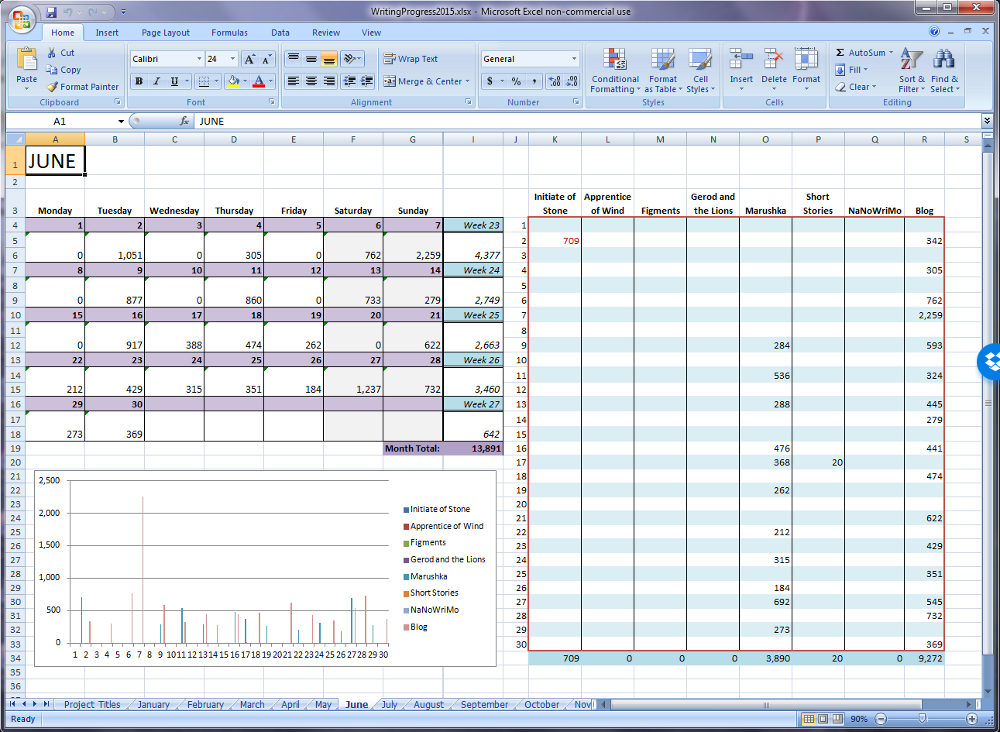
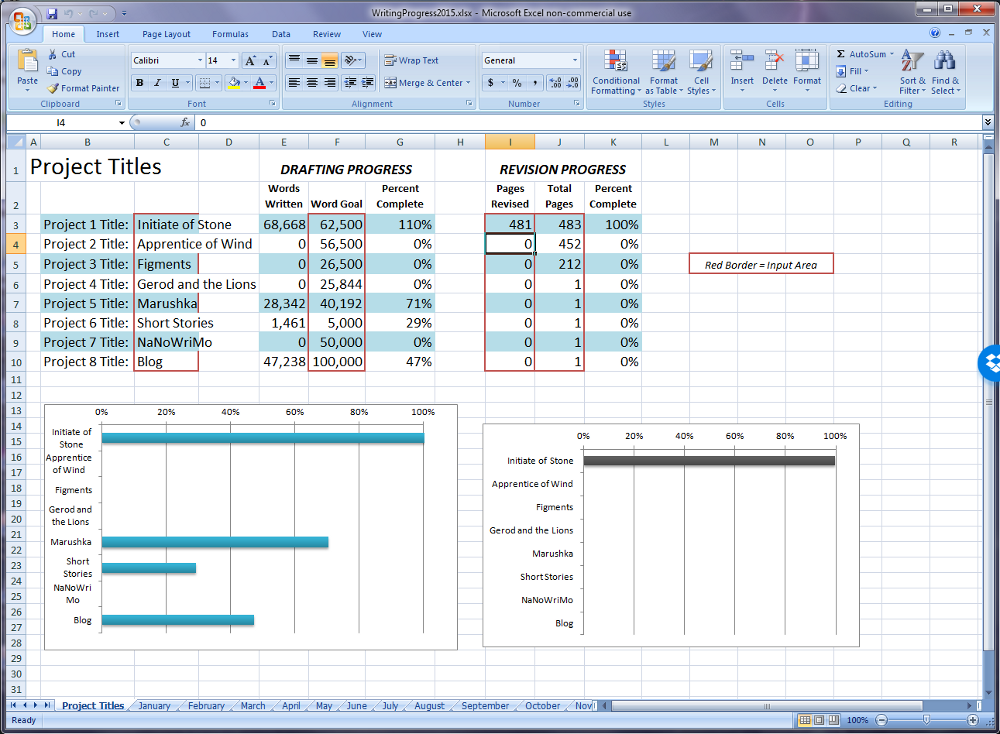
The 709 words written in the IoS column represents my third and final (for now) stab at the synopsis.

I’ve already received my first “not for me” response from my first batch of queries. In typical Canadian fashion, I seriously considered writing the agent back and thanking her for such a prompt response. LOL!

You’ll notice on the summary (below) that I’ve now written/revised 110% of my goal on IoS.

On the short fiction front, the story I’d sent out in May was rejected, and the two stories I sent out in June have also been rejected (just found out about the second of those yesterday). I’m persistent, though, and I’ve turned around and sent in another story to the anthology that is still open to submissions.

The one thing I’ve discovered is that, with each rejection, they are getting easier to handle. You get desensitized after a while. It is very much a part of the business of writing, but it’s only experience that takes the sting out of it. I barely blink now. I’m not really sure if that’s a good thing or a bad thing . . .

First time rejectees can rarely expect to receive negative feedback with such equanimity.

No story is submitted without some form of revision and/or editing, however.

So, though the short fiction word count was only 20 words, that number represents the revisions on two short stories.

I drafted another 3,890 words on Marushka and expect that I will finish up in July (yay!). I’m at 71% of my goal. I might make 60K on the draft yet 🙂

And now the blog has resumed its place as my primary new word generator at 9,272 words.

My total word count for June is a modest 13,891. It’s pretty much where I figured I’d be, though, so I’m good with that.

June 2015 summary

I’m going to start actively revising, editing, and submitting my short fiction until all of my existing pieces find homes. I haven’t really had any further ideas that fit the short story format and until I do, I’m going to stay focused on my novels.

After I finish up my draft of Marushka, I’m going to return to Gerod and the Lions and finish up that draft. Once GatL is finished, I’m moving on to Apprentice of Wind, the second book in my epic fantasy series. I don’t know how far into that I’ll be when NaNoWriMo rolls around again, but then I’m going to be moving forward with Reality Bomb (working title for my NaNo 2015 project).

My goal in NaNo will be to write more words on the project than I managed last year. Since I will once again be attempting NaNo while working, and I already know I’ll be out of town for a full week in November for training, it’s going to be a tough goal to reach.

I think that will take me through to the end of the year rather nicely 😉

So that’s been my month in writing.

How about all of you? Achieve your goals? Fall short? Acceptances or rejections? One way or the other, it’s all Writerly Goodness. Share yours in the comments 🙂

The Next Chapter

Ad Astra 2015 day 2: Canadian young adult literature

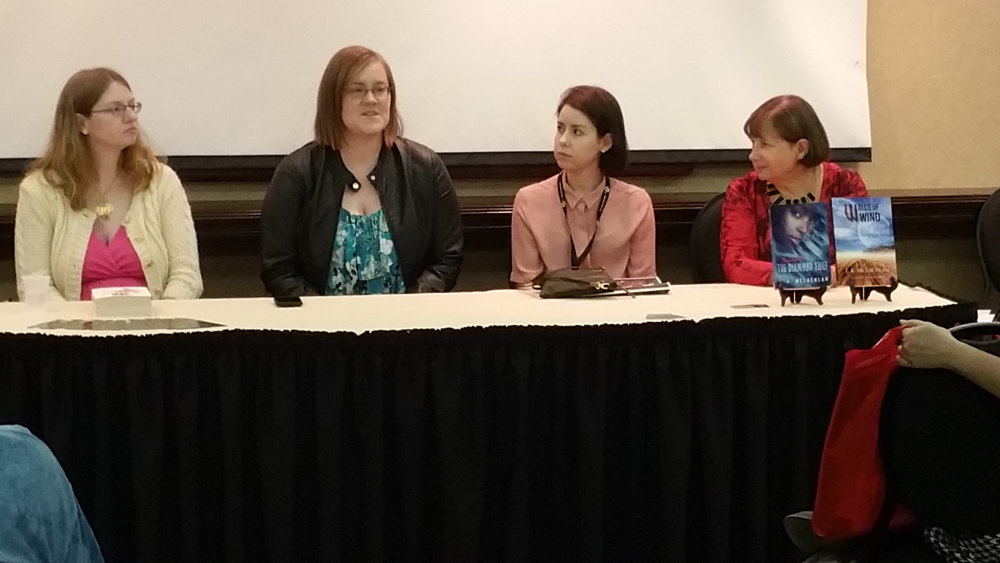
Panellists: Amanda Sun, E.K. Johnston, Monica Pacheco, Jane Ann McLachlan

Canadian YA panel

MP: What makes a YA novel Canadian?

JAM: Weather. We have a unique obsession with seasons, weather, and winter.

MP: Setting. American cities are the default for most YA authors.

EKJ: The Story of Owen is set in my home town. When I go to read at local schools, the kids are always excited: “Hey! That’s my street!”

MP: There’s a trend for setting becoming a character in its own right.

AS: Can lit is starting to embrace the speculative.

EKJ: We have horror to thank for that.

MP: For me, it always comes down to the writing and the voice.

JAM: There’s a difference in dystopian, too. Americans don’t trust their government as much as we do. It’s a central theme. Canadians are different. Our dystopias are often ecological disasters.

EKJ: One review of The Story of Owen said, “This is a poorly written dystopia.” It’s not a dystopia!

JAM: Even people on the right are left-leaning in Canada. How do we sell to American readers?

EKJ: I actively don’t care. Readers are looking for interesting and different books.

AS: My editor is American. He’s the gatekeeper. What’s March Break? What’s icing sugar (it’s powdered sugar in the States)? You wrote “in hospital.” Did you mean in THE hospital? Are you done work, or done working?

EKJ: I reclaimed Canadian spelling in subsequent printings of my book. It was a victory.

AS: I write in Canadian English.

JAM: I edit to American spelling but I’m afraid we’re going to lose Canadian spelling if all our young people are reading American English. I feel like I’m contributing to the delinquency of our youth.

Q: What’s your opinion of the renaming of Harry Potter and the Philosopher’s Stone to Sorcerer’s Stone in the States?

[There was a brief discussion of how Scholastic made the decision to rename the book in America and how this translated into the movies. Was it a “dumbing down”? No, just a matter of wording, like icing sugar vs. powdered sugar.]

MP: Both authors and editors expect advocacy. There’s more acceptance of diversity now.

EKJ: Maureen Johnston is an American author, but she wrote an amazing book that is British in every way: setting, weather, politics, and language.

JAM: That’s another thing that distinguishes Canadian YA: our sense of humour and multiculturalism. Canada is a mosaic and America is a melting pot.

EKJ: I have friends in the leadership of the We Need Diverse Books movement. It’s a slow burn.

AS: We don’t understand how divisive race is in America (or other countries).

Q: What about the “white washing” of diverse characters (the character is one of colour, but the cover image shows a white character)?

EKJ: It happened to Beth Revis. In Across the Universe, the male love interest is black. The actor in the movie is white.

AS: I wanted my novel’s Asian love interest on the cover and was nervous, but the publisher agreed. Julie Kagawa’s Clockwork Prince features an Asian on the cover. The cover for Nalo Hopkinson’s Brown Girl in the Ring is culturally appropriate.

EKJ: YS Lee’s Agency series is another example.

MP: I have noticed some of this, but I’ve seen more graphic covers that don’t feature a person at all. I don’t know if I’m reading too much into it, though.

JAM: What about the humour aspect? Canadian humour is self-deprecating.

And that was time.

Next week: We’ll be cutting contracts 🙂

On deck (today): The next chapter June update and a Caturday quickie pupdate.

Thoughty Thursday: Things that made me go hmmmm on the interwebz, June 21-27, 2015

Sorry this is late, but I had–HAD–to watch the final episode of Sense8. OMIGODSOGOOD!

And now back to our regular programming 🙂

Now let’s get your big squishy grey thing into gear!

The rainbow hued news of the week: The US Supreme Court makes same sex marriage a right, nation-wide. The New York Times. Then, of course, the fall out started and conservatives and religious fundamentalists declared they’d leave the country . . . for Canada. <Facepalm> Um, Dudes. We’ve had the right to same sex marriage for years!

These two grade eight students have been campaigning for consent in the Ontario sex-ed curriculum. Now they’ve created a documentary. And. It. Is. Awesome. Watch Allegedly. The Huffington Post.

Related: The next time someone says women aren’t victims of harassment, show them this. Tickld.

This short video is haunting and beautiful. i09.

Alan Watts on the acceptance of death.

The real boogeyman: serial killer Albert Fish. Creepy. i09’s True Crime.

Can climate be hazardous to your mental health? Psychiatric Times.

Sitting down for too long may increase anxiety. Just another reason to get an adjustable or standing desk. Discovery News.

First Nations lawyer will wear traditional clothing when she’s called to the Ontario bar. The Huffington Post.

At last! Vancouver company creates compostable G-Cups for Keurig Brewers. The Huffington Post.

The best weather photos of the year, collected for you by i09.

Canadians tweet amazing pictures of the Northern Lights. The Huffington Post.

Peter Ray Allison wonders if we will ever build ring worlds. BBC.

Sudbury’s regreening efforts were highlighted at an international conference. Listen to the interview on CBC.

IFLS shares an infographic that describes what happens to your brain when you don’t get enough sleep. See that one at the bottom right? It says BRAIN DAMAGE!

It’s okay to be smart looks into the reasons bees are dying:

A doggy retirement home! Love this idea. I heart dogs.com.

What Disney animals would look like if they were human. These are pretty good! Distractify.

Sophie Tweed-Simmons comes to Sudbury to film her first Canadian film. Seriously. They’re filming this right now. Great time of year to be doing it 😉 The Toronto Star.

A friend shared Johnny Cash’s cover of Trent Reznor’s Hurt and I remembered how much I love this version.

Now go be thoughty, and I’ll see you on Saturday for more Ad Astra reportage, the next chapter, and . . . a pupdate.

Thoughty Thursday

Tipsday: Writerly Goodness found on the interwebz, June 21-27, 2015

W00t! You wanted moar writerly goodness? Well, here it is!

In local publishing news, Latitude 46 moves into the void left by Your Scrivener Press. The Northern Life.

Listen to K.M. Weiland’s weekly podcast (and subscribe) or read her companion post. Last week’s offering: What every writer ought to know about omniscient point of view (POV).

How to make your secondary characters truly memorable. Katie’s Wednesday vlog.

Will readers find you protagonist worthy? Angela Ackerman on Writers Helping Writers.

The bigger the dream, the greater the resistance. When resistance pays you a compliment. Steven Pressfield.

The four dangers of writing and critique groups. The title says ‘hidden dangers,’ but they’re not really hidden. First-timers and eternal optimists might be blind to them, though. Jennie Nash on Jane Friedman’s blog.

How to write about guns without sounding like a doorknob. Benjamin Sobieck (who was much more polite about it that I was) guest posts on Jane Friedman’s blog.

The Listen Inside podcast from Readers in the Know features chapter 2 from Veronica Sicoe’s The Deep Link.

The ten best literary love songs brought to you by Quirk Books.

BuzzFeed compiles their list of the 53 best opening lines in literature.

Not to be outdone, Penguin Random House offered its list of captivating first lines.

In case you weren’t already crushed by the weight of your unread book stack, BuzzFeed compiles this list of ALL 339 books referenced in Gilmour Girls.

i09 lists its essential cyberpunk reads.

ZDNet shares their list of 26 essential science fiction novels that will help you prepare for the future.

Where Japanese science fiction has been and where it’s going. Japanese Times.

The 2015 Sunburst Awards finalists announced on the CBC.

And here’s Quill & Quire’s piece on the awards.

The brilliant ideas that didn’t make it into Pixar’s Inside Out. i09.

I must say that Phil and I are enjoying Sense8 quite a bit. Then again, we love well-developed character and story. The slow burn is just fine with us. Here’s Bram E. Geiben’s take on season 1 for i09.

Moar season 2 fodder for your Droughtlander jonesing. Carter Matt.

See you on Thoughty Thursday!

Tipsday

Sundog snippet: Miscellaneous things are miscellaneous

Okay peoples.

This is just going to be a bunch of pictures.

I’ll put captions on them so you can figure out why I’m sharing them 😛

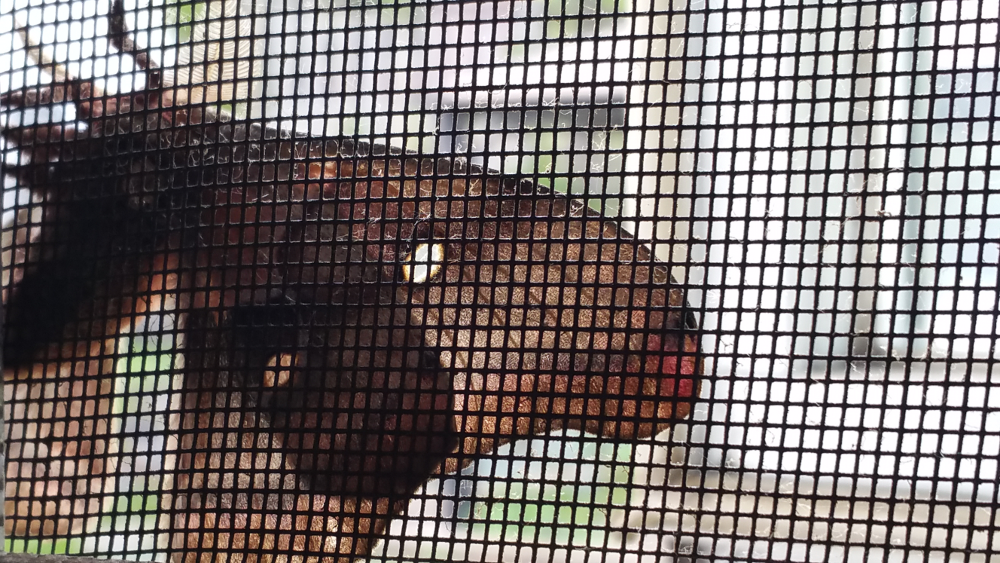
A visitor

A visitor

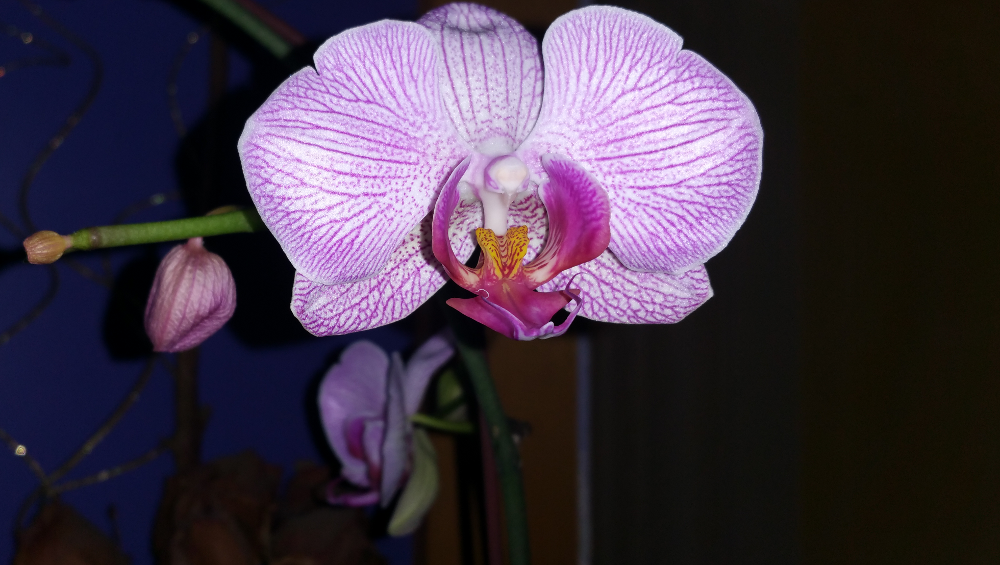
No past the bud blast yet, but I haz a flowers!

No past the bud blast yet, but I haz a flowers!

A friendship ball from my recently retired friends, Sue and Monique

A friendship ball from my recently retired friends, Sue and Monique

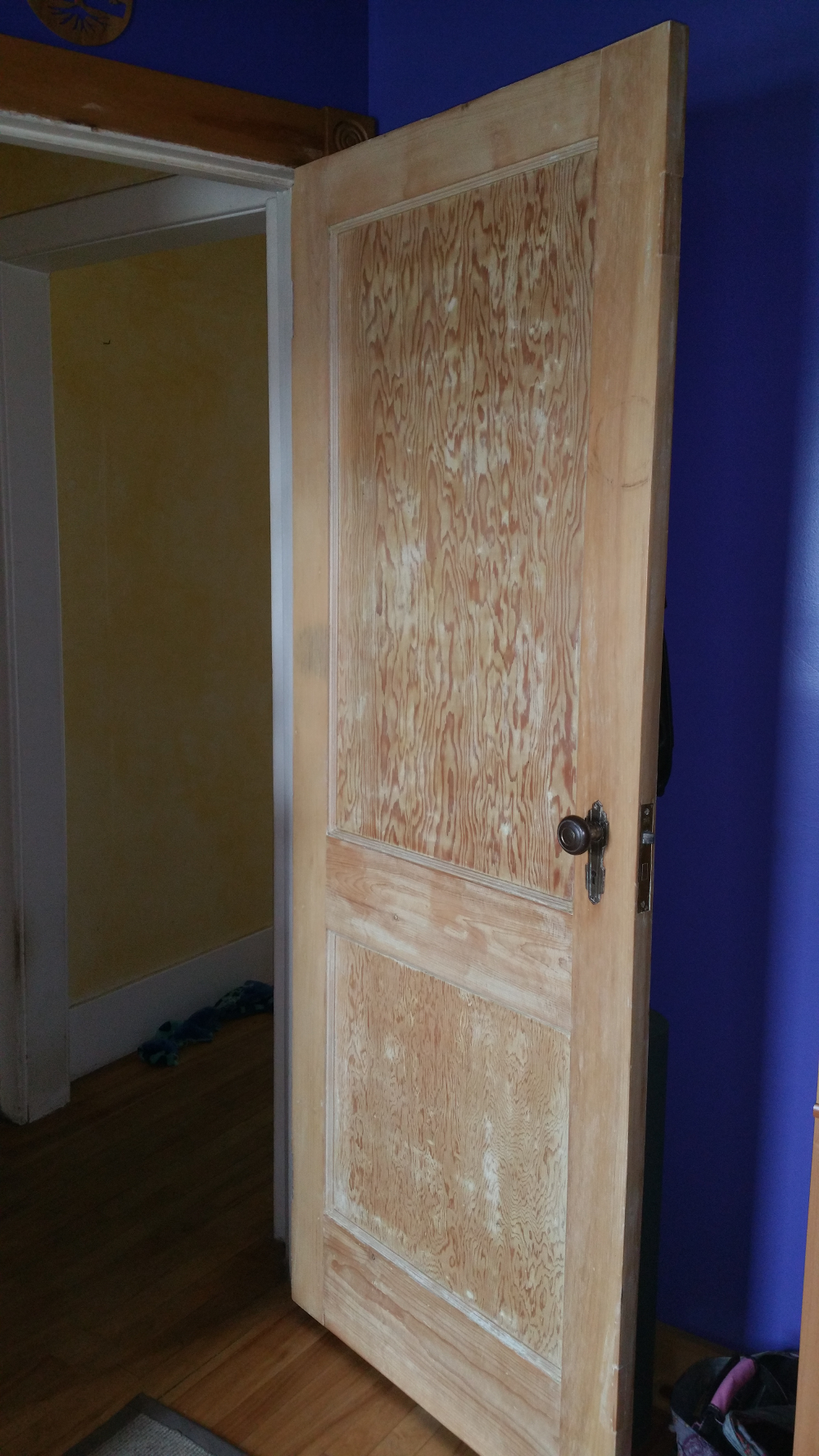
My office door. I went for the pattina this time.

My office door. I went for the pattina this time.

Or maybe I was just lazy. Either way, the door's done and hung. So there.

Or maybe I was just lazy. Either way, the door’s done and hung. So there.

And that’s it for this weekend of bloggage.

Next week: The Next Chapter June 2015 update will be coming up.

How to get published with Madeleine Callway and Wordstock Sudbury 2015

I know I’m a little tardy with this report, but after spending the day at Wordstock on Saturday, I was exhausted, and returning to work on Tuesday, so forgive me, but I’m not going to apologize outright.

So first up is Madeleine Harris-Callway’s “How to get published” workshop which took place on June 18.

To Madeleine, there are three main components: confidence, commitment, and courage. Her presentation focused on the traditional publishing industry because that’s where she’s had her experience and her success.

After introducing the group to her experience and to the state of publishing today, we moved onto the three C’s of publishing success.

I’ll go over each component in a little more detail below:

Confidence

Perfect your writing skills.

  1. Formal learning
  • Creative writing courses at universities and colleges.
    Cambrian College: The Essentials of Writing Fiction
    Correspondence courses: e.g. Humber College, Toronto
  • Writing workshops by established teachers.
    Brian Henry – Quick Brown Fox
  • Workshops and panels by published authors.
    Literary festivals
    Authors associations
    Public libraries
  1. Feedback on your work
  • Critique groups are essential to success
    Join and existing group, or form your own.
    Consider manuscript evaluation services or freelance editors
    Find them through professional associations or writing conferences.
    Explore mentoring programs
    Find them through professional associations, universities or colleges, or make a private agreement with an established author.
  1. Grow into a novel
  • Write short fiction first for magazines or anthologies
    Start a blog
  1. Writing awards and contests
  • An excellent way to get recognition for your writing
    Short story competitions
    Unpublished novel contests

Commitment

  1. Just write
  • Every day
    Use the ten minute rule (even if you don’t feel like it, try writing for 10 minutes – if you still want to stop, then stop)
    Critique groups provide motivation
  1. Network
  • Join writing associations
    Stay in touch with writers you’ve met
    Attend book launches
    Local author readings
    Attend literary festivals and conferences
  1. Social Media
  • Join online literary groups
    Connect to other writers through Facebook and Twitter
    Subscribe to online writing publications
    Join literary sites (e.g. Goodreads)

Courage

  1. Rejection is the norm
  2. Take heart – even famous authors were rejected
  3. Use strategy
  • Contact publishers in your genre only
    Study their websites
    Follow their submission guidelines to the letter
  • Edit your queries and proposals – eliminate typos and formatting mistakes
  • Multiple submissions are fine
    Follow up
  • Find an agent
    Study their websites
    Follow their submission guidelines to the letter
    Attend pitches at writing conferences
  • Consider small publishers
  • Consider epublishers

Then, Madeleine ended the evening with a Q&A session.

Having organized the session, I forgot to take pictures 😦

Wordstock Sudbury 2015

This was only the second edition of the festival, but the organizers made a number of improvements.

Friday night began with a reception at the Speakeasy, followed by the announcement of the Youth Writing Contest winners and “An evening with Terry Fallis and Sandra Shamas.”

Saturday started early with book table set up and the organization of the two venues for the workshops and panels at Sudbury Secondary School. Over at the Greater Sudbury Public Library, Danielle Daniel held a children’s story time.

As of 10:30 am, the workshops and panels began and continued right through until 5:15 pm. I’ll let you read the program on their web site to get the details if you wish.

Madeleine Callway readingI participated in the author readings at noon, attended the genre fiction panel at 1 pm, volunteered at the indie book table until 4 pm, and then caught the graphic novel panel.

After we closed up the book table, the venue moved to the Motley Kitchen at 6 pm for a dinner and performance by Corin Raymond, back to Sudbury Secondary for Cheryl Cecchetto’s book launch, and finally back to the Motley Kitchen for Spoken Word After Dark.

It was a busy day. Hence the tired.

Wordstock Sudbury 2015 was a success, in my opinion, but it has room to develop and grow as a literary festival.

I’m looking forward to the next iteration.

Genre Panel

Graphic Novel Panel

Up next: I’m getting miscellaneous.

Ad Astra 2015 day 2: What’s your punk?

Panellists: Ian Keeling, Angela Keeley, Gemma Files

What's your punk? panel

AK: What is a –punk?

IK: Punk, to me, is an attitude. Skate punk, for instance. It’s anti-authoritarian. You find it in video games and anime.

GF: When you punk a genre, you’re deconstructing it.

AK: Punk comes from the music of the same name but is most closely identified with industrial and Goth sub-cultures. It’s an aesthetic. You can have diesel punk, steam punk, and desert punk (think Tank Girl or Mad Max).

GF: It can also transfer from fashion into fiction. “I’ve made this persona and I want a story that this persona can exist in.”

Q: How do you world build in a punk setting?

GF: There’s an element of alternative history. What if the industrial revolution had gotten stuck in the steam age? You look to the relevant historical period and research.

IK: You have to do enough research to make your world feel authentic.

AK: It’s retro-futurism. In fiction, look to H.G. Wells, Mary Shelley (Frankenstein), and Marlowe (Faust).

Q: I’d like to write in a(n) (Art) Deco punk setting. What should I aim for in terms of aesthetic?

GF: The aesthetic of an age is always attached to other things.

AK: Think of Gotham in Tim Burton’s Batman. The tortured but beautiful body was a fascination of the age. The 20’s were glittery and then the Great Depression happened.

Q: We haven’t mentioned cyberpunk yet. What about The Difference Engine?

AK: Charles Babbage was the inventor of the Babbage Engine, or the difference engine. In fiction the invention/thing itself is aware.

Q: Are there any contemporary punks?

AK: It’s hard to write an alternative history about now.

GF: Karl Schrader is a futurist, or rather an “ambiguist.” His question is, how do we make complicated ideas simple/accessible through story? The future is the only period that is wholly ambiguous.

AK: Colonialism belongs in this conversation. It has the transgressive and rebellious aspects required for a punk. Punk is always dystopian. Otherwise it’s gaslight fantasy. The prevailing mood of a dystopia is distrust of government.

IK: I’d argue that we live in a flawed society, not a dystopia.

GF: The horror iteration is splatter punk. It’s extreme in everything. It’s a response to mainstream horror authors like Stephen King, whom some people view as “tame.”

IK: Has punk lost its meaning?

AK: I don’t think so. Look at A Knight’s Tale. That’s medieval punk.

GF: Punk is intended to be offensive and in your face.

IK: Chaucer was a rowdy, irreverent writer. Was he punk, or meta? Is postmodernism the original punk?

GF: The Dadaists, maybe.

AK: Punk lacks the self-awareness of meta or postmodernism. A Clockwork Orange was not punk. It was a visceral reaction to the direction Burgess saw society heading in.

Q: Can you punk gender? How do you write a gender neutral being?

IK: Choose a pronoun/word and use it consistently, but realize that it will make your book more obscure/niche.

And that was time.

This was one of the most interesting panels I attended. It had a distinctively academic/intellectual bent that I kind of appreciated.

Tomorrow: How to get published with M.H. Callway, and Wordstock Sudbury. And things might get a little miscellaneous 😉

Thoughty Thursday: Things that made me go hmmmm on the interwebz, June 14-20, 2015

A couple of fraught issues to start you off today, and then we move through psych and science to some feel-good at the end.

Jon Stewart on the Charleston church shooting:

The RCMP report that there have been 1,118 missing or murdered aboriginal women since 1980. CTV News.

13 brave, indigenous women share their stories of how they almost joined the missing. McLean’s.

Delilah S. Dawson isn’t going to tear you down. She’s going to build you up. Whimsy Dark.

Can diet shape your mental health? Gives a whole new meeting to ‘you are what you eat’ 🙂 The Globe and Mail.

The genetic link between creativity and mental illness has been found. Collective Evolution.

Why Finland’s teachers are different. The Guardian.

They’ve discovered the compound responsible for ‘old person smell.’ Mental Floss.

The link between stress, creativity, and orgasm: Naomi Wolf writes about the vagina in her new book. BrainPickings.

Take a look at this adorable octopus. What are scientists thinking of naming it? Adorabilis 🙂 BoredPanda.

How jellyfish put themselves back together. The National Geographic.

How does a creature reproduce when it’s actually four creatures? On man o’ wars and other siphonophores. i09.

Kayakers have a close encounter with a whale 🙂

Dogs will snub people who are mean to their owners. IFLS.

Kangaroos are lefties (and why handedness is rare in animals). The National Geographic.

I shared a post a few weeks ago about how mice were shown to have inherited their parents’ fears. Well, here’s another article on the subject. Science Gymnasium.

NASA is one step closer to its mission to Europa. i09.

Dr. Michelle Thaller: We are all dead stars. The Atlantic.

Yes, androids do dream of electric sheep. The Guardian.

Darwin’s grandfather once thought up a plan that would destroy the world. i09.

The Barra McNeils and Ashley McIsaac in Windsor:

Hope you have lots of great ideas this week!

See you Saturday.

Thoughty Thursday

Tipsday: Writerly Goodness found on the interwebz, June 14-20, 2015

Another wonderful week for Writerly Goodness!

What’s the key event and how is it different from the inciting incident and the first plot point? I know I still forget the distinctions. K.M. Weiland’s Helping Writers Become Authors.

And here’s Katie’s Wednesday vlog: How to write a riveting characteristic moment.

Roz Morris shares her experience with repetitive stress injury (RSI).

Kassandra Lamb guests on Jami Gold’s blog: Nine psychology myths you need to avoid.

Tips on picking up the pace from Rebecca LuElla Miller.

Learn about the magic systems of Brandon Sanderson. Tor.com.

Five ways first contact could turn into an epic fail. Veronica Sicoe.

Neil Gaiman offers his thoughts on why stories last. (w/ Podcast) BrainPickings.

Liz Bourke ponders how we speak of strong female characters. This post refers to others I’ve shared in past weeks and takes it in a slightly different direction. Very interesting. Tor.com.

How can you keep readers from hating your characters? Jody Hedlund.

Beth Revis posts on Janice Hardy’s Fiction University: How do you know you’re ready to publish? Agent Carly Watters of P.S. Literary wrote on the same topic last week 🙂

Dave King explores our motivations for writing. Writer Unboxed.

Kameron Hurley asks, why are we self-publishing? Locus.

Porter Anderson takes a look at Hugh Howey’s promotion of self-publishing and what it really means in the context of the continually evolving publishing industry. Thought Catalog.

Related: Nielsen Book’s latest results indicate that self-publishing is more like traditional publishing. Publishing perspectives.

Amazon changes its terms for KDP select. The Digital Reader.

Why I teach diverse literature. The Toast.

What librarians wish we knew about how to use a library. i09.

Authors share the places that inspire them. FlavorWire.

Ten books you should read before you see the movie. The Huffington Post.

Mark Twain’s advice to little girls. BrainPickings.

This is fun 🙂 Classic novels with clickbait titles. BuzzFeed.

BuzzFeed shares 22 book-themed gifts for readers.

Watch the Scooby Doo crew’s fashion evolve through the last century. i09.

The first set photos of the new all-female Ghostbusters! i09.

Mike Hale states that Game of Thrones the series is going the way of Lost . . . What do you think? The New York Times.

Here are Charlie Jane Anders’s suggestions about how to fix Game of Thrones. Is it even possible? i09.

How Terry Dresbach’s costumes bring history to life on Outlander. Variety.

Orphan Black’s season finale: history yet to be written. It was awesome (IMO). The Wall Street Journal.

See you Thursday 🙂

Tipsday

Ad Astra 2015 day 2: High quality self-publishing

Panellists: Beverly Bambury, Caro Soles, Catherine Fitzsimmons, Samantha M. Beiko, Stephen Kotowych, Mark Leslie

Self-publishing panel

ML: When you self-publish, do you use your own name?

CS: It’s not professional.

BB: If it’s a small publisher that no one has ever heard of, why not use your own name?

SMB: It doesn’t really matter. The book will speak for itself.

SK: Using your professional name adds credibility.

ML: I run Kobo Writing Life for small publishers and independent authors. The top 15 to 20 best selling Kobo books are independently published.

BB: Does Kobo offer supports?

ML: We’re looking into how to best connect authors and services. There are a lot of predators out there. We should be bringing out something later this year.

BB: Supports vary. Authors have to do more regardless.

SMB: An author will finish writing and editing a book and say, “Well, that was a nightmare.” Fasten your seatbelts, people: it gets worse.

ML: What’s your best advice to the author considering self-publication?

CS: Join writers’ organizations. You find out what’s going on in publishing. Hire a copyeditor.

SMB: Come out to events like this one. Everyone really wants to help everyone else.

SK: Don’t spam people. Offer something of value.

CF: Don’t skimp on the cover, but be smart. Shop around.

CS: I do my own covers. You just have to learn how.

BB: Someone with a graphic design background could be better than an artist. Invest in an editor.

CS: A beautifully written story, if poorly copy edited, will lose competitions for awards and other opportunities.

ML: A good cover catches attention. A good back cover copy reels readers in. Write your next book. Nothing sells you last book like your next book.

CS: An ebook cover has to look good in thumbnail form.

CF: Check out Kindle cover disasters on Tumblr.

Q: You mentioned two different kinds of editors. Could you elaborate?

SMB: There are substantive editors. They look at the big picture, structural stuff. They can cost a lot. A copyeditor or line editor looks at sentence structure, grammar, and syntax. Is this the best way to convey your intent? A proof reader looks at spelling and punctuation.

ML: Who’s looking at the revised copy? If you have beta readers, ask them, “Where did you fall out of the story?”

CF: With beta readers, the more the better.

ML: Beware the hype of the Kindle gold rush. Don’t look at self-publishing as your ticket. It’s a long term game, not a quick buck.

BB: As a publicist, I have people coming to me with unrealistic expectations.

Q: What are your thoughts on giving away your work for free?

CF: You shouldn’t start that way. If you have a complete series, then offer the first for free. If readers like it, they’ll buy the rest of the series.

ML: Kobo uses free in different ways. It works best when the call to action is to buy the author’s next book (series or otherwise).

SMB: If you have a novella, don’t give it away for free. It’s considered an exclusive item. Give it a limited run.

ML: Let’s run the numbers. Say you offer a book for free and 10,000 people download it. Of those 10,000, maybe 2,000 will open the book. Of those, only 350 will finish it. Of those, only 175 will buy the next book.

Q: How do you balance everything?

CS: That’s up to you.

SK: Schools can be a goldmine.

And that’s all we had time for.

Next week: Ad Astra gets punked 😉

And sorry folks, you’ll have to wait until next weekend for my report on Madeleine Callway’s workshop and Wordstock. I’m bushed.