Six questions with Mat Del Papa

Mat is a writerly friend and a past-president of the Sudbury Writers’ Guild. He’s published two collections of stories loosely based on the history of the railway in Capreol, and now, he has become an editor, assembling fact and fiction to create Creepy Capreol, a collection of supernatural tales about his hometown.


Welcome to Writerly Goodness, Mat!

WG: What inspired the Creepy Capreol project, and how did it evolve?

MDP: The inspiration came from Spooky Sudbury. Mark Leslie and Jenny Jelen put together a great book and I was fortunate enough to be involved in a small way. That got me thinking about doing something more scary than my usual. Seeing the phenomenal success they had combined with the unexpected discovery of two other stories about Capreol in Spooky Sudbury to give me another push. Mark provided the final impetus. We’d been joking, via email, about the various weirdness in Capreol (the river’s burned twice and the fire hall three times — for a example) and he said something like “You should write a book.” I forget who came up with the title, him or me, but it clicked.

WG: How did you go about recruiting your writers and artist? How smoothly did that process go for you?

MDP: I recruited the writers I thought would the best fit first — current and former Capreol residents who already write genre-type stories. Steve Vernon was on top of that list. Born and raised in Capreol he’s had a great deal of success writing horror. Next came Jason Shayer, another Capreol boy who’s gone on to bigger things. Both were happy to contribute and their inclusion gave me the confidence to move forward (until they signed onboard I was more or less toying with the idea — getting two published authors was the final push).

It would have been a thin book though if I hadn’t approached a few members of the Sudbury Writers’ Guild. Betty Guenette wrote about her uncle from Milnet (a ghost town just north of Capreol) and gave me a second story set in Sellwood (another nearby ghost town). Lisa Coleman-Brown had impressed me with her ability to write gross fiction and she delivered another stomach-churner for Creepy Capreol.

The artist proved easiest of all. Robert Michelutti lives in Capreol and volunteers at the local train museum (the Northern Ontario Railroad Museum and Heritage Centre). I’ve had dealings with the museum before (they sell my previous books in their gift shop) and so had an “in” with Bob. I sent him some samples stories and he sent me some sample art — they proved a great fit.

WG: Once you had the writers lined up and their stories in hand, it would have been time for editing. What did you learn from wearing the editorial hat that you may not have known as a writer?

MDP: Editing is hard. Everyone knows that. What I didn’t realize was how many little details there were. Things you have to keep track of at all times. It’s like juggling — only you’re dealing with people and their creations! Getting the best work sometimes meant stepping on toes. I found a hundred ways to say, politely, “Try again. You can do better.” The amazing thing is . . . the various contributors did do better, every time, revising until we both were happy. No doubt they came to curse my very name, but the final product proved the efforts (and swearwords!) weren’t in vain.

WG: Did you do the layout work yourself as well? How was it organizing text and images for publication?

MDP: I did just about everything — that’s the only way to keep costs reasonable. Luckily there are plenty of quality programs and templates available. It probably took me ten times as long as a professional, but in the end everything came together.

The hardest part was balancing the content. I agonized over the order, trying to compliment each story with the one before and after.

WG: What is it like to create a project like this and have a hand in it from start to finish?

MDP: Satisfying . . . and frustrating. I enjoyed 99% of the process. But that last 1% had me almost tearing my hair out. I can live with the odd technical glitch. It’s my own stupid mistakes that gall. Luckily I’ve done the whole self-publishing thing three times before and have learned from most of my mistakes.

Having contributors was a new experience. One I found both difficult and exhilarating. Their enthusiasm pushed me through some rough patches, but waiting on others to revise (in some cases four or five times before getting it right) was a challenge. The fact that I’m not the best time manager meant that the last few weeks were a tight crunch. Still, for all the struggles, the final product turned out better than I could have hoped.

WG: What’s coming up for Creepy Capreol?

MDP: First comes the official launch. I always hold a book-signing/launch as part of the Capreol Days festivities (held on the August long weekend). This summer is no different. I’ll be in downtown Capreol on Saturday, August 2nd with a table of books — Creepy Capreol will be selling at a special holiday price of $14.00 — and encourage anyone interested to come out. There’s music, barbeques, a sidewalk sale — last year had horse rides, kids games, an animal exhibit — and more.

After that I hope to hit Valley East Days in early September. It’s another fun weekend, full of music, food, and entertainment.

The book should be available on Amazon in the fall. Kobo, Kindle, and iBookstore versions are coming soon. And I hope to have it in Chapters Sudbury location for October.

Thank you for taking the time to tell us a little about Creepy Capreol and your journey to publication.


About the book:Creepy Capreol
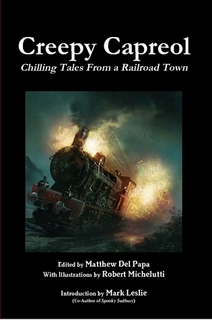
Creepy Capreol
Chilling Tales from a Railroad Town

Introduction by Mark Leslie.
Illustrations by Robert Michelutti.

The book consists of two parts:

Non-Fiction

That Darn Sock Monkey — How a stuffed sock monkey traumatized my youth.
Bigfoot Lives! — A look at the Capreol connection to the famed creature; with references to fact, legend, and some personal observations.
Help! My Wheelchair Is Trying To Kill Me — Humorous take on the many times I’ve almost been killed by my wheelchair. Mostly true, some exaggeration for effect.
Vigilante Justice: Capreol Style — An account of Frederick Chase Capreol’s many failings and lone stellar success. It is mostly factual, but with some humour.
The Mystery Of Capreol’s Mass Grave — Fact-based article that refutes the commonly held belief that between 30 and 80 people are buried in a mass grave.
The Wreck At Drocourt — A poem by Ida Quackenbush and her son George. Originally written approximately 1930.
Ghost Town Trilogy — Loose histories of three local ghost towns.

Fiction

Rolling Stock — Steve Vernon
Set in Capreol’s railyard the story revolves around one man’s late-night encounter with the supernatural.
Not The Basement! — Lisa Coleman-Brown
An overworked PSW is filling in for a co-worker when she discovers a disturbing secret.
The Likely Story — Paul Mandziuk
A literary mystery; it features a vicious murder in a bookstore — with a novel twist.
This Old Man — Betty Guenette
The bond between nephew and uncle are tested as more than age and isolation separate the two.
The One That Got Away — Matthew Del Papa
A northern Ontario fish story as told by the bait dealer who saw it all happening.
Dual Ghost Towns — Betty Guenette
Ghost towns aren’t always empty. Two sisters find this out in traumatizing fashion on a visit to Sellwood.
Stagnant Waters — Jason Shayer
Exploring abandoned buildings reveals something unexpected … and evil.


CanWrite! 2014: Publisher Panel, June 20

Christie HarkinCraig PyetteHalli VillegasPanellists: Christie Harkin, Lorimer; Craig Pyette, Random House; Halli Villegas, Tightrope Books.

Moderator: Sue Reynolds


SR: What would make you shout “Eureka!” if it crossed your desk today?

CP: If we’re talking fiction, I’m not likely to shout right away, but something fresh, or new, would make me pay attention.

HV: The writing has to be excellent. The writer has to be willing to work hard in the editorial process. I like unique settings, LGBT, quirky, diverse books. In our best essays anthology, there was a piece about hospitals that was fascinating.

CH: I have a spreadsheet with tic boxes. I have to check off all the boxes to consider the piece. It has to fit into one of our current series, have an urban setting, preferably in the downtown core, it must be edgy, realistic, modern, and not elitist. If I receive something that meets the criteria, I’d shout “Eureka!”

SR: How many books do you consider from your respective slush piles? How do you prefer to be approached?

CP: If you want to submit to a larger house, get an agent. Most of what we produce comes to us through agencies. With regard to your first question, it would be close to none. I can think of one book we accepted from the slush pile. It was non-fiction about the intersection of gun culture/manufacture and hip hop/urban culture.

HV: Every season, there’s at least one book I find in the slush pile. We’re a small press and periodically closed to submissions. Sometimes we put out a call for an anthology. Our most recent was for mystery stories. We also accept projects though grants, like the OAC’s Writers Reserve. If I like the work, I’ll get in touch.

CH: I’ve been with Lorimer for eight months and before that, I was with Fitzhenry & Whiteside. At Lorimer, there is no slush pile. When the list is specific, the submissions are low. We ask for specifics. Read the submission guidelines.

SR: How do you make a business case for a book? In other words, what happens after “Eureka?” How do you sell a book?

CP: The business case is part of the eureka moment. We have to see that there is a robust audience for the book. We talk a lot about comps.

HV: Comps are the first thing sales asks for. Tightrope has built its own market. Readers say, “I trust their aesthetic.” We have our annual poetry and essay anthologies, we’ve published material on plus-sized women. We’re not necessarily focused on the market in general, but on our audience. We published a book titled, How to get a Girl Pregnant, about a gay couple trying to have a baby. The author needs to be part of the process.

CH: We also want proactive authors. They have to be willing to attend conference, Word on the Street, commit to local promotion. The biggest market for kids books is in schools and libraries. Take a look at the curriculum and write book club-like content for teachers so they can teach the novel in class. There was a book about Jacques Plante, but it was too focused and a lot of the kids it was aimed at wouldn’t be able to relate. This morphed into a book about hockey safety in general and how players have contributed to innovation over the years. The revised book had a more universal appeal.

SR: Publishing is a business. You know what you’re looking for. What about international rights and contracts?

CH: If you don’t have an agent, you don’t have any negotiating power. You probably don’t have the knowledge, or the connections. Think seriously before you sign a contract.

HV: We had a South African author who wanted to publish in both countries. I have a North American and European distributor. I don’t like being limited to Canadian rights only. It’s a smaller market. The first print run is 600-1000 books. We’ve just added ebook rights as well. We don’t do commercial fiction, however.

CH: You want your publisher to contract for US rights. More books will sell in the States than in Canada. Lorimer insists on US rights, in fact. If the author wants to retain them, that would be a deal-breaker.

CP: You don’t want your rights squandered. Ask what the publisher wants to do. Random House has a great foreign rights department, but half of our authors aren’t Canadian. We’re a Canadian-oriented publisher, though. With an agent, the world is their oyster.

HV: Big publishers will have a legal department. I don’t. If things get too complicated, I send the writer to an agent or a lawyer.

CH: Yes, an intellectual property (IP) lawyer.

SR: Let’s open the floor to questions.

Q: What’s your risk tolerance?

CP: Keep in mind that the greater the risk, the higher the potential payoff. Last fall was unusual. We published books on Bobby Orr and Chris Hadfield. Colossal risks, but the payoff was huge, too. Sometimes you blow it, but if you’re passionate, you take the risk.

HV: We don’t have a big budget, so we don’t take big risks in the traditional sense. I like to build the ladder rather than climb it.

CH: At Fitzhenry & Whiteside, I had a lot of latitude. My risks paid off. I’ve been lucky. Lorimer is less of a risk-taker, but we will still weigh the pros and cons before making a decision.

Q: What is the process of getting on the bestseller lists?

CP: If we knew that, we’d all be millionaires. That’s putting the cart before the horse. In 2006 Booknet started tracking sales at the cash register for 90% of the retailers in Canada. The Globe & Mail Bestseller list is based on Booknet numbers.

Q: Does politics play a role?

CP: It’s hard sales numbers.

HV: Do you mean, “it’s who you know”?

CP: Maybe there’s the odd favour.

CH: Maybe we can get the book into a reviewer’s hands.

HV: It’s a chicken and egg thing. Some authors will automatically be on the bestsellers lists. Stephen King, Margaret Atwood, Michael Ondaajte.

Publisher's Panel


And that’s all we had time for.

Next week: Writing Fantasy with Kelly Armstrong!

CanWrite! 2014: How to be your own editor with Farzana Doctor June 19

Farzana DoctorThat’s Dr. Farzana Doctor 😉

Learning to edit your work is learning to know when to let go. Maybe that’s what this workshop should be called: Let it go.

This is what I do. You don’t have to do what I do. Do what works for you in your process, but I hope you’ll find some interesting tips and techniques you can incorporate into your process.

First, a couple of definitions:

  • Prose editing is fine tuning: Spelling, grammar, syntax, usage.
  • Revision is substantive, structural, plot-related.

To start the editing process, you must have a completed piece of writing.

What was your intention in writing the piece? That core intention will guide you in the editing process.

Plan the process

Prose editing checklist:

  • Overused or repetitive words. First identify them. Everyone has her or his words. Then, use find and replace to address them.
  • Useless words (Mel’s note: also called zero words, because you can remove them from the sentence without changing the meaning of it) such as, just, only, that, actually, etc.. If you’re not sure what useless words are, Google it.
  • Grammar tics. Again every writer has a weakness. (Mel’s note: mine is commas. I either use too many or too few.)
  • Passive language. Examples: The biscuit was eaten by the dog (the dog ate the biscuit). She was jumping up and down (she jumped up and down).
  • Telling versus showing. Telling has its place, but avoid it where possible. Check your use of adverbs, adjectives, and clichés. These are often signs that you are telling, rather than showing.
  • Dialogue. Tags – do you need them, or would an action beat be better? Do all of your characters sound the same? Said is just fine. Read it out loud to see if it “sounds” right.
  • I start with editing first, because I find it easier. Some writers may not want to do this because it may mean too many wasted words when the revision stage is reached. Editing first works for me.

Revision checklist:

  • Where does the story begin? Is it too early, too late, is there enough action, conflict?
  • The protagonist. What does he want? What prevents him from getting it?
  • Other characters. If you can take her out of the story and not alter it, she should go. Every character should serve the story. Every character should be real, have a background, desires and frustrations of her own.
  • Keep track of plot and subplots. Structure.
  • Description. Is there too much or not enough?
  • Flashbacks. Do they stall the story?
  • Is the ending satisfying? Is it a resting place?

How to do it:

  • Focus. No distractions. Space. Set time, page number, or word count goals.
  • Separate new writing from editing and revision. Could be different times of the day, or different days.
  • Revision iteratively. Editing as you’re going. Must always make progress, however. S.J. Rozan’s method of Iterative Revision – Bookbaby. Start with previous day’s work, and then move on. It’s like a progressive spiral.
  • Change perspective. Step away. Change your font. Read aloud. Print it out. Draw maps. Pretend you are a reader.
  • Create a visual outline. Literally cut and paste your scenes and chapters.
  • Write a synopsis or jacket copy. Write a logline or tagline. Write a poem. Find your theme.

Asking for feedback

  • Who will you ask?
  • When is the best time to obtain a critique?
  • Be specific about what you want/need.
  • Stay general. When did you stall, get bored, get lost?
  • Receive your critiques without resistance. Set it aside. Decide what rings true. Ask for clarification (do not defend).

The rest of the workshop was spent reading and responding to the participants’ works-in-progress.


I must admit, I haven’t thought of purposefully editing first. I have edited too early before, and regretted spending all that time fixing scenes and even chapters that I would eventually delete. For me, I would think that revising first makes more sense.

Similarly, iterative revision doesn’t work for me. I get caught in an endless loop of going further and further back. It doesn’t prime the pump for me, it engages my inner editor too early in the writing process and stalls me.

Overall, I found Farzana’s workshop informative and practical.

I hope that you, too, will find something useful that you can use in your daily practice.

CanWrite! 2014: Agent panel, June 19

Panelists: Sam Hiyate, Carly Watters, Marie Campbell

Sam HiyateCarly WattersMarie Campbell


Moderator: James Dewar

JD: What’s changed in the author-agent-editor relationship over the years?

SH: When I was studying English literature, agents were invisible. Editors shaped the work. Now, there is too much work for an editor to do. Some of that work has devolved upon agents. The leisurely relationship between author and editor is a thing of the past. Editors want a perfectly edited manuscript to they can turn around and sell it to their publishing house.

MC: Whatever golden age there might have been, ended just before I started working in the industry. YA is a big market now. Editors are not so much about developing talent, but about recognizing it. We need to be good “pickers.” Some agents have moved into this gap.

CW: Agents are also fighting against each other to get their authors placed.

JD: How much time do you spend developing authors?

SH: I couldn’t give you a percentage, but somewhere between three and five drafts.

MC: It varies with the client. It could be anywhere from one to twelve drafts.

CW: I spend between three and six months, not just editing, but understanding the vision for the work. The “revise and resubmit” letter might contain one to seven pages of suggested revisions. You have to find out if you can work together. Some agents won’t take on a client without doing an R&R letter. They won’t take the risk.

JD: What are some of the reasons authors don’t respond to your suggestions the way you expect?

CW: The author doesn’t take it seriously. They don’t understand how much work goes into reading and analyzing and preparing the R&R.

MC: I was at a conference last year on a panel reading first pages. The top three, as the prize, would be given consideration, moved to the top of my slush pile. Only one of them responded right away. I read and signed her. The second one just came in last month. Sometimes they’re scared. When you get the opportunity, jump for it. It may not be there in six months.

SH: The easy answer is that Canadians are afraid. Americans want to see the money. Adopt a professional persona. Andrew Pyper wrote five or six books. His agent asked to see what he was working on. He presented it to his agent and the agent asked, “do you have anything else?” It’s a conversation.

MC: I had a conversation with one of my writers who said he had so many ideas he could work on. It’s my job to say, “no, no, no, yes.”

JD: What is exciting you these days?

SH: Ask me when I’ve had a few cocktails.

MC: Because I’ve worked in children’s literature for so long, it’s exciting to see the new work coming in. Because there’s so much of it, the bar is set high. Picture books were dying out, but now they’re coming back.

CW: In the acknowledgements of her second book, one of my authors said that without me, she’d be a starving artist. I was thrilled. It’s the best part of being an agent, being able to grow with your authors.

SH: I can give you an answer now. There is a graphic novel about two girls coming of age in this one summer in cottage country. Canadian writers do this very well. The book was #8 on the New York Times, moved up to #7, dropped off the list, but now a review has come out and we’re waiting to see where it goes.

JD: When you look at a manuscript, what are you hoping to find?

CW: The book always comes first, but I look for potential for book cubs, translations, you never know.

MC: With kids’ books, you have to consider the age of your audience, and then look at merchandizing. Is there series potential? Having said that, I will never say the word “trilogy” again.

SH: It depends on the book. The first may be a distinctively Canadian book, but two or three down the line, it could be a whole different story. Look at Yan Martel. Pi was his fourth book. His first was a collection of short stories.

JD: So, the book is not the end of it.

SH: The moment Pi hit the mainstream, everyone went back to buy his other two novels.

JD: How are Canadian authors doing on the world stage?

SH: That’s a really big question. Ebooks are based around genre. It’s getting harder and harder to sell literary novels. The Luminaries is essentially a thriller written in a literary style.

CW: Canadian authors aren’t as ambitious. They’re too laid back. Literary is still a market. If you’re writing genre, though, consider your setting. An anonymous town that could be anywhere in North America won’t be as problematic for an American publisher.

MC: Writers have come to me and said, “I’ve been successful in Canada. Now I want to break into the American market. Canadian’s are good at problem novels. American’s love them too, but they don’t translate into the UK market. It can affect foreign rights and sales. Consider changing your setting to Detroit.

JD: If you had one piece of advice for emerging writers, what would it be?

MC: Treat it like a business. It’s my business and it’s hard work. It’s creative, but it’s also a business.

SH: If you think your manuscript is perfect, it’s probably not. Make sure you have readers, alphas and betas, and critique groups lines up.

CW: Define what success is for you. Plan for it. Implement the plan.

Q: Is there an art to selecting alpha and beta readers?

CW: You have to give some thought to who your ideal audience is. Find people who are better than you to work with. Read everything.

MC: One of the most successful, grass-roots groups I’ve heard of is a workshop run by an editor.

SH: There isn’t a formula. Getting criticism can destroy your work. Art is not created by committee. Have a conversation with your critique group and your readers. Be discerning.

MC: A book club does not trump an editor. Don’t try to defend your work by saying that your group loved it.

Q: Do books set in other countries, like Australia, do well in Canada?

CW: Good books travel.

SH: Catton (The Luminaries) is from New Zealand.

MC: Children’s books are not sold to or bought by children, but in libraries and schools (teachers, librarians, parents). It can be tricky. For every rule there is an exception.

JD: Is sex okay in a YA novel? We’re seeing a lot more of it.

MC: We call it content.

CW: It needs to be part of a character’s development and not gratuitous.

SH: Erotica is still on the New York Times Bestsellers Lists, but the market may be saturated until the next big thing comes along.

Q: Have you ever turned down something you later regretted?

CW: I haven’t passed on anything that became a bestseller, but maybe I failed to get a deal I wanted, or someone beat me to the punch.

MC: I presented a book to an editor who passed on it, but later, when that book sold and was produced by another house, she pointed to it as her “ideal” book.

SH: Agents compete all the time.

MC: On the adult side, I recommended a book to two colleagues. One passed and the other took it and ran with it. It ended up being on the Globe and Mail bestseller list for eight weeks.

Thank God Harry Potter never crossed my desk!


I’m just going to head right into the panels and sessions for CanWrite! 2014. I’ll give a little perspective in my wrap post at the end.

Since I’m away from home, I don’t have copies of the fiction and poetry I was going to post this weekend with me. I’ll try to get one of those posts up tomorrow.

A poetic road trip to Rutherglen

Yesterday, those of you who follow me on Facebook may have noticed that I was out of town again for a bit. This time, it wasn’t for work, though!

My gifted, poet friend, Kim Fahner (who is likely cringing as she reads this—stop that—you are gifted), was invited to a reading, irreverently called Fools on Stools at the La-Tea-Da Cafe in Rutherglen (about 20 minutes outside North Bay, ON).

She asked me to go with her and we decided to turn the reading into an opportunity for a poetic road trip—my FAVOURITE kind!

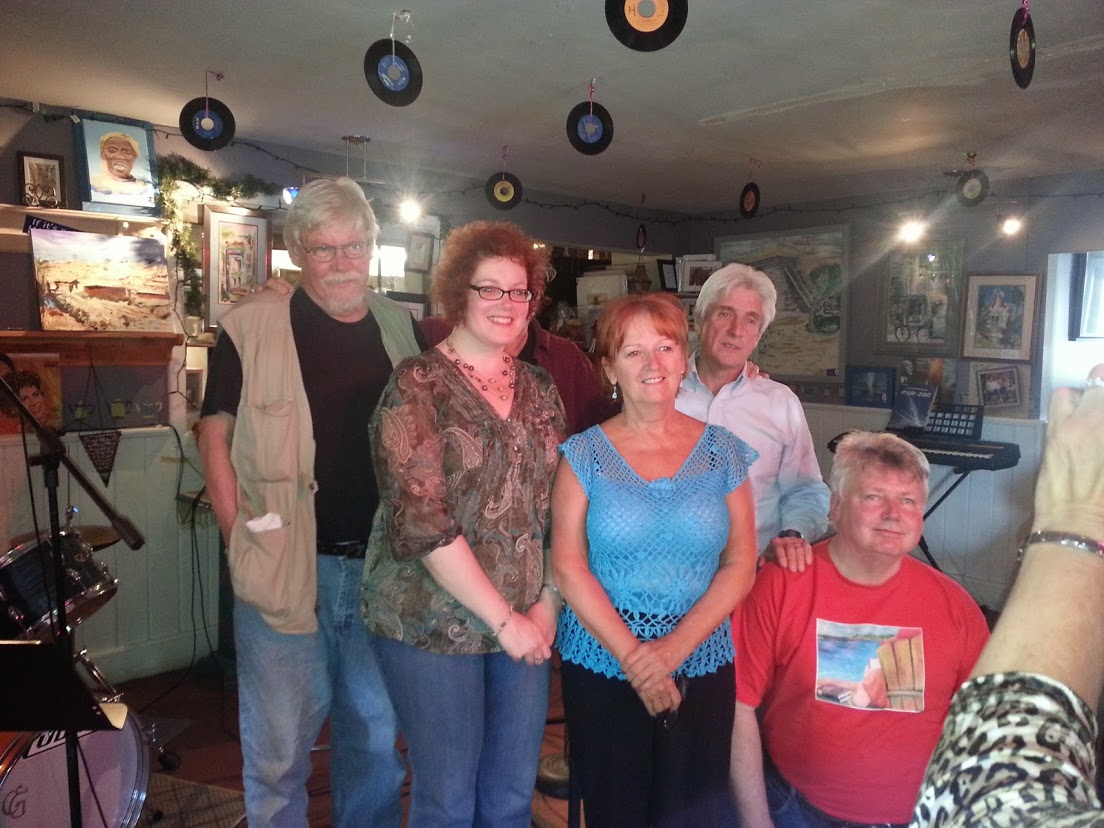
At the reading was fellow Sudbury author Ric deMeulles, and North Bay area authors Steve Pitt, Barry Grilles, and Ken Stange. We saw several poets and writers from the Conspiracy of Three reading series, and the host, Carin, who owned the La-Tea-Da Cafe, was gracious and welcoming.

Fools on Stools readers

Ken Stange, Kim Fahner, Barry Grilles (behind Kim–sorry Barry), Carin, Ric deMeulles, and Steve Pitt

The group rotated through three sets of readings with breaks for refreshments. At the end, the readers were invited to make Fools on Stools a regular event.

It was a lovely and creative afternoon.

Kim sold several copies of The Narcoleptic Madonna, and received some publishing advice from the other readers.

Then we returned to North Bay, checked into a hotel for the night, and set off in search of supper. The parking lot of Average Joe’s, to which we were referred by the helpful young man at the front desk, was full, so we turned into the downtown area to find sustenance.

Since neither of us had had much by way of lunch, we were ravenous by this time.

Fortunately, we saw My Thai Palace, a restaurant that we were both familiar with from Sudbury, parked, and dined.

After a delicious supper and a half litre of wine, we moseyed down to the lakeshore for a walk.

Lake Nipissing

There was a beautiful ray of sun shining down on the water, but by the time I got my phone out for a picture, this was all that was left. Still, Lake Nipissing is wonderful.

Back at the hotel, we settled into our lovely suite, watched Orphan Black, read, and chatted until we fell asleep. It was an adult sleepover 🙂

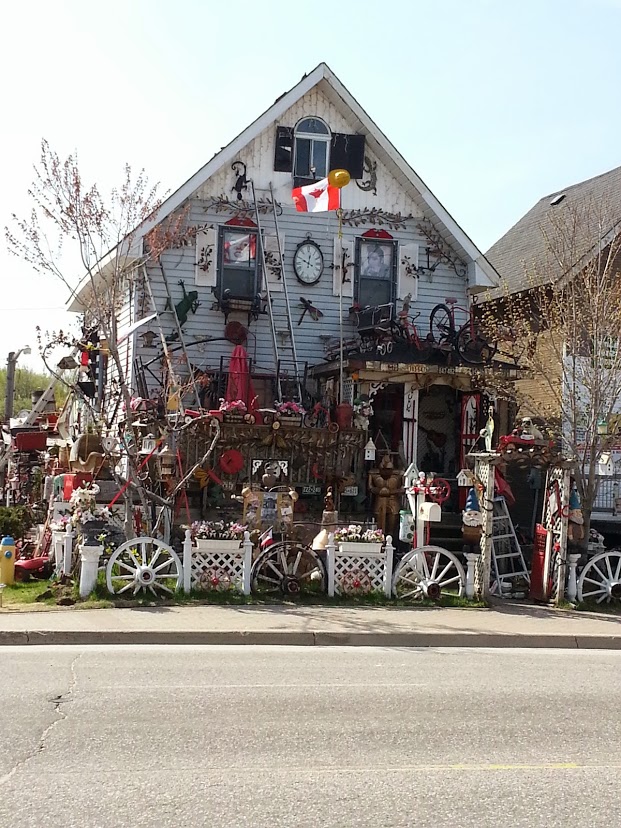
This morning, after a tasty breakfast at the hotel, we returned to town briefly to capture a daylight picture of the most amazing house.

Crazy collectible house

The house Kim had to go back to see.

Turns out, the Canadian Pickers (the Canadian edition of the US franchise) had visited. I’m sure they found a lot of interesting stuff. As we drove away, we had to turn and drive around the block. The entire property, yard, and garage were similarly festooned with collectibles.

The drive back was uneventful and we continued our discussion of the world’s troubles and how to solve them.

Sometimes you just have to get away and have some fun. Though I’ll admit, our fun may be tame in the eyes of others, but we had a blast.

Poetic road trips ROCK!

Have you gotten away for a fun weekend with friends lately?

Ad Astra 2014: It’s a wrap!

Doctor Who Welcomes You

The TARDIS and a Dalek formed the welcoming committee

I’ve been blogging this puppy for a month and a half now (!)

There was so much more to Ad Astra than the awesome sessions, though. There was so much that I couldn’t take part in.

I mentioned waaaaay back in my first post that there was Klingon Karaoke (not karaoke in Klingon, though that might be cool …). There was an anime lounge with various series and movies running all three days of the convention, an art room, a Lego room, the book store, author readings, and signings.

Also, for every session I attended, there were, like six others. There was astronomy in the parking lot at night, the masquerade, gaming sessions, Consuite events, and book launches by various SF/F publishers.

And there was the Guest of Honour brunch, which I foolishly chose not to purchase a ticket for (hey, it was my first time, I didn’t know it would be so awesome).

If I thought it was possible, I could have stayed up for the entire three days and done something different every hour.

What I did do (aside from the sessions)

I attended readings by Patricia Briggs, Julie Czerneda, Marie Bilodeau, Matt Moore, and Dennis Lee.

Patricia Briggs

Patricia Briggs

Julie Czerneda

Julie Czerneda

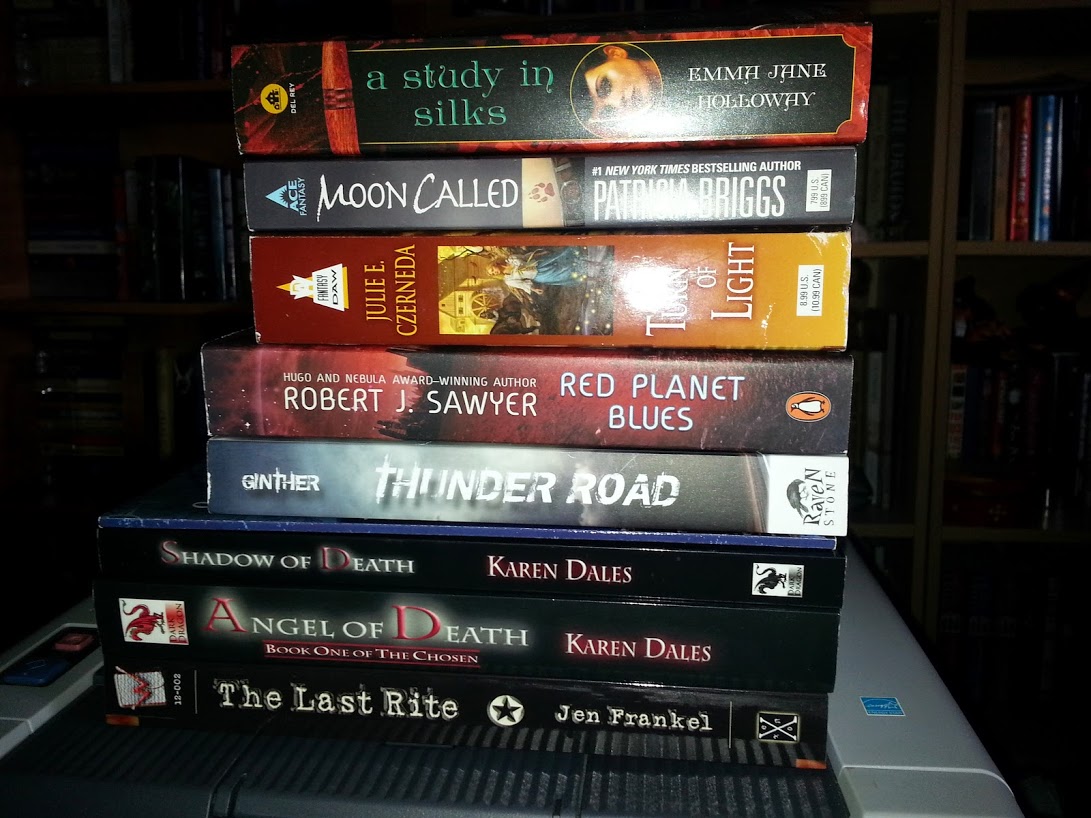
I bought (way too many) books and got some of them signed by the authors.

I bought a couple pieces of jewellery and a t-shirt.

Had a tonne of fun.

Not bad.

Think I’m going back next year 🙂

The book haul

The book haul

What about you? Have you attended any conventions or conferences recently?

Ad Astra 2014 day 3: Biotech, identity, and personal freedom

Panellists: Alison Sinclair; Shirley Meier

SM: Everyone is terrified of the loss of control. We use plague zombies to explain our fear. Dracula was about the fear of women’s power and blood magic. One of our biggest fears in biotechnology. There are a couple of good TED talks on the subject (Mel’s note: I found this one and this other one). Chemotherapy can be delivered directly to the tumour.

AS: Spider Robinson wrote about electrodes implanted in the pleasure centre of the brain. In the Star Trek: The Next Generation episode, “Crossroads,” the Federation becomes a dystopia. The Borg are biological machines. In Star Trek: Voyager, 7 of 9 and Hugh explore these ideas.

SM: The essential questions are: Who am I? Who owns my thoughts?

Q: In Brave New World, what was horrifying then is common place now. People fear science. What’s the positive side of biotechnology?

SM: In my books, MOM (the medical override module) is corrupted. Technology is what saves people, frees them from the villain, Prime. Pets are modified into true companions. Of course, then you have the issue of old age, disease, and how you can justify putting the dog down. They rejuvenate animals, mammals specifically.

Q: What about clones? Currently they age rapidly to the age of the animal they were cloned from.

AS: Medical technology is always advancing. Right now, they’re working on cloning the heart. The brain is still too much of a mystery. Is it ethical to “treat” mental illness? How does the process impinge on personal freedom?

SM: Heart surgeons have noticed personality changes after bypass surgery. There is a distinctive decrease in, or complete loss of, empathy.

Q: Who should be afraid of biotechnology? Who will suffer?

SM: We add to our knowledge; we don’t replace it. The old doesn’t disappear. Norms shift.

Q: Do you have statistics regarding the percentage of personality change in heart transplant patients?

SM: It was in a Smithsonian Magazine article. The percentage isn’t certain. They’re not even sure why it happens. It might be a drug interaction.

Q: If we look at biotechnology rationally, our fear is relatively low. Irrational fear is automatically high, however. People forget our own criminal predisposition.

SM: Look at the military. They have drills for the nuclear fighter jets frequently. They have to make sure that all is in readiness in case the worst happens. They don’t run in these drills. They walk slowly. If the jets take off, the world will probably end. The ground crew is assessed. If they don’t react appropriately, they will be removed. When we write SF, we are troubleshooting. What if? Utopias are boring. Consider the controversy over stem cells.

AS: But what about the cost? We need to invest in quality control. In our society, who can afford it? In Speed of Dark by Elizabeth Moon, the main character is autistic and offered a cure. Who chooses?

Q: What do you consider “you”?

AS: My mother has Alzheimer’s. Her personality hasn’t changed yet, but layers of memory get stripped off.

SM: Treatment is not the same as a cure. It makes illness tolerable. There’s a loss of dignity in Alzheimer’s that’s difficult to deal with. In the early stages, patients can be mistakenly addressed as if they are in the advanced stages. They don’t need that.

Q: There’s a tension between internal and external identity. Who we are vs. who others think we are. Is it the same person? I’m thinking of Heinlein’s Puppet Masters.

AS: Do we have a problem with free will?

SM: Yes. Our monsters steal our free will. Truth, justice, and the American way vs. the New World Order.

Q: What about mind control?

SM: Noam Chomsky’s Manufacturing Consent is a fascinating look at mind control and possession in our society.

AS: There’s also a struggle between personal and medical personhood.

SM: Why do things not work? We’re essentially monkeys. Would you give a monkey “the button”?

AS: Technology both reinforces and subverts existing power structures.

And that is the last session I attended at Ad Astra this year.

I’ll save the wrap post for next weekend.

In the meantime, have a fabulous weekend, my writerly peeps. I’ll be back on Tuesday with my regular Tipsday curation.

Ad Astra, day 3 (finally): Science in Urban Fantasy

Panellists: Shirley Meier; Alyx (A.M.) Dellamonica; James Alan Gardner; Dennis Lee

SM: I write fantasy and science fiction.

AD: Science fiction with an ecoscience bent.

DL: I recently coauthored a science fiction book with Mercedes Lackey.

Q: How do you reconcile fantasy with real world science?

SM: In Dead Girl Walking, zombies are a part of the world. My protagonist wants to be an astronaut. How do you hide your essential nature (rigorous medical testing). Does she have the “rot” stuff?

JAG: Urban fantasy is contemporary-ish. Can, or should, magic be explained? Charles de Lint doesn’t explain his magic, it’s wondrous. What is the attitude toward magic in your novels? Is it threatening, or saving?

DL: Magic is an underlying, mysterious thing for me, but it follows the rules of science, the laws of thermodynamics. My mage does magic by completing complex equations in her head.

SM: Most people accept our technology as magical. Flick a switch and you have light. Push a button and you can communicate with people all over the world.

JAG: Magic and technology are not indistinguishable. In urban fantasy and superhero subgenres, 1% have “bought” immortality. The blue collar class has lucked into it somehow. It’s wish fulfillment. Neil de Grasse Tyson says that you don’t have to “believe” in science. It works for everybody. In fantasy, you often have to be “the right” person. The one. Anyone can learn science.

AD: Access to science is privileged too, though.

SM: Barbara Hambly’s editor wouldn’t buy one of her books because it was written in terms of fantasy. The science wasn’t explained.

AD: What about Thor? Marvel’s tried to explain that all of Asgardian magic is, in fact science, but it’s not explained either. What about Pern? Lord Valentine’s Castle?

SM: Dracula was born out of the fear of women’s power of creation and “blood magic.” People are as afraid of science or nature as they are of the supernatural.

JAG: They are placed side-by-side, too. The virus zombie vs. the raised, Vodoun zombie. There’s a story from the set of Star Trek: The Next Generation, where the writer’s would put in a placeholder: Jeordy – tech. This would be the cue for the researcher to come up with some kind of plausible explanation for what science had apparently just made happen.

SM: With NCIS, it’s the same thing. Their placeholder is: Abby – technobabble.

DL: The project I’ve been working on has been a Google Docs collaboration. Each author has a specialization and lends their expertise to the project. Pharmacology, molecular biology, etc.

JAG: Peter Watt asked the question, “At what point is your bafflegab authentic enough?”

DL: It has to be grounded in something real.

JAG: Orson Scott Card says that there are three questions the reader shouldn’t ask: Huh? So what? and Who cares?

SM: When did we stop trusting “once upon a time”?

AD: Are there better branches of science that fit better with fantasy?

SM: The so-called “soft” sciences: sociology, anthropology, political science.

JAG: In my latest novel, I have four young protagonists, a physicist, a chemist, a biologist, and a geologist. All of them are “supers.”

SM: Is the increasing prevalence of autism evolutionary? It’s one of the questions that intrigues me. I inherited the history library of a professor friend of mine. It’s an excellent resource for steampunk. The science in steampunk needs to be shown, not explained.

DL: One of my characters is a geomancer, so she has to have math and physics.

SM: Look at Dresden. Magic is the realm of the guy in the basement with a hockey stick wand. Magic has a cost. Science does not.

DL: Science has to have a cost.

AD: Why? I want to write magic that works and has no cost.

SM: Then we have the problem of Superman.

Q: Does is come down to the transfer of energy? The way I see it, once that’s broken, so is the science.

JAG: Iron Man breaks science all the time.

Q: Do you explain it?

SM: You have to sell it, make it believable.

DL: Serve the story.

JAG: Like the faster than light in Star Wars; you either buy it, or you don’t. You can’t keep technology a secret.

Q: What about explaining the force in terms of “midichlorians”?

JAG: Midichlorians doesn’t really explain anything.

SM: Is A Wrinkle in Time science fiction, or fantasy?

Q: Or the technomages from Babylon 5?

SM: And we’re back to the Superman problem. Read A Canticle for Leibowitz. There is science beside the new church and its radiation saints.

JAG: Ultimately, you have to serve your story the best way you can.

Ad Astra, day 2 (yes, still): What makes a great villain?

Panel: Ada Hoffmann, Matt Moore, Rob St. Martin, Thomas Gofton

AH: I write short stories and other things.

MM: Science fiction and horror writer.

RSM: Author of three horror, three urban fantasy, and five steampunk novels.

TG: Film producer, actor, and editor. Heroes are no fun to play.

RSM: Do villains drive the plot? What makes a great villain?

AH: The villain opposes the hero, but in some way, is secretly like the hero.

MM: A good villain is someone readers want to know more about.

RSM: The villain is the active force in the novel. The hero is reactive. Nobody thinks they are a villain. Villains are the heroes of their stories.

MM: Villains can be forces of nature, like Jaws or the T-Rex in Jurasic Park.

TG: It’s great when heroes have to dip into their inner darkness to defeat the villain. A great villain inspires fear. Mordred, for example.

RSM: The villain should instil fear in the reader. What will happen if the villain wins?

TG: Sometimes a villain never gets comeuppance. There was one character in The Messenger who was an absolute prick, but he gets off Scott-free.

MM: Think of great villains, like Hannibal Lector, or the Joker. They are completely foreign to the audience, fascinating. The universe is not necessarily just. It has no morality. It’s realistic.

TG: In terms of comics, the DC villains are cool while the heroes suck. In Marvel comics, it’s less black and white. Xerxes from 300 is a great villain, too.

Q: What traits do you choose?

MM: Look at some of your favourite villains, Beloque from Indiana Jones, or Hans Gruber from Die Hard. Pair your hero and villain, give them opposing character arcs. Everybody wants something. If the hero and villain want the same thing, but for different reasons, it gets interesting. Villains should be larger than life.

RSM: Hannibal is a monster, but he’s so charming. His relationship with Starling is what draws us in. Lestat was originally a villain, but he became the hero in later Anne Rice novels.

Q: What are your thoughts on moral greyness? For example, the monster as hero, the human as villain?

RSM: Look at King Kong, or Godzilla.

MM: After 9/11, everything became grey. Can the villain rehabilitate? Sideshow Bob from The Simpsons is a great example and a redemption story.

AH: Work out your novel’s morality.

MM: Alfred Bester from Babylon 5 was a fascinating character study. I’d like to point out that every human villain we’ve discussed so far has been a man. What about women villains?

A brief discussion ensued about the stereotypes of women villains, Disney’s wicked stepmothers and witches, which led into a discussion of some truly awesome women villains, but I must confess I became so engrossed by the discussion, I forgot to take notes (!) Now, a month later, I can’t remember what was said 😦

Mea culpa. I have c.r.a.f.t. disease: can’t remember an f-ing thing 😉 I’m too young for this shit.

If any of the panellists care to weigh in, please comment and fill in the gaps.

Other than that, if you, my dear readers, have some examples of absolutely fabulous, or terrifying, women villains, please share.

Ad Astra Day 2: When an editor is not an editor

Panel: Anne Groell; Max Turner; Michael Matheson; Karen Dales

AG: I’m executive editor at Penguin Random House (A.K.A. Random Penguin) working with high profile clients such as George R.R. Martin and Connie Willis.

MT: Author and freelance editor.

MM: I’m editor for ChiZine’s book imprint and I do some freelance work on the side.

KD: I’m an author, creative writing teacher, and more recently, a freelance editor. What’s the biggest misconception writers have about editors?

AG: People don’t think editors edit anymore. I have to love a book if I take it on. I may read it as many as fifteen times in the editing process. I really have to love it.

MT: Stephen King says in his On Writing that he edits once, and the book is ready. This is not what usually happens for most writers. When I submitted my manuscript, I assumed it would come back heavily marked up with specific direction. This did not happen either. I had submitted a 160k word draft and was told there was an 80k word story hidden in it. I was asked to cut 60k words. The book is the intellectual property of the author. Editors won’t muck around in it. Their aim is to help the author turn the novel into the best book it can be. It’s a very hands off process.

MM: Good editing is completely invisible. There are different types of editing: the substantive, which is global and concerned with structural issues. Does the book work? Then, there’s line editing. This is a closer look at consistencies and story logic. Finally, there is copyediting. At this stage, when large chunks of the text will not be disappearing, errors are covered, line by line.

KD: You have to be careful with self-publishing. With ebooks, unqualified editors make for a poor product. A good freelance editor will ask for a sample of your writing first. They have to like it. You have to be able to trust them with your work.

AG: I’ve sent out 20-35 page editing letters in the past. That’s love.

MT: Are established authors edited as thoroughly as newer authors?

AG: They are if their editor is good.

KD: I know of a New York Times Best Selling Author who’s next book in a series was not picked up by the publisher. She decided to self-publish and did not opt for a qualified editor. The book she self-published was not comparable to the others in the series. (Mel’s note: I think the word actually used was crap.)

AG: If you’re my client, you may not like my solutions, but you have to concede that this particular aspect of your novel isn’t working. We can talk about other solutions, but what isn’t working has to change. Bottom line.

KD: Fact-checking is critical. I edited a SF time-travel novel set in renaissance London. One of the main settings used was the Tower of London. Not all of the building existed at the time. I asked the author to do more thorough research. Then the manuscript was submitted indicating that there were balconies on the White Tower. This was again, not the case. I sent it back a second time. This may be an extreme example, but even he improved and now he’s one of my favourite people to work with.

MM: Do not depend on Wikipedia for your research.

MT: You have to be willing to do as much work on the research as you are willing to work on revisions and rewrites.

MM: Editors are not inviolable. Stick to the heart of your story. Defend it if you need to.

KD: With another book I was working on, the author wanted to send the manuscript to her uncle, who turned out to be Jack Whyte. Jack edited extensively, but he edited to the way he wrote. He threatened the author’s voice. I had to step in and defend her work.

AG: We are champions for our authors.

Q: What is the value of beta readers?

AG: It can be helpful. You have to trust them, though. They have to be objective and they should have some expertise in what you’re writing.

KD: “I like that” is not constructive. The best beta readers are not going to be your family or friends.

MT: Asking your friend to beta-read for you isn’t fair. They feel obliged to like your work.

(Mel’s note: Margaret and Kim, sorry if you feel this way. I do not expect you to feed my vanity. I do trust you and will take direction.)

MM: If you hire an independent editor, never ask them to edit multiple versions of you manuscript. You’ll never earn back what you pay them.

Q: What should an author look for when hiring and independent editor and how much should you expect to pay?

KD: Look for education, a degree in a related field, experience, and ask for references. Most editors will ask for $1.50 to $2 per word or a maximum number of pages.

MM: Some also charge a flat rate.

MT: Get the recommendation of a writer you trust. Every writer has a shelf of “learning novels.” If you read early Bradbury, you can see the difference between that work and his more mature novels.

KD: Trunk novels can be rewritten, though.

Q: As an editor, how do you improve?

AG: Learn to cut. The two Connie Willis novels Black Out and All Clear originally came to my desk as a 300k word draft.

MM: Work as a slush reader or apprentice at a publisher.

KD: Work as an assistant editor.

MM: You learn to establish a collaborative relationship with your authors.

MT: What happens when you establish that relationship and they then hand in crap?

AG: It’s horrible.

And that’s it for the session.

There are only three more sessions for me to transcribe and then I’ll write a wee wrap up piece.

Overall, Ad Astra was well worth the trip. It will probably be one of my staple conventions from here on out.