On virtual homework and the reading of books

Dan Blank of We Grow Media

So here we are in week two of We Grow Media’s Build Your Author Platform course.

Week one was about developing focus, and I think I did pretty well.  As I mentioned a few weeks ago in my post about Michael Hyatt’s Life Plan document, I’ve done a lot of thinking about my life and what I want out of it.  It wasn’t difficult for me to put into words my plans for my creative life.

This week, it’s going to be a little more challenging.  I have to figure out my writerly identity and brand.  I know what I’ve said about myself on this blog and elsewhere, but this week’s assignment will have me digging deeper.

I have this morbid image floating about in my head …  See, a garden spade is pretty sharp, and I can imagine that digging into my tender heart and mind being a bit painful.

One benefit is that my name is pretty unique, and since I’ve bought my domain and all my SoMe is in my name, my blog, Twitter, Facebook account, LinkedIn account, etc. appear at the top of the results in most search engines.  And if my blog isn’t up there, then one of my poetry books, NEOVerse is.  So that’s a win.

I’ll have to let you know how the branding exercises go.  I’m not a tooter of my own horn.  It makes me squirm, actually.  Hence the painfully-sharp-spade-phobia.

On introversion

I’m an introvert, though I work in an industry that has me putting myself “out there” as a trainer.  My friend, Brainy (pseudonym) had this to say about introversion on her blog this week:

Other people in my work environment likely see me as fairly extroverted because I am very outspoken and I address individuals and groups quite confidently when sharing the expertise that I have accumulated in recent years.  I do a lot of online coaching and desktop sharing with collaborative technology but it’s usually one-on-one now.  I can only sustain the energy required for the group stuff once in awhile and with considerable advance preparation.

I can relate.

She also recommends Susan Cain’s Quiet: The Power of Introverts in a World that Can’t Stop Talking.  It’s on my reading list.

What else I’ve been reading lately

Last month, I finished Suzanne Collins’s The Hunger Games.  I’d had the trilogy since last year when I saw the movie with a couple of friends who had both read the whole series and loved it.  More recently, I was urged to take the plunge for two more reasons: 1) my mom had just read the series and also loved it, and 2) Larry Brooks’s eleven-part analysis of the first book on his Storyfix blog (more on that in a moment).

I too, loved the book.  Having seen the movie, read Brooks’s analysis, and a few other reviews/articles on the novel, I was well aware of the plot and events of the novel.  But spoilers never spoil a book for me.  When I know the major plot points, I only enjoy the book more.  I read to improve my craft.
Collins’s prose is clean, her POV engaging, and her craft extraordinary.  Damned.  Good.  Book.

Mind you, I think I might be the last person on the face of the earth to read The Hunger Games 🙂

Brooks’s analysis of the book also lead me to read his: Story Engineering.  I did get a lot out of his book, but it was despite the author’s ethos.  Brooks comes on a little strong for my liking, and I truly resent having anyone shake a virtual finger at me.
For more of my thoughts on this writing craft book, please check out my review on Goodreads.

Ethos, for those who may not know, is the author’s personality as it comes through in print.

My undergrad was in rhetoric, so I’m pretty adept at reading past ethos.  It’s a good thing too, because Brooks does have some great information to share and I have already implemented some of his lessons.  I do get it.  I’m just not fond of how Brooks got his message out.

Currently, I’m reading Diana Gabaldon’s The Scottish Prisoner, which I’m enjoying quite a bit (though not as much as the main novels in the Outlander series), and A Medieval Miscellany.

Will let you know how all of that goes.

Right now, Writerly Goodness needs a wee bit of rest.  A new work-day awaits!  Egad …

Bees, wasps, and hornets, oh my!

A different way to look at creativity.

So bees, wasps, and hornets have been on my mind lately.

It started with the bees

Characteristics of common wasps and bees

Characteristics of common wasps and bees (Photo credit: Wikipedia)

Last month, the story was everywhere, on the news, in the paper, on line … A couple, living in Owen Sound, Ontario, discovered that they had not one, but three colonies of bees living in their attic (!)  My first thought was, “how could they not hear all that buzzing?”

The fun bit was how they figured it out: honey started dripping from a crack in the ceiling.

Now I love bees.  The humble bumble is a wonderful conundrum.  While I’ve heard since childhood that bees shouldn’t be able to fly, they clearly do.  They are very important pollinators for plants and several kinds produce lovely honey.

There are stingless bees, but of the bees with stingers, it’s not their first instinct or line of defence to sting.  When they sting, they die, the stinger ripping out the bee’s venom sac in the process.

Because of this, though I know it’s a shameful anthropomorphization, I like to think of bees as pacifists, who in the defence of their hive nobly sacrifice themselves for the greater good.  They’re diligent workers and great creators of communities.

I don’t mind bees.  If they come around, I let them have a sniff, realize I’m not a flower, and move on.  No need to swat.

Wasps are another matter

wasp

I’ve been noticing recently that there are a lot of wasps around and just last week, I saw this article on The Weather Network.

Now wasps retain their stingers and can sting you repeatedly.  They don’t have to worry about dying.

Though I know you should stay still and mind your own business, but it’s difficult to do.  If you’ve ever been stung by a wasp, you know what I mean.  It’s pretty painful.

Wasps are also diligent pollinators and industrious workers.  The material they make their nests out of is commonly called “paper.”

They’re cool in their own way, but I don’t like the mean streak.

And Hornets?  Shudder

Hornets are big wasps.  Their poison is a lot more painful too.

Hornet - Hymenoptera - Vespa crabro

Hornet – Hymenoptera – Vespa crabro (Photo credit: Mick E. Talbot – off line 4 weeks 11/08/2012)

A friend of my mom’s was out in her back yard, gardening.  She dug into the soil … and pierced a hornet’s nest.

The poor woman was stung over every inch of her body.  She was so swollen that she couldn’t move her fingers for the better part of a week.  My mom and a couple of other friends had to go over and do her groceries, help her cook, and do her dishes.

Hornets are the warriors of the bee/wasp world.

In terms of creativity

Are you a sweet, humble bumble?  Do you get aggressive with challenges like a wasp?  Or are you an arts activist like the hornet?

Me?  I’m a bumble 🙂

What I’ve been reading

I just finished reading Fanny Burney’s Evelina.  It was a hold-over from my university days, a book I hadn’t completely read (sorry Dr. Orr).  I just didn’t have the time.  With a full course load of English and other humanities, I often had 20 to 30 books to read a semester.

I had to choose my battles, and unfortunately, Evelina was one I retreated from.  I skimmed, read bits, enough, I thought, to participate in a class discussion.

I should have read it, but I don’t know if I could have appreciated the novel then as I can now.  We all grow up eventually.

The fact is I loved it.  Couldn’t put it down.  It’s a bit surprising.  Burney wrote her novel in the epistolary style, that is, as a series of letters between characters.

I started reading with a certain apprehension.  I mean how exciting could letters be?  Really, it’s just a bunch of exposition, of telling, one of the cardinal sins of writing.  The truth is I found Evelina compelling.

What I learned about storytelling: it’s not essential to be with your characters every minute of every day.  In choosing which parts of the story to relate in the letters, Burney chose the best.  Though a romance, and a novel of sensibility, every scene moves the plot forward, presents a new challenge, or a revelation.

Burney tipped her hat to the pastoral romances of the Renaissance with her protagonist, an orphan, whose mother died in obscurity, rebuffed by a man who refused to acknowledge their marriage.  There is mystery and intrigue.  Evelina discovers a brother she never knew, is perused by several men, only one of whom has any idea of what is truly proper.

It’s a novel of class, showing that the humble peasant raised in retirement can be more noble than lords and baronets and that the unworthy can rise to prominence through marriage and scheming without ever being truly improved by their circumstances.

Satire is a man’s weapon, but Burney puts it in full control of a wonderful supporting female character.  No one is as witty as Mrs. Selwyn 🙂 The crass and coarse are taken to task, and through it all, Evelina perseveres, tries to do what’s right, and is rewarded for her virtue in the end.

I know, it doesn’t sound compelling, does it.  But it is.  Read it.  You’ll see.

BTW, it’s on Project Gutenberg 🙂

TTFN, my writerly friends.

The peregrine and all that followed

A.K.A inspiration, happiness, desire, Buddhist philosophy, and semiotic journeys

The peregrine

This morning, as I walked my dog, we neared a series of well-manicured cedars … and something flew out of them.  It looked about pigeon-sized, but it didn’t fly like a pigeon.  I like watching birds, okay?  I know what pigeon-flight looks like.  I know what it sounds like too, the rhythmic pumping of the wings that seems to push a little sigh with each down-thrust.

Pigeons don’t “kree” either.

This happened fast and I noticed most of it peripherally, but my interest was piqued, and the motion drew my eye to a nearby rooftop where a peregrine falcon was just landing. I saw the markings on its tail feathers and wing tips, and when it turned, I saw the pale breast, its feathery “pants.”

I mock you with my feathery pants.

It was beautiful, perfect even.

The words were out before I even knew I’d spoken: thank you.  The world shifted around me slightly.  My day was made.  Gratitude can do that to you.

I let Nuala sniff about for a bit.  She hadn’t noticed the peregrine, so I was able to watch.  It bobbed its head, assessing the threat.  I figured we must have disturbed its breakfast, that it downed something tasty and was having at in between the cedars.

So we moved on and let the peregrine get back to business.

I know we have peregrines in Sudbury.  In the past, they’ve nested at the University and of some of the buildings down town, but it’s not often I get to see one, and rare that I see one so intimately.

It got me thinking of several things.  In no particular order, they are:

There’s a poem in this

In my Thursday poetry posts, I often write a few words about the inspiration for the poem.  When I see something like the peregrine, and it touches me, usually there’s a poem in the moment.

If the moment is fleeting, I have to get it down, and quick, but if it has some staying power, the moment has to rattle around in my head for a few days, maybe a few weeks, gathering images and words like a mental tumbleweed until it gets so weighed down it can’t move anymore.  Then it’s time to write.

That’s what’s happening now.  Wee little tumbleweed, rolling around in my skull … 🙂

Happiness

The thing that made the world shift around me, that made me utter thanks, it feels like a “ping.”  It makes me take notice.

Moments of happiness and gratitude are all around you.  You experience them all the time, every day.  Pay attention.  It really does make the rest of the madness of life easier to put into perspective.

I don’t want to sound all hokey, but there’s sacred in those pings.

Desire

Which got me thinking about want.  A writer-friend posted to Facebook last week that she’d enjoy writing so much more if she wasn’t so invested in the whole publication thing.

I didn’t want to preach, so I didn’t comment, but what I wanted to write was: then stop worrying about publishing.  Write.  Act with purpose.  Continue submitting, by all means, but don’t hang your hopes on publication.  Persistence and practice pay off.  If you’re not enjoying it anymore, then you shouldn’t be doing it.  Take a break.  Give yourself a chance to remember why you love writing, why you really don’t want to do anything else.  Find your passion again and just write.  When passion fuels your efforts, you will write amazing things.  Shop those amazing things around and someone will accept them.  But stop wanting.  Just be a writer.  Write.

Another writer-friend posted this on Facebook today:

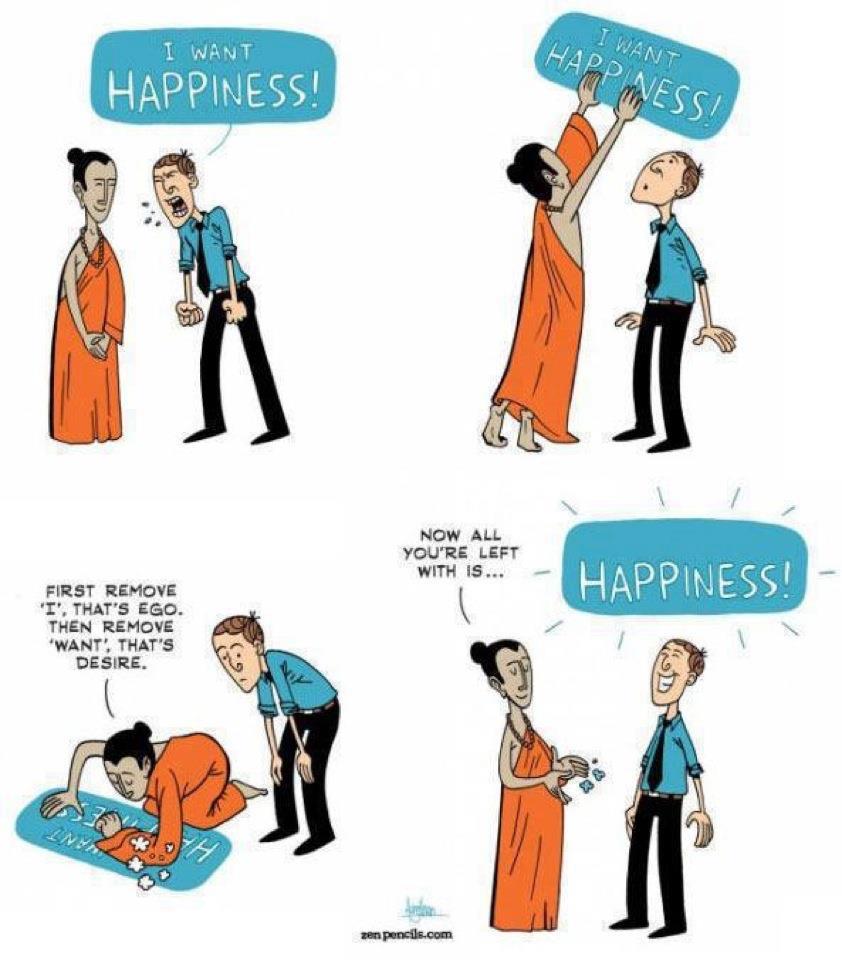
Take the “I want” out of anything, and you’ll find the happy.  It doesn’t come easily all the time, but if you can manage it even occasionally, you’ll be a happier person.  It’s this whole wibbley-wobbley, timey-wimey thing … No, that’s Doctor Who.  Sorry, obsession of mine 🙂

Really, it’s Buddhist philosophy

I read the Bhagavad-Gita not long ago, and that’s the central message of the text: stop wanting.  Stop desiring.  Be in the moment.  Act with conviction.

See the beauty, the power, and the terror (or the Krishna, if you’re a Buddhist) in everything.  It’s all connected.

Which brings me back to the peregrine.  Isn’t it a lovely little circle?

Oh, and something else

Peregrination.  Isn’t’ that a lovely word?  It means to take a journey, a pilgrimage.  Isn’t that what all of us writers do?

It’s all a wonderful semiotic mess 🙂

More insight into the mind of Mel.  Terrified yet?  Where has your mind been going lately?  Has it been going there without you?  How do your mental peregrinations influence your creativity, your art?  Do tell.

Three great books on self-editing

(A.K.A. more writing-book porn!)

Since I started serious writing practice and got down to the business of trying to turn my idea into a publishable work, self-editing has been an obsession of mine.  I started out with a good grounding (2 degrees in English), but soon learned that there is always room for improvement.  Always and forever.

When the publishing boom of the 80s and early 90s changed directions, agents and editors state one principle requirement: write a damn good book, and write it well.

Here are, in no particular order, three books that have helped me immensely.  Just ask my Author Salon critique group, I am the queen of nitery-pickery (I’m not sure why I choose to write it like that, but I suspect it might have to do with the character of Rockery Hud-Peck from The Fintstonesthat’s just how my brain rolls).

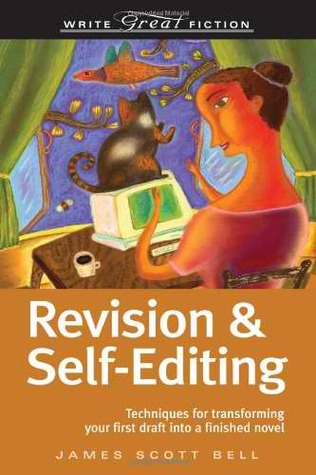
1. Revision & Self-Editing: Techniques for transforming your first draft into a finished novel by James Scott Bell (The Write Great Fictions Series, Writer’s Digest Books, Cincinnati, OH, 2008).

Bell divides his book between self-editing and revision, which he states are two separate processes.  They are 🙂

In his introduction, he references Browne and King’s Self-editing for Fiction Writers: How to edit yourself into print, another of my selections (see below), as well as a slew of writing gurus ranging from Brenda Ueland to Natalie Goldberg and Ray Bradbury.

Bell begins each section by presenting his philosophy of the task, then proceeds through self-editing with various chapters on each aspect of the work (character, plot, POV, etc.), asking probing questions along the way to get the writer deeper into their novel, and offering exercises to assist with the understanding of the element at hand as well as its relevance in self-editing.

When he gets to revision, it’s more about process than elements and analysis, but Bell is equally insightful in his discussion.

Bell is a skilled author and editor.  He writes from his experience in self-editing.  This perspective is what sets my first pick apart from the others.

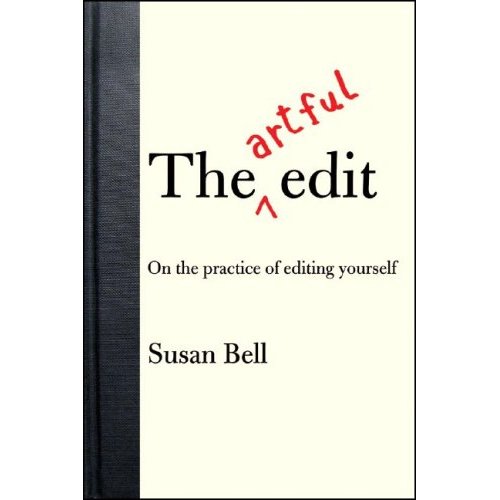
2. The artful edit: On the practice of editing yourself by Susan Bell (Norton, New York, 2007).

Susan Bell is a veteran editor and author, but her authority and perspective derive from the former role.

She breaks the self-editing task into Macro and Micro phases, again, providing examples, checklists, and exercises to deepen understanding. Then Bell offers what she calls her Master Class, provided in the form of experts in different creative fields (photographer, film, etc.) and what each can teach writers about how to make their story come alive.

Finally, she provides an overview of the evolution of editing, fascinating in itself.

Bell applies investigative zeal to her book, and it offers unique insight into the world or authors and editors, their relationships, where one begins and the other ends, and what the writer can do to become both.

3. Self-editing for Fiction Writers: How to edit yourself into print by Renni Browne and Dave King (Second Edition, William Morrow, New York, 2004).

First published in 1994 by HarperCollins, Self-editing for Fiction Writers is seen by many as one of the definitive works on the subject.

As with the James Scott Bell’s book, Browne and King’s breaks the task of self editing into its elements (characterization, dialogue, voice, etc.) devoting a chapter to each with examples and exercises.

One thing that I appreciate is the first chapter: Show and Tell (emphasis mine).  The point is made, and I fully agree, that while the writer should endeavour to show, that there are some places in your novel where telling is not only appropriate, but necessary.  It is the skilled writer who knows the difference and knows what technique should go where.

I also enjoyed the collaborative tone of the book.  When the authority is identified by “we” and not “I,” something rhetorical and clever happens: readers begin to feel that they are a part of the illustrious editorial team that wrote this book.

It’s an inclusive way of writing that empowers reading-writers to believe in their ability to self-edit.  The doors of the country club have opened, my friends, and we have all been invited in for drinks 🙂

The Wordsmith Studio Goodreads group is currently reading this book and it’s been a wonderful opportunity for me to get reacquainted with some old friends.

I recommend all three books highly (not to show favouritism or anything).

Do you have any books on self-editing that you would recommend?  Share their titles and maybe a few choice words of review in the comments so everyone can benefit from your experience 🙂

Writerly Goodness is calling it a night.

Building your writing resume: three points to consider

This topic has come up in a peripheral way on Wordsmith Studio: As an unpublished, or even as a not-recently-published author, what can you do to bolster your writing resume?  I say peripheral, because the actual question asked was whether it was worthwhile to enter contests because many of the entry fees are expensive/potentially prohibitive.  I believe the question was posed in the context of accruing publishing credits, however, and that’s when I started to think about this topic in earnest.

So for better or worse, here are my thoughts on the subject in the context of my personal experience.

1. Contests

Contests can be fun.  They can inspire you, particularly if they have a theme you can latch onto, and the deadline always helps to motivate.  The issue for me is that many contests in literary magazines, whether for poetry or prose, carry with them entry fees, and some of these can be as much as $40 (!) for a single entry.  If that entry is a single poem (not epic, they usually have line limits), or a 2000 word or fewer short story, you really have to weigh the benefits of paying someone to consider your work, which already carries with it a labour cost in author-hours spent writing/revising.

Food for thought: Value your work.  How much do you think it cost to write?  Even at minimum wage per hour (and I’d advise a higher value than that) it’s probably more than the entry fee.  How much are you willing to pay to have your work published?  In the beginning, we may all have to pay for this consideration, but it’s important to remember that unless you have a really good day-job, you’re going to reach the point of diminishing returns sooner than later.

Yes, you can write off the entry fees on your taxes if you claim your writing as self-employment, and yes, you often get a year’s subscription to the magazine or journal, which you can declare as income on your taxes as well, but you have to consider the relative cost for benefit.

For example: If you’re paying a $25 entry fee to receive and annual subscription worth $15 or $20, this may not be in your best interest.  Sure, you may stand to win $500 if you place first in the contest, but if the magazine or journal holding the contest is well-known, you’re going to be up against some stiff competition.  Take the possible purse out of the equation and work through your numbers again.  If you don’t win, or even place, will this still be a good investment for you?

Contests are sometimes a way for a magazine or journal to generate some fresh material, gain new subscribers, or refill the enterprise’s dwindling coffers.  If you like the journal and want to support them, consider a paid subscription and simply submit to them according to their submission specifications (see below) to see if you can get published by other means.

Further, most magazines and journals that hold contests receive so many entries that their judges cannot possibly comment, even in general terms, on the quality/suitability of your work.  Entering a contest may be a good experience, but if you’re aiming to get critical feedback, it’s not your best bet.

Note: The concerns for poetry are a little different than for prose, at least here in Canada.  A poet can rarely make even a meagre income from their work unless they self-publish, and even then, the costs of producing the anthology often outweigh the profits derived from sales.  A best-seller in terms of poetry might be 500 – 1000 copies and the poet often has to go on the road (or start up a YouTube or podcast channel to promote their work) to give public readings and drum up interest in their work.  In my experience, poets write for the love of poetry.  They’re not aiming to make money from the endeavour.  The fact of publication is often worth the cost, whatever it happens to be, and most poets are gainfully employed in other, though sometimes related professions, to offset the costs associated with their calling.

My advice: Look for contests that have low or no entry fees.  They do exist.

2. Calls for submission

Which brings us to our next consideration: calls for submissions.  Most magazines and journals do have their criteria for submission posted on their Web sites.  Occasionally, periodicals, or even publishers wishing to put out an anthology will have a themed call.

Like the contests listed above, themed calls can be fun and often for the same reasons (theme, deadline, etc.).  One consideration that you should keep in mind is the potential for resubmission.  If the theme is too specific or narrow, the story or poem produced thereby may not be suitable for submission elsewhere, unless another publisher is interested in Animal Bollywood, or Japanese Steampunk.

Note: Follow the submission guidelines carefully.  Many publications weed out submissions that are not perfectly aligned with their criteria, particularly the more popular or well-known ones that are flooded with the work of hopeful authors.

Some magazines close their submissions once they’ve received what they deem to be “enough.”  Usually, this has to do with their publication schedule.

For example: A quarterly (four times per year or every three months) that publishes three to four short stories per issue might close their submissions after receiving eighteen to twenty stories (a year’s worth plus a few back-ups) that they deem suitable for publication.

This can happen in any genre (poetry or fiction) or any genre within fiction or poetry (SF, fantasy, romance, mystery, etc.).  This only reinforces the importance of looking up the submission guidelines for whatever magazine or journal you choose to submit to.  If you rely on annual print publications to plan your submission strategy, this is especially important.  The periodical’s or publisher’s situation could have changed since the guide was produced.

Remuneration: These terms can also be found on most magazine’s or journal’s Web sites.  Often, for fiction, it will be a sliding scale of cents per word depending on the length of the story.  It may be a flat fee per poem.  Some journals, particularly poetry or literary journals, will only offer contributor copies, or a year’s subscription.  Once again, as with the contest entry fees, weigh the benefits of publication.

A note regarding online publications: Online publications may not offer contributor copies either (because there is no print version), and if relatively new, may not be able to pay much, if anything.  If they are established enough to have advertising income they may provide remuneration.  Once more, read carefully.

In most cases, it will be rare that a piece of creative writing submitted in response to a call will receive detailed commentary. Once again, it’s a matter of numbers.  If you had to read a hundred short stories, would you be able to give each one individual attention?  We’d all like to say that we would, but I think the reality is that after ten or so, we’d all admit to a certain amount of exhaustion.  And to be fair, why give commentary to a handful, when everyone deserves the same consideration?  This is why most publications will not go this particular extra mile.

If you do receive a few comments or pointers: excellent!  It means that your submission was good enough to merit some extra time and attention.  If the commentary is specific, take heed and use it to your best advantage.  If it’s simply complementary, keep it, and try not to use it as an excuse not to edit and revise before submitting the piece to another venue.

3. Resources

One of the most popular series of guides is the Writer’s Digest series: Writer’s Market, Novel & Short Story Writer’s Market, etc.  I might recommend a subscription to the Writers Market.com service, which will have resources/listings updated in real time and on a regular basis.

For Canadians there is The Canadian Writer’s Market, but I’ve found that WD has been getting better and better at keeping their Canadian listings up-to-date.  This may be a good resource for those dedicated to publishing in Canada.  It comes out less frequently than WD, and so checking out the individual Web sites of publishers and publications becomes very important.

While the Interwebz can provide a plethora of resources, I’ll recommend Duotrope as an excellent starting point.  The service is currently looking for donations to remain in operation as a free resource.  If you’ve used the service and found value in it, seriously consider donating.

That’s all the Alchemy Ink Writerly Goodness has for this week!

Until next time!

The things you learn when you look into your family tree

Or … the duty of a bard

This week, I thought I’d write a little bit about genealogy.  I’m not going to post any of my family trees (I have three, though they’re incomplete and slightly out of date) … I’m just going to write about the wonderful things you can learn when you do a bit of digging.

The first is this: genealogy is one of the duties of the bard.

Whether you think of a bard as a bard, or filidh, or ollamh, a bard wasn’t just a collector of tales, a memorizer of songs and poems, but they also held the responsibility to guard the family history and bloodlines.  They were scholars, doctors, law-givers, and just darned cool, and as a writer, I feel that I have some connection to that tradition, and some responsibility for the history of my family.

I’m a Celtophile, and unabashedly so (hence the interest in filidh and ollamhs), but the family I can trace is Finnish.  Yes, Marttila is a Finnish name.  You can generally tell because of the three consonants together.  That, or the double vowels (e.g. Saarinen) are pretty clear give-aways.

The larger family name in my genealogy is Wiirtanen.  There is a large Finnish community in the Sudbury area, many of them coming from the Long Lake area of town and the Pennala subdivision there.  That’s where the Wiirtanens settled.

One of my Wiirtanen relatives still lives out at Beaver Lake, a bit of a drive out of town.  He’s a trapper and owns a farm.  Other Finnish families moved into town around Lake Nepawin (Maki Avenue was named after one of them) and there have been a few books published on the Finnish roots of Sudbury.

A number of years ago, a genealogist visited me out of the blue.  I sat with him for a few hours in an afternoon and he taught me a few things about my family, which happened to be part of his family tree, which is why he looked me up.

In Finland, at the beginning of the last century (give or take a few years) families gave up their names, and took on the names of the farms or cities where they worked.

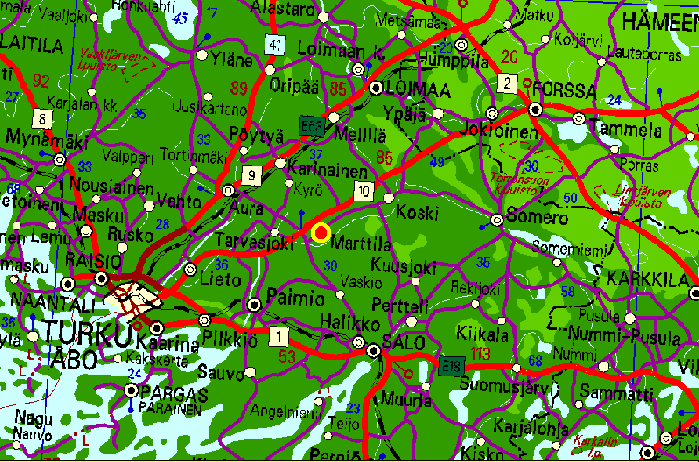
There’s a city in Finland called Marttila.  My uncle Walter and aunt Margaret visited it years ago.  Here’s a wee map and the city’s crest from their Web site:

Notice the image on the crest: It’s St. Martin of Tours cutting his cloak in half to give to a beggar.  So Marttila roughly translates to St. Martin, not a particularly Finnish icon, but at least I know where my family name comes from.

So I started keeping a few files on my family tree.

Something else I did was to look into the kalevala, the national epic poem of Finland.  It’s a creation myth, set of legends, and features magicians and the mystical sampo, which could be, among other things, an analogy for an instrument that could track the precession of the stars.

It’s no wonder I’m into the fantasy 🙂

My mother was adopted and has no interest in looking into her family, so I’m kind of stumped there, though she tells me that she was Irish, something my grandfather liked to tease her with.  So maybe there’s a reason, I’m so enamoured of all things gaelic.

Have you delved into your genealogy?  What did you discover?

Ten things I’ve learned from giving and receiving critique

You may remember from previous posts, that I’m part of an online critique group in Author Salon.  It’s intense.  AS does not want thin-skinned writers who wither and whine, nor do they want wimpy critiquers.  They have stringent guidelines and templates to follow.  The questions to answer make you think critically, analyze, dig deep, and justify every comment.

It’s hard as hell, but it’s also teh awesome (misspelling intentional) 🙂

I’m not going to blog about finding a critique group, group dynamics, or any of that stuff.  I’m just focusing in on what I’ve learned from being on both ends of the process.

I’ll start on the giving end, and really, the way to think about a critique is that you are not just giving one, but gifting one.   I’m not saying I’m all that and a bag of chips, but if you do the job well, and put your heart and soul into it, you’re giving your absolute best to your partners.  You’re giving them a gift.  It takes me forever to do what I think is a good job, and I’m still not great at it.  I apologize at some point in every one, because ultimately, it’s just my opinion.

And away we go!

Five things I’ve learned from giving critique

  1. Be honest.  If you like what you’ve read, great, but don’t stop there.  Figure out why you like it and explain your thinking honestly to your partners.  If you don’t like something that you’ve read, that’s fine too, but you can’t leave it there.  Figure out why it bothers you and articulate those thoughts honestly to your partners.
  2. Be specific.   Rather than writing, “S/he needs to figure this out sooner,” again, explain it in detailed and concrete terms.  So, “The character you’ve written is smart and thinks on her feet (you may want to summarize an example from the piece).  You’ve placed several clues in his/her way (again detail the clues) but she’s/he’s not picking up on them.  Your protagonist needs to be at least as smart as the reader.  Have him/her connect the dots along with the reader.  It will be a more immersive/engaging experience.”
  3. Be reflective.  One thing I discovered almost immediately is that as I started analyzing the work of others I figured out a few things about my own writing.  Make notes to carry back to your own work in revision.
  4. Be consistent.  This is about bringing your A game every time.  Feeling tired/uninspired?  Write through it anyway.  The words will come just like they do when you’re writing your novel.  You can always edit out the unintelligible crap later 🙂
  5. Be better.  The more you critique, the better you get, the deeper you can go, the more articulate you can be about why a certain change will improve your partner’s work.

Five things I’ve learned from receiving critique

  1. Be grateful.  If you’ve given your best, expect that your partners have done the same.  Thank them for all their hard work.
  2. Be receptive.  You won’t like everything your partners tell you about the weaknesses in your work.  Get out of your own way and consider every point.  Then …
  3. Be selective.  You don’t have to enact every change your partners recommend.  In doing that, you’ll try to please everyone and end up pleasing no one.  But …
  4. Be critical.  If you choose not to accept the blood, sweat, and tears that is the advice of your partners, then start digging again.  Find the compelling reason that this won’t work in your novel.  Defend your decision, but don’t get defensive.  Finally …
  5. Be honest (redux).  There comes a time when all your justifications and refutations fall apart into the random collection of words that they are and you have to admit that you still have work to do.  You could see this as a defeat, but I’d rather reframe it as an epiphany.  When you finally understand what needs to be done and can see how to do it, the way forward will appear as a glowing path through the darkness.  It won’t be easy.  It never is, but if you keep the path in sight and walk it faithfully, it will lead you to a better novel.

Do you have any critiquing experiences to share?  What have you learned from them?

Like, comment share, subscribe!

Writerly Goodness, signing off.  Good writing to you all!

A virtual tour of Mel’s office

I was inspired to blog this after seeing two similar posts from people in my writers’ learning network (hey professionally I can have a personal learning network, or PLN; why can’t I have a WLN?) Brian Braden, one of my critique partners from Author Salon, and Diana Gabaldon, one of my favourite authors.

I’d intended to do this as a vlog, or video blog, but I haven’t figured out my new tablet sufficiently to do a creditable job.

I’m going to do this a little differently than my compatriots though.  As with everything I blog, there’s a little story to go with this virtual tour.

Starting with the street on which I live.

My intent was to go out and take a picture of the street sign, but someone crashed into the post on which the sign used to hang last year, and while the post has been replaced, the street sign hasn’t.  So Googlemaps is the best I can do.  You can go there yourself and get the street view, but it’s from a few years ago.

But … did you notice anything about the street name?  That’s right!  It’s my last name.  It provides endless entertainment for just about everyone, and then I have to explain: yes, my grandfather bought the property that became Marttila Dr and then subsequently sold the lots to the city, who named the wee street after him.

And it is a wee street.  Please don’t go assuming I’m rich or something.  I don’t “own” the street, nor does anyone in my family.  I own the little house on the corner with the chunk of pre-cambrian shield in the unfinished basement and my mom owns the house next door.  Poor financial decisions on the part of a number of our family (myself included) mean that the house is all I have.

Sure, I’m gainfully employed and so is my husband, but all we have to show for our collective life’s work is a 2 bedroom bungalow on one of the busiest street corners in town.

We’ve made the best of her though, slowly renovating, inside and out.

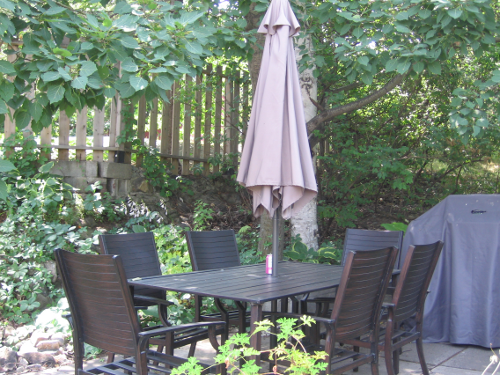
Before we head inside, I’d like to point out my summer office.

When it’s not insanely hot (like it’s been this year), I’m outside most weekends, days off, and even evenings with my lap top.  If you’ve ever heard that relocating for revision is a effective way of shifting your creative mind out of writing mode and into editor mode, I’m here to tell you it’s abso-frickin’-lutely true.  Works a charm for me at any rate 🙂

Now let’s move into the office itself.

The first thing that every office needs is a door.  Right now, my office door is one of the originals that came with the house and is painted white … over blue … over white … over ?  When I have a significant period of time off, I want to strip the door and polish up the brass handle like I did last year with the door to our bedroom.  So this is what it eventually will look like when I get it done 😀

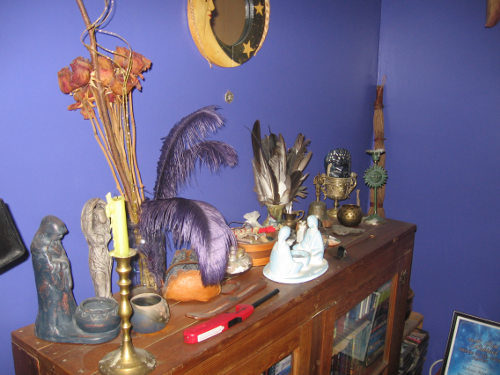
The first thing you see upon entering my office is this. Yes, it’s an altar.  I have distinctively pagan-ish, shamanic leanings.  What you may notice if you look down is that it’s also a bookshelf.  Another one of my stripping and refinishing projects, this cabinet used to hang on the wall of my mother’s  sewing room.  Originally, it was from the local school board.  My grandfather used to work there, and when they dismantled one of the schools, he nabbed this cupboard.  It’s crammed, top to bottom, with paperbacks.

Also, in the lower right corner of the picture, you’ll see my honourable mention from Ron L. Hubbard’s Writers of the Future contest.  Having just refinished the room (down to the studs and rebuilt from there) I’m still reluctant to poke holes in the walls, even for cool stuff like degrees and awards.

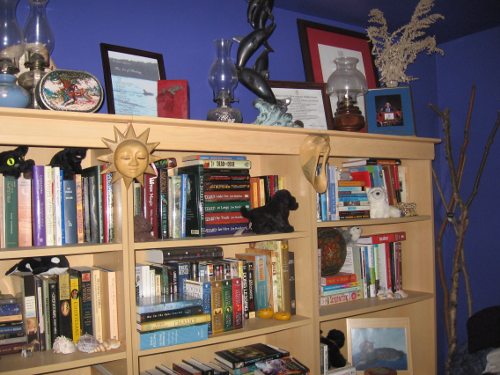
On the far wall are my three additional bookshelves, purchased to harmonize with the massive desk (in a moment, hold your horses …) I inherited from my mother-in-law when she moved about ten years ago.

The first shelf from the left houses historical and spiritual research books.  The bottom row is devoted to books on gardening and herbalism.  The middle shelf is overflowing with fiction I don’t want to store away, or haven’t read yet.  Like the paperback bookshelf, it runs the gamut from fantasy and SF, YA, classics, UF, to mysteries and literary fiction, etc.

The final shelf is populated with a number of my books on the craft.  Interspersed on the shelves are a number of objects I value: artefacts from family and friends, old tins, kerosene lamps, masks, my degrees, my picture from the alumni address I gave a Laurentian University a few years ago, and a couple of framed poems, “Fire and Ice” which was featured in the ekphrastic art project Fusion, and “The Art of Floating,” the poem I wrote for my dad.

The rest of my books are stored in approximately twelve Rubbermaid tubs in the basement.  Yup.  I’m a book addict, and happily so.

In the corner, you will notice three staves.  Actually, it’s one poplar staff, and one birch and one maple stang. All generously donated by the trees in my back yard (resulting from lightning strikes and wind storms).  Another project for the future: stripping the bark from these lovlies and waxing them to preserve.

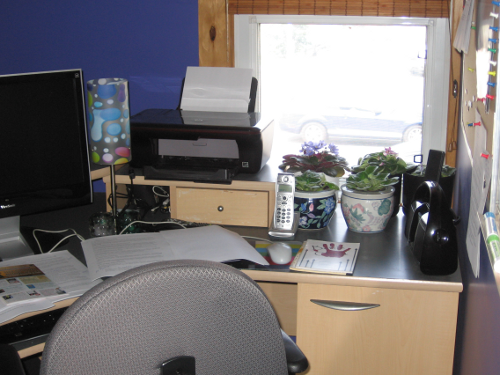
Now comes the organized chaos I call my desk.

The first picture shows a collection of journals (the ones I write in and the ones I have subscriptions to), a few key reference books including the Guide to Literary Agents and Novel and Short Story Writer’s Market, research DVDs, binders containing three earlier versions of my novel, my BIG binder of AS critique material, my Brother inkjet printer, and various pens, pencils, highlighters, clips, push-pins, and other tools that I make use of at my desk.

The keen observer may notice the ashtray and the wine glass.   Yup.  You caught me.  I’m a vile smoker and I drink wine on occasion.  Once again, unapologetic about it.

The second picture doesn’t look quite so chaotic, but shows the rest of what’s on my desk.  My computer, whatever project I’m currently working on (in this case, Rachel Walsh’s The Last Scribe) underneath which hides my laptop, my colour printer/scanner/copier (currently on the fritz), a couple of my poetry books, my African violets (green things essential), and my i-pod (in the corner, also essential).

Behind my desk, on the wall, are my cork board and white board.  On my first and second revisions (after the draft has been completed) I use these extensively to map out my story and make notes.  As each piece of paper is addressed, it comes down for shredding and as each note is incorporated into the novel, it’s erased.

Right now, the board it just reminding me of outstanding submissions I haven’t heard back about yet, my blogging schedule, and calendar.

And that’s it.  I didn’t clean up on purpose, because I thought I’d let everyone see what I really work like.

So I hope you enjoyed this little tour.  Take comfort in the chaos!  My office is as much a part of my process as a writer as anything else.

What does your office/writing space look like?  How does it reflect your process?

Some of my favourite books on the craft

Several months ago, I read a post called “Confessions of a Craft Book Junkie.”  I had no choice but to comment, because reading books on the craft of writing is an addiction for me.  I’m always buying more!

I have no idea what brought this issue up for me again, but having thought of it, I’ve decided to share some of my favourite craft books with you, and may you reap their myriad benefits! I don’t care if you get them as ebooks, or from a used book shop.  Just get ‘em 🙂

In the beginning …

There was Natalie GoldbergWriting Down the Bones and Wild Mind were the first two books I read about writing, and they’ve stuck with me through the years.  Goldberg espouses a philosophy of “first thoughts.”  Writing in your journal first thing when you wake up.  Sound like morning pages to you?

Goldberg introduced me to free-writing, and weaves in wonderful exercises for journal writing with Buddhist philosophy.  Monkey mind and wild mind is a concept I come back to again and again.  Monkey mind is the nattering, distracted place in our heads we occupy most of the time. 

Wild mind … well, draw as big a circle as you can on a piece of paper.  Put a wee speck of a dot in the middle of it.  The dot is monkey mind.  The rest of the circle—you guessed it—that’s wild mind, the cosmic consciousness that will endow your writing with greatness.

The key is to let go.  Don’t worry.  Don’t pin all your hopes on the greatness you might achieve.  Just be in the moment and do it.

Word after word

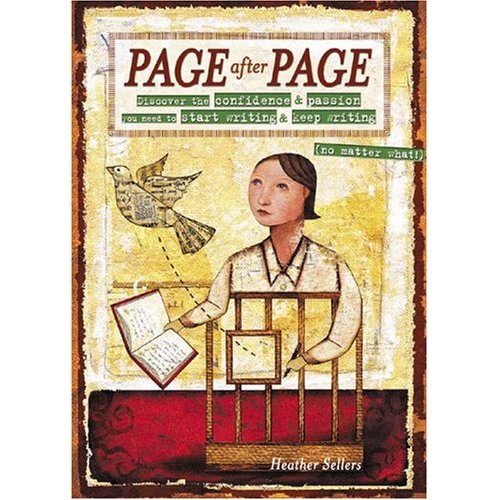
Heather Sellers two books: Page After Page and Chapter After Chapter really changed my writing game.  It was time for some tough love, and Sellers delivered.  She was the first author I read who asked the question: do you want to be a writer, or are you a writer?  She made the distinction very clear.

Wanting to be a writer means that you’re letting things get in the way, making excuses, because the phrase is always followed by the word “but.”

If you are a writer, you write.  You write every day.  You’re dedicated to your craft and you don’t let excuses get in the way.

Sellers also writes about her struggles, how the disapproval of peers and professors affected her, how relationships, good and bad, can influence your work, and how serious life incidents like car crashes and disease can change things forever.

In the end, you can only keep writing, word after word, page after page, and chapter after chapter 🙂

The Maass Oeuvre

Donald Maass is an industry expert and he turned his expertise into several wonderful books.

His first, The Career Novelist, delved into the changing face of the publishing industry.  No longer the land of monster advances, runaway auctions, and multi-book contracts, Maass discussed the kinds of writers, the kinds of agents, the kinds of editors, and publishers that were emerging, how they might survive the new era, and he offered a lot of practical advice about the mathematics of publishing (what do the numbers mean and why should I care?).

In the current market, this book has lost some of its relevance, but I would argue that it is still an important read.  Understanding the changes that led to the current state of publishing offers the reading writer insight.  Learning from history, we hope not to repeat it.

Writing the Breakout Novel gets more into the mechanics of how to write a damn good novel.  Using his personal experience and that of some of his well-known clients, Maass explains what agents and publishers are looking for, and gives the reader tools to achieve their goals.

The Fire in Fiction is more of the same, but deeper.  Maass really asks the writer to dig deep in this one and offers exercises to deepen your understanding of exactly what it is you’re doing.  Analysis.  Critical thinking.  If you’re willing to work for it, Maass tells you how to write a novel that will WOW.

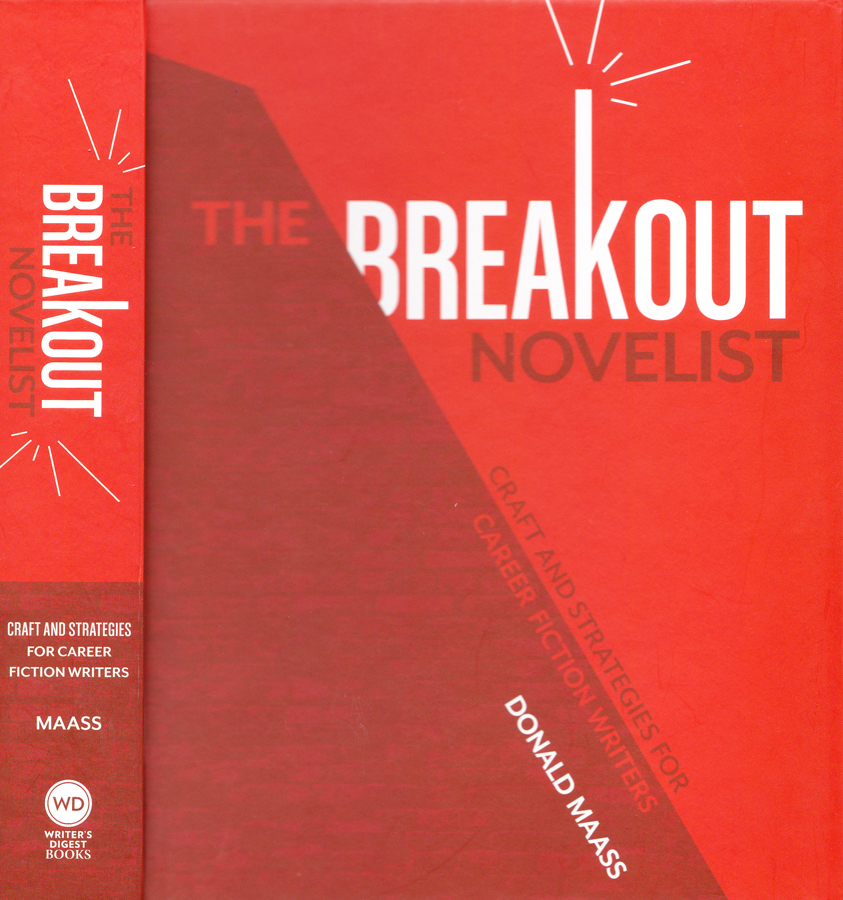
Finally, The Breakout Novelist, Maass’s most recent publication, is more of a workbook and reference than some of his other books.  It combines the best of Writing the Breakout Novel and The Fire in Fiction with extra exercises.  If you’re having trouble with a particular aspect of your novel, flip to that section and start working through the exercises.

Obviously, I’m a fan.

I’ll have more of these coming in future months.  I just thought I’d start with what I think are the best of the best 🙂

What are some of the craft books that you value and why?  How did they speak to you?  And as always, like, comment, share, subscribe!

Dream a little dream … and go from there

I was going to write something about where I get my ideas from because a lot of people out there have done that recently, but it really depends on where I am, what I’m doing, and what the idea ends up becoming. So I think I’ll focus on one of the best places I get my ideas: my dreams.

When I was a kid, I had very vivid dreams. The earliest I can remember, occurred after I had my tonsils out. Actually, it occurred after my stitches ripped open and I was rushed back to the hospital for emergency surgery.

In the wake of that experience, I had a dream in which I actually died in the process of that surgery, but I still woke up the next morning.  Only, in the world I woke up in, I dreamed of this one.  It’s hard to explain.  Essentially, I dreamed that this world was nothing but the dream of my sleeping self in another world.

Pretty multidimensional/existential for a four-year-old, eh?

I had insomnia, the kind where you wake up in the middle of the night and can’t get back to sleep.  I’d lay there and rehearse my dreams, or tell myself stories until I eventually got back to slumber town.

When I dreamed of falling, I woke up several inches off the bed.  What I know of dreams now tells me that the sensation of falling in the dream was so intense I felt that I was still falling when I woke.  I wasn’t actually levitating 🙂

A visit to a Christian book store led to me reading a comic book about an African missionary.  The barbarism with which the artist depicted the rituals of the native tribesmen made such an impact on me that I dreamed of the scar-faced man, had nightmares about him really.  You know the ones, where there’s a man standing at the foot of your bed, staring at you?

I often had out of body experiences (OBEs) when falling asleep, or waking.  I remember these distinctly.  I was like a balloon, tethered, but being flung around (or was I trying to escape?).  That’s how my young mind interpreted it, but when I later delved into meditation and eastern spirituality, I realized that this is classic OBE.

I didn’t keep a dream journal then, but many of my childhood dreams and nightmares have stayed with me nonetheless.  I often dreamed of being abandoned: driving in a van with my family and then one by one, everybody but me disappeared, and I was too small to drive the van (couldn’t reach the pedals).  Stuff like that.

I actually dreamed in story sometimes.  Full, 3-act drama.  If my dreams stayed with me long enough, I wrote them down, but often the delay meant I lost critical pieces.  I’d tell my dreams to my friend Margaret at recess as a way to keep some of them alive.

I started to record my dreams (among other things) when I went away to university for the first time.  I have a number of story ideas that have emerged from those journals.

In university, my room mate, Sandra, enlightened me regarding another aspect of my nocturnal life.  I talked in my sleep, and often sat up and did things as well.  Once, she reported that I sat up in bed, said, “It’s really not that bad … ,” reached around to open the closet door (right beside my bed), looked frowning into the mirror on the door, looked at her, then closed the door, and went back to sleep.

I had night terrors too.  Once I dreamed that something (what I can’t remember) was escaping from me.  I reached up to snatch it back, and when I woke up, I’d torn down a mobile that was hanging in the window.  I dreamed of insects (or other things) crawling on me, or of not being able to find something important.

The first time I went to camp (Southerners read cottage) with my boyfriend (now husband), I sat up and started searching the bed frantically for something.  I kept saying, “I can’t find it.  Help me find it.”  That kind of freaked Phil out, but it wasn’t the most bizarre thing I did while I was sleeping.

When we were living in Married Students’ Residence at Laurentian University, we had a 1-bedroom apartment.  In the middle of January, I got up in the middle of the night and opened all the windows. Phil woke up at 4 am shivering, realized what I’d done, and rushed to close the windows before the radiators burst.  It was a very cold night.  I had no memory of doing that.

One of my favourite courses was one regarding the Surrealists (writers primarily, but artists to a lesser extent).  I really fell in love with the way the surrealists let loose with their subconscious and tried to capture the world of dream on the page.

Since I started working full time and sorted out my depression (that’s another story), my dream life has been less vivid.  I dream more of stress and work-related issues (repetitive loops of action) or of terrible things happening to me or someone that I love.  I still have insomnia, but it’s more troublesome because I can’t afford to sleep in to catch up, and I don’t like what sleeping pills do to me …

I’ve started reading before I go to bed and have noticed I’m having more creative dreams.

I don’t necessarily want to start sleepwalking, having night terrors, or fall into depression again, but it would be nice to have the old story-dreams back again.  I’ll let you know how it goes.

An interesting book about writers and their dreams:

A selection of dream/depression/creativity links:

A dreamy soundtrack:

  • California Dreamin’ – The Mamas and the Papas, 1966
  • Dream a Little Dream – Mama Cass, 1968
  • Dreamboat Annie – Heart, 1976
  • Dream On – Aerosmith, 1976
  • Dreams – Fleetwood Mac, 1977
  • Dreaming – Blondie, 1979
  • Sweet Dreams – Eurythmics, 1983
  • These Dreams – Heart, 1986
  • Don’t Dream it’s Over – Crowded House, 1987

There are hundreds more, but these are my favourites 🙂

How have your dreams influenced you as a creative person?  Have your dreams/sleeping habits  changed over the years?  How has that affected your writing?