Writer tech: Converting from WordPress.com to WordPress.org

In my continuing indecision regarding whether to make the leap to WordPress.org or not, I’ve been doing some research.  Gemma Hawdon has graciously consented to let me post our conversation.  I’m sure it will be as enlightening for you as it was for me.

____________________________________________________________________________

How long were you blogging on WordPress.com before you decided to make the move?

I was only blogging for 6 weeks before I decided to swap to self-hosted WordPress.

What kind of research did you do and what were your considerations?

I started by talking to a few friends who had already taken the plunge into self-hosted blogging. I was lucky to have one friend in particular, Caroline of http://presentimperfection.com – a marketing and communications strategist – she was extremely helpful.  I think it’s important to seek the opinions of others and to have someone you can turn to for help.

I also read information provided on the WordPress site: http://en.support.wordpress.com/com-vs-org/.

Another helpful article was this one by Problogger: http://www.problogger.net/archives/2012/03/04/wordpress-com-or-wordpress-org-which-ones-right-for-you/

In terms of considerations, I wanted to find out which version was more suitable from a long-term point of view. Although a complete beginner, I didn’t like the thought of wasting time and effort building a blog that might restrict me in the future.

What made you decide to take the plunge?

In the end it was the flexibility of self-hosted WordPress (WordPress.org) in terms of wider choice of custom themes and the ability to increase functionality of the blog through plugins (i.e. to enhance SEO, email newsletters etc.) I wanted to build something that I would have full control over creatively and (if in the future I’m lucky enough!) commercially. Have I actually utilized many of these options yet? Absolutely not! I’m a little lost to be honest, finding my feet, tepidly…

Are you with a hosting “farm” where you’re largely in charge of everything, or do you subscribe to a hosting service where they have people who can help you with technical questions?

To be honest, I’m not entirely sure what a hosting farm is! But yes, I am pretty much in charge of everything (terrifying). I chose to host with hostgator.com – who were recommended to me because they have a solid reputation and competitive pricing. I have the Hatchling plan which is only $3.96 p/m unlimited disk space (you can upgrade at any stage). This plan also offers 24×7 technical support.

Mel’s note: If you have technical support, it’s not a farm 😉

From what you mentioned, there are good and bad points about the move.  What are they and what would you do differently if you had the chance?

The main shock after swapping to WordPress.org was the terror of suddenly feeling completely alone! WordPress.com takes care of everything for you. You feel part of a community because they publish your posts across Reader. When I switched to self-hosted I lost a huge chunk of traffic. Previously, I was gaining 5-10 new followers each week – that has fizzled out to 1 if I’m lucky!! Plus it’s amazing how encouraging those simple ‘likes’ can be – you get none of that with WordPress.org.

To help me transfer, I used a friend of a friend because he was incredibly cheap and he did a great job, but initially I lost all of my followers. I had to contact WordPress in the end and they transferred them across for me, but it took several weeks. In the meantime, I had to post from both platforms. I think If I had to do it again I would use WordPress’ own guided transfers – they cost $129 USD.

I’m still feeling lost on the technical side of things. With WordPress.org you’re the one responsible for stopping spam, for creating and maintaining backups and for updating versions of software. I haven’t taken full advantage of the creative freedom yet because it would mean paying someone to build a logo and banner and I can’t justify that right now; however, I’m learning about new things each day and certainly making progress.

One thing that is working for me is having a Feedblitz icon on my site. Feedblitz allows subscribers to view all of their blogs on the one page (a little like WordPress Reader). Followers who subscribe through this software are generally savvy Internet users and bloggers themselves.

I have to keep reminding myself that I’ve only been blogging for 5 months and it takes time and effort to build a solid following. However, I do feel as though I’m finally making progress. I’m rising in the ranks of Google and Twitter and my traffic is increasing! More than anything, I enjoy the creativity of what I’m doing and the fact that I’m the boss of something that is completely mine.

I think it’s important to figure out what you want from your blog and you’re reasons for blogging before you decide which WordPress version to go with.  For me, the benefits of starting with WordPress.com allowed me to experiment before investing any money. I gained an insight into how people responded to my voice and writing and whether there was a demand for my topic or not.

In the end, I think WordPress.org is better for the long-term if you want to build a blog that is completely yours, which you have full control over – no limitations.

I hope this is of some help – Thanks Melanie for your questions – Happy Blogging!

So what do you say, blogophiles?  Will Gemma’s expereince be helpful to you?  I’ll certainly benefit!

I’d love to hear what you have to say.

____________________________________________________________________________
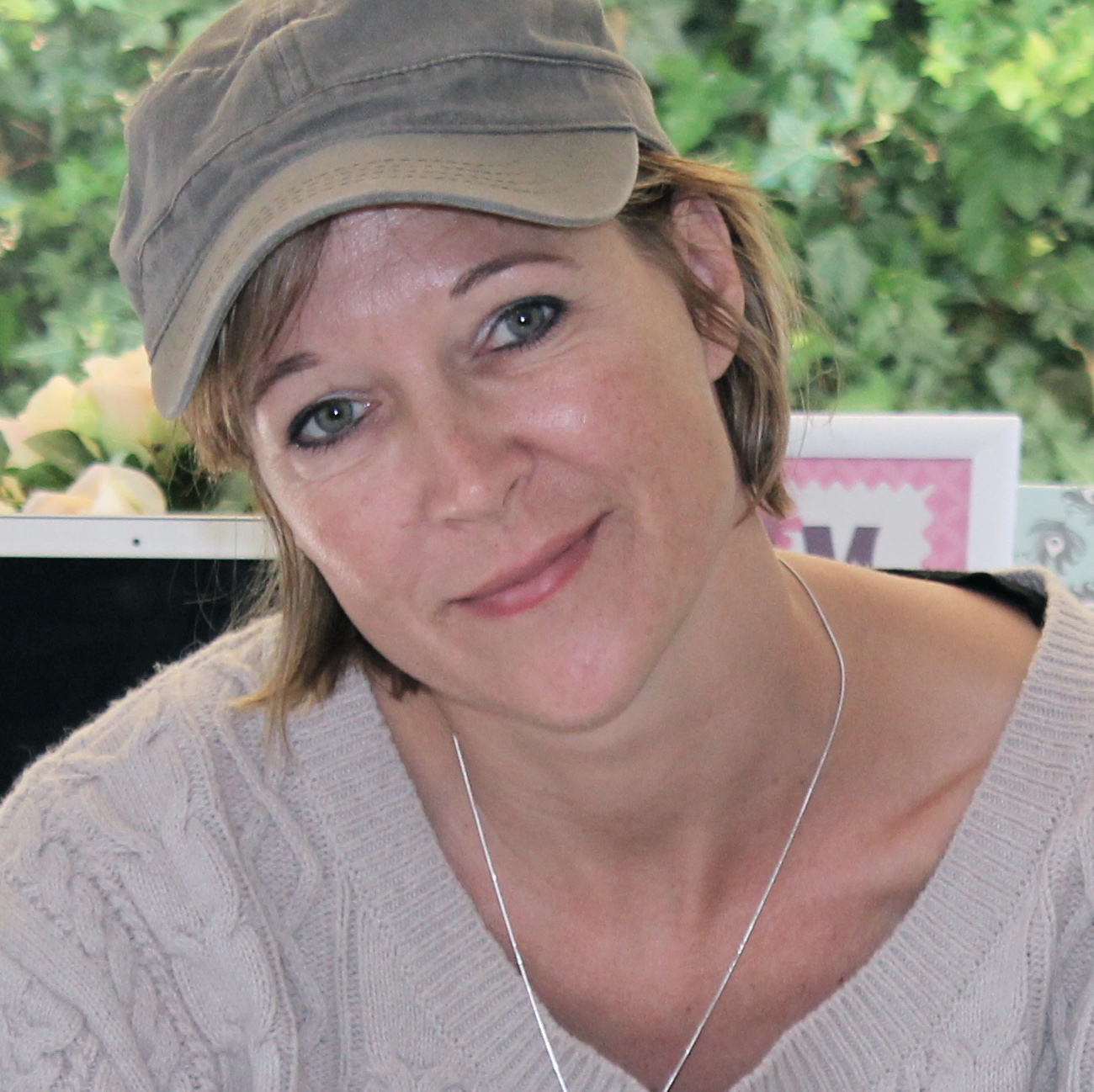
Gemma Hawdon

Gemma Hawdon

Gemma Hawdon lives in Melbourne, Australia with her husband, two children, one dog and a couple of rabbits. Having always worked in marketing prior to having children, she turned her attention to writing about 4 years ago and has never looked back! Gemma has published articles in parenting magazines across Australia including Melbourne & Sydney Child and Parenting Express and dabbles in writing ghost-articles for extra income, but her most passionate project is the children’s fantasy she is writing which she never seems to get the time to complete! Gemma is also responsible for running the administration and finances for their family-run business in the building industry.

Gemma’s blog, topoftheslushpile.com, documents the challenges, highs and lows of writing a book and getting it ready to tackle the competitive publishing industry.
Caturday Quickies: On inspiration

Place as inspiration

As I mentioned in the first of today’s (not-so) quickies, I was in Chatham this week.

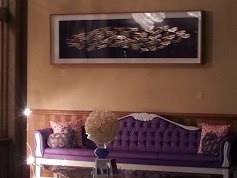
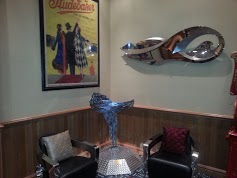
The place I stayed in was an amazing hotel called the Retro Suites.  If you’re ever in Chatham, I’d recommend it, just for the fabulous quirk factor.

The owner restored classic cars for years and you can see a lot of that material  has made its way into the hotel.  Fenders turned into benches, tools turned into sculpture and art.

retro7

A “school” of vice-grips 🙂

retro6

An assemblage of dispirate art and antiques

The owner is a massive collector as well.  Throughout the suites, framed classic movie posters, old microphones (including one from Elvis and one from the Voice of America) and radios, vintage furniture, tables made out of the tail-pieces of WWII bombs, authentic Turkish samovars, and paintings by one of the owners’ family members grace the walls.  He even has a couple of the FAO Schwartz tin soldiers in there.  You can spend hours just wandering around the joint.

A pair of FAO Schwartz tin soldiers with automotive-part furniture

A pair of FAO Schwartz tin soldiers with automotive-part furniture

Each suite is decorated in theme.  My suite was the “Chrom-e-delic.”  I’m sure you can see the mod 70s influence 🙂  Go to the site (linked above) and see some of the other suites for yourselves.

retro8retro9

The hotel is actually a block of converted and renovated buildings.  It’s a wonderful maze in there and inspired an idea for my third (of thirteen) original short stories for Kasie Whitener’s Just Write: 2013 Short Story Challenge.

Books as inspiration

I started reading Catherynne M. Valente’s Palimpsest this past week.  Just previous, I finished Deborah Harkness’s A Discovery of Witches, which features as its MacGuffin, a palimpsest, or book within a book.  Picking up Valente’s book next just seemed the logical extension in my mind 🙂

I was struck by Valente’s lyrical style of writing.  It reminded me of a couple of other books I’ve read: Kathryn Davis’s The Thin Place, and Richard Grant’s Views from the Oldest House.  I’m not sure why I associate them, but I think that, once again, it has to be the quirk factor.

This too, is feeding into my new story 🙂

Dreams as inspiration

I’ve often mentioned that I, like many other authors, draw inspiration from my dreams.  I’ve had a couple this week that I’m going to keep in the idea file.

One, though I think I’m going to play with the particulars a bit, is about a family of vampires (hence the playing, I don’t think another book about vampires could be published any time in the next few decades), who hire a human investigator to discover why their fellow creatures want to kill them.

The dream was more detailed, of course, but this is just to give you the basics.

The second dream is a little more bizarre.  A group of refugees (what they’re running from was not clear in the dream) take refuge in what looks like the ruins of a castle, but turns out to be sentient.  Not only that, but as they explore the castle, they come across indications that at least one of them has travelled to the past, and left messages for them to find around the castle.

Definition of inspiration (courtesy of the Miriam-Webster Online Dictionary)

1
a : a divine influence or action on a person believed to qualify him or her to receive and communicate sacred revelation
b : the action or power of moving the intellect or emotions
c : the act of influencing or suggesting opinions

2
: the act of drawing in; specifically : the drawing of air into the lungs

3
a : the quality or state of being inspired
b : something that is inspired <a scheme that was pure inspiration>

4
: an inspiring agent or influence

in·spi·ra·tion·al adjective

in·spi·ra·tion·al·ly adverb

What inspires you?

Writer-tech: Dropbox on Wordsmith Studio

Please go see my post on Wordsmith Studio: Writer-tech: Dropbox.

Image representing Dropbox as depicted in Crun...

Image via CrunchBase

Wordsmith Studio is a wonderful collective of writers that began through Robert Lee Brewer‘s April Platform Challenge last year.

Thanks to Lara Britt for inviting me into the designers group and encouraging my more active participation it the collective.

Hope you enjoy!

Writerly Goodness, signing off from Timmins, Ontario 🙂

Writer-tech: Asus Transformer and Samsung Galaxy Note II

I’ve always been a bit of a technophile.  I think it comes from the fact that Phil is computer-dude supreme, a genius even, or, as one of our friends once called him, an ass in jeans 🙂  I like to joke that I learn things from him through osmosis.  I’m fairly certain that if it weren’t for Phil, that I’d still be tech-clueless and likely in a lot sorrier shape than I am now.

I’m still tentative about some things though, and learning something new in the technical realm that I’m not particularly motivated to learn can still stress me out.

Once upon a time …

In another life (that’s how long ago it was), I had an interest in creating Web pages, and with Phil’s help, I learned how to do basic HTML scripting, you know, the kind that you had to type out in Wordpad, tags and all?  I’d do my own graphics too, real basic stuff, that I’d put together in a freeware imaging editor that I no longer remember the name of.  I use The Gimp now 🙂

I did a few Web pages for some of my employers at the time: Huntington University, The Art Gallery of Sudbury, and ACCUTE (the association of Canadian college and university teachers of English).  Eventually, I graduated to Microsoft FrontPage, but I couldn’t compete with the new Web page design companies that were plentiful even in a place like Sudbury.

I maintained listservs too, and brought at least one employer into the world of Yahoo! Groups, then the only game in town, so to speak.

Enough of my techie history though.  I just wanted to give you some perspective, and to set the stage for my next revelation.

Let’s do the Time Warp!

Fast forward a few years and here I am happily writing away with a desktop, laptop, and USB keys to affect file transfers.  I was a confirmed bibliophile too, lived the smell and the feel of books, and didn’t want to enter the world of ereaders even after Phil bought one (a Kobo, by the way).  As Rupert Giles said to Jenny, knowledge should be … smelly.

I’d started my blog, been hacked, restarted my blog and was on a dedicated mission to build my platform.  I didn’t even understand what that was to begin with; I just know that I should have one.

My phone was what I affectionately called a “dumb” phone.  It was the dumbest I could find when my contract came up.  Called the Doro phone, it was marketed at seniors 😛 with a big number pad and no camera on board.  I had a digital camera.  I didn’t think I’d ever have need for anything else.  I just wanted to be able to make a phone call, and to receive one, maybe text a friend every once in a while.

Then things changed

I got tired of the dumb phone and its limitations, of paying more than half of what my friends were for their I-phones and Blackberries.  As my shelves were quickly filled with paper books, I began to see the benefits of an ereader.

Phil had given his Kobo to his mom and purchased an ASUS Transformer.  He began to use it every night, reading books off Project Gutenberg, comics, and even watching Netflix in bed.  I began to see the attraction.

So, I bought my own ASUS Transformer, and I love it!Transformer1

First, it was super easy to set up and learn how to use.  I was downloading apps from the first day.  There’s more than enough space on the dear little thing to keep me happy for a long time.

Second, it has a suppementary keyboard attachment which extends the battery life, memory, and data ports, as well as helping to protect your investment.

I have access to internet, email, all of my social media, WordPress, and just about anything else I’d want.  The only down side is that it’s not so easy taking my writing on the road.  Polaris Office doesn’t do a bad job, but there are some features that I’ve just gotten used to in Microsoft Word that Polaris doesn’t understand or offer.

Dropbox has the potential to replace my USB though 🙂

transformer2I also have, with the tablet, not only Kobo’s, but Amazon’s app too, so now I can read whatever I want wherever I want 🙂  I also have news, comics, and other readers, so I’m pretty much loaded for bear.

Plus, it has a camera/video recorder with voice recording too!  Can my dreams of podcasting and vlogging be far off?

The Transformer’s all but made my laptop (and my camera) obsolete.  Who knew that an upgrade could actually lead to an overall reduction in the amount of tech I own/use?

plus ça change, plus c’est la même chose

(The more things change, the more they stay the same.)

Around my birthday last year, I had done a lot of word-of-mouth research, asking friends and coworkers about the kinds of smart phones they had, about their service providers, and contracts.  How much were they paying a month and what were they getting for the price?

I’d had my eye on the Galaxy Note since Guy Kawasaki reviewed his purchase of one.  I looked up every review and the worst anyone had to say about it was that it was a little big.  Big whoop, I thought, I’ve got decent-sized hands.

As serendipity would have it, my service provider sent an upgrade offer to my email.

Phil, who used to have his own cell phone, then tired of it, had been forced back into a contract by his employer.  Then, as a cost-saving measure, his employer introduced a cost-sharing program, whereby Phil could get his own phone again, and his employer refund him for part of the monthly cost by way of compensation for using the service for work purposes.

So when I mentioned the upgrade offer, and that I was seriously considering the Galaxy Note II, it was perfect-tech-storm time 🙂

Galaxy1We went out and got ourselves a couple of Galaxy Note II’s that weekend.

Phil now uses his note to read/watch movies in bed 🙂  It’s lighter than the Transformer, even without the keyboard.  We have a wireless network at home and Phil has one at work, so we’re going to downgrade his data plan.  He almost never has to use LTE at all.

I’ve found it a boon because I can keep track of my email and SoMe notifications at work and better manage the time I spend online in the evenings.  I haven’t yet graduated to using it to create blog posts at lunch or anything, but I can see that happening in the future.

It’s essentially a tablet with a phone and text capability.  Because it’s an Android, like my tablet, I can have all the apps I have on my tablet on my phone too.  Many of them will even sync up.

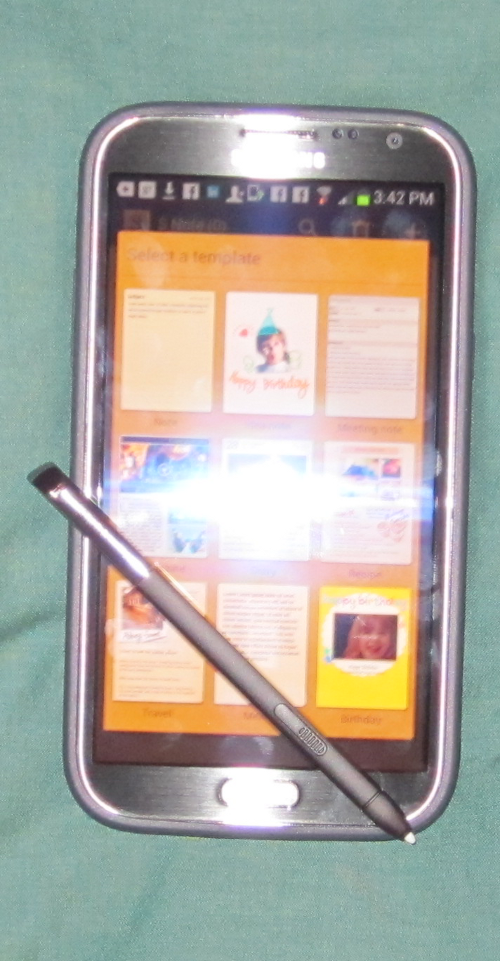
I love the stylus feature though.  Included in the Galaxy Note II’s applications is a note suite galaxy2which has everything from basic notes, to meeting minutes, mind-mapping tools, financial planning notes, greeting card creation notes, drawing apps, etc.  I haven’t explored these thoroughly yet, but I have used it for shopping lists, to do lists, and reminders.

galaxy3You can simply write on your note, or use the text conversion feature to change your handwriting to text.  It works great for me.  It’s only messed up once, when I was demonstrating the feature to a friend.  I can definitely see this replacing my journal some day, but I still have about 10 or so paper journals to write through first.

I’m not an early adopter

For some things, I’m the first person to take an interest and conquer the new tech.  This happens most often in my day-job.  In general, I’m not the first person to pick up the latest technology.  I like to wait until the manufacturer has worked out the bugs and someone else has tested the product first, often Phil.

I haven’t been very quick on the uptake with respect to all the writerly apps I can make use of on my tablet and phone either.  I’ve barely scratched the surface, so I’ll leave you with a few sites I found that were very helpful to me in selecting the best apps for my droid.

I hope this post will be useful to those of you considering a tablet or smart phone.

Tomorrow, there will be a brief pupdate.  Come on back now, ya hear 😉

The Right to Write

As part of the Wordsmith Studio Goodreads group, I have been reading Julia Cameron’s The Right to Write.  I think I’ve fallen in love 🙂

Cover of "The Right to Write: An Invitati...

Cover via Amazon

Julia’s philosophy of writing is something that I’ve aspired to for years and I think that I’ll be referring to her book for some time.  The book has an organic quality to it that I admire.

What follows are the gems I mined from Cameron’s book, and all the credit for them must, of course, go to the author.

Gems:

Introduction
“Writing has for thirty plus years been my constant companion, my lover, my friend, my job, my passion, and what I do with myself and the world I live in.  Writing is how, and it sometimes seems why, I do my life.”
“Our ‘writing life’ … cannot be separated from our life as a whole.”
“… writing is a powerful form of prayer and meditation, connecting us both to our own insights and to a higher and deeper level of inner guidance …”

Begin

“It’s a luxury to be in the mood to write.”
“… writing is like a good pair of pyjamas …”

Let yourself write

“We have an incredible amount of mystery, mystique, and pure bunk around exactly what [becoming a writer] means.”
“When we just let ourselves write, we get it ‘right.’”

Let yourself listen

“Writing is about getting something down, not about thinking something up.”

The time lie

“The myth that we must have ‘time’—more time—in order to create is a myth that keeps us from using the time we do have.”

Laying track

“For the first time, I gave myself emotional permission to do rough drafts and for those drafts to be, well, rough.”
“Writing—and this is the big secret—wants to be written.”

Bad writing

“Bad writing—when it’s good—is like New York street pizza.  Sometimes it’s a little too crusty.  Sometimes it’s a little soggy, but the tang is undeniable.  It has flavor.  Spice.  Juice.”

This writing life

“I have crawled out of lovers’ beds to sneak off and write.”

“There is a great happiness in letting myself write.  I don’t always do it well, or need to, but I do need to do it.”
“Writing is alchemy.”

Mood

“All of us have a sex drive.  All of us have a drive to write.”
“Writing may be an art, but it is certainly a craft.  It is a simple and workable thing that can be as steady and reliable as a chore—does that ruin the romance?”

Drama

“Keep the drama on the page.”
“Keeping the drama on the page is ruthless, enlightened self-interest.”

The wall of infamy

“… I advocate writing for revenge.  I advocate writing ‘to show them.’  You turn the dross of your disappointments into the gold of accomplishment.”

Valuing our experience

“Seeking to value ourselves, we look to others for assurance.  If what we are doing threatens them, they cannot give it.  If what we envision is larger than they can see, they cannot give support for what it is we are doing.”
“Valuing our experience is not narcissism.  It is not endless self-involvement.  It is, rather, the act of paying active witness to ourselves and to our world.”

Specificity

“One thing at a time, one thought, one word at a time.  That is how a writing life is built.”
“Detail allows us to communicate precisely what we mean.”

Body of experience

“Because we think of writing as something disembodied and cerebral, because we ‘think’ of writing rather than notice that what we do with it is meet or encounter it, we seldom realize that writing, like all art, is embodied experience.”
“True knowledge, authentic knowledge, is something deeper than the mind entertains.”

The well

“Writing is what we make from the broth of our experience.  If we lead a rich and varied life, we will have a rich and varied stock of ingredients from which to draw …”
“Sanity in writing means acknowledging that we are an creative ecosystem and that without fresh inflow and steady outflow the pond of our inner resources can grow stagnant and stale.”

Sketching

“If I see or hear the impulse to put in a tree, I put it in the landscape of what I am writing … the writing itself knows when and how and where it will use it.”
“‘It’s a sort of lucid dreaming where I carry the idea of the story and the Universe delivers to me bits and pieces as I need them.’”

Loneliness

“Not writing is the lonely thing.  Not writing creates self-obsession.  Self-obsession blocks connection with others … with the self.  Writing is like an inner compass.  We check in and we get our bearings.”

Witness

“What writing brings to life is clarity and tenderness.  Writing, we witness ourselves.”

“Why don’t we do it in the road?”

“People who write from discipline … take the risk of trying to write from the least open and imaginative part of themselves, the part of them that punches a time clock instead of taking flights of fancy.”

Connection

“Writing is a way not only to metabolize life but to alchemize it as well.  It is a way to transform what happens to us into our own life experience.  It is a way to move from passive to active.  We may still be the victims of circumstance, but by our understanding of those circumstances we place events within the ongoing context of our own life, that is, the life we ‘own.’”

Being an open channel

“When writing dominates a life, relationships suffer—and not coincidentally, so does the writing.”
“Although we seldom talk about it in these terms, writing is a means of prayer.  It connects us to the invisible world.”

Integrating

“The root of the word ‘integration’ is the smaller word ‘integer,’ which means ‘whole.’  Too often, racing through life, we become the ‘hole,’ not ‘whole.’”

Credibility

“Based on the idea that writing is product, not process, the credibility attack wants to know just what credits you’ve amassed lately.  The mere act of writing, the fact of which makes you a writer, counts for nothing with this monster.”

Place

“The accumulation of details, the willingness to be specific and precise, the willingness to ‘place’ a piece of writing accurately in context—all of these things make for writing that a reader can connect to.”

Happiness

“It is my belief that writing is a way to bless and to multiply out blessings.”
“Writing is a form of cherishing.”

Making it

“The universe is not, to my eye, a cruel and capricious place.  I believe that our desire to write is a deep-seated human need to communicate and that it is answered by an equally powerful human drive to be communicated to.  In other words, for every writer there is a reader—or many readers.”

Honesty

“Writing is about honesty.  It is amost impossible to be hinest and boring at the same time.”

Vulnerability

“Vulnerability in writing is the enemy of grandiosity … of pomposity.  It is the enemy of posturing; the enemy of denial … Vulnerability is writing health, and health—as I can assure you—can be a scary-feeling experience for some of us.”
“Vulnerability, which is honesty’s shy younger sister, is the part of ourselves that renders un capable of great art, art that enters and explores the heart.”

Dailiness

“Writing is the act of motion.  Writing is the commitment to move forward, not to stew in our own juices, to become whatever it is that we are becoming.”
“Reality happens in daily doses.  Life lived a day at a time is life made much of.”

Voice

“Writing from the body—dropping down into the well of your experience and sounding out how you feel—ultimately yields a body of work.  We say that a voice is full-bodied without realizing that this is a literal phrase: when we write from our gut rather than from our head we acquire the same resonance that a singer does when the breath comes from the diaphragm rather than high up in the chest.”

Form versus formula

“… joie de vivre, … kick-in-the-pants power comes when we allow form to triumph over formula.  In other words, when we trust that writing ‘live’ has a real and valid life to it.”

Footwork

“It is a spiritual maxim that God never closes one door without opening another.  It is a spiritual joke that while this may be true, the hallway in between is murder.  When we are ‘stuck’ in our writing lives, it is usually because we are clinging to a situation that has outlived its usefulness to us or we are unwilling to explore a new risk that we sense we really must take.”

Practice

“Practice means what it says: writing is something to be done over and over, something that improves through the repetitive doing but that needs not be done perfectly. … Consistency is the key to mastering the instrument that is you.”

Containment

“Showing our writing to hostile or undiscerning readers is like lending money to people with terrible fiscal pasts.  We will not be repaid as we wish.”
“We must write from love and we must choose those to read us who read from love: the love of words.”

Sound

“We talk about the writing voice but seldom about the importance of literal sounds in the sound it makes.”
We talk about music in writing but we seldom focus on the music all around us.”

I would live to write, but …

“We want official validation that we are ‘really’ writers.  The truth is, we need to give that permission, that validation, ourselves.”

Driving

“I have a drive to write and I do drive to write. … the art of writing devours images and … if I am going to write deeply, frequently, and well, I must keep my inner pond of images very well stocked.  When I want to restock my images, I get behind the wheel of my car.”

Roots

“… writing benefits from other commitments.  Writing responds well to some gentle scheduling.  A day job not only promotes solvency, it promotes creativity as well.”

ESP

“It is my belief that all of us are naturally intuitive and that writing opens an inner spiritual doorway that gives us access to information both personally and professionally that serves us well.  I call this information ‘guidance’ …”

Cheap tricks

“… the part of me that writes in young, vulnerable, and easily swayed. … I use a lot of cheap tricks to bribe my writer into production.”

Stakes

“In writing, stakes are a question of clarity and empathy.  As writers, we must make it very clear what our characters stand to lose or gain so that our readers, encountering these stakes, can feel empathy and care about the outcome.”

Procrastination

“Writers procrastinate so that when they finally get to writing, they can get past the censor.”

Into the water

Julia’s prescription of morning pages, a narrative time line, and cups.  You’ll have to read the book to find out what these are.

The right to write

“To be truly human, we all have the right to make art.  We all have the right to write.”

These are only a few of the gems I could have plucked out for you, and all of them are of a similar nature.  If you are inspired or intrigued in any way by these, go grab the book.  Go on now!  Give yourself a lovely gift for Christmas.  Or suggest it to a loved one.

Cameron includes exercises at the end of each chapter and it forms a kind of writer’s rehab.  The Right to Write is, if nothing else, Cameron’s attempt to heal the injured and encourage the aspiring writer.

Creative connections: On pomegranates, movies, and books

Pomegranate Fruits. Español: Una granada, frut...

Pomegranate Fruits. Español: Una granada, fruto del granado (Punica granatum). Eesti: Granaatõun. Français : La grenade, fruit du grenadier. Русский: Плод граната. (Photo credit: Wikipedia)

I love a pomegranate, tearing into one and slowly devouring every pip over the course of an hour or so.  Inevitably, I wear as much as eat 🙂  There’s something visceral, exotic, and, frankly, erotic about the fruit.  Juices drip, stain fingers, lips, and clothes in a rich purple.

I can see why some Biblical scholars make the argument that it was the pomegranate and not the apple in the garden of Eden.

There’s also an element of the meditative about the pomegranate though.  To eat one, patiently cracking open and tearing apart the fruit, bursting each pip between the teeth, crunching down on the seeds, it takes time.  It takes focus too.  The act of consumption is totally absorbing.  It opens the mind and clears the palate.  It nourishes more than the body.

My assignment for any of you creative types: eat a pomegranate.  Take your time.  Let the act take on meaning beyond the obvious.  Journal it.  Create something from the experience.  It’s pretty cool 😉

Twilight to date and The Woman in Black

Onto movies now.

The same weekend I had my mind blown by the Cloud Atlas, I also had the opportunity to catch up on the Twilight franchise to date.

I’ve only read the first book, and while I did enjoy it, I can understand some of the criticisms levelled against it.  I do intend to read the rest of the series at some point, but I’m in no particular rush to do so.

I saw the first movie a few years ago when it was first out on demand.  I thought it was cheesy, to be honest.  I thought the effects were poorly done, and the whole visual of the sparkly vampire left me … cold.

It just so happened though, that Space was airing New Moon that Saturday, and the movie

Cover of "New Moon (The Twilight Saga, Bo...

Cover of New Moon (The Twilight Saga, Book 2)

channels were playing Eclipse, and Breaking Dawn, part 1 on Sunday and Monday respectively.

New Moon was the least enjoyable of the three with all of Bella’s moping.  At least the film makers tried to collapse that into a montage.  I can see how this will be tedious in the reading.  Not looking forward to that.  The continuing story line developed, however, and I enjoyed the depiction of the Volturi.

Eclipse was very much a “middle of the series” movie.  The plot continued to evolve, the characters and their various factions were further defined and solidified in Bella’s world.

Breaking Dawn, part 1, was, in my opinion, the most enjoyable of the three.  It was pretty much non-stop action from the beginning, and yes, I do see the wedding and honeymoon as action pieces, plot-critical events did unfold, if not as dynamically as the “battle for Bella” that makes up the remainder of the movie.

Overall, it wasn’t bad, but I wouldn’t have paid to see any of them in the theatre.  Sorry for the heresy.  Just sayin’.

Also watched The Woman in Black that weekend (yes, it was a barn-burner of a weekend for ole Mel) and quite enjoyed it.

I liked the atmospheric gloom and suspense, the mystery, and in particular, the movie’s ending.

*Spoiler alert*

Although the young lawyer manages to figure out the impetus of the ghost’s rage and the reason she abducts and murders children, and although he does what many ghost stories of the past have taught us, that is to right the wrongs of the past, the spirit of vengeance is not appeased.

Instead, she does not forgive, and kills the young lawyer and his son.  Though this turns out to be a kindness, as the family is reunited with the predeceased wife and mother in death, it is clear that the titular character will not end her predations.

I like it when my expectations are turned on their collective ear 🙂

Disappointments that I’m not sure what to do with

I have to get this out.

I’ve read a couple of books recently by authors I’ve met and admire precisely because they’ve accomplished what I have yet to do, and that is publish.  Cover blurbs and positive reviews aside, despite the careers these books have launched, I found myself disappointed.

For that reason, I will not disclose the names of the authors, nor the titles of the books.  And don’t bother parsing my Goodreads account.  You won’t find them or their reviews there.  I don’t put all the books I read on GR.

I think it comes down to poor editing.

When I come across a clear error that was not caught by author or editor, and that repeats several times over the course of the novel, it ticks me off.

When a character’s name changes several times, I’m (I think understandably) peeved.

It pulls me out of the experience of the novel to a degree that robs me of my enjoyment of the book.

Other issues: the plot of the one was not particularly inspired, came across as episodic, and left me wanting more.  In a bad way.  The plot of the other was truly epic, ambitious, and had so much potential that the author failed to realize that I again found my teeth clenching in consternation.  Point of view issues also plagued one of the two books, making me remember why I’ve sworn never to write a novel in a truly omniscient POV.

I read all kinds of books and I try to learn something about either the art or craft of writing from each one.  Sometimes the lessons are more in the way of what not to do.  I’ll take ‘em.

Never stop reading, writing, watching movies, or engaging in the arts in your community (real and virtual).

You never know where the most important gems will be unearthed.

Cover of "The Right to Write: An Invitati...

Cover via Amazon

Coming soon: Julia Cameron’s The Right to Write (yes, Kasie, I’m reading it and will post on GR post hasty); An Interview with Kim Fahner; blogging the Launch of The Narcoleptic Madonna, and more!

This is Writerly Goodness, signing off.

Stay well everyone, and enjoy your “end” (what’s left of your weekend by Sunday).

Mel’s movie madness

Beware! Here be spoilers!

Cloud Atlas

Cover of "Cloud Atlas"

Cover of Cloud Atlas

Last Sunday, I attended the film with my mother, mother-in-law, and sister-in-law.  I was blown away.  Loved it.  Like any good meal, fine beverage, or other work of art, it wants savouring.  It takes time to digest.  And so, here I am, a week later, blogging about it.

First, a word about music.

In a previous life (only about 25 years ago), I was a music major.  Total miscast, that one 🙂  But I learned a few things that have stood me in good stead as a writer.

In my first year, I was introduced to the structure of symphonies.  Like most other art forms, symphonies tell stories.  They’re told in several movements and bound together thematically by the leitmotif.

Think of Bethoven’s Fifth.  The opening bars provide the listener with the motif.  The motif appears throughout the work in its rhythm and interval, but it transforms through key and tonality.

Another example is Berlioz’s Symphonie fantastique.  The leitmotif appears first as a lilting flute line, reflecting the main character’s beloved.  Through the movements, the motif transforms into a parodic witch’s dance on the main character’s grave and ultimately to the main character’s redemption.

Classical music is a wonderful exercise in structure.  Get into a music appreciation/analysis class sometime and you’ll see.

All kinds of good to be taken away to the writer’s desk.

So back now to Cloud Atlas.

Based on David Mitchell’s novel of the same name, the movie is a masterful symphonic composition.

Six stories play out simultaneously, weaving back and forth between one another and bookended by a seventh.

The movie begins with an old man telling a story around a camp fire under a starry sky.  His face bears markings reminiscent of Maori, or other aboriginal cultures, and he speaks in a form of pidgin English.

Though the movie moves back and forth between the stories constantly, I’ll lay them out in a more or less chronological fashion.

In 1849, lawyer Adam Ewing travels to the Chatham Islands to conclude a business contract for his father in law, Haskell Moore, a man famous for his tracts on the moral rectitude of slavery.  While on the islands, Ewing is horrified by the manner in which the slaves are treated.  He meets Dr. Henry Goose as he digs for evidence of cannibals and subsequently contracts some form of parasite, which Goose promises to treat for him.  One of the slaves stows away on Ewing’s ship and convinces Ewing first to hide him, then advocate for him.  Goose is actually poisoning Ewing in an attempt to steal his gold, and the slave saves Ewing’s life.

In 1936, gay composer Robert Frobisher leaves his lover in Cambridge and becomes amanuensis to famed composer Vyvyan Ayres in Edinburgh.  His goal is to complete his own work and while under the thumb of Ayres, he becomes embroiled in the drama of Ayres’s “Jewess” wife (remember this is pre-WWII), and seeks solace in the travel journal of one Adam Ewing.  He writes letters to his lover, Rufus Sixsmith.  Ayres hears Frobisher’s composition, The Cloud Atlas Sextet, and attempts to take credit for it.  Frobisher shoots Ayres and flees, completes his masterpiece living under the assumed identity of Adam Ewing, and ultimately commits suicide, leaving his work to Sixsmith.

We leap to San Francisco (coincidentally the home of Adam Ewing) 1973, where journalist Luisa Rey bumps into a much older Sixsmith, who is now a nuclear physicist.  Sixsmith wants to disclose something to Rey, but before he can, he is murdered.  As she follows the clues, Luisa discovers Frobisher’s letters to Sixsmith and falls in love with their story.  This leads her to a second hand record store where the proprietor plays The Cloud Atlas Sextet for her.  She determines to solve the mystery of Sixsmith’s murder.  At the reactor where Sixsmith worked, Rey meets Isaac Sachs, who gives her incriminating evidence against the plant’s owner who is purposefully looking to engineer a failure to feed Big Oil interests.  Though Rey becomes a target of the assassin, a war buddy of her father’s helps her out and she survives to write her expose.

In 2012, publisher Timothy Cavanaugh watches one of his authors throw a critic off a balcony in front of a room full of witnesses.  The spendthrift wastes the ensuing windfall and when the author’s criminal family come to claim their share of the profits, Cavanaugh flees to his long suffering brother, who institutionalizes him in a nursing home reminiscent of One Flew Over the Cuckoo’s Nest.  Eventually, in a series of comedic misadventures, Cavanaugh escapes and pens a screenplay of his story which becomes a major motion picture.  He also writes of Alexander Solzhenitsyn in his screenplay.  I believe Rey is one of his other authors.

In dystopian Neo Seoul of 2144, Sonmi-451, a fabricant waitress, comes to the awareness that she is a member of a slave race.  Freed by Hae-Joo Chang, a member of the resistance, she studies Solzhenitsyn and Cavanaugh’s movie as she is inducted into the underground.  Fabricants, told that they are going to ascend, are in fact slaughtered and recycled into the food that feeds them.  As the final battle between Neo Seoul military forces and the rebellion plays out before her and she watches Chang die, Sonmi-451 broadcasts her message of hope and freedom.  When she later tells her tale prior to being executed, she influences the man who interviews her.  He now believes as she does.

Finally, the post-apocalyptic Hawaiian Islands (approximately 2321) form the setting of the final story.  Zachry, a devotee of the goddess Sonmi, is plagued by visions of “Old Georgie,” his tribe’s version of the devil, after failing to save his brother-in-law Adam from the cannibalistic Kona.  A Prescient (the remnants of technological society after “the fall”) named Meronym visits from the mainland.  She is on a mission to save humanity by activating a distress beacon located on the island.  The beacon will send a call to humans who have settled off-world.  Radiation will kill everyone on Earth if they can’t evacuate.  In the process Zachry and Meronym find the recording of Sonmi-451’s broadcast.

We return to the even later, where the old storyteller, Zachry, finishes his epic tale.  His audience is composed of his many grandchildren.  At the end of the tale, Zachry shows one of the children where Earth winks in the sky, then ushers them inside where Meronym waits to embrace him.

While it may seem that I’ve spelled everything out here, I haven’t.  The story, or stories, are much more complex than that.

On Theme

When I first emerged from the movie, in a bit of a daze I must admit, my first thought on its theme was: The truth shall set you free.

While I still think this holds true, there are many themes in Cloud Altlas, just as there are many stories that intertwine throughout the movie.  Slavery appears overtly in Ewing’s story as well as in Sonmi-451’s, but prejudice and the abuse of power go hand in hand with it.

Homophobia and anti-Semitism appear in Frobisher’s story and the abuse of the elderly in Cavanaugh’s story.  Zachry’s tribe lives in ignorance and is victimized by the Kona.  Cannibalism features in Ewing’s tale as well as Sonmi-451’s and Zachry’s.

The abuse of power shows up in all the stories one way or another, from Haskell’s assertion that slavery benefits the enslaved, through Ayres’s attempted appropriation of Frobisher’s work, corporate espionage in Rey’s story, Cavanaugh’s commitment, and the “right” of the Neo Seoul hierarchy to create a slave race to serve society, to the Kona’s slaughter of Zachry’s people and the abuse of secrets withheld from them by the Prescients.

Knowledge is power could also be a theme as well as the enduring power of the creative work.

With regard to the leitmotif, the endurance and influence of the creative work is one.  Each story connects in some way to the next through the creative medium.  Ewing’s travel journal, Frobisher’s letters to Sixsmith and The Cloud Atlas Sextet, Rey’s expose and resulting career as a mystery novelist, Cavanaugh’s screenplay, and Sonmi’s broadcast.

The actors form another set of leitmotif, as most appear in every story.  The make-up and effects are stunning.

If I was still in school, I’d be writing a thesis on this movie 🙂  It is that good.

Best movie I’ve seen this year. It’s the true-true.

Writerly goodness, signing off.

The launch of Dead Air, Pontypool, and other Writerly Goodness

Last night was the official launch of my writer friend Scott Overton’s first novel, Dead Air.  I bought my official copy, Scott signed it, officially, I hung out with the other members of the Sudbury Writers’ Guild who came out to support Scott (his official fan club?), and he even got the official CTV interview 🙂

Before I get to particulars, I wanted to share a few more views of the Living with Lakes Centre at Laurentian University where the launch was held.  Yes, that’s the same place that Scott read with John Forrest and Mark Leslie last week for the LUminaries reading series.

I won’t say that I arrived early, but it looked like I had some time to walk around the grounds and I took a couple of pictures of the centre from a different angle, and then another looking out over Lake Ramsey from the centre’s dock.

Upon entering, I immediately gravitated to the huddle of SWG members.  We chatted and caught up a bit before the flurry of purchasing and signing got underway.

There were beverages, but word soon spread that the caterer hadn’t shown up yet.  Ever the consummate showman, Laurence Steven of Your Scrivener Press gathered the crowd and ushered us into the room for the reading.

One of the SWG members had thoughtfully brought cookies and just as Laurie apologized for the lack of provisions, the caterer arrived, the result of an understandable miscommunication.

With that sorted, Laurie made a brief but gracious introduction of Scott and brought him to the podium.

Scott first introduced his wife, Terry-Lynne, to whom his book is dedicated, his co-host for his morning radio show, and then he read three selections from his novel.  Afterward, he opened the floor to questions.

Scott spoke of his inspiration, the process of writing the novel, and the interesting things he learned on the way.  He also spoke about the editing process and how he and Laurie had negotiated that.

Overall, it was a very entertaining evening.

But I got this cold, see?  So when I got home, I crawled into bed like the little illen-filled chicklet I am and settled in for the evening.  In cruising the channels, I came across Pontypool.

In the movie, adapted from Tony Burgess’s novel of the same name, a morning radio host (sound familiar, Scott?) is trapped in his radio station while people in the town around him succumb to a strange virus.

Far from the scads of zombie-related virus movies, Pontypool takes a left turn.  The virus is spread in the form of words, and the infected begin to babble and fixate on a particular word or sound.  Through the timely visit of a doctor to the studio, the protagonist learns that it is the understanding of a word that seems to trigger the infection and that speaking in another language is an effective means of evading the illness.

As everyone around them succumbs, the protagonist and his producer are hiding from the hordes and she (the producer) begins to babble, “kill, kill, kill …”  The morning man, twigged by the words of the visiting doctor, begins to try to break his producer’s loop, telling her that kill isn’t kill, that it’s sun, dress, flower, and finally he settles on kiss.  Kill is kiss.

He knows he’s been successful when she says, “kill me.”

I just found the premise fascinating.  A semiotic virus.

You may have noticed me dropping that academic bomb from time to time on my blog, and the reason for it is that I love semiotics.  It’s the study of meaning, to put it simply.  Ultimately all language is invented and arbitrary.  Language is a series of signs or symbols that we chose to mean things so that we can communicate with others and think about them.

We accept that the letters D O G spell dog and that means a certain class of canine quadrupeds that many of us choose to coexist with, but why is it dog and not cap or tree of bazooka?  Who came up with the word and why did everyone accept that this wee beastie should be called dog (and not tomato)?

Two things: have you ever repeated a word to yourself over and over again until the word loses all meaning and just becomes a sound?  Have you ever written or typed a word that you’ve written or typed thousands (perhaps millions) of times before only to think immediately that the word is somehow wrong?  Have you been so convinced of this illusion that you look the bloody word up in the dictionary just to make sure you’ve not gone insane?

That’s semiotic confusion, or uncertainty and may just lead to the thought that it’s not the experience that’s the illusion, but all language and meaning lumped together.

That’s the kind of mind-blowing awesome of a movie like Pontypool.  Not to mention the eerie serendipity of coming from the launch of my morning radio show host friend Scott, whose novel is about a morning show host who receives what turns out to be a very serious threat and finding a movie about a morning radio show host in the middle of a semiotic virus breakout.

Gave me dreams, man …

One last thing, well two really, but they’re related.

I’ve been so busy guest blogging, hosting guests, blogging events, and interviewing that I forgot to mention that Brian Braden of Underground Book Reviews interviewed me last week!  And this week, as the result of the number of comments and likes, he’s posted an excerpt from Initiate of Stone, my work in progress.  Sure, he may have misspelled my name, but everyone does 🙂  Hazard of being me.

So if you want to find out what my WIP is made of, go read for yourself!

Need to curl up with my dog and some wicked cold meds.

Fairy tales, Snow White and the Huntsman, and Mirror, Mirror

Once more, I find myself a day late and a dollar short, but for good reason.  Last night, I attended the Sudbury Writers’ Guild meeting and caught up with my fellow writers in arms 🙂

A lot is happening up here in the north.  Matthew Del Papa published Green Eyes through Capreol, a collection of short stories based on life in the railway town.  Scott Overton had one of his short stories accepted into the recently published Tesseracts 16, will have his first book, Dead Air, launched October 11, 2012, and next week, he will take part in the LUminaries reading series at Laurentian University along with Mark Leslie and John Forrest presenting on the topic “The Power of Popular Fiction.”

Several members are nearing completion of their various works in progress (yay!) and the Guild is moving forward on an anthology of northern writers.

Exciting creative times in Sudz!

____________________________________________________

Last week, I was a little out of sorts.  My response to stress seems to be to heap more of the deadly stuff on until my overwrought brain insists on a break.  Thanks to the kind comments of my writer friends, I embarked on a dedicated weekend of relaxation, and as part of that, I watched a couple of movies: Snow White and the Huntsman, and Mirror, Mirror.

In the beginning

Both movies are based on the fairy tale of Snow White.  Now the original story is much the same as the one most of us have become familiar with through Disney.  With a few subtle differences.

A young queen, desperate to have a child, sits spinning at her wheel.  She looks out through the ebon-wood frame of the window, onto a snowy field.  So distracted, she pricks her finger and three drops of her blood fall.  In that moment she wishes for a child black as ebony, white as snow, red as blood.

She has the child, but dies in childbirth.  The king remarries a vain woman who owns a magic mirror.  As the child grows in beauty, the new queen grows jealous and orders her huntsman to murder the girl.  The huntsman, touched by her beauty, cannot kill her, and she runs into the woods.

The huntsman figures the girl will be killed by wild animals in any case and shoots a deer with his bow, taking its innards (not just heart) to present the queen.  In the meantime, Snow finds her way to the home of the dwarfs and they allow her to stay if she will cook and clean for them.

The queen learns from her mirror that Snow still lives, and the artefact is so kind as to tell her where.  So she disguises herself and visits the dwarfs’ home while they are away working.  First, she gives snow a lace collar that once tied around the girl’s throat, chokes her.  The dwarfs return and remove the collar, restoring Snow.

They warn the girl not to receive strangers but the naive thing does so twice more, once to be poisoned by a comb placed in her hair, which the dwarfs also remove, and then to be poisoned by an apple, a mouthful of which lodges in her throat.

The dwarfs cannot revive her this last time, and determine to encase her body in a glass coffin.  As they transport the coffin to a mountain top, a traveling prince literally runs into them, upsetting the coffin, and dislodging the poisoned apple.

The prince announces he will marry Snow and invites everyone in the land.  The queen, preparing to attend the great feast and not knowing the identity of the bride, checks once more in her magic mirror, and is told once again that Snow White and not she is the fairest in the land.  The mirror neglects to tell her where Snow is this time, however, and she goes to the wedding still ignorant.

At the feast, the queen and her treachery are exposed and she is presented with a pair of iron shoes that have been heated in the fire.  She must dance until she dies.

Clarissa Pinkola Estes, in her anthology of the Tales of the Brothers Grimm, writes:

A tale invites the psyches to dream upon something that seems familiar, yet often finds its origins in a far away time.  In entertaining the tales, listeners are re-envisioning the meanings of them, “reading with the heart” these important metaphoric guidances about the life of the soul.

As my recent foray into Fairy tale blogging madness will attest, fairy tales have an enduring fascination.  Snow White has been given homage in many novels and movies as a result.

Snow White and the Huntsman

This movie is quite faithful to the original fairy tale at the outset, but then takes a radical departure.

**Warning: Spoiler alert!**

Snow White & the Huntsman

Snow White & the Huntsman (Photo credit: Ludie Cochrane)

The queen, a fearsome sorceress who drinks the life force of beautiful maidens to remain young and beautiful, murders the king and keeps Snow White a prisoner for ten years while the country grows desolate around them.

When Snow White escapes into the dark forest, where she has no power, the queen recruits a huntsman and binds him with the promise that she will resurrect his dead wife if he will kill Snow White.

In the forest, Snow meets the dwarfs, who have fallen on hard times.  The huntsman finds Snow White, but Snow convinces him that the queen has deceived him and that they will both die if he takes her back to the queen.

They flee with the dwarfs, through various adventures, and joined by Snow’s childhood playmate, the son of a neighbouring duke, they defeat the queen’s brother and his men.  The queen, however disguises herself as the duke’s son and offers Snow the fateful apple.

When she is revived, Snow convinces the Duke to go to war against the queen and in a final confrontation, a Snow that appears more like Joan of Arc than a fairy tale princess, kills the queen.

What I liked about it:

  • The queen.  She was a brilliant villain, made more complex by a back story of abuse and tragedy, and more creepy by implications of incest with her brother.
  • The dwarfs.  They were a mystical, gruff bunch.  Bob Hoskins was fantastic 🙂
  • The lord of the forest.  At one point, the group enter fairy lands, and the lord of the forest blesses Snow.  It was a scene reminiscent of Princess Mononoke, with the lord of the forest appearing as a giant white stag with gloriously branching antlers, though I much preferred Myazaki’s Puff ‘n’ Fresh-like head rattlers to Huntsman’s eerie fairies that crawled out of the bodies of animals.
  • The scarred women.  To protect themselves from the queen’s predations, the widowed and orphaned women of the land scar their faces.
  • The awakening kiss.  Though it is the duke’s son who loves Snow, his kiss does not awaken her.  It is the huntsman’s kiss that proves to be the kiss of true love, but not because he loves Snow.  It is a kiss born of his sorrow for failing Snow as he failed his wife before.  I liked that a lot.
  • The ending.  Snow White, having defeated the queen and reclaimed her kingdom, sits on the throne, no man by her side, not the duke’s son, and not the huntsman.
  • The song.  Breath of life by Florence + the Machine is awesome!

What I didn’t like:

  • Some of the plot points were too convenient.

Why keep Snow White a prisoner?  The queen could have just killed her, or better still, take the girl’s life force to maintain her beauty.  It’s only when the mirror reveals to her (ten years on) that Snow’s heart will keep her forever young that she thinks to do anything with her rival.  Why did the mirror wait so long to tell her?
The queen has no power in the dark forest, so she recruits the huntsman, but she still sends her brother in after Snow.  Why didn’t she just send her brother in the first place?
The duke’s son gets himself recruited to the queen’s brother’s hunting party, but when they find Snow, he’s more concerned about maintaining his cover than in helping her.

  • The fairies creeped me out.
  • Snow is innocent and pure.  It’s that purity that allows her to defeat the queen, but for the final battle, she’s done up in plate mail.  It promises bad-assery that Snow fails to fulfill.  The queen tosses her around like a rag doll and she only succeeds in killing the queen because she’s lucky.

Mirror, Mirror

Mirror, Mirror, from the outset, seemed a movie that didn’t know what it was trying to accomplish.  It starts with the queen, narrating her own story in a British accent, which she doesn’t maintain.

There are moments in it that are potentially dark, but they are overwhelmed by the silly.

In this revision of the fairy tale, Snow is merely locked away while the queen fritters away her money on parties and trying to look young.  She is advised by a maid to go out and have a look at the kingdom herself.  Snow is horrified by the poverty she sees.

When the prince comes on the scene, the queen settles on him as a means to continue her wastrel ways.

The prince, however, has fallen in love with Snow (who rescued him after the bandit dwarfs left him hanging), so the queen decides to get rid of her, sending her chief boot-licker out to do the job.  That part is faithful to the fairy tale.  The boot-licker is unable to kill Snow, but leaves her to the beast that lives in the forest and shows the queen some organ meats that were left in the kitchen.

The dwarfs are highwaymen in this version.  They rob the prince twice, and in keeping with the fairy tale, permit Snow to stay with them if she cooks and cleans for them.

As the queen tries to seduce the prince, Snow becomes a highwayman herself, insisting that the dwarfs return the money they steal to the townspeople to whom it truly belongs.

The queen eventually sends “the beast” out after Snow and the beast turns out to be her father.  Snow breaks the enchantment, marries the prince, and when the queen sneaks into the wedding feast and offers Snow the gift of an apple, Snow sees her for what she is, and refuses to be fooled.

What I liked:

  • The mirror.  In this version, the mirror is a kind of portal to another place where the queen communes with the mirror, which is herself.  Kinda nifty.
  • Snow as a highwayman.  She delivers on the kick-ass, though not terribly convincingly.
  • The beast/the king.  It was Sean Bean!  He got to live, for once!

What I didn’t like:

  • The queen.  Shallow and careless.
  • The prince.  He’s depicted as a doofus from the beginning and totally unworthy of Snow.
  • The dwarfs.  Though they’re thieves, they run around on stilts and do circus stunts.
  • The potion.  In the queen’s attempt to seduce the prince she gives him a potion without first examining what it is.  It turns out to be puppy love.  More doofus action for the prince.
  • The puppets.  The queen sends marionettes after Snow and the dwarfs.  Lame foes and once Snow sees their strings, she easily cuts them and saves everyone.
  • The Bollywood production at the end.  Totally misplaced.
  • The soundtrack.  Very traditional orchestral stuff.  Probably very good, but easily ignored given the ridiculousness of the movie.

Takeaways

  1. Villains that have a reason to be villainous and who do truly terrible things as a result are always better than purely selfish divas.
  2. In the same vein, flawed heroes are better than the goody-two-shoes, but …
  3. Heroes need to be heroes.  No doofaci (the plural of doofus, don’t ya know?) need apply.
  4. Convenient plot points will always be noticed and called out by the faithful reader.
  5. Go for the subtle twist.  The kiss of true love doesn’t necessarily mean what you think it means.
  6. The trails that your characters go through have to be dangerous, dire, challenging.  If no one is truly in danger, the reader won’t care.
  7. Even minor characters can be awesome: the scarred women.
  8. If in doubt, borrow from Anime before going to Bollywood for inspiration 😉
  9. Similarly, go for the quirky new artist rather than the traditional soundtrack for inspiration.
  10. Your story doesn’t have to end with a kiss, or even a relationship beyond mutual respect.

Have you seen any movies lately that got you thinking?  Do you watch movies for plot?  Learn anything about your craft in the process?

Writerly Goodness must hit the hay.  Reading at the 100 thousand poets for change event in North Bay tomorrow!  And you know I’m going to blog about that 🙂

Resistance is futile … or is it?

This has been a rough week, the second of two spent out of town for the day job.  I’m exhausted, feeling ill, and I seem to be getting a lot of bad news, or rather I’m taking the news (in itself, neither bad nor good, just news) I’m receiving rather poorly.  I know, that’s my problem, not yours, but I’m sharing anyway in the hope that someone out there might benefit from my momentary struggles.

On a side note, I was moved to join Alex J. Cavanaugh’s Insecure Writers’ Support Group, but the sign up page does not appear to exist at the moment (!)  Yes, it’s been that kind of week.

This goes back to the issue of having, or in my case lacking, thick skin.  When I blogged about this originally, I wrote that having thick skin was kind of like being brave.  Being brave doesn’t mean you’re fearless, it means that you act despite your fear.  Having thick skin doesn’t mean shrugging off criticism or refusing to be affected by it.  Having thick skin means that you have to find a way to view criticism objectively, find a way to accept what you can, compromise where necessary, stick to your guns on what you believe is truly essential, justify your position, and write on.

That’s where I’m having trouble this week, and I think I just need some time to get some objective distance.

So what was the news?  The biggie was the illness of a friend.  The specifics I won’t get into because they’re not mine to share.  Needless to say, it was a bit of a blow.  Perhaps it was more of a trigger.

It’s coloured everything else I’ve done, and all the feedback I’ve received, this week: my coursework, my day job, and especially my writing.  What would otherwise be constructive criticism (taken in stride), or even compliments, have taken on a significantly more subversive tone.

Fraud, the sub-text whispers …

writer's block - crushed and crumpled paper on...

writer’s block – crushed and crumpled paper on notepad (Photo credit: photosteve101)

Why?  I’m blocked.  For the first time in years I can’t write a sentence without rewriting it five times.  Even then, I delete half of what I’ve written (the equivalent of the old-timey writer crumpling up sheet after sheet of paper as they emerge from the typewriter) and try to come up with something that has meaning.

For five years, I’ve written every day.  I’ve returned to the words and they haven’t failed me.  Until this week.  I’m hitting a crisis point, truly overwhelmed, and clueless as to how to proceed.  Surely this means that epiphany can’t be far away?

What I really think is that my old frenemy, depression, is starting to rear its ugly head again.  And yes, it’s my head, so I can call it ugly if I want.

Time to count my blessings:

  1. My health.
  2. My husband (wonderful man – unlimited hugs).
  3. My mom (amazing woman).
  4. My friends (all of them, a blessing in my life).  I have to note a couple of specifics here: Margaret, out of the blue, sent me a card because we’d shared emails of woe; Kim put a quote of mine on her forthcoming book cover (wonderful poet! I’m so honoured!).
  5. My work friends.  More specifics: Monica, dealing with some heavy personal issues of her own, saved our training bacon this week; the training team – most of us got together last night for a lovely evening out and lots of laughter and hugs were shared; my manager commended the training team for our superb work and dedication.
  6. My dog.  Has to be said: unconditional love and sweetness.  Panacea 🙂
  7. My critique group, honest and tough, but very supportive.  They help me become a better writer.
  8. The Wordsmith Studio community, sources of great ideas and resources, chats (though I don’t get to participate as often as I’d like), and networking.
  9. My classmates and our instructor: encouraging and informative.  Another virtual community in the making.

I’ll work my way through this rough patch.  The way is not yet clear, but with all of the above help, how can I not succeed?  Sometimes we just need a reminder.  Life is good, folks, for all that it seems otherwise.

Is anyone else out there fighting the good fight?  What do you do to remain positive?  Any tips and tricks to share?