The next chapter: January 2016 update

First, a note about the non-writing parts of my life

Well, the new year has gotten off to a bit of a shaky start, not with respect to my writing and revision goals, but with respect to other stuff.

In the last week of December, Phil got sick enough he had to go see a doctor. He hadn’t been in a very long time and in the process of diagnosing the illness he went to see the doctor for in the first place, the doctor diagnosed him with two other, fairly serious, illnesses. Three for the price of one. Yay?

I won’t go into the details, because it’s not my story to tell, but he’s on several medications, we’ve had to change our diet (not significantly, but still), and we’ll have to commit to several more lifestyle changes in the coming months. It’s going to be a good thing, ultimately, but I’m a creature of habit. Change is stressful.

Phil’s been told not to tackle everything at once, and so we’re dealing with things one issue, and one day, at a time.

I’ve gotten a cold for the first time in about three years. Since I don’t get them often, I tend to get doozies. I’m also in the process of seeing whether I’m anaemic or not, and my gall bladder is acting up.

I guess this is my reaction to the stress of everything else.

Which includes learning that I’ve been screened out of the consultant process at work. We’ve had a general information session, because many of the over three hundred people who applied were screened out, but I’m still getting an informal discussion of the specific reasons I was screened out. That happens Tuesday.

I’ve really been trying not to get upset. Work is work and I’ve tried to prioritize my creative work over the day job, but having been successful in the last three processes and had four acting assignments in as many years, I can’t help but feel that I’ve been kicked in the teeth. They still have testing and interviews to go, and if the eventual pool ends up being as small at I suspect it will be, there will be another process in the future. I have to question the point of putting myself through the wringer again, though.

My current acting assignment ends next Friday and at that point, so far as I know, I’m heading back to the training and advice & guidance team, but everyone keeps saying that I’m not going back and even managers aren’t including me in the training plan and no one is telling me anything. I’m kind of suffering from mushroom syndrome.

I’m trying to be Zen, but I’m not very good at that, in all honesty. I am a lot more laid back than some people, but I internalize a lot. Hence, the illen.

Now, onto the Writerly Goodness 🙂

I took some time over the holidays to plan out my writing year. Using Jamie Raintree’s amazing new Writing and Revision Tracker, I set writing and revision goals for the year, and for each month.

As I mentioned in my last Next chapter update, 2016 will be the year of revision. As I return to the querying process with Initiate of Stone, I realize I want to have some of my other five finished novels revised and edited and ready to go so that I can keep working toward my dream of a traditional deal.

What I did was to add up the current word totals of all my drafts and divided them up according to what I figure will be my productive months. I also estimated what my blogging totals would be per month and add in my NaNo 2016 writing goals.

What that worked out to was 37,550 words of revision each month (except November and December), between five and seven thousand words of blogging each month (except November), and 50k words drafted in November and December (NaNo this year will be book three of the Ascension series I figure it will take me two months to complete the draft).

So this is what January looked like.
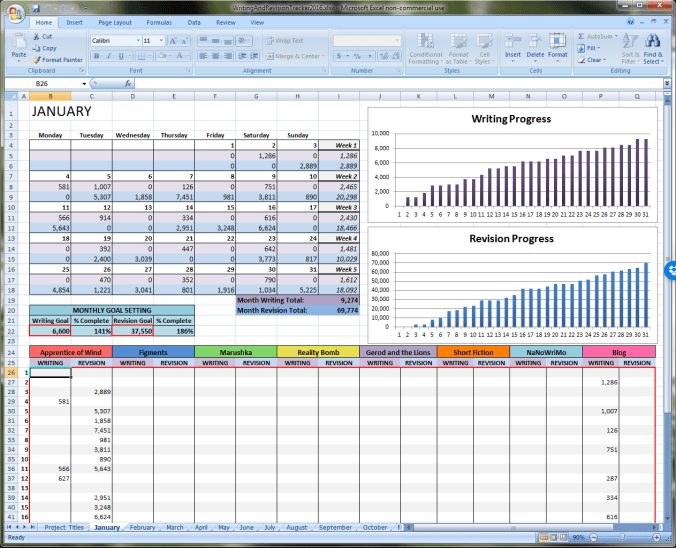
JanuaryProgress

And I even took a few days off (!)

The month started with a couple of days devoted to reading through my draft of Apprentice of Wind, and then I set to. I’ll probably have the first run through done within the next couple of weeks, and then I’m probably going to go through it at least one more time.

So at 9,274 words, I wrote 141% of my writing goal and at 69,774 words, I almost doubled my revision goal (186%).

I also revised and sent out two short stories, and heard that another short story is still under consideration from a submission last year. So that’s awesome.

I also sent out IoS packages to open submission periods for a couple of publishers. As of the end of last year, the three Canadian small publishers I’d pitched last fall had either declined or failed to respond.

We’ll see where all of that gets me.

Other excitement

I’ve attended a few events this past month. The first was Last Stop at the Sudbury Theatre Centre, in which a couple of writer friends had their plays in progress workshopped in front of a live audience (us). It was awesome.

Then, I attended a Skype workshop with Barbara Kyle through the Sudbury Writers’ Guild on adding magic and verve to your first thirty pages. Barbara is an excellent presenter and so knowledgeable about her craft. It’s a pleasure to learn from her.

Finally, I attended a lecture by singer/songwriter Steven Page at Laurentian University on ending the stigma around mental illness. He sang a couple of songs from his new album and discussed his struggles with mental illness.

I’m also currently enrolled in two online courses.

First, I couldn’t resist signing up for Story Genius with Lisa Cron and Jennie Nash. It’s based on Lisa’s new book (of the same name) and is eight weeks long. I’m working on my week four submission this weekend. It’s hard (like, it hurts my poor, tender head hard), especially negotiating the day job and health issues Phil and I are facing right now, but I can see how it’s going to improve my ability to write a novel that will hook readers and keep them reading.

Second, I signed up for Jamie Raintree’s Design a writing career you love workshop. I’m trying to keep one foot in the business side of things. Jamie’s an excellent instructor and I always enjoy her courses.

I’ve booked my hotel for both Ad Astra in April and WorldCon in August and am still waiting for the registration information for The Canadian Writers’ Summit to emerge.

So, I guess it’s no wonder I’m under the weather at the moment.

By and large, though, I love my life. The creative part of it anyway 😉

Next week, the CanCon 2015 reportage continues.

Hope your creative endeavours are moving full steam ahead and that you’re all well on your ways to meeting your goals. Feel free to share your trials and triumphs in the comments below.
The Next Chapter

Thoughty Thursday: Things that made me go hmmmm on the interwebz, Jan 24-30, 2016

Popping your mental corn for . . . a couple of years now, anyway 😉

Walking helps us think. Ferris Jabr for The New Yorker.

Diversity at the Oscars matters. #OscarsSoWhite Cameron Bailey for The Globe and Mail.

I am not black. You are not white.


The bitter experience of residential schools translated through ballet: Going Home. CBC.

Steven Page shared his mental health struggles in Sudbury last Thursday night. The Northern Life.

You are not weak by Devin Sarges.


New Alzheimer’s treatment fully restores memory. Science Alert.

The memory capacity of the brain is ten times greater than previously thought. New Universe Daily.

Mental Floss lists ten legendary monsters of North America.

Plants communicate using a network of fungi. Uplift.

Trees have social networks. Another article on the same topic. The New York Times.

Traces of a 9000 year old civilization discovered in Lake Huron by University of Michigan researchers. Message to Eagle.

Lupus 4 is a dark cloud in space. Phil Plait examines the mysteries of this tentacular hole for Slate.

Lady Science, a new anthology, is helping to stamp out sexism in the sciences. Slate.

A buried ‘daytime hotel’ is rediscovered in all its Art Nouveau splendour. Messy Nessy Chic.

Roger Boisjoly, the engineer who tried to stop the Challenger launch, dies at the age of 73. The LA Times.

Mimi Matthews explores cat funerals in the Victorian era.

And that was Thoughty Thursday.

And guess what? I lied last Saturday when I said I’d be back with more convention reportage. It’s actually Next Chapter time! So, I’ll be back on Saturday with that.

Thoughty Thursday

Tipsday: Writerly Goodness found on the interwebz, 24-30, 2016

The video frenzy has calmed down, but the space has been filled with all kinds of Writerly Goodness!

Your NaNo novel is a hot mess. K.M. Weiland explains how to approach revision and editing.

Katie posted later in the week about how to write realistic fight scenes and later still with the number one problem with backstory (and how to fix it).

Outlining your scenes will help you write a great novel. C.S. Lakin.

Sue returned with another entry in her scene structure series: understanding the truth about character arcs.

Roz Morris gives us a simple way to understand show, not tell.

Everyone is all about structure, the outline, and planning rather than pantsing. Well, I’m proud to identify as a plantser. Steven James explains to Writer Unboxed readers how abandoning your outline can improve your story.

Bonnie Randall guest posts on Janice Hardy’s Fiction University writing about matching actions and emotions.

Christian Cameron writes about war, violence, and killing characters.

Cara Sue Achterberg shares how she added a touch of fantasy to her novel. Author First.

Don’t worry, it only gets harder. Dan Blank explains why it’s important to keep your focus where it belongs. Writer Unboxed.

Kameron Hurley considers kindness and conventions. Later in the week, she’s committed to the drop and offers a few words of advice on non-compete clauses and rights grabs.

The politics of justice: Identity and empire in Ann Leckie’s Ancillary Trilogy. Liz Bourke for Tor.com.

Renee Baum helps us to see writing as surgery for the soul. The Elephant Journal.

The Book of Kells is now free to read online. It’s a masterwork of medieval illumination. Trinity College Dublin.

Jake Rossen asks, why do books have blank pages? Mental Floss.

There’s a new Beatrix Potter story to be published after 100 years. CBC.

Eight words reveal the sexism at the heart of the English language. The Guardian.

Stephen Fry, Ina McKellen, and Melvyn Bragg share their stories for this new online course, Literature and mental health. The Independent.

Hit Record: a different kind of social media. Check it out. It looks awesome.

Shane Koyczan’s Crush:


Outlander casts Brianna for season two. The Hollywood Reporter.

It was a good week. Here’s to another!

See you Thursday 🙂

Tipsday

CanCon 2015 day 2: Magic and magical systems

Panellists: Leah Bobet, Kate Heartfield, Jim Davies, Leah Petersen

KH: Why do we choose to systematize magic?

LP: There are so many ways to approach it. I think the goal is to bring something unique to readers. Generally, epic fantasy means systemic magic.

KH: Have reader expectations changed over time?

LP: If you know what you’re aiming for, you have to dig in.

JD: In Alice in Wonderland and The Wizard of Oz, magic is inexplicable. It’s more wonderful because it’s not explained. Observation yields magic. Understanding saps magic of its wonder. The best solution is to have your magic system generate questions in the reader.

LB: Where do you want to go today? Patricia McKillip is more mystical. Lev Grossman is more systemic. Your story is going to dictate the nature of the magic in it. Magical realism liberated the idea of what magic could be. I could be organic. You need the right tool for the job. People read books for different reasons. Is the reader looking to be challenged or are they looking for the familiar?

JD: I read role-playing game books for pleasure. I had trouble getting through Harry Potter because I felt that there wasn’t anything that couldn’t happen.

LB: Authorial fiat may damage your world building drastically. You might end up with one foot on the cliff and one foot in the air.

KH: The question asked in Grossman’s The Magicians is, who gets to have the magic? Harry Potter never explored that question. How do modern authors address this?

LP: In a book I’ve read recently, every culture within the world had its own magic.

JD: The charm of hidden world stories like Harry Potter is that it could be happening right now. Writers could also be lazy.

LB: Some magic systems play with magic and class. Scarcity implies privilege. What would it be like to be special? Knowledge can be magic. Music can be magic. If magic is important in your story can the average person get it? I am special – magic is internal and only the gifted can access it. This thing is special – the magic is external and anyone can use it. Our systems are a reflection of our enthusiasms as authors.

LP: Increasing diversity means that everyone looks at magic differently.

KH: A great example of that is Aliette de Bodard’s House of Shattered Wings.

LB: In The Shadow Speaker, the pathways to knowledge are difficult.

Q: Can magic and technology work together?

LP: Yes. Look at the Powder Mage trilogy. As technology increases, so does magic.

LB: Elizabeth Bear had one of her characters use divination by MP3 shuffle. That would be cool – an app for magic.

KH: Steampunk conflates technology and magic.

Q: How do you decide that the story you’re writing needs magic?

LB: I had an idea for magic using resonance and chords. It was cool stuff theory. Editors make you justify your bullshit, though.

KH: You have to get into the how of it. Science and technology is to science fiction what magic is to fantasy, generally speaking.

LP: I had to think about how the magic in my story world worked, but do my readers really need to know this?

Q: How quantified does the system have to be?

LB: Theme can be your guide. Like Water for Chocolate used food magic. In [Gabriel Garcia] Marquez, the landscape is magic. In The Cooler, the magic was the character’s ability to dampen luck.

JD: How systematized is systematized? Even if you use spells, unpredictable results may render the magic non-systemic.

LB: Magic cooking would be yummy.

Q: When do you go subtle and when do you sensationalize?

JD: Stage magicians are sensational. People who want you to think they have power work more subtly.

LP: It will depend on the story.

LB: If everything is at a 10, they everything is really at a 1.

Q: Can you talk a little about consequences?

LB: Magic can have social consequences, sour relationships. It can be small, cumulative things. Check out Resurrection Man.

KH: The magic user can get to a point where they’re forever changed by the magic. In The Fisher King legend, the king is linked to the land, so the consequences are not just for him, but for all his people.

LP: The price could be to lose your generative ability. You’re sterilized as an initiation. It’s all up front.

JD: In The Runelords, the cost of magic comes from someone else.

LB: For Ged, in the Earthsea trilogy, the cost is his morality.

And that was time.

Next week: Blood spatter analysis (!) A constable from the OPP explains how it’s really done 😉

Thoughty Thursday: Things that made me go hmmmm on the interwebz, Jan 17-23, 2016

Oh noes! I’ve rediscovered YouTube and the videos have invaded . . .

Canada is named the second best country in the world. How Canadian 🙂 We’re excited about coming in second. Global News.

Some of our new Syrian friends enjoying tobogganing for the first time:


Peter Denton wonders, where have all the readers gone? The Globe and Mail.

Dear parents: Everything you want to know about your son or daughter’s university, but don’t. Michael Enright interviews Ron Srigley for The Sunday Edition on CBC.

Education is performance art. Penn & Teller share their thoughts in The Atlantic.

When Trent Hamm thinks of the times he’s been the happiest, he notices two common threads. The Business Insider.

The powerful benefit of exercise that’s rarely discussed. Guess I’d better get my ass in gear. Quartz.

Dinah Laprarie of NISA champions mental health in Sudbury. CBC.

Cyndi Roberts of The Elephant Journal shares seven steps to easing anxiety without a pill.

Anna Lovind finds her own way to divine guidance 😉

So now a new study says smoking pot doesn’t lower adolescent IQs. IFLS.

Watching a water bubble freeze (in Finland):


Space-X attempted another booster landing last Sunday. And then this happened. Phil Plait, Bad Astronomer, for Slate.

That weird star with the Jupiter-sized planet and the suspected . . . something else orbiting it? Well the more they learn about it the stranger things get. Slate.

A constellation has been named for David Bowie (though it’s not officially recognized yet). IFLS.

Check out this planetary alignment through February 20. IFLS.

Phil Plait features this alignment on his Bad Astronomy column too. Slate.

xkcd charts possible undiscovered planets.

Rick Mercer’s rant on anonymous comments:


Gypsy Vanner horses:


Ms Mr performs “Reckless.”


And that was your week’s edutainment.

Hope you enjoyed it.

See you on Saturday for more CanCon 2015 reportage.

Thoughty Thursday

Tipsday: Writerly Goodness found on the interwebz, Jan 17-23, 2016

There’s as much for you to watch as there is for you to read 🙂

Roz Morris shares three paradoxes of writing life.

Set up and pay off, the two equally important halves of foreshadowing. K.M. Weiland.

Jan O’Hara explores the ethical implications of the writing life with nods to Canadian Prime Minister Justin Trudeau and a disturbing psychological experiment. Writer Unboxed.

Janice Hardy explains the difference between setting and world building. Fiction University.

Kim Bullock is desperately seeking darlings (to kill). Writer Unboxed.

Chuck Wendig has some thoughts for mid-career authors. Terribleminds.

Carly Watters explains how you can write for the market (not to trends) and write for yourself.

Joanna Penn discusses publishing trends in 2016 with Jane Friedman.


Jannifer Garam shares the secret of writing when no one gives a shit. Brilliant!

Hugh Howey offers his advice on how to become a writer. The Wayfinder.

Chris Winkle details the perils of land travel before engines for Mythcreants.

How authors can employ supernatural elements in a non-fantasy story. Authors First.

Carol Daniels shares her experience writing a strong indigenous heroine in response to the pain of history. Quill & Quire.

Iconic science fiction editor David G. Hartwell (yes, the same man who presented The History of SF at CanCon in October) has died. Patrick Nielsen Hayden, Making Light (with links to other tributes).

Kathryn Cramer, David’s wife, wrote this touching post: till death did us part.

Authors call for a boycott on literary festivals that don’t pay. Nadia Khomami for The Guardian.

Jeannine Hall Gailey is disturbed by the plight of the amazing disappearing woman writer. The Rumpus.

Anne Thériault writes about mental illness and the male gaze in the figure of the sexy, tragic muse. Guerilla Feminism.

Plans are in the works for the 162 Arts Hub, a gathering place for artists, centering on indie cinema, right here in Sudbury! Our Crater.

Lisa Cron presents her Wired for Story TED Talk:


The storytelling animal. Jonathan Gottschall’s TED Talk at Furman:


Shayne Koyczan. Turn of a light. So love this.


Mental Floss lists 25 words that are their own opposites. They’re called contronyms.

The Park of Monsters is featured on Atlas Obscura. There’s a literary connection.

Marco Kalantari made this epic science fiction short film called The Shaman. You need to watch it. A-MA-Zing!

When Nichelle Nichols met Martin Luther King Jr.:


Fantasy Fiction Focus interviews Suzy Vadori.


I hope something gave you that special little bit of writerly advice you need to take your WiP to the next level.

See you Thursday!

Tipsday

CanCon 2015 day 2: Writing fiction and fact for Analog

Panellists: Derek Kunsken, Eric Choi, Trevor Quachri, Andrew Barton

AnalogPanel

TQ: With respect to hard science fiction, there’s a soft creep to fantasy, and a hard creep to the uber technical. I care most about character and plot, but the story must make sense scientifically as well.

DK: Eric, since you’ve been published in Analog several times, what is an Analog story to you?

EC: Trevor’s covered it really. I edited an anthology with Ben Bova called Carbide Tip Pens, which has been described as Analog in hard cover.

DK: Is there a quantifiable difference between Asimov’s and Analog?

EC: Both have published my Mars-focused fiction.

DK: I have a track record of stories Stan (editor for Analog) rejected, but Sheila (editor for Asimov’s) bought.

EC: Editorial personalities and preferences do play a role.

DK: Andrew, you’re not a scientist, but you’ve had stories published in Analog.

AB: All of them have been science oriented. I’m not a scientist, but I try to make as few demands on the reader with respect to the science, except for the one big lie that is the basis for the story. I try to be rigorous, but I also try to write an entertaining story.

TQ: I commend Andrew for the material he’s submitted. There’s a misunderstanding out there about how rigorous the science has to be, though. Stan was a physics professor. He’d fact-check. You have to be science literate. You have to do the leg work.

DK: Andrew and Eric, what would be the difference between writing a physics-based story, and writing a chemistry-based story or a biology-based story?

EC: My most recent one was on baseball statistics.

AB: Everything I know about orbital mechanics, I’ve learned from playing Kerbal Space Program.

DK: I tend to write on the biological side of things. One response I received was that I was just showing off what I knew. What I really needed to focus on was the how.

TQ: You have to know how things work.

EC: Don’t limit yourself to a particular type of story. Smash the stereotypes. For “Crimson Sky,” I talked to a pilot and an ER trauma surgeon. Don’t be afraid.

TQ: Culture and biology may be a match. Stan was also into linguistics. Look at Dune. It’s science fiction with fantastic elements. Cultural prediction is interesting is done well. Sometimes it’s about the approach to story rather than the nature of the science involved.

Q: Can you have different physics?

TQ: It could work if you’re rigorous in your created universe.

DK: Let’s turn to non-fiction science articles.

TQ: I never get tired of those. Give me more. They have a popular focus. The information has to be accessible. Balance is key. We also have scientists who read Analog. Science fiction relative is also good, the deconstruction of tropes, idea generation, interesting research. How can a writer use this information? It has to be entertaining.

Q: Should I query first, or just go ahead and write?

TQ: If you’re adamant, go ahead and write, but we also take queries.

Q: Any formatting tips?

TQ: We’re not to picky.

Q: Can we use figures as long as they’re cited?

TQ: That’s no problem as long as they’re right.

DK: Your readers seem to be hungry for everything.

TQ: There needs to be diversity. Don’t be too complacent. Curve balls are important.

DK: What’s the ultimate fate of these stories and articles?

TQ: It falls to the individual authors what happens to the piece after publication. Sometimes there are tie-in “science behind the story” articles, audio versions, etc..

There was then some promotion regarding subscriptions to Analog, as well as where to get sample stories and articles online. It’s all available on the web site. Start there and you won’t go wrong.

Next week: We’re talking magic and magical systems.

Thoughty Thursday: Things that made me go hmmmm on the interwebz, Jan 10-16, 2016

It was a terrible week, in some respects. First, we learned of the death of David Bowie, and only a few days later, of Alan Rickman. Both at the age of 69, and both of cancer. *shakes fist impotently at the powers that be*

Here are a few posts commemorating both men:


The Guardian offers some tips on how to be happy in the New Year.

How to exercise your empathic muscles. The Elephant Journal.

Physician, heal thyself! Why silence is the enemy for doctors who have depression. The New York Times.

IFLS shares Stephen Hawking’s advice for people who suffer from depression.

Thirty nine: a documentary by Tara Henley on CBC’s The Sunday Edition with Michael Enright.

Childhood trauma can result in adult illness. Aeon.

Feministing reports: lesbian families produce an abuse rate of 0%. Then a kind commenter shared this: lesbian mothers’ children. Food for thought, people. Who’s producing these studies and for what reason?

Doug Saunders explains how gun ownership became a ‘right’ in the United States, and why it’s not. The Globe and Mail.

Bonus: Tori Amos’s cover of the Beatles’ “Happiness is a warm gun.”


We had another two earthquakes in the Sudbury area last week. I didn’t feel them, but that makes quite a few in the last couple of years. Is this some kind of message? The Northern Life.

Hootsuite’s CEO got clever and came up with this $25 standing desk solution. Vancouver is Awesome.

Check out this beautiful, underground kingdom. Bright Side.

A 600 million year old mutation is responsible for . . . us (!) The Washington Post.

Scientists believe they’ve found the first fossil bed from the dinosaur extinction. IFLS.

Mapping the ocean floors with gravity. Phil Plait for Slate.

Ice crystals cause this optical phenomenon and ‘draw’ a map of a city in the sky. Slate.

Open Culture brings back the animated Bayeux Tapestry. It’s really something special.

Please, cuddle the cat! It’ll make you feel better.


Quite the thoughty week, if I do say so myself 😉

See you on Saturday for more CanCon 2015 reportage.

Thoughty Thursday

Tipsday: Writerly Goodness found on the interwebz, Jan 10-16, 2016

Of Writerly Goodness, there is much 🙂

Do you re-read your favourite books? K.M. Weiland shares five tips on how you can up the re-readability factor for your novel.

Janice Hardy explains (ha!) what you need to know about show, don’t tell. Fiction University.

C.S. Lakin shares the five essential components of scene structure. Live, write, thrive.

Later in the week, she offers an older post on the same subject: your opening scene.

Jane Friedman shares Mary Buckham’s advice on how writers can craft effective settings.

Chuck Wendig offers five lessons learned from Star Wars: The Force Awakens.

Continuing his ruminations on shame and guilt, David Corbett writes the broken arc for Writer Unboxed.

Lisa Cron wonders, why do we write? Writer Unboxed.

Sarah Callender writes about when to ditch the jammies on Writer Unboxed.

Delilah S. Dawson explains what you really need to call yourself a writer.

Porter Anderson uses Erik Anderson’s discussion of diversity—or the lack thereof—in his reading as a jumping off point to explore the issue of diversity in writing. Writer Unboxed.

Dean Wesley Smith offers some tough love for writers who think they’re starting too late.

Carly Watters compares the various methods of pitching and querying. Which one is best for you?

Susan Spann drops by Writer Unboxed to share some tips for writers on how to obtain reversions of your publishing rights.

Delilah S. Dawson writes about using mindfulness and flow as a way to overcome depression.

Later in the week, she continues with this post: ‘just breathe’ is my new motto.

Inspired in part by Delilah’s posts, Chuck Wendig offers his unique take on self-care for writers. Comfort food for your big, squishy brain.

David Bowie’s death (and her own near-death experience) inspired Kameron Hurley to write this post on creation and legacy: Yes, we’re all going to die.

A horse trainer points out the most common writers’ errors with regard to horses. Dan Koboldt.

Two hundred linguists from the American Dialect Society have declared the singular ‘they’ as word of the year. The Washington Post.

A visual timeline of the future based on famous fiction. Brainpickings.

i09 lists their top 40 science fiction and fantasy books coming out in 2016.

And that was Tipsday!

Come on back for Thoughty Thursday, y’all. Hear?

Tipsday

CanCon2015 day 2: The history of science fiction

Presenter: Dr. David G. Hartwell (and, his site).

DavidHartwell

Sorry for the poor pic. It was the best of the bunch I took 😦

Frankenstein (1818) was actually a collaboration between Mary and Percy Bysshe Shelley. The Bodleian library holds the original manuscripts. They reveal four distinct hands. That it’s the first science fiction written by a woman is therefore debatable.

Aphra Behn, Margaret Cavendish, and Jane Louden could be contenders.

Many of the manuscripts from the early 20th century are now being re-examined.

Facsimile reprints only lasted 15 to 18 years for the research set. Now we have Google Books, Project Gutenberg, and the like.

There have been no organized, concerted efforts dedicated to science fiction. It’s something fun for academic researchers. The early works, in particular, don’t get a lot of attention.

After Shelley, we have Jules Verne (1828 – 1905) and Edgar Allen Poe (1809 – 1849).

Poe was, arguably, not a great writer, but he more or less created genre fiction, specifically mystery, science fiction, and horror.

Kafka (1883 – 1924) and Edward Bulwer Lytton (1803 – 1873) published speculative works as well.

There was a growth in modern nationalism and military invention at the end of the 1800s. The machine gun, the tank, and the air plane. It was largely considered the end of war the way it had always been fought. Governments other than monarchy developed.

More’s Utopia and Plato’s speculations were considered thought experiments. They were never realized.

By the 1890s, there was a large body of work that could be read and mimicked.

George Orwell was considered to have wrote scientific romances.

Currently, it is thought that the ‘important’ science fiction is written in one language, but there are French, German, Polish, and Italian writers in the genre.

Q: What is proto-science fiction?

Science fiction is a conscious effort. If it’s accidental, it’s proto-SF. The second consideration is that there has to have been an audience for the work.

Q: What about other literatures?

There are Arabic texts describing aliens that date back to Medieval times.

Q: Is Tom Swift considered science fiction?

Not really. It’s more adventure.

All imaginative literature got scrunched together and separated from ‘proper’ literature. The fantastic exists in literature since Gilgamesh. That doesn’t mean it was what we consider fantasy.

Q: What’s the difference between a techno-thriller and science fiction?

In the techno-thriller, the changes are temporary. The world reverts to normal. Science fiction tends to change the world permanently.

J.G. Ballard’s work usually involves a disaster of some variety and humanity must live with the results. It’s not the optimistic attitude of most science fiction.

Between 1920 and 1940, the literary establishment had to start excluding written material to maintain their elitism. The typical modernist text of the time was normal life with psychological insight.

John Updike wrote about The World Treasury of Science Fiction. He said it couldn’t be first rate literature.

The attitude of the literary establishment toward science fiction is not acceptable.

Q: Could you comment on Orwell? What about Huxley and Burgess?

Burgess liked reading science fiction, but his only analogue is A Clockwork Orange. Orwell wrote in the tradition of H.G. Wells. He would have been appalled if anyone called him a science fiction author.

Science fiction and fantasy are marketing categories.

Genre is an interaction between the author, the text, and the reader. There’s direct feedback. The traditional genres (literature, drama, poetry) don’t necessarily have that.

There was a fair amount that I didn’t get written down with this particular presentation, but it was still a great source of information. It filled in a few gaps for me from my previous studies. I have a feeling that Dr. Hartwell could have kept going 🙂

That’s it for this week.

I’m off to Bedfordshire (as in bed).

TTFN!