Iconic science fiction editor David G. Hartwell (yes, the same man who presented The History of SF at CanCon in October) has died. Patrick Nielsen Hayden, Making Light (with links to other tributes).
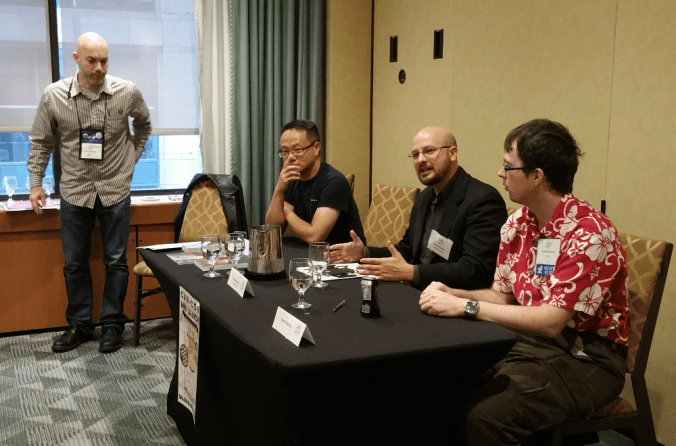
TQ: With respect to hard science fiction, there’s a soft creep to fantasy, and a hard creep to the uber technical. I care most about character and plot, but the story must make sense scientifically as well.
DK: Eric, since you’ve been published in Analog several times, what is an Analog story to you?
EC: Trevor’s covered it really. I edited an anthology with Ben Bova called Carbide Tip Pens, which has been described as Analog in hard cover.
DK: Is there a quantifiable difference between Asimov’s and Analog?
EC: Both have published my Mars-focused fiction.
DK: I have a track record of stories Stan (editor for Analog) rejected, but Sheila (editor for Asimov’s) bought.
EC: Editorial personalities and preferences do play a role.
DK: Andrew, you’re not a scientist, but you’ve had stories published in Analog.
AB: All of them have been science oriented. I’m not a scientist, but I try to make as few demands on the reader with respect to the science, except for the one big lie that is the basis for the story. I try to be rigorous, but I also try to write an entertaining story.
TQ: I commend Andrew for the material he’s submitted. There’s a misunderstanding out there about how rigorous the science has to be, though. Stan was a physics professor. He’d fact-check. You have to be science literate. You have to do the leg work.
DK: Andrew and Eric, what would be the difference between writing a physics-based story, and writing a chemistry-based story or a biology-based story?
EC: My most recent one was on baseball statistics.
AB: Everything I know about orbital mechanics, I’ve learned from playing Kerbal Space Program.
DK: I tend to write on the biological side of things. One response I received was that I was just showing off what I knew. What I really needed to focus on was the how.
TQ: You have to know how things work.
EC: Don’t limit yourself to a particular type of story. Smash the stereotypes. For “Crimson Sky,” I talked to a pilot and an ER trauma surgeon. Don’t be afraid.
TQ: Culture and biology may be a match. Stan was also into linguistics. Look at Dune. It’s science fiction with fantastic elements. Cultural prediction is interesting is done well. Sometimes it’s about the approach to story rather than the nature of the science involved.
Q: Can you have different physics?
TQ: It could work if you’re rigorous in your created universe.
DK: Let’s turn to non-fiction science articles.
TQ: I never get tired of those. Give me more. They have a popular focus. The information has to be accessible. Balance is key. We also have scientists who read Analog. Science fiction relative is also good, the deconstruction of tropes, idea generation, interesting research. How can a writer use this information? It has to be entertaining.
Q: Should I query first, or just go ahead and write?
TQ: If you’re adamant, go ahead and write, but we also take queries.
Q: Any formatting tips?
TQ: We’re not to picky.
Q: Can we use figures as long as they’re cited?
TQ: That’s no problem as long as they’re right.
DK: Your readers seem to be hungry for everything.
TQ: There needs to be diversity. Don’t be too complacent. Curve balls are important.
DK: What’s the ultimate fate of these stories and articles?
TQ: It falls to the individual authors what happens to the piece after publication. Sometimes there are tie-in “science behind the story” articles, audio versions, etc..
There was then some promotion regarding subscriptions to Analog, as well as where to get sample stories and articles online. It’s all available on the web site. Start there and you won’t go wrong.
Next week: We’re talking magic and magical systems.
It was a terrible week, in some respects. First, we learned of the death of David Bowie, and only a few days later, of Alan Rickman. Both at the age of 69, and both of cancer. *shakes fist impotently at the powers that be*
Bonus: Tori Amos’s cover of the Beatles’ “Happiness is a warm gun.”
We had another two earthquakes in the Sudbury area last week. I didn’t feel them, but that makes quite a few in the last couple of years. Is this some kind of message? The Northern Life.
Porter Anderson uses Erik Anderson’s discussion of diversity—or the lack thereof—in his reading as a jumping off point to explore the issue of diversity in writing. Writer Unboxed.
Dean Wesley Smith offers some tough love for writers who think they’re starting too late.
Inspired in part by Delilah’s posts, Chuck Wendig offers his unique take on self-care for writers. Comfort food for your big, squishy brain.
David Bowie’s death (and her own near-death experience) inspired Kameron Hurley to write this post on creation and legacy: Yes, we’re all going to die.
Sorry for the poor pic. It was the best of the bunch I took 😦
Frankenstein (1818) was actually a collaboration between Mary and Percy Bysshe Shelley. The Bodleian library holds the original manuscripts. They reveal four distinct hands. That it’s the first science fiction written by a woman is therefore debatable.
Aphra Behn, Margaret Cavendish, and Jane Louden could be contenders.
Many of the manuscripts from the early 20th century are now being re-examined.
Facsimile reprints only lasted 15 to 18 years for the research set. Now we have Google Books, Project Gutenberg, and the like.
There have been no organized, concerted efforts dedicated to science fiction. It’s something fun for academic researchers. The early works, in particular, don’t get a lot of attention.
After Shelley, we have Jules Verne (1828 – 1905) and Edgar Allen Poe (1809 – 1849).
Poe was, arguably, not a great writer, but he more or less created genre fiction, specifically mystery, science fiction, and horror.
Kafka (1883 – 1924) and Edward Bulwer Lytton (1803 – 1873) published speculative works as well.
There was a growth in modern nationalism and military invention at the end of the 1800s. The machine gun, the tank, and the air plane. It was largely considered the end of war the way it had always been fought. Governments other than monarchy developed.
More’s Utopia and Plato’s speculations were considered thought experiments. They were never realized.
By the 1890s, there was a large body of work that could be read and mimicked.
George Orwell was considered to have wrote scientific romances.
Currently, it is thought that the ‘important’ science fiction is written in one language, but there are French, German, Polish, and Italian writers in the genre.
Q: What is proto-science fiction?
Science fiction is a conscious effort. If it’s accidental, it’s proto-SF. The second consideration is that there has to have been an audience for the work.
Q: What about other literatures?
There are Arabic texts describing aliens that date back to Medieval times.
Q: Is Tom Swift considered science fiction?
Not really. It’s more adventure.
All imaginative literature got scrunched together and separated from ‘proper’ literature. The fantastic exists in literature since Gilgamesh. That doesn’t mean it was what we consider fantasy.
Q: What’s the difference between a techno-thriller and science fiction?
In the techno-thriller, the changes are temporary. The world reverts to normal. Science fiction tends to change the world permanently.
J.G. Ballard’s work usually involves a disaster of some variety and humanity must live with the results. It’s not the optimistic attitude of most science fiction.
Between 1920 and 1940, the literary establishment had to start excluding written material to maintain their elitism. The typical modernist text of the time was normal life with psychological insight.
John Updike wrote about The World Treasury of Science Fiction. He said it couldn’t be first rate literature.
The attitude of the literary establishment toward science fiction is not acceptable.
Q: Could you comment on Orwell? What about Huxley and Burgess?
Burgess liked reading science fiction, but his only analogue is A Clockwork Orange. Orwell wrote in the tradition of H.G. Wells. He would have been appalled if anyone called him a science fiction author.
Science fiction and fantasy are marketing categories.
Genre is an interaction between the author, the text, and the reader. There’s direct feedback. The traditional genres (literature, drama, poetry) don’t necessarily have that.
There was a fair amount that I didn’t get written down with this particular presentation, but it was still a great source of information. It filled in a few gaps for me from my previous studies. I have a feeling that Dr. Hartwell could have kept going 🙂
A quick disclaimer, since I haven’t provided one recently. These posts are transcriptions of my notes from the panels in question. There will be errors. If you can provide clarification of correction of any of the information provided, please do not hesitate to do so. I will make any corrections post hasty.
Update: Feb 4, 2016. Ariella was gracious enough to give me some additional notes 🙂 These have been added with brackets.
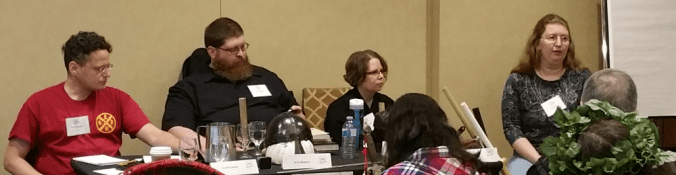
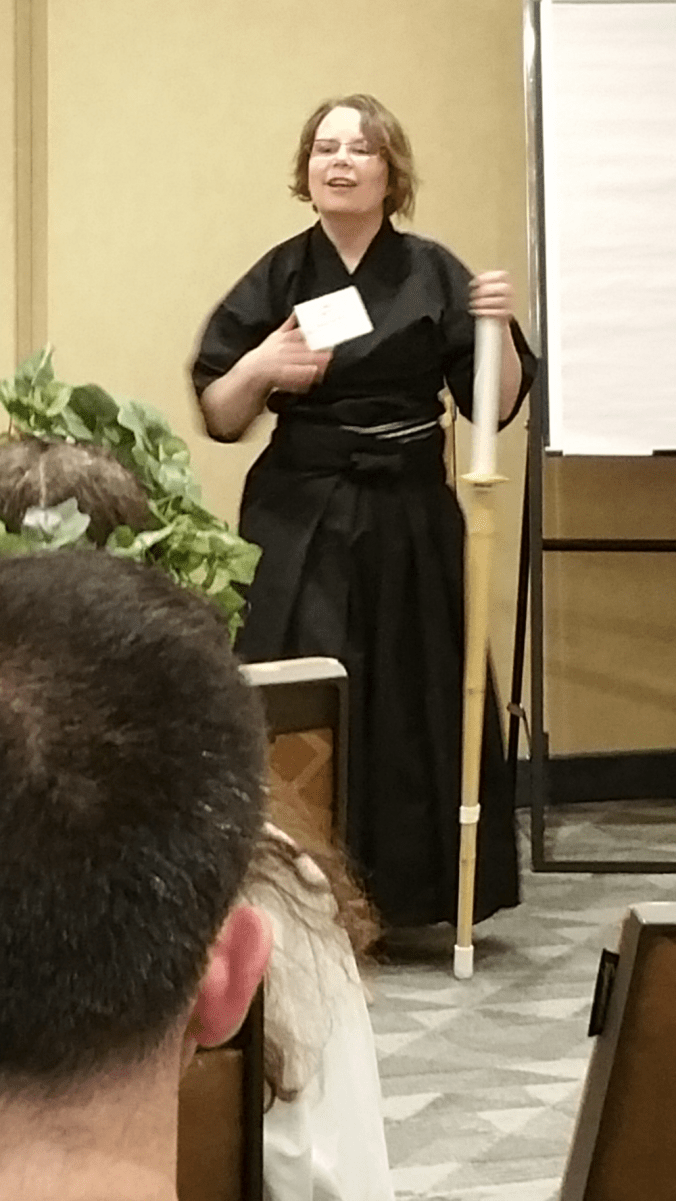
GG: What bugs you most about how most movies and television shows represent sword fighting?
KR: Flynning. Named after Errol Flynn. It’s all the swahbuckling stuff that would never work in real life. When it’s done well, you can’t tell an actor is Flynning. If not, it’s terrible. The last Three Musketeers movie is an example. You try to stay out of blade range when you’re fighting with a sword.
RR: I hate it when actors fight with a katana and cut through the opponent’s body. It would get stuck. The first two inches of the blade is the dangerous part.
KR: Swords are only for when you’ve run out of all other means of attack.
RR: And samurai using two katana? One is heavy enough. Musashi carried two, but is was a shorter blade and a katana, not two katana.
AE: A ‘case’ of rapiers. It can be done. It’s a flashy trick for duels, but it requires mastery of use in both dominant and non-dominant hands.
KR: Longer weapons tend to flex and it makes them less deadly. A shorter weapon is deadlier. When using two blades, it’s usually one long and one short. The longer blade deflects, and the shorter blade is used to kill.
GG: How has swordplay changed, historically?
AE: With armour, the shield became redundant. [More precisely, the development of complete suits of plate armour in late fourteenth-century Europe made shields less necessary. Having two hands on a sword gives you the leverage to cut faster with a longer blade.] The second hand was used on the sword for more power. The Germans placed the emphasis on speed. [IIRC, this comment was specifically about the differences in style between Italian and German masters in the fifteenth century. Fiore dei Liberi, an Italian master, seems to have been fond of moving into close range. His treatise, The Flower of Battle, has a lot of instructions for grappling, disarms, and pommel smashes in the face. The German masters, especially the later ones, tend to put more emphasis on the things you can do a little farther out at cutting range. This may be a reflection of the fact that Fiore was teaching people who were likely to face heavily armoured opponents, while the later Germans had a tradition of holding unarmoured tournaments.] When fighting in a tournament, knights fought at sword range.
KR: There was an older, battlefield style that included bo, naginata, and grappling.
Q: When did they stop having tournaments?
GG: It depends on the culture.
AE: I wrote my PhD dissertation on it. Trial by Battle in France and England. Tournaments ran from about 1050 – 1250. The last big tournament was in France in 1455. [1455 was the year of the last judicially-sanctioned trial by battle in the territory of what is now France. Subsequent duels were not organized by courts of law. The last trial by battle in England that came to blows was in 1456, but there were some outlying attempts to revive the practice in the 1650s and the early nineteenth century. Fencing tournaments of one sort or another have existed pretty much continuously since the Middle Ages.] There were outliers as late as the 1650’s. By and large, fire arms took over. Usually, they missed each other.
KR: There were cavalry charges with swords as late as WWII.
AE: By that time, though cavalry was a combination of horses and vehicles.
AE: Charles Jevins (?). [Charles Jevons is a terrific maker of aluminum practice swords. His site is here: http://www.swordcrafts.com/] He uses aluminium these days. Weight and balance of a steel sword can be duplicated, but there’s greater safety because of a thicker edge. You can get steel swords as well. It will run you anywhere between $300 and $2500.
Q: What was the historical cost of a sword?
KR: It’s hard to say. Again, it would depend on the culture. Initially, Japanese swords were made from crap steel. Then, they learned how to make it durable. It took months to craft and took two smiths to make. They’d quench them in clay.
AE: In the thirteenth century, the cost was about 12 pence. That’s about two weeks of wages for the average peasant. [Here’s a place where the Historical European Martial Arts community has collected some data on medieval European sword prices: http://www.fioredeiliberi.org/phpBB3/viewtopic.php?f=4&t=18566]
KR: The Vikings were very poor. That’s why they raided. They had to go out to get what they needed to survive.
Q: In 1966, I bought a Japanese katana for $400.
KR: Now they’re made in a Chinese factory.
Q: Can anyone carry a sword, or do you need a permit?
AE: In Canada, it’s technically legal, but you could cause a disturbance by walking around with one and get into trouble that way. I have white lady privilege, though. I can walk through the financial district of Toronto carrying my sword. Only the panhandlers notice. [I admit to having done this quite close to the financial district. It was probably dumb. I don’t recommend trying it yourself: results may vary. Sword canes almost certainly fall under the category of concealed knives, but I don’t know of any legal cases that have set definitive precedents on the matter. I’m a medieval legal historian, not a lawyer, so don’t take anything I say for legal advice. 🙂 ]
Q: How about cane swords?
AE: It’s a grey area. It could be considered a concealed weapon.
Q: What do you think of the sword work in Sparticus?
AE: The fight director might be Philippine influenced. The theory is that the Medieval Arabs taught everyone sword fighting. [My personal hypothesis is that medieval Arab sword arts influenced both Chinese and European fencing theory. There are quite a few medieval martial arts treatises in Arabic that have not yet been edited or translated into any European language. The oldest one dates from the mid ninth century CE.]
KR: There are only so many ways you can move with a sword.
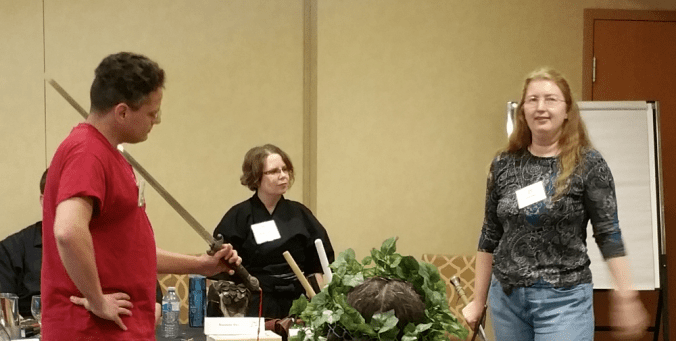
Demo ensued.
We didn’t really get into the Viking axe, sorry to say.
Next week, we’ll delve into the history of science fiction from an academic perspective.
If you’ve seen SW:TFA, you may remember that island where Ray finds you-know-who at the end. Guess what? It’s a real place: Skellig Michael, in Ireland. Irish Central.