The next chapter: July 2019 update

So … here we are in the dog days of August. The spring may have been a late one but, as it did last year, the temperature rose quickly. We had to use out portable air conditioner a couple of nights in June and a couple more in July. I find myself wondering if the weather will continue hot. It’s interesting (to me) to observe the effects of climate change locally.

The month in writing

July was a quiet month. I continue my review of the Ascension series at a snail’s pace. I’m only up to reviewing the first part of book two at the moment. I blame work, but really, I think I just need a break. I’ve just had five days off and I haven’t looked at it … I may try to turn that around.
JulyProgress

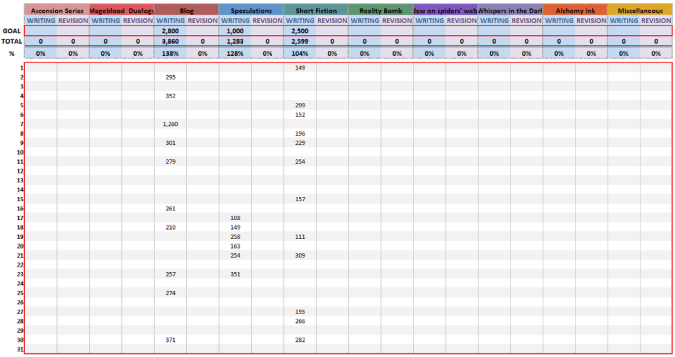
I continue to revise January’s short story. It’s closer, but not quite “there” yet. There’s more work to be done. February’s story waits in the wings. I set myself the goal of writing 2,500 words of short fiction in July and wrote 2,599 words or 104% of my goal.

I blogged 4,695 words of my 2,800-word goal, or 169%. This was largely because I finally got around to writing a book review. I have a backlog of them pending so expect more in the coming weeks. I may have to reconsider my blogging goals accordingly.

Finally, I wrote my latest Speculations column in 1,283 words, or 128% of my 1,000-word goal.

It was a decent month, writing wise, but quiet, as I said.

Filling the well

July 15th marked my 25th wedding anniversary with Phil. I mentioned on social media that it doesn’t seem like that much time has passed and yet I find it difficult to remember life without Phil. That’s not true, I have a lot of pre-Phil memories, but they’ve taken on a surreal quality, like they’re artefacts from someone else’s life.

On the 6th, my sister-in-law threw us a nice, quiet party. Just the Moms and some family friends. It was a lovely day.

The other writerly event I attended was Ad Astra, which was from July 12-14. I went down July 13 and came back July 14, so it was a bit of a whirlwind, but I still attended some great panels and met up with some writerly friends.

What I’m watching and reading

Phil and I watched the last season of Jessica Jones. It was disappointing, but I think that came of trying to turn a non-powered person, Sallinger, into an effective villain who managed to stymie the police, Jessica, Trish, Malcolm and J’s new boyfriend, AKA, headache boy 🙂 Jeri’s sub-plot was all over the place which, in turn, messed up Malcolm’s. Jessica’s reconciliation with Trish was never genuine and it was unsurprising when—SPOILERS!—the newly-minted Hellcat was arrested.

At the end, Jessica’s about to leave New York, dispirited by Trish’s downfall, her adopted mother’s death (following on the heels of her birth mother’s death at Trish’s hands), and her failure to bring Sallinger to justice. She’s broken up with her boyfriend, referred him to Costa as a CI, and handed the key to Alias Investigations to Malcolm.

As she’s purchasing her train ticket to a randomly chosen destination, Killian’s voice tells her how right she is to give up. Jessica’s surrounded by the violet light that is her first nemesis’s signature and she turns away from the ticket counter, smiling, while the camera pans wide and fades to black. Odd choice for a series ending.

We also watched the final season of i, Zombie, which was more satisfying, but a little contrived. I thought that—AGAIN SPOILERS!—Liv and Major’s decision to remain zombie, raising their zombie family and providing a home for all the zombies who couldn’t, or didn’t want to, be cured … odd. Not because they wouldn’t have done it. They would so have sacrificed their human lives to help others, but the reasons for their choosing this life arise so late in the game that it belies their previous and oft-expressed desires to the contrary.

No movies this month.

Reading-wise, I loved Lauren B. Davis’s The Grimoire of Kensington Market. It was a retelling of The Snow Queen but had a feminist flavour and living/mystical stores, which is a trope I’m fond of. I won’t say much more because this is another novel you should really pick up for yourself.

I also read Eden Robinson’s Son of a Trickster and, again, loved it. I find I’m really enjoying indigenous stories these days. I recommend it highly.

I read La Brigantessa, written by writerly friend Rosanna Micelotta Battigelli. This novel was historical fiction set in post-Unification Italy. It focuses on the journey of Gabriella and the event that force her to flee her village to eventually seek sanctuary with the brigands of the Aspromonte mountains.

Then, I read Jim Butchers The Aeronaut’s Windlass, which I enjoyed. I’m looking forward to the next instalment of the Cinder Spires series. While I loved Rowl, I thought it strange that he was the powerful figure in the cat world. Like the great cats, feral populations are generally matriarchies.

I liked the ensemble cast with their unique characteristics and abilities. Bridget’s ability to talk to cats, Benedict’s warrior-born, feline qualities, and the Etherealists’ insanity. This last was fascinating. Every Etherealist is twisted by the etheric forces they work with, but each, in order to control their madness, channels it into one aspect or obsession. Master Ferus needs collections of very specific things, his apprentice Folly can’t speak directly to anyone but her etheric crystals, and Sycorax is obsessed with etiquette and politeness. I’m curious to see more.

Next, I dove into Emma Newman’s Any Other Name, the second in her Split Worlds Series. The first novel left off on an uncomfortable note, with Cathy in an arranged, and forced, marriage. Her mother actually drugs her into acquiescence. The theme continues with Cathy’s new husband alternately trying to convince her to “make a go” of it, and using charms to coerce her into bed so they can a) consummate their marriage before either of their fae lords takes exception and b) conceive the child that is Cathy’s primary obligation in the arrangement.

The fae lords are manipulative in their own ways as are the family patroons. Charmed rings that enforce fidelity, charms that guarantee a boy at conception, and demands that Cathy become duchess of London and to keep up the appearances due her new station.

Meanwhile, Max continues to look into the mystery of the bath chapter’s destruction and Sam grows increasingly concerned about his wife’s promotion and new flat.

I read Story Arcana, by Caroline Donahue, ostensibly about using the major arcana of the tarot as a structure guide for both the novel and the writer’s life. I became aware of Donahue and her book through an interview with Joanna Penn on the Creative Penn podcast. While I found the book useful, it was poorly edited and largely a promotional tool for Donahue’s online course of the same name, site, and podcast. The podcast looks good and I’ll probably tune in. I was just a little disappointed in the presentation.

Finally, I read Joe Mahoney’s A Time and a Place. I enjoyed the story, loved the T’Klee, the novel’s cat-like aliens, and appreciated the parallels to T.H. White’s The Sword in the Stone. The execution wasn’t quite up to the premise, though.

Look forward to reviews of most of these books over the coming months.

And that was this month in this writer’s life.

Until tipsday, be well, be kind, and stay strong. The world needs your stories!
The Next Chapter

Thoughty Thursday: Things that made me go hmmmm on the interwebz, July 21-27, 2019

Since I’m a learning mutt, the stuff that interests me runs the gamut. I hope something here pops you mental corn. They did mine 🙂

This week, a couple of disturbing images were shared online about vulnerable populations in downtown Sudbury. I will not share them. My brave and thoughtful friend, Kim Fahner, was moved to post about it: a reflection on despair, mental health, and being mindful of one another when it’s not always popular to do so. Choose compassion people. There but for the grace of God go I. The Republic of Poetry

A group of young people on Manitoulin Island spent the last month crafting a birch bark canoe like their Anishnaabe ancestors. CBC’s “Up North” with Waubgeshig Rice.

Marina Koren tells the story of JoAnn Morgan, the Apollo engineer who almost want allowed in the control room. The Atlantic

It’s okay to be smart tries to figure out why we haven’t found evidence of other technological civilizations in the galaxy yet.

Physics Girl follows up with how we’re looking for life within our solar system.

Marjan Yazdi invites us to learn about the ancient art of henna-making in modern-day Iran. Ozy

Bob Holmes reveals how archaeologists study the common peoples of the past. Knowledgeable

SciShow Psych looks at the sunk cost fallacy.

Neville Ellis considers hope and mourning in the Anthropocene: understanding ecological grief. The Conversation

It’s okay to be smart considers the wood wide web.

Thank you for stopping by. This weekend, I’ll be composing my next chapter update for July. You’re welcome back if you want to find out what I’ve been up to.

Until then, be well!

ThoughtyThursday2019

Tipsday: Writerly Goodness found on the interwebz, July 21-27, 2019

July is winding down and we’re heading into the dog days of summer: August. We’ve already had more than our share of hot, humid days—fact, I’m not complaining—and I’m trying to make the most of each one. I hope you’ve been making meaningful progress in your creative projects.

It’s time to reward yourself with some informal writerly learnings 🙂

Janice Hardy offers a Sunday writing tip: reveal something new in every scene. Then she wonders, are you asking—and answering—the right story questions? Fiction University

Alexa Donne talks about nailing your beginnings (first sentence through first act).

Tracy Hahn-Burkett says, if you want to make a difference, tell a story. Heather Webb offers some notes from a book tour. Keith Cronin shares some serious lessons from a fool on a hill. Writer Unboxed

K.M. Weiland explains how to make your plot a powerful thematic metaphor. Helping Writers Become Authors

Jenn Walton says, let your imagination run wild. Gabriela Pereira crawls inside the mind of a worldbuilding junkie with Fonda Lee. DIY MFA

Angela Ackerman visits Writers in the Storm to discuss character building for pantsers.

Jenna Moreci discusses some of the differences between flat and round characters.

Justin Attas wants you to create a credible magic system. Writers Helping Writers

Lisa Bell wonders, is your writing plan ready for a crisis? Jami Gold

Chris Winkle explains what storytellers should know about normalization. Choose compassion. Write stories that normalize the positive. Then, Oren Ashkenazi examines five stories with premises that don’t suit their settings. Mythcreants

Structuring a chapter. Reedsy

CBC books recommends ten Canadian science fiction and fantasy books you should be reading.

Ada Hoffman is moving towards a neurodiverse future by writing an autistic heroine. Tor.com

Thanks for visiting. I hope you’ve found something for your writerly toolkit.

If you’re looking for some inspiration or research material, be sure to come back on Thursday for some thoughty links.

Until then, be well, my friends 🙂

Tipsday2019

Review of The Sorrow Stone by J.A. McLachlan

I’ve been a fan of Jane Ann’s for some time and when I saw that she was launching her latest historical fiction novel at 2018’s Ad Astra, I had to pick up a copy. Jane Ann is an excellent storyteller and The Sorrow Stone did not disappoint. I have been lax in my commitment to write reviews for my author friends. I read The Sorrow Stone some time ago and I’m only now rectifying my tardiness in writing my review.

TheSorrowStone

What Amazon says:

Winner of the Royal Palm Literary Award for Historical Fiction.

What if you could pay someone to take away your sorrow?
In the middle ages people believed a mother mourning her child could “sell her sorrow” by selling a nail from her child’s coffin to a traveling peddler.

Lady Celeste is overwhelmed with grief when her son dies. Desperate for relief, she begs a passing peddler to buy her sorrow. Jean, the cynical peddler she meets, is nobody’s fool; he insists she include her ruby ring along with the nail in return for his coin.

A strange but welcome forgetfulness comes over Celeste when the transaction is completed – until she learns that without her wedding ring her husband may set her aside, leaving her ruined. She embarks on an urgent journey to retrieve it. But how will she find the peddler and convince him to give up the precious ruby ring?

Pretending to be on pilgrimage, Lady Celeste secretly hunts for the peddler. In dreams and brief flashes her memory begins to return, slowly revealing a dangerous secret buried in her past. Will she learn what she needs to know in time to save herself, or will the knowledge destroy her?

If you like realistic, well-researched historical fiction with evocative prose, complex characters and a unique story, you’ll love The Sorrow Stone. Travel to 12th Century France with this compelling story based on an actual medieval superstition.

“J. A. McLachlan is a terrific writer — wry and witty, with a keen eye for detail.”
~ Hugo award-winning author Robert J. Sawyer
“Strong, character-driven fiction — McLachlan makes you both care and think. You can’t ask for more.”
~ Aurora award-winning author Tanya Huff

My thoughts:

While this novel is somewhat of a departure from her adult and young adult science fiction publications, the inspiration for the story is a superstition and fantastic elements infuse the novel.

In the wake of the transaction that forms the inciting incident, Celeste is not only forgetful, but she’s also lost her capacity to feel compassion in any form, making her alien to her lady’s maid, the nuns of the convent she’s been sent to for her recovery, and the clergy and pilgrims she meets on her journey.

The only thing she’s certain of, at first, is that something terrible happened that sent her to the convent and, because she can no longer feel the love she once did for her dead child or her husband, while she knows the something terrible involves her infant’s death, she can only assume that her life had been one of cruelty and pain to have resulted in her current state of health. Celeste uses her mind and sense of logic, skewed because of her lack of feeling, to try to unravel the mystery.

She’s afraid of revealing her compromised state to anyone and engages is some radical behaviour to achieve this end. She travels with only her maid as a companion, she seeks the means to become independent, and she tries to track down the merchant to whom she traded her sorrow and her wedding ring with the intent of reclaiming only the ring and not her emotion, now viewing it as a weakness. Her actions in pursuit of these goals verge on cruel.

For his part, the pragmatic merchant Jean finds his life plagued by unwanted compassion. He wants to rid himself of Celeste’s ring and the sorrow attached to it, but his every attempt to do so ends in failure or worse. After he recovers from a robbery and assault that nearly results in his death, Jean returns home to find his bad luck extends to his family. His daughter is seriously ill and may die if he doesn’t find the means to set things right.

The outcome of these intertwined journeys involves a mystery, betrayal, and greed on multiple levels. As Celeste’s husband pursues her, thriller elements come into play. Can Celeste reclaim her ring before her husband catches up to her and finds out what she’s done?

The Sorrow Stone is a complex story about how important it is to achieve a balance between logic and emotion, the destruction that greed engenders, and the revelatory and healing powers of love.

My rating:

Four out of five stars.

I really liked it 🙂

I’m going to try to catch up on my review obligations over the next weeks, so you can look forward to more reviews on writerly goodness.


Thoughty Thursday: Things that made me go hmmmm on the interwebz, July 14-20, 2019

It’s time to get your mental corn popping. Let’s get started with some lunacy in honour of the 50th anniversary of the moon landing 🙂

Alexandra Witze says these young scientists will shape moon research for the next 50 years. Nature

Eli Glasner talks to astronauts about which movies have “the right stuff.” CBC

Proof that Sudbury was mentioned on the moon. We live up here

Nicole Mortillaro: Sudbury was a stand-in for the moon and other, little-known (Canadian) things about the Apollo program. CBC

Veritasium looks at why astronauts also trained at a nuclear test site.

Molly Hennessy-Fiske explains how the women of NASA made their mark on the space program. LA Times

And … from Mary Robinette Kowal: to make it to the moon, women have to escape Earth’s gender bias. The New York Times

Alexander Rose wants to make something that lasts 10,000 years. BBC

Mark Gollom report on how Zoe the police dog sniffed out two missing girls in Algonquin Park. CBC

Laura Staugaitis shares the shadowed beauty of DAKU’s “Theory of Time” street installation. This is Colossal

Viktorija Gabulaité and Jonas Grinevičius introduce us to Australia, AKA, the land of nope. Bored Panda

Thank you for taking the time to visit, and I hope you found some inspiration for your next creative project (or a current one).

Until next tipsday, be well, be kind, and stay strong. The world needs your stories 🙂

ThoughtyThursday2019

Tipsday: Writerly Goodness found on the interwebz, July 14-20, 2019

The weeks continue to march along, whether we want them to or not. Summer’s passing too fast! Console yourself with some informal writerly learnings.

Jan O’Hara extolls the life-changing magic of zeroing non-writing commitments. Carol Newman Cronin says, there are no wasted words: power to the pantsers! Julie Carrick Dalton is interrogating characters about their motivations. Writer Unboxed

Manuela Williams looks at five mistakes you’re making with your author brand (and how to avoid them). Pamela Taylor is extrapolating the past. DIY MFA

Reedsy examines the chosen one trope.

Robert Lee Brewer: everyday vs. every day. Writer’s Digest

Jeri Bronson’s married to a coroner and she explains the hows, whys and the WHAT?! Writers in the Storm

Jenna Moreci answers all your critique partner questions.

Lisa Cron poses three simple questions that will unlock your story. Writers Helping Writers

Nathan Bransford explains how authors make money.

Angela Ackerman visits Jami Gold’s blog to explain how to avoid the boring stuff in character descriptions. Then, Kassandra Lamb stops by: what’s the right way to include multiple POVs?

Oren Ashkenazi examines six stories with failed turning points. Mythcreants

Nina Munteanu considers Vonnegut’s ice-nine and superionic ice. Science!

Thanks for stopping by, and I hope you found something you need to help you with your current work in progress.

Until Thursday, be well, my writerly friends!

Tipsday2019

Thoughty Thursday: Things that made me go hmmmm on the interwebz, July 7-13, 2019

And, once again, it’s time to get your mental corn popping!

Michele Adelman reports on how Ford cuts have unleashed a crisis of conservation. Now Toronto

Physics Girl visits the first gravitational wave detector—LIGO. Stellar

SciShow Space looks at how a tank of water could change physics forever (AKA looking for evidence of a GUT).

Robin McKie: everyone’s going back to the moon. But why? The Guardian

Anne Collins Goodyear: long before Armstrong and Aldrin, artists were stoking dreams of space travel. The Conversation

The secret language of trees – Camille Defrenne and Suzanne Simard. Ted.ed

Erin Biba says, in the real world, Simba’s mom would run the pride. National Geographic

Sara Barnes: photographer spends years taking poignant portraits of animals on the brink of extinction. Beautiful. My Modern Met

And that was thoughty Thursday. I hope you found something to spark your next great work 🙂

Until next tipsday, be well, be kind, and stay strong. The world needs your stories!

ThoughtyThursday2019

Tipsday: Writerly Goodness found on the interwebz, July 7-13, 2019

Looking for some informal writerly learnings? Here they are!

Jim Dempsey offers some fiction therapy: achieve your writing goals. Juliet Marillier explains why editing matters. Then, David Corbett shares the content of his Thrillerfest workshop about characters in search of a moral compass. Writer Unboxed

Sacha Black explains why every novel needs a sprinkling of fear. Writers Helping Writers

How to write with multiple POVs. Reedsy

Julie Cantrell wonders, should authors break free from their brands? Then, Julie Glover shares seven tips for finding a great critique partner. Writers in the Storm

Jenna Moreci shares her top ten romance tropes.

Rebecca Fish Ewen explains how to draw nothing. DIY MFA

Chris Winkle lists five information technology blunders and how to fix them. Then, Oren Ashkenazi examines five popular tropes writers struggle with. Mythcreants

Show, don’t tell, the Reedsy way.

Nathan Bransford explains why Robert Louis Stevenson’s Treasure Island works. This novel was one of two I focused on for my independent study in grade 12 English class. I have a fondness, and a bias 😉

I’m putting this in tipsday, because reasons. The Lost Words Blessing – The Lost Words.

Thanks for stopping by and I hope you found something useful.

Until Thursday, be well, my writerly friends!

Tipsday2019

Thoughty Thursday: Things that made me go hmmmm on the interwebz, June 30-July 6, 2019

It’s time to get your mental corn popping 🙂

Sabrina Imbler covers the forgotten trans history of the wild west for Atlas Obscura.

Nicole Cliffe interviews Alanis Morissette on being pregnant at 45, childbirth, post-partum depression, and #metoo. You might be surprised, but I like Alanis Morissette. I’ve been a fan since she was on “You can’t do that on television.” I’ve only really liked her music since Jagged Little Pill, but, ya know, I was never into the pop princesses. And Alanis wasn’t either. She didn’t want to follow that path. I’m glad she didn’t. Self

SciShow Psych explores whether you can learn emotional intelligence.

Kris Newby recounts one family’s journey to a diagnosis of Lyme disease. It felt like the flu. It took ten doctors, a year, and $60,000 to find out the truth. Vox

It’s okay to be smart looks at what it takes to create a world-sized telescope to see a black hole.

This is just something cool: ceramic skulls for your fire pit or fireplace. Can You Actually

Michael Greshko reports that these capuchin monkeys are 3,000 years into their own “stone age.” National Geographic

The White Wolf Pack shares a sweet video of raven courtship. Have I ever told you that corvids rock my world?

Haley Weiss: dogs’ eyes have changed since humans befriended them. It might be argued that dogs domesticated us 😉 The Atlantic

Thanks for stopping by.

Until next tipsday, be well, be kind, and stay strong. The world needs your stories!

ThoughtyThursday2019

Tipsday: Writerly Goodness found on the interwebz, June 30-July 6, 2019

Another week, another batch of informal writerly learnings 🙂

Jeanette the Writer: forewords, introductions, and prologues … oh, my! Then, Tammy Lough wants to help you create your series bible. DIY MFA

K.M. Weiland wants you to take your writing to the next level: whole-life art. Helping Writers Become Authors

Yi Shun Lai: better your writing by being a beginner—every day. Later in the week, Justin Attis warns against some common pitfalls of trying to make your story “unique.” Jane Friedman

Sophie Masson relates the pleasures and pitfalls of writing a multi-POV narrative. Donald Maass is back to the one-word titles: legendary. Bryn Greenwood explains what a ghost heart has to do with writing fiction. “The difference between the memoir I’ll never write and the novels I can’t stop writing is all about processing personal experience into fiction.” Jo Eberhardt: one story, many paths. Writer Unboxed

Tamar Sloan is digging deep into the psychology of a layered story. Writers Helping Writers

Fae Rowan writes about lost love and using your young adult voice. Later in the week, Janice Hardy stops by to explain how to write an opening scene that hooks readers. Writers in the Storm

David Safford explains how to apply helpful writing feedback (and how to know what you can ignore). The Write Practice

Chris Winkle shows you how to avoid melodrama in your writing. Then, Oren Ashkenazi writes about water travel before engines. Mythcreants

Cory Doctorow: I shouldn’t have to publish this in the New York Times. The New York Times

Open Culture reveals how Jane Austen edited her manuscripts with straight pins.

And that was tipsday. I hope you found something you need to help with your current work in progress.

Until Thursday, be well!

Tipsday2019