Tipsday: Writerly Goodness found on the interwebz, March 29-April 4, 2020

As we all adjust to the new normal, some things offer continuity. Here are you informal writerly learnings for the week.

K.M. Weiland presents eight challenges (and solutions) to writing at home. Helping Writers Become Authors

Shaelin also offers her advice on how to balance writing and a remote job. Reedsy

Joanna Penn interviews Mark Leslie Lefebvre about getting your book into libraries and bookstores. The Creative Penn

Janice Hardy lists the pros and cons of studying writing craft. Later in the week, she poses five questions that will make your scenes stronger. Fiction University

Gabriela Pereira exposes an internet abomination. How the Internet Archive’s Open Library hurts readers, writers, and the whole publishing industry. Then, Abigail K. Perry wants you to use the Story Grid scene analysis template to read with purpose. DIY MFA

Matthew Norman shares confessions of a former anti-outliner. Donald Maass: the upside of anxiety. Cathy Yardley explains how to strike a balance between productivity and chaos. Writer Unboxed

Susan DeFreitas shows you how to develop a writing practice, part one: stepladders. Then, Lisa Cooper Ellison is writing from the bottom rung. Jane Friedman

Jami Gold considers whether to italicize character internalization. Then, she considers tenses: what is literary past tense?

Tim Hickson explores (and he really does) writing mental illness in video games. Hello, Future Me

Chris Winkle breaks down act one of Dr. Horrible’s Sing-Along Blog. It’s a fun web movie. Ideal for these times. Then, Oren Ashkenazi analyzes five contrived legal conflicts in speculative fiction. Mythcreants

Jonathan Bailey recounts the bizarre history of the copyright symbol. Plagiarism Today

Thank you for visiting. I hope you took away something to support your current work in progress.

Until Thursday, be well and stay safe, my friends!

Tipsday2019

Tipsday: Writerly Goodness found on the interwebz, March 8-14, 2020

As the covid-19 crisis continues to escalate, keep calm and stock up on informal writerly learnings from the comfort of your home.

Sophie Masson advises us about creating and presenting writing workshops. Jim Dempsey: writing when you’re not writing. Juliet Marillier wants you to tell a tale for our times. Kathryn Craft says, let your protagonist’s light shine. Writer Unboxed

K.M. Weiland uses critique to demonstrate six tips for introducing characters. Helping Writers Become Authors

Jenna Moreci shares her favourite paranormal tropes.

Laurence MacNaughton shares a six-point story checklist for powerful scenes. Then, Janice Hardy offers a three-step plan for returning to a partially finished manuscript. Fiction University

Jami Gold helps you find the right pace for your story. Writers Helping Writers

Nathan Bransford: everything writers need to know about book series.

Sara Letourneau offers some writing exercises for exploring the theme of man and the natural world. Later in the week, Dave Chesson shares five tips for levelling up your craft. DIY MFA

Some great tips for creating a consistent writing habit. Reedsy

Becca Puglisi shares eights ways to hook readers at the ends of chapters. Then, Oren Ashkenazi analyzes five plot twists that are too obvious. He tackles some well-known, bestselling, award-nominated, or award-winning novels and, while I can see and might even agree with the assessments, I’ll note that it did not have a negative impact on my enjoyment of the novels (well, with one exception, but I won’t get into that here). I think many readers enjoy these books regardless of, or despite, these faulty plot twists and that writing something similar won’t necessarily hurt your chances of publication. You can always strive to do better, and I think that’s the point of the article. Still, take it in context (and don’t panic). Mythcreants

Robert Lee Brewer explains how to daringly and correctly use semicolons. Writer’s Digest

Thanks for stopping by and I hope you took away something to help with your current work in progress.

Now more than ever, be well, my writerly friends.

Tipsday2019

Why you should enrol in Writing the Other

Disclaimer: I’m a total newb at trying to express my thoughts and feelings on diversity and cultural appropriation. If I inadvertently write anything offensive or harmful, I invite you to let me know. But I have to start somewhere, try and fail, or I might never improve. Thank you, in advance, for your time, attention, and kind intervention (if required).

I’m not rolling up content as I have in other posts of this nature.

Out of the gate, I’ll recommend Writing the Other (WtO) to any writer concerned about writing inclusive fiction with respect and dignity accorded to characters unlike the authorial self. If you’re not concerned with these vital aspects of craft, then stop reading this post now. There’s nothing for you here.

K. Tempest Bradford and Nisi Shawl deliver an amazing and thought provoking course, the point of which is not to police creativity, but to ask authors to examine their fears, context, and assumptions, and to do their best to write inclusively. WtO will give you the tools to write characters of other ROAARS (race, sexual orientation, age, ability, religion, and sex) characteristics with integrity, and the resources to deepen your knowledge and understanding.

The point is that writing well is hard work, and writing well and respectfully of otherness takes effort and practice, like any other aspect of the craft. You have to be open, willing to learn, willing to practice, and willing to think critically about the creative choices you make in your fiction.

Those of us who come from a background of privilege (white, male, heterosexual, able-bodied, etc.) and those of use who align fairly closely with the unmarked state, still want to write inclusively. If we do so without due consideration, education, or research, we run the risk of harming the people from the same communities as the characters we write from sheer ignorance.

This can take the form of tokenism. Only have one character who is a person of colour? Why not include two, or even three, so readers can see that these characters are, first and foremost, people? Explore the experience of these characters in a fully-fleshed and respectful way. Give them voices. Compare and contrast them. Give them as much attention and thought to them as you give your main character. They may not have as big a role to play in your story, but they deserve to be real.

If your one gay character just happens to be the antagonist, you may inadvertently send the message that you think all gay people are like the antagonist. If your one trans character is the sidekick who gets killed, they become disposable, and that is another negative message you may unintentionally send.

If you have a disabled character who is “cured” by technology or magic, you effectively erase the character’s identity and struggle. If the character has to be able-bodied for the story you’re telling, then tell the story with an able-bodied character. Think about why you want to write a disabled character. If it’s to honour their struggle, then honour it. If you just think it’s cool, that may be true, but your choices may bear more thought.

Recently, in Canada, there was the “appropriation prize” debacle. [I’ve been curating articles and posts on the issues, in Tipsday and Thoughty Thursday, for the past few weeks. Peruse, if you’re so inclined.]

Last year, there was the Lionel Shriver controversy. [And yeah, I curated that one, too.]

Cultural appropriation happens when you take a story that belongs to a culture other than your own without permission and consultation (both are required) and write about it in a way that dishonours the originating culture.

This can happen in any of the arts.

The word diversity has been thrown about in publishing and writing so much in recent years that the word has almost lost its meaning. I’ve heard of speakers who have retreated from panels on literary diversity because they are often attacked or their statements taken out of context for the sake of theatrics or sensationalism.

Diversity, to me, means that people of colour, of other sexual orientations, of differing ability, age, religion, or sex, should write their own stories. And they should be welcomed into the publishing world. We need more editors, agents, and other publishing professionals who are from different backgrounds, too.

This doesn’t mean that no one should write a character that doesn’t share their background. If they do, though, they should be prepared to take the time and do the research to represent that character authentically.

For myself, I’ve decided that I won’t write a protagonist that is significantly different from me. That’s my personal choice, though. I won’t prohibit anyone else from doing that. And there are some writers who have written the other brilliantly, so I won’t say that it can’t be done. I choose not to.

But I want to write inclusively about a world that’s like the one I see every day. To do that, I have to educate myself. And WtO was a first step on that path.

As always, be well, be kind, and stay strong.

Muse-inks

Review of Jane Eyre: Writer’s Digest Annotated Classics by K.M. Weiland

I read Charlotte Brontë’s Jane Eyre for the first time when I was in high school. At the time, though I enjoyed it, I wasn’t yet reading with the critical mind of an author. I wasn’t reading for craft.

The second time I encountered Jane Eyre, I was in university and, having read it before, it was one of the books I set aside from my massive stack of reading. I managed well enough in the course and placed the book on my shelf.

Years later, I read the book a second time. Though I was a writer, and published, it was as a poet, and again, I read for enjoyment rather than for craft.

Now, I read for craft and I find I mentally dissect books as I read them. I don’t mind knowing the ending, and in fact, I often flip forward in a book. Rather than spoil the reading experience, knowing the climax allows me to see more clearly where the author has foreshadowed events.

I can see the structure of a novel like a glowing thread. Here is the hook, the inciting incident, the first major plot point. Reading for craft is more enjoyable for me than reading for pleasure.

It’s like daily writing practice. Once you start down the path, it’s hard to stop, and, after a while, you no longer want to.

K.M. Weiland and her blog, Helping writers become authors, have been instrumental in my development as a reading writer.

You could say I’m a groupie, if there is such a thing. It’s a bit more than being a fan. I share nearly all of Katie’s posts. I want all my writer friends to benefit from her insight and technique.

So, of course, when Katie emailed me and asked if I would mind reading and reviewing her upcoming book, Jane Eyre, annotated with an eye to technique I instantly agreed.

Onto the review . . .


What Amazon says:
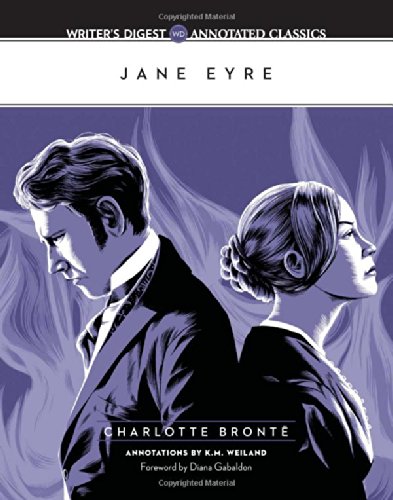
AnnJaneEyreCover

“I am no bird; and no net ensnares me; I am a free human being with an independent will…”

One of the most sweeping and enduring novels in English literature, Charlotte Brontë’s Jane Eyre has become a beloved classic and a must-read for fans of period romance. Filled with memorable characters, witty dialogue, emotional scenes, social commentary, and intriguing twists, Brontë’s novel, written in 1847, still has much to teach writers about crafting exceptional stories.

As part of the Writer’s Digest Annotated Classics series, this edition of Jane Eyre features hundreds of insightful annotations from writing instructor and author K.M. Weiland. Explore the craft and technique of Jane Eyre through the lens of a writer, and learn why and how Brontë made the choices she did while writing her iconic novel. The techniques learned from the annotations and accompanying study guide will aid in the crafting of your own celebrated works of fiction.

My thoughts:

I’ve read Jane Eyre a couple of times, once in high school and once in university, but I’ve never read it as a writer.

Weiland’s annotations were an eye-opener.

Initially, I considered a couple of what I saw as lapses on Weiland’s part to be creative or editorial decisions, and there is an element of that present. What I was amazed to discover is that Weiland’s annotative decisions are artful, or perhaps I should say crafty, in a way I never expected.

Very quickly, her annotations have the effect of tuning the reading writer’s eye to Brontë’s creativity and craft. The reader begins to pick out additional examples of the same techniques as they occur, and may even, as I did, page back through the book to see where Brontë employed the same technique in the past and to what effect.

Jane Eyre: Writer’s Digest Annotated Classics is not only a writing craft book, but an instructional manual on how to read critically, as a writer.

Under Weiland’s ever-gentle guidance, the reading writer learns that analyzing a text for craft does not have to be a negative experience nor even an academic one.

Those of us who suffered through textual dissection in university will be grateful to Weiland for showing us, in the best authorial sense, that analysis can be fun, and even exciting, as our minds race back to our own works-in-progress to apply lessons learned.

On that subject, the worksheets in the back are, in my opinion, worth the price of the book. Covering setting, character development, structure, indeed, every aspect of writing a novel, Weiland asks questions, assigns tasks, and refers back to Brontë’s work if we need a little help figuring out how to apply the technique in our writing.

This is a top-notch writing craft book and a spectacular start to a new series for Writer’s Digest. Diana Gabaldon’s introduction doesn’t hurt either 😉

My highest recommendation.

My rating:

Five out of five stars.

About the Author:
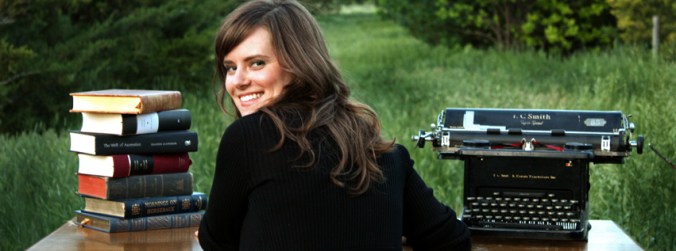
KMWeilandLooking-Back

K.M. Weiland is the internationally published author of the Amazon bestsellers Outlining Your Novel and Structuring Your Novel, as well as the western A Man Called Outlaw, the medieval epic Behold the Dawn, and the fantasy Dreamlander. When she’s not making things up, she’s busy mentoring other authors through her award-winning blog HelpingWritersBecomeAuthors.com.